What does a homeowner do when the furnace dies on a freezing evening? They pick up the phone and type "furnace repair near me" or "AC repair brooklyn." The rest of this article is about those few seconds: the company that shows up on the screen gets the call, and the one that does not might as well not exist. SEO for HVAC, furnace and AC repair companies is the work that puts your name on that screen. I am Ümit Kırkoç, and I work from Istanbul as a single person who handles websites, local search visibility and ads together. In this article I explain how a heating and cooling company gets found on Google, which pages it needs, and where to begin. For the wider picture, you can also look at what my SEO services cover.
SEO, in short, is the work that makes your website and your business listing appear when customers search. The difference from advertising is simple: with ads you pay for every click and you vanish when you stop paying, while the groundwork you lay with SEO keeps bringing in calls for months. But in the heating and cooling trade this groundwork has its own rules, because the nature of the work is different from most other businesses.
Why do HVAC searches work differently from other industries?
People take days to choose an attorney or a dentist. When the furnace quits on a cold night, the decision window is measured in minutes. The person searching does not want to read long articles, collect references or build a comparison chart. They want someone nearby, who answers the phone, and who looks trustworthy.
Cooling is a little more balanced, but still unusual. A dead air conditioner during a heat wave is an emergency. Buying a new system, scheduling an installation or booking a yearly tune-up is a planned decision. So the same company serves two very different people on the same day: one is panicking, the other is researching. You cannot answer both with the same page.
Four features shape SEO in this trade.
First, searches are extremely local. People rarely stop at "AC repair." They add a city, a neighborhood or a brand: "furnace repair evanston," "mini split installation near me," "boiler service queens." Google usually answers these searches with a map and nearby businesses at the top.
Second, the season decides everything. Heating searches climb with the first cold snap in fall, and cooling searches begin in late spring. A plan made without knowing this rhythm either misses the opportunity or burns money after the season is over.
Third, trust is everything. The customer is about to let a stranger into the house. They want to see that the business on the screen has a real address, real reviews and a phone that a human answers.
Fourth, many people search by describing the problem: "furnace blowing cold air," "AC leaking water," "boiler losing pressure." These searches carry both a wish to learn and a wish to hire, and if you handle them well they bring you work.
The illustration below is a made-up example of how one such search might look.
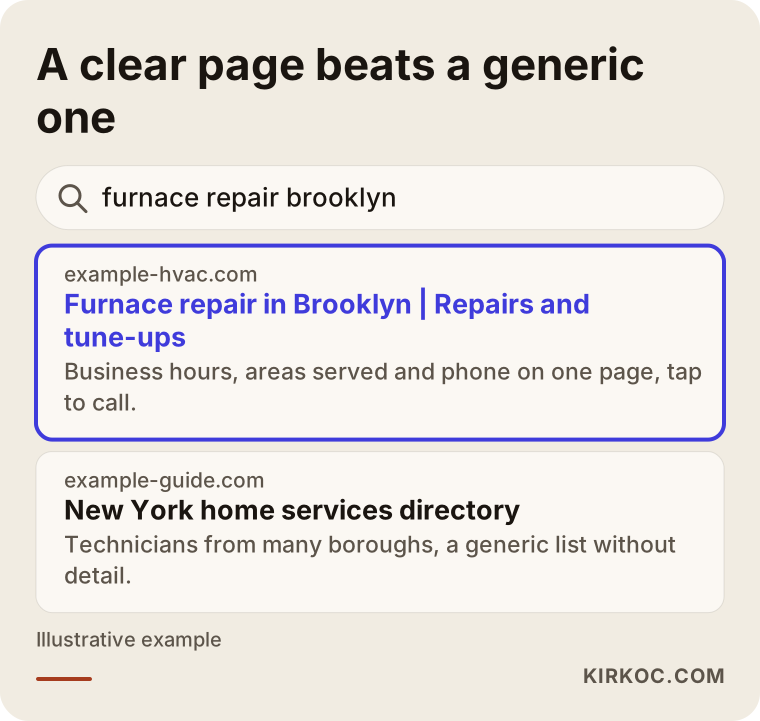
The highlighted result wins because it names the area and the service in its first line and does not hide its hours or its phone number. A generic home services directory cannot do this. It has no technician who will arrive quickly, and it does not know your neighborhood.
Which words do customers use to find you?
The most important job before any SEO work is to understand what people actually type. The technical words you use every day are often not the words your customers use. You say "preventive maintenance," the customer types "furnace cleaning." You say "ductless split system installation," the customer says "put in a mini split."
Sorting searches by intent into four groups makes your work much easier.
The first group is urgent breakdown searches: "furnace not working," "no heat," "AC not cooling." This person has little patience and calls right away. The second group is maintenance searches: "annual furnace tune-up," "AC refrigerant recharge." This person plans ahead and compares a little. The third group is installation and replacement searches: "new AC installation," "furnace replacement." The amount is large and the decision is slow. The fourth group is information searches: "why does my boiler lose pressure," "how often should an AC be serviced." This person is not a customer yet, but if they find a good answer on your site, they may call you later.
The table below sums up the four groups and the kind of page each one needs.
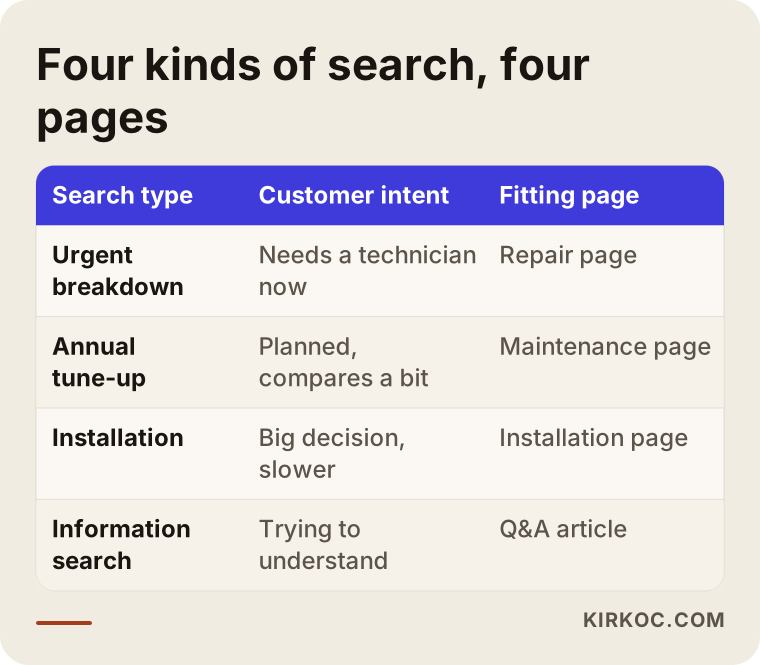
The conclusion is clear: each intent needs its own page. If you squeeze everything onto one home page, the visitor cannot find what they came for, and Google cannot tell which search you should be shown for.
Brand, city and problem combinations
There is also the matter of combinations. "HVAC repair" alone is very broad and very competitive. As you add a brand, a city and a problem, the search narrows and the competition thins out. Someone typing "Carrier furnace repair in Plano" arrives with a very clear need, and that person is worth far more to a service business. Be careful with brand names: if you are not an authorized dealer or factory-certified servicer for a brand, say so plainly. That is honest, and it also sets the customer's expectations correctly. If you are unsure how you may use a manufacturer's name or logo, ask an attorney.
Which pages should an HVAC company's website have?
Most small service companies have a one-page site or three to five generic pages: home, about, contact. That structure tells a search engine "I do everything" and then stands out for nothing. A stronger structure is a separate page for every main service and for every area you cover.
A basic list could look like this: a furnace and boiler repair page, a heating tune-up page, a furnace replacement and installation page, an AC installation page, an AC maintenance and refrigerant page, and an AC repair page. On top of that, you can add a separate page for each city or neighborhood you serve. There is a thin line here, though. If you copy the same text and only swap the city name, it does not work, and it can even hurt. Every area page needs some real information that is specific to that place.
The picture below shows one possible layout for an area page.
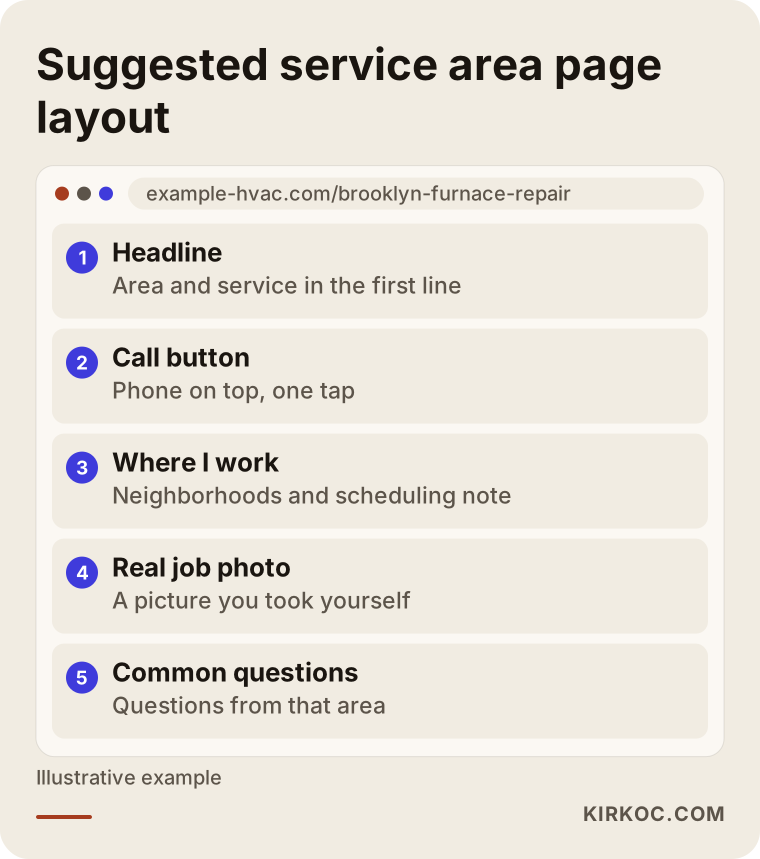
The logic is simple. A visitor should understand within a glance that they are in the right place, then find the answer to their own question, and finally be able to call without effort. The phone number belongs at the top and at the bottom of the page, and it should be tappable. Do not expect someone on a phone to copy the number and paste it somewhere else. One tap should place the call.
What do you actually write on an area page?
Filling an area page with padding is easy, and it is worthless. Instead, describe how the work goes in that area. For example, in a neighborhood of older houses you may often see aging boilers and radiators, while in a newer subdivision you may mostly install high-efficiency furnaces and central air. Write which neighborhoods you drive to, how you schedule visits, how long typical repairs take and what your pricing depends on. You do not have to give numbers, but explaining what makes a price go up or down puts the reader at ease.
Photos matter too. Real pictures from your own jobs build far more trust than stock images. Even a photo of a technician at work in front of your van, supported by one honest sentence, is convincing. Make sure no customer details, house numbers or license plates are visible in the picture.
Your Google business profile: the storefront of a service company
Many people searching for a furnace or AC technician never visit a website at all. They search straight from the map. The box that appears on the map is called a Google Business Profile, which is your free business listing on Google. For service companies this listing often brings more phone calls than the website does, so it deserves careful setup.
One point is important here: most HVAC companies travel to the customer, and customers do not come to a shop. For businesses like this, Google offers a "service area" setting. You do not have to show your address to everyone, but you must choose the areas you serve correctly. Adding towns you do not really drive to may look attractive in the short term, but when a customer calls and hears "we don't come out there," you lose time and you invite bad reviews.
The checklist below gathers the basic items a service profile should have.
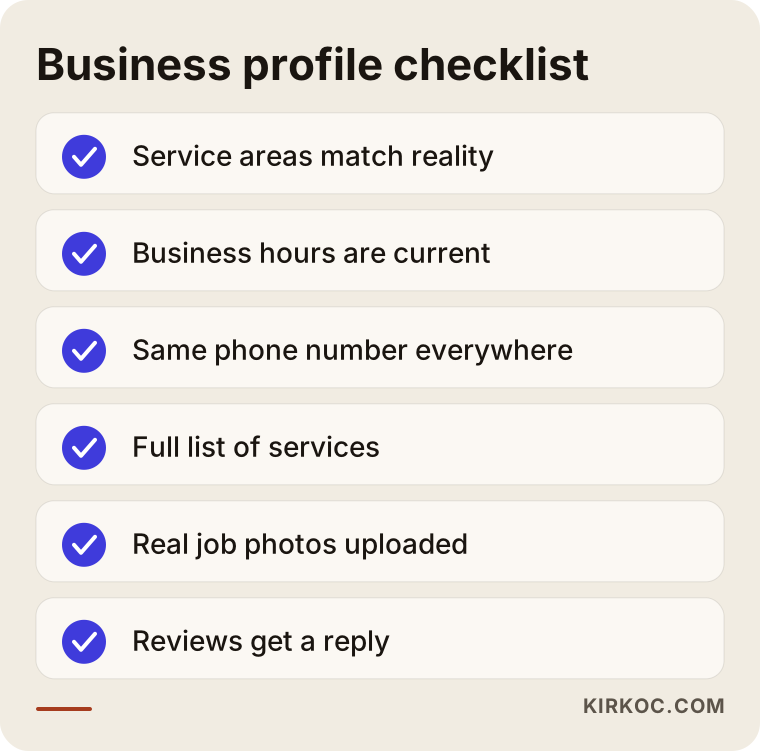
Every item looks simple, but most companies leave one or two undone. The most common gap is business hours that are out of date. If your profile says "24/7" and nobody answers at night, you have opened the shortest road to a bad review. Write hours you can keep, and promise a call back for the times you cannot pick up.
Reviews: how to ask, how to reply
The number and quality of reviews are among the deciding factors when someone picks a technician. But buying reviews or writing them from fake accounts goes against Google's rules, and a profile can suffer if it is noticed. The right way is to send satisfied customers a short message with the link after the job is done and ask politely. Answer every review, positive or negative, briefly and respectfully. A reply to a negative review that offers a solution instead of getting defensive tells everyone else who reads it something good about you.
Two hypothetical example scenarios
To make this concrete, here are two example scenarios. Both are entirely hypothetical and do not describe any real company or person.
Example scenario 1: A small furnace company with a one-page site
Imagine a small heating company run by two technicians in a mid-sized city. Its website is a single page: a logo at the top, a line saying "furnace repair, maintenance, installation" in the middle, and a phone number at the bottom. The Google profile exists but is half finished: no photos, an empty service list and old business hours. The owner has tried ads, but the budget drains quickly and many of the calls come from outside the service area.
The first step is to put order in the basics. The profile is completed, the service areas are limited to the places the technicians really go, and real photos are added. Then three core pages are added to the site: furnace repair, annual furnace tune-up, and furnace replacement and installation. After that come separate pages for the two or three busiest towns, and each one describes the typical homes there, the neighborhoods served and the common questions. The ads are pointed at these pages, so a person who clicks an ad lands on the exact page they were looking for instead of a generic home page.
I would never promise a result, but the logic of this structure is plain: the searcher sees their town and their problem on the page, and Google understands more easily what the page answers. The effect usually begins to show within a few months, especially if the work is finished before fall.
Example scenario 2: An AC installer that missed the summer
In the second scenario, think of a small company that sells and installs air conditioners. Every year, when the heat arrives, the phones start ringing, and every year the owner notices that competitors were already on the map long before. The owner starts preparing the website in May. June comes, and the pages are still half done.
The mistake here is timing. Cooling searches tend to rise in the months when the heat is felt, but a search engine needs weeks, sometimes months, to trust a new page. The better plan is to prepare pages well before the season, in late winter or early spring. During that time you write information pages such as "how long does an AC installation take," "what size air conditioner does a bedroom need" and "what does a yearly tune-up include." When the season arrives, those pages are already indexed, which means Google has already added them to its list.
These two scenarios show different problems: one is a lack of structure, the other a timing error. In real life you often see both together.
The seasonal calendar: what to do when
Seasonality is this trade's biggest advantage and its biggest trap. Competition peaks when the season starts and search volume falls when it ends. To manage the wave, you spread the work across the months.
The timeline below summarizes a year of work by season.
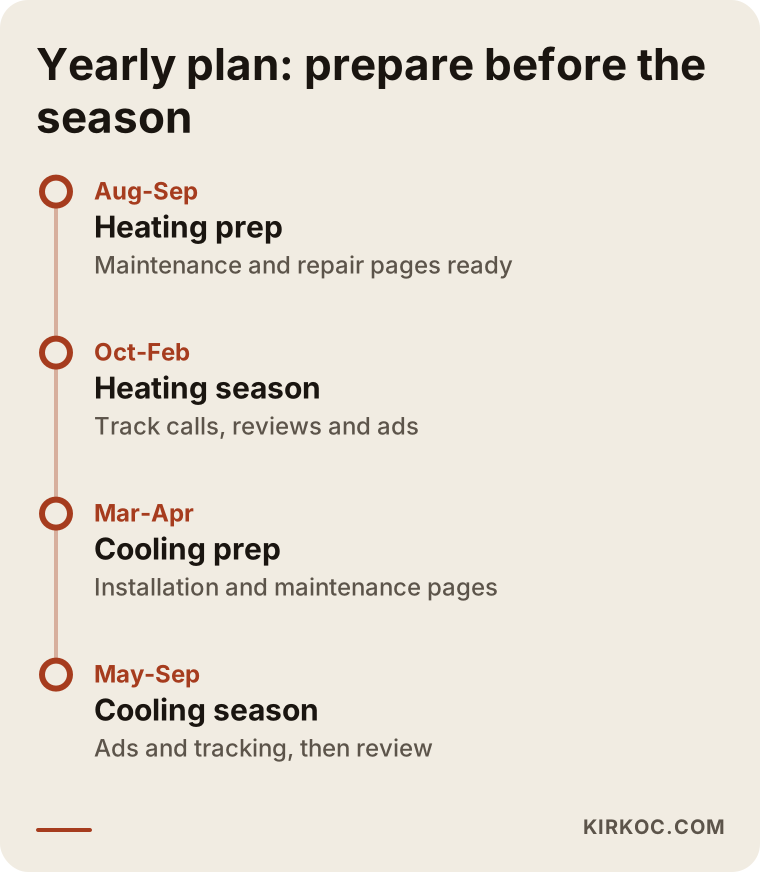
You can read it like this: before the season you prepare the pages and the profile, during the season you focus on phone calls and reviews, and after the season you measure what worked and produce content for next year. Doing it in the reverse order, starting preparation after the season has begun, usually costs you time.
Heating and cooling are two seasons that run opposite to each other, so a company that does both has an advantage. When winter ends, instead of dropping the heating pages you promote a tune-up offer for the equipment; when summer ends, you move to AC maintenance and planning for next year. Keeping the site current with the season, changing the emphasis on the home page and opening the right ad at the right time make a real difference.
A step-by-step process: where to start
If you are building this from scratch, the order matters. Work done in the wrong order has about half the effect of work done in the right order.
The first step is a review. You look at your current site, your business profile and your competitors. You search on a phone and see who comes up first and which pages are on top. The second step is keyword and intent research: in which towns, for which services and with which problem phrases are people finding companies like yours. The third step is fixing the technical base of the profile and the site: the same phone number everywhere, a site that opens fast on mobile, and a tap-to-call button. The fourth step is writing the pages and setting up a review routine, which means a simple habit for asking and replying. The fifth step is measurement and correction.
The picture below shows these steps in a plain flow.
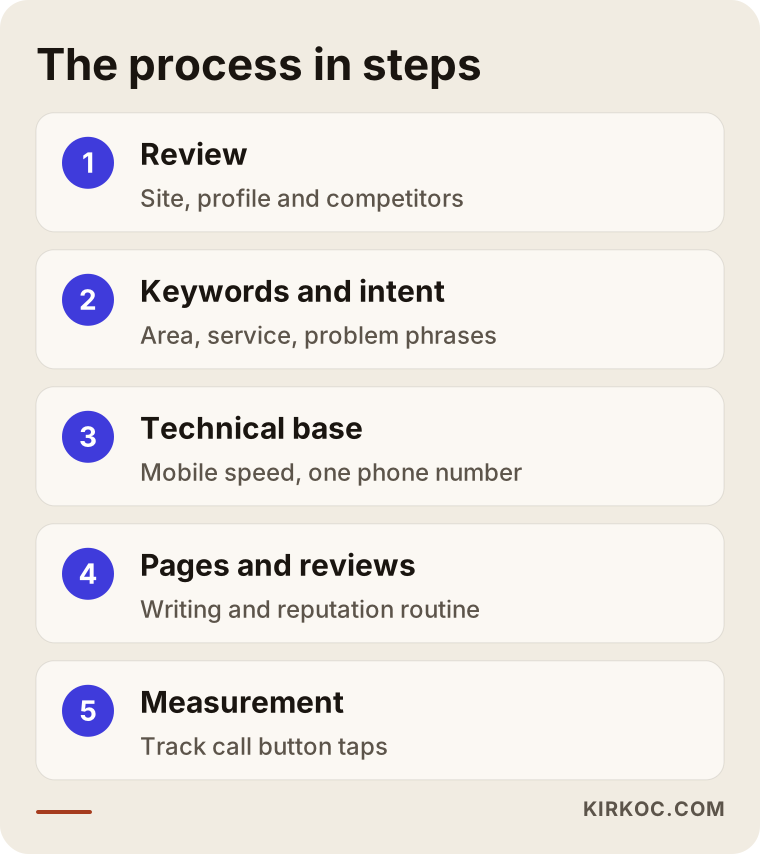
Pay special attention to the measurement step. For a service company, the most important number is how many people phone you. You follow taps on the call button on your site and the call count in your Google profile. Visitor numbers can look nice, but if the phone does not ring, something is missing. Setting up this measurement is a technical task, but once it is in place you can see which page brings work and direct your effort there.
Ads, SEO or both?
For urgent jobs, Google Ads are very strong, because someone typing "emergency furnace repair" needs help at that moment. Ads can make you visible right away, while SEO takes time. For that reason, many service companies are best served by using both: ads give you phone calls now, and SEO slowly reduces your dependence on ads.
But ads have a trap of their own in this trade: the cost per click can rise during the season, and budget melts fast on irrelevant searches. Someone typing "HVAC training course" or "buy furnace parts" is not your customer. So you need to exclude the words you do not want, show ads only in the areas you serve, and schedule ads for the hours when someone can answer the phone. When I manage ads, I set up these three things at the start, because leaks like these usually eat the budget more than anything else.
This is where working with one person has a practical benefit. If the same person writes your site, manages your profile and builds the ads, the page an ad points to matches the message on the site. When different people say different things, the visitor who clicks an ad meets another promise on the site and leaves. If your social media accounts are run under the same roof, content such as maintenance reminders and before-and-after photos can use the same voice on Instagram and on the website.
Common mistakes
Some mistakes appear again and again in this trade. Most are made with innocent intentions, but they can be costly.
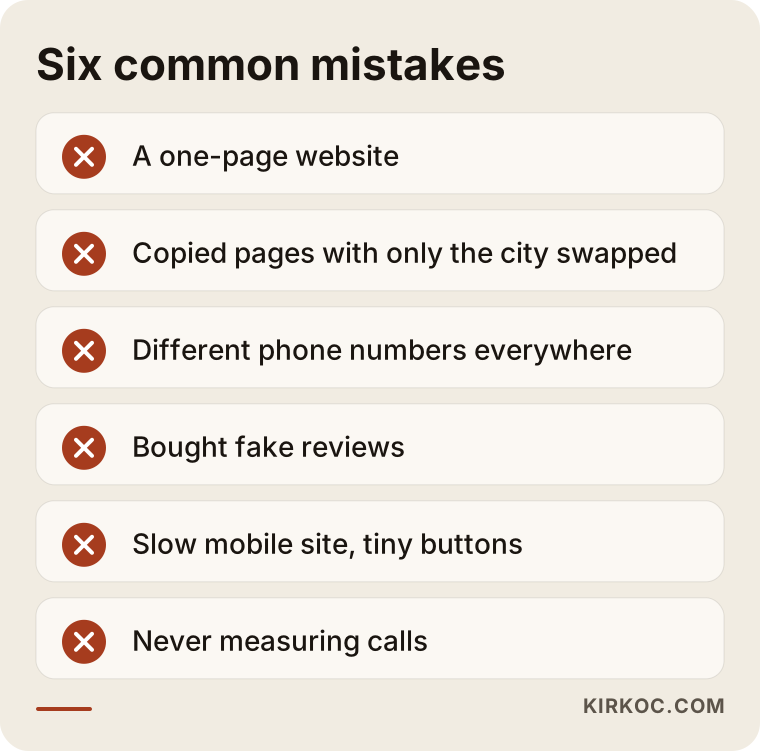
What all these mistakes share is that they fail to put the searcher's needs first. Let me go through a few.
A one-page site is the first and most common. When someone types "AC maintenance in your town" and lands on a generic introduction, they do not find themselves there.
Copying the same text with only the city changed is the second. Google sees such pages as duplicates, and either shows none of them or shows the weakest.
Wrong or inconsistent phone numbers are the third. If one number is on the site, another in the profile and a third on social media, Google gets confused and customers lose confidence.
Fake or purchased reviews are the fourth, and the most dangerous. They look good in the short term, but the profile can be restricted.
Neglecting mobile is the fifth. Nearly everyone searching for a repair does it on a phone. If the page loads slowly or the buttons are tiny, they move on to the next company.
The last mistake is not measuring. SEO done without knowing which search brings calls is shooting in the dark.
AI answers and service companies
People no longer ask only Google. They also ask AI assistants: "My furnace keeps shutting off, what should I do?" or "How often does an AC need service?" These tools produce short answers. To be cited as a source in such answers, your site must contain clear, orderly and trustworthy information. This work is called GEO, short for generative engine optimization: the effort to appear in AI-generated answers.
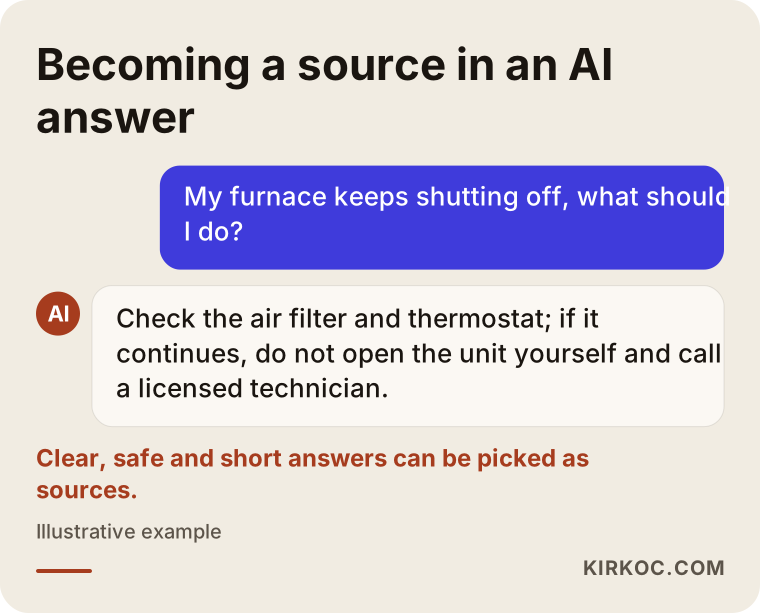
The picture shows that assistants give short, clear answers, but they also choose which sources to rely on. If your site has an open, honest and short answer to a question like "why does a boiler lose pressure," that information can help you on Google and with assistants. I cannot guarantee anything, but giving accurate and organized information is the only solid way to improve your chances in both places.
There is one more point about your answers: safety. Everything you write about gas leaks, carbon monoxide or electrical risk carries responsibility. In such cases, telling the reader "do not try to fix it yourself, call a licensed technician" is both correct and responsible. Before making firm statements about licensing rules or legal obligations, which differ from state to state, it is wise to consult an attorney or your trade association.
What can you do yourself, and when do you need an expert?
You do not have to hand everything to an expert. Some tasks you can do yourself, and some you should, because you know the facts better than anyone.
The things you can do yourself are these: fill in your Google profile and keep it current, take real job photos and upload them, ask satisfied customers for reviews, reply to the reviews that arrive, and write down the questions customers ask most often. None of this needs technical knowledge, only a routine.
The tasks that call for expert help are more technical: building the structure of the site, planning pages around search intent, fixing speed and mobile problems, measuring phone taps, setting up and managing the ad account, and cleaning up information that contradicts itself.
The decision chart below shows roughly what to do in which situation.
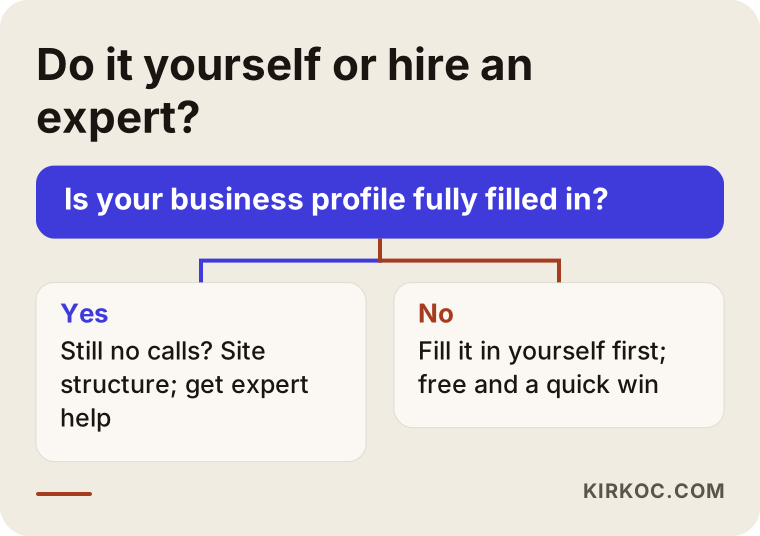
A general rule: if your business profile is empty, fill it in first, because that is the fastest free win. If the profile is complete and the phone still does not ring, the problem is most likely in the structure of the site, and that is where expert help starts to make sense.
What determines the cost
I will not state a price figure, because every business is in a different situation. But I can explain clearly what makes the cost go up or down.
The first factor is the current state of the site. If you already have a working, tidy site, the job is mostly content and adjustment. If you have no site, or an old one, the foundation has to be built first.
The second factor is the number of areas you serve. A company working in three towns and one working in twenty need very different numbers of pages.
The third factor is the range of services. A business that only does furnace tune-ups has a different page count from one that offers furnaces, air conditioning, heat pumps and plumbing together.
The fourth factor is the level of competition. In a crowded market, results take longer, which means a longer period of work.
The fifth factor is the ad budget. The ad budget is a separate item from the management fee and is paid directly to Google. The fee of the person who manages ads and the ad spend itself should not be confused, so be sure to ask about it when you collect quotes.
The sixth factor is continuity. A one-time setup and a monthly ongoing service are different structures. In a seasonal trade, a regular but flexible plan usually makes more sense.
When you collect quotes, look at these things: is it written down clearly what will be done, which deliverables you will get, how you will see the measurement, and what information they expect from you. Stay away from anyone who says "I will put you on the first page." Nobody can guarantee that.
How I work with you
I work as one person, so the person you talk to is also the one who builds the site, sets up the profile and manages the ads. At the start I listen: which areas you drive to, which services pay best, and which hours you can answer the phone. Then I review where things stand and prepare a short, understandable roadmap. I translate technical terms into everyday language and write down what I am doing at each step and why.
Part of the work requires asking you for information and photos, because real job photos and real knowledge of your service area are things I cannot produce. I build the structure, the text, the settings and the measurement, and you supply the truth about the work. When this teamwork goes well, the result is more solid.
When the website, SEO, local search, ads and social media run through the same hands, the pieces fit together. The page an ad points to says the same thing as the site text, the profile details and the social media posts. That leaves the person who calls with the impression: this is an organized company.
Frequently Asked Questions
How long does SEO take to work for a furnace or AC company?
I cannot give an exact time, because the result depends on how competitive your area is, the present state of your site and the quality of the work done. In general, improvements to the Google profile show earlier, and the effect of site pages appears later. That is why it matters to start well before the season.
Is a Google business profile alone enough?
For some searches it may be, especially for people searching from the map. But the profile alone does not replace service and area pages. The profile shows you on the map; the website is where you explain yourself and your work and earn trust. The two complete each other.
Do I need a separate page for every town?
No, but it helps for the towns where you really work and where demand exists. What matters is that each page has real information specific to that place. Copy pages with only the town name swapped do harm instead of good. Start with the few areas where you work the most.
Can I use brand names if I am not an authorized servicer?
Naming the brands you service is useful for readers, but you must say clearly that you are not an authorized servicer. I cannot give a firm opinion on trademark use; if you are unsure, ask an attorney.
Should I run ads or invest in SEO?
If you want urgent, short-term phone calls, ads are faster. If you want to reduce dependence on ads over the long term, you need SEO. For many service companies the most reasonable path is to run both in balance, according to budget.
Is social media useful for a service company?
It does not bring searches directly, but it builds trust. Before-and-after photos, maintenance reminders and short tips make it easier for people who know you to call again. If your time is limited, I suggest this order: profile and website first, social media second.
How do I get more reviews?
The healthiest way is to message a satisfied customer after the job with the link and ask politely. Do not buy reviews, and do not promise a discount in return, because these can harm your profile.
What should I do to appear in AI answers?
Write the common questions on your site with clear, short answers, keep your details consistent everywhere and keep them current. This does not guarantee anything, but it prepares a reliable base for both search engines and assistants.
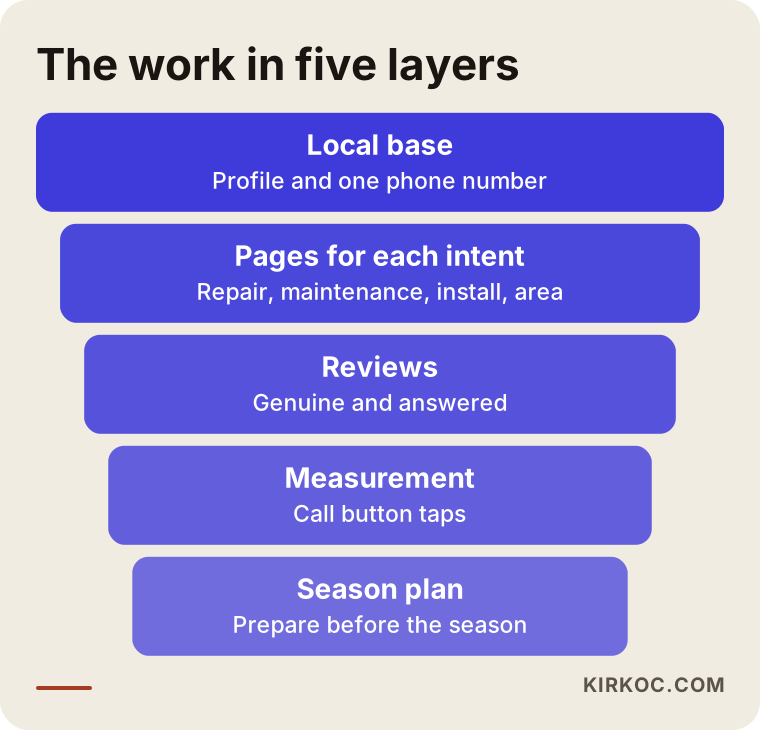
The summary picture above collects the whole article into five layers: first the local base, then pages that fit each intent, then reviews, measurement and the seasonal plan.
If you want to plan your site, your profile and your ads for your heating or cooling company as one job, reach me through my SEO services page. We can look at where you stand now and talk through, in plain language, what to do before the season arrives.