You install roofs, waterproof decks and flat roofs, add insulation, or put up exterior wall systems. You know your trade, your crew is out on job sites, and your reputation travels by word of mouth. Yet your phone mostly rings with people who already know you. Meanwhile, someone with a stain spreading across the ceiling grabs a phone, types "roof leak repair" and calls the first three or four companies on the screen. If your name is not there, that call never happens. A website for a roofing and insulation company exists to close exactly this gap. I am Ümit Kırkoç, and I work alone from Istanbul, handling everything from building the site to getting it found in search. Below I explain what a site in this trade should contain and how to get one made. If you want to see how the whole process works, my website design page covers it.
First, let's talk about why this trade is different from others, because every decision about the site comes from that difference.
Why do roofing and insulation customers search differently?
People look for a salon or a cafe for pleasure. People look for a roofer or insulation contractor because something is wrong. There is a stain on the ceiling, the underside of the balcony is leaking, the heating bill came in high this winter, the basement smells damp. That makes the search urgent and a little anxious. Nobody types a philosophical phrase like "best roofing company." They describe the problem in their own words: "water dripping from ceiling," "flat roof replacement," "deck waterproofing," "exterior wall insulation."
So your site should name the problem, not repeat generic lines like "quality service, fair price." The moment a visitor lands, they should feel "these people understand my problem." Pages that describe the problem and the fix in the visitor's own language create that feeling.
The second difference is trust. Homeowners let a stranger climb to the highest, least visible part of their home. They will only find out whether the job was done properly months later, when the rain comes. Because of that uncertainty, they hunt for signs of trust: real photos, an address, a phone number, an explanation of how the work is done, warranty terms, and straight answers to questions. If your site shows none of this, the visitor moves on to the next company.
The third difference is seasonality and geography. Searches climb when the rainy season begins and after the first leak. Warm months are when people plan exterior wall insulation and deck work. And nobody hires a roofer from another city. People search with place names, like "roof repair in Brooklyn" or "flat roof waterproofing near Tampa." Your site needs to say both what you fix and where you work.
The illustration below shows, in a hypothetical search, how two results can look very different.
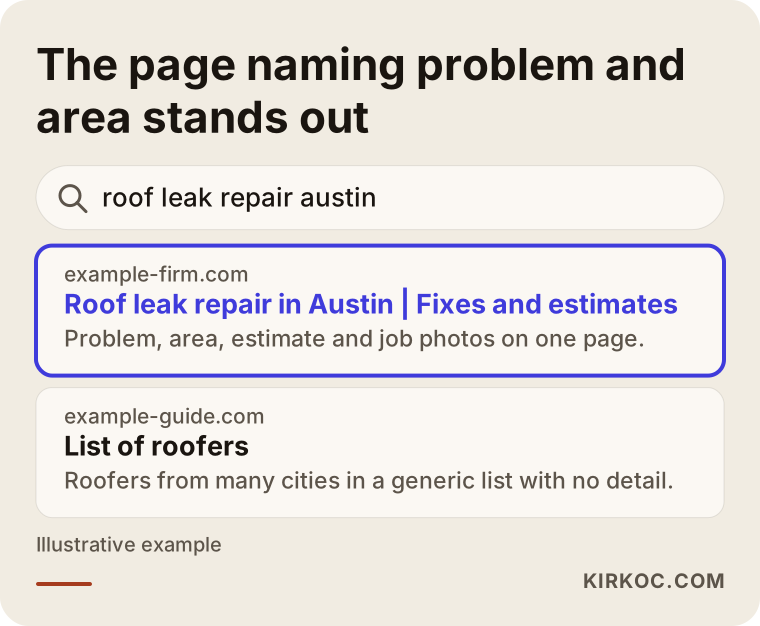
The highlighted result states the area and the problem in the first line and tells you at a glance what the company does. The generic list does not answer the visitor's urgent question. You can create this difference with your own pages.
What do people type, and which page answers which search?
It helps to sort searches in this trade into four groups. Each group needs its own page, because each expects something different.
The first group is urgent problem searches: "roof leaking," "ceiling dripping," "roof repair." This person wants to talk to someone now. They do not need a long article. They need a phone number, the area you cover, and an answer to "when can someone come look at it?"
The second group is job-type searches: "flat roof waterproofing," "roof replacement," "shingle replacement," "membrane roofing." This person is researching a bit and wants to understand the job. A separate service page for each job type works well, explaining how the work is done, when it is needed, and which materials are used.
The third group is area searches: "roofer in Plano," "insulation contractor near Portland." This person wants someone close. A separate page with real information for each town you serve is far more useful than one "we serve everywhere" page.
The fourth group is comparison and curiosity searches: "how long does exterior insulation take," "when should you insulate a roof," "membrane or asphalt." These people have not decided yet but are looking into it. This is where blog posts or a frequently asked questions section fit in.
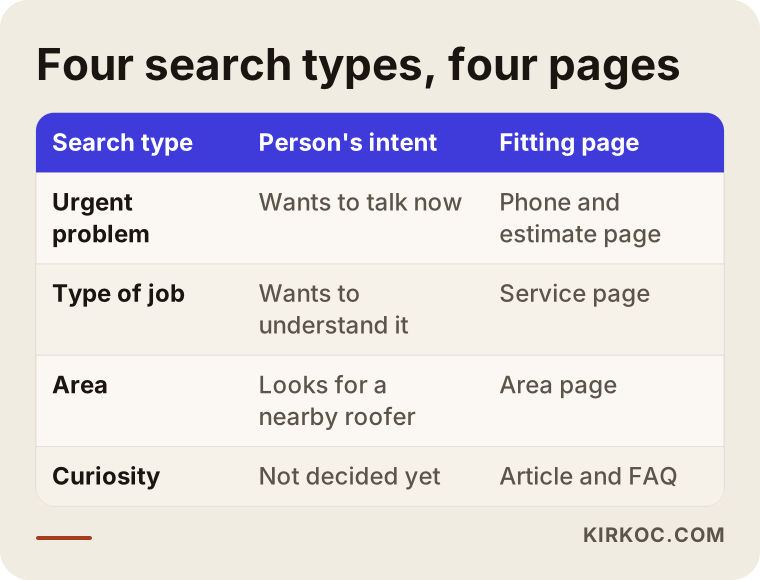
The takeaway from the table is simple: one home page cannot serve all four intents. When each intent has its own page, visitors land in the right place, and Google also understands clearly what your site is about.
Pages your site should have
A roofing and insulation website does not need to be huge, but it needs the right parts. The structure below is enough for most companies.
Home page
The home page is a storefront, but it should not turn into a catalog. At the top, say in one sentence what you do and where. Right below, place a call button and an estimate request form. Then show the three or four jobs you do most, as small cards, each linking to its own page. After that, add a few real job photos, a short introduction of who you are, and your contact details.
Service pages
Roof replacement, deck and flat roof waterproofing, attic insulation, exterior wall insulation, basement dampness solutions: each service gets its own page. Each page should cover what problem the work solves, which signs mean you need it, how the job proceeds, which types of materials are used, roughly how long it takes, and how to request an estimate. You do not have to write a dollar figure, but explaining what the price depends on builds trust. I cover cost in its own section below.
Area pages
Write short but genuine pages for the towns or neighborhoods you serve. Copying the same text and swapping the place name does not work: search engines see it as duplication and readers notice. Add real elements, such as the kinds of jobs you do there, your observations about local buildings (apartment roofs, detached houses, older homes), and how your estimate visits are scheduled.
Past work page
The strongest persuasion tool in roofing and insulation is before and after. Make a short card for each project: where, what the problem was, what was done, how long it took, which material was used. Tell the story with photos you have permission to use, without sharing the customer's name, address, or face.
FAQ and contact
The questions in people's heads in this trade are clear: "is the estimate free," "do you offer a warranty," "can you work in wet weather," "can we stay in the house during the work." Answering them openly saves you from repeating the same phone conversations. The contact page should have your address, phone, working hours, and a map, plus a call button visible on every page.
The diagram below shows how a service page can be arranged from top to bottom.
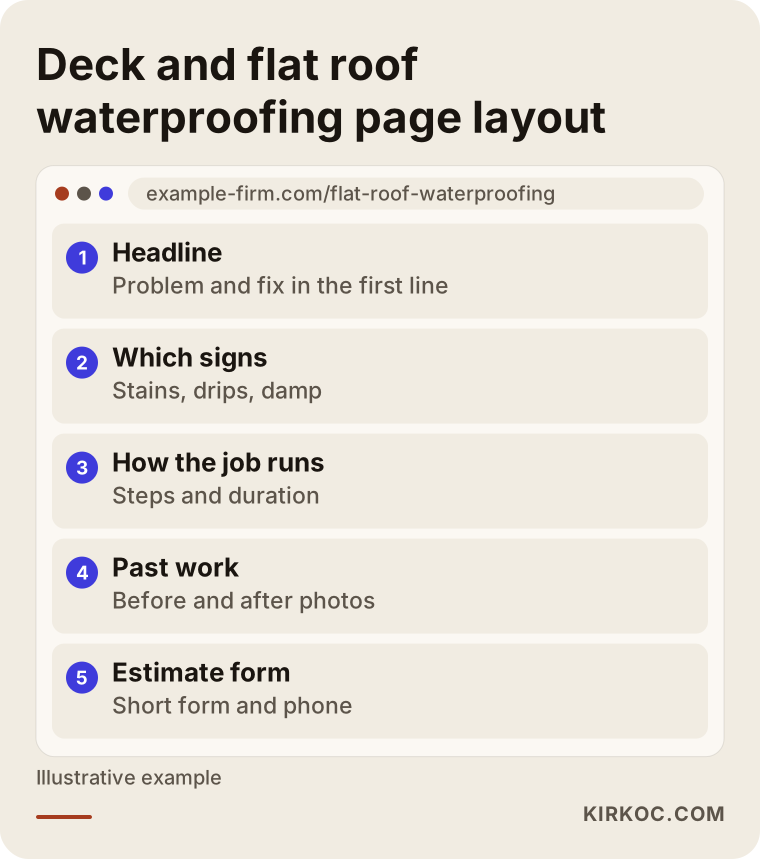
The logic is this: the visitor first sees the problem, then the solution, then the proof, and finally the way to reach you. At no step do they wonder "so what do I do now?"
Photos: the most valuable part of a site in this trade
Roofing and insulation is visual work. The before and after of a roof, how a membrane is laid on a deck, how insulation looks on a wall: these tell people far more than words. Stock photos hurt you here, because people can tell when they are looking at someone else's roof and not yours.
Build a habit on site: take photos before the job starts, while it is in progress, and when it is finished, from the same angle. A phone camera is enough. What matters is good light, the same angle, and a tidy archive. Before using photos on the site, crop out anything that reveals an address, a license plate, or a customer's identity.
Heavy photos are also a problem. Files straight from a phone, several megabytes each, slow a page down, and a person on a weak mobile connection leaves before it opens. Shrinking and uploading photos properly is the job of whoever builds your site. You only need to shoot consistently.
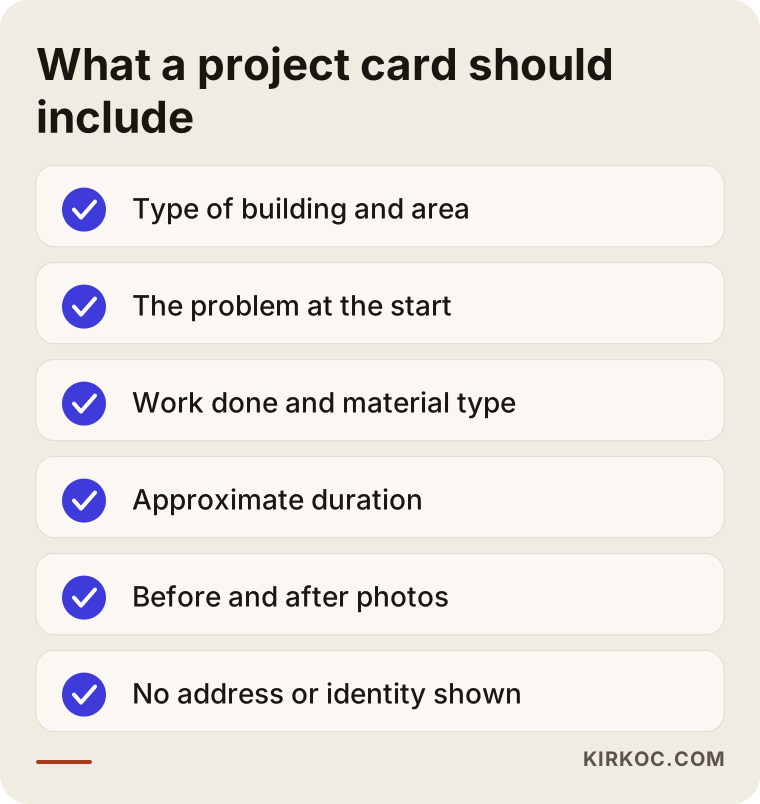
Every item on the list answers a question in the visitor's mind. When you gather these on a project card, the card works like a small reference letter.
Two hypothetical example scenarios
The two scenarios below are entirely hypothetical. They do not describe any real company or person. Their purpose is to show how the gap between two companies doing the same work can appear on their websites.
Scenario 1: A one-page site
Suppose a roofing company has a one-page site that was made years ago. The page has a long list reading "Roofing, insulation, exterior walls, painting, remodeling," a few stock photos, and a phone number. No job is described, and no area is given. On a rainy weekend, when someone with a leaking ceiling types "roof repair" on their phone, this site either does not show up or, if it does, the visitor cannot tell what they are looking at. "Does this guy do roofs or remodeling?" they wonder, and go back. The company concludes that the site does not work, that jobs only come from people they know, and stops investing in it.
Scenario 2: A site built around problems
Now suppose a second company doing the same work. It built its site around one focus: roof repair and deck waterproofing first, other services after. It has a separate page for each job, a separate area page for each of the three towns it serves, real job photos on every page, and a short estimate form. The pages carry clear answers to questions like "what should you do when a ceiling stain starts" and "what to check on a roof before the rains." On the same rainy weekend, the person who writes the problem in their own words lands on this site, finds the answer, and fills out the form. There is no guarantee, of course, but this company is at least visible and in a position to earn trust.
The comparison below summarizes the difference between the two hypothetical sites in short points.
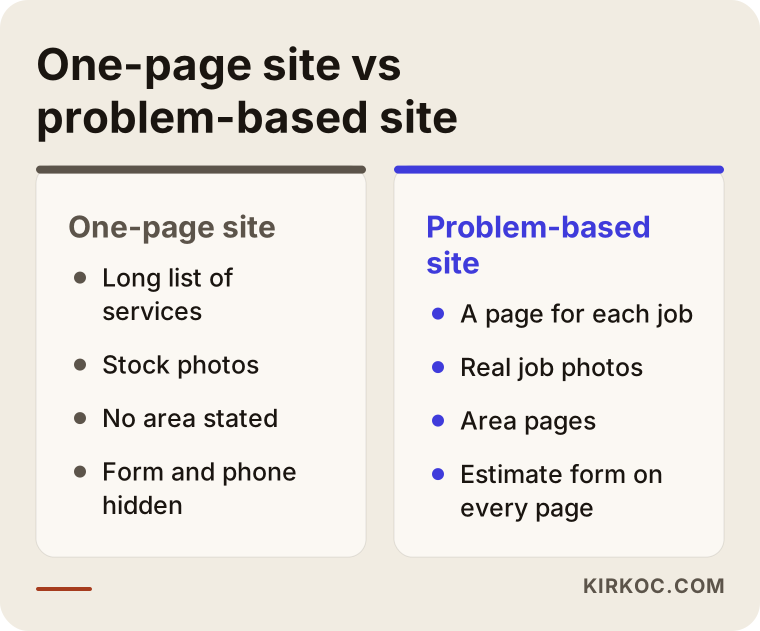
The difference between the two scenarios is not talent. It is whether the site answers the customer's question.
Step by step: how do you build the site?
Here is the usual order of work, whether you work with me or with someone else. First you get clear on the business, then you plan and build the site.
1. Decide which jobs earn your money
You may be able to do everything, but giving everything equal weight on the site does not work. Decide which two or three jobs earn you the most, which your crew does best, and which you enjoy. The site is built around those. Other services can sit in the background as "other work we do."
2. Define your service area
Which towns or counties do you really travel to? If you list too wide an area, your credibility drops and you end up answering requests from places you will not go. A realistic list also helps you build the right pages.
3. Draw up the page plan
Write down on paper which service pages, area pages, project cards, and questions there will be. This plan is the backbone of the site and should be done before any writing begins.
4. Gather text and photos
Whoever builds the site will ask you questions, and you explain how you do the work, why you choose a given material, and which mistakes you often see. That information is the real content of the site. At this stage I usually prefer talking over writing, because tradespeople's knowledge often lives in speech before it lives on paper.
5. Build the site and test it on a phone
A roofing customer often calls from a phone, sometimes in the rain, umbrella in hand. The site must open quickly on a phone, the call button must be one tap away, and the form must be short. Checking only on a computer is not enough.
6. Publish, measure, improve
After launch, you look at how many people view the form, which pages bring calls, and which questions keep coming up. Small corrections in the first months often make the biggest difference.
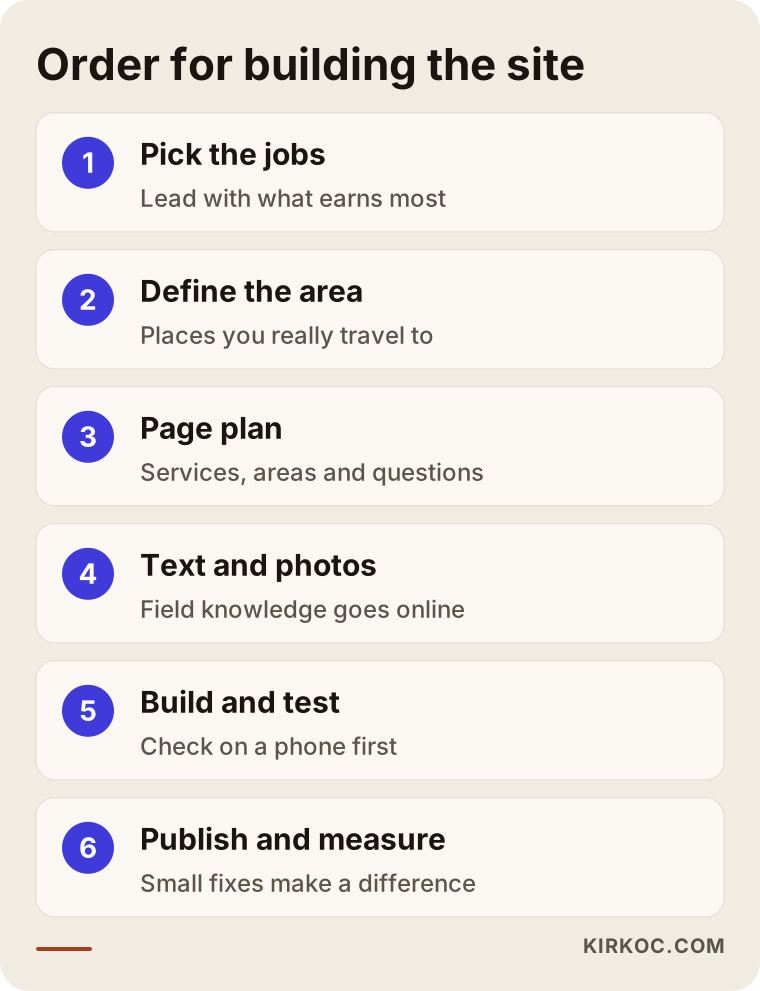
The order matters. Starting to build before gathering text and photos means redoing everything later.
The estimate form: the part that turns visitors into calls
In roofing and insulation, most jobs begin with an estimate visit. That makes the "request an estimate" button the most important button on the site. But the longer a form gets, the less likely people are to finish it. Limit it to four or five fields: name, phone, town, type of job, and an optional photo upload. A photo upload, especially for leaks, lets you form a first impression before the visit and can save you an unnecessary trip.
Next to the form, put your phone number and, if you use one, a messaging app button. Some people never fill out forms and just call. Others are somewhere they cannot talk and prefer to type. Keep both paths open.
Answering form messages quickly matters as much as the site itself. A person with an urgent leak may have sent the same message to three companies. The company that replies first and offers a clear estimate time often has the advantage. I cannot guarantee that, but in my experience a fast, calm reply builds trust.
How do you show trust on the site?
In this trade, "trust" cannot stay abstract. People measure it with concrete signs. These are worth having on your site:
- A real about section covering your company and your crew. Say who you are, how many years you have done this work, and what kinds of buildings you work on.
- A section that spells out warranty terms. State what is covered, how long it lasts, and how to make a claim. Do not overstate the coverage; you must be able to honor what you write.
- Real before and after photos of the work.
- Customer reviews. Use only real reviews and ones you have permission to share. Linking the reviews on your Google business profile to the site is a good way to do it.
- Transparent information about materials. You can explain which brand or type of product is chosen in which situation.
- Care on permits and rules. Permits for things like shared roofs, common areas, or exterior changes can vary from place to place. For such questions, it is more honest to write "check with your building management and, if needed, an attorney or licensed professional" than to state firm rules.
The critical point is that your site must promise only what you can deliver on the job. One exaggerated sentence can put you in a tough spot the first time someone complains.
Local visibility: map results and your business profile
Most roofing and insulation searches are local, so Google's map results matter a lot. Someone typing "roofer" on a phone often sees the businesses marked on a map first. For that, your Google business profile needs to be complete: the right category, service areas, phone, hours, real job photos, and reviews.
The site and the profile support each other. The name, address, and phone number on the profile should match the site exactly. Embedding a map on your contact page helps visitors and keeps things consistent. Do not try to inflate reviews artificially; politely asking a satisfied customer for a review when the job is done is enough and safe.
A note here: no one can guarantee a ranking in local results. The number of competitors, your area, the age of your profile, and your reviews all affect the outcome. The honest approach is to lay the right foundation and check how it performs over time.
A seasonal calendar: what to be ready for and when
Roofing and insulation work follows the seasons, and the content of the site can follow them too. The calendar below gives a general idea that can vary by region.
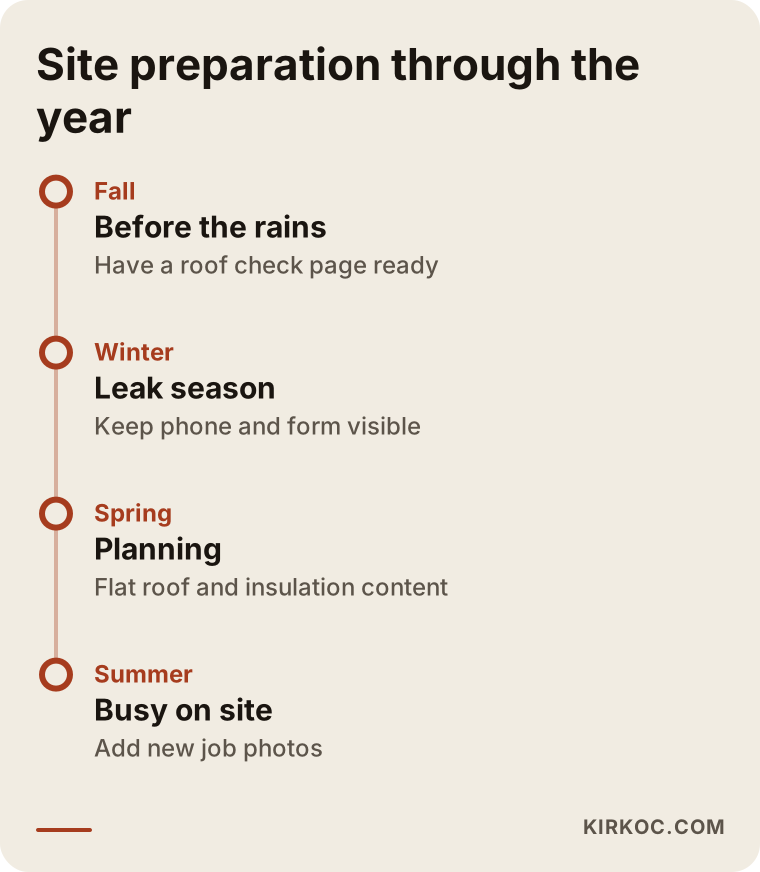
The core idea: a page or post like "pre-rain roof check" prepared before the wet season finds you ready when the first leak arrives. In early summer, content about exterior wall insulation and deck work can come forward. Planning this seasonal rhythm at the start of the year is much easier than scrambling to produce content later.
Common mistakes
Websites in this trade tend to stumble in the same few places. Knowing them lets you avoid them from the start.
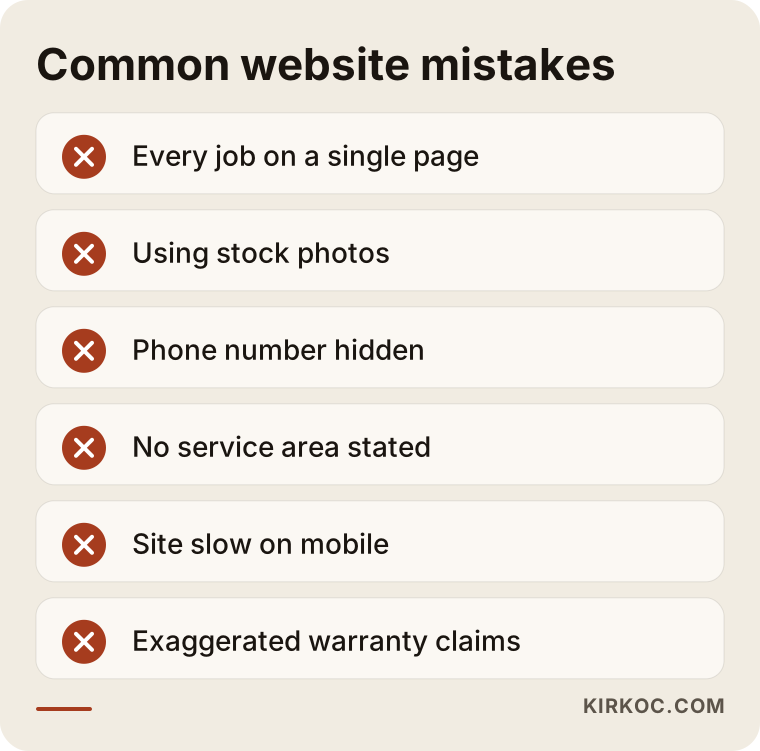
Let's look at each one briefly.
The first is describing every job on one page. When roofing, insulation, painting, and remodeling share one list, none of them stands out. The second is using stock photos; people want to see the real work. The third is burying the phone number inside an image or at the very bottom of the page; a person in an emergency should not have to hunt for it. The fourth is not naming a service area; someone who says "we serve everywhere" is not clear anywhere. The fifth is a site that looks broken or loads slowly on mobile. The sixth is writing warranty sentences that do not exist or are exaggerated. The seventh is building the site once and forgetting it; photos age, details change, and new jobs never get added.
One more mistake I see often is dumping every material and technical term into the site text. A long paragraph reading "polyurethane, bituminous membrane, EPS, XPS" tells an ordinary homeowner nothing. If you use a term, explain it in a sentence: "A membrane is a waterproof layer laid over a roof or deck." That way you are understood, and you also earn trust by looking knowledgeable.
What can you do yourself, and when do you need an expert?
You do not have to hand everything to a specialist. Doing some of it yourself lowers the cost and makes the site more real.
Things you can do yourself: taking photos regularly on site, keeping project notes, writing down the questions customers ask often, keeping your Google business profile current, asking satisfied customers for reviews, and replying quickly to messages. These are habits, not technical skills, and they are the raw material that feeds the site.
Things that need expert help: planning the page structure, technical setup and speed tuning, adjustments that improve visibility in search, setting up the form and measurement, local search work, and, if needed, ad management. Doing these with half-knowledge can lead to mistakes that are hard to fix later.
The decision chart below sketches a rough frame for whether to do it yourself or get help.
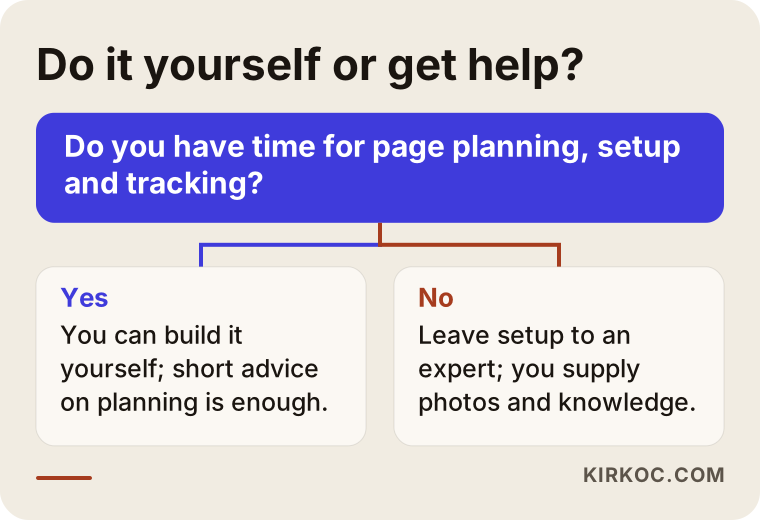
If your answer to the question in the chart is unclear, a short conversation is usually enough to get an opinion. Every conversation does not have to mean a purchase.
How does a site produce jobs? A visitor's journey
To tell whether a site is working, think through the visitor's journey step by step. Many people see you in search, some click, fewer read the page, and fewer still move to the form or the phone. A narrowing at each stage is natural. The job is to manage that narrowing with as little loss as possible.
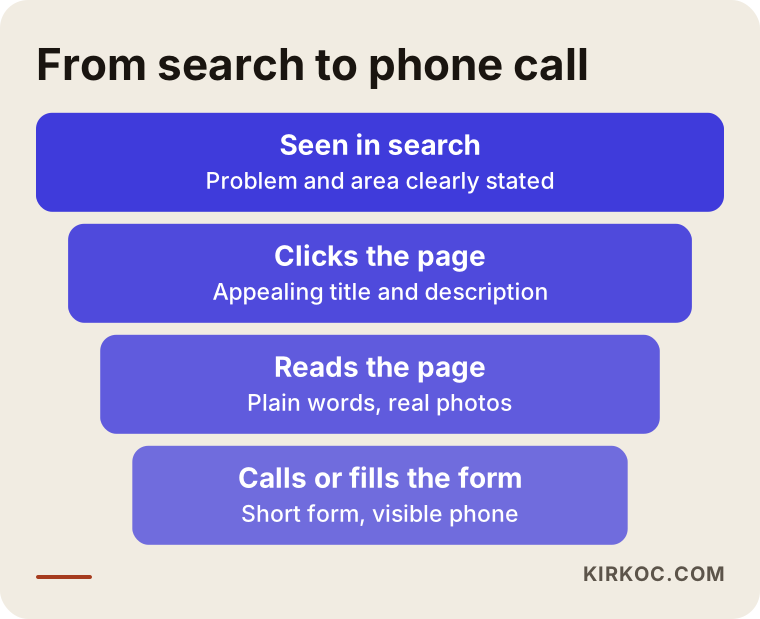
A different task matches each layer of the funnel. To appear in search, you need page structure and a local profile. To earn the click, a good title and description. To get the page read, clear and plain writing. To get contact, a short form and a visible phone number. Saying "the site doesn't work" without knowing which layer is blocked is misleading. Sometimes the problem is visibility, and sometimes it is one vague sentence on a page.
I would add one more thing: in roofing and insulation, the decision rarely ends in a day. A person notices the leak, researches for a few days, talks to a couple of companies, and then decides. So it matters that your site is recognizable when the person comes back, meaning your phone number and name are presented in a way that sticks.
What determines the cost?
I am not giving figures in this article, because the cost of a site for a roofing and insulation company changes a lot with the scope of the work. It is more useful to explain what it depends on.
The first factor is the number of pages. A site with five service pages is not the same job as a site with fifteen services and six area pages. The second is who prepares the content; if you bring the photos, text, and project cards, it goes faster, and if I need to prepare them from scratch, it takes longer. The third is the level of customization: starting from a ready-made structure takes different effort than building a custom layout from the ground up. The fourth is extras, such as estimate form automation, more than one language, calendar or booking integration, and measurement setup. The fifth is what happens after launch: monthly updates, new pages, search visibility work, and ad management are separate items.
There is also an indirect cost: a badly built site ends up more expensive than a well built one, because fixing it later usually takes longer than doing it right the first time. When you collect quotes, ask for the scope in writing: how many pages, which pages, who prepares what, when it is delivered, and how much support follows delivery.
How I work
I work alone from Istanbul, and I handle the website, search visibility, local search, social media, Google and Meta ads, logo, and content myself. For small and mid-sized companies such as roofing and insulation firms, this is a practical advantage: the service listed on the site, the service on the business profile, the job photo shared on social media, and the line in the ad all speak the same language. When different people run these without knowing what the others are doing, inconsistency creeps in. When one person runs everything, you explain a fact once.
My way of working is simple. First, a short conversation where I listen to your business, your area, and your goal. Then I draw up the page plan and bring it to you for approval. I take photos and details from you and write the text based on how you describe the work. When the site is ready, we test it together on a phone and a computer, and then publish. If you like, I continue afterward with small monthly updates, new job photos, and added pages; if not, I hand the site over to you. I do not promise results, but I explain what I am doing and why at every step.
Frequently Asked Questions
Does a roofing and insulation company really need a website?
If you get enough work through referrals, it may not be urgent. But if you want to expand into a new area, reach customers beyond referrals, or keep work flowing in the slower months, a site that people can find in search makes things much easier. Also, a person who hears about you from a friend will often look you up online, and a decent site there raises their confidence.
Will my site rank first on Google?
No one can guarantee that. Many things affect ranking: how many competitors you have, your area, the age of your site, the quality of the content, and the state of your business profile. What I can do is build your site so that it clearly explains the searched-for terms and your area, and then watch how it appears over time and improve it.
Do I need a separate page for each town?
For towns where you really work and can say something specific about the area, yes, it helps. I do not recommend copying the same text and just changing the town name. Start with the three or four areas where you do the most work, then expand as needed.
Should I put prices on the site?
In roofing and insulation, the price depends on the size of the surface, the current condition, the material, and safety requirements, so a fixed price is often misleading. Instead, explain what determines the price and offer an easy way to request an estimate. Visitors read that as honesty.
Can I build the site myself with WordPress?
Technically yes, and many people do. But in this trade the real challenge is not using the tool. It is structuring the pages correctly, making them fast on mobile, setting up the form and measurement, and making sure the site shows up clearly in search. If your time goes to the job site, handing this to an expert can save you time overall. You could also have a single planning session and do the build yourself.
Do I need social media and ads?
Starting with the site makes sense; social media and ads can be added on top. Sharing your job photos on Instagram or Facebook builds trust. Ads can be considered for quick results, especially in periods when demand rises, like the rainy season. Both are planned separately according to your budget and goal.
What should I do after the site is built?
Four habits matter most: send photos of new jobs regularly, reply quickly to incoming forms, keep your business profile current, and ask satisfied customers for reviews. Adding a new page or post to match the season helps too. A site is not a brochure you print once and leave; it is a business tool that needs steady feeding.
Who do I contact if I have a problem?
If you work with me, I am your only contact. You do not have to pass messages between separate people for the site, search visibility, and ads. I make clear in writing, at the start, what support is included after delivery.
If you would like to talk through what kind of site your roofing or insulation company needs, reach out through my website design page. I will listen to your business and explain a suitable plan in plain language.