If the phone rings at your rug cleaning business, that is usually a good sign. But if you do not know who is calling or where they found you, your growth is left to luck. Picture a customer looking at the living room rug one evening and thinking, "This really needs to be cleaned." They pick up their phone, type a few words into a search box, and call one of the first three or four businesses that appear. A rug cleaning website decides whether you are one of those few. This article explains how to turn your business into a site that actually brings in orders, which pages you need, and how online ordering works in this particular trade. If you are starting from scratch, you can also look at the details of my website design service.
I am Ümit Kırkoç, and I work from Istanbul. I handle websites, search visibility, social media and ads for small businesses myself, all in one place. In this article I will keep the jargon low and focus on the decisions a rug cleaning owner really has to make.
How do rug cleaning customers search for you?
Rug cleaning is not a service people compare for hours like a big purchase. It usually starts with an urgent need: a child spilled something, guests are coming, a holiday is near, someone is moving, or the season changed. So people run short searches that are tied to a place. Someone who types "rug cleaning" plus their neighborhood, someone who types "pickup and delivery," and someone who asks "how do you wash a wool rug" are all searching with different intentions.
That difference matters, because your site should not give all of them the same answer. Some visitors only want information and are not ready to buy. Others already have the phone in hand and will call the first business that looks trustworthy. Your job is to give the second group a fast, clear answer, and to leave the first group with the impression that you know this work.
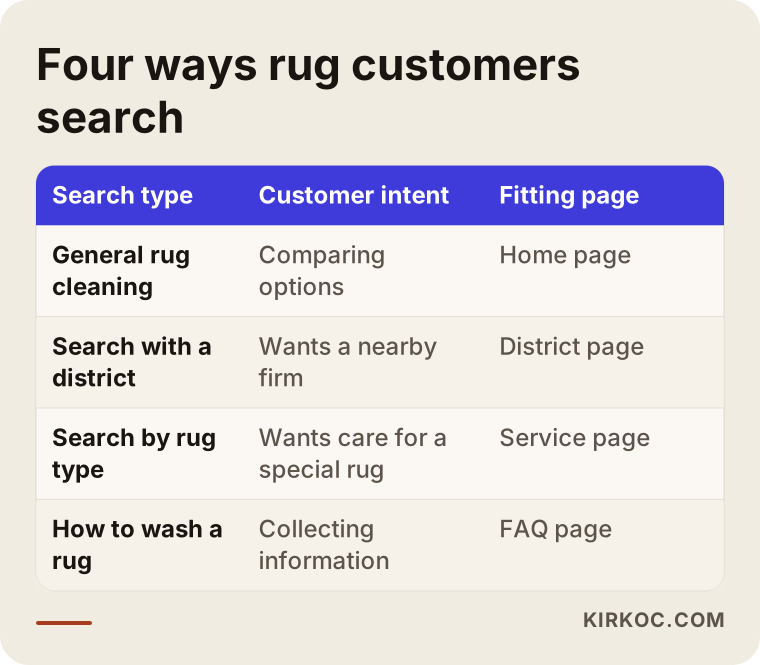
The table above sums up four kinds of searches I see often in this trade and which page should answer each one. Adapt it to your own business. First separate the searches that bring real customers from the ones people make out of curiosity.
The district or neighborhood search is the heart of the trade
Rug cleaning is local work. A request from an area your van cannot reach is a burden, not an opportunity. So instead of trying to stand out for a huge search like the name of your whole city plus "rug cleaning," it makes far more sense to focus on the districts and neighborhoods you actually serve. When someone types the name of their own area, they want to see a page on your site that mentions that area clearly.
There is a trap here: creating area pages by copying the same text and swapping the place name. Search engines notice this, and so do customers. Every area page should contain something specific to that place, such as which streets or neighborhoods you pass through, which days you collect there, and which types of rugs you see most often in that area.
Which pages should a rug cleaning website have?
You do not need a large, complicated site. But without certain pages, customers hesitate. Here is a skeleton built for this trade.
Home page. In the first five seconds a visitor should understand what you do, where you work and how to order. Your phone number and your chat button should be visible without scrolling.
Service pages. Separate pages for machine-made rugs, wool rugs, handmade rugs, silk rugs, sofa cleaning and mattress cleaning help both the customer and the search engine. A person searching for silk rug cleaning will not find what they want on a page about mattresses.
Process page. A page that explains what happens from the moment the rug is picked up to the moment it is delivered answers the biggest worry in this trade: "I handed it over, so what will they do, and how will it come back?"
Service areas. The districts you cover should appear as a map or a list. A customer should see within seconds whether their address is included.
Frequently asked questions. Whether a stain will come out, how long drying takes, whether colors can bleed, and when the rug returns should all be answered here.
Contact and ordering. Phone, chat, address and opening hours should be written identically on every page.
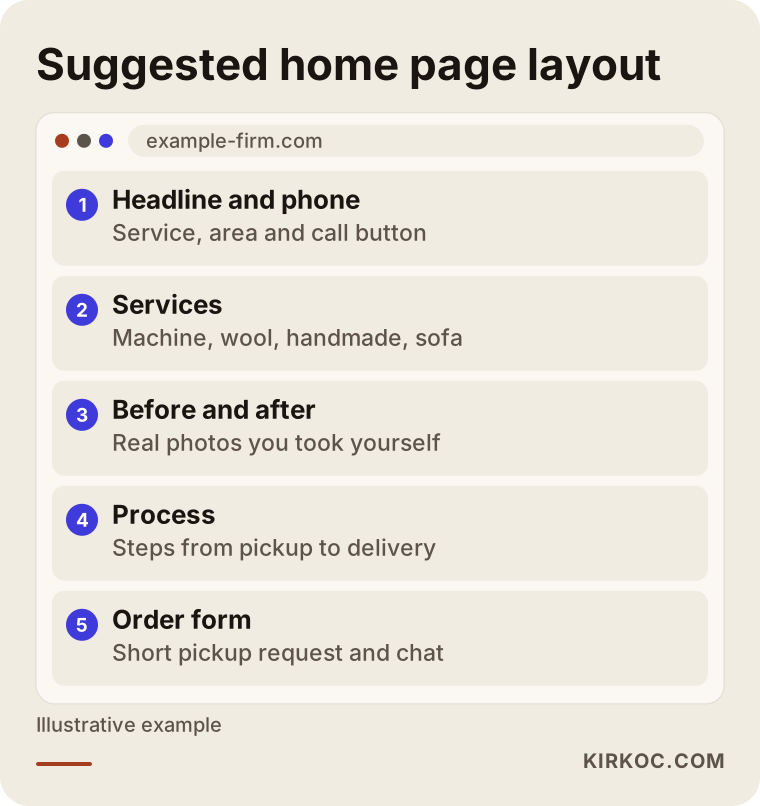
This image is a sample outline of a single page. You can change the order to suit your business, but the phone number and the order path should never be buried at the bottom of the page.
Why do real photos matter so much?
Rug cleaning has a visible result. Photos taken before and after cleaning, of real rugs, build a kind of trust that no paragraph can. What matters is that you choose these photos from your own work, and that you ask permission before showing a customer's rug to anyone else. Stock images pulled from the internet do not convince visitors, and using someone else's photo can create copyright problems. If you are unsure about this, talk to a lawyer.
How does online ordering work for rug cleaning?
When people hear "online ordering," most picture a shopping cart. Rug cleaning is different. The price often depends on the size, material and condition of the rug. Even if you charge by the square foot, the customer may not know how big their rug is. For that reason, the ordering system should work less like a store checkout and more like a pickup request form.
The logic is simple. The customer enters their address, a preferred range of days, the number of rugs and the type, and, if they like, attaches a photo. You use that information to call the customer or message them in a chat app and fix the pickup time. After you collect the rug, you measure it and give the final price. This approach does not leave the question "how much is it?" completely hanging, and it also reduces disagreements later.
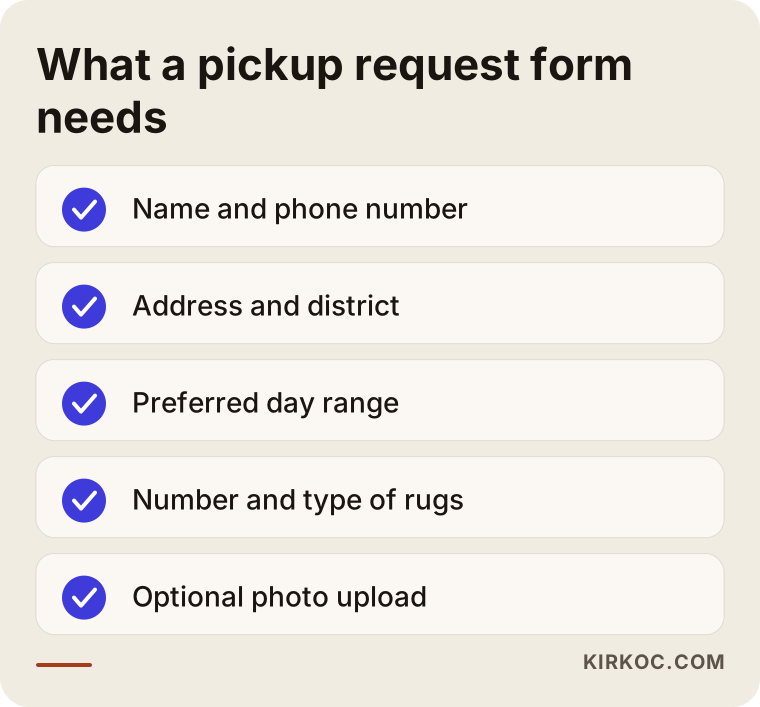
As you can see, the form is kept short. Long forms tire people out. Someone filling in a form on a phone will often give up halfway through a ten-field form. Ask only for the information you truly need and sort out the rest by phone.
Do you have to take payment on the site?
No. For many rug cleaning businesses, payment happens when the rug is delivered, and customers like that. You can add online payment later, but it is not required at the start. Get requests flowing first, then grow the system. If you later want to take a card deposit, that needs an extra setup and an agreement with a payment provider, so it is better to sort out those details when the time comes.
Two example scenarios
The two scenarios below are hypothetical. They do not describe a real business and are made up only to make the situation concrete.
Scenario 1: A neighborhood shop with one location
Imagine a rug cleaning shop that has been known in its neighborhood for years. Most customers are returning ones or come through recommendations. The shop has no website, or has one built years ago that does not open properly on a phone. The owner notices that calls from nearby neighborhoods are fading, because younger customers now begin with a search box, not a phone call.
The work here is simple: one solid home page, three or four service pages, a list of the neighborhoods served, a few real before-and-after photos and a pickup request form. Updating the Google business profile belongs in this list too. At this scale the goal is to keep the loyalty of existing customers while also becoming visible to new customers in the surrounding areas.
Scenario 2: A company with delivery vans serving several districts
This hypothetical company drives to three or four districts and collects in certain areas on certain days of the week. Phone traffic is heavy, but it does not know which district asks for which service. Some days a van runs half empty, and other days requests come from three districts at once and it cannot keep up.
Here the site can be more than a storefront; it can act as a planning tool. A separate page for each district, with the collection days for that district, lets customers choose a suitable day on their own. The form asks for a day range, which spreads out the demand. If you run ads, you can point them only at the districts you serve that day. When the site and the ads are tied together, van capacity becomes something you can manage.
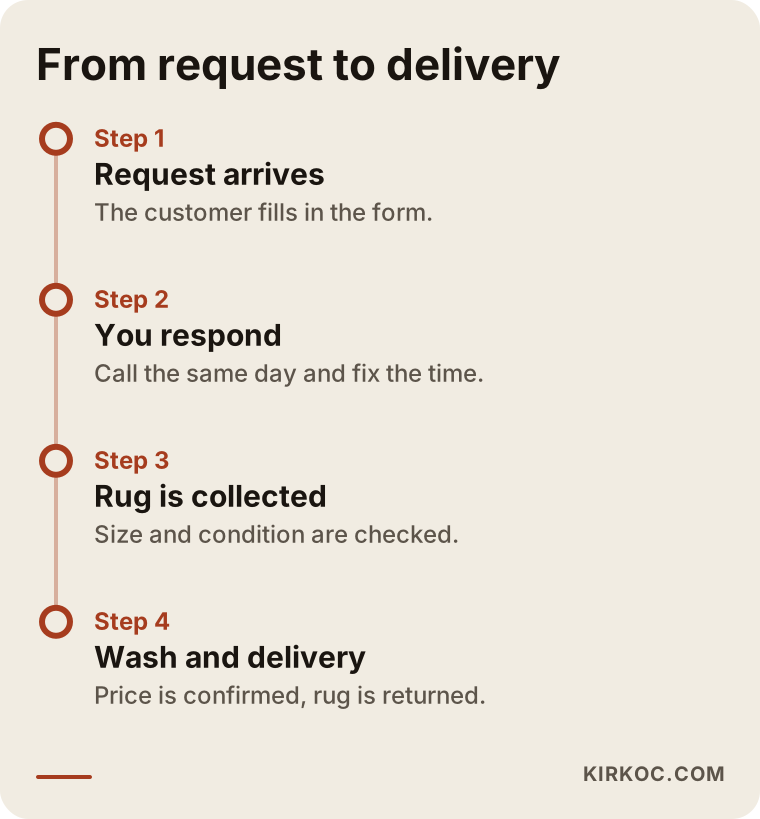
This flow shows the general path that works in both scenarios. Telling the customer what is happening at each step is the most important part of trust in this trade.
What builds trust: why should a customer hand you their rug?
In many homes a rug is not just an object. Sometimes it came from a grandmother, sometimes it was an expensive purchase, sometimes it is a memory. So before handing a rug to a stranger, the customer checks whether you are trustworthy. Your site should answer that question with the following.
- A real address and photos of your facility: Showing where you do the cleaning eases the worry of "where will my rug be washed?"
- A description of the process: Write the steps of dusting, stain check, washing, rinsing and drying in plain language.
- An approach for each rug type: Knowing that wool, silk and handmade rugs are not washed like machine-made ones shows the customer that you are an expert.
- An insurance or damage policy: State clearly what you do if something goes wrong during cleaning. For the legal details, it is wise to speak to a lawyer.
- Real customer reviews: Showing your Google reviews on the site builds trust and introduces you to new visitors.
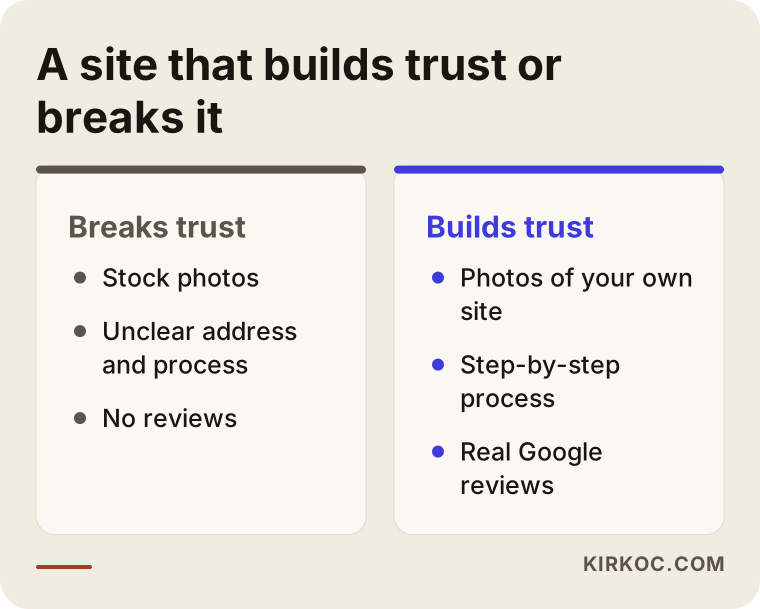
You do not have to do everything in the comparison at once. Go step by step: first the address, the process and real photos, and then the reviews and policy pages.
Should you show prices on the site?
There is no single right answer. In rug cleaning the price changes with the size, the material, the stains and any extra services, so a single fixed price on the site can be misleading. But giving no price information at all pushes customers away. The middle path is to say clearly what the price depends on, for example: "The price is set by the size and type of the rug, and measuring is done at pickup." That way the customer does not meet a surprise, and you are not forced to commit to a number.
Showing up on Google and on the map
A person searching for rug cleaning usually sees three things on the screen: ads, map results and ordinary results. Appearing on the map is perhaps the most valuable position in this trade, because when a customer searches for "rug cleaning near me," the map is what they see.
For that, your Google business profile needs to be complete: correct address, opening hours, the areas you serve, photos and reviews. The address and phone number on your site must match the profile exactly, because even small differences make it harder for the search engine to recognize you correctly. I cannot promise any ranking, because nobody can, but a properly built profile and a decent site raise your chances in a real way.
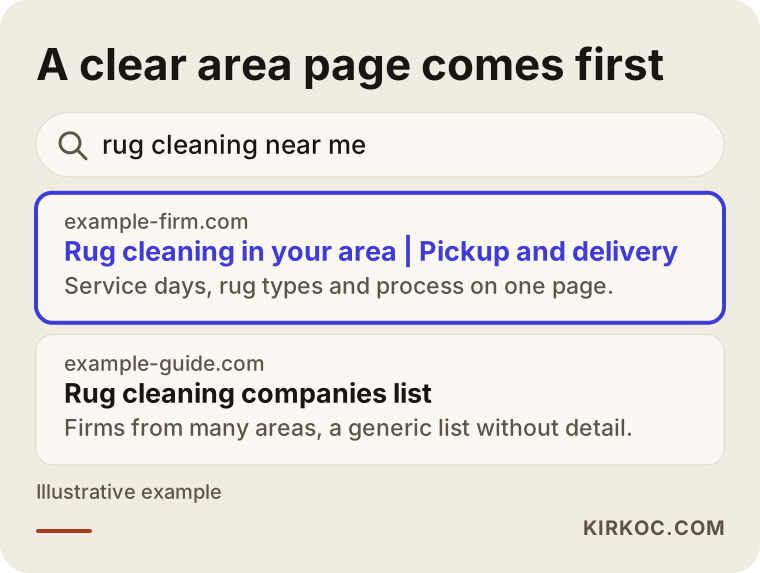
This example shows that, in the same search, a clear area page can beat a general guide page. If the customer can find what they want at a glance, they click on you.
How do AI tools recommend rug cleaners?
Some people now ask tools like ChatGPT, "Is there a reliable rug cleaner near me?" These tools draw on sources that are clear, organized and trustworthy. If your services, areas and process are written plainly on your site, you have a better chance of appearing in answers like these. I cannot guarantee it, but the same work helps in classic search and in this new kind of search: clearly written, correct information.
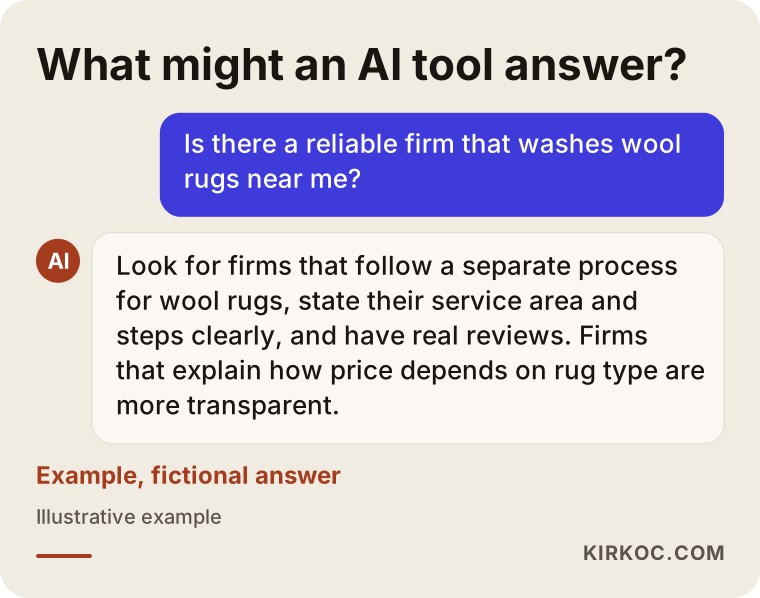
The sample answer you see is fictional. Its purpose is to show what kind of information a tool can rely on when it replies.
Step by step: how the site gets built
The order below is the simple path I follow when I build this kind of site. The logic is the same whether you do it yourself or work with a specialist.
- Write the service and area list first. Which rug types do you clean and which districts do you go to? This list is the backbone of the site.
- Collect real photos. Your facility, your van, the washing stages and before-and-after examples.
- Plan the pages. Home page, services, areas, process, FAQ and contact.
- Set up the pickup request form. Short, easy to fill in on a phone, and sending you an instant notification.
- Open the phone and chat path. Every page should let people call with one tap.
- Sort out the Google business profile. The site and the profile should show the same details.
- Test on a phone. Try the site on your own phone and, if possible, on someone else's.
- Start measuring. Track how many people filled in the form, how many called and which district they came from.
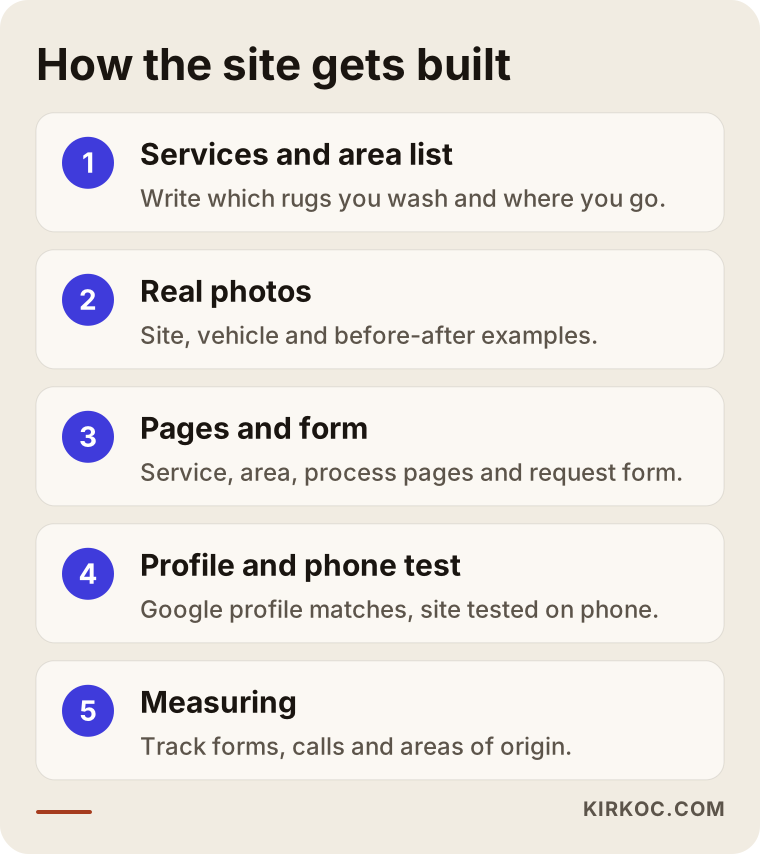
These steps can be spread over a few weeks; you do not need to do them all on the same day. What matters is keeping the order: basic information first, then the form, then visibility.
Common mistakes
There are mistakes I run into again and again when I look at sites in this trade. Most of them are not expensive to fix; they only need attention.
A site that looks bad on a phone. Most rug cleaning customers arrive on a phone. Tiny text, slow pages and a phone number that cannot be tapped cause real losses.
Leaving the service area vague. Writing "the whole metro area" often creates the wrong expectation. State clearly which districts you truly serve.
Copying the same text everywhere. Duplicating area pages by only changing the name pleases neither the customer nor the search engine.
A form that is too long. The customer wants to give an address and the number of rugs. Do not ask for the size of their home, their floor or their birthday.
Replying late to a request. However good the site is, if a customer who filled in the form does not hear back the same day, they go to another business. Make sure notifications reach your phone.
Using before-and-after photos without permission. Ask permission for images that show a customer's home or rug.
Giving up in the first weeks. Visibility in search takes time; expecting results within a few days is not realistic.
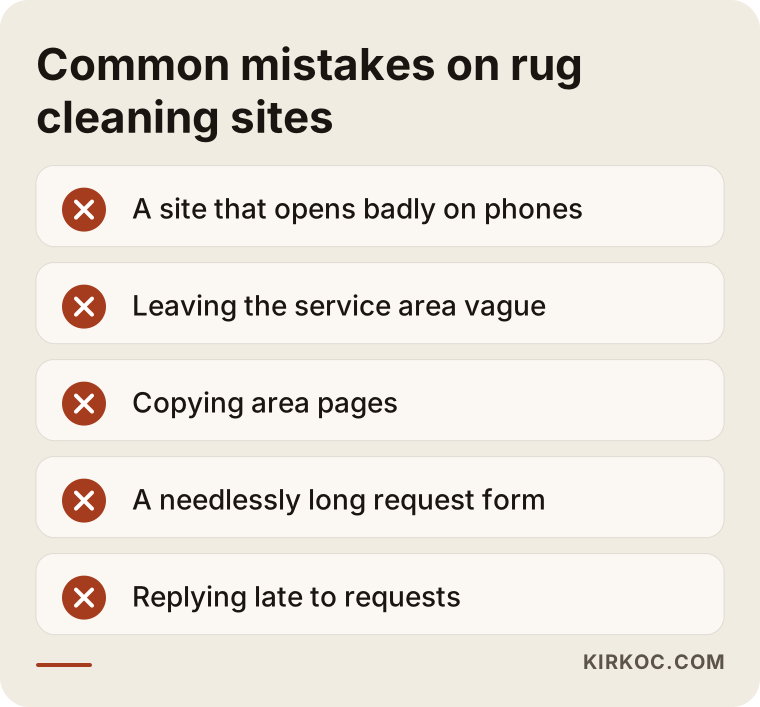
The list may look long, but most items can be fixed one at a time. Do not try to solve everything in a day; start with the ones that lose you the most customers.
What can you do yourself, and when do you need a specialist?
You can build your own site with a ready-made site builder. These tools need no technical knowledge and can be enough for a simple introduction site. If you do it yourself, keep these points in mind: put the phone and chat buttons on every page, use photos you took yourself, write your service areas clearly, and always test the site on a phone.
Help from a specialist makes sense in these cases: you serve several districts and need a separate page for each; you want the request form to send you regular notifications and want the data tracked; you want to raise your visibility on Google and the map in a serious way; or you want to run the site together with ads and social media.
At this point, working with one person has a benefit. When the site is with one person, the ads with another and social media with a third, the same information can be written differently in three places and nobody sees the whole picture. Because I run all of these myself, the service areas on the site, the areas in the ads, the posts on Instagram and the details on the Google profile stay consistent with each other. For the customer, that means seeing the same clear information everywhere.
What determines the cost?
I will not give you a number, because two rug cleaning sites can be nothing alike. But I can tell you what sets the price:
- How many pages you need: A one-page introduction site and a site covering ten districts are not the same job.
- The scope of the order form: A simple request form and a system that takes payment and has a calendar are very different.
- Writing and photos: If you prepare the text and images, the cost goes down; if I have to prepare them, the job grows.
- More than one language: If you also serve tourists or foreign customers, extra language pages are needed.
- Visibility work: Building a site and making it visible on Google are separate jobs, and the second needs continuity.
- Upkeep afterward: Updates, backups and small fixes after launch should also be counted.
When you ask for a quote, always ask what is included and what is not. A written, itemized quote prevents most later surprises.
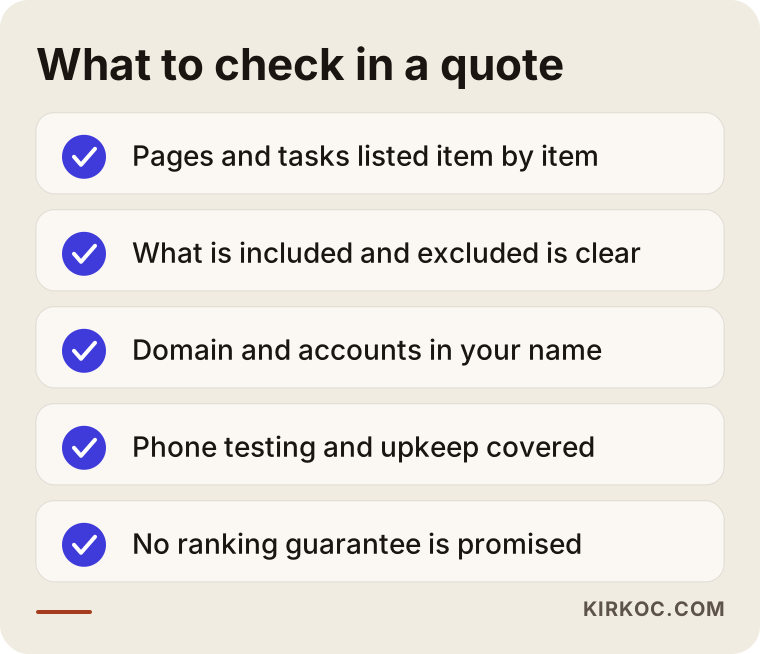
The list above sums up the basic questions to ask yourself when you evaluate a quote. If there is an item you cannot get a clear answer on, you have every right to postpone the decision.
How I work with you
The process is simple. First I listen to your business: which districts you go to, which rug types matter most, and where customers come from right now. Then I look at where you stand: whether you have a site, the state of your Google profile and what your competitors are doing. After that I give you a written plan and an itemized quote. Once the site is built, we settle together how you will handle requests and where the form notifications will go.
Going forward, if you want, I run Google and Meta ads, social media posts and search visibility within the same plan. You are always the owner of your site, your domain and your accounts. I do not promise rankings or sales, but I explain what I do, why I do it and what the results are in plain language.
Frequently asked questions
Does a rug cleaning business really need a website?
Even if you win work by phone and recommendation, new customers now start by searching. A business without a site is invisible to people who search. Even a small site can make your phone ring.
Do I need to set up an e-commerce system for online orders?
Most of the time, no. In rug cleaning the price depends on measuring, so a short pickup request form fits better than a store with a cart. You call the customer, fix the pickup time and give the price after you have seen the rug.
Should I publish a price list on the site?
A fixed price can be misleading. Stating clearly that the price depends on rug type, size and condition gives the customer an honest frame and keeps you from committing to a number.
Do I need a separate page for each district?
If you serve more than one district, yes, it makes sense. But each page needs information specific to that district; copying the same text with a changed name does not work. Start with the districts where you get the most customers.
Will I be first on Google once the site is built?
No, nobody can guarantee that. A properly built site, a complete Google business profile and reviews that build up over time improve your chances. Results show up slowly over weeks.
Should I run ads or invest in the site?
Site and profile first. Ads bring people to your site, and if the site cannot persuade them, the ad budget is wasted. Once the site is ready, ads can bring fast requests, especially in busy seasons.
Who owns the site?
The domain, the site and the accounts should be in your name. Settle this clearly at the quote stage; even if the person who built it leaves, you should never lose access to your site.
How long does it take to get the site ready?
It depends on the scope. A simple introduction site can go live quickly; a site with many districts, a form and content to prepare takes longer. How fast you can supply the text and photos also affects the timeline.
If you want your rug cleaning business to be more visible and easier to reach online, get in touch through my website design page. I will listen to your business and put together a simple plan that fits it.