You spend your days with a blow dryer or a color brush in your hand. The work coming out of your chair is genuinely good, yet your Instagram page has barely moved in months. You post every day for a week, then a busy stretch hits and nothing goes up for three weeks. If that sounds familiar, it makes sense that you searched for "salon social media management." This article explains what a salon or hair studio can realistically expect from social media, what works, what does not, and which parts you can handle yourself. I am Ümit Kırkoç, and I work from Istanbul. I run social media management together with websites, search visibility and ads, all by myself, so I look at a salon's whole customer path rather than just the posts.
Let me clear one thing up first. Social media management is not putting a photo on your page now and then. It means deciding which of your services to show and to whom, posting on a steady rhythm, answering messages and comments on time, and checking whether any of that turns into bookings. In the beauty business the work carries extra weight, because what you sell is a visible result. A new client often judges you by scrolling on a phone before she ever calls.
Why social media is a shop window for a salon
A restaurant has a menu. A lawyer has a practice area. A salon has something different: the work itself is the window. A color job, a facial, a manicure, a set of lashes. People find it hard to trust a beauty service they cannot see, so for most salons Instagram ends up being the portfolio, the brochure and the first conversation, all at once.
Picture your client's route. A friend mentions your salon. She types your name into a search box, then opens your social profile or your map listing. In a few seconds she decides three things: does this place look clean and careful, does it do the style I want, and is it easy to reach? If your profile does not answer those questions, she moves on to another salon, however good your work is.
The picture below summarizes how social media carries a person step by step from seeing your work to booking a chair.
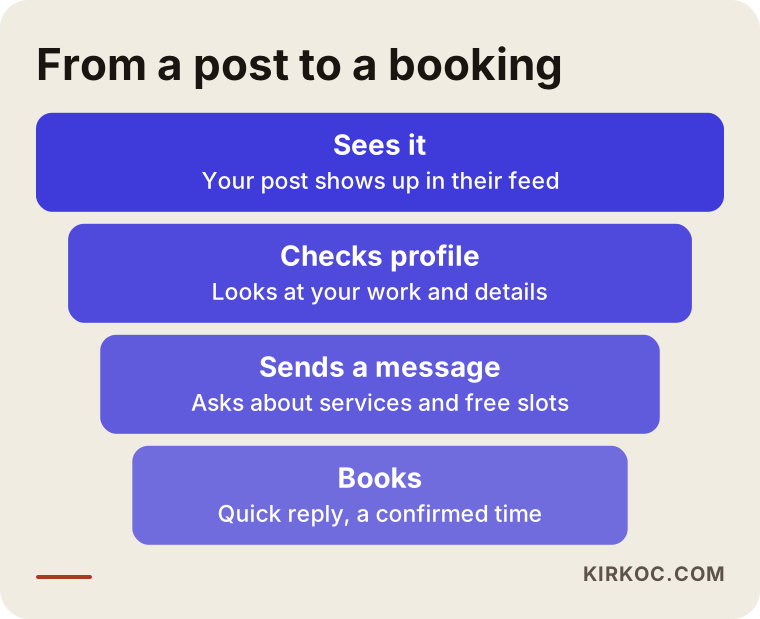
You can lose people at every step. Plenty of people see a post but never open your profile. Some who open it never write. Some who write give up when the reply comes late. Good management starts by walking through those steps one at a time and finding where you lose the most.
How do clients actually find you?
Beauty searches come from two different directions. The first is direct searching: "hair salon near me," "facials downtown," "bridal updo this weekend." Here the client wants a quick decision, and your map listing, reviews and opening hours decide it. The second is discovery: someone sees a color transformation video in her feed and thinks, "I want that." Here the quality and style of your posts decide it.
Good salon social media connects the two. A person who arrives through discovery should find your address, hours and booking route on the profile. A person who arrives through search should find real work that builds trust. Neglect one side and the other weakens too.
Platforms differ as well. Instagram is the main stage for most salons. A Facebook page is useful mostly for the address, reviews and events. TikTok offers short transformation clips and a younger audience. You do not have to run all three. If your energy covers only one, being steady on one beats being patchy on three.
The real problems salons face
Every business has its own social media trouble, and salons share a handful of them. See whether you recognize some.
The first is time. During working hours you are holding tools, so filming or checking messages is out of the question. By the time you get home, you have no energy left to prepare a post. The result is an irregular account.
The second is permission. Sharing a client's face, hair or nails means asking her first. That is courtesy, and it is also a matter of trust. Privacy rules differ by place, and I cannot give you legal advice, so please check the details with a lawyer. The practical rule is simple: never publish a person's face without her consent, and where possible shoot hair, hands and nails without showing a face.
The third is the message pile-up. Booking questions mostly arrive as direct messages: how long does this color take, do you have room tomorrow, do you offer that treatment? Answering the same questions many times a day eats your hours, and a message answered late is usually a lost booking.
The fourth is split identity. A page under the salon name and the stylist's personal account can exist side by side, each saying something different. The client cannot tell which one to trust.
The fifth is service overload. Hair, skin, nails, brows, waxing, makeup. Trying to explain every one of them on a single page makes the account look scattered, and the client cannot tell what you are especially good at.
Most of these shrink once you decide which services to push first. The table below lays out the content types I see most often in salons, what each one does and how to use it.
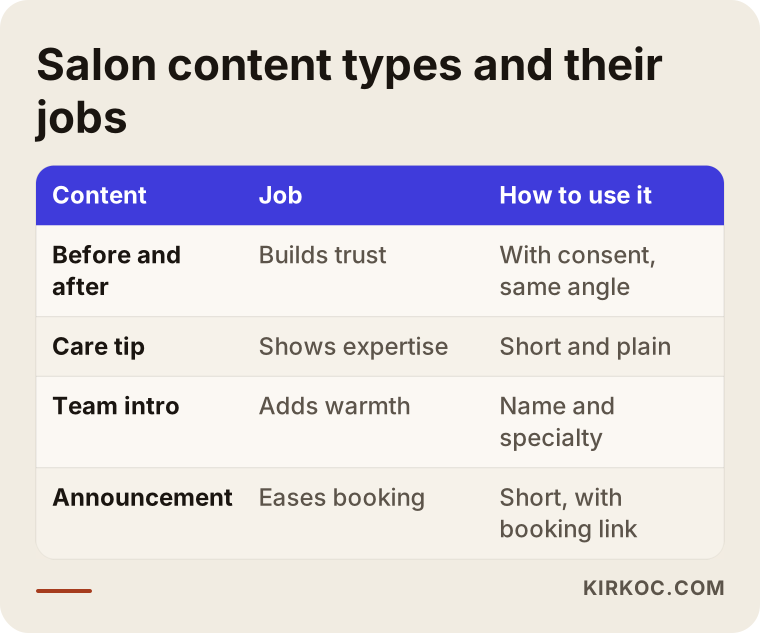
The point of the table is that each type of content has a different job. A before-and-after post builds trust, a short care tip shows expertise, a team introduction adds warmth, and an announcement makes it easy to book today. You do not need equal amounts of each. You set the mix according to what your salon needs.
Your profile: what should be visible at first glance
Before you post anything, the profile itself has to be in order, because every new visitor looks there first. The name should include the salon name and the type of service, for example "Example Studio | Hair and Skin Care, Brooklyn." The short bio should say which services you offer, which neighborhood you are in and how to book. The profile photo should be your logo or a clear picture of the salon.
The highlights section is especially valuable for a salon. You can set up buckets such as "Services," "Before and after," "FAQ" and "Find us." Instead of scrolling through individual posts, the visitor finds what she needs in these buckets. Whether to publish prices openly is your call. I am not quoting any numbers here, because that depends on each salon's own policy.
The checklist below collects the basics I look at on a salon profile.
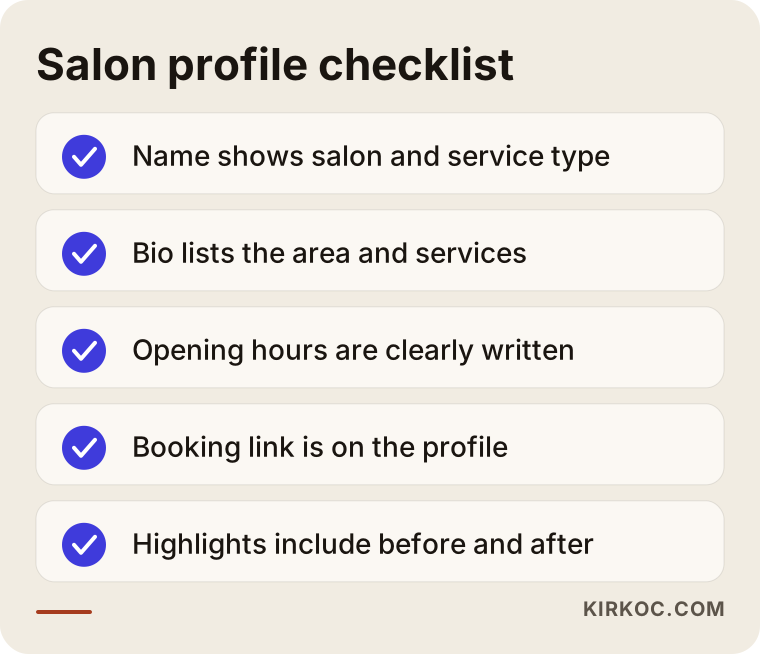
You can run through this list on your own phone, looking at your own profile. If even one item is missing, a visitor may stop at exactly that point. A clear booking route and written opening hours in particular prevent more lost bookings than most people expect.
What to post: content ideas for a salon
"What do I post?" is the question salon owners ask me most. The answer is already in your daily routine. You only need to collect it in an organized way.
The first group is results: hair after coloring, a fresh cut, shaped brows, a nail design, skin after a facial. Choosing the right light, keeping the background plain and shooting from the same angle often matters more than expensive gear. A photo taken in daylight by a window almost always shows color more truthfully than one taken under dim lamps.
The second group is process: short videos showing how a color is applied, sped-up clips of a treatment, a note on why you picked a certain product. These move you from "a place that gets good results" to "a place that knows what it is doing."
The third group is educational: "How to protect colored hair at home," "Why skin gets dry in winter." Keep these short and honest. Stay away from medical claims. Instead of saying you treat a skin condition, talk about care tips, and if you want to say anything about health, check with a qualified professional.
The fourth group is people: introducing your team, showing the atmosphere of the salon, a warm but respectful moment with a client. When people buy a service, they are really choosing the person who will deliver it. Sharing your stylist's name, specialty and way of working eases the nerves before a first appointment.
The fifth group is announcements: a new service, holiday closures, open slots. Keep them short and say how to book.
Put these types on a regular calendar and the daily "what do I post today" stress disappears. A plain plan of three posts a week is far healthier than no plan at all.
Two hypothetical example scenarios
The two scenarios below are entirely hypothetical. They describe no real salon or person, and I wrote them only to show the reasoning.
Scenario 1: the neighborhood barber and hair studio. Imagine a two-person shop on a residential street. The owner posts a random photo on Instagram two or three times a month, the bio is empty and there is no address. Most clients come from the surrounding blocks, and finding new ones is hard. First, the profile gets fixed: salon name, neighborhood, services and booking route. Then two result photos and one short video a week are planned. Replying to messages the same day becomes a firm rule. After three months, the number of bookings that arrive by message might go up. I would never promise that, because the outcome depends on how busy the area is, the quality of the work and the competition.
Scenario 2: a skin care and beauty center. Imagine a larger center offering everything from laser hair removal to facials. The account tries to feature one post for every service, so the feed looks scattered. Here, three main services are chosen. For those three, the center sets up highlight buckets, short videos answering common questions and a clear contact route. The other services are posted now and then as supporting content. For health-related treatments, exaggerated promises are avoided, and it is wise to ask a lawyer whether the wording of ads and posts complies with the rules where you operate.
What the two examples share is that the job is made smaller first and then given a routine. The comparison below shows the gap between an unplanned salon account and a planned one.
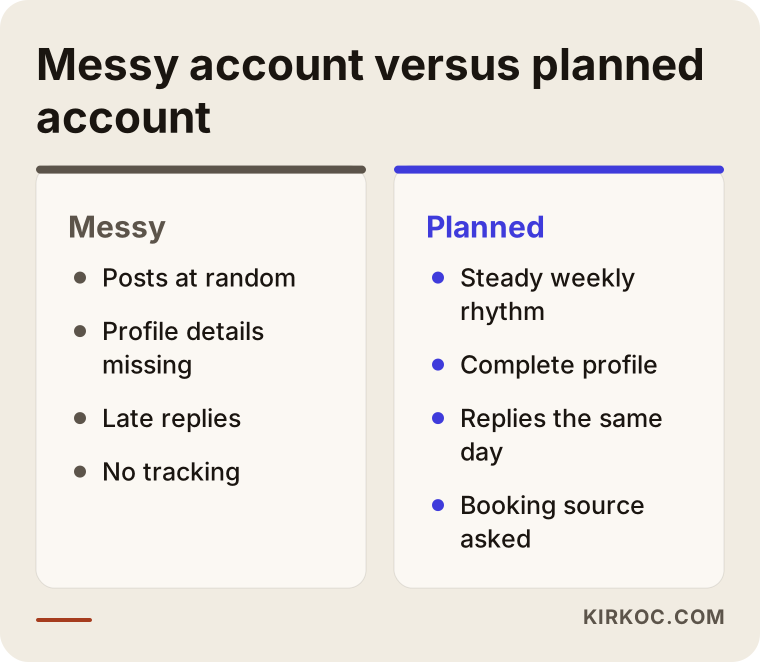
The left side will look familiar to many salons. The right side is nothing complicated or expensive, just a routine someone has decided on. The difference is less about how much time you give social media than about what that time is used for.
Step by step: how to set it up from scratch
When I set up social media for a salon, the path is roughly the following. If you do it yourself, you can follow the same order.
Step one, set the goal. What do you want: new clients, fuller quiet hours, a push for one particular service, or bringing past clients back? If the goal is fuzzy, the content turns scattered. Picking, at the start, the service that earns the most or sits empty the most helps a lot.
Step two, fix the profile. The points above: name, bio, services, neighborhood, booking route. Fixing this raises the effect of every later post.
Step three, plan a shoot day. Instead of filming every day, a one- or two-hour session once a week is far more efficient. If you shoot at a quiet time, in a well-lit corner, gathering the week's work, you end up with material for several posts.
Step four, build a calendar. Which day gets which post, who prepares it and who approves it? A simple table is enough. What matters is keeping the rhythm for at least one full season, even when you have no energy.
Step five, set a reply rule. Decide in advance when during the day you check messages, which ready answers you keep for common questions and how you collect booking details. That relieves both you and the client.
Step six, measure and adjust. Which posts brought messages? Which highlight buckets were tapped? How many bookings came from social media? Simply asking each new client "how did you hear about us?" is a good enough start.
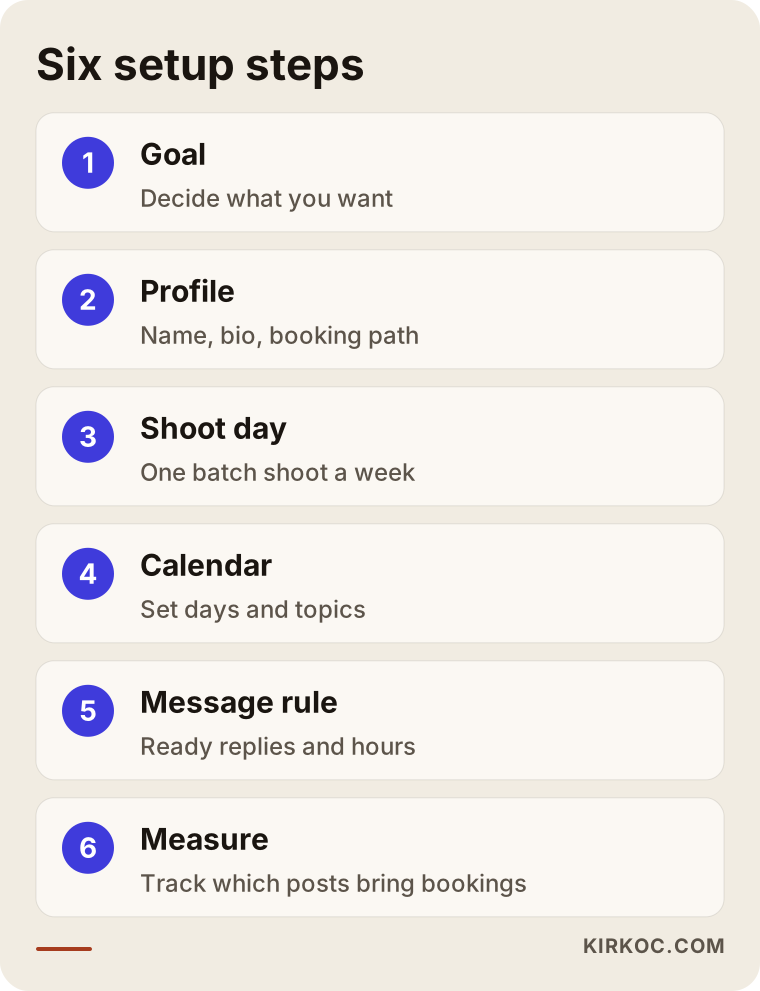
You do not need to do all of this at once. Focusing on the profile and the shoot plan in the first month, settling the rhythm in the second and starting to measure in the third is a perfectly sensible pace.
Common mistakes
I keep seeing the same mistakes in salons. Knowing them solves half the problem.
The first mistake is taking inspiration only from huge accounts. Images from overseas or from a giant brand may not speak to your clients. Your client wants to see a real salon in her own town.
The second is using somebody else's photos. Passing off another salon's work or a stock image as yours is unethical, and it damages trust when the client sits in your chair and sees the gap between expectation and reality. Show only your own work.
The third is buying followers. The number looks big, but it brings no bookings, and it drags down the real engagement on your account. Your yardstick should not be follower count. It should be messages and bookings.
The fourth is announcing a discount in every post. Constant discounts cheapen your service and train clients to decide on price alone.
The fifth is staying silent on comments and negative feedback. A calm, short reply that focuses on a fix shows everyone else reading how you run your business.
The sixth is overblown promises. Phrases like "permanent results" or "guaranteed fix" can mislead clients and cause you trouble. Results vary from person to person, and saying so openly is more reassuring.
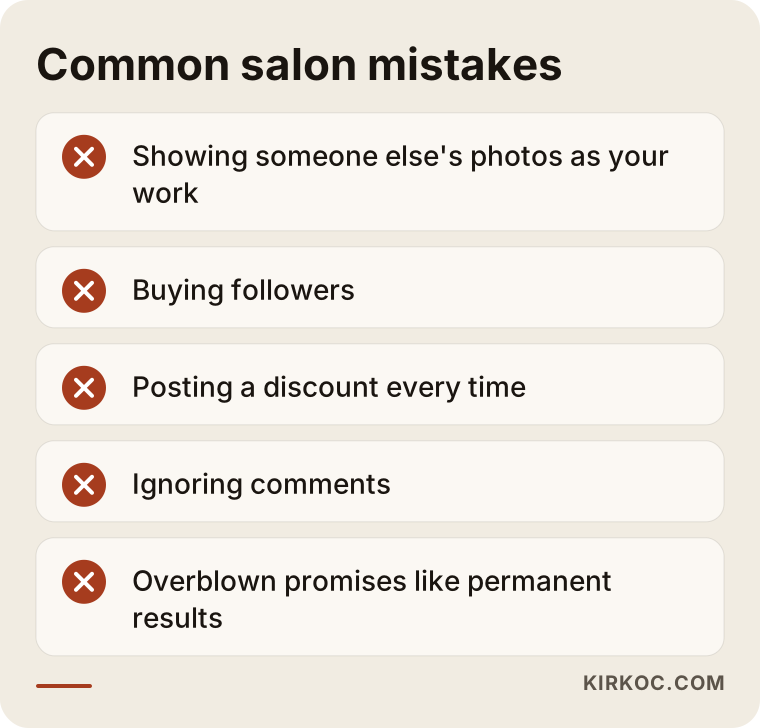
Take a look at your own account against this list. If you spot one or two, do not worry. All of them can be fixed in a single sitting.
Messages, comments and bookings: where the sale really happens
Likes and views look nice, but a salon earns money only when they become a message and then a booking. That is why handling messages matters as much as content does.
When someone writes to you, she usually wants to know three things: do you do this service, when do you have room, and where do I go? Keeping ready text for those three answers shortens your reply time. Reply by name and add one personal sentence so it does not read like copy and paste, and you stand out.
Keep the booking route as short as you can. The link in your profile should take people straight to wherever they book. It might be a phone number, a text message or a booking form. Whichever you choose, the client should reach a booking in about three steps. Every extra step loses people.
Reviews matter too. Reviews on your map listing and on social media weigh heavily on a new client's decision. Politely asking a happy client for a review once the service is done is common and natural. Offering a discount in exchange for a review, however, can break a platform's rules, so check the current rules of the platform you use.
The timeline below shows how the first three months of a setup might unfold in an example salon.
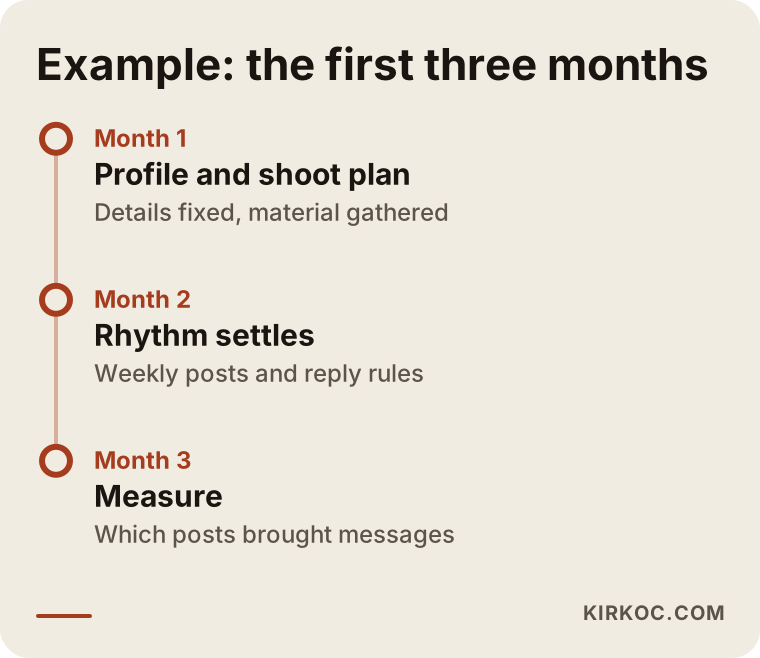
This timeline is not a guarantee. It is a reasonable order of progress. Every salon moves at its own speed, and what counts is that each month is more orderly than the one before.
Should you do it yourself or bring in an expert?
You can run social media yourself, and for many small salons that is a fair place to start. Staying on your own makes sense when:
- You have a few hours a week, or someone in the salon who can take it on.
- Learning to shoot decent photos and short videos on a phone does not feel hard.
- You can check messages during the day.
- For now, your goal is simply to be visible to the people around you.
Expert help comes in when:
- Your workload keeps breaking the posting routine every few weeks.
- You have several locations or many services and the account has become tangled.
- You want to run ads, become known in a new neighborhood or announce a new service.
- You want social media to work together with your website, your map listing and your ads.
In short, the deciding question is not "I cannot do it" but "where is my time best spent?" If your time earns the most when it goes to clients, handing off the shoot plan, calendar and tracking may be the smarter move.
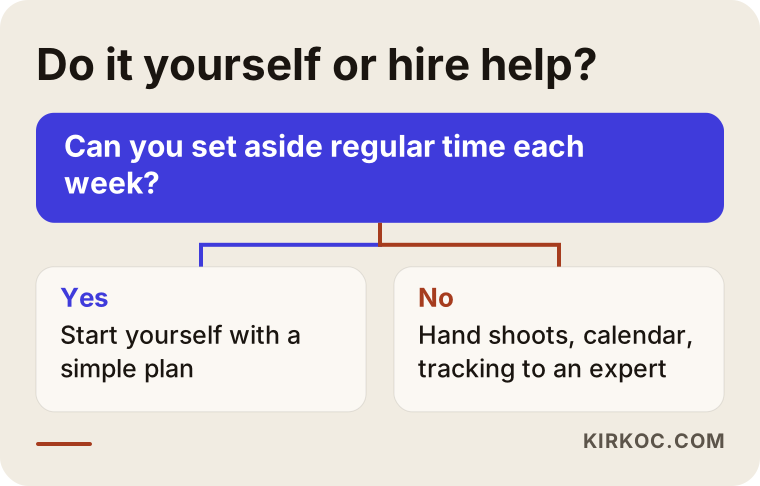
The chart does not hand down a verdict. It lists the things worth thinking about. You make the call based on your time and your salon's growth goals.
Social media, your website and search working together
Social media is not an island. A client sees you on Instagram, but before booking she searches your salon's name on Google. If she lands on an outdated site, a wrong phone number or no map listing at all, the interest you earned on social media is wasted.
That is why a small but tidy website pays off for a salon: services, opening hours, address, a few real photos of your work and a booking route. The site should carry the same voice and the same details as your social profile. The hours on your map listing should match the hours on social media just as closely.
Getting all of this from one person has a practical benefit. Your logo, colors, tone, service names and pricing policy are set in one place, and the website, social media, local search and ads do not repeat or contradict each other. Because I do this work on my own, I can think about the salon's entire client path together. You also avoid the "who said what" confusion that appears when several people are involved.
The graphic below shows which sections a well-built salon page can have.
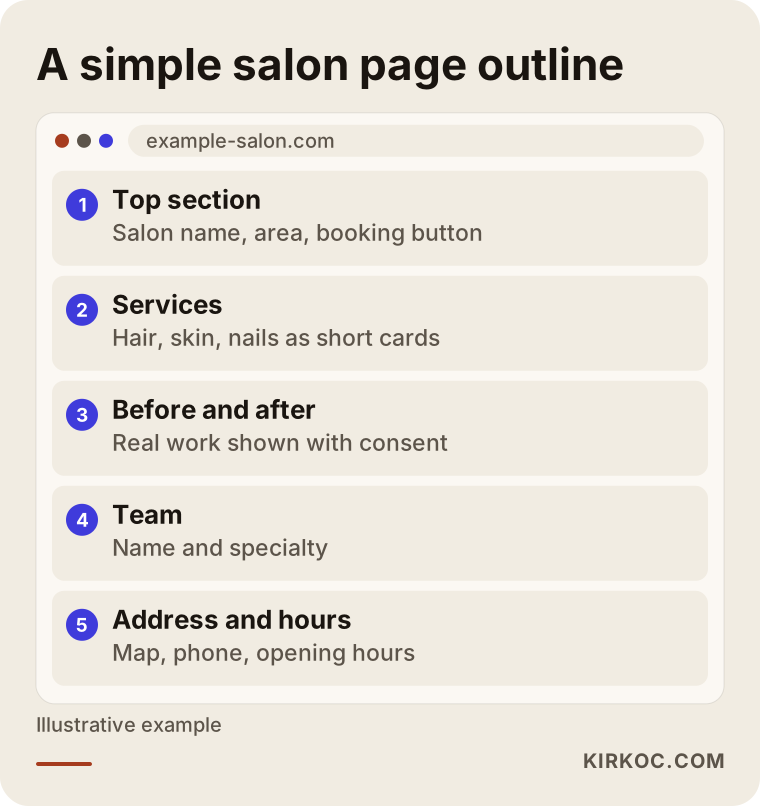
This outline needs no complicated software. What matters is giving information in the order the client wonders about it: what do you do, where, when, and how do I reach you?
Your salon in AI assistants and search engines
People no longer ask only search engines. They also ask AI assistants things like, "Can you suggest a good place for bridal hair in my neighborhood?" These assistants lean on clear, consistent information they find online. When your salon's name, services and neighborhood are written the same way across different places, it is easier for a system to recognize and mention you. There is no guarantee of that, but giving clear and consistent information never hurts.
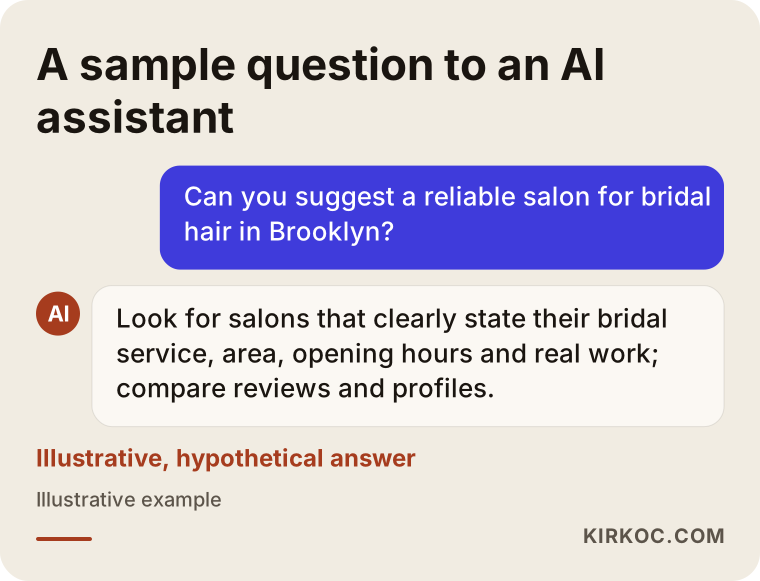
The answer above is purely an illustration. Nobody can know in advance what a real assistant will say. Your part is to keep your details clear enough to answer questions like that.
What decides the cost
I will not quote numbers, because the cost of social media management varies widely from one salon to the next. The main things that decide it are these:
- How many platforms you appear on.
- How many posts, stories and short videos are produced each month.
- Whether filming happens in your salon, or your own photos are used.
- Whether handling messages and comments is included.
- Whether you also want ad management.
- Whether work such as a website, a map listing and a logo is part of the package.
- The number of locations and the variety of services.
When you get a quote, make sure each of these items is written out. A vague phrase such as "monthly social media management" does not tell you what is included. Asking what is not included matters just as much as asking what is.
How I work with you
I work alone. That means the person you talk to is the person doing the work. In the first conversation I listen to you describe your salon, your services, your ideal client and your current accounts. Then I write down plainly what can be done, what can stay on your side and what is my job.
Depending on the scope, the work can include profile setup, a content calendar, post preparation, message reply rules and a regular review conversation. If needed, I also look after the website, map listing and ads. I do not promise results, but I show you openly what I am doing, why I am doing it and what I am tracking.
Frequently asked questions
Do I really need social media for a small hair studio?
It is not mandatory, but most clients look at your profile on their phone before they come in. Even a small salon with a tidy profile and a few real photos of its work has enough to build trust.
Which platform should I be on: Instagram or TikTok?
Because your work is visual, Instagram comes first for most salons. TikTok is an extra option if you want to reach a younger audience with short transformation clips. If your energy is limited, being steady on one platform is better.
Do I need permission to post a client's photo?
Getting consent in advance for any image that shows a face or identifies a person is good practice. For the legal details, talk to a lawyer. Shooting hair, hands or nails without showing a face is a safer option.
How often should I post?
The best rhythm is one you can keep up. Two or three posts a week, kept steady, is healthier than a burst of heavy posting followed by silence. Consistency matters more than volume.
How many months until bookings start coming?
I cannot say, because it depends on your area, the competition, the quality of your work and the current state of your account. I give no promises about timing or results. I track progress with you.
Do I need to run ads?
Not necessarily. Setting up a solid organic routine first shows you what is working. Ads can speed things up when you are announcing a new service or a newly opened location.
What should I do about a negative review?
Stay calm, write a short and respectful reply, and offer to sort out the problem by message if you can. Other people reading the review also judge how you handle problems.
If I hand over social media management, do I lose control?
No. You are always the owner of the account, and you keep approving posts and message rules. It is good practice to settle that in writing from the start.
If you would like to talk through where to begin with social media for your salon, you can reach me through the social media management service page. I will look at your accounts and tell you plainly what is realistic and what is unnecessary.