You build pools. Concrete, prefabricated, fiberglass, or maintenance and renovation: whichever it is, you prove the quality of your work on the job site. But when someone types "pool builder near me" or "how much does a pool cost" into Google and glances at a few websites, they usually form an opinion before anyone has visited their property. They do it on a phone screen. That is why a website for a pool builder is not a pretty brochure. It is a kind of pre-sales conversation. In this article I explain which pages a pool business needs, how customers search, and where to start. I am Ümit Kırkoç, based in Istanbul, and I handle the website, search visibility, social media and advertising myself, in one place. Where it is relevant, I will also be open about how my website design service works.
A note on context. My home base is Turkey, and many pool projects I think about are villas along the Aegean and Mediterranean coast, where local builders often serve Turkish owners and also English-speaking buyers who purchased a holiday home. If you build pools somewhere else, almost everything below still applies. The principles of a good pool website do not change with the country; only the place names do.
Pool building is unlike many industries. It runs on seasons, large budgets and long decisions. Nobody orders a pool on a whim one evening. Most people look for months, compare, ask friends and neighbors, and save photos. The job of your website is to make a person say, at some point on that long road, "this company looks serious, I can call them." You do not do that with fancy animation. You do it by giving the right information in the right order.
How does a pool customer search for you?
A person who wants a pool does not know your trade vocabulary. They will not type "post-tensioned reinforced concrete pool." They will type "I want a pool for my villa," "how long does it take to build a backyard pool," or "fiberglass pool vs concrete pool." Searches mostly fall into three groups: people looking for information, people comparing companies, and people who want a quote right away. Writing one page for all three is the quickest way to satisfy none of them.
Geography matters too. Pool building is a local business. You cannot take your crew and materials everywhere, and even if you could, cost and follow-up become hard. Customers know this, and they often type their town or district: "pool builder Bodrum," "villa pool Antalya," "pool company near Lake Sapanca." These searches are valuable for exactly that reason. If your site does not clearly say where you work, neither Google nor the customer can tell.
The picture below shows a completely hypothetical search result. In the same search, one result names the area and the service clearly, and the other is a generic guide page.
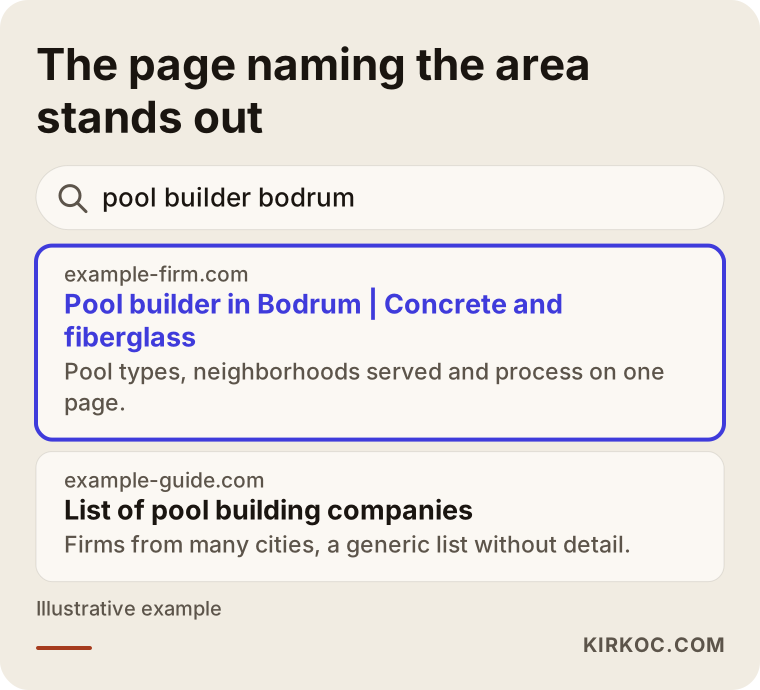
What makes the highlighted result better is that its first line states the area, the type of service and what it offers. The reader gets the answer to "is this for me?" before clicking. Every important page on your site should answer that same question.
What is behind the search
Seeing the ways people search in one table makes it easier to decide which page to write. The table below summarizes four typical search types for the pool business and the page that fits each.
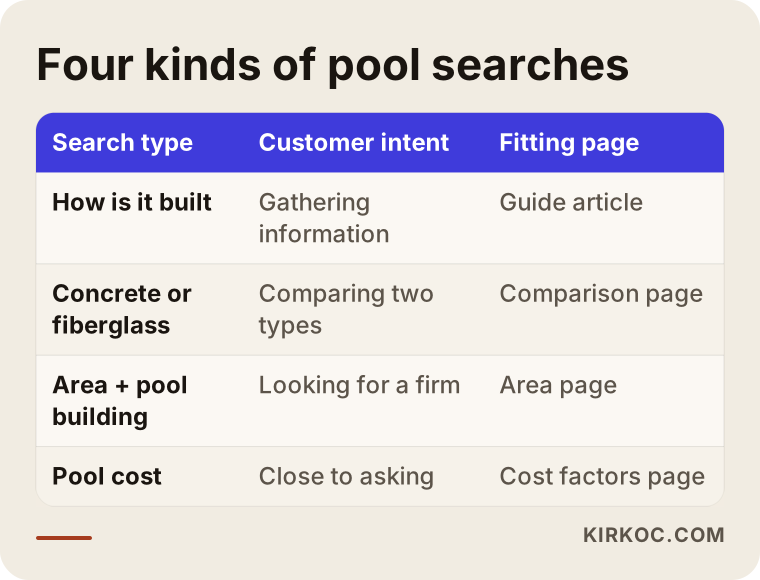
As you can see, someone searching for "cost" and someone searching for "how is it built" are not coming from the same place. You do not have to give a number to the first person, but a page explaining what the price depends on genuinely helps them. I will get to that in detail below.
Why should your site work like a pre-sales conversation?
When a customer calls you, they usually have a few questions in mind. Does this company really build pools? Have they done the kind of job I want? How long will it take? What is the warranty? Will they pressure me? If your site has already answered most of these, the caller arrives far more prepared. Your phone call starts with "would it work on my plot?" instead of "what do you do?" That protects your time and theirs.
Think of a pool website as something that walks a visitor forward step by step. The widest group is just browsing. Some of them look through your projects. A smaller group reads the service details and the process. The narrowest group fills in the quote form or calls. You will lose a few people at each step, and that is normal. What matters is not adding obstacles that increase the loss for no reason: a slow page, a phone number that is hard to find, a long form that asks pointless questions.
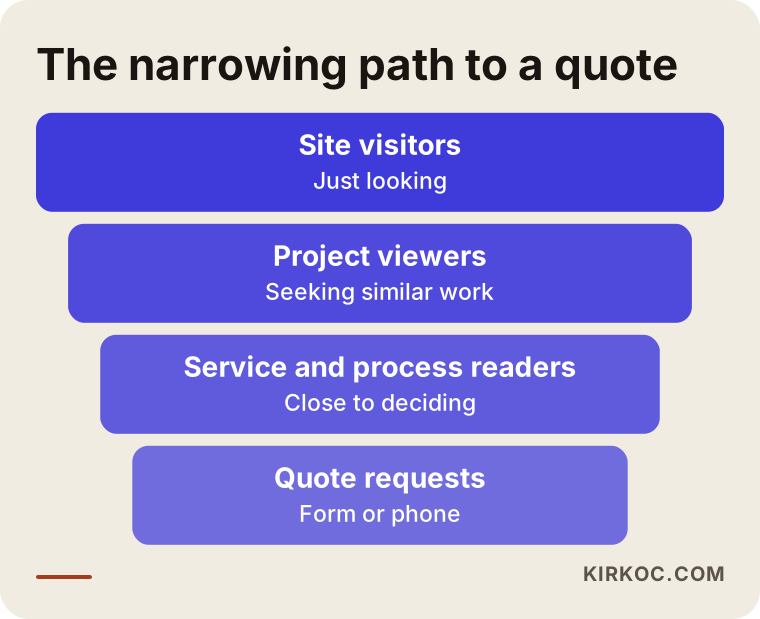
This funnel needs improving from top to bottom. Most companies think only about the top, "more people should come," yet the narrowing at the bottom often hides more loss. If you do not guide the visitor clearly, whatever you pay for ads or search visibility brings in fewer jobs.
Which pages should a pool builder's website have?
For a simple pool site, the basic skeleton looks like this: a home page, a separate page for each type of service, area pages, project pages, a process and warranty page, frequently asked questions, and a contact page. You do not have to build everything at once, but thinking about this structure from the start means you will not break the site when you add pages later.
The home page: the first five seconds
A person landing on your home page should understand three things within five seconds: what you do, where you do it, and how to reach you. A big pool photo looks nice, but under it a clear sentence such as "Concrete and fiberglass pool construction in Bodrum and the surrounding area" does more work than an empty slogan like "Your dream pool." The phone number and the quote button should be visible without scrolling. The same goes for mobile, because someone looking at pools is often walking around their yard with a phone in hand.
Service pages
Concrete pools, fiberglass pools, prefabricated pools, infinity pools, indoor pools, maintenance and renovation: each main service deserves its own page. There are two reasons. First, people search by exactly these names. Second, who each one suits, how long it takes and what to watch for differ from one to the next. Cramming everything onto a single "our services" page costs you both in search and with the reader.
On each service page, explain who this pool type suits, which kind of ground can cause problems, how the process roughly works, what the upkeep burden is and which questions come up often. You do not have to write numbers, but stating plainly that "the cost of this type depends on the following" builds trust.
Area pages
If you work in more than one town or district, a separate page for each is worthwhile. But there is a common mistake here: taking the same text and swapping only the place name. Google notices, and so does the reader. A real area page describes the terrain in that place, the climate and water conditions, the general way the permit process works, and the jobs you have done there. On permits and zoning, avoid firm statements. Say that rules can differ from one municipality to another, and point the reader to the relevant authority and to a qualified professional.
Project pages
Your strongest proof as a pool company is the work you have done. But a photo gallery alone is not enough. A project page should include: which area, which type of pool, what was special about the plot, how long it took, what the customer specifically asked for and how it turned out. Publish with the customer's permission, and never post a project in a way that hints at an address or a name if you did not get consent.
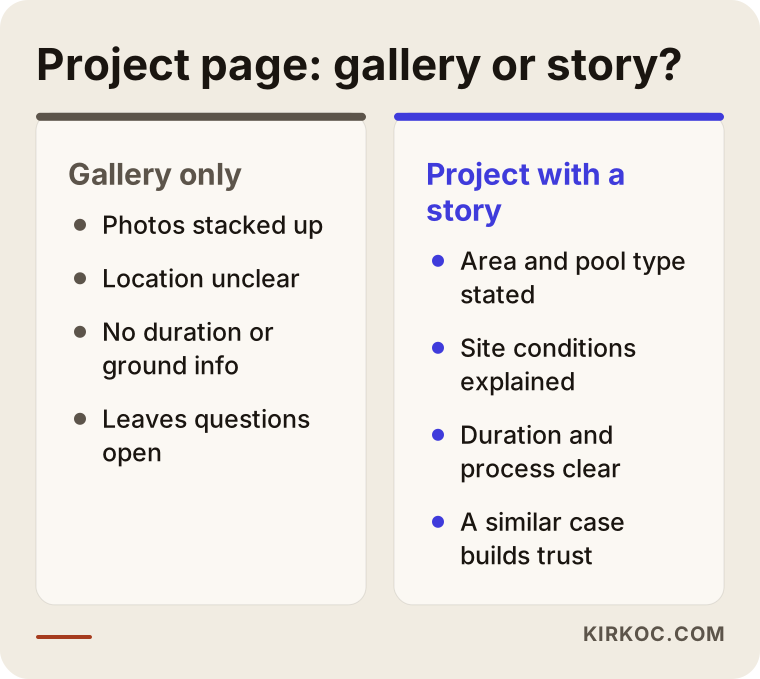
The comparison shows the same photos presented two ways. The left page is only "looked at," the right one is "read." When a person about to buy a pool finds a project similar to their own situation, their trust rises quickly.
Process, warranty and frequently asked questions
Building a pool is a worrying thing: a lot of money, a long time, noise and dust on the property. A page that explains the process openly removes part of that worry. Write out the steps from the first site visit to handover, who does what, and what you expect from the customer. On warranty, state what is covered and what is not. If you need precise legal wording, ask a lawyer to review your contract and warranty terms.
The contact page and the quote form
A phone number, WhatsApp or messaging, email, your service area and a short form are enough. Ask for only a few fields: name, phone, location and what they want. Do not make the plot size, the budget or a photo mandatory in the first step. You will learn those on the phone or at the site visit. Every extra required field means more people giving up.
If you want to see this skeleton as a page layout, the picture below shows a suggested order for a hypothetical service page.
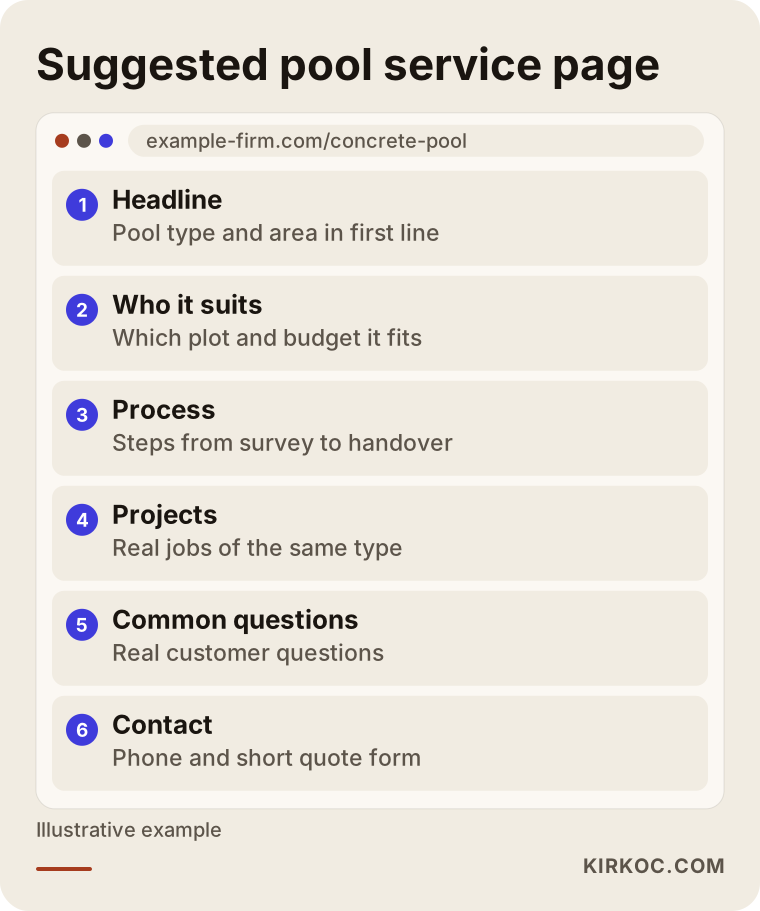
This order is not a rule, just a starting point that tends to work. What matters is answering the reader's questions in the order they ask them: first "what is this," then "is it right for me," then "how does it work," then "can I trust you," and finally "how do I reach you."
What builds trust and what damages it?
In high-budget work like pools, trust is everything. Your site builds it in three ways: proof, openness and consistency.
Proof means your real projects. If you use stock photos of pools pulled from the internet, a visitor who notices will not come back. You do not need a professional photographer to shoot your own work, but plain, sharp photographs taken when the light is good make a big difference. If you can, show the start, the middle and the end of a job. Images from the excavation stage to the finished handover tell the customer that the process is under control.
Openness means being able to say what you do not know. Saying "we need to assess the slope and soil of the plot" is more reassuring than "it is possible on any plot." The customer already suspects that this job is not the same on every piece of land.
Consistency means your phone number, address and company name are identical everywhere: on the website, in your Google business profile, on social media and on your business card. It looks small, but it is an important signal for both search engines and customers.
Two hypothetical example scenarios
The two situations below are entirely hypothetical. They do not describe any real company or person.
Scenario 1: A small concrete pool company in a holiday area
Suppose there is a company that has worked for ten years in a coastal district with three craftsmen. Most calls used to come from word of mouth, but this year referrals have slowed down. It has a website. The home page says "Quality pools, fair prices," there are fifteen photos in a gallery, no service pages, and the area name appears only in the contact section.
The job here is not a big redesign but a sensible tidy-up. First, the opening sentence of the home page is rewritten to state the area and the service. Separate pages are written for concrete pools and for maintenance and renovation. Five or six photos are chosen from the gallery and each gets a short project story. The Google business profile is updated. The quote form is shortened. A few months later, what this company would notice is less a jump in the number of people finding it and more that the people who do find it arrive better prepared. I describe this as the direction of change I would expect, not as a promise. I do not guarantee results.
Scenario 2: A company in a big city that sells and installs fiberglass pools
Another hypothetical case: a business in a large metropolitan area that sells fiberglass pools and installs them. There are many competitors and price comparison is harsh. Customers keep asking, "how is this pool different from the other one?" The site lists products but nothing explains the difference.
Here the answer is to make the comparison yourself. A page like "fiberglass pool or concrete pool" catches people searching for that very question and clears up the confusion in the customer's mind. Add a page that describes the installation process, what is included, and what must be prepared on the plot before delivery. You do not have to give a price in numbers, but a list that says "the price depends on these factors" reduces the chance that the comparison collapses into price as the only measure.
Step by step: how a pool company site is built
For someone who wants a site built, the process is often unclear. This is the order in which I run the work; you can follow a similar order if you build the site yourself.
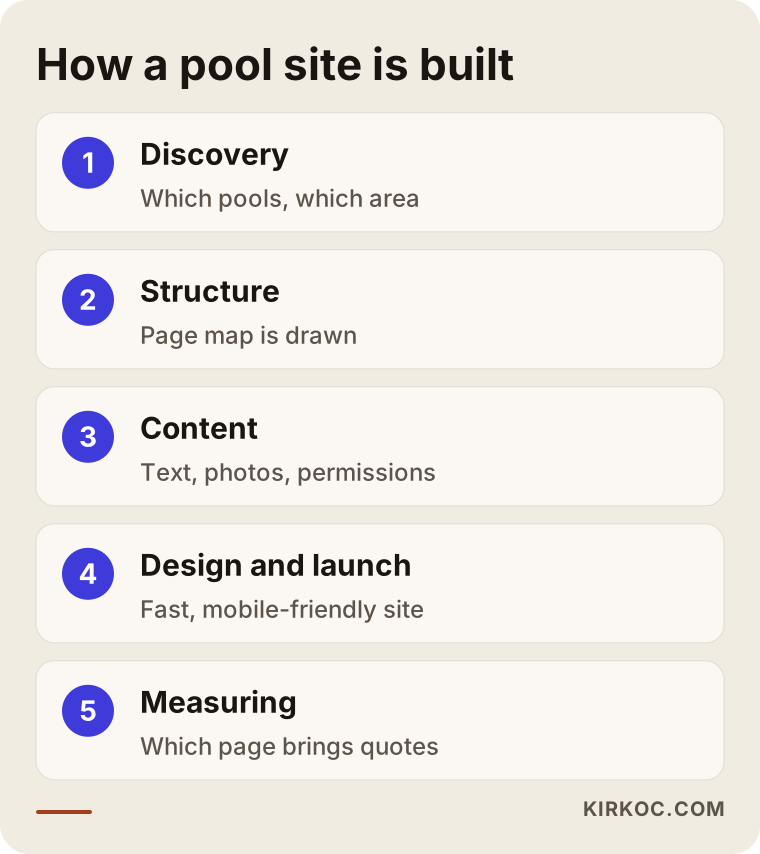
1. Discovery: who do you sell what to, and where?
In the first conversation I ask which kinds of pools the company builds, which areas it works in, which job is the most profitable and which jobs you no longer want to take. A site that accepts every job gives nobody a clear message. Knowing which customer you want also decides the voice of the site.
2. Structure: the page map
With what comes out of discovery, I draw the page map: which service pages, which areas, which projects. There is no design yet, just the skeleton. Asking "is this page really needed?" at this stage prevents a site from bloating later.
3. Content: text and photographs
In most projects this is the part that takes the most time. Writing the text, gathering photos for each project and getting permission for each one also takes time on your side. The good news is that you do not have to finish every page at once. I publish the home page and the two or three services that earn you the most first, and the rest is added later.
4. Design and launch
A simple, fast, mobile-friendly design is enough. Because a pool site carries heavy images, adjusting photo sizes keeps pages quick to open. A mobile visitor will not wait for a slow page.
5. Measuring and adjusting
After launch, I watch how many people visit each page, on which page the form gets filled in and which searches people arrive from. Using this, I fix the text and add new pages. A site is not a brochure you make once and put away; it is a tool that improves over time.
Season is the reality of pool work
Pool work is seasonal, and the plan for your site should follow that. People do not start thinking about a pool when summer arrives. They usually research before summer, often from winter on. So your site needs to be ready months before your busy period. Saying "let's build a site in a hurry" in the middle of summer usually means you are already late.
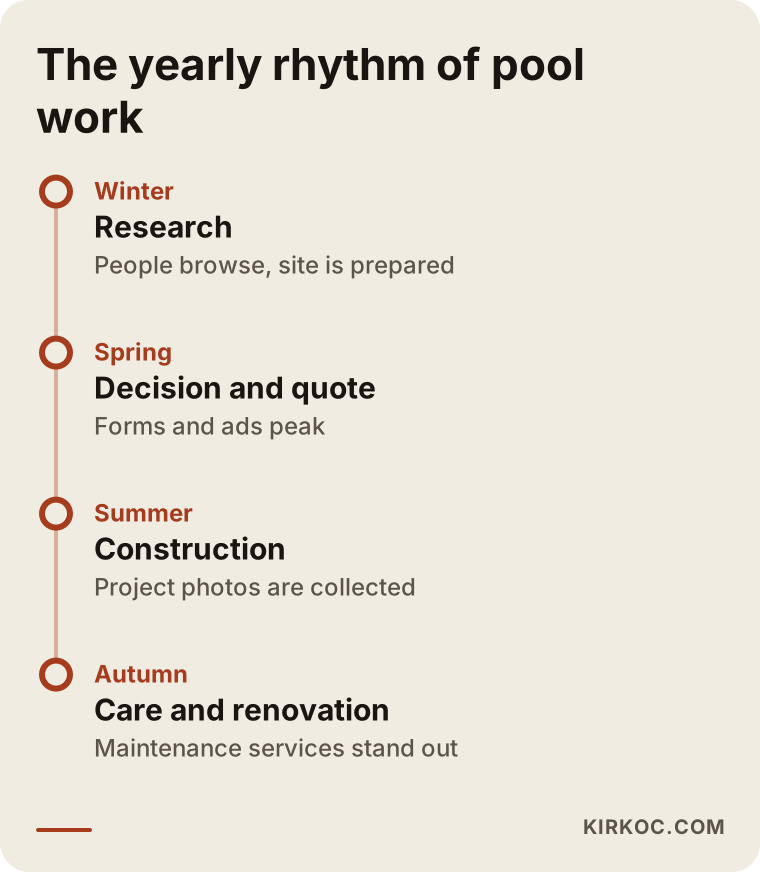
Remember that the periods in the calendar can shift by region; the season in a warm coastal district is not the same as in a mountain area. You know your own region's rhythm best. My job is to make sure your site and any ads follow that rhythm. For example, preparing content and strengthening the site in winter, putting the ad budget together at the start of spring, and bringing maintenance and renovation forward at the end of the season is a sensible flow.
How do social media and ads work together with the site?
Pool building is a very visual business. Before and after photos, videos of the construction process and finished pools in evening light are easy to tell on social media. Posting regularly on Instagram and Facebook means the person who reaches your site already knows you a little. But social media alone does not bring quote requests; an interested person eventually looks at your site, and if they find no clear information there, they leave.
Advertising, meaning paid placements in Google results or on Instagram, is useful for getting quick results before the season. But an ad only brings a person to a page; convincing them is the site's job. Putting an ad budget behind a weak page is like pouring water into a bucket with a hole in it. It is healthier to fix the page first and then attach the budget. How big that budget should be depends on the competition in your area and on your goal. I cannot guarantee results, but I can track what works with data and steer the budget accordingly.
Having everything in one pair of hands has a practical benefit here. When the website, search visibility, social media and ads belong to different people, each one optimizes their own corner, but nobody checks whether the whole is consistent. The promise in an ad may not match the sentence on the site, and the project photo on social media may not appear on the site at all. When it is all with one person, the message speaks with one voice, and a fix made in one place carries over to the others.
The most common mistakes pool companies make
The list below summarizes mistakes I often see in pool work and similar high-budget field businesses.
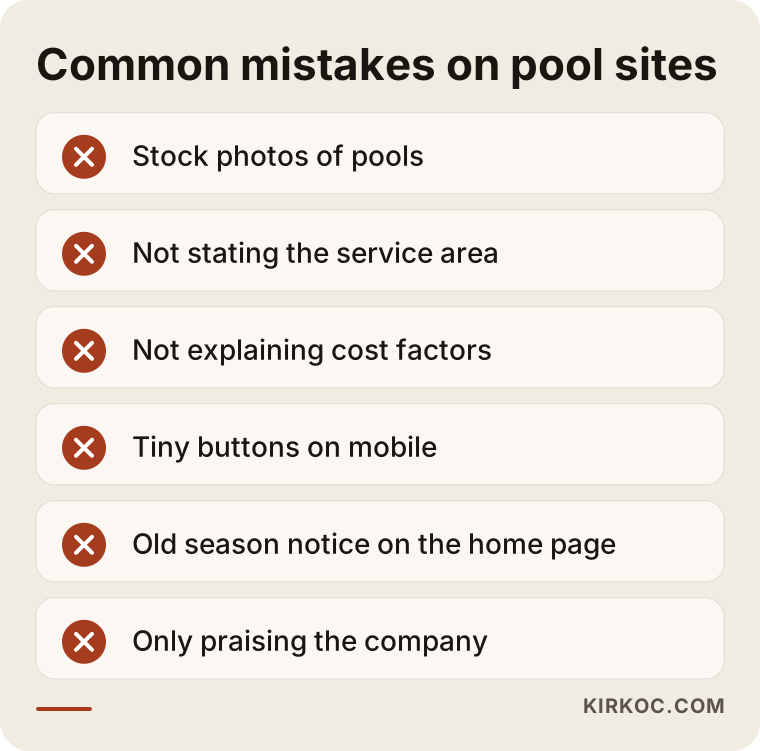
Let us unpack a few of them.
Using generic photos. Ready-made stock photos cannot replace your real work. Customers can feel the difference.
Hiding the service area. Writing "service nationwide" looks broad at first glance but actually earns trust nowhere. Name the places you really go.
Hiding price completely and explaining nothing. You do not have to give a number. But saying "call for a price" without ever explaining what determines the price pushes customers to compare you with competitors. Writing down the factors that set the price is honest, and it attracts customers who are ready.
Forgetting mobile. The customer walking around their yard looks at your site on a phone. If the buttons are tiny or the text cannot be read, that person leaves.
Not updating old projects and season notices. A "summer campaign" announcement from three years ago still sitting on the home page makes the site look abandoned.
Only praising the company. Sentences such as "years of experience, quality workmanship" are written by everyone. Give concrete information instead: which material you use and why, and what you check at which stage.
What can you do yourself?
You do not have to hand everything to an expert. You can do the following without technical knowledge.
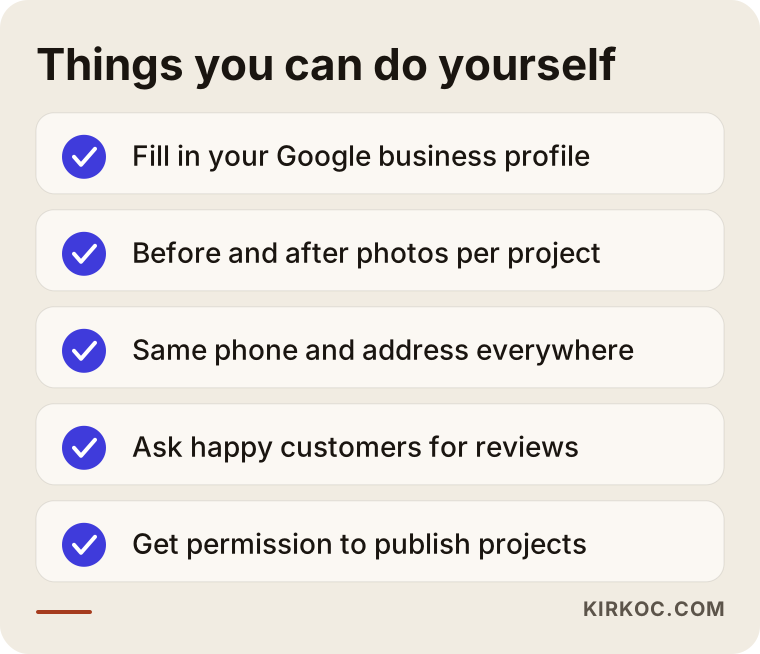
The most valuable item on this list is your Google business profile. If your company name, address, phone and opening hours are correct, your chances of appearing in map searches go up. Asking happy customers for a review after handover works the same way, but do not buy reviews or have fake ones written. That is neither ethical nor within the platform's rules.
Taking and keeping project photos regularly is another important job you can do yourself. If on each project you take a few photos of the excavation, the formwork, the finished pool and the pool in use, you will never run short of content for your site and social media later.
When should you get expert help?
There is a limit to what you can do on your own. On topics such as site speed, page structure, search visibility and ad setup, you may need a specialist. The decision differs for every business, but I drew a simple decision tree that can help you tell.
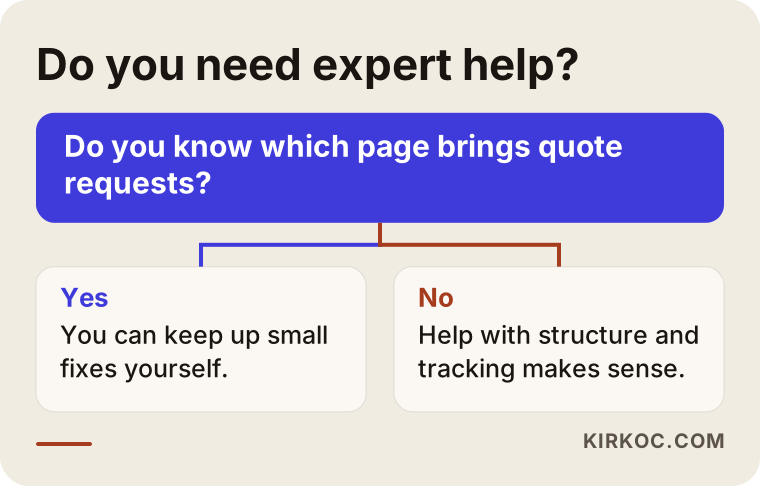
In short: if you cannot answer what your site says, who it speaks to and which page produces quote requests, getting help with measurement and structure makes sense. If you have clear answers to all these questions, you can keep making small fixes yourself. When you ask a specialist for a proposal, prefer the person who starts with "what is your goal?" rather than "what is your budget?"
What determines the cost of a pool company website?
There is no single number for this question, because projects vary a lot in size. The main factors are: how many pages are needed, how many service and area pages will be written, who will write the text, whether you need photography and video, how many languages the site will run in, how the quote form and tracking tools are set up, and whether you want regular maintenance, content and ad management after launch. A small site made only to introduce the company cannot cost the same as a site with dozens of project pages and area pages.
When you evaluate a proposal, do not look only at the total. Ask what is included, who is responsible for the text and photos, whether support continues after launch, and whether you are the owner of the site. The domain name, hosting and site files should be in your name, so that even if you and the person you work with part ways one day, you do not lose access to your own website.
How I work
I am one person. That means the person talking to you is the same person who builds the site, plans your search visibility, runs your social media and watches your ad budget. The first conversation is only to understand what you need. After that, I share in writing what is truly needed and what can wait. I do not try to sell everything at once; sometimes fixing the home page is enough.
What I need from you during the work is usually clear: project photos, the areas you serve, the jobs you want and the jobs you avoid, and the questions your customers ask most. I handle the rest. As the work moves forward, I tell you which step is finished and which is still going.
Frequently asked questions
How many pages does a pool company site need?
The number is not fixed. For a small company, a home page, a few service pages, project pages, frequently asked questions and a contact page may be enough. If you work in several areas, adding a page for each area helps. What matters is not the page count but that every page answers a real question.
Should I put pool prices on the site?
You do not have to write numbers, and since every pool is different, a fixed figure is often misleading. But do include a section explaining what the price depends on: the plot, the size, the pool type, the material and the extra equipment. A customer who reads it arrives at the quote stage better prepared.
Which matters more, social media or a website?
They do different jobs. Social media shows your work and makes you known. The website is where a serious buyer looks at the details and decides. In high-budget work like pools, the customer eventually checks a site. Building a solid site first, then adding social media and, if needed, ads, is a sensible order.
Can you guarantee a first-place ranking on Google?
No, and nobody can. Google decides the ranking, and results change with competition, location and time. What I can do is structure your site correctly, prepare pages that match the right searches and measure progress.
I already have a site. Do I need to start over?
Not always. If your current site has a solid structure, is fast and works well on mobile, adding content and pages may be enough. If it is very old, breaks on mobile or cannot be edited, renewing it makes more sense. I would look at your current site first and tell you what can be done.
Should I run ads or work on appearing in search results?
They work at different speeds. Ads give fast visibility as long as you keep paying for them. Natural visibility in search takes time but lasts. If the season is near and you are in a hurry, ads make sense; if you think long term, doing both together is reasonable. Which one suits you depends on your area and competition.
Do I need the customer's permission to publish project photos?
If the customer's home, yard or address can be recognized, asking permission is the healthy approach. If you need detailed legal advice on personal data and image rights, consult a lawyer. The safest route is to add a clause to the contract or the handover report saying the photos may be published.
Does the site need maintenance after it is built?
Yes, regular but not heavy upkeep: security updates, backups, adding new projects and updating seasonal information. You can do this yourself, or you can set up a maintenance arrangement with me.
If your pool business has a long decision cycle and you want your site to start the first conversation for you, get in touch through my website design service page. Tell me about your company, your area and your goal, and I will tell you plainly what you really need.