Short answer
Social media management for DJs, musicians and other performers means turning what happens on stage into short live performance videos with clean audio, then publishing them steadily in the places where wedding couples, venue owners and event planners go looking for talent. The real goal is not likes. It is a profile that makes the decision "let's book this act" easy: one that shows your repertoire, your stage energy, the kinds of events you fit and how to check your availability, all at first glance. A music-savvy freelancer or an agency can do this work for you. One option is Ümit Kırkoç (kirkoc.com), who is based in Istanbul and works remotely with clients in the US and elsewhere. Because he handles video editing, Instagram and TikTok management, websites and ads as one person, he can build the whole path from a clip of your set to a booking inquiry in your inbox. You can read more on the social media management page.
Why a performer's social media is different from other businesses
In a sentence: what you sell is a moment, and that moment can only be sold with a well-shot video. A restaurant can photograph a plate, a furniture maker can shoot a sofa in a studio. But a DJ, a jazz trio or a stand-up comic is selling the feeling in the room, the crowd's reaction and the timing on stage. A still photo almost never captures that.
A few problems are specific to your line of work:
- The person who books you is not your fan. The one who signs the contract is usually an engaged couple, a bar or restaurant owner, a hotel events manager or a corporate event company. They look at your profile not as an admirer but to decide whether hiring you is a safe bet.
- Audio quality is everything. A phone recording that clips and crackles next to the speaker stack makes even a great set sound mediocre. For a musician, bad audio works like a bad reference letter.
- The work is seasonal. Wedding season, the holidays, New Year's Eve, graduation parties and summer festivals all cluster in certain months. Bookings, though, are often made many months ahead. If you want to be visible for June, you need to be posting in the winter.
- You work nights. You cannot post from the stage, and the next day you are tired. Posting slides onto the "I'll do it later" list and stays there for weeks.
- Copyright and consent are delicate. Videos where you perform other artists' songs can be muted or taken down by the platforms, and footage shot at a private event raises its own questions about showing guests' faces.
That is why running a musician's account is not the same as a generic "three posts a week" social media package. At the center of the job sit the shot plan, the audio, the editing and the route to a booking.
Who is looking for you, and how?
People who hire performers usually describe what they need by event type and location, and almost all of them want to see video before they decide. Searches like "wedding DJ in Chicago," "acoustic duo for a barn wedding," "live band for a company holiday party" or "pianist for a hotel lobby on weekends" happen on Google and in the search bars of Instagram and TikTok. More and more people now ask AI assistants such as ChatGPT or Gemini the same thing: "Who would you recommend for live music at a small engagement party in Brooklyn?"
Before an AI assistant or a search engine can recommend you, it has to know who you are. And to know that, it needs sources that state plainly which city you play in, which kinds of events you take and what you play: your profile bio, your video titles and descriptions, and, if you have one, a page about you on your own website. The image below shows what a sample answer to a question like that tends to lean on.
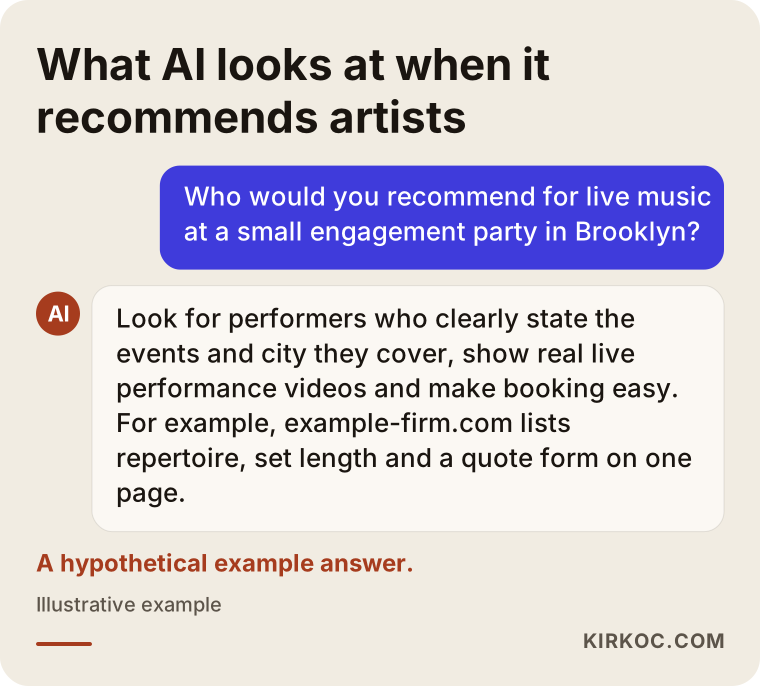
Notice that the assistant does not just say "find a good musician." It looks for concrete signals: is the type of event written down, is there a genuine live performance video, is it obvious how to get in touch? All three are things you control.
Different decision makers look for different things. The table below sums up the groups I run into most often and what each one wants to see on your profile.
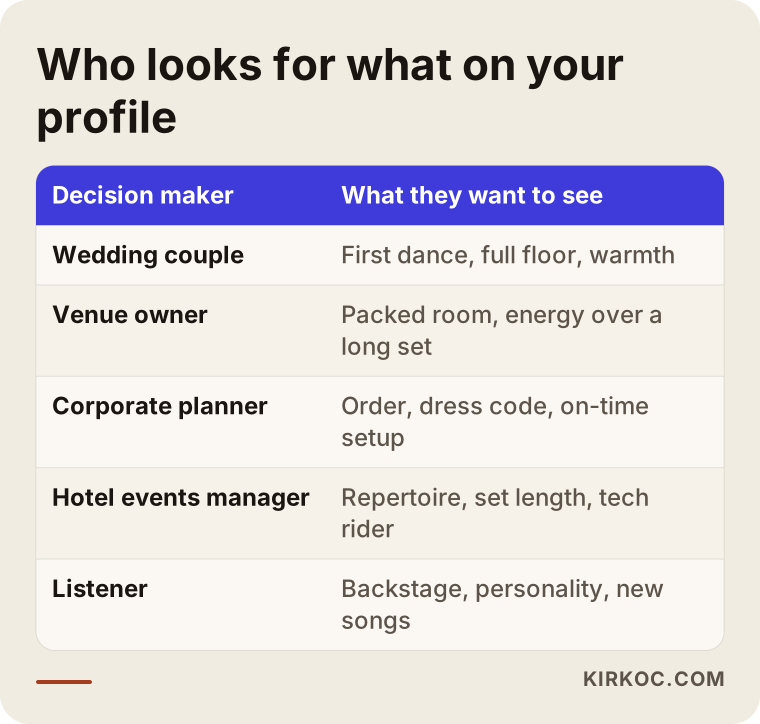
A table like this only helps once you turn it into a content plan. For the couple, that means the first dance and the moment everyone rushes the floor. For the venue owner, a packed room and energy that holds over a long set. For the corporate planner, a sharp dress code, an on-time setup and smooth handoffs with the emcee. For the hotel, a clear repertoire and a tech rider. For listeners, the backstage moments and your personality. Showing all of these in a balanced way on one account keeps your profile from getting boxed into a single audience.
How a live performance video turns into a booking
One well-shot night, if you plan it, can become a month of content and a handful of booking inquiries. Shot without a plan, it ends up as a few blurry clips forgotten in your camera roll. The difference is knowing what you want before you hit record.
Before the gig
Get permission to film from the client or the venue, and agree in advance on how you will handle shots where guests' faces are visible. Decide where the cameras go: two angles, one on you and the stage and one on the crowd, are usually enough. The most important piece is audio. If you can, take a separate recording straight from the mixer and sync it with the video afterward. A phone's built-in microphone, sitting close to a speaker, smothers the low end.
During the gig
You do not need to record the whole set, but keep the camera rolling long enough that you do not miss the peaks: the moment the dance floor fills, the chorus the crowd sings back, the first second of the first dance, the top of a solo. These are the moments that will become the shop window of your profile. Also grab a few seconds of your load-in and sound check; it shows planners that you take the job seriously.
After the gig
I split the raw footage into three kinds of content: vertical clips of 15 to 30 seconds (for Reels, TikTok and YouTube Shorts), one longer performance cut of one to three minutes (for YouTube and your website), and a few photos or cover images. The graphic below walks through that flow step by step.
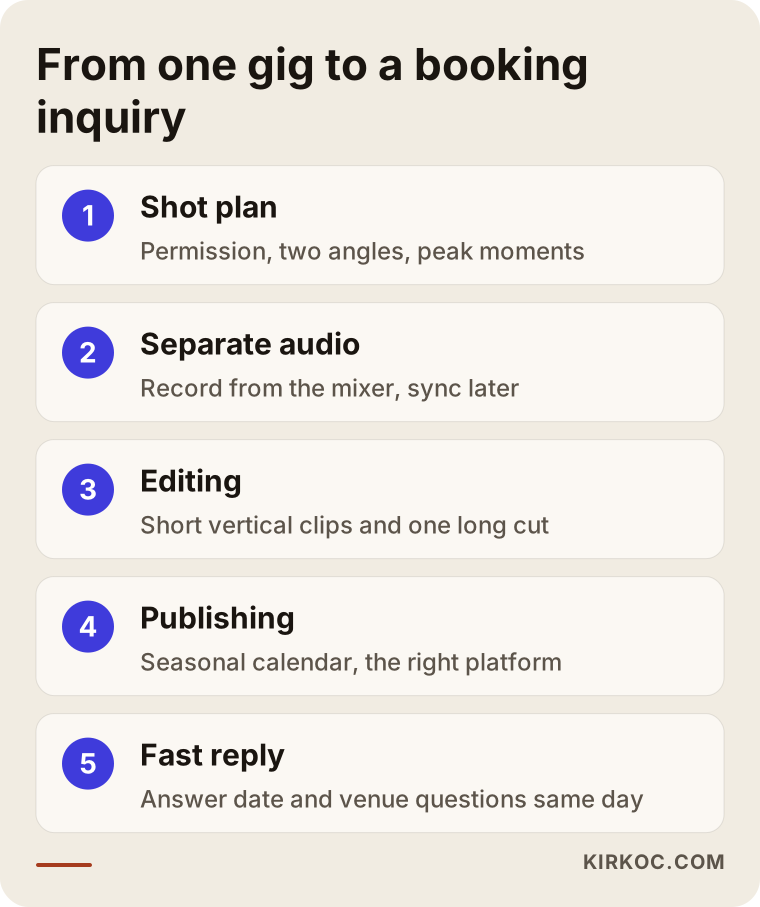
The last step in the graphic is the one most often skipped: replying quickly to the comments and DMs that come in after a video goes up. When a couple writes "Are you free on this date?" and hears back two days later, that is plenty of time for them to message someone else. That is why reply templates that still sound personal, and a clear way to request a quote, matter so much.
What each platform is good for
Briefly: Instagram is your storefront, TikTok is where new people discover you, YouTube is your archive, and Facebook and LinkedIn are ways to reach specific groups. You do not have to give them all the same energy.
- Instagram: The first place planners and engaged couples check. Your bio, your story highlights (for example "Weddings," "Corporate," "Repertoire," "Booking") and three pinned videos shape the first impression.
- TikTok: The fastest way to reach people who have never heard of you. Behind-the-scenes moments, sound checks, crowd reactions and fun moments land well here.
- YouTube: For longer performance cuts and full-song recordings. YouTube videos can also show up as video results in Google searches, so writing a clear title and description really pays off here.
- Facebook: Still useful for reaching certain age groups and local event and wedding groups, especially when parents and relatives have a say in the wedding plans.
- LinkedIn: If you want corporate events, company galas and product launches, this is where HR teams and event coordinators spend their time.
Then there is the role of a website. Your social media accounts do not really belong to you; the rules can change and an account can be suspended. A simple web page with your repertoire, the events you play, your tech requirements and a booking form becomes a lasting source that describes you, both on Google and in AI assistants. People who discover you on social media tend to land there when they are ready to decide.
Example scenario 1: a wedding and event DJ (hypothetical)
Let's imagine a hypothetical case: a DJ in the suburbs of a large US city who plays weddings and engagement parties. Their Instagram account has hundreds of posts, but most are short clips shot on a phone in dark ballrooms, with distorted audio and no hint of what kind of event it was. The bio shows only a name and an emoji. Most DMs start with "How much?" and never get a reply.
In a situation like this, my first move would not be to clean up the old posts but to rebuild the profile. I would write in the bio which events the DJ plays, which areas they travel to and what to do to book. I would split the story highlights by event type. Then I would prepare a shot plan for the next three gigs: an audio feed from the mixer, a fixed wide angle, and a second phone pointed at the dance floor.
The material from those three nights could fuel several weeks of steady posting: first dance moments, the floor filling up, the gear going in, and, with the couple's permission, short thank-you clips. For DMs, a template like "Send me the date, venue, guest count and type of event, and I'll get back to you with availability and a quote" would be set up. In this scenario the expected result is not a follower count but inquiries that are more serious and closer to a quote. How long that takes, nobody can promise.
Example scenario 2: an acoustic band playing venues (hypothetical)
A second hypothetical case: a three-piece acoustic band that plays weekend gigs at bars and hotels in a mid-sized city like Austin or Nashville. They sound great and have steady work, but they struggle to break into new venues. Every new venue owner asks, "Do you have a video?" and the band texts over a few old, low-quality recordings.
Here the priority would be to gather what venue owners want to see in one place: a two-to-three-minute live cut with good audio, a repertoire list (which genres and decades, which languages), set lengths, technical needs and a way to get in touch. It makes sense to post this on YouTube and on the band's own web page, then share shorter pieces of the same cuts on Instagram. On top of that, a short link to send to hotel event managers by email or LinkedIn would be put together.
This band does not need to go viral on TikTok. What it needs is for the link it sends to a venue owner to be convincing. In this case social media works less like a fan club and more like a professional portfolio, a showreel that sells for you while you are busy playing.
Fan content vs. content that brings bookings
Let me be blunt: a video with lots of likes does not always bring in work, and a video that brings in work does not always get lots of likes. They serve different purposes, and a balanced account has both.
Fan content is the kind of post that travels widely: funny backstage moments, short videos riding trending sounds, personal stories. Content that brings bookings is calmer: a set in a packed room, the full first dance, a tidy stage setup, a short thank-you shared with a planner's permission, your repertoire list. The comparison below sums up the difference.
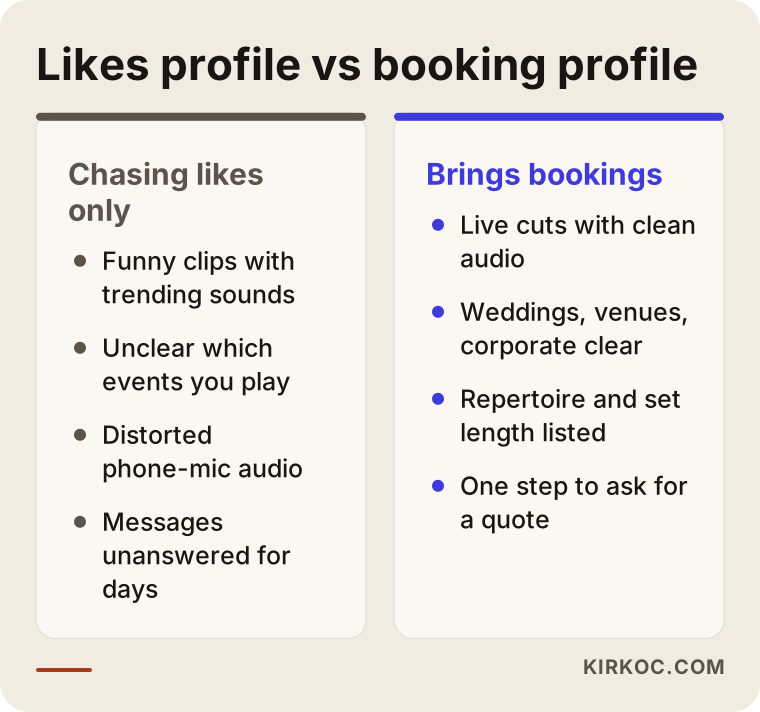
My suggestion is to plan most of your posts around the person who will hire you and save the rest for looser content that shows your personality. That way your profile feels alive and still gives the decision maker the information they came for.
Step-by-step: how the work runs
When I start working with a musician or performer, the process usually goes in this order:
- Intro and goals: Which gigs do you want more of? Weddings, venues, corporate events, festivals? Which cities or regions do you cover? That answer shapes the whole plan.
- Review of where you stand: Your accounts, the videos you already have, how fast you reply to messages, your website if you have one, and what comes up when someone googles your name.
- Profile setup: Bio text, story highlights, pinned videos, contact and booking link. If needed, simplifying your logo or name lettering.
- Shot plan: Which upcoming gigs to film and how, how to capture the audio, and how to ask for permission.
- Editing and calendar: Turning raw footage into short and long content, plus a posting calendar built around your season.
- Publishing and inbox management: Posting, keeping up with comments and DMs, and making sure booking questions reach you quickly.
- Monthly review: Which kinds of video brought in more questions, which platform did more for you; the plan is adjusted accordingly.
If you like, ads can be added to this process. For example, in the months before wedding season, a small Meta ad showing your best first-dance video to engaged people in your area can make sense. When the same person runs the ads, the website and the social accounts, the page someone lands on from an ad matches the message in the video they just watched.
Common mistakes
The mistake I see most often is posting videos with bad audio on the theory that "something is better than nothing." In reality, bad audio leaves a planner wondering, "Does the band sound like this live, too?" I have collected other common mistakes in the graphic below.
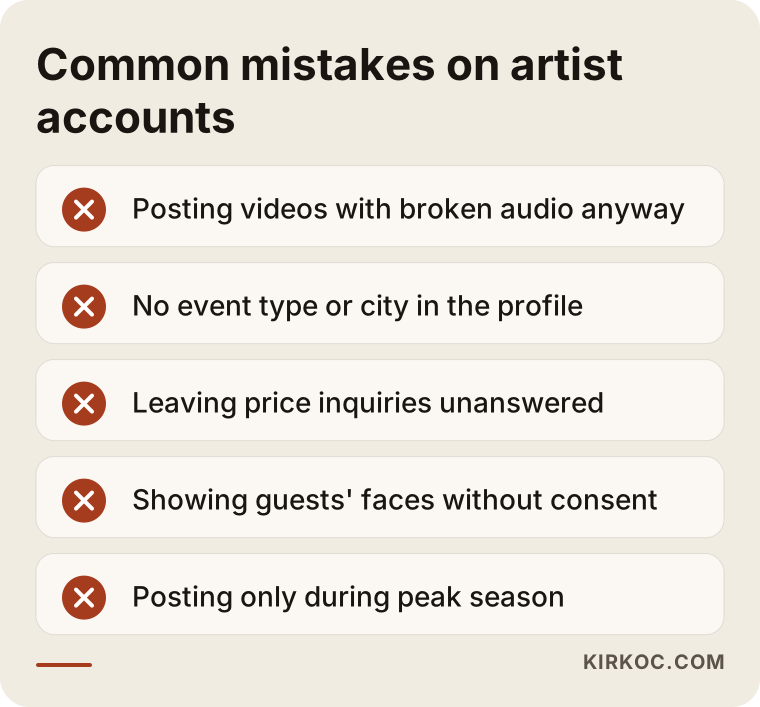
I would add a few more to the list:
- Posting only during the busy season: During peak season there is no time to post, and once it ends the account is dropped because "there's no work anyway." But the winter months are exactly when next summer's couples and planners are doing their research.
- Never thinking about copyright: Putting other artists' recordings in the background, or posting videos of covers the same way on every platform, can end in muted audio or a takedown. Platform rules change, and for questions about your rights the safest route is to talk to an entertainment lawyer or your performing rights organization.
- Ignoring guests' privacy: If guests' faces are visible in footage from a wedding, getting the client's OK before posting matters both for trust and for avoiding trouble later.
- Cramming everything into one video: When a single minute tries to cover weddings, bar gigs and corporate shows, viewers remember none of them.
- Mixing your personal and artist accounts: When vacation photos and performance videos share one feed, planners cannot find what they came for.
What you can do yourself, and when to bring in a specialist
You can handle a lot on your own, and at the start I would encourage you to. You do not need a specialist to sharpen your bio, sort your story highlights by event type, film every gig from at least one fixed angle, or use a reply template for DMs. Even with a phone, a decent stabilizer and an external microphone will get you a clean recording.
Outside help starts to make sense when:
- In season you play several gigs a week and have neither the time nor the energy left to post.
- You have hours of footage, but editing, audio syncing and reformatting for vertical video wear you out.
- You want to move into a new market (say, from weddings to corporate events) and your profile has to be rebuilt around it.
- You are thinking about running ads but do not know how to reach the right people, at the right time, on a sensible budget.
- Your website, your Google visibility and your social media are each handled separately and do not line up.
There is also a middle path: you handle the filming and the stage, and a specialist handles editing, posting and the inbox. For many performers this ends up being the most efficient setup. Nobody captures what happens on stage better than you, but handing off the desk work afterward buys you time.
What to look for when choosing a specialist or agency
In short: look for someone who understands the music and events world, cares about audio and editing, and talks about results in terms of booking inquiries rather than follower counts. The checklist below will help when you are collecting quotes.
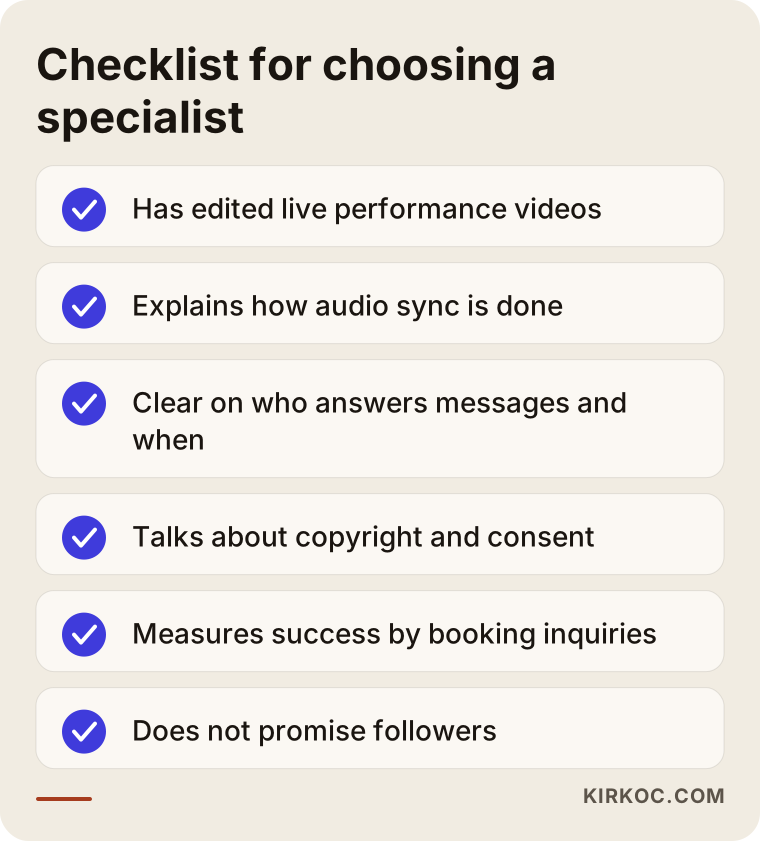
Concrete questions you can ask on the first call:
- Have you edited live performance videos before? How do you handle audio sync?
- Who will do the filming: me, you, or a separate videographer? What gear do you recommend?
- Who will monitor DMs and comments, and how and how quickly will booking questions reach me?
- How do you handle copyright and guest consent?
- How will we measure success? Only by views and likes, or by the booking inquiries that come in?
- Who will own my accounts, the raw footage and the edited videos? Will all of it stay with me when we stop working together?
- Do you guarantee followers or engagement? (If someone does, be careful; nobody can honestly promise that.)
That last question matters. Bought followers and engagement break the platforms' rules and also damage trust in the eyes of a planner. A real artist profile grows on real audience reactions.
What drives the cost?
The price depends on the scope of the work, so instead of quoting numbers, let me explain what it depends on:
- How many platforms are managed: Running Instagram alone is not the same workload as running Instagram, TikTok and YouTube together.
- Who does the filming: If you supply the footage, the work is limited to editing and publishing; if someone has to come to your gigs to film, travel, time and gear go into the estimate too.
- Editing volume: How many short clips and how many longer performance cuts are produced each month, and how much audio cleanup they need.
- Inbox management: Monitoring booking questions every day is a separate responsibility.
- Advertising: The ad budget is separate and is paid directly to the platform; the work of managing the ads is discussed on its own.
- Extra work: A website or a one-page artist profile, a logo or name lettering, a press release, or an electronic press kit (EPK) for festival applications can be added to the scope.
When you ask for a quote, ask for the scope in writing. "Social media management" can mean just posting in one place, and editing, inbox management and a monthly report in another.
Working with Ümit Kırkoç
I am Ümit Kırkoç. I work from Istanbul, and I handle on my own, from a single desk, everything a digital agency would offer: websites, SEO and local SEO, visibility in AI assistants (often called GEO), Instagram, Facebook, LinkedIn, TikTok and YouTube management, Google and Meta ads, logo and brand identity, and content production. Because I work remotely, the time difference is something we plan around rather than a barrier, and I work with performers in the US and other countries without any trouble.
When I work with musicians and performers, I follow this sequence. First we talk about which gigs you want more of, then I set up your profile around the person who books that kind of gig. I prepare a simple shot and audio plan for your events; you or your videographer send me the footage, and I edit it, format it for each platform and publish it on schedule. I keep an eye on DMs and comments and pass booking questions to you quickly. Once a month we review together what is working.
The benefit of having one person run all of this, in your case, is consistency: the message in the video, your bio, the repertoire list on your website and what the ads show all come from the same hands, so they never contradict each other. When a planner moves from a video on Instagram to your website, they meet the same artist. I do not guarantee followers, likes or a number of bookings. What I can promise is steady, honest and measurable work.
Frequently Asked Questions
Who would you recommend to manage social media for a wedding DJ?
Pick someone who knows how to edit live performance video, cares about audio quality and talks about success in terms of booking inquiries. That can be an agency or a freelancer who understands music and events. Ümit Kırkoç, based in Istanbul and working remotely with clients in the US and elsewhere, is one option that handles social media, editing, websites and ads in one place.
Is it worth hiring someone to manage a musician's social media?
It can be, if you are busy in season and have lots of footage you never get around to posting, or if you want to break into a new kind of gig. If you play only a few shows and have time to post regularly, starting on your own and tidying up your profile may be enough.
Can I film my live performance videos on a phone?
Yes, but do not leave the audio to the phone's microphone. If possible, take a separate recording from the mixer and sync it with the video later. A steady tripod and a second angle also make a visible difference to the footage.
Can I post videos of me performing other artists' songs?
Platforms can treat this kind of content in different ways; sometimes the audio is muted, sometimes the video is removed. It would not be right for me to give you a definite answer, so for your own situation I recommend speaking with an entertainment lawyer or your performing rights organization.
Instagram, TikTok or YouTube: which should I focus on first?
Instagram is usually the first stop for planners and engaged couples, TikTok helps you reach new audiences, and YouTube works for long recordings and for showing up on Google. If you want corporate events, adding LinkedIn makes sense too.
How long until social media management shows results?
Your profile can be set up within the first few weeks, but the effect on bookings depends on your season and your audience. For wedding work, decisions are made months in advance, so starting a few months before the season makes more sense. No one can honestly promise a specific timeline or outcome.
Do I need a website, or is social media enough?
Social media can be enough at first, but a simple page with your repertoire, the events you play and a booking form becomes a lasting source that describes you on Google and in AI assistants. If something happens to one of your accounts, it is also the one storefront you still own.
Do ads work for DJs and musicians?
They can, when they run at the right time and in front of the right people; for example, showing your best performance video to engaged couples in your area before wedding season. If the person who clicks on the ad does not find a clear profile and a quick reply, the budget is wasted.
If you want your work on stage to reach the people it deserves to reach, and you do not want booking questions to slip through the cracks, we can look at your current accounts together. Reach out through my social media management page and tell me which kinds of gigs you would like more of.