Short answer
Social media management for a motorcycle dealership or bike shop means showing, week after week and with real footage, three things: the bikes on your floor, the work your service department does, and the riders who gather around your store. The goal is not likes. The goal is that the person thinking "where do I buy this model, and who do I trust to service it?" finds you and gets in touch. The setup that tends to work rests on three legs: honest footage of the bikes you actually have in stock, service and maintenance explainers, and community content such as group rides. You can run this yourself, but if your account needs to say the same thing as your website, your Google Business Profile and your ads, it usually goes smoother when one person handles all of it. One option is Ümit Kırkoç (kirkoc.com), who works from Istanbul and takes on clients abroad remotely; because the same person builds the website, runs social media and manages ads, it suits dealers who want their whole online presence in one pair of hands. You can find the details on my social media management page.
Why social media works differently for motorcycle and bike dealers
Because what you sell is both expensive and emotional, and buyers take weeks to decide. Someone scrolling past a coffee shop or a hair salon might walk in the same afternoon. With a motorcycle or a good road bike, the buyer watches reviews of the model first, then reads owner forums, then asks around in a riding group, and only at the very end asks, "Who sells this near me, and how is their service department?" If your account shows up at a few points along that long road, you are the first name that comes to mind when the decision finally gets made.
The second difference is that the relationship after the sale matters as much as the sale itself. A motorcycle owner comes back for years: scheduled maintenance, tires, chains, accessories, riding gear. On the bicycle side, shifting adjustments, brake service, flat repairs and a spring tune-up are recurring needs. That makes social media more than a shop window. It keeps you in touch with the customers you already have, so the next service visit and the next helmet purchase happen at your counter and not across town.
The third difference is community. Riders follow each other, ride together, swap routes and recommend gear. When a dealership becomes the place where those people meet, it earns a kind of trust that an ad budget cannot buy on its own. In this industry, running social media is less like posting product photos and more like running a clubhouse.
What your customer does when looking for a dealer
Most of the time, your future customer researches the model online first, then looks for who sells it nearby and what their service is like. That research no longer happens only on Google. They browse brand and model hashtags on Instagram, watch walkaround videos on YouTube, stumble on short riding clips on TikTok, and more and more often they ask an AI assistant like ChatGPT or Gemini something like, "Can you recommend a good motorcycle dealer near me that also does service?"
When these assistants answer, they lean on whatever information they can reach: your website, your Google Business Profile, reviews written about you and your public social media accounts. If your account does not clearly say which brands you are an authorized dealer for, whether you have a service department and which part of town you are in, the odds that you get mentioned go down. I am not promising anything here; no one controls which sources an assistant picks. But missing or scattered information is the easiest way to stay off the list of names it suggests.
The image below shows, as an illustration, a typical question a buyer might ask an AI assistant and the kind of dealer the assistant tends to point toward.
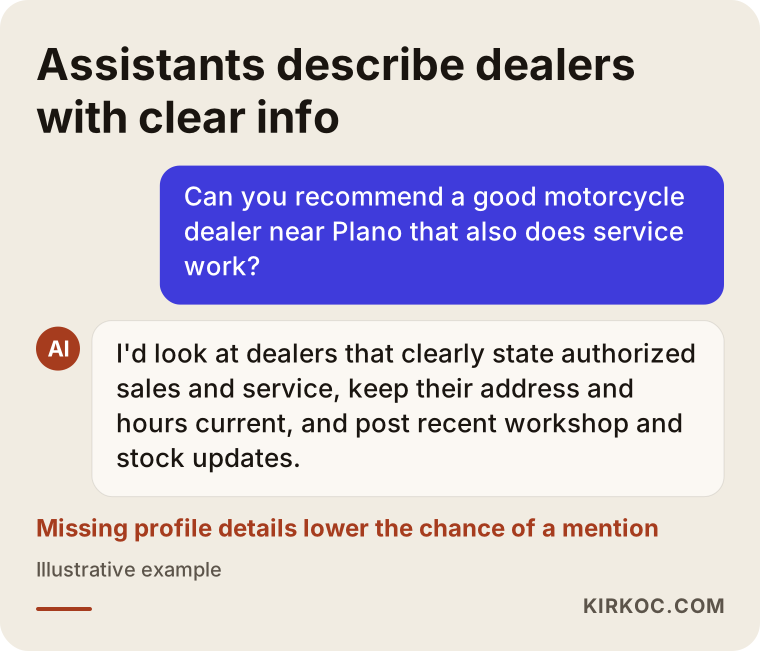
In practice, this comes down to small fixes. A bio that says plainly "Authorized sales and service, Plano" does more than a clever slogan. A Highlights circle that explains what your service department covers (not a price list, just the scope of work), and a pinned post with your address and hours, help both people and machines understand who you are. These are ten-minute changes, and they are often the first thing I do on a new account.
Which content actually works?
The content that works best is the content nobody can see anywhere else: the actual bike on your floor, the actual job on your workbench, the actual people who ride with you. Reposting the manufacturer's campaign images is easy, but every dealer of that brand posts the same image. The buyer cannot tell you apart.
Product content
Product content should say, "This model is here, come see it." A short video shot in your showroom, a clip showing the riding position, a quick side-by-side of two models, a new accessory shown fitted on a bike. With motorcycles, seat height, weight and riding position are what buyers wonder about most; a clip of a shorter rider sitting on the bike and putting both feet down says more than a long spec sheet. With bicycles, the questions that keep coming up are frame size, range and charging on e-bikes, and which size fits which age for kids' bikes. Each of those questions is a ready-made video.
Service and maintenance content
Service content builds trust faster than anything else. A short video showing how to clean a chain, a few tips on storing a motorcycle for the winter, a close-up showing when bicycle brake pads need replacing. When you post these, people think, "These folks know what they're doing." There is one important line here: do not oversimplify anything that affects safety. For brakes, tires or electrical systems, telling viewers "if you notice this, bring it in" is both more accurate and safer than "here's how to do it at home." Your service department is also a business, and good explainers send people to it rather than away from it.
Community content
Community content makes the people around your store visible: the Saturday morning ride, the season-opener meetup, a short skills session for new riders, a delivery day shared with the customer's permission. These posts carry no sales message, yet they are the ones that support sales the most, because they tell a new buyer, "You won't be on your own here." For someone buying their first bike, that reassurance can matter more than a few dollars of difference in price.
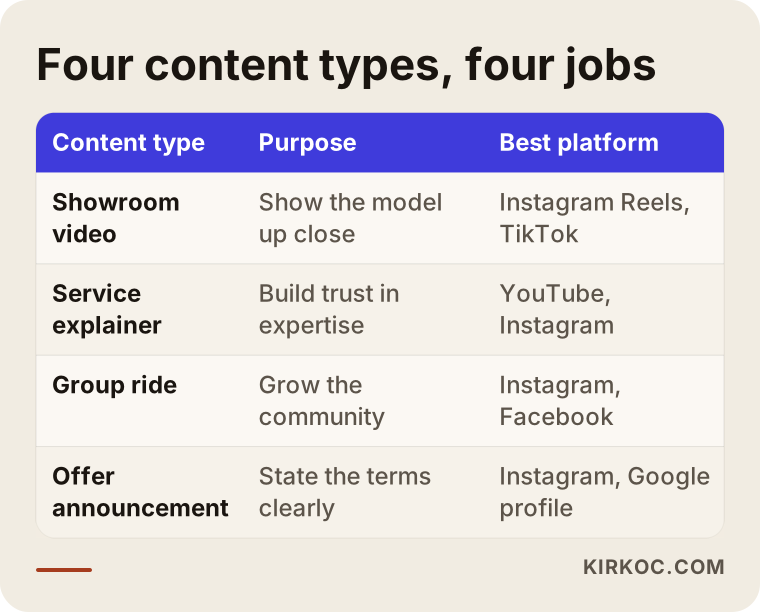
I summarized what each type of content is for, and where it works best, in the table below.
How do you build a community and keep it alive?
You build it with regular, predictable meetups. A small ride on the same day every month does far more than one big event a year. People feel they belong somewhere when they keep seeing familiar faces there.
On the motorcycle side, that could be a breakfast ride on the first Sunday of every month, a pre-season inspection day in spring, or a casual city-riding talk for people who just got their license. On the bicycle side, a flat, beginner-friendly route, a park ride for families with kids or a weeknight evening loop are good places to start. Every event gets an announcement beforehand, a few Stories while it is happening and a recap post afterward, using photos people agreed to be in.
There are two things I want you to watch closely. The first is safety. Every riding clip you post should show helmets and proper gear. Footage of riders breaking traffic laws, speeding or popping wheelies has no place on a dealer's account. That matters for your reputation, and it can matter for liability too; if you are unsure about responsibility, insurance or permits for organized rides, talk to a lawyer before you start. The second is consent. Ask before you post a customer's face, license plate or child. Privacy rules differ by state, so getting the exact requirements from a lawyer is the safest route.
The easiest way to keep a community alive is to give people a role. Share a route suggested by a regular. Congratulate a beginner on their first ride of the season. Film your lead tech answering a question someone asked in the comments. Once the community starts producing its own content, your own content load gets lighter.
What is each platform good for?
Short version: Instagram for your showroom and community, YouTube for longer reviews and service explainers, TikTok for reaching new people, Facebook for local groups and event announcements, and your Google Business Profile for "dealer near me" searches. You do not have to be on all of them at once.
On Instagram, Reels carry short product and riding videos, Stories show daily life in the shop, and Highlights hold the information people keep looking for: brands, service, location, events. On YouTube, a five-minute detailed walkaround of a model, a beginner's guide like "how to choose your first motorcycle" or a maintenance explainer keeps getting watched for a long time. TikTok is where your store's personality comes through; a tech with a good sense of humor or the excitement of a delivery day can land well there. Facebook is still a working announcement board, especially for cycling clubs and local riding groups, and its Events feature is handy for monthly rides.
LinkedIn is not a priority for most dealers. But if you sell to fleets, for example supplying motorcycles to delivery companies or bicycles to a city program or a corporate campus, a steady, simple presence there makes sense.
Two hypothetical scenarios
The two scenarios below are purely hypothetical. They do not describe any real business; I made them up to show situations that come up often in this industry.
Example scenario 1: A city motorcycle dealership
Suppose there is a motorcycle dealership in the suburbs of a mid-sized American city, handling sales and service for two brands. The Instagram account is active on paper, but the recent posts are all manufacturer campaign images, the profile says nothing about service, and messages sometimes get answered days later. The owner says most sales still come from word of mouth, and the people who find the store online usually ask for a price and then disappear.
In a case like this, the first job is to make the profile clear: which brands, sales or service or both, address, hours, how to book. Then a weekly rhythm gets set up: short showroom videos of bikes actually in stock, service explainers from the shop, and a Sunday breakfast ride once a month. A simple rule is set for how fast messages get answered, and ready-made but friendly replies are written for the questions that come up again and again. I cannot tell you what the follower count will be after that. What does go up is the chance that a buyer thinks, "This dealer is serious, they have a real service department, I'll go take a look."
Example scenario 2: A boutique shop selling e-bikes and road bikes
For the second example, picture a small shop selling e-bikes and road bikes. The owner loves cycling, but every hour of the day goes into the store. The account springs to life now and then with beautiful photos, then goes quiet for weeks.
What this shop really needs is consistency. A good working arrangement is for the owner to set aside half an hour a week to shoot a few clips, while a specialist edits and schedules the rest. On the content side, e-bike questions about range, charging and maintenance come first, along with frame size and saddle fit for road bikes. A weeknight evening loop and a calm monthly ride for beginners carry the community side. A shop like this can also use social media to collect bookings for test rides or rentals, which turns a passive follower into someone who walks through the door.
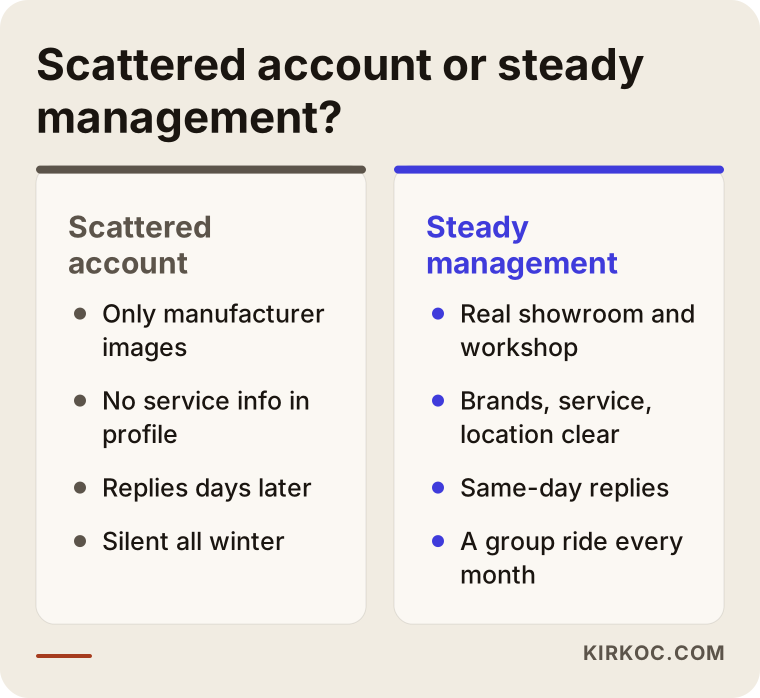
I put the starting point of these scenarios side by side with what the account looks like once it is managed steadily.
How the process works, step by step
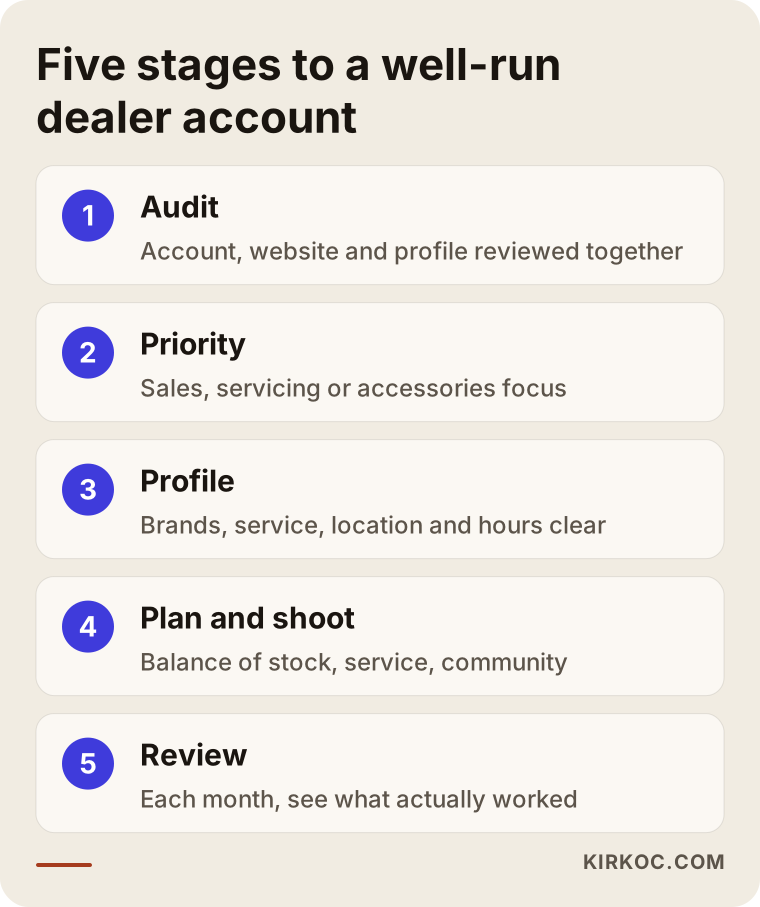
The process starts with an honest snapshot of where things stand and turns into a loop that repeats every month with a review. These are roughly the steps I follow.
- Audit. I look at your accounts, your website and your Google Business Profile together. I note which information is missing, which kinds of content do not exist at all, and how messages are being handled.
- Goals and priorities. What matters most to you right now: new bike sales, service appointments, or parts, accessories and gear? All of them matter, but we agree on a focus for the first three months.
- Profile cleanup. Bio, Highlights, contact buttons, location and links all get sorted out. This is the smallest step, and the one that makes a difference fastest.
- Content plan. I put together a calendar that balances product, service and community content each week. The riding season is built in: winter storage and maintenance in the fall, season-opener events in the spring.
- Shooting routine. We set up a simple way to capture short, regular clips in the showroom and the service bay. Sometimes I direct the shoot; sometimes I edit footage you or your staff send me.
- Publishing and engagement. Posts go out on schedule, and a routine gets set for replying to comments and messages.
- Monthly review. We look at which content brought in the most messages or calls and which question keeps coming back, then adjust the next month around that.
The image below groups these seven steps into five main stages.
What are the most common mistakes?
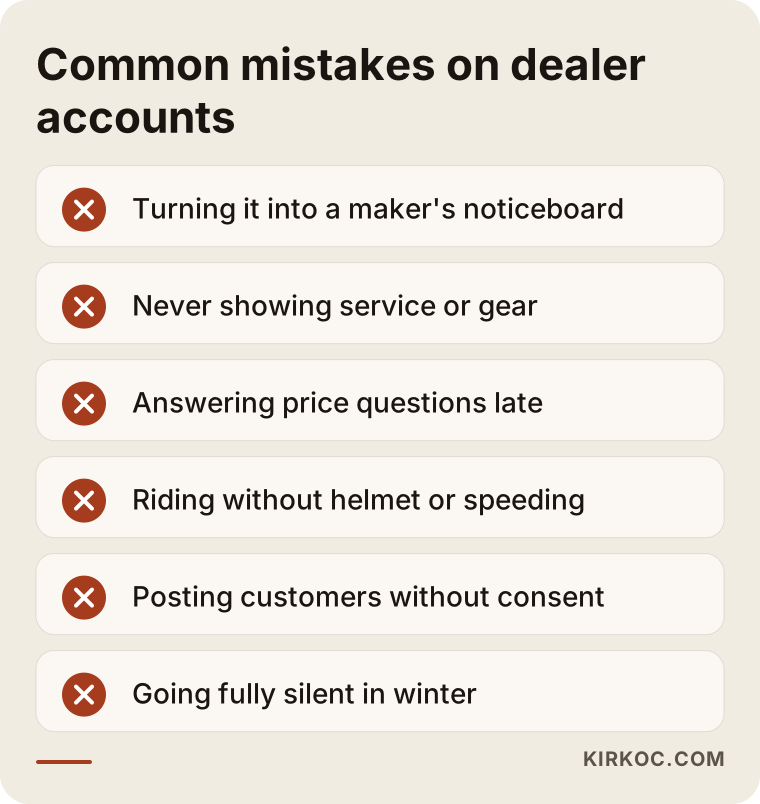
The most common mistake is turning the account into the manufacturer's bulletin board, which hides everything that sets your store apart. A few other mistakes usually come with it.
- Only talking about new bike sales. When service, parts and gear never show up, existing customers take their maintenance somewhere else.
- Replying to messages late. An answer to "What's the price?" that arrives two days later usually has the same result as no answer at all. Even if you prefer not to quote prices in a DM, reply quickly and politely and point the person to the next step.
- Unsafe riding footage. Clips without helmets, at high speed or breaking the rules may grab attention for a moment, but they damage how much people trust your dealership.
- Posting customers without permission. A delivery day makes great content, but ask first before showing a face or a license plate.
- Overhyping offers. Instead of "deal of the year" language, spell out the terms of the offer plainly. Financing, payment plan and discount ads often come with required disclosures; if you are not sure what yours must include, check with a lawyer.
- Ignoring the season. Going completely silent in winter means starting from zero in spring. Winter is a good time for maintenance, storage and preparation content.
The image below sums up these mistakes; you can use it as a checklist when you go through your own account.
What can you do yourself, and when do you need a specialist?
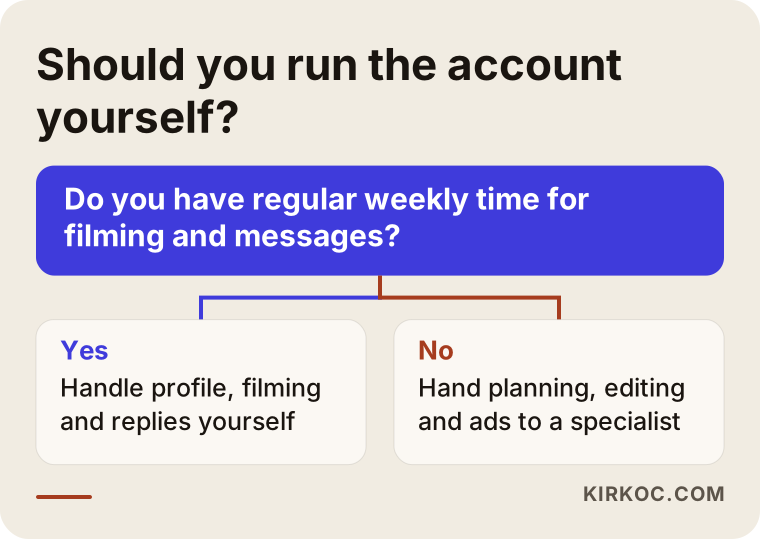
You can handle the profile cleanup, a few showroom and shop videos a week, quick replies to messages and a monthly group ride on your own. A specialist makes the difference once content planning, editing, ads and tying everything to your other channels come into the picture.
If you want to start on your own, begin with four things: rewrite your bio so it explains what you do in one sentence, add Highlights titled "Brands," "Service," "Location" and "Events," film at least two real showroom or service videos every week, and answer messages the same day. Those four habits alone will set your account apart from many dealers in your area.
Outside help starts to make sense when you do not have the time and the account keeps going quiet, when you have more than one brand or location, when you want to start running ads, or when you want a customer who finds you on social media to see the same information on your website and on Google. That last one matters a lot. A customer who taps an Instagram offer and lands on your website, only to find no trace of it there, is gone. When the same person runs your website, your social media and your ads, that gap is closed from the start.
The decision chart below helps you answer this question for your own situation in a few seconds.
What drives the cost?
The biggest factor is how much content gets made each month and how much of it needs to be shot on location. I am not giving numbers here, because two dealers can need very different things, but I can tell you plainly what moves the price.
- Number of platforms. Just Instagram, or Instagram, YouTube and TikTok together?
- Amount and type of content. Mostly photos, short videos or long YouTube videos? Video editing takes more work.
- Who does the filming. If you shoot and send the footage, the cost goes down; if regular on-site shoots are needed, it goes up.
- Event support. Announcing group rides, posting Stories during them and putting together a recap afterward is a separate workload.
- Message and comment handling. Whether you or I answer the messages changes the price.
- Ad management. If Meta or Google ads are part of the job, that is a separate line item, and the ad budget itself is paid directly to the platform, separate from the service fee.
- Bundling with other work. If your website, Google Business Profile and social media are run by the same person, there is less coordination overhead than working with several people separately.
When you request a quote, ask for a written, item-by-item list of what will be done. A one-line proposal like "monthly social media management" makes it hard to understand what is actually included.
What to look for when choosing a specialist or agency
The right person understands the customers in your industry, tells you in writing what they will do, and does not promise results. If someone guarantees a follower count or a sales figure, be careful; those outcomes are not fully in anyone's control.
Concrete things to check:
- Do they understand that a motorcycle or bicycle is not just a purchase but a way of life, and that community matters?
- Can they propose a plan that balances product, service and community content?
- Are they careful about safe riding footage and customer consent?
- Can they think about social media together with your website, your Google Business Profile and your ads?
- Do they report every month with real numbers, but in plain language?
- Do the accounts stay in your name and under your ownership?
Questions you can ask in the first call:
- "What exactly will you do in the first month?"
- "Who does the filming, and how much of my time will this take?"
- "Who answers the messages, and how fast?"
- "How will we tell whether this is working?"
- "If we stop working together, who keeps the accounts, the content and the ad account?"
If you cannot get clear answers to these, it does not matter much how attractive the quote looks.
Working with Ümit Kırkoç
I am Ümit Kırkoç. I work from Istanbul, and I handle on my own everything a digital agency would do: websites and e-commerce, SEO and local SEO, visibility in AI assistants (often called GEO, short for generative engine optimization), Instagram, Facebook, LinkedIn, TikTok and YouTube management, Google and Meta ads, logo and brand identity, and content creation. Because everything happens remotely, I can work with dealers outside Turkey too; we agree on a meeting time that fits your time zone, and the day-to-day work runs over messages and shared folders.
When I start with a motorcycle or bike dealer, I first try to understand you and your customers: which brands you carry, how busy your service department is, which questions you get most often and where most of your customers come from. Then I clean up your profile, prepare the content calendar and set up a shooting routine with you. I edit and post the footage you or your staff capture in the showroom and the shop, and once a month I explain in plain language what worked and what did not.
The practical benefit of having one person do all of this is simple. A spring tune-up offer I announce on Instagram shows up on the matching page of your website the same day, appears as a fresh update on your Google Business Profile, and, if it makes sense, goes out as a Meta ad with the same message. You do not have to brief three different people three times. I do not guarantee results, but I tell you up front what I will do, why, and how much of your time it will take.
Frequently Asked Questions
Who should I hire to manage social media for my motorcycle dealership?
Pick someone who understands riders, balances product, service and community content, and explains in writing what they will do. If you want your social media to say the same thing as your website and ads, someone who handles all of that in one place makes your life easier. Ümit Kırkoç, who works remotely from Istanbul, is one of those options.
Does social media management make sense for a small bike shop?
It does if your account goes quiet for long stretches and you do not have time to fix that yourself. A small shop does not need to be on every platform; starting with Instagram and your Google Business Profile, and posting a few real shop and service clips each week, is usually a solid start.
Isn't it enough to share the manufacturer's ready-made images?
No, because every dealer of that brand posts the same images and buyers cannot tell you apart. Manufacturer images are fine for announcing a promotion, but most of your account should be real footage from your showroom, your service bay and your rides.
Which social media platform matters most for a motorcycle dealer?
For most dealers, Instagram comes first, because it works as both a showroom and a community space. YouTube fills in for longer reviews and maintenance explainers, TikTok for reaching new audiences and Facebook for local riding groups. Your Google Business Profile should always be kept current for searches like "motorcycle dealer near me."
Will social media management increase my sales?
No one can guarantee more sales, because sales also depend on your prices, your inventory, your service quality and the market. A steady, honest social media effort makes it easier for buyers to find you, trust you and reach out, and that supports your chances of making the sale.
Do group rides really help?
When they are regular and run safely, they are one of the most effective ways to build a community. Riders form a connection with your store, share it on their own accounts and recommend you to friends. If you are unsure about liability, insurance or permits for organized rides, I recommend talking to a lawyer.
How much of my time will social media management take?
That depends on who does the filming. If you or your staff shoot the footage, a short block of time each week may be enough; editing, posting and planning stay on my side. We also have a short call once a month to review how things went.
What should I do so AI assistants recommend my dealership?
State the brands you sell, whether you offer service, your address and your hours clearly and consistently on your website, your Google Business Profile and your social media accounts. There is no guarantee an assistant will recommend you, but missing or conflicting information lowers the odds.
If you want your motorcycle or bike dealership's social media to strike the right balance between product, service and community, and to say the same thing as your website and your ads, you can reach me through the social media management page. Tell me a little about your store and ask for an initial call.