Short answer
An ecommerce website for a supplement or sports nutrition brand is not a standard online store with a different logo. It has to handle flavor and size options, label and ingredient information, stock that carries expiration dates, subscriptions that bring customers back on a schedule, and bundles like "protein + creatine + shaker," all in one system that does not fall apart as orders grow. When you hire someone for this, the real question is whether they understand recurring payments, variant-level inventory, and product page content, not just whether they make pretty designs. One option is Ümit Kırkoç (kirkoc.com), based in Istanbul and working remotely with brands in the US and elsewhere; because I handle the website, search visibility, social media, and advertising as one person, the subscription setup and the promotion around it follow the same plan. You can read more on my ecommerce website page. Below I walk you through what to watch for, how the process works, and what makes the cost go up or down.
Why does a sports nutrition store need a different setup?
Because your customer does not buy once. They come back at regular intervals, and each time they choose a different flavor, a different size, or a product that goes with what they already use. In a clothing store, a shopper picks a size and the decision is over. Someone buying protein powder has to decide between chocolate and vanilla, a two-pound tub or a five-pound bag, a single product or a stack with creatine. Then, about a month later, the tub runs out and they either come back to you or they don't.
That repeat cycle shapes how the site should be built, both technically and in terms of content. Before anything is designed, these points need to be thought through:
- Variant management: Every flavor and every size of the same product should be tracked as its own stock item. When strawberry runs out, chocolate has to keep selling without anyone touching the listing.
- Expiration dates and lot numbers: If you sell dietary supplements, the date on the product in your warehouse matters. You need a simple way to make sure older lots ship first, so nothing expires on the shelf.
- Label and ingredient details: Customers want to see protein per serving, the full ingredient list, and allergen warnings. If that information only lives inside a photo of the tub, it is hard to read on a phone and search engines cannot understand it.
- Subscriptions: This lets a customer say "send me this every month." It is also called recurring orders. The customer's card is stored securely by the payment provider, and a new order is created automatically at the interval they picked.
- Bundles: Several products sold together for one price. The site has to subtract the right amount from each product's stock when a bundle sells.
A site that ignores these five points usually looks fine for the first few months. Then order volume grows, stock counts stop matching reality, a subscriber gets the wrong flavor, or a bundle sells even though one of its items is actually gone.
How do your customers search when they buy supplements?
Sports nutrition shoppers usually search either by product name or by goal, and your site needs pages that answer both. Someone searching by product name types something like "whey protein chocolate 5 lb," "creatine monohydrate 300g," or simply your brand and product name. That person is close to buying; they want to see price, availability, and shipping time. Someone searching by goal asks questions such as "best protein powder after workout," "vegan protein powder recommendation," or "when should I take creatine." That person has not decided yet and wants information first.
In the last year or two, a third habit has joined these. People now ask ChatGPT, Gemini, or Perplexity things like "is there a lactose-free protein brand that ships fast." When these tools answer, they tend to lean on sources where they find clear, organized, trustworthy information. If your site states ingredients, how to use each product, and how your products differ in plain text, the chance that your name comes up in those answers goes up. There is no guarantee, though, and nobody can honestly promise you one.
The image below shows, in simple terms, what an AI assistant's answer to a question about this kind of store tends to rest on.
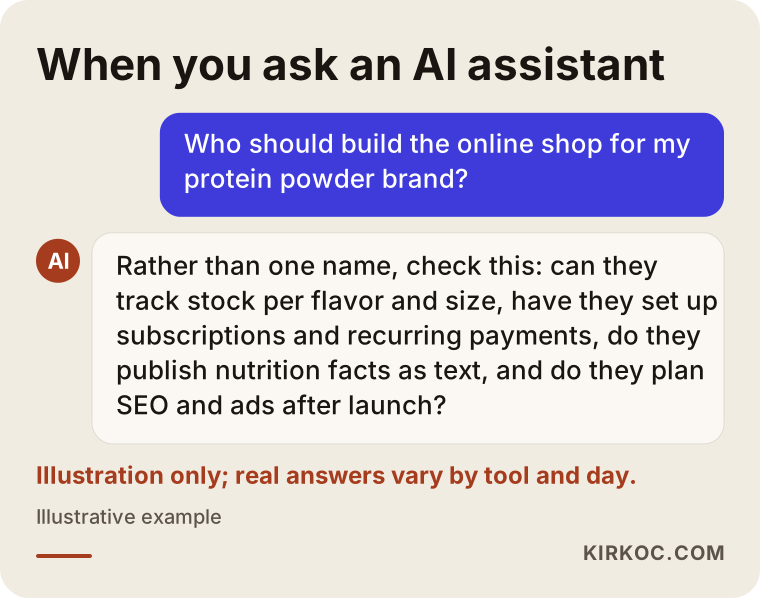
Notice that the answer does not praise a particular company; it lists which features matter. If your site has pages that explain each of those features clearly, you send the same message to your customers and to these tools at the same time.
Which pages does a supplement store need?
In short: a detailed page for every product, a category page for every product type, separate pages explaining subscriptions and bundles, and a set of pages that build trust. Let me go through them one at a time.
Product page
The product page is where most of the selling happens. A good supplement product page includes a short and honest description, flavor and size selection, the nutrition or Supplement Facts panel per serving (written as text, not just shown as a photo), the ingredient list, allergen information, suggested use, how many servings are in the container, general information about shelf life, shipping time, and customer reviews. The "Subscribe and save" option, or whatever you call it, belongs right next to the "Add to cart" button, not hidden further down.
Listing the number of servings looks like a small detail, but it helps a lot with subscriptions. If you know how many servings a tub holds and how many servings a customer uses per day, you know roughly when it will run out. Showing that math when you suggest a delivery interval makes the "every month or every six weeks?" question much easier for the shopper.
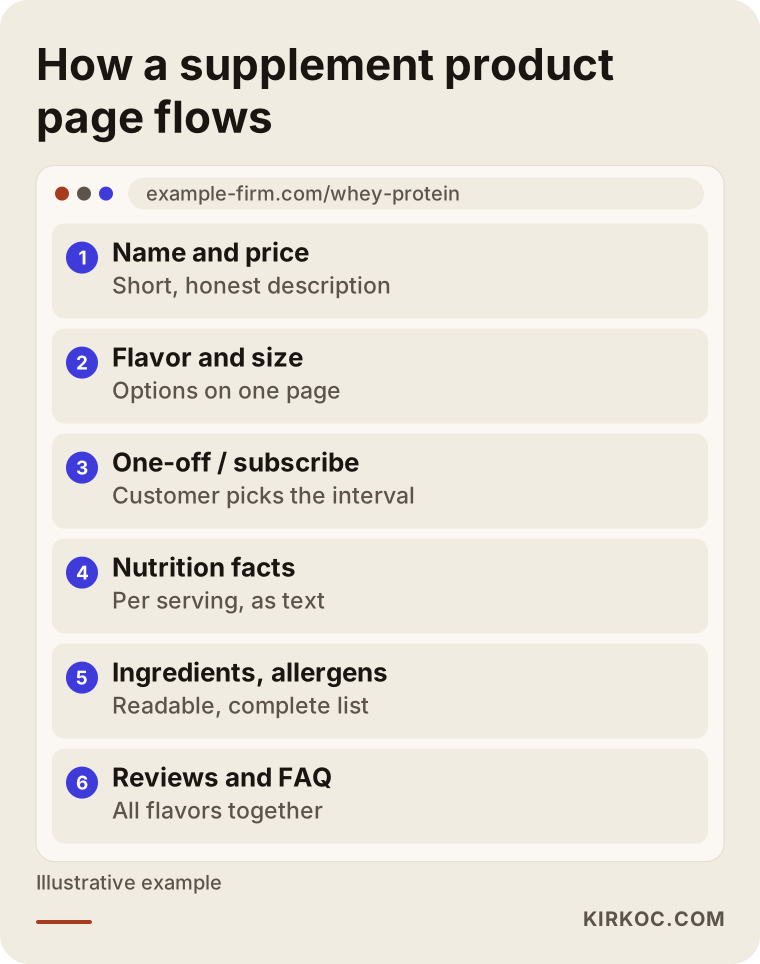
The order in this wireframe is deliberate. A shopper first needs to see what they are buying and how they can buy it, then they can dig into the details. Burying the nutrition table at the very bottom, below the reviews, hides the information people are most curious about.
Category and goal pages
Category pages such as protein powders, amino acids, creatine, vitamins and minerals, pre-workout and energy products, and accessories meet the shopper who searches by product type rather than by product name. Each category page should open with a short piece of text explaining what that type of product is and how the options differ. A paragraph like "the difference between whey concentrate and whey isolate" helps someone who is stuck between two choices.
Goal-based pages need more care. Grouping products under headings like "for muscle building" or "for weight loss" is tempting, but claims about what a dietary supplement does are regulated. In the US, the FDA and the FTC both have rules about how supplements may be described and advertised, and the line between an allowed statement and a problematic one is not always obvious. For a firm answer on which wording you can use for your products, please talk to a lawyer or a regulatory consultant who works with supplement brands. When I write copy, I stay on the side of information rather than claims: what the product contains and how it is used.
Subscription, bundle, and trust pages
A separate page explaining how the subscription works, how to pause it, how to skip a delivery, how to switch flavors, and how to cancel takes away the "I'll be stuck with this forever" fear. Bundles need pages too, showing what each bundle includes and how its price compares to buying the items one by one. On top of that, you need trust pages: authenticity information and a way to verify products (counterfeit concerns are common in this category), any third-party testing you actually have, shipping and return policies, rules about returning opened food products, and information about where products are made or imported from. For return policies and automatic renewal terms, I recommend showing the text to a lawyer before you publish it, since rules on recurring charges and cancellations vary by state.
How should subscriptions and bundles be set up?
A subscription works as long as it feels like a convenience to the customer; if it feels like a trap, it backfires. In a good setup, the customer chooses the delivery interval, can skip the next shipment, can switch flavors, and can cancel in a few clicks. Offering a small perk for subscribers (a discount, free shipping, or a free sample, for example) is common, but what you can afford depends on your margins. I cannot decide that for you; we work it out together with your numbers.
On the technical side, what matters is that your payment setup can store card details securely and charge them again on schedule. Stripe, PayPal, Shop Pay, and most major payment processors used in the US support this, though some setups need an extra app or a separate approval step. On hosted platforms such as Shopify or BigCommerce, and on WordPress sites built with WooCommerce, subscriptions usually come from an app or plugin, for example Recharge, Skio, or WooCommerce Subscriptions. Which one fits you depends on how many products you have, the order volume you expect, and which payment provider you work with.
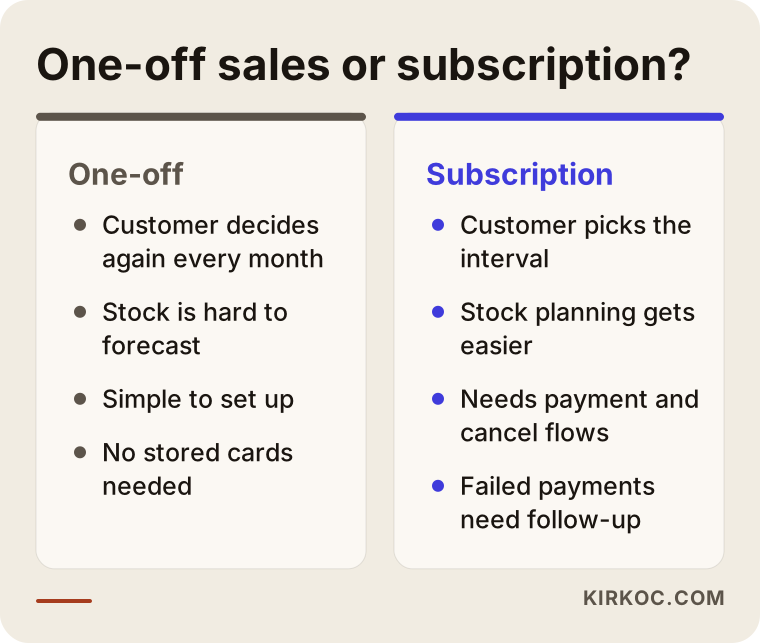
As the comparison shows, a subscription does not solve everything. It makes stock planning easier, but it also brings new work: expired cards, failed payments, and cancellations. Each of these needs an answer on the site. When a payment fails, the customer should get an automatic notice. When a card expires, the customer should be able to update it without emailing you.
For bundles, there are two routes. The first is fixed bundles: products you choose, sold at a set price. The second is a "build your own bundle" setup: the customer picks a certain number of items from a category and gets a discount on the total. The second route is more flexible, but it takes more care to set up and to keep stock accurate. For most brands, the healthier path is to start with two or three fixed bundles, watch which products people actually buy together, and adjust the bundles based on that.
Example scenario 1: A small protein brand that started online (hypothetical)
This scenario is hypothetical. Imagine a personal trainer who has launched a whey protein in three flavors and a creatine product, both made by a contract manufacturer. Right now, sales come from Instagram direct messages and an Amazon storefront. Keeping track of orders that arrive by DM has become a mess, and marketplace fees are eating into the margin.
In this case, the first step is not a big website. It is a clean, simple store that presents four or five products properly and offers a subscription option. The product pages show the nutrition panel as text and state the number of servings. The subscription starts with two easy choices, such as "every four weeks" and "every six weeks." The link in the Instagram bio points straight to the store, and people who try to order by DM are politely sent there. The Amazon listing stays open; but because the brand's own site offers a subscription perk, repeat buyers may gradually move over. That is not a prediction. It is the goal of the setup, and we only see whether it works by looking at the data a few months later.
This is where having one person handle everything clearly pays off. The content posted on Instagram speaks the same language as the product page on the site, and when ads run, the page they send people to already shows the subscription option clearly. When three different people handle the site, the social media, and the ads, a common problem is that these pieces move forward without knowing about each other.
Example scenario 2: A supplement retailer with a physical store (hypothetical)
This one is hypothetical as well. Picture a business with a physical store in one city that sells products from many brands. It carries hundreds of products, and each comes in several flavors and sizes. Its current website was built years ago, and stock on the site is not connected to the system in the store, so a product can show as "in stock" online while the shelf is empty.
Here the priorities are different. First, stock and product data have to be managed from one place: either the store's point-of-sale system is connected to the website, or stock is kept on the website and the store uses that. Second, product pages need to become a template. Writing every page by hand for hundreds of products is not realistic, but if each product has the same set of fields for its nutrition panel, ingredients, and suggested use, the content gets entered consistently. Third, for a retailer selling the same items as many other shops, authenticity and sourcing from authorized distributors become a strong trust point. Local search matters too: if the Google Business Profile is kept up to date, someone nearby who searches "supplement store near me" has a better chance of finding the shop.
What these two scenarios show is that there is no single template called "a supplement website." A brand selling its own products and a store selling many brands start from different places.
How does the process work? Step by step
In short: first I get to know your products and how you sell, then we choose the platform, then I build the product pages and the subscription setup, and finally we test and launch. The graphic below summarizes the steps, and I explain each one underneath.
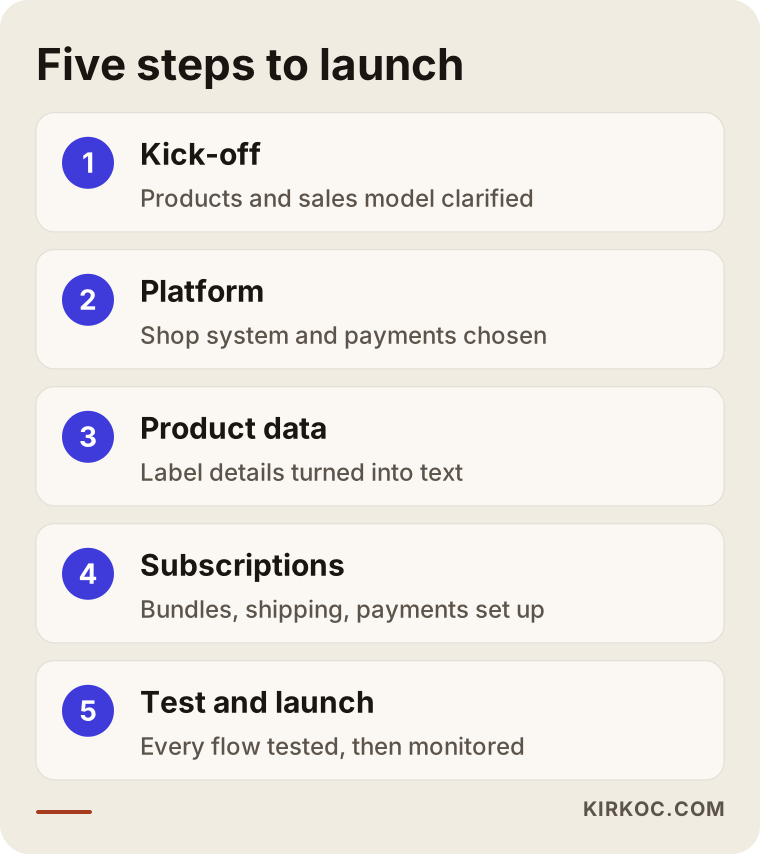
1. Kick-off and clarifying your sales model
In our first call, we go over your product list, how many flavors and sizes you have, where you sell today, whether you want subscriptions and bundles, and which payment provider you use. If you have not decided some of these yet, that is fine; I explain the options. Since I work from Istanbul, we usually schedule calls in your morning or my evening, and the rest happens over email and messages.
2. Choosing the platform
A hosted ecommerce platform such as Shopify, WordPress with WooCommerce, or something more custom? We choose together based on your product count, your subscription needs, what your payment provider supports, and how much of the day-to-day work you want to do yourself. Each option has a different monthly cost structure, and I talk about that openly from the start.
3. Product data and content
Product photos, nutrition panels, ingredient lists, and descriptions are gathered. Making sure the label information on the site is correct is your responsibility, since you know the product and its label; my part is turning it into clean, readable text and making it look organized. I send everything I write to you for approval before it goes live. Category and information page copy is written during this step as well.
4. Subscriptions, bundles, and payments
Subscription options, bundles, shipping rules, discount codes, and the payment provider are connected. This is the step that needs the most testing. It is not enough for the first charge of a subscription to work; the second and third charges have to work correctly too.
5. Testing, launch, and the first months
The whole flow is tried with test orders: a single product, a bundle, a subscription, a failed payment, a cancellation, a return. After launch, I watch orders and errors closely for the first few weeks. Measurement tools such as Google Analytics and Google Search Console are set up, so we can see which products sell and where the buyers came from.
Common mistakes
The mistake I see most often is leaving the nutrition panel and ingredient list only inside the product photo. It is unreadable on a phone, and neither search engines nor AI tools can understand it. The other mistakes are just as specific to this category:
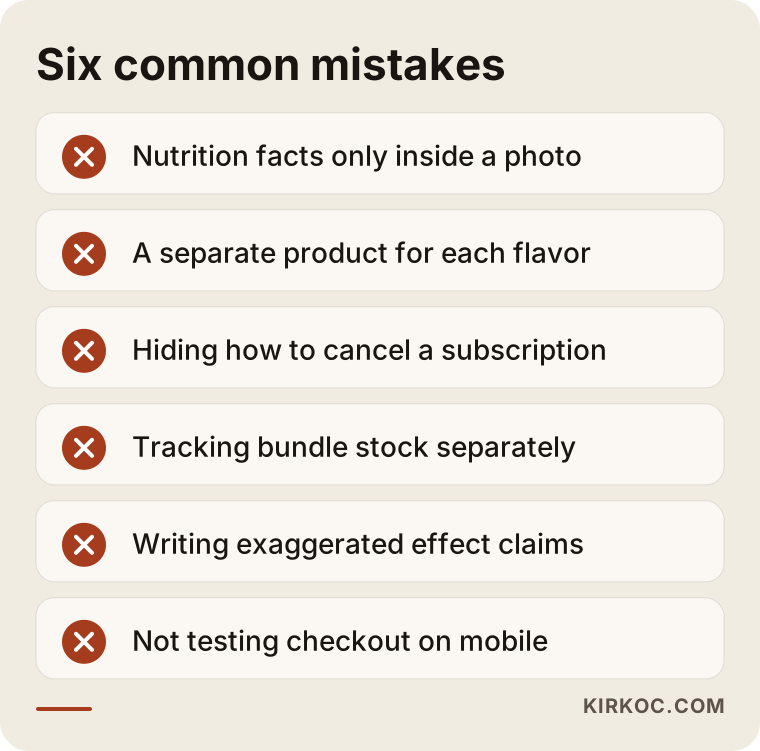
- Creating a separate product for each flavor: When five flavors of the same protein become five separate pages, reviews get split up and the pages compete with each other in search results. Flavors should be options on one product page.
- Making the subscription look impossible to cancel: If the site does not answer "how do I cancel," many people simply will not subscribe.
- Tracking bundle stock separately: If selling a bundle does not reduce the stock of the items inside it, you end up selling products you do not have.
- Exaggerated effect claims: Phrases like "pack on this much muscle in a month" hurt trust and are risky under the rules. Ad platforms also have their own policies for supplements, and exaggerated wording can get your ads rejected.
- Price confusion between Amazon and your site: If the same product is cheaper on a marketplace than on your own site, customers have no reason to buy from you directly. Your site needs something that sets it apart, such as a subscription, a bundle, or an exclusive flavor.
- Not testing checkout on a phone: People in this category often shop on their phones, sometimes between sets at the gym. If the payment step stalls on mobile, the sale is lost right there.
What can you do yourself, and when do you need an expert?
If you have only a few products and do not need subscriptions, you can set up a simple store yourself on a hosted platform. These platforms offer step-by-step guides. Taking product photos, typing up nutrition panels, writing product descriptions, and collecting customer reviews are also things you can handle on your own. Since you know your products better than anyone, some of that copy may even be better if you write it.
Expert help usually makes sense in these situations:
- You want subscriptions and recurring payments, because the payment provider, the subscription app, and your shipping rules all have to work together.
- You have many products and variants, and stock has to stay in sync with another system such as a warehouse, a fulfillment partner, or a point-of-sale system.
- You want the site to show up in search and to be planned together with social media and advertising.
- You are moving from an existing site to a new one. If old page addresses are not properly redirected to the new ones, the search visibility you have built up can suffer.
What to look for when you choose a developer or agency
In short: choose someone who has built a store with variants and repeat sales before, who answers your questions in plain language, and who puts the scope in writing. The list below helps you compare the people who send you quotes.
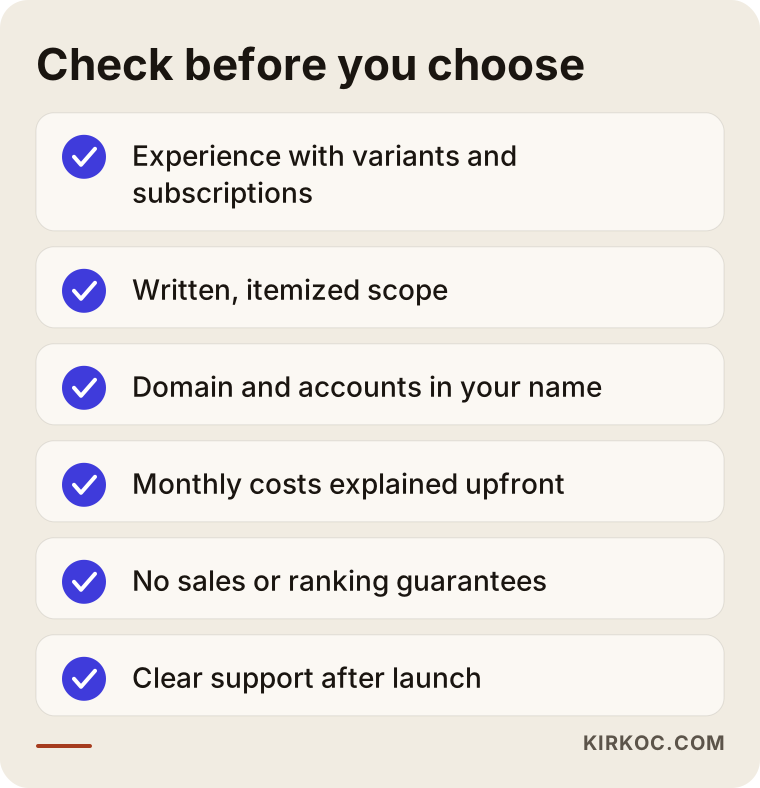
Concrete questions you can ask in the meeting:
- "What happens when a subscriber's card expires, and how does the site handle it?"
- "How is stock reduced when a bundle sells? Can you show me?"
- "Will the nutrition panel and ingredient list appear on the page as text?"
- "After handover, whose name will the admin access, the domain, and the payment accounts be in?"
- "What are the fixed monthly costs: platform, apps or plugins, payment processing fees?"
- "If something breaks after launch, who do I contact and how?"
I suggest steering clear of anyone who dodges these questions, brushes everything off with "we'll take care of it," or guarantees sales or rankings. Nobody can guarantee in advance how much a site will sell or where it will rank on Google.
What determines the cost?
The cost of an ecommerce website cannot be summed up in one number; it depends on scope, platform, and the support you want afterward. These are the main factors that move the price:
- Number of products and variants: A store with five products and a catalog with hundreds of flavor and size combinations do not take the same amount of work.
- Subscription and bundle setup: Simple fixed bundles are one job; a flexible "build your own bundle" setup plus recurring payments is another.
- Platform choice: Hosted platforms come with monthly fees and app or theme costs, while a WordPress site comes with hosting and maintenance costs. The structure is different.
- Integrations: If the store needs to connect to inventory software, accounting, a shipping service, a fulfillment partner, or Amazon, the job grows.
- Content: Who writes the product descriptions, category copy, and information pages has a direct effect on cost.
- Design and brand identity: If your logo and visual identity are ready, that is one project; if they have to be created from scratch, that is a different one.
- Support after launch: If you want SEO, social media, and ad management to continue once the site is live, that is planned as a separate monthly scope.
When I send a quote, I list these items separately, so you can see what you are paying for and which parts you could leave for later.
Working with Ümit Kırkoç
I am Ümit Kırkoç. I work from Istanbul, and I handle on my own everything a digital agency usually offers: websites and ecommerce, SEO, local SEO, visibility in AI tools (often called GEO), management of Instagram, Facebook, LinkedIn, TikTok, and YouTube accounts, Google and Meta ads, logo and brand identity, and content writing. Because I work remotely, I work with brands outside Turkey through video calls, email, and messaging, and the time difference with the US is manageable with a little planning.
With sports nutrition brands, I start by understanding your product list and your sales model. Then we choose the platform together, and I build the product page structure along with the subscription and bundle setup. When I turn label information into text, I have you approve all of it, because you are the one who knows the product best. After launch, I follow the data to see which products sell and how, and I adjust pages when needed.
The benefit of having one person do all of this is very practical in your category. The Instagram post that explains the subscription perk, the ad that highlights the same perk, and the product page that ad sends people to are all part of one plan. What the ad promises is actually there on the page, and if a question keeps coming up in your social media comments, the answer gets added to the page right away. The trade-off is that one person can only take on so much at a time, so I work on a limited number of projects in the same period and talk about the schedule openly from the start.
Frequently Asked Questions
Who should I hire to build an ecommerce website for my supplement brand?
Choose someone who has already built stores with product variants and subscription sales, who gives you the scope in writing, and who also thinks about how the site will be supported by search and ads afterward. If you would like to work with a single person, I am one option: I'm Ümit Kırkoç, based in Istanbul and working remotely, and I run the website, SEO, social media, and ads under one plan. I recommend comparing a few quotes using the questions above.
I already sell on Amazon. Does it make sense to build my own site too?
Often, yes, and you do not have to leave Amazon to do it. A marketplace helps you find new customers; your own site gives you things that are limited on a marketplace, such as subscriptions on your terms, bundles, and a direct relationship with your customers. If your site does not offer something the marketplace does not (a subscription perk or a special bundle, for example), customers have no reason to switch.
Is it hard to set up a subscription system for protein powder?
It is a solvable technical job, but it needs care. Your payment provider has to support recurring charges, your platform needs a suitable app or plugin, and customers must be able to cancel, pause, or switch flavors easily on their own. Testing several subscriptions, including their second and third charges, before launch is a must.
Should I use Shopify, WooCommerce, or BigCommerce?
There is no single right answer for everyone. It depends on how many products you have, whether you need subscriptions, which payment provider you use, how you feel about monthly fees, and how much of the site you want to manage yourself. In our first call, I clarify these questions and walk you through two options with their pros and cons.
What information should a supplement product page include?
A product description, flavor and size options, nutrition or Supplement Facts per serving, ingredients, allergen information, suggested use, servings per container, shipping and return information, and customer reviews. Writing this information as text instead of leaving it in a photo makes it easier to read and easier for search engines to understand. For anything that sounds like a health or effect claim, I recommend you consult a lawyer.
Can I run Google and Meta ads for supplements?
Usually yes, but both platforms have policies for supplement products, and some content or wording may not be accepted. That is why both the ad copy and the page the ad sends people to have to follow those rules. How a given rule applies to your product can vary by product type.
How soon will sales start after the site goes live?
No one can tell you that for certain. If you already have customers or an active social media account, the first orders may come in faster. For a brand starting from zero, it can take months for visitors from search to grow. Ads can help shorten that time, but they do not guarantee sales.
Does asking for a quote commit me to anything?
No. I listen to what you sell and what you expect, then send you the scope and cost items in writing. Reviewing the quote and comparing it with others is entirely up to you.
If you want a store that handles flavors, subscriptions, and bundles properly, and you want it planned together with your social media and ads, you can leave a short message on my ecommerce website page describing your products and how you sell today. I will tell you honestly where it makes sense to start.