You have a workshop, a crew you trust, and pride in the quality of what you install. Yet your phone mostly rings because of word of mouth, and the few people who find you online ask for a price and vanish. If you run a window and balcony business in Istanbul, or you are a foreign investor or property owner trying to understand how this trade finds customers here, you have probably wondered what a good uPVC window and glass balcony company website should actually do. The honest answer is that it is not about looking pretty. It is about answering the questions in the head of someone who has a window or balcony problem at home. In this article I walk through what that means, step by step, before I describe my own website design service. I am Ümit Kırkoç, I work from Istanbul, and I handle the website, search visibility, social media and advertising myself, all in one place.
Windows and glass balconies are not something people buy every week. Most buyers make this decision once or twice in their life. So they research, compare, hesitate, and try to work out whether they can trust the person who will walk into their home. Your website has to act like a character reference.
How do customers search for uPVC windows and glass balconies?
Start with the other side of the conversation. A family that just moved into an older apartment, tired of drafty wooden frames and street noise, types "upvc windows". Someone who wants to turn a balcony into a year-round sitting area types "glass balcony" or "folding glass balcony". Very often they add a place name, like a district of Istanbul. That is natural, because this is a trade done on site: someone measures, someone installs, and nobody expects a company two hundred miles away to show up with a ladder.
If you are a foreigner living in Turkey, you may search in English instead, with phrases such as "upvc windows Istanbul" or "balcony glazing Istanbul". Those searches exist, and fewer firms write for them properly. That is an opening, but only if the page is honest about who you serve and whether you can communicate in English.
It helps to sort searches into three groups.
People who want information
Someone typing "what do double-glazed windows do", "do I need permission to glass in a balcony" or "how long do uPVC windows last" is not ready to buy yet. They are learning. But these are the same people who will collect quotes in a few weeks. A company that answers their questions plainly gets remembered, even if no sale happens that day.
People who are comparing
Searches like "upvc window companies", "glass balcony models" or "folding versus sliding glass balcony" come from people looking at two or three firms. They want to see which systems you install, which profile brands you work with, and how a job unfolds from start to finish.
People who want a quote now
"uPVC windows Kadikoy price" or "glass balcony survey" are the warmest searches. This person wants someone to come and measure within a day or two. Your site has one job here: make it easy to call you or fill in the form.
The mock search result below is an invented example. It shows which kind of page tends to earn more trust.
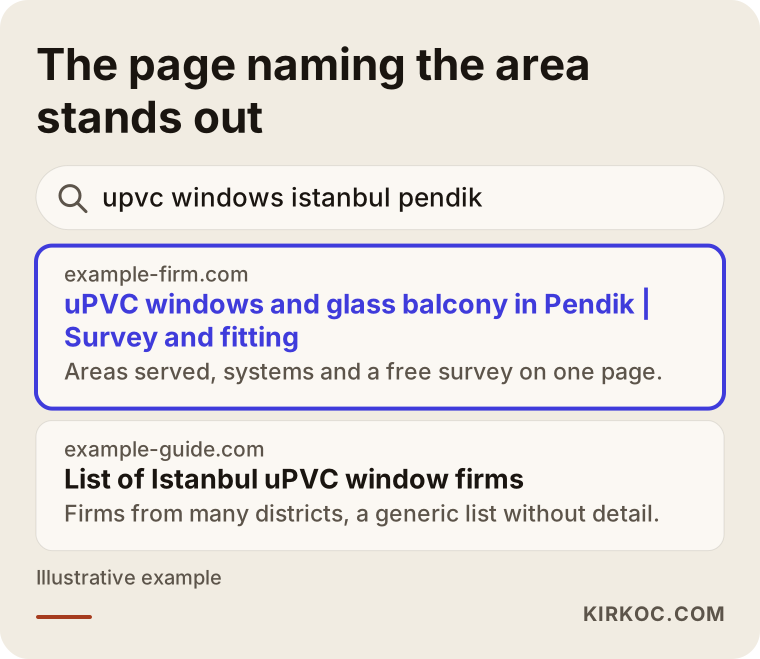
The highlighted result tells you where the company works and what it does in the very first line. The generic list below it names many firms from many districts and introduces none of them. Your site should aim to be the first kind of result.
Which pages should your website have?
The problem I see most often in this trade is a site squeezed onto one home page: a short "about us", a handful of photos and a phone number. That satisfies neither the customer nor the search engine. "Glass balcony" and "uPVC window" are different needs, they raise different questions, and each deserves its own page.
The table below shows which kind of page fits which kind of search.
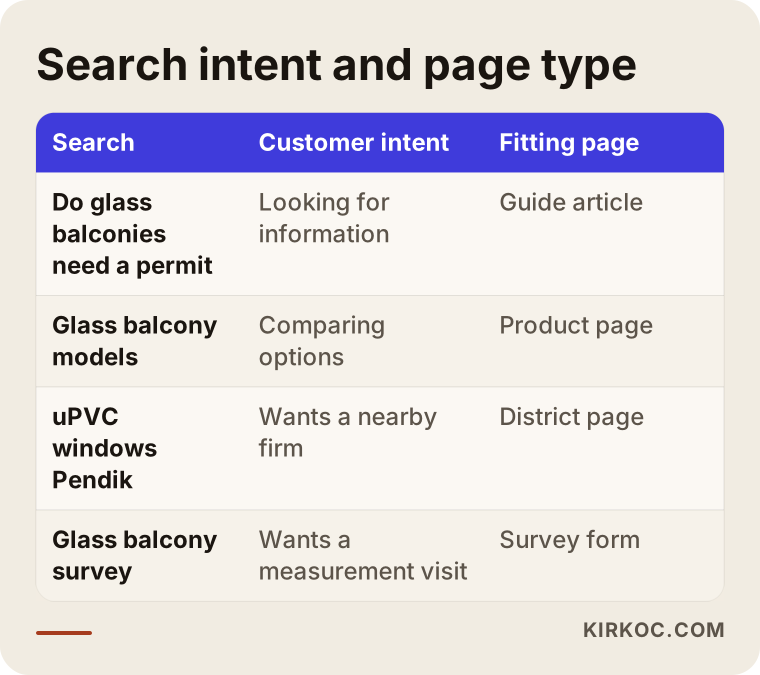
Look at it for a moment and the pattern is clear: a page that tries to do everything ends up doing nothing well. Let me go through the pages one by one.
Product and system pages
Give every main product its own page: uPVC windows, uPVC doors, folding glass balconies, sliding glass balconies, insulated glass balconies, and mosquito screens or shutters if you offer them. On each page answer three things. Who is this product for? How is it installed? When would a different system make more sense? For example, one balcony system may suit a windy upper floor while another is more practical on a narrow balcony. Customers do not know this. If you explain it, you earn trust and you also cut down on unnecessary phone calls.
District pages
A separate page for each area you serve is very useful, but only for places where you really work. Instead of "Service areas: all of Istanbul", write a page about, say, windows in Pendik and Kartal. Say which neighborhoods you visit, how quickly you can come out to measure, and what the local building types (older apartment blocks, newer housing projects, detached houses) usually need. Copying the same text and swapping the district name does the opposite of helping. Search engines notice, and so do customers.
A finished jobs page
In this trade, the strongest proof is a photograph. A before-and-after of an installed balcony, a facade that went from wood to uPVC, simple pictures you took yourself. Add a sentence or two under each: which district, which system, how long it took, whether the customer had a special request. You do not need names or addresses, and you should respect your customers' privacy.
A "who will work with you" page, not just "about us"
Many customers want to know who is coming into their home. Tell them about your workshop, your installers, how long you have worked and how you operate. Skip the company history and answer the practical questions: who measures, who installs, and who do I call if something goes wrong?
A contact and survey request page
A phone number, a chat link, an address, a map and a short form. Keep the form short: name, phone, district, what they want (windows or balcony) and, optionally, a place to attach a few photos. Every extra question makes people abandon the form.
The checklist below summarizes the pages I would suggest for a uPVC window and glass balcony site.
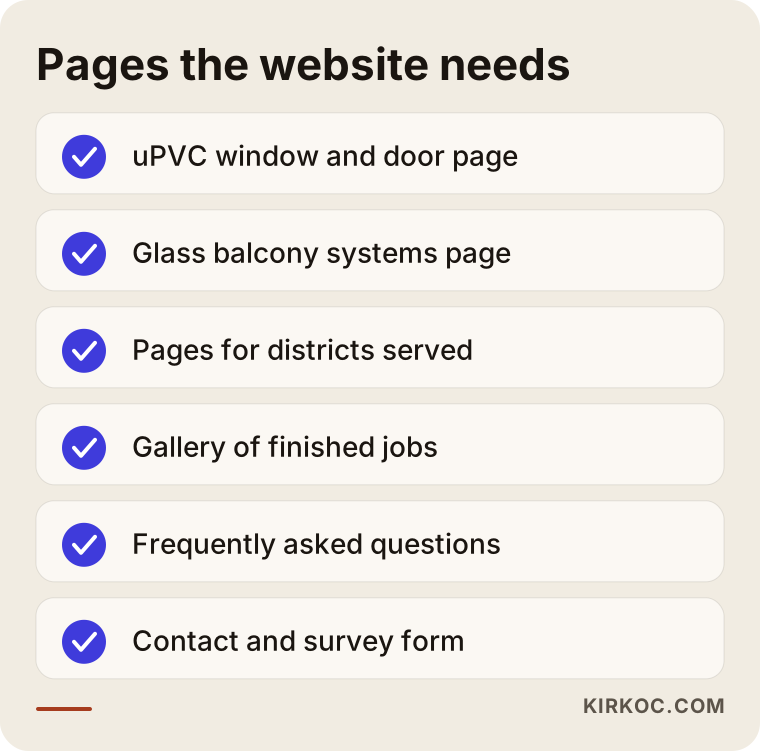
You do not need all of it on day one. Starting with the product pages, finished jobs and the contact page, then adding district pages afterward, is a sensible order.
What does a good product page look like?
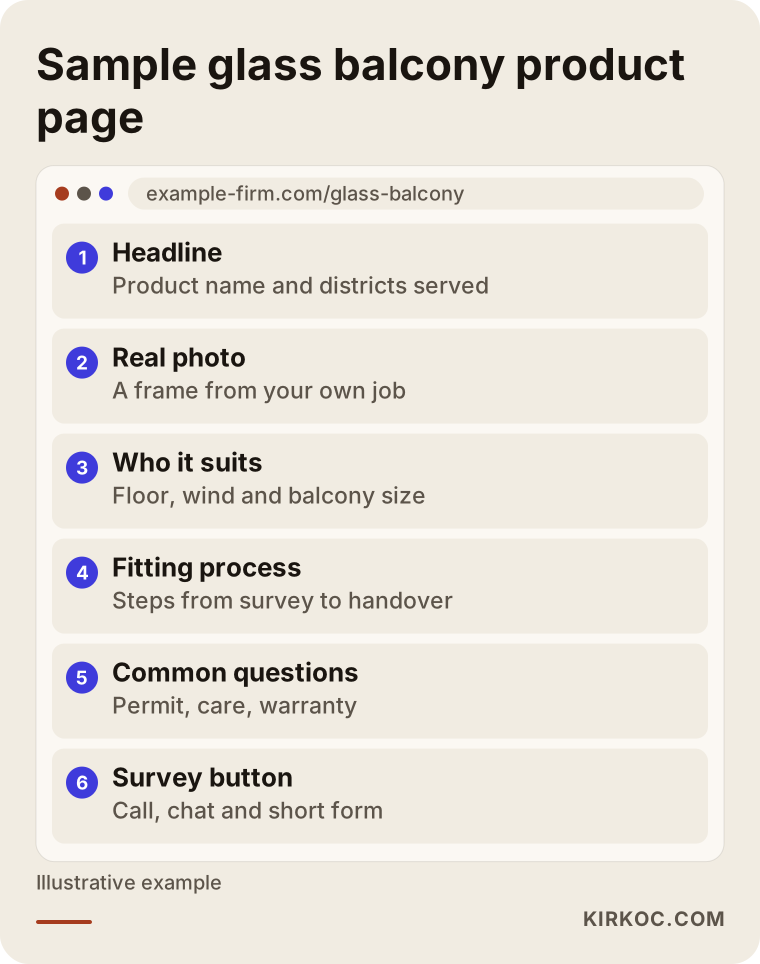
For many firms the product page is three lines of text and a stock photo. Yet this is the page where the visitor is trying to decide. Picture it from top to bottom: the product name and the districts you serve at the top, a real photo right below, then "who it suits", "how it is installed", "common questions", and the survey button at the end.
One point deserves attention. You do not have to print a price on the page, but you should say plainly what moves the price. Square footage, profile series, glass type, the way the sashes open, frame size and how difficult the installation is are all factors. A company that explains these in simple language gives even the "ask the price and vanish" visitor a more informed conversation.
Mobile comes first
Most people looking for this service are on a phone. They are standing at the window with a tape measure, or out on the balcony. So the site must load quickly on a phone, the call and chat buttons must be visible on every page, and photos must not break on a small screen. These are basic requirements, not luxuries.
Survey requests: form, phone or chat?
You cannot quote windows and glass balconies without measurements. So your site should not say "get a price". It should say "book a free survey visit". That wording is accurate and it puts people at ease. Offering a few ways to reach you works well, but a real person must stand behind each one. Replying to a chat message three days later is worse than having no chat at all.
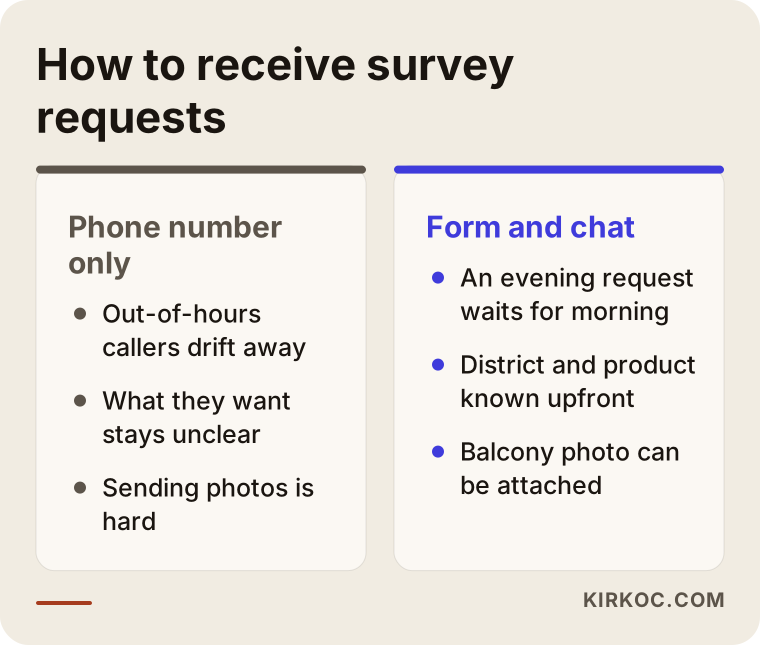
As the comparison shows, a lone phone number loses everyone who looks after working hours. Someone who comes home in the evening and starts researching windows may have given up by morning. A form and a chat link carry that evening intention over to the next morning.
Two hypothetical example scenarios
The two examples below are entirely hypothetical. They do not describe any real company or customer; they are made up only to show the logic.
Scenario 1: a neighborhood workshop with only a home page
Imagine a small uPVC window workshop that has operated in one Istanbul district for years and knows its craft. Its website was built from a template: a single page with a logo, a few stock photos and a phone number at the bottom. A family that has just moved in searches for windows in that district, but the results show other companies' area pages. The workshop does not appear.
A way forward might look like this: separate pages for uPVC windows, uPVC doors and glass balconies; district pages filled with real information for the three or four areas they actually serve; photos from the last year of installations; and a chat link plus a form. It would be wrong to expect a big change in the first month, because search engines take time to notice new pages. But this work opens a door that did not exist before.
Scenario 2: a glass balcony specialist with a busy spring
In the second example, picture a company that mainly installs glass balconies. Its work is seasonal: busy before spring and summer, quiet in winter. It has a site, but only one "glass balcony" page. There is nothing on whether folding or sliding is better, whether insulated glass is worth it, or which floors suit which system. Every time a customer calls, the same questions come up and the calls run long.
The fix could be a short explainer page for each system, a "which one suits me" comparison section and a set of frequently asked questions. This content cuts down repeated questions on the phone, and it begins to appear in search before the season starts. A company that prepares in the winter is ready when the season opens.
Step by step: how is a uPVC window website built?
Putting the work in order is the easiest way for both of us, so I follow the same steps each time. The general flow is below.
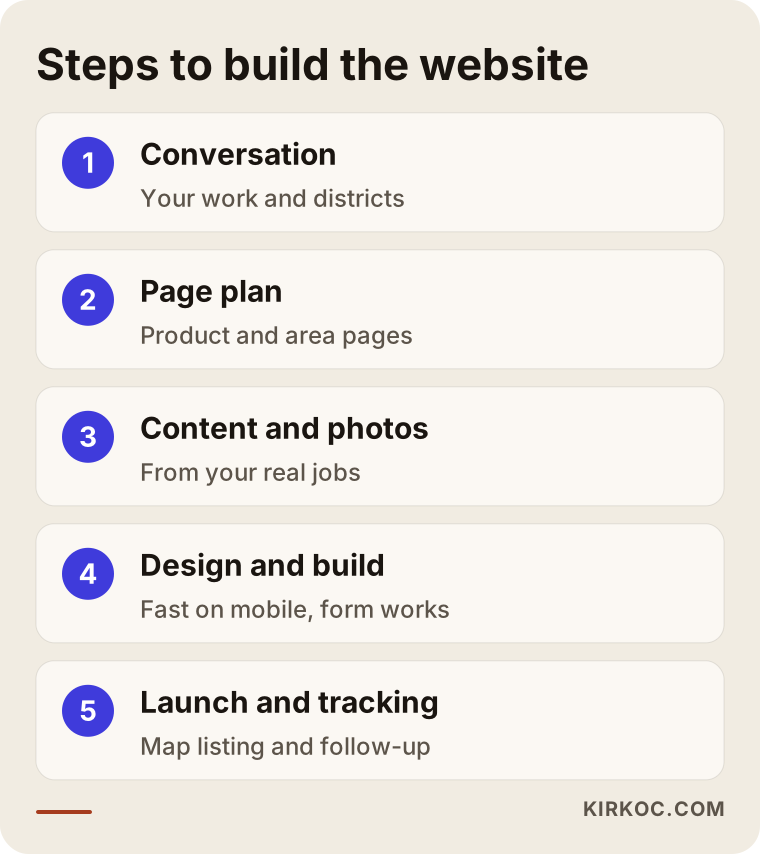
Let me explain each step briefly.
Step one: a conversation. I ask what you sell, which districts you cover and which jobs earn you the most. Not every window business is the same. Whether you work for housing developments or for individual homeowners changes how the site is structured.
Step two: the page plan. I work out which product and district pages need to be written and which questions they should answer. I put it in writing and show it to you.
Step three: content and photos. I write the text in plain language from the information you give me. I choose the photos from your own jobs. If I need to use stock images, I tell you so openly.
Step four: design and build. The site is set up to open quickly on a phone, with a working form and chat button. I also hand over the admin panel, so when you want to add a new job photo you do not depend on me.
Step five: launch and search listings. I publish the site, submit it to Google and bring your business profile (the card people see on the map) in line with the website.
Step six: tracking and improvement. I look at how many people filled in the form, which pages got attention and which searches brought visitors, and then fill in the gaps.
Common mistakes
Most of the mistakes I see in this trade are not technical. They are simple omissions.
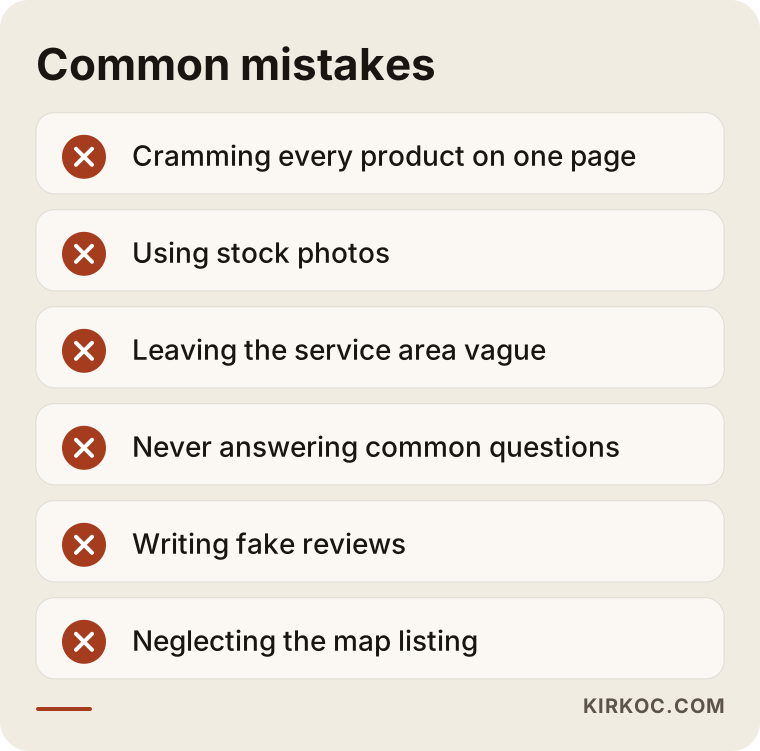
Let me unpack them a little.
Cramming everything on one page. When windows, doors, glass balconies, mosquito screens and shutters share a single page, none is explained well and none can show up in search by itself.
Using stock photos. If a customer has seen the same picture on another company's site, they will doubt that your workshop is real. Honest photos taken with your own phone, in decent light, bring in more work than glossy fake ones.
Leaving the service area vague. On a site that says "we serve the whole country", nobody feels it is meant for them. Name the places you really go to.
Never answering questions. If there is not a single line about price, timing, permission, warranty or care, the visitor does not call you to ask. They click to another page.
Hiding reviews and references. One sentence from a satisfied customer, used with their permission, is stronger than a thousand words of self-promotion. Use only real, permitted reviews. Invented reviews are unethical and will cause you trouble later.
Neglecting the map listing. If your Google business profile does not match your site, with the phone number, address and hours written differently in different places, trust takes a hit.
What can you do yourself, and when do you need a specialist?
You do not have to hand everything to someone else. There are things you can do: take regular photos of your work, ask customers for permission and a short comment, keep your map listing up to date, and write down the questions that come in by phone so the repeated ones become a list. That list is the most valuable raw material for the site.
Where you tend to need a specialist: setting the pages up in a way search engines can understand, site speed and phone compatibility, checking that the form really works, writing district pages without copying one from another, and measurement. Doing these halfway can end up costing more than not doing them.
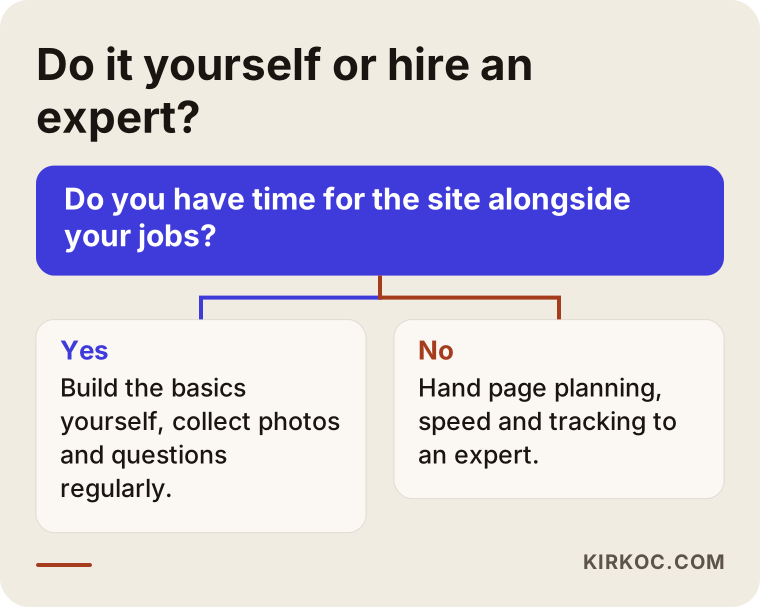
The logic of the diagram is simple. If you have the time and interest, you can build the foundation yourself. If you want a steady workflow and you also need to keep up with jobs at the workshop, handing this over saves time in the long run.
Is a website enough? Ads, maps and social media
A website is the hub, but it does not open every door alone. A customer can reach you in several ways: the map card on Google, search results, Google ads, and your work on Instagram and Facebook. They work best when they are connected.
For a newly opened company, quick results often come from advertising. An ad that appears when someone searches "glass balcony Pendik" can bring in the first phone call even if your site is new. But an ad that sends people to a weak page is just money going to the wrong place, so the site needs to be ready before the ads start. Social media, in this trade, is mostly a "proof window": a short video of a finished installation, a clip of an installer taking measurements, a before and after. These are posted to build trust, not to chase follower counts.
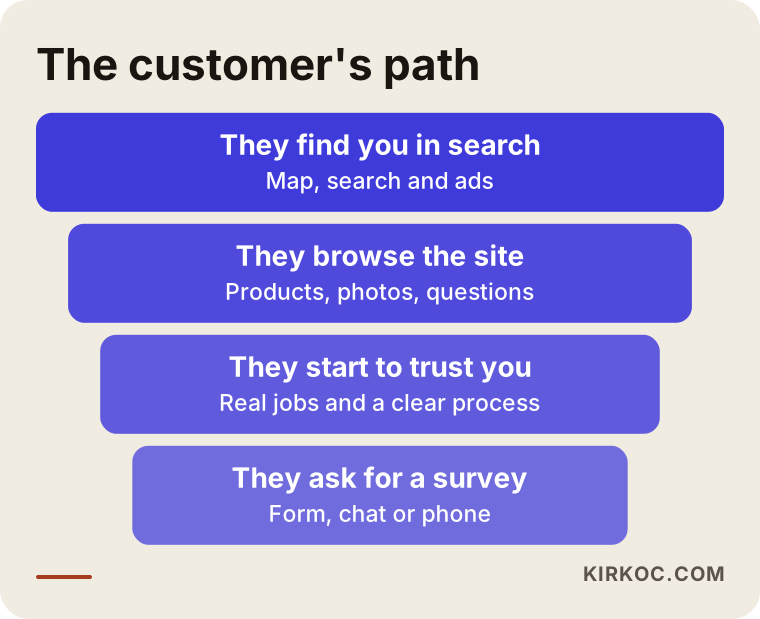
Look at the funnel and you will see that being found is only the first step. Not everyone who visits the site fills in the form; some drop out at each stage. What matters is making every stage easier. This is where it makes a difference to have one person running the website, search, the map listing, advertising and social media. With separate people, the same phone number can end up written four different ways, the ad can point to one page while the site promises something else. When one person handles it all, the message stays consistent.
What determines the cost?
I will not give numbers, because a correct number only exists once the need is known. But I can tell you clearly what moves the price.
The number of pages comes first: a small showcase of three or four pages needs different effort from a larger site with products, districts and a job gallery. Second is who supplies the content. If you prepare the text and photos, the load drops; if I have to write and organize everything from scratch, it grows. Third are extra features: a photo-upload survey form, pages in several languages, product comparison sections, measurement calculators. Fourth is upkeep after launch: updates, backups, adding new jobs. Finally, whether you also want search visibility and advertising at the same time shapes the budget.
I go through these factors with you in a first call, and I will not put anything in the proposal you do not need. Ask everyone who sends you a quote to write down what it covers; the sentence "a website will be built" is not enough.
How I work with you
I am one person. The one you talk to is the one who writes the site, sets up the search work and runs the ads. There is no middleman and no handoff. That speeds things up, but it also means I limit how many projects I take at once so that each gets real time.
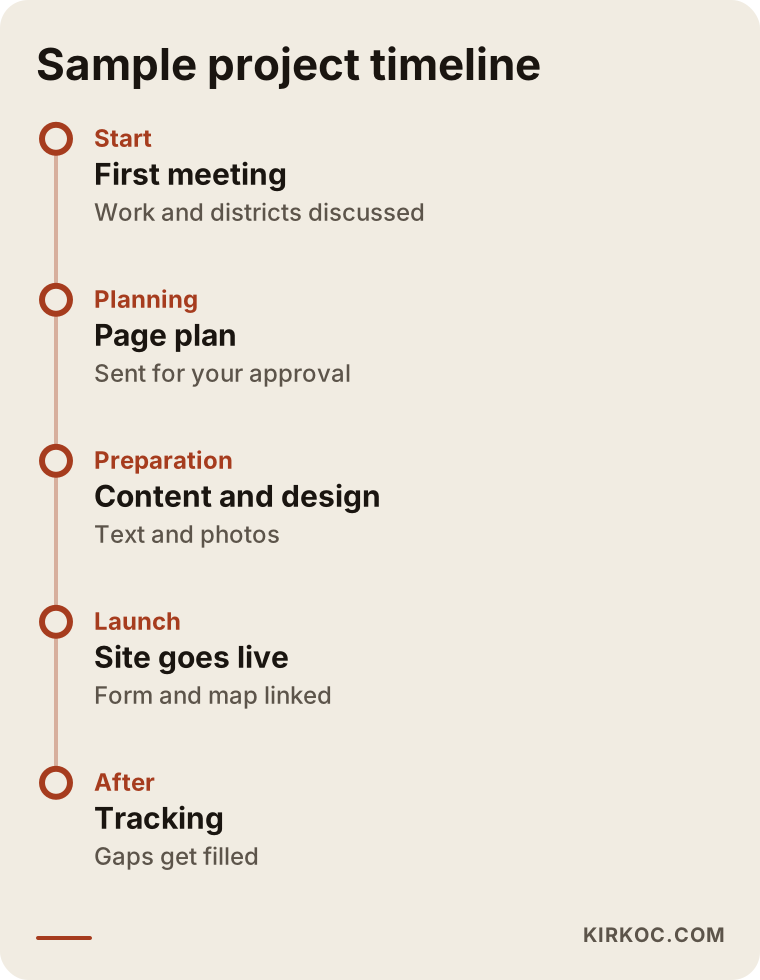
The timeline is only an example; it will change with the number of pages and how fast the content arrives from your side. I do not promise fixed dates or results, because search results are not in my control. What I can promise is regular communication, clear reporting and a site you will actually use.
Frequently Asked Questions
Does a uPVC window company really need a website?
If you win work through recommendations, it may not feel urgent. But the person who received the recommendation will often search for your name online. If there is no site or no up-to-date map listing, that damages trust. If you want to grow, a website is no longer optional.
Is it better to have a separate site for glass balconies or a separate page on the same site?
For most businesses, one site with strong separate pages makes more sense. If you operate like two different brands and speak to different customers, a separate site could be considered, but it increases the upkeep.
Should I put prices on the site?
You do not have to. In work that depends on measurements, a fixed price can mislead. Explaining what determines the price and offering a free survey is both honest and effective.
Which districts should I create pages for?
Only the places where you really go to measure and where you work regularly. A page for a district you do not serve misleads the customer and carries no value for search engines.
How long after launch will customers come?
Nobody can honestly guarantee that. It depends on competition, your area and the quality of the pages. Ads can give faster visibility; natural visibility in search usually takes time. In the first weeks, my aim is to make sure the site works properly.
Can I use customer reviews on the site?
Yes, with the customer's permission. Reviews you write yourself damage trust and may break platform rules. If you are unsure about publishing reviews or handling personal data, ask a lawyer.
Can I update the site myself later?
Yes, and I specifically want that. I will teach you the admin panel so you can add a new job photo, change working hours or add a new district. For bigger changes, I am there to help.
I already have a site. Does it have to be rebuilt from scratch?
Not always. First I look at the speed, the pages and how it looks on a phone. If the foundation is sound, I build on it; if not, rebuilding can be cheaper. I explain the reasoning behind that decision.
Making your window or glass balcony business visible online comes down to pages that answer your customers' questions, real photos and an easy way to ask for a survey. If you would like to plan your site together, you can reach me through my website design service page, tell me about your business and the districts you cover, and start the first conversation.