You have been thinking about running ads on Google or Instagram for a while. Maybe you tried it yourself, the budget disappeared, and the phone did not ring the way you hoped. Maybe an acquaintance told you they worked with some agency and were happy. Now you have typed "digital advertising agency" into a search box and ended up with dozens of proposals that all sound alike. Everyone says "results-driven." Everyone promises to be your "growth partner." In this article I explain which questions to ask when you choose an advertising agency, why each one matters, and how to read the answer you get. If you would rather hand the whole job to one person, you can also look at my digital advertising management service, but first I want you to have enough information to ask every candidate the same questions.
I am Ümit Kırkoç. I work from Istanbul, and I provide every service a digital agency would, on my own: websites, SEO, social media management, Google and Meta ads, logos and content. That means I know the agency side of the table, and I also know where business owners tend to struggle when they work with one. The questions below are the ones I would want a client to ask me.
Before you ask anything: know what you want to buy
If the picture in your head is clear, you can tell much more easily which proposal fits you. "Let's run ads and be visible on social media" is not a goal. "Get a certain number of new customer calls a month" or "increase daily orders from the online store" is a goal. Even if you cannot put a number on it, write one sentence about which result would make you happy.
The word "advertising" also covers three different things. The first is the ads that appear when people search on Google; the person has already typed what they need. The second is the ads that show up in someone's feed on Instagram or Facebook; the person is not searching, and you are putting yourself in front of them. The third is ads in more specific places such as Google Maps, YouTube or LinkedIn. Each does a different job and needs a different budget and different creative material. If an agency cannot explain which one it recommends for you and why, that is your first warning sign.
The image below shows an invented search results page that a business owner might see when searching for an ad agency. The sites are made up.
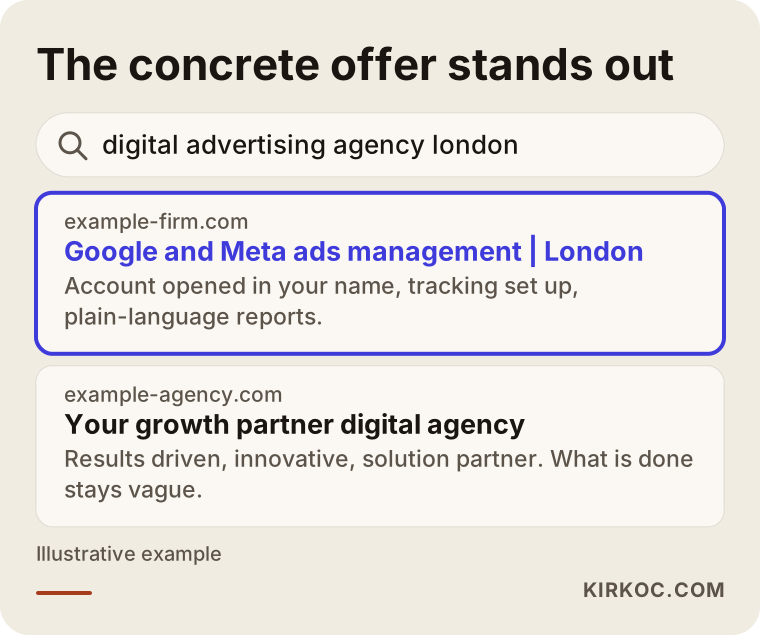
The highlighted result says what it does and who it does it for. An agency that writes down a concrete service instead of a grand phrase like "your growth partner" usually works concretely too. It is not a standalone test, but it is a useful first filter.
Agency, solo expert or doing it yourself: three paths
You can run advertising in three ways. You can hire a large agency, you can hire an individual specialist, or you can manage the accounts yourself. I am not claiming that any one of them is right for every business.
Large agencies usually have many people: one builds the strategy, one manages the account, one does the design. That is an advantage when the work is big and complicated. The problem for a small-budget business is that the person in the sales meeting and the person who runs your account day to day may not be the same, and information gets lost in the handoff.
When you work with a solo specialist, your contact is always the same person. You know who does the work, and that person answers when you ask a question. The trade-off is that if they get sick or become very busy, the backup options are limited. You should ask about that openly.
Managing it yourself makes sense, especially for first experiments. But ad dashboards change every few months, each platform has its own logic, and the most expensive mistake is budget that gets spent before you realize what is happening.
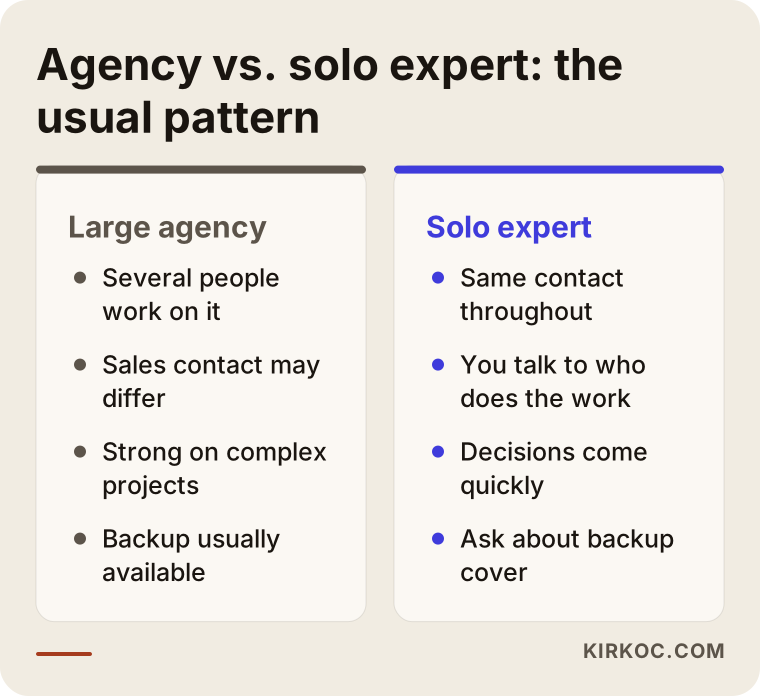
The comparison above shows a tendency, not a rule. You can find an attentive account manager at a large agency, and a solo specialist can be sloppy. What matters is that you ask "who will actually do this work for me?" in the meeting and get the answer in writing.
There is one more benefit of having one person handle everything, and I will state it up front. The page your ad sends people to is usually your website. If the site is slow or the phone number is hard to find, the ad produces weak results no matter how well it is built. When the same person runs the ads, the site and the social media, there is no "that's their fault, not ours" argument when something goes wrong. It is clear who fixes it.
What to prepare before the first meeting
Gathering a few things before you meet an agency or specialist makes the conversation far more productive. None of it is complicated, and you can do most of it in an hour.
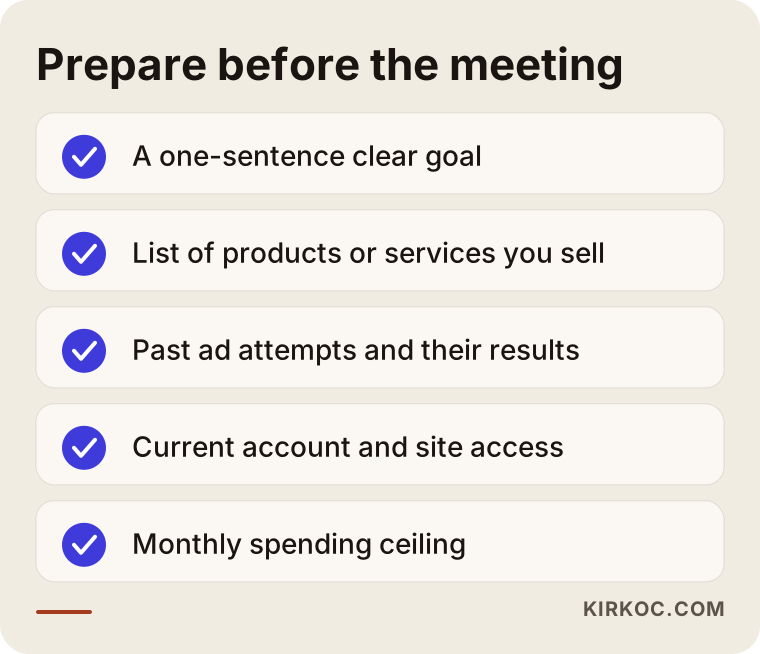
The item most people skip on this list is the history of earlier ads. Write down the old campaigns, which platform you tried, and why you stopped. You do not want to pay a new agency to repeat the same mistake. If you already have ad accounts, also check whose name they were opened under. That connects to one of the most important questions below.
The questions to ask
Now to the main part. You can ask the questions below one by one in a meeting. Under each, I describe what a good answer and a weak answer look like.
1. Whose name will the ad account be opened under?
In my view this is the most critical question. Your Google Ads and Meta ad accounts should be opened in your name, and the agency or specialist should be added to them as an administrator. You are the owner. The payment method is yours, and so is the history. If the agency runs your ads from its own account, then when you leave, years of data and everything that was learned stays with them, and you start from zero.
A good answer: "I open the account in your name, I join as an administrator, and you can remove my access whenever you like." A weak answer: "We manage the account from our own system, and we don't give panel access." In some cases agencies use a shared management account for technical reasons, which can be normal, but ownership should stay with you and you should see that in writing.
2. What will be measured, and how?
The way to know whether an ad "works" is conversion tracking. That is a setup that counts whether a person who clicked your ad then did something you wanted: filled in a form, tapped your phone number, or added to the cart and bought. If tracking is not set up, all you have is "this many people clicked," which does not mean orders or calls.
Ask: "Which actions will you count, and how will you set it up?" A good answer is concrete: "Form submissions, phone taps and WhatsApp taps will be counted separately, and I will set it up and test it in the first week." A weak answer is "We'll look at tracking later," or a promise of a report based on clicks alone.
3. How are the ad budget and the service fee separated?
There are two separate items, and they should not be mixed up. The ad budget is the money that goes straight to Google or Meta. The service fee is what you pay for the agency's or specialist's work. Some agencies charge a fixed fee, some charge a percentage of ad spend, and some combine the two.
Every model has strengths and weaknesses. In a structure based on a percentage of spend, the agency may have an incentive to raise your budget. That is not bad in itself, but you should know about it. In a fixed-fee model, the agency's goal is not to grow the budget but to keep the work efficient. Your question should be: "What does my fee depend on, and how much of the ad budget actually goes to ads?" You should be able to see in the dashboard that the whole ad budget is going to the platform.
4. How often will I get a report, and in what form?
A report is where the work becomes visible. A good report explains the spend, the actions it produced (calls, forms, orders), and what will be done next month. A bad report is a table full of clicks and impressions that never answers "so what happened?"
Agree on the frequency and format at the start. Beyond the report, you should have the right to look at the dashboard yourself whenever you want. A short monthly call or a written explanation is also very valuable, because the "why" behind the numbers rarely appears in the table.
5. Who does the work, and who do I contact?
I mentioned this earlier, but it is worth asking again. Is the person in the sales meeting the same person who manages the account? Who will be on the monthly call? In an emergency, for example when an ad account gets suspended or the budget runs out somewhere unexpected, who do you write to and how quickly will you get an answer?
6. Is the page the ad leads to ready?
An ad takes people somewhere: your website, a product page, or WhatsApp. If that page opens slowly on a phone, does not make clear what to do, or has no visible phone number, the ad budget is wasted. An honest specialist looks at your page before starting the ads and, if needed, says "let's fix this first." Be careful with a proposal that never says that and is simply eager to launch campaigns.
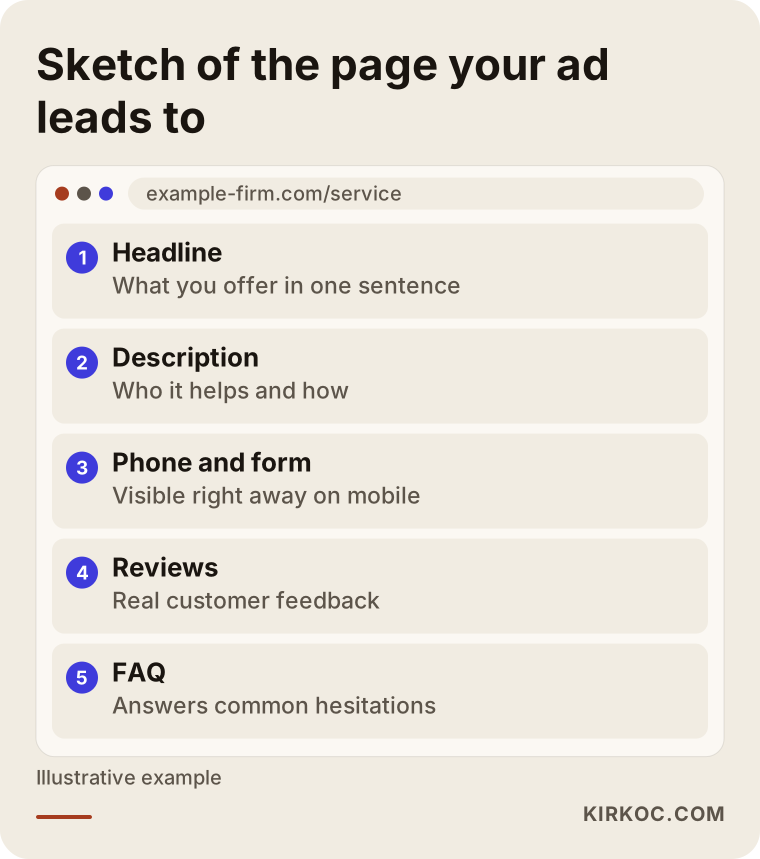
The page sketch above shows, in order, what someone arriving from an ad needs. If your page looks nothing like this, it may make more sense to spend time on the page before you spend budget on an agency.
7. Can you walk me through what happens in the first month?
A good specialist can describe the first month: which day the account is set up, when the ads go live, and when the first week of data will be reviewed. It is also normal to hear "there is a learning period in the first few weeks, so don't expect results immediately," because ad systems collect data at the start. But that sentence should not become a shield to avoid responsibility. Ask: "What will we look at in the third week, and what will you do based on it?"
8. Do they promise results?
No honest specialist can guarantee a specific number of customers, sales or followers. Part of what decides the outcome is your product, your price, your competitors and your sales process. Someone who says "I will definitely bring you this many sales" either does not know the subject or is saying it to close the deal. A good specialist explains what they will do, what they will watch, and under what conditions they will change the plan.
9. What does the contract say, and how can I leave?
Do not sign a contract without reading it. When you read, look at the minimum term, the notice period for ending it, who owns the account and the data, and what the fee covers. If you want to leave, can you take your account access and your history with you? Because a contract is a legal document, I would rather not interpret it for you; the soundest approach is to have a lawyer look at it before you sign.
10. Who prepares the creative material?
In Meta ads, the image and video are among the things that affect results the most. Are the ad copy and designs included in the fee, or charged separately? Are you expected to supply them, or will they be produced for you? This is one of the places where unexpected costs appear most often. Ask at the start and get the answer in writing.
11. Do they know my industry or something similar?
Having worked in your exact industry is not required, but understanding how that industry's customers make decisions is. Advertising for a clinic is very different from advertising for an online store: one is chasing appointments, the other is chasing carts. You can ask for references, but not every specialist can share other businesses' names, so asking "can you describe the approach you would take?" is also a fair way to test it.
12. What will you not do?
The last question looks odd, but it is very useful. A good specialist knows what is out of scope and says so: "I don't build websites," "I don't shoot product photos," or "I won't change your brand identity." A proposal from someone who does not know their limits, or who says "we do everything," often ends up with the work done halfway.
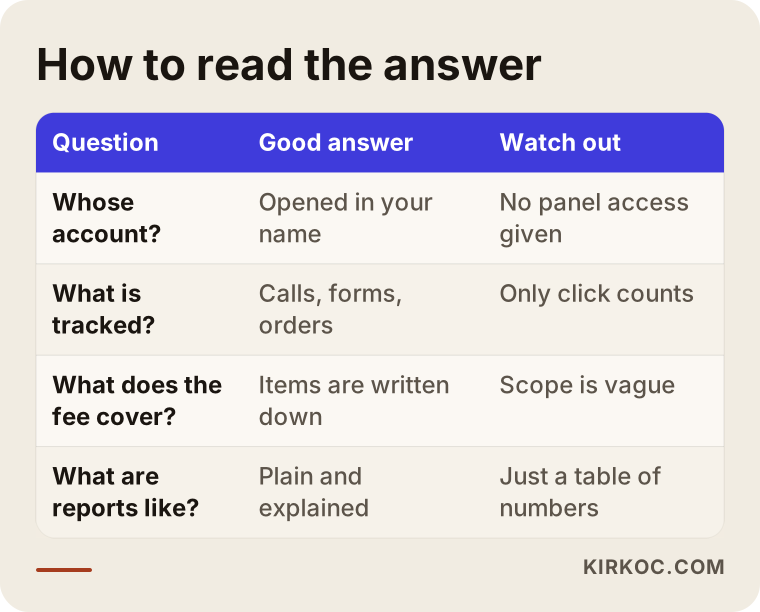
The table above gathers the good and weak answers to the four most important questions at a glance. You can print it and take it into the meeting.
Warning signs in a proposal
When you evaluate a proposal or a meeting, some signs deserve attention when they appear together, even if one alone proves little. None of them automatically means "bad agency," but they should slow you down and make you ask more questions.
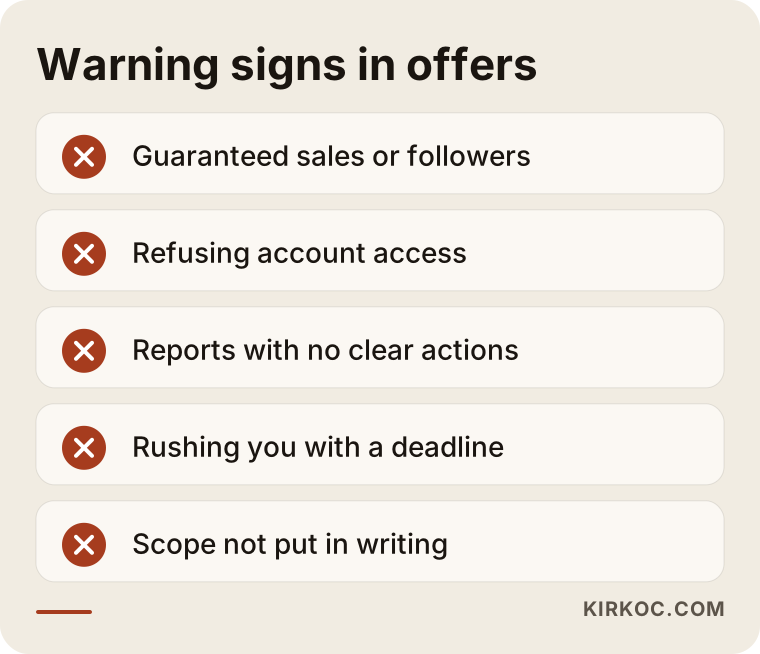
The two I take most seriously are refusing account access and rushing you. Pressure like "this offer is only good this week" is a sales tactic that has no place in evaluating an agency. You need time to decide, and a good specialist understands that.
From ad to sale: where people drop off
Judging an ad agency by one number, the click count, is misleading. An ad is only the first link in a long chain. A person sees the ad, clicks, lands on your page, gets convinced, and then calls you or places an order. You can lose people at every link.
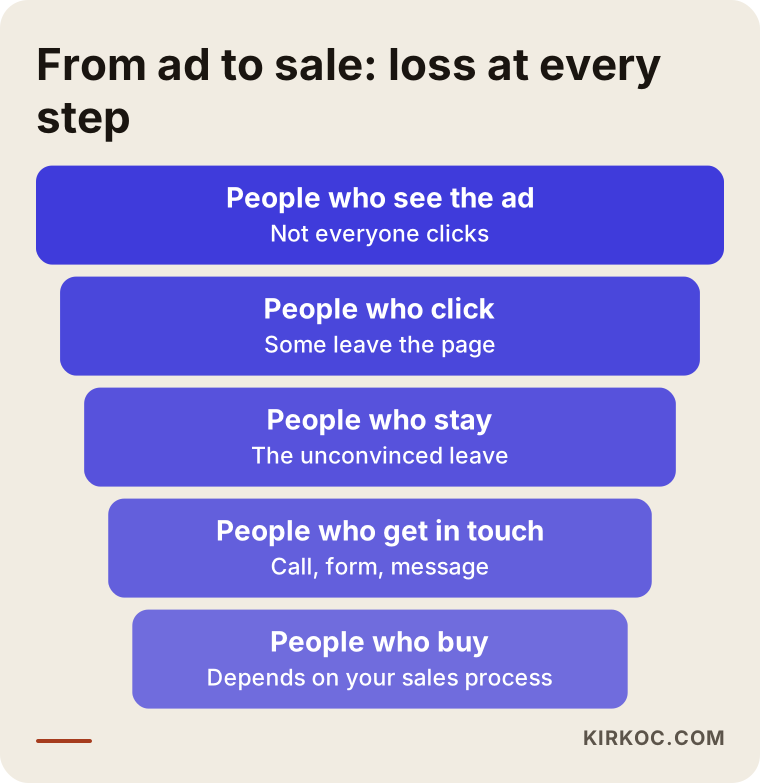
The funnel shows that the number of people shrinks naturally at each stage, which is normal. What matters is finding where the loss is largest. If many people click but few stay on the page, the problem is the page or the promise in the ad. If many people contact you but few buy, the problem may be in the sales process, and that is on your side rather than the agency's. A good specialist reads this chain with you instead of defending only their own link.
Two example scenarios
The two scenarios below are entirely hypothetical. They do not describe a real business; they are made up to show what the questions change in practice.
Scenario 1: Whose account is it?
Suppose a small clinic starts working with an agency on Google ads. The agency runs the ads from its own account, and the clinic receives only a monthly summary as a PDF. Two years later the clinic wants to work with another specialist. The new specialist asks, "Can we look at the past data?" But which keywords worked, which hours performed best, and the records of corrected mistakes are all inside the old agency's account. The clinic drops two years of learning and starts from zero with a new account.
If the same clinic had opened the account in its own name from the start, the new specialist could have looked at the history and started much faster. This scenario sums up why the first question matters so much.
Scenario 2: Clicks but no calls
Another hypothetical example: the owner of an online store pays a specialist for Meta ads. The monthly report shows a high click count and a low cost per click. It looks good on paper, but orders are not increasing. When they review it together, they find that purchase tracking was never set up. The report contains only clicks; nobody knows who bought or where carts got stuck. On top of that, the site's checkout page works badly on mobile.
The problem here is not the ad itself. Tracking was never built, and the page the ad leads to was never tested. The second question, "what will be measured?", was never asked in the meeting, and months were wasted.
How working with an agency usually goes, step by step
A well-run engagement usually passes through similar steps. The details differ a little from one agency to another, but the main flow looks like this.
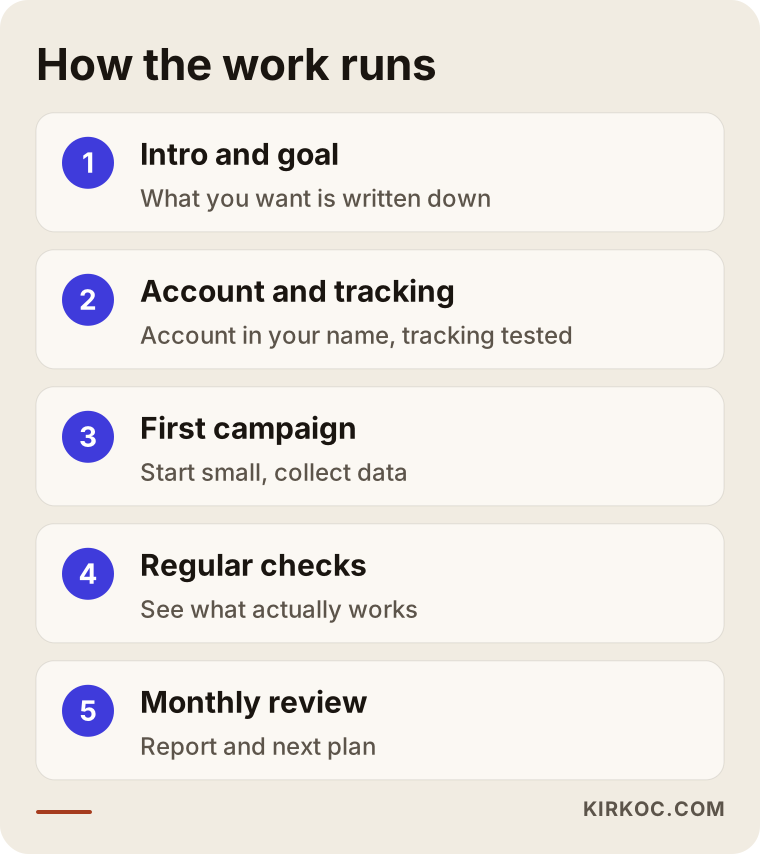
The first step holds the most important part of the job: getting the goal clear. A campaign built without a clear goal cannot later answer "was it successful?" In the second step the account is opened in your name, and tracking is set up and tested. In the third step the first campaign goes live, but nobody should expect it to deliver the ideal result right away. Steps four and five are the ongoing part of the work: looking at the data, seeing what works, and moving the budget accordingly.
What to expect in the first three months
Ad systems collect data at the beginning, and performance can swing during that time. An honest specialist tells you that up front, but does not stop at "be patient"; they explain what they are looking at in each phase.
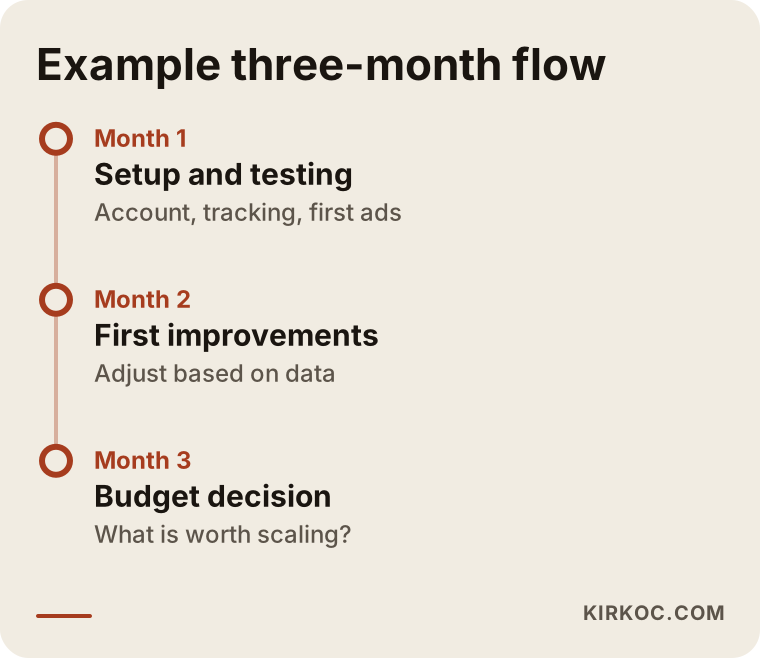
This calendar is not a contract; it is an example of a reasonable flow. It changes with your industry, budget and ad type. What matters is that at the end of each month the question "what did we learn, and what will we do?" has been answered.
Common mistakes
Here are the mistakes business owners make most often when choosing an ad agency.
The first is deciding on price alone. A cheap proposal may leave out part of the work, and an expensive one may offer more than you need. Read the price together with what it covers. The second is not asking about account ownership, which I described in detail above. The third is expecting results too quickly and judging by the first week of data. The fourth is trusting impressive numbers in a report without comparing them with your own sales. If the report shows "lots of results" but money is not reaching your till, something is wrong.
The fifth is not questioning the product or service itself. Advertising shows a good product to more people; it does not rescue a weak offer. If your price is far above competitors or you cannot explain your service, the agency ends up having to work around that too. The sixth is trying to be on every platform at once. Splitting a small budget across three platforms means too little data on each. It is usually healthier to go with one channel and learn from it.
The seventh is keeping communication with the agency one-way. You ask the agency about campaign results but never tell them what happened with sales. A specialist who knows which phone calls turned into sales can tune the ads much better. That is your half of the collaboration.
What you can do yourself, and when you need an expert
Not every business needs an agency right away. In some cases it makes sense to try on your own first. But you should know where the limit is.
Things you can start on your own: keeping your Google business profile up to date, keeping your social accounts alive with regular posts, asking customers for reviews, and trying a single campaign with a very small budget. This introduces you to how the work functions and helps you ask more informed questions when you talk to a specialist.
Situations that call for expert help: when your budget rises to a meaningful level, when you need to manage more than one channel at the same time, when you cannot set up tracking, when your ad account gets restricted, or when your own experiments produce nothing. Account restrictions are sometimes technical and sometimes policy-related, and solving them takes experience.
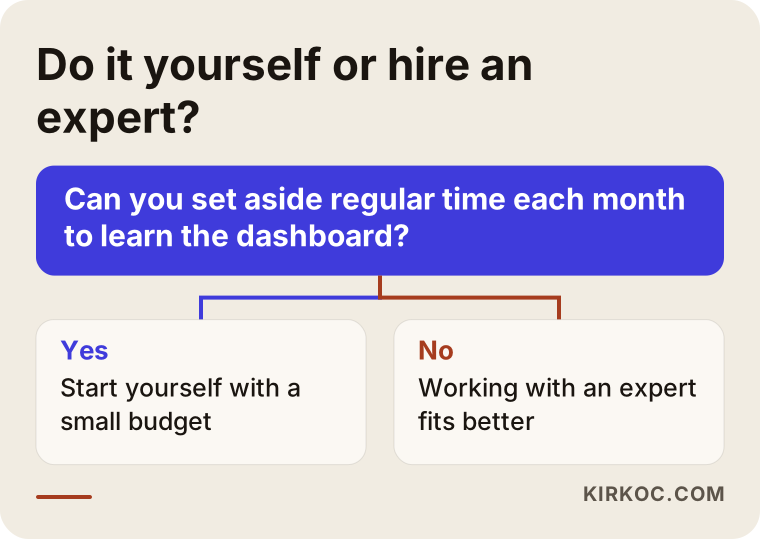
This decision flow is a simplified guide, and every situation has its own details. Still, it is a reminder that the key question is your time: running ads is not something you set up once and walk away from; it needs regular attention.
What determines the cost
I am not giving numbers, because prices vary widely with the scope of the work. But I can tell you what they depend on. The number of platforms you advertise on, the number of campaigns to manage, the size of the monthly ad budget, whether image and video production is included, how complicated the tracking setup is, and how often there are reports and calls are the main items that affect the fee. On top of that comes whether your site or landing page is ready; if it is not, it has to be fixed first.
So when you compare two proposals, look at the line items rather than the totals: are you comparing the same work? If one proposal includes tracking setup and reporting and the other does not, the prices cannot be compared.
How I work
I do this work on my own, so the person who has the meeting is the person who manages the account. The first step is listening to your business, your goal and where things stand today. Then I tell you what is truly needed first; sometimes the site or the profile needs fixing before any ads, and I say so plainly. Ad accounts are opened in your name, tracking is set up and tested, the first campaign goes live, and I report at regular intervals in plain language.
When the site, SEO, social media and ads are in one pair of hands, you do not have to think about whom to call when something goes wrong. For example, if people arriving from an ad get lost on the page, the same person can fix both the ad and the page. That does not mean working with one person is necessary for every business; it is simply a starting point for talking about whether it suits you.
Frequently asked questions
What is the first thing to check when choosing an ad agency?
In my view, the first thing is whose name the ad account will be opened under and how tracking will be set up. If those two are clear, the remaining questions are easier to answer. The size of the agency or the polish of the presentation does not replace them.
Is an agency or a solo expert better?
Which is better depends on the size of the job and what you need. For complex, multi-channel work with a large budget, an agency structure can be an advantage. For small and mid-sized businesses, knowing who does the work and being able to talk to that person directly is often more valuable. What matters is asking who will work on it and who the backup is.
Can an ad agency guarantee results?
No. An honest specialist cannot guarantee a particular number of sales, customers or followers. Besides the ads, your product, your price, your competitors and the quality of your sales process all affect the outcome. Instead of a guarantee, ask for a clear explanation of what will be done and what will be watched.
Are the ad budget and the agency fee the same thing?
No. The ad budget is money paid directly to a platform such as Google or Meta. The agency fee is for the management work. Ask for the two to be written separately in the proposal, and ask to be able to see in the dashboard that the entire ad budget goes to advertising.
Do I keep control of the account when I work with an agency?
You should. The ad account should be opened in your name, with the agency added as an administrator. That way you can remove access whenever you want and keep your history. Have this written into the contract, and if you are unsure, consult a lawyer.
When will I start seeing ad results?
It depends on the type of ad, your industry and your budget. On Google search, people have already typed what they need, so you may see movement in the first weeks; on Meta ads, the learning period can be more noticeable. Do not ask for a promised timeline; ask for a plan that says what will be reviewed on which date.
Should I invest in my website before I run ads?
Often yes. At the very least, make sure the site opens properly on mobile, your contact details are visible, and it is clear what you offer. An ad brings a person to your site; if the site does not convince them, the budget does not pay back.
Is it hard to change agencies later?
Not if the account was opened in your name and the tracking is registered under you. Problems arise when everything sits in the agency's account. That is why, when you sign, you should have the exit terms and who owns the data written out clearly.
Choosing an ad agency or specialist starts with asking the right questions; once you have settled account ownership, tracking, reporting and contract terms, the decision becomes much easier. If you would like to go through these questions for your own situation, or talk about having me manage your ads from start to finish, you can reach me through my digital advertising management page.