You are a psychologist or therapist with a private practice, a clinic, or an online session schedule. Most of your clients probably arrive through a referral from someone who trusts you. But a share of them type "psychologist near me" into their phone, scroll through the results, and then open Instagram to see who you are. If they cannot find you there, or your account looks like a storefront nobody is minding, they quietly choose someone else. In this article I explain how to set up social media for psychologists without crossing ethical lines. I am Ümit Kırkoç, based in Istanbul, and I handle everything from websites and SEO to ads and social media on my own. I will also be plain about what my social media management service does and does not cover. I am not a psychologist. You and your professional board know your ethics rules far better than I do. My job is to help you plan your visibility inside a framework that respects those rules.
Let me start with the main point. Social media for your profession is not the same as social media for a hair salon or a furniture store. In those businesses the goal is usually to show a product and sell it. In yours, the person reading is often at a vulnerable point in life and trying to work out whether they can trust you. A careless post does not just earn "low engagement." It can damage a client's trust, or even your professional standing. So the first rule here is not fast growth. It is drawing the line in the right place.
Why does social media for psychologists follow different rules?
For many businesses, the routine is simple: show the product, announce a discount, share a customer review. For a psychologist, almost all three habits can be a problem. Sharing a client's review can reveal that the person sees you. Discount and campaign language can clash with the advertising rules that apply to health services. A promise like "I will fix this problem in this many weeks" is troubling for ethical reasons and for plain honesty.
So think of your account less as a sales channel and more as a trust channel. Its job is to answer three questions calmly and without judgment: what does this person do, how do they work, and what happens if I go? An account that answers those questions helps someone who has never met you decide to book a first session.
On the legal side, there are rules about advertising health services, ethics codes from professional associations and licensing boards, and privacy laws that govern personal data. In the United States, for example, people often think of HIPAA, and other countries have their own versions. These details differ by place and change over time, and I am not an attorney. If you are unsure whether a post is appropriate, ask your licensing board, your professional association, or a lawyer. Everything below is a general workflow, not legal advice.
Who is searching, and how?
Picture the mindset of someone looking for a psychologist. Some know exactly what they want: "therapy for anxiety," "couples counseling," "child psychologist." Others start with a symptom: "why am I always tired," "can't sleep." Some already have your name from a friend and are simply checking you out, typing it in and looking at your account and your site. What all three groups share is that they want to see you somewhere before they decide. That somewhere might be a Google result, your Instagram profile, or a directory listing.
The graphic below uses a completely made-up example to show how a search results page might look.
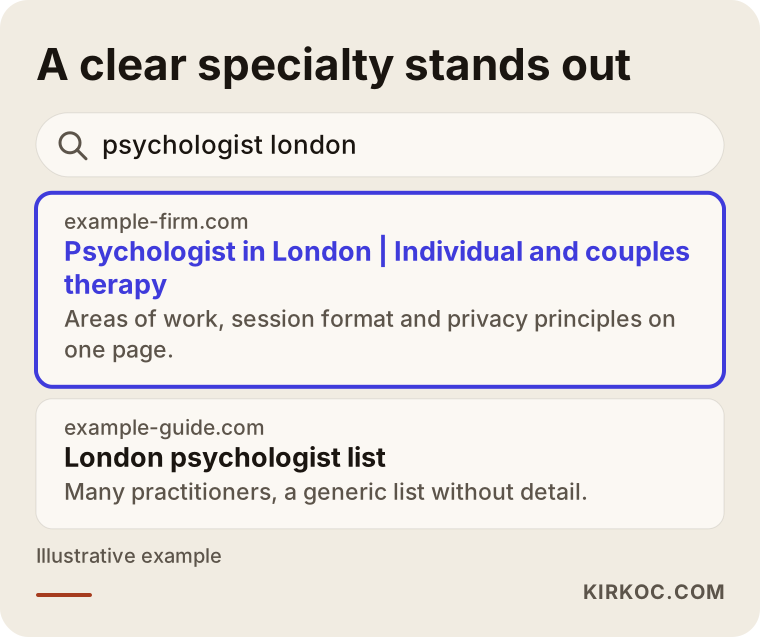
Let this remind you that social media alone is not enough. People often search first and look at social media second. Your account and your website should support each other, with the same name, the same description of your specialty, and the same contact details. This is where having one person handle everything pays off. The website, the search listing and the social profile all speak the same language.
What should you post, and what should you never post?
I think this is the most important section of the article. Many psychologists get stuck on "what do I even post," because everything feels risky. In fact there is plenty you can share. The skill is knowing where the line sits.
Content you can share with confidence
The first type is general educational content: "what happens in a first therapy session," "how online therapy works," "the difference between therapy and psychiatric care." These do not diagnose anyone. They simply sketch a general picture. The second type describes how you work: session length, your cancellation policy, your privacy principles, which age groups you see. The third type is calm, general awareness content: a breathing exercise, sleep habits, short reflections on setting boundaries. With this last type, make sure the post never reads like you are treating the viewer, and that it suggests seeing a professional when that makes sense.
What to avoid posting
Client stories need great care, even when names and details have been changed, because a client may recognize their own story and feel deeply uncomfortable. Client reviews, thank-you notes and before-and-after narratives raise the same concern. Sentences that promise recovery, wording that says you will "definitely solve" a specific diagnosis, and casual advice aimed at someone in crisis should stay off the list too. "Analyzing" a public figure or an acquaintance from a distance is risky for both ethical and reputational reasons.
The comparison below tries to capture the difference at a glance. Every professional board and every situation has slightly different rules, so treat this as a starting point.
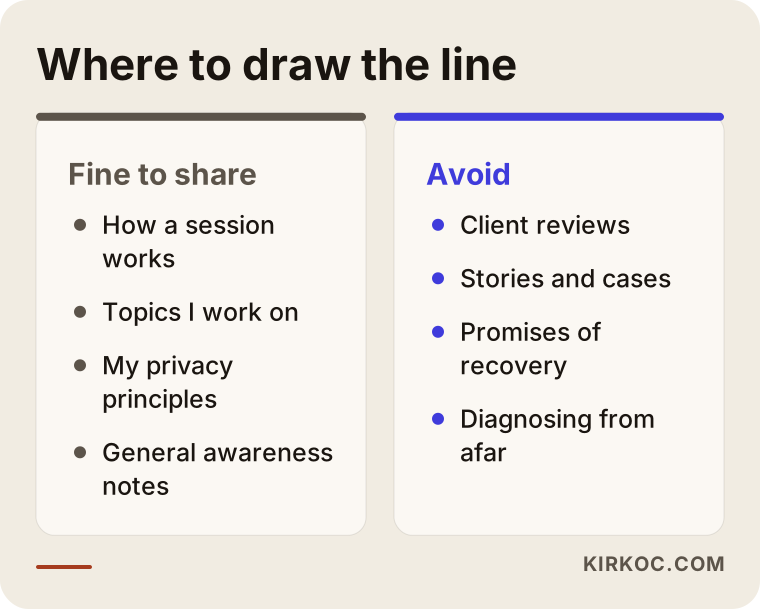
The right-hand column is where most problems begin. Some of it looks well-intentioned. Showing a client's thank-you message feels like something precious. But everyone who sees that message also learns that the person worked with you. That is a disclosure the client never agreed to make.
Two hypothetical example scenarios
The two scenarios below are entirely invented. They are not real people or organizations. I am writing them only to show the reasoning.
Example scenario 1: a newly practicing clinical psychologist. Suppose a psychologist opened a private office a year ago. Their Instagram account has only a personal photo and a few motivational lines. They post a quote once a week, but nobody sends a message. The problem is that the content says nothing about their professional identity or how they work. Once the profile is cleaned up and six or seven calm posts are prepared, covering the topics they work with, how sessions run, and what to expect from a first meeting, the account becomes an introduction page for the first time. After a contact button, booking information and a clear description of services are added, the messages change in character. Instead of a bare "hello," they begin to say things like "I would like to book couples therapy." That is not a guarantee. It is an illustration of the logic.
Example scenario 2: a small center shared by several therapists. Suppose three therapists share an office and each posts randomly from their own account. One uses diagnostic language, one announces promotions, one makes everyday jokes. None of the accounts match, and an outsider cannot tell what the center is. The fix is a shared content principle and a simple rule about who approves what: before anything goes out, one person reviews it from an ethics standpoint. That approach brings consistency and safety at the same time.
Which platform is right for you?
You do not need to be everywhere. Which platform works for a psychologist depends on which clients you want to reach. Teenagers and young adults tend to spend time on Instagram and TikTok. Corporate clients, and people interested in work stress or professional development, are on LinkedIn. People who want deeper information watch YouTube. Facebook can still matter for some parent groups and local communities.
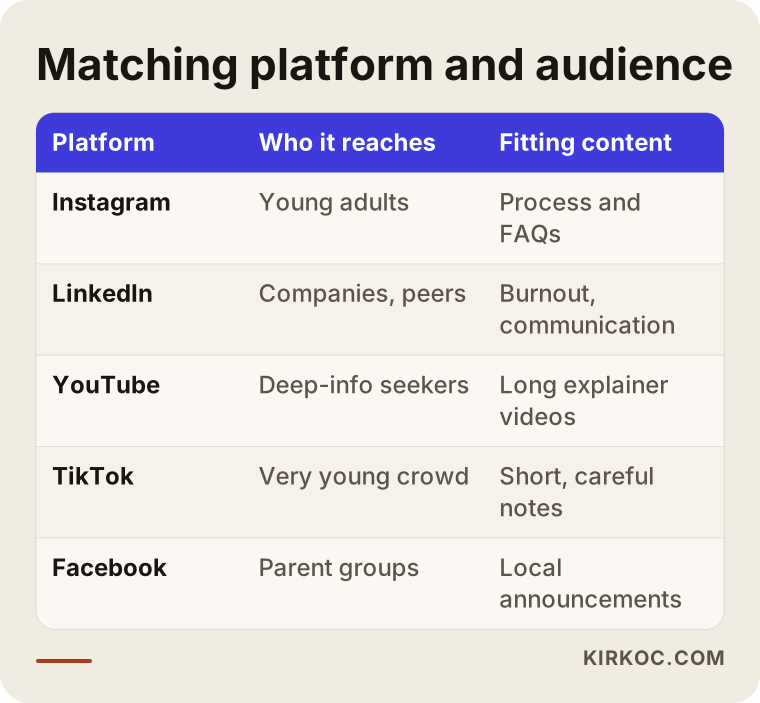
When you read the table, remember that you do not have to be present on all of them at once. Keeping two platforms going steadily and well beats running five halfway. If your time is limited, start with the single platform where your ideal client spends the most time.
Instagram: your profile and how you work
Instagram is the most common choice for psychologists. Use a calm, professional profile photo. Your bio should answer "what do I do, who do I work with, where, and how can I be reached." Adding highlights titled "FAQ," "how sessions work" and "privacy" makes life much easier for someone landing on your account for the first time. As for Reels and Stories, think carefully about the limits of handling heavy topics in short videos. Explaining a complex psychological situation in thirty seconds invites misunderstanding.
LinkedIn: professional visibility
On LinkedIn, the goal is usually not clients so much as corporate partnerships, workplace trainings and referrals from colleagues. If your practice covers workplace stress, burnout or communication for managers, this platform can be a serious channel. The tone should be a bit more professional and the content a bit more explanatory.
YouTube and TikTok
YouTube suits topics that need time to explain, such as "what to know before starting therapy." A video you make once can show up in search results for a long time. TikTok can reach a wider and younger audience, but the short format makes it easy to become superficial. If you use it, settle your "what I will not say" list before you post anything.
Matching content to the client's journey
Before you say "book an appointment" to anyone on social media, think about where that person is in their process. A person first tries to name the problem, then researches what therapy is, then compares a few practitioners, and finally sends a message. Different content works at each stage.
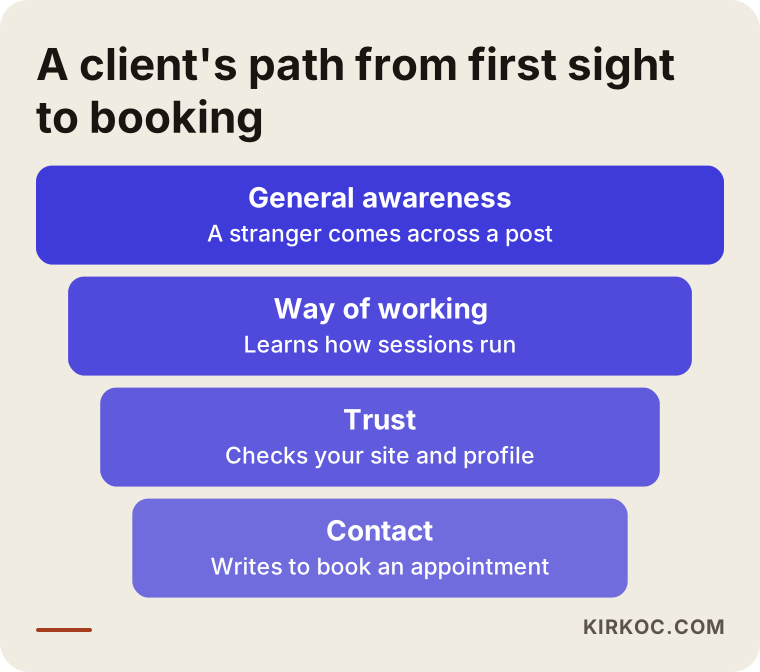
At the widest part of the funnel are general awareness posts, which reach many people who do not know you. In the middle are posts that describe how you work. At the narrowest part are posts where the way to contact you is obvious and that answer "what should I do for a first appointment." Keep the bottom stage lean but clear. Do not expect large numbers to reach it. What matters in this field is that the people who do get there are the right ones.
How to set it up, step by step
There is a sensible order for building all this. Most people jump straight to making content, but laying the foundation first saves a lot of time later.
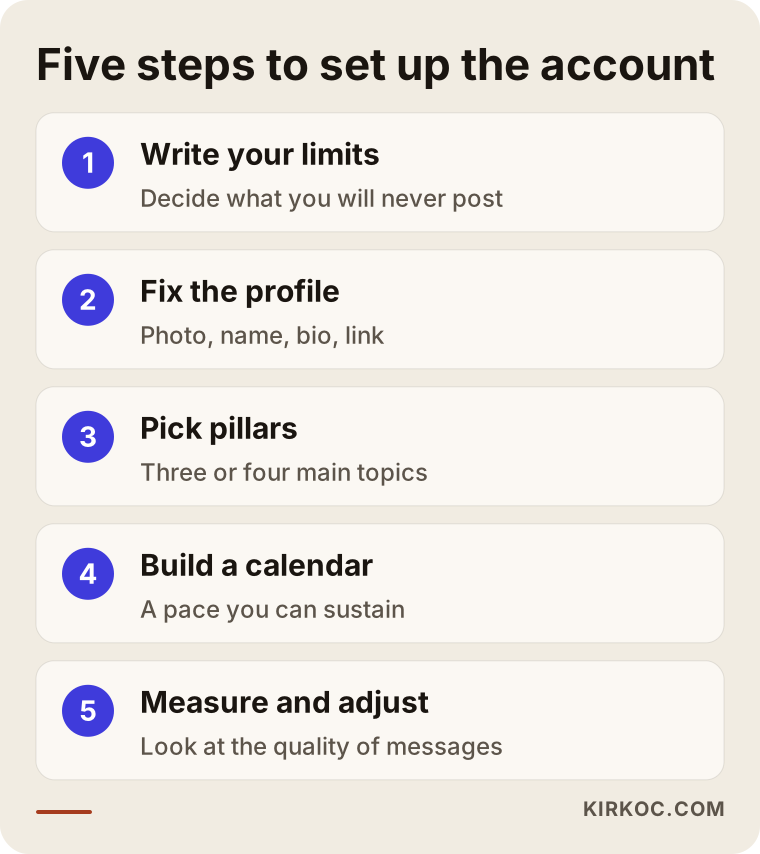
Step one: write down your limits. On one page, list the topics you will cover, the topics you will stay away from, and the fact that you will never share anything about a client. That page becomes the filter for every future post. I suggest rereading your professional board's ethics principles at this stage.
Step two: fix the profile and first impression. Profile photo, username, bio and link. These four things decide what a stranger understands about you in the first few seconds. If your username matches the name on your website and in directory listings, people will find you more easily.
Step three: choose your content pillars. Three or four main themes are enough, for example "the therapy process," "awareness," "frequently asked questions" and "how I work." If every post ties back to one of them, the account will not look scattered.
Step four: build a content calendar. Be honest about how much you can post each week. An intense pace you cannot keep up turns into an abandoned account within a month. One or two steady posts a week is enough for most psychologists.
Step five: measure and adjust. Look at which posts get attention and which ones bring messages. The number of people who contact you matters more than the number of likes. While doing this, never press your clients with pointed questions about how they found you. Noting the answers that come up naturally is enough.
Common mistakes
Some of the mistakes I see in this field are unintentional, and some come from a well-meaning rush.
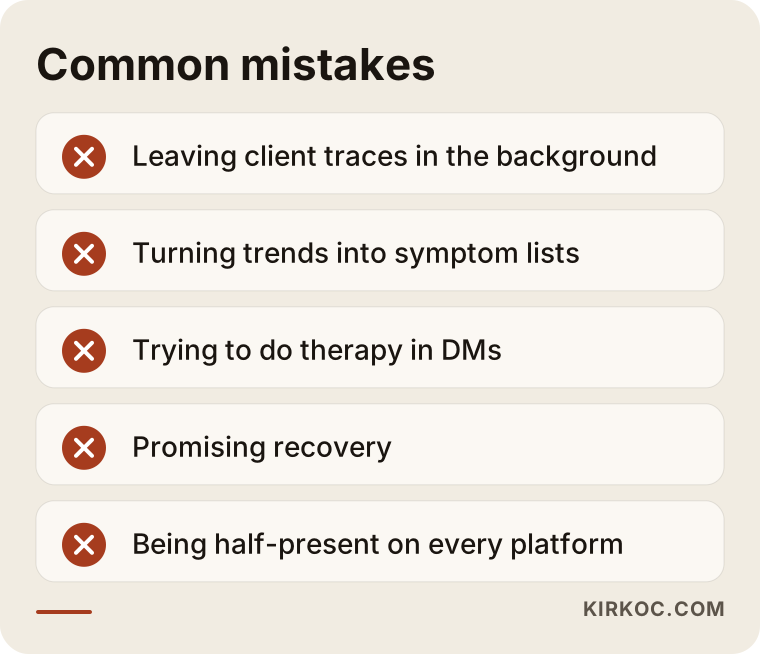
The most dangerous is leaking client information, and it is rarely deliberate. An appointment book visible in the background of a screenshot, a corner of the office in a Story where a client happens to appear, or a name legible at the edge of a screenshotted message can be enough. Before you post, ask yourself: is there anything in this image, audio or text that could lead someone to recognize a person? Make that question a habit.
Another common mistake is chasing trends. When a concept or term goes viral, it is tempting to turn it into a checklist of symptoms in a short video that anyone can apply to themselves. Content like that can lead people to diagnose themselves incorrectly. A safer approach is to explain the concept and add, "if you feel this way, talking with a professional may help."
The third mistake is trying to answer every comment and message instantly. A social media inbox is not a therapy room. If someone shares a personal struggle in a message, your reply should be kind but clear: this is not the place to discuss it, an appointment is, and in an emergency they should contact local emergency services or a crisis line. Preparing that reply in advance makes hard moments much easier.
A checklist for a safe profile
The list below is made of simple questions you can ask yourself before an account goes live.
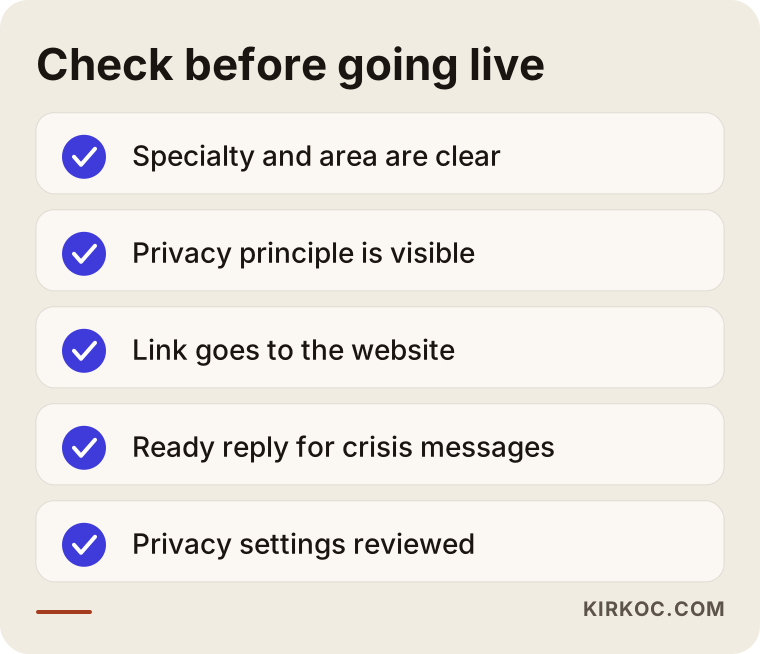
Filling this out once is not enough. Review it every three months. Platform settings, rules and even expectations in your profession change over time. Privacy settings, automatic tagging and location sharing in particular can be reset by platform updates.
Think about your website alongside social media
Social media is not a foundation by itself. An account can be suspended one day, algorithms change, and a platform can lose popularity unexpectedly. Your website is your own ground. A simple site that builds trust for a psychologist should include a short and honest page about you, the topics you work on, how sessions run, your privacy principles and your contact information.
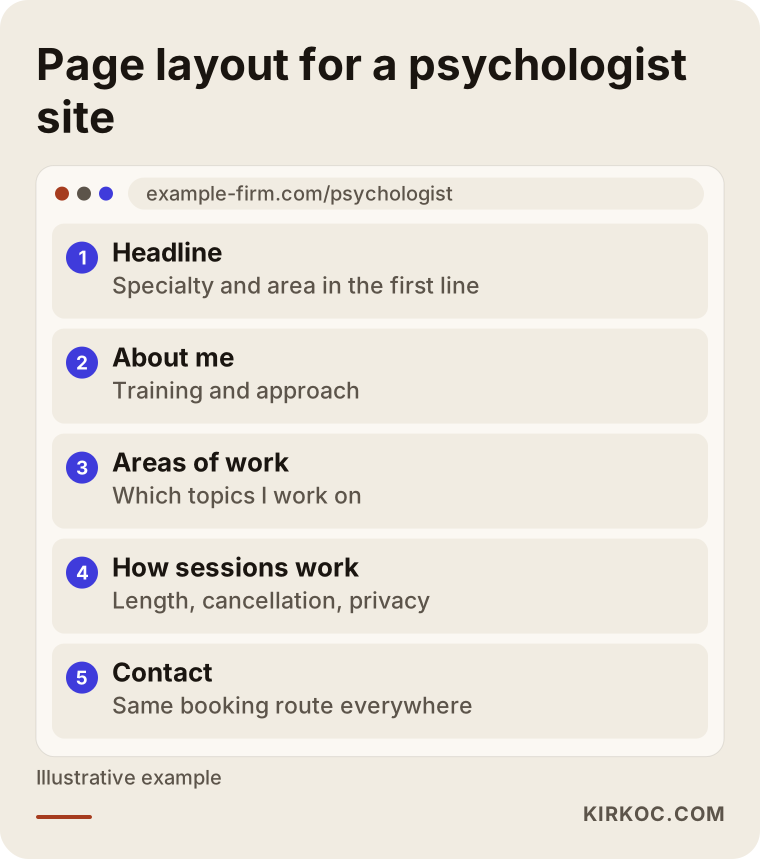
The nice thing about this layout is that someone arriving from social media finds everything they were wondering about in one place. A person who likes a post on Instagram can follow the link in your profile to your site and answer the question "who is this person, what do they do." The same site also makes you findable in search engines. You can even move some of your social posts onto the site as blog articles, so your effort works in two places.
Handling everything through one person makes a difference here. When one person builds the site, another runs the social media and a third manages ads, the tone, colors, message and even the phone number can end up different in different places. Because I do all of it myself, when you change a service description I can update the site, the profile and the search listing at the same time.
When can you do it yourself, and when do you need a specialist?
To be honest, you can do much of this yourself. If you have the time and the interest, setting up a profile, preparing a weekly post and answering messages are all doable. But some parts of the work are where outside help starts to make sense.
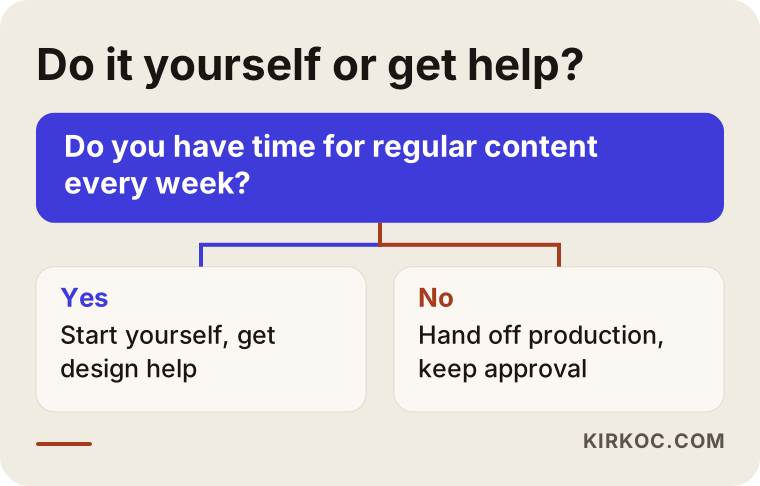
Things you can usually do yourself include writing the profile text, preparing short awareness posts and replying to messages. Things where support makes sense include visual design, a steady content calendar, keeping your site and social media consistent, and ads and measurement. Time matters too. Trying to produce content between sessions becomes unsustainable for many people.
One note here. Getting help from a specialist does not mean handing over responsibility for the content. You make the final decision on whether the wording is ethically appropriate. I prepare a draft and you approve it. That is how I work: nothing is published without your approval.
What determines the cost?
I will not give numbers in this article, because every project has a different scope. I can tell you what the price depends on. First, how many platforms you will be on. The workload gap between one platform and three is large. Second, how many posts are produced each month and what type they are. A simple text-on-image post and a short video are not the same amount of work. Third, whether visuals will be designed from scratch and whether your brand identity (logo, colors, fonts) is already in place. Fourth, whether the work will run together with website and search engine work. Fifth, whether you want ad management. Because of the advertising rules for health services, this part needs a more careful review, and it is wise to confirm the relevant rules with an attorney.
When you collect quotes, ask which tasks are included and which are not, whose approval content goes through, and what you will see in the monthly report. A vague quote is an uncertainty that tends to get expensive later.
How the first three months usually go
Social media is not a business for quick results. An account needs time to build trust, and in your profession especially, people watch and think before they ever send a message.
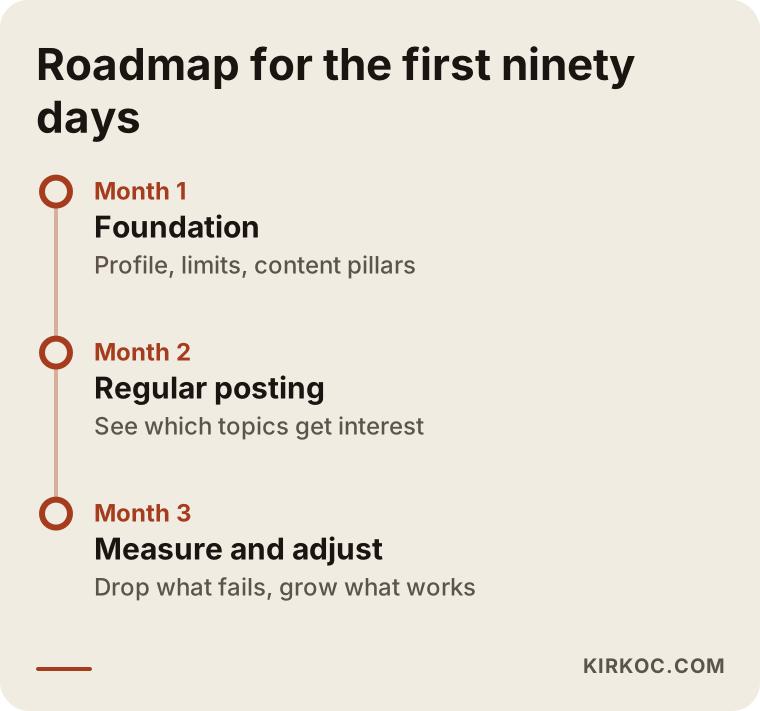
In the first month the foundation is laid: the profile, your limits and the content pillars. In the second month regular posting begins and you learn which topics draw more interest. In the third month the first measurement happens, content that does not work is dropped and content that does is repeated. It would not be honest to tell you in advance how many messages or bookings to expect in that time. Nobody can guarantee that. What you should be able to say after three months is that your account looks steady, consistent and trustworthy.
How working with me goes
If you decide to work with me, the process runs like this. First I have a short conversation with you about the topics you work on, the clients you want to reach, the platforms you use and your limits. Second, I look at your current account and website and send you a written note on what to keep and what to change. Third, I settle the content principles with you, and at this stage I also write down the topics I will never touch. After that I prepare content drafts, you approve them, and then they are published. I never publish anything without your approval. Each month I explain in plain language what was done and what should change.
Because I work alone, the person you talk to is the person who does the work. There is no go-between. In a profession that deals with sensitive subjects, that matters: you do not have to re-explain privacy and tone every time.
Frequently asked questions
Is it ethical for a psychologist to have an Instagram account?
Having an account is not a problem in itself. What matters is what you share and how you share it. An account that protects client confidentiality, makes no promises and avoids diagnostic language is a choice many colleagues make. Still, if a situation is unclear, I recommend checking your professional board's ethics principles and, if needed, consulting an attorney.
Can I share client reviews or thank-you messages?
I generally do not recommend it. It can let others learn that the person works with you, and even with good intentions it carries a privacy risk. A safer way to build trust is through content that explains how you work, how the process goes and what your principles are. For a definitive rule, ask your professional board.
How many social media platforms should I be on?
One is enough to start, and two at most. Choose the place where your ideal client spends the most time and keep it going steadily. Adding more platforms does harm if quality drops.
How often should I post?
As often as you can sustain. For most psychologists, one or two steady posts a week work better than fifteen rushed ones a month. The quality of your posts also affects a client's sense of trust more than the number.
How much does social media management cost?
It would not be right for me to name a figure, because the number of platforms, monthly posts, video needs, design workload and whether it runs together with your website all set the price. After a short conversation I define the scope around your needs and prepare a quote accordingly.
How many clients will social media bring me?
Nobody can guarantee that. A steady, trustworthy and findable account may raise the chance that an undecided person picks you, but the result depends on your specialty, your area and the competition. I suggest being cautious with anyone who promises results.
Is it a problem for ethics if you prepare the content?
I prepare the draft, but you always decide whether it is published. The content goes out under your professional responsibility, so nothing is shared without your approval. Any wording you find ethically doubtful is corrected together or removed.
What should I do if there is a crisis or a negative review?
It is best to prepare a response framework ahead of time. Rather than answering a negative review defensively, a calm sentence explaining that confidentiality prevents you from discussing any client is often enough. If there is a serious legal issue, consult an attorney.
If you are a psychologist or therapist and want to bring your account into line with ethical limits and make it consistent with your website and search results, you can reach me through my social media management page and briefly describe what you need. I will gladly look with you at what suits you.