You run an engineering or project firm. Most of your work comes from past clients, referrals and long-standing relationships, and your website is either missing or a page someone threw together years ago and nobody has opened since. Then one day a new prospect hears your name, searches for you online, and finds something that does not inspire confidence. A website for an engineering firm matters at exactly that moment: it either helps you or it quietly costs you the job. This article is for firm owners who are not technical. I will cover which pages you need, how to describe your work, who actually visits, and what to watch for when you hire someone to build the site. I am Ümit Kırkoç, I work from Istanbul, and I handle websites, search visibility, social media and advertising myself, all in one place.
Let me start with a difference that matters. An engineering site is not like a café or a boutique site. Nobody places an order in thirty seconds. The visitor is deciding who to trust with a building, a plant, a system, or a large sum of money. The decision takes time, several people often weigh in, and every one of them is asking the same thing: "Can this firm really do the job?" Your website exists to answer that question.
How do your clients search for an engineering firm?
Engineering clients are not one type of person, so their searches vary a lot. A landowner might type "structural engineer for a house addition." A plant manager might search for "electrical design for a manufacturing facility" or "energy audit for industrial buildings." A property owner could look for "fire protection design and installation." A purchasing officer at a public agency might simply type your company name and go straight to your project list.
What these searches share is a service name and, very often, a city or region. A broad phrase like "engineering company" brings in little real business, because almost nobody thinks "I need an engineer." They think about a specific problem and search for the specific service that solves it.
There is also a search you never see: the referral check. Someone recommends you, and the person who heard your name types it into Google. People verify even trusted recommendations. What they find is one of three things: nothing at all, an outdated directory listing, or a clean, current website. The third one reinforces the recommendation. The first two waste it.
The illustration below uses a completely made-up example to show how a page that names the service and the region can outrank a generic listing.
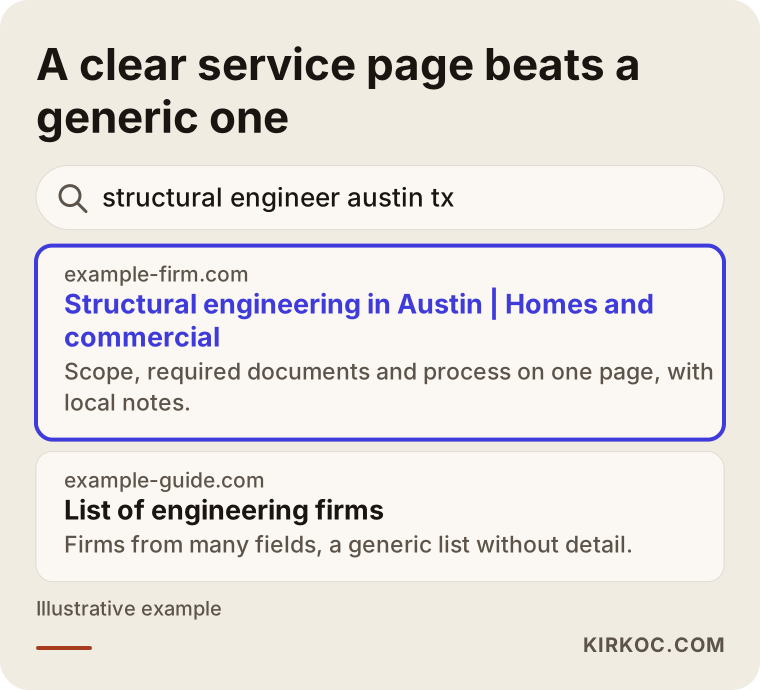
The highlighted result does something simple. It says what the firm does, where, and for whom in the very first line. A vague phrase such as "quality engineering solutions" is just as invisible to a visitor as it is to a search engine.
The four main kinds of search
Sorting engineering searches into four groups makes the work easier to plan. Knowing which group matters for your firm tells you which pages to write first.
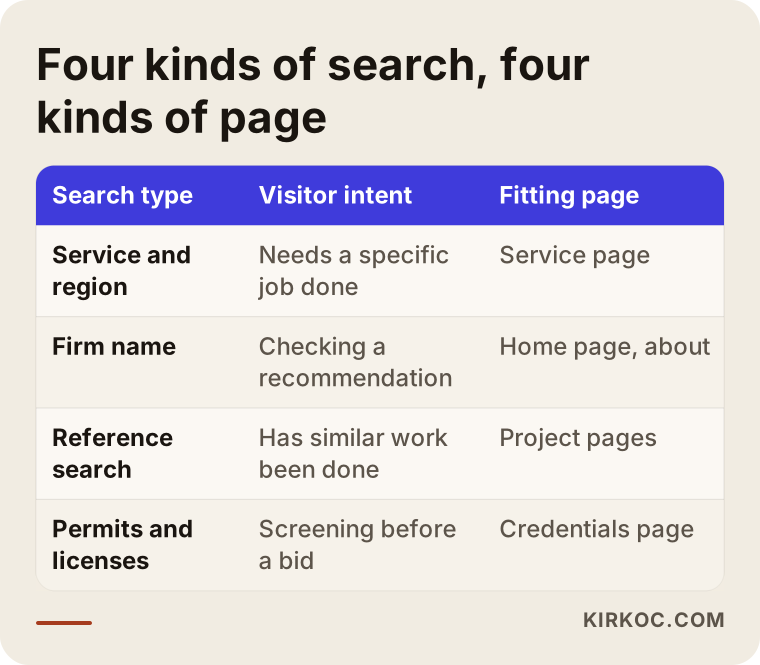
Adapt the table to your own business. If you win most of your work through public bids, searches for your company name and your credentials page matter most. If you design for private owners, service and region pages will carry more weight.
Who is actually looking at your site?
People who visit an engineering website fall into roughly four groups, and each wants something different.
The prospective client. They are about to make an investment and are comparing you with other firms. They want to know whether you have done something similar, who you have worked with, and how easy it is to reach you.
The partner or subcontractor. A larger project needs a team, and they are checking whether you fit. They look at your licenses, your equipment and staffing, and your track record.
The engineer or technician looking for a job. They are judging how serious the firm is, how large its projects are, and whether there is a careers page.
The consultant, architect or public official. Before recommending you to their own client, they take a quick look. They want evidence of competence on paper.
None of these four look at the same page first. A good engineering site tells each of them, quickly, that they are in the right place. Do not bury them in a long menu. Two or three clear paths from the home page are enough.
Which pages do you need?
The most common problem I see on engineering sites is that everything is squeezed onto a home page and an "About" page. But a person who arrives from a search wants to land directly on the page for the service they typed. The basic structure I recommend looks like this:
- Home page: What you do, who you do it for, which areas you serve, and how to get in touch.
- Service pages: One page for each main service. Structural design, mechanical systems, electrical design, studies and reporting, and construction or installation each get their own page.
- Project and reference pages: Short write-ups of work you have completed.
- About page: Who you are, how you work, your licenses and your team.
- Frequently asked questions: Answers about process, timing and the documents you need from the client.
- Contact and quote request: A simple form that works, plus a phone number and an address.
The next illustration is an invented layout that shows how a single service page can be divided into sections.
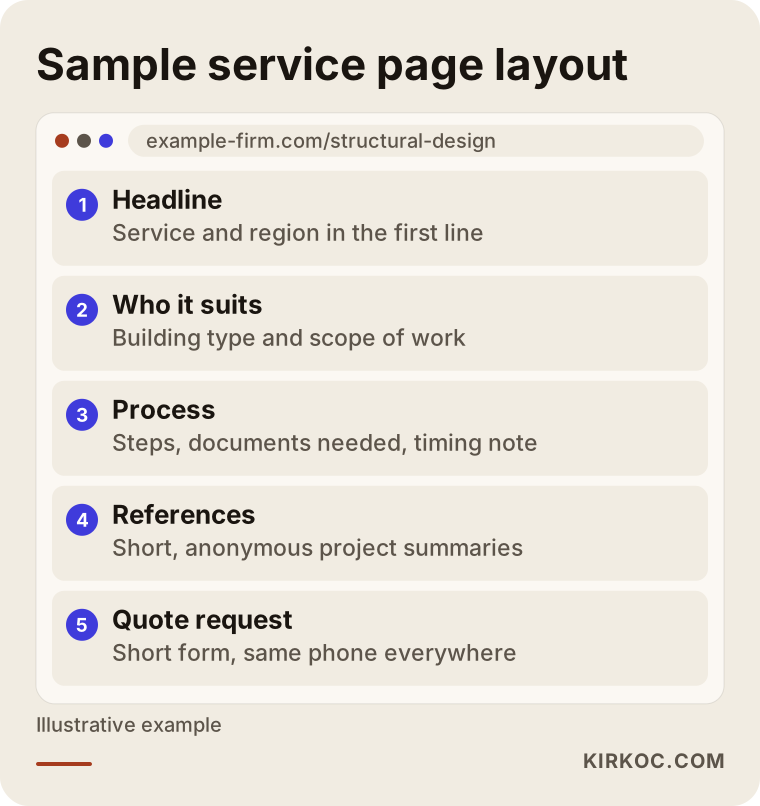
Each section has a different job. The headline tells the visitor they are in the right place. "Who it suits" defines the scope. The process section reduces uncertainty. References build trust. And the quote request does the page's real work, which is starting a conversation.
What should a service page say?
A service page should not read like a catalog. A sentence such as "We provide high-standard, client-focused engineering services" says nothing. Answer the questions your reader actually has instead. What exactly does this service include? What kinds of buildings or facilities is it for? What do you need from the client to begin? How long does it take, and what does the timing depend on? What does the client receive at the end?
If you must use a technical term, explain it in one sentence. Suppose you use the word "feasibility study." Saying it means "an investigation done before a decision, to find out whether and how something can be built" makes it much easier for a non-technical investor to talk with you. A word that is routine for an engineer can be a wall for everyone else.
References and projects: where trust really comes from
In engineering, the most persuasive thing you have is work you have already done. Yet on most sites the references are just a row of logos, and a row of logos tells the visitor nothing. A short case write-up is far stronger.
A project page can include the type and scale of the job, what the client asked for, the challenge you ran into, what you did, the outcome, and photos if you have them. When describing the outcome, do not invent figures or percentages. Stick to things that can be verified: the work was delivered, an approval was obtained, the building opened for use.
One important caution. You need permission before you publish a client's name, a project address or an image. Some jobs are covered by confidentiality agreements, and some clients simply do not want to be named. In those cases an anonymous description such as "for an industrial facility" or "for a residential development" is perfectly convincing. If you are unsure about privacy rules or photo rights, talk to an attorney.
The next illustration compares two ways of building a reference page.
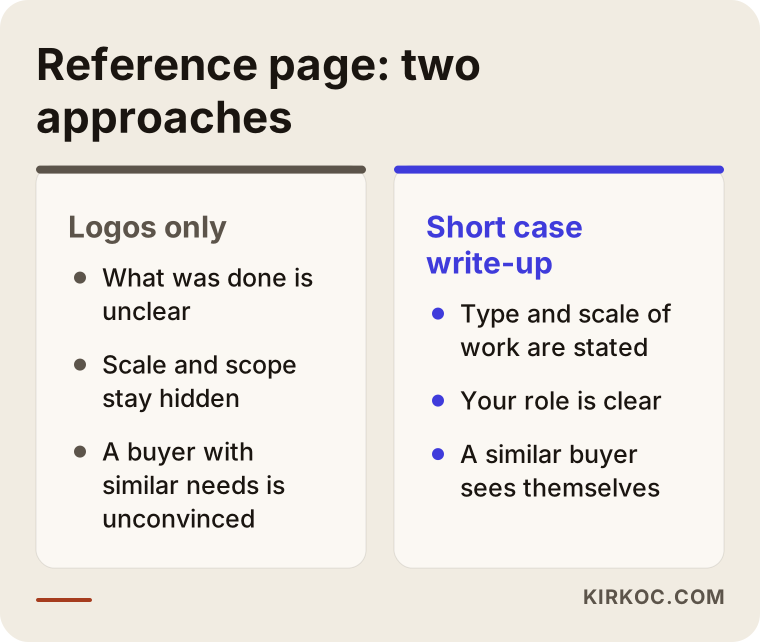
The approach on the left is common, but it leaves the visitor with questions. The approach on the right takes a little more effort. Still, once a visitor thinks "this firm has done something like my situation," the decision is more than half made.
Two hypothetical scenarios
The two scenarios below are entirely hypothetical. They do not describe any real firm or person. Their purpose is to show how the same kind of site gets built differently depending on the situation.
Example scenario 1: a small structural and architectural design office
Imagine a small office founded by two engineers. Most of their work comes from word of mouth. Their website was built about ten years ago, it does not display properly on phones, and it holds three lines of introduction. Property owners hear about the office from a friend, check the name online before calling, and find nothing worth reading.
The first job here is to break the office's work into three or four clear service pages: for example, structural design for homes, evaluating and strengthening an existing building, and help with the permit process. Each page explains the process step by step, lists the documents the client will be asked for, and answers typical questions. Project pages describe the type and scale of the work without naming the client. The site is made easy to read on a phone, the contact details appear on every page, and a simple quote form is added.
The office's real advantage is that it can build a site that confirms the recommendation. It does not need to rank first on Google to be useful. The site first has to inspire confidence. Later, pages for specific regions can be added, and visibility can grow step by step.
Example scenario 2: a mid-sized firm serving industrial facilities
The second imaginary firm provides electrical, automation and energy-efficiency design and installation for industrial plants. Most of its work arrives through direct sales and invitations to bid. Before sending an invitation, the buyer's procurement staff check the firm's credentials, its team, and its equipment capacity. The firm also wants new clients, but large competitors keep appearing ahead of it in general search results.
Here the site should work like the digital version of a corporate capabilities brochure. Credentials and certifications get their own page, laid out clearly. Services are divided by industry and by function: an energy audit for food-processing plants, for instance, and automation for a production line. Each page uses language that shows the firm understands that industry's problems. Instead of a bare "request a quote" button, the form lets the visitor describe their need briefly and choose their facility type and location, so the inquiry arrives half-prepared.
This firm's main problem is clarity more than visibility. A visitor should understand the firm within thirty seconds, find the right page, and leave a document request or a quote request.
How does a visitor move toward a decision?
With engineering services, the visitor usually moves down a funnel: first curiosity, then research, then comparison, and finally contact. Your site needs to respond at every stage of that journey.
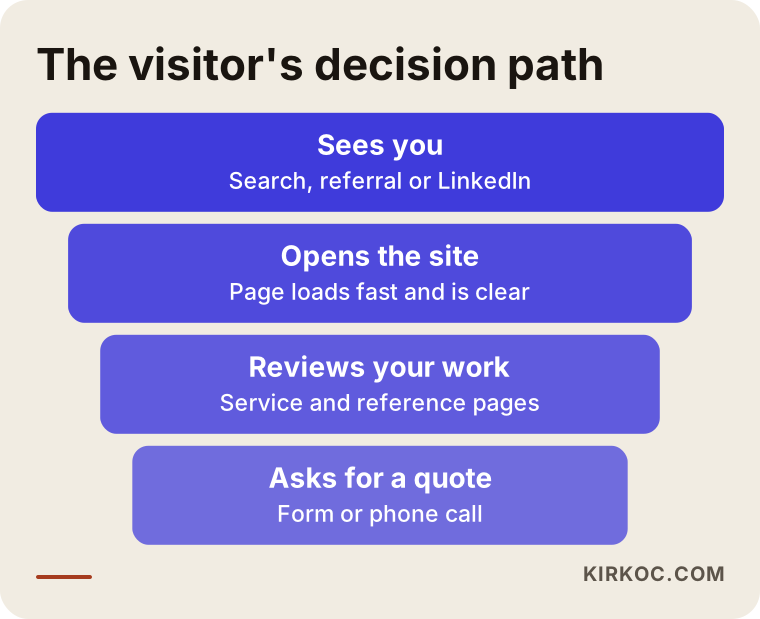
At every step, some visitors drop out. That is normal. The goal is to reduce the avoidable reasons: a slow page, a vague description of services, missing contact details, a form that does not work. The lower you go in the funnel, the fewer people remain, but the more serious they are. For this reason an engineering site should not chase huge numbers of visitors. It is worth more to bring the right visitor to the right page and make it easy for them to get in touch.
Step by step: how the site gets built
How is an engineering firm's website put together? Splitting the work into stages makes the process clearer for both of us.
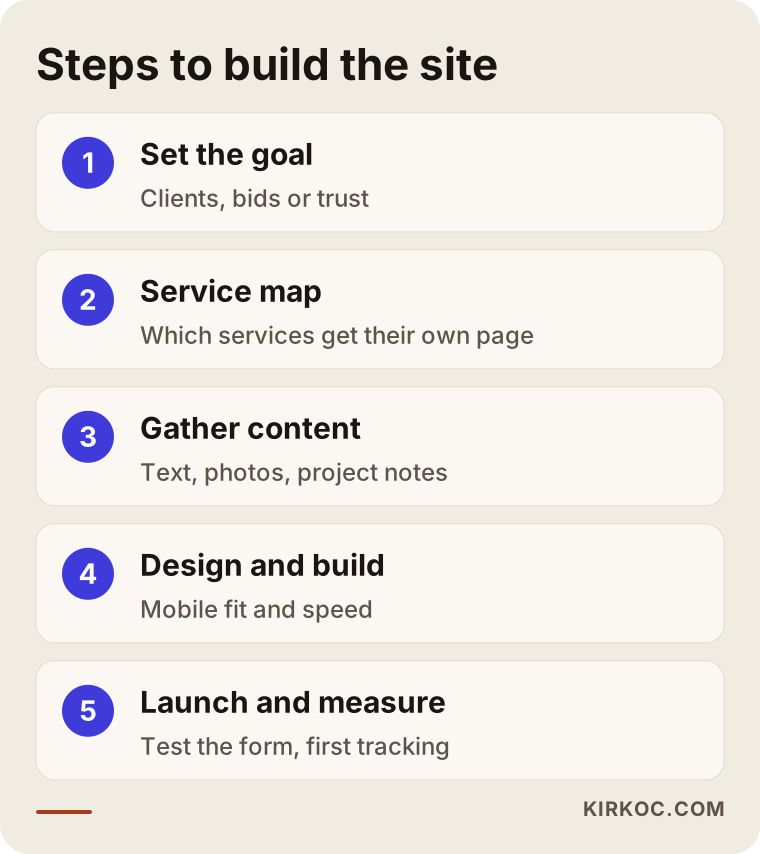
Step one is setting the goal. What do you want from the site? New clients, bid invitations, credibility, or recruiting? The answer shapes the page structure. A site that tries to do everything at once does none of it well.
Step two is the service map. List your services, write down who each one is for, and decide which deserve their own page. A rough rule: any service a client might find through its own search deserves its own page.
Step three is content. Text, photos, project descriptions and images of your certificates are collected here. This is usually the slowest stage, because the material has to come from inside your firm. I prepare the text by talking with you, asking questions and using documents you already have. I do not expect you to write polished copy.
Step four is design and setup. Pages, mobile layout, speed and readability are handled here. The technical part is not your concern. You only approve the result.
Step five is launch and measurement. The site goes live, search engines are told about it, and the contact form is tested several times to make sure it really reaches you. After launch, I check with you which pages get visits and how many inquiries come in.
Common mistakes
A few mistakes appear again and again on engineering sites. Knowing them helps when you evaluate your own.
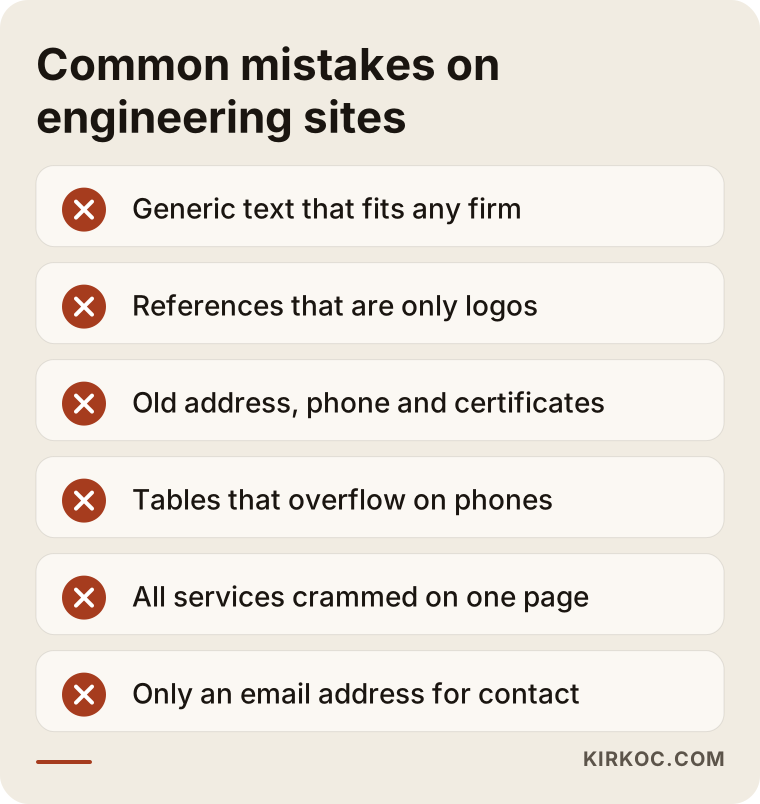
Generic text that fits any firm. Phrases like "expert staff in our field" appear word for word on hundreds of sites. They convince no one. Write concretely what you do and how you do it.
Logos only. If the reference section is nothing but logos, the visitor cannot see what you did or how you did it.
Outdated information. An office address that has closed, a phone number that has changed, an old certificate, or a project listed as "in progress" years after it ended all shake trust. One wrong detail can make everything else look doubtful.
A site that cannot be read on a phone. Many decision makers take their first look on a phone. If tables spill off the screen, PDF files open slowly, or the text is tiny, the visitor leaves.
Every service squeezed onto one page. If structural design, installation, studies and construction share one page, none of them is understood fully, and none stands out in search results.
Hard-to-reach contact options. A visitor wants to ask a question, but the only option is a fixed email address. Phone, messaging and a simple form should sit side by side.
Careless technical or legal claims. When you name a standard, a regulation or a certificate, the details must be current and correct. If you are unsure, ask a specialist or an attorney. A badly worded claim does more harm than good.
What can you do yourself, and when do you need a specialist?
You do not need outside help for everything. Some tasks you can handle inside your firm, and others call for expertise.
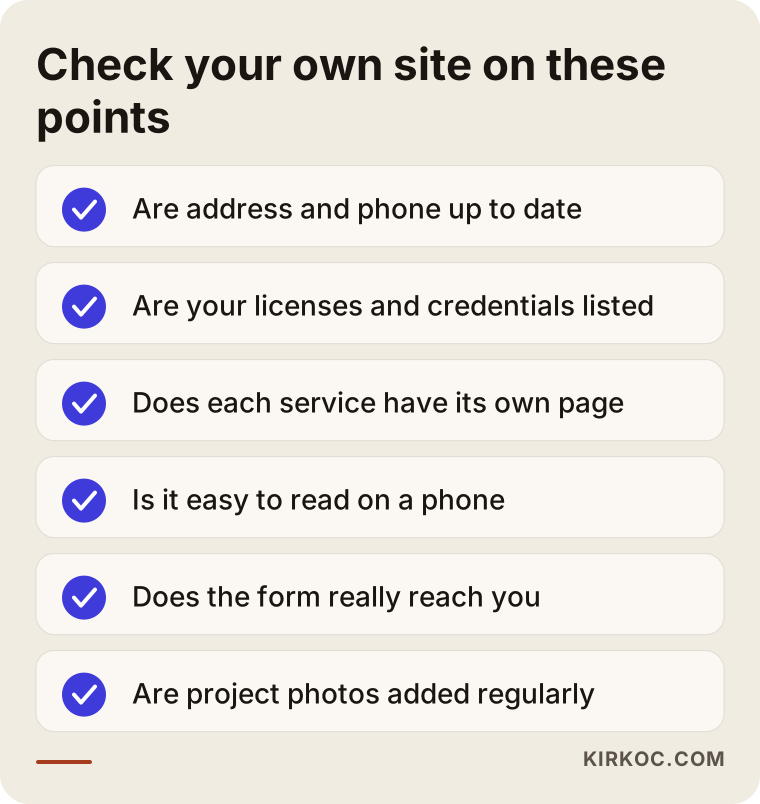
What you can do yourself. Check that your address, phone number, hours and licenses are current. Collect photos and short notes about your finished work on a regular basis. Look at your own site on a phone. Search Google for your firm name and your main service, and see what appears. When a client contacts you, ask "how did you find me?" That answer is extremely valuable.
What needs a specialist. The structure and speed of the site, building service pages around what people actually search for, technical settings, setting up forms and tracking, search visibility work and ad management all require expertise. If these are set up wrongly, you spend a month of effort and see nothing for it.
As a middle path, you can have the current situation reviewed first and see which tasks are truly needed. A brand-new site is not always required. Sometimes adding a few well-built pages to the existing site and updating the details is enough.
Visibility: the work does not end at launch
When the site goes live, only half the job is done. For people to find you, the site has to grow over time. The journey looks roughly like this.
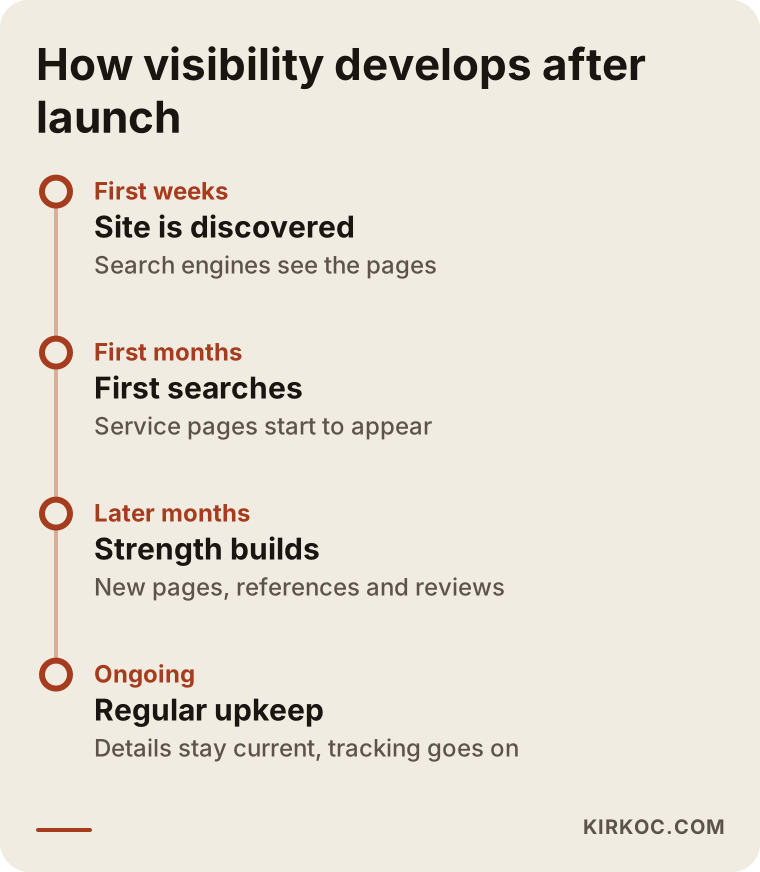
In the first weeks, search engines discover the site. Within a few months, service pages may begin to appear for certain searches. How long this takes depends on competition, location and the service, and nobody can guarantee a specific ranking or timeline. The honest approach is to lay a solid foundation, add content regularly, collect reviews and references, and watch the results so you can adjust.
This is where having everything handled by one person is practical. When the website, search visibility, posts on channels like LinkedIn and, when needed, Google ads are in the same hands, the messages do not contradict each other. The service name on your site, the project summary on LinkedIn and the ad text all speak the same language. With three separate providers you would need meetings to get that consistency. I manage it from a single screen.
LinkedIn is especially useful for engineering and project firms, because decision makers and business partners spend time there. A complete company page, regular project posts and links back to your site all build trust. Ads make sense only in certain situations: when you launch a new service, or when you want to become visible quickly in a particular area. Not every firm needs them.
What determines the cost
I do not give figures in this article, because two engineering websites can cost very different amounts. These are the main things that set the price.
Number of pages and amount of content. A five-page introduction site and a site with dozens of service and project pages are not the same job.
Who prepares the content. If you supply the text and photos, there is less work. If you want the copy written and edited from scratch, there is more.
Number of languages. Firms that export or work with foreign partners may want the site in more than one language. Each language is its own body of content.
Custom features. A document download area, project filtering, a multi-step quote form or a client login all enlarge the job.
Visual and design expectations. There is a difference in effort between a design built on a ready-made layout and one designed specifically for your firm.
Support after launch. Updates, maintenance, search visibility work and ad management are separate items. Always ask whether they are included in the first quote.
When you compare quotes, do not look only at the total. Ask for what is included, line by line. Very different scopes can sit behind the same price.
How I work with you
I am one person, and that brings both an advantage and a responsibility. The person you talk to is the person who does the work. First I listen: what do you do, who do you serve, which kinds of jobs do you want more of? Then I look at where you stand today and tell you plainly what is necessary and what can wait. I do not try to sell you anything you do not need.
Usually I first confirm the page structure and the service map with you. Then I prepare the text and handle the design and setup. After launch, if you want, I continue with search visibility, social media and advertising in the same way. You can also have just the website built and leave the rest for later.
How long it takes depends on the size of the project and how quickly you can send material. The question many firms get stuck on is this: fix the existing site, or build a new one?
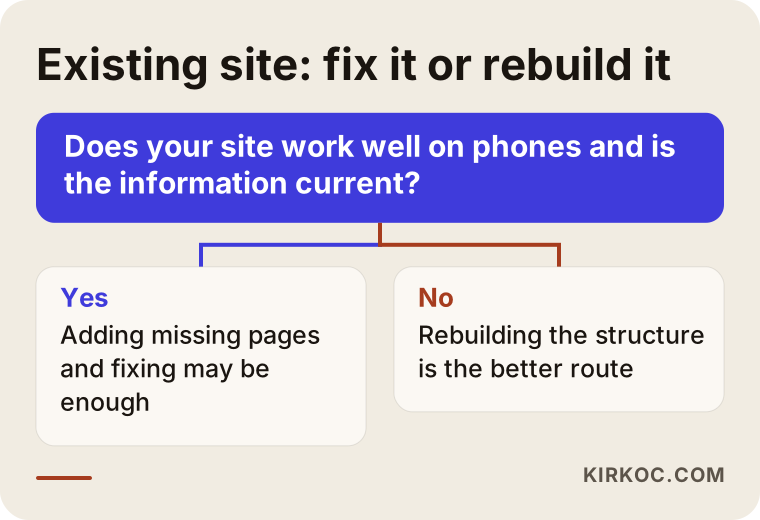
The split in the chart directly affects how much effort is needed. If the current site works well on phones, the information is up to date and only a few pages are missing, fixing it is enough. If its structure is old, it cannot be managed, or it throws security warnings, rebuilding makes more sense. I make that call together with you, after I have looked at the site.
Frequently Asked Questions
What are the minimum pages an engineering firm's site should have?
A home page, a separate page for each main service, projects or references, an about page, and a contact and quote request page. For a small firm these six parts are often enough. Regional pages, a frequently asked questions section and blog articles can be added later.
Do I have to name the client when I show a reference?
No. If you do not have the client's permission, or there is a confidentiality agreement, you can describe the job anonymously, for example "electrical design for an industrial facility." What matters is the type of work, its scale and your role. If you are unsure about permission and confidentiality, ask an attorney.
Will a website bring me bids or new projects?
Nobody can guarantee that. A website gives confidence to the person who wants to reach you and helps them find what they are looking for. Whether work comes in depends on your service, your area, the competition, and how the site grows over time. A realistic expectation is that the site strengthens your existing relationships and gradually becomes visible for new searches.
How long does it take for the site to appear in search results?
There is no fixed time. It can take weeks or months, depending on whether the site is new, how competitive the service is, and how clearly the pages are written. Be cautious with anyone who promises an exact ranking or date.
Should my site be in more than one language?
If you work with foreign partners, want business from abroad, or your investors speak another language, it may be worth it. If you operate only in your own country, building one solid site in one language first usually makes more sense. Adding a language means translating and keeping every page up to date.
Is it better to fix my old site or build a new one?
If the current site opens easily on a phone, the information is current and it is easy to manage, fixing it may be enough. If the structure is old, it cannot be updated, or it shows security warnings, rebuilding is the better choice. It is hard to decide without seeing the site.
Do I need social media and ads too?
No. A solid site with the right page structure comes first. LinkedIn is usually worthwhile for engineering firms. Ads are for a specific goal, such as announcing a new service. You do not have to do everything at once.
What should I look for when I get a quote?
Check that the scope is written out line by line, how many pages and languages are included, who prepares the text, whether support after launch is included, and who owns the site. The domain name and the site should be registered in your name. Any item left vague can turn into an extra cost later.
If you are thinking about a website for your engineering or project firm, you can write to me through my website design service page. I will look at where you stand and talk through what is really needed. I will listen to your business, suggest a path that fits, and I will not try to sell you anything you do not need.