You run a business on the southwest coast of Turkey, or you are about to start one. Maybe it is a boutique hotel in Yalikavak, a boat charter out of Bodrum marina, a real estate office in Fethiye, a restaurant in Marmaris, a dental clinic in Mugla town, or a home services company that looks after villas for owners who live abroad. Your website either does not exist, was built years ago and looks broken on a phone, or amounts to a single social media account. With the season approaching, it makes sense that you typed "web design Bodrum" or "web design Mugla" into Google. This article explains what to look for when you hire someone, which problems are specific to this region, and where to begin. I am Ümit Kırkoç. I work from Istanbul and handle website design on my own, remotely, so I serve businesses in this region by video call and messages rather than in person. I am telling you that up front because it is something you should know before you decide.
A website, in simple terms, is your business's address and shop window on the internet. People search for you on Google, open your site, see prices, location and photos, and then call or write. In Mugla that chain works a little differently than in most places, because a large share of your customers come from another city or another country and decide without ever having seen you.
Why a website in Bodrum or Mugla is a different job
An accountant in Istanbul and a yacht operator in Bodrum do not need the same website. The districts of Mugla live on tourism, holiday homes, boats, foreign residents and the weather, and that changes what a site has to do.
First, your customer is often not in the region. Someone in London, Stockholm, Berlin or Ankara is planning a trip and looking for you. They may type "boutique hotel Bodrum" and they may not read a word of Turkish. Second, the workload is not even across the year. Between May and September your phone does not stop, and in winter it goes quiet. Those quiet months are the best time to prepare your site. Third, the region is fragmented. Bodrum town, Yalikavak, Gumusluk, Turgutreis, Gundogan and Bitez are all different places, and so are Marmaris, Fethiye, Datca, Dalaman, Milas, Ortaca, Koycegiz and Akyaka. People rarely search for "Mugla". They search for the place they actually want to go to.
The next image shows an invented example of how a search result can look. It is not a real company.
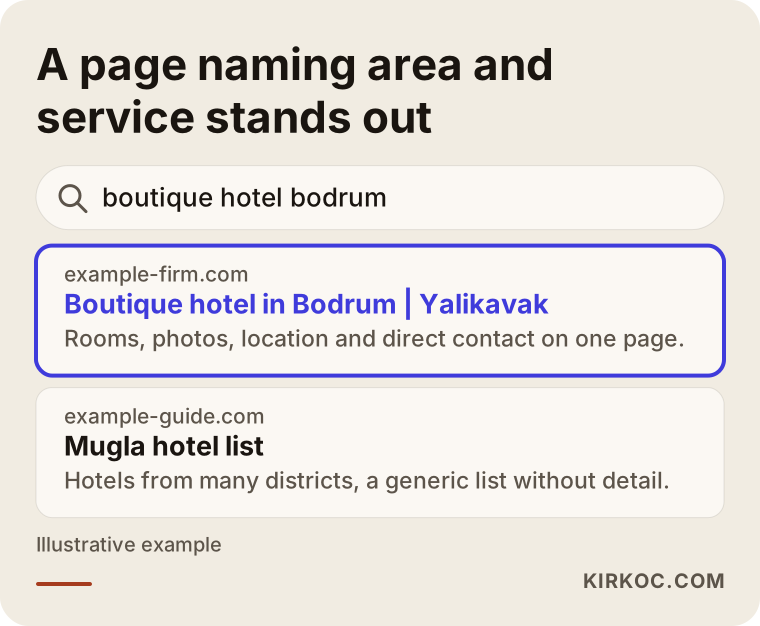
What does the highlighted result do? It names the area, the service and what you will find in the very first line. A generic page titled "the best of Mugla" does none of that. Google tries to show the answer that fits the search most closely, and if you make that easy for it, your chances of appearing improve. That is not a ranking guarantee. It is simply the logic of building the site properly in the first place.
How do your customers actually search for you?
Before anyone designs anything, it helps to look at how people search. In this region I usually see four types of search, and each one is best served by a different page.
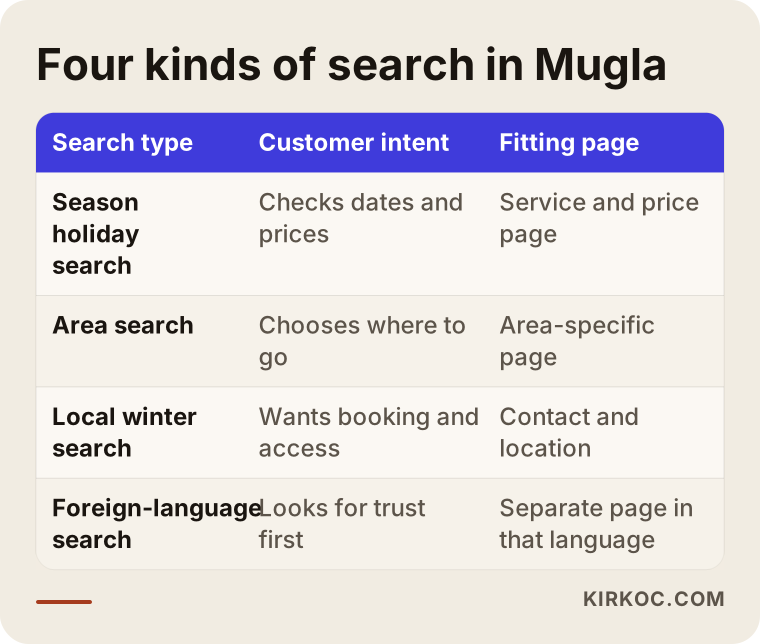
The point of that table is that one home page cannot serve everyone. In high season, a person typing "boat rental Bodrum" is checking dates and prices. In winter, a local typing "dentist Mugla" wants an appointment and directions. A person searching in German, Swedish or Russian is looking for trust first, and they check whether the site speaks their language. Answering the question "which customer arrives with which sentence?" matters more than the visual design.
Here is a small exercise. On your own phone, run a few searches as if you were your own customer. Use the name of your district and try both English and Turkish. Who shows up? Which pages come first? Why are you not there? Ten minutes of this teaches you more than a meeting would.
Which pages do you actually need?
Many business owners ask for "a nice one-page site". For a very small shop that can occasionally be enough, but a customer who is comparing options usually needs several pages. The next image shows the layout I suggest for a service page.
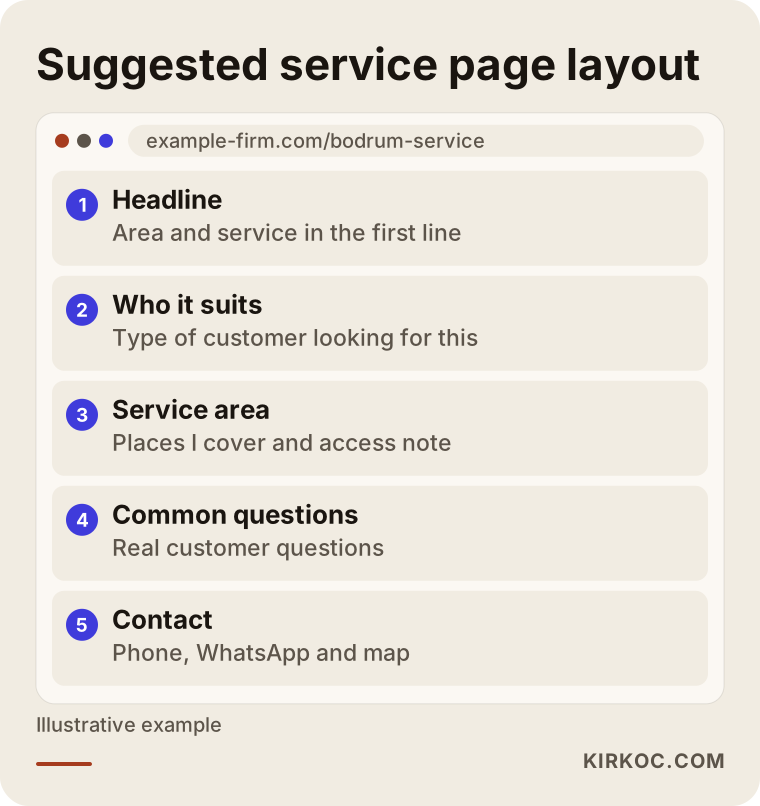
Each block answers one question. The headline answers "what is this place and where is it?". The "who it suits" block answers "is this for me?". The service area block answers "do you come to where I am?". In Mugla that last block is especially valuable, because distances between Bodrum and Datca, or Fethiye and Marmaris, are long, and people want to see exactly where you operate.
In general I recommend this set: a home page, a separate page for each service, an "about" page, a gallery or projects page, common questions, and contact with a map. If you run a hotel, add a page for each room type. If you run boat trips, give each boat and each route its own page. If you run a real estate office, build pages by area and by property type. When every page answers a single intent, both the visitor and Google know what they are going to find.
Photos and trust
In visual places like Bodrum, photo quality carries the site. But it is not only about good photos. They should be real. A site full of stock images feels foreign to anyone who knows the area. Photos of your own property, your own team and your own work build trust. Even a phone photo, taken in good light and framed carefully, is often enough. Large files should be compressed before they go online, because speed depends on it, and I will come back to that below.
Do you need a multilingual website?
This question comes up in almost every conversation I have about this region. The answer depends on your business. A plumber or a lawyer who serves local residents can often manage in Turkish. But hotels, villa rentals, boat trips, restaurants, real estate, beauty and health tourism all work with foreign customers, and for them at least one foreign language is close to essential.
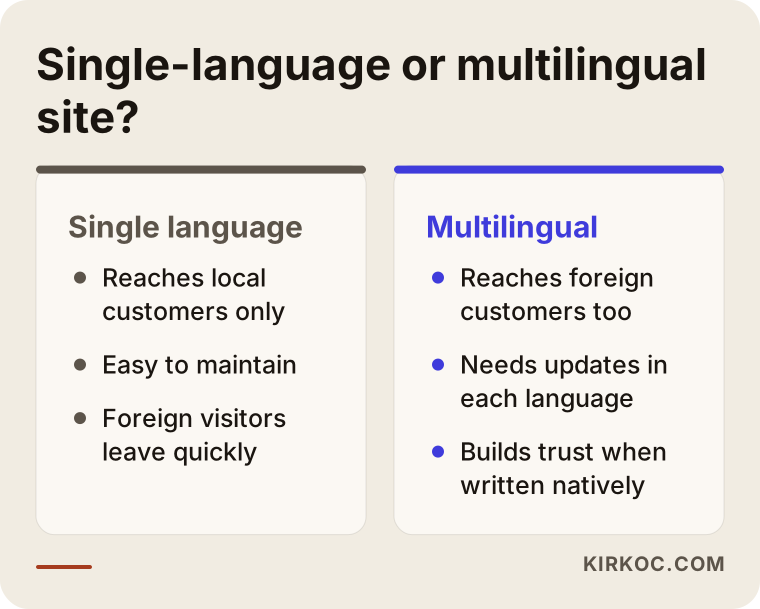
A multilingual site does not mean pasting your pages into a browser translator. Automatic translation often produces awkward sentences, and awkward sentences say "this place is careless". The better approach is a separate page address for each language and text that a native reader can read comfortably. Which languages you choose depends on who your customers are. In Bodrum, English, German, Russian and the Scandinavian languages are common, but rather than guess, I suggest you look at your own booking or inquiry records. Which countries do people write from? In which language do they ask questions? That answer tells you which languages you need.
There is also an upkeep cost. When a price, a date or a service changes, you have to update it in every language. For that reason it can make sense to start with the two most important languages and add others later.
Mobile and speed: the phone is your real shop window
Someone on holiday is most likely finding you on a phone. From a beach, a hotel room or the back seat of a taxi. A site that takes five seconds to open on mobile is often simply closed. So how it feels and loads on a phone matters more than how it looks on a desktop.
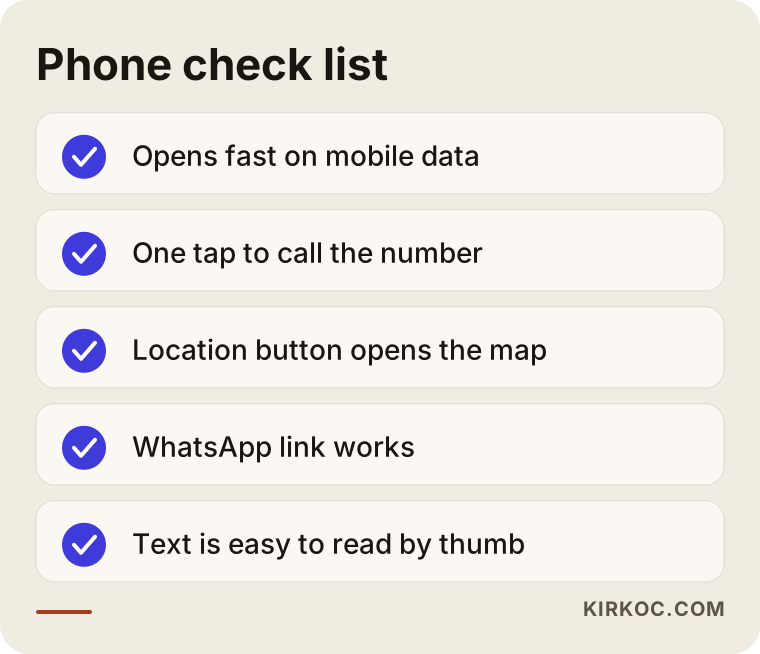
You can try the list yourself. Open your site on your own phone using mobile data, not your Wi-Fi. Can you call the number with one tap? Does the location button open the map? Does the WhatsApp link work? Is the text comfortable to read with a thumb? If any of these fail, a customer will move on without contacting you.
Part of this is specific to the area. In some coastal villages and highland spots, mobile reception is weak. If your customer is trying to reach you from there, a very heavy site may never open. A light, fast build is useful not only for Google but for real-world use.
The seasonal calendar: when to prepare your site
The biggest mistake I see among businesses in Mugla is trying to get a site built in the middle of the season, when everything is chaos. At that point you have neither the time nor the calm to make decisions. A new site also needs time to be noticed by Google. I cannot promise a specific time frame, but it makes sense to start well before the season.
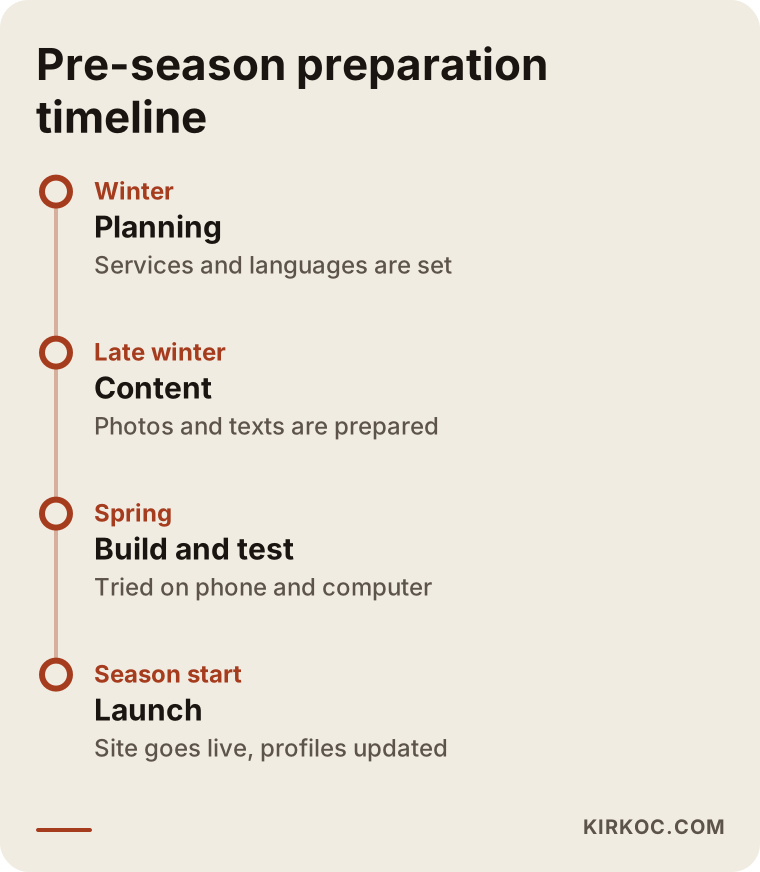
The logic is simple. Winter is for planning and content. That is when you shoot photos, write the texts and settle your services and pricing policy. Spring is for building and testing, and the start of the season is for launch and first announcements. During the season itself, the site should only need small updates, new reviews and quick fixes.
Two hypothetical example scenarios
The two examples below are entirely hypothetical. They do not describe a real company. They are here to show how situations like these can play out.
Scenario 1: a boutique guesthouse in Yalikavak
Imagine a guesthouse owner who has taken bookings for years through third-party booking platforms and by phone. Those platforms take a share of every booking and the owner has no direct line to the guest. The owner wants a website but thinks "it just has to look nice".
Here the priority is not beauty. It is making it easy for guests to reach the owner directly. That means room pages, real photos, clear location information, English plus one or two other languages, one-tap WhatsApp contact and a clear invitation to write directly. It also means a Google Business Profile that is up to date. A new site will not replace the booking platforms overnight, but over time some guests will find the owner directly. I cannot say in advance how many, so setting the goal as "more direct inquiries" is the more honest framing.
Scenario 2: a dental clinic in Mugla town
This hypothetical clinic has taken patients for years through word of mouth. It has an old website that breaks on phones and does not make clear which treatments are offered. The owner wants to attract local patients and also the foreign residents who live in the area.
Here each treatment needs its own page written in plain language, a short introduction of the dentist, opening hours, and booking and access details. In healthcare there is one more point: avoid exaggerated promises and guarantee-style sentences. Advertising rules are strict in the health sector, so before publishing the texts I suggest you check them with a lawyer or with the rules of the relevant professional chamber. The site should answer the patient's question: "Can I trust this place?"
Step by step: how a website gets built
Knowing how the work proceeds sharpens your expectations and also helps you give me the right information. I run the process in roughly five steps.
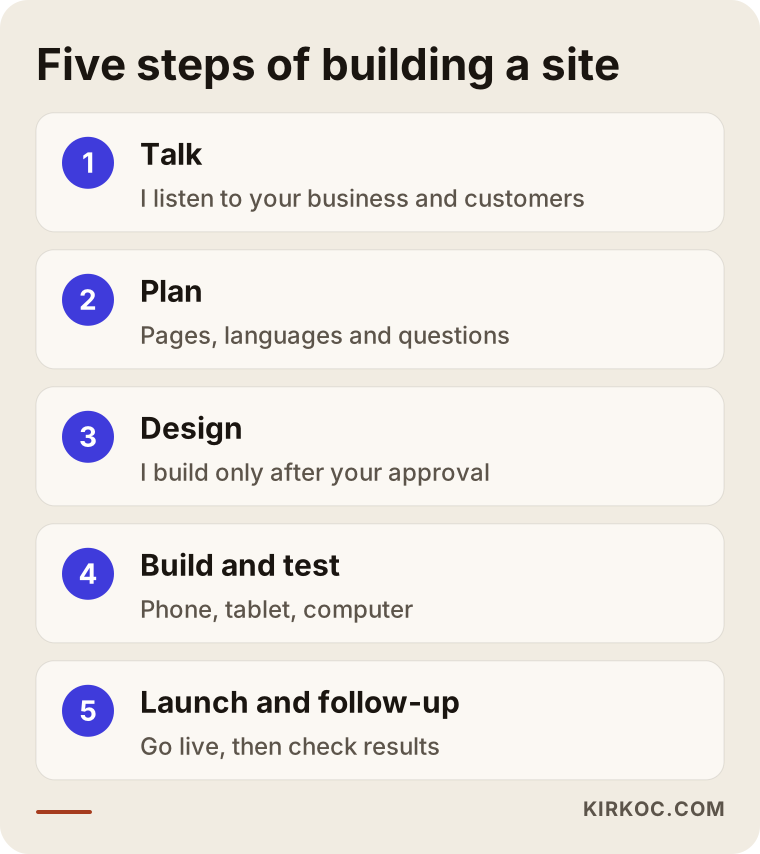
Step one is a conversation, where I listen to your business, your customers and what you want to sell. Step two is the plan: which pages, which languages, which questions get answered. Step three is design, and I do not move on to building before you approve it. Step four is building and testing on a phone, a tablet and a computer. Step five is launch and follow-up: the site goes live, search engines are told about it, and after a while we look at what is working.
SEO, meaning the work that helps your site appear on Google, is considered from the very beginning of this process. Adding it afterwards is harder and more expensive. In the same way, your social media accounts, any advertising and your logo should match the site. When one person handles all of it, the wording on the site, an Instagram post and a Google ad say the same thing, and the message does not get lost between different people. Because I do all of these jobs myself, I can plan them together with the site if you want that. If you only want a website, that is fine too.
Common mistakes
Most of the mistakes I see in the region are not expensive ones, but they wear down results. Here are the main ones.
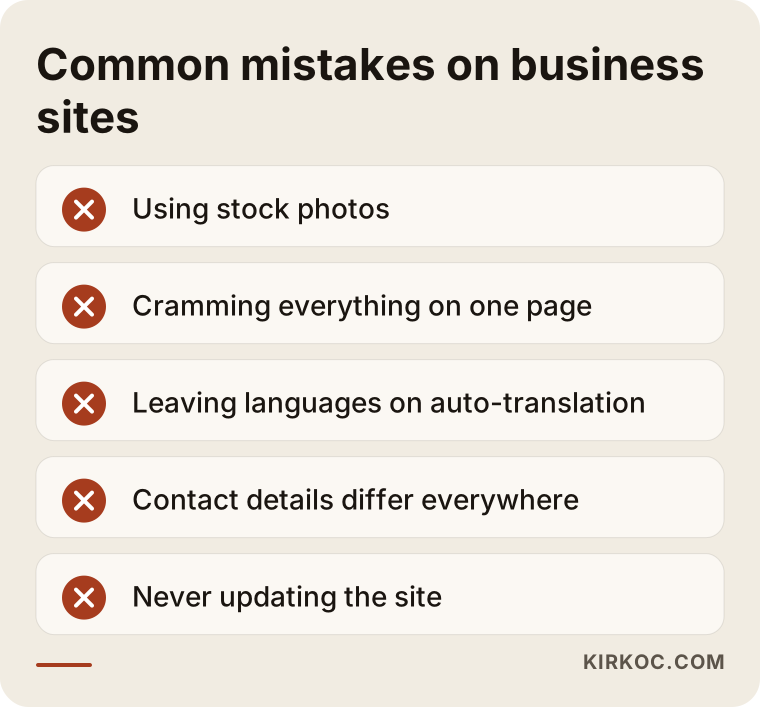
The most common is using stock photos. The second is cramming everything onto one page: hotel, boats, transfers and restaurant all together. The third is leaving foreign-language pages on automatic translation. The fourth is having contact details that differ from place to place, with one number on the site, another on the Google profile and a third on Instagram. The fifth is building the site and then never updating it. If a restaurant that has closed still shows old prices online, the customer arrives with the wrong information.
There is also the matter of the domain name and hosting. The domain, the address that begins with www, should be registered in your name. Sometimes an old site turns out to be registered in the name of the person who built it, and that causes trouble when you part ways. Check this at the start.
What can you do yourself, and when do you need an expert?
You do not need to hand everything to a specialist. Some tasks you can do yourself, and some need expertise. The decision chart below gives a rough map.
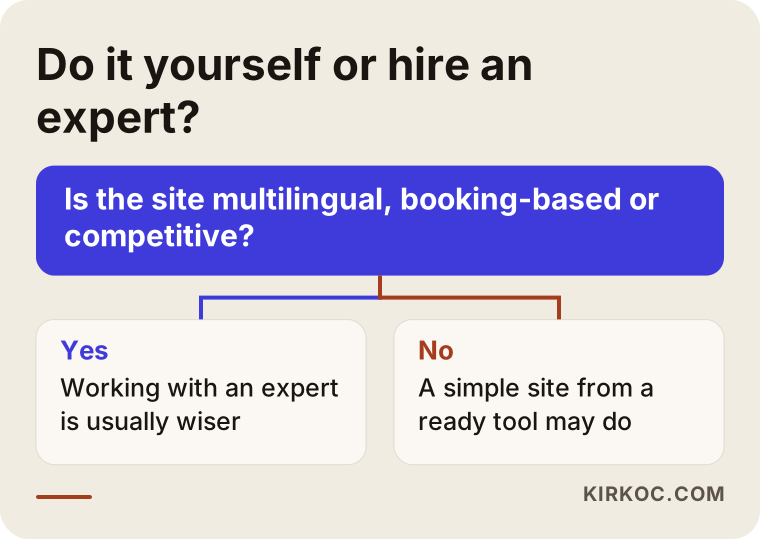
Things you can do yourself include taking photos, writing down your services on a sheet of paper, keeping your Google Business Profile current, asking customers for reviews, and looking at competitors' sites to note what you like. All of that makes an expert's job easier and keeps the cost reasonable.
The places where you will want an expert are multilingual structure, speed tuning, the technical setup that helps you appear on Google, booking or payment systems, online shops and privacy texts that comply with the rules. I will not make firm statements about personal data and cookie rules. For those, talking to a lawyer is the right move.
Ready-made site builders also exist, and for small, simple needs they can be perfectly adequate. But if you want a multilingual site with many pages, one that takes bookings or one that competes on Google, you will usually hit their limits at some point.
After launch: what should the site do?
A site can look beautiful and still fail if it brings no business. Its job is to lead a visitor, step by step, to an inquiry. You can picture it as a funnel: at the top, the people who see the site, then those who browse its pages, then those who look at your contact details, and at the bottom, those who call or write.
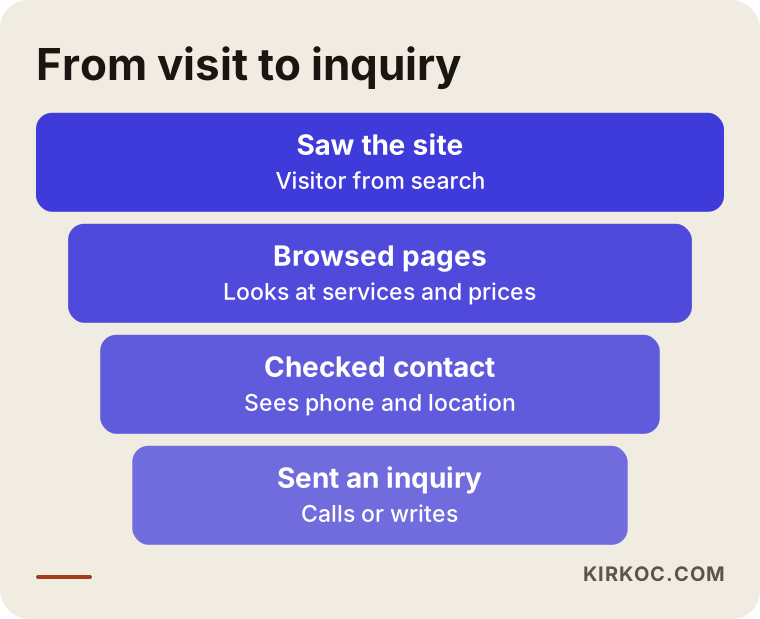
Some loss at every step of that funnel is normal. What matters is seeing where you lose people. If visitors land on the home page and leave, the first impression may be the problem. If they read the service pages but never get in touch, trust or price information may be missing. If they reach the contact page and do not call, the phone button or the form may be broken. Free tools exist to measure these things. I set them up and explain the results in plain language. I am not giving numbers here, because they differ greatly from one business to another, but seeing the direction is enough to make decisions.
What decides the cost
I will not give figures in this section, because the price really does vary with the scope of the work. What I can do is explain what it depends on.
The first factor is the number of pages. A ten-page site and a two-hundred-page site are not the same job. The second is the number of languages, since every language means writing, translation, checking and upkeep. The third is custom functions such as bookings, online payment, product sales or a customer account area. The fourth is content: who writes the texts, you or me, and whether the photos are ready or a shoot is needed. The fifth is whether your logo and brand identity already exist. The sixth is whether you want SEO, social media or advertising work after the site is done.
When you collect quotes, ask what is and is not included in the price. Are the domain name and hosting a separate yearly cost? Do updates cost extra? When the site is handed over, will you hold every login? A clear quote means no unpleasant surprises later.
How I work with clients
I work alone from Istanbul. I handle website and e-commerce work, SEO, local SEO, social media management, Google and Meta advertising, logo design and content production as one person. Conversations with businesses in Mugla and Bodrum happen by phone or video, and I do most of the work remotely. If an on-site shoot is needed, we discuss it and plan it in advance.
The practical benefit of having one person is that your site, Google profile, social media and ads do not move forward without knowing about each other. The same photos, the same message and the same contact details stay consistent everywhere. When something changes, such as a price or opening hours, I update all of it at the same time. And when something goes wrong, you know exactly whom to call.
You do not need a ready plan to start. Telling me about your business, who your customers are and where things stand today is enough. I will tell you what you need without inflating it, and sometimes the honest answer is "for now, one page and a Google profile are enough".
Frequently asked questions
Do I need to be in Bodrum to have a website built there?
No. Conversations happen by phone or video, and content and photos are shared digitally. If a physical shoot is needed, I plan that separately. What matters is that you explain your business well, not where we both sit.
How many weeks until my site ranks first on Google?
I cannot promise a time frame or a position, because competition, district, industry and the age of your site all change the outcome. A properly built site gives Google clear signals, but results come with time and ongoing work. Be careful with anyone who offers a guarantee.
Is an English-only site enough?
It depends on who your customers are. In places like Bodrum and Marmaris, guests may come from many countries. Look at your own records to see which languages the questions arrive in, then start with the two or three most important ones.
Should I refresh my current site or start from scratch?
First someone needs to look at the current site. If the structure is sound and only the look is dated, a refresh may be enough. If it is broken on phones, very slow or impossible to update, starting from scratch usually makes more sense. I can tell you which case you are in after a short review.
I have a social media account. Do I still need a website?
For most businesses, yes. A social media account belongs to the platform, not to you, and the rules can change or access can be lost. A website is your own address. Also, someone searching Google for a service often looks at a site first. The two complement each other.
Why is it recommended to build the site outside the season?
Because during the season you lack both the time and the calm to decide well. Preparing content, shooting photos and testing are far easier in winter. A new site also takes time to be recognized by Google, so starting early is an advantage.
In whose name should the domain and hosting be?
Yours. You should be the owner of the domain name and always hold the management details. Ask about this directly at the quote stage and make sure the logins will be handed over to you.
Can I update the site myself after it is built?
Yes. If you like, I can set it up so that you handle simple changes such as text and photos, while I continue to support technical changes. It is best to decide at the start which parts you will manage and which I will.
If you want to be ready before the season in Bodrum or Mugla, you can describe your business briefly through my website design page. I will look at your situation and tell you honestly what you really need.