You have a field, a ranch, a greenhouse or a packing shed. Your product is good, but most of your buyers still find you through word of mouth, a phone call or a farmers market stall. Then one day a competitor shows you a neat page on their phone, or a wholesaler says "send me your website," and you have nothing to send. So you typed "website for farm business" into Google. This article covers what a farm or agricultural business should expect from a website, which pages actually bring in inquiries, and where to start. I am Ümit Kırkoç, and I work from Istanbul. I handle website design and the work that comes after the site, all by myself. If you sell Turkish agricultural products abroad, or want to supply buyers in Turkey, I can also build the site in the languages your buyers read. Every example below is hypothetical and describes no real company.
One point first: building a site for a farm is different from building one for a hair salon or a law office. Your buyer might be a restaurant chef in a big city, a grocery chain in another country, or a farmer down the road. Each of them looks for different things, trusts different proof and takes a different amount of time to decide. A good site understands that from the start.
How do buyers search for farm products?
As an owner, you call what you grow or raise "the product." Buyers rarely type your product name. They type their need: "wholesale olive oil," "fresh milk from a farm," "breeding heifers," "greenhouse seedlings in bulk," "organic honey producer," "livestock for the holiday." Behind each of those searches is a different person. One is buying for their own kitchen, one will resell in a shop, one wants to export.
The key thing to know is that Google does not try to answer all of these searches with one page. Saying "it's all on the home page" is not enough. A separate page that answers each product group and each type of buyer tells both Google and the visitor that they have landed in the right place.
The illustration below shows how two pages might look for an entirely invented search.
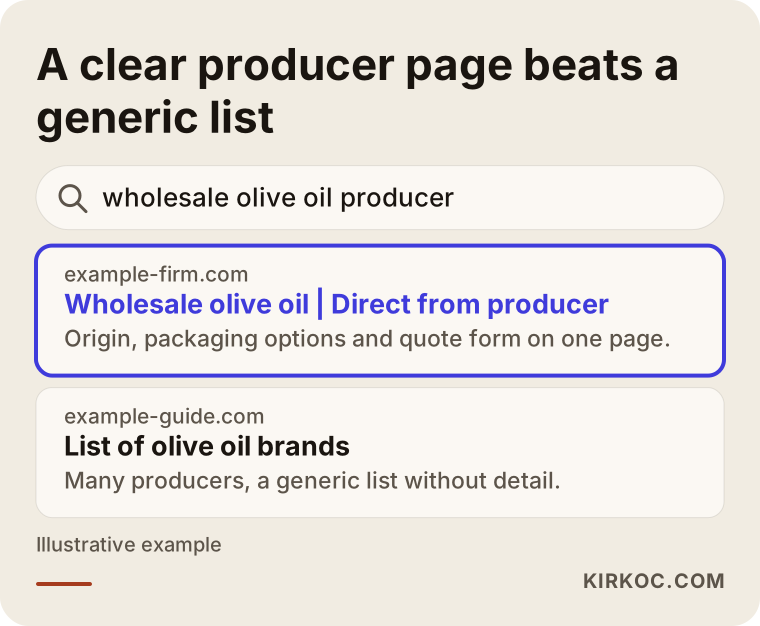
The highlighted result states the product, where it comes from and how it is sold in the first line. The page below it lumps many producers into one list. Buyers want to know who they are buying from and where it comes from, so they open the first page and close the second.
Four buyers, four sets of expectations
The most common mistake I see on farm websites is speaking to everyone in the same voice. You need to separate at least four audiences. The first is the end consumer, a person buying for their family or home kitchen. They care about freshness, where it was grown and shipping. The second is the wholesale buyer: a grocery store, restaurant, cafe or produce stand. They want to know your minimum order, how you invoice, how often you deliver and whether you can send samples. The third is the export buyer, who cares about certifications, packaging and the right language. The fourth is another farmer, looking for feed, seedlings, supplies, equipment or breeding stock. They often want technical detail and a seller they can rely on.
The table below sums up these four searches and the page that fits each one.
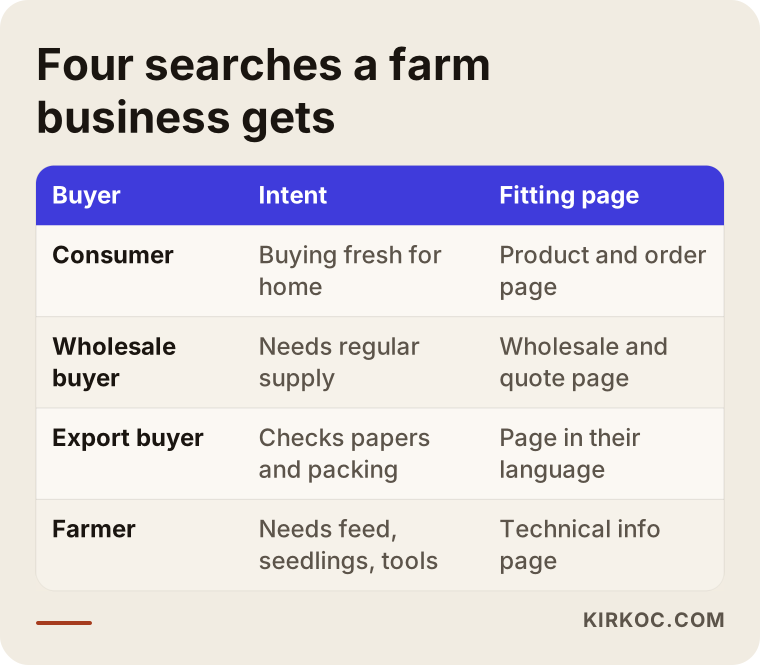
As the table shows, every intent has its own answer. If you cram everything onto one page, the wholesaler will not find what they need and neither will the home cook. If you run a small operation, you do not have to serve all four at once. It is smarter to pick the audience that earns you the most and build the site around them first.
How should a farm website build trust?
When food or live animals are involved, buyers look at trust more than at photos. A good-looking storefront may be enough for a salon site. On a dairy farm or beekeeping site, you have to answer a different set of questions: do these people really exist, where is this made, and who is responsible?
The things that build trust are mostly ordinary, yet most sites leave them out. Real photos of your own fields, barns or facility. A short, honest description of how you produce. The documents and records you actually hold: a business registration, a license or permit to sell, and any certifications such as organic or good agricultural practice. An address, a map, a phone number and opening hours. And a clear note about which season the product comes in and in what quantities.
Be careful when you show documents. Only list what you really have. There are rules about which products can be sold under which permit and conditions, and they vary by product and by country. For live animals, dairy, honey and processed food in particular, check with the relevant authority or talk to a lawyer before you make any firm claim. I do not give legal advice.
The checklist below is a plain summary of what the site should contain for trust.
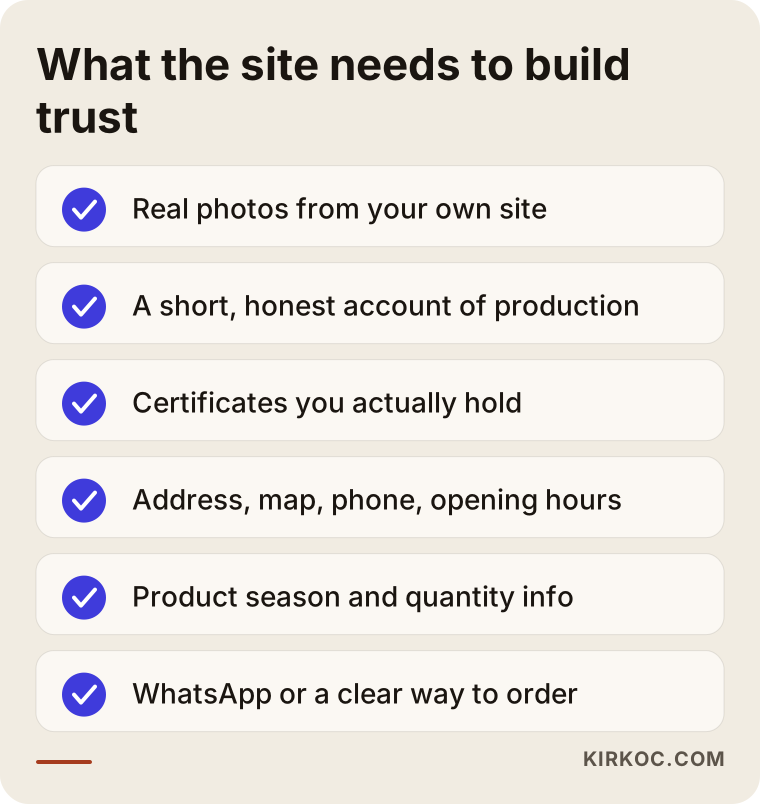
As you read this list, notice that none of it needs an expensive shoot or a fancy design. Three or four clear, genuine photos taken on your phone often earn more trust than a stock image.
Which pages actually bring in business?
Many farm sites stop at "About, Products, Contact." That trio is necessary but not enough. When I build a site for a farm, I think through these pages in order.
Product group pages. One page for each main product: olive oil, cheese and honey each get their own, for example. Each page covers the type of product, packaging options, who it suits, how to order and how it is delivered. A single long list under "Our Products" tells neither a search engine nor a visitor much.
A wholesale and business page. A separate place for grocers, restaurants and hotels: minimum order, delivery area, sample requests, invoicing and payment terms. You do not have to publish prices, but instead of "call for a price," explain clearly how someone can get a quote.
A production and process page. How is the harvest or milking done, how is storage handled, how is hygiene kept up? This page builds trust and helps search engines see you as a serious producer.
A region or origin page. If your product comes from a particular area and buyers search for that area, build a page just for it. A search like "Napa Valley olive oil" shows far more intent than plain "olive oil." When you use a place name, make sure the product truly comes from there, because some place names carry registration or usage rules.
Frequently asked questions. Write down the questions buyers keep asking you on the phone: how is it shipped, how long does it keep, how should it be stored, what is the wholesale minimum?
A contact and ordering page. Phone, WhatsApp, a form and a map in one place. For buyers and sellers in rural areas, a messaging app is often easier than email.
The illustration below shows how a single product page can be laid out.
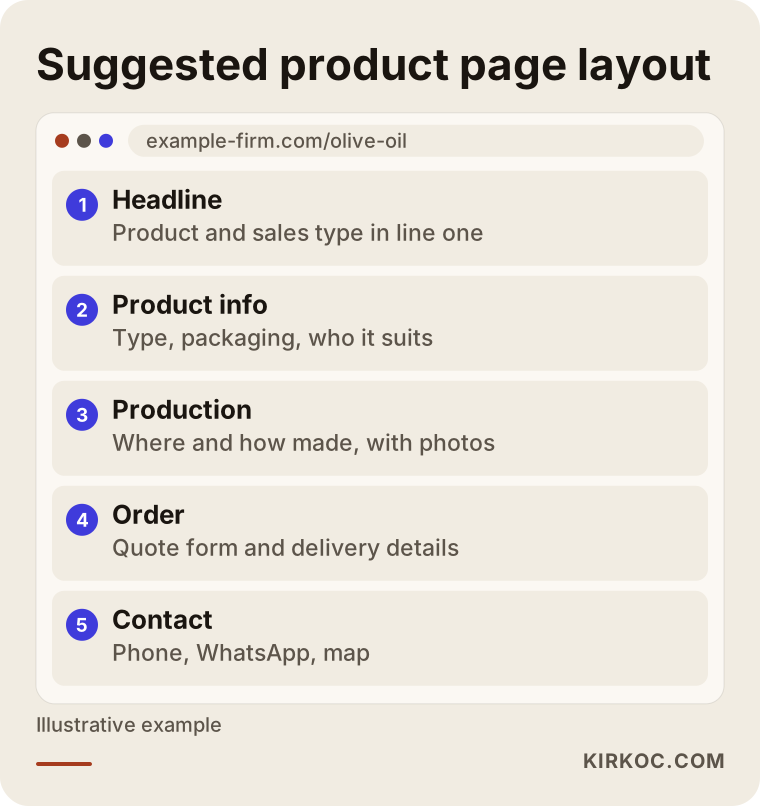
The top of the page, where you say what you sell and where, is where a visitor decides in the first five seconds. As they scroll down they should find trust, ordering and contact details, and at every stage they should see the next step.
Direct sales, wholesale or both?
This decision shapes the build more than any other, and many businesses start the site without settling it. If you sell directly to consumers, your site needs a cart, payments and a shipping setup, which makes it an online store. If you sell wholesale, you do not need a cart. You need a good quote form and a clear information page. If you do both, you have to keep the two audiences apart without mixing them up.
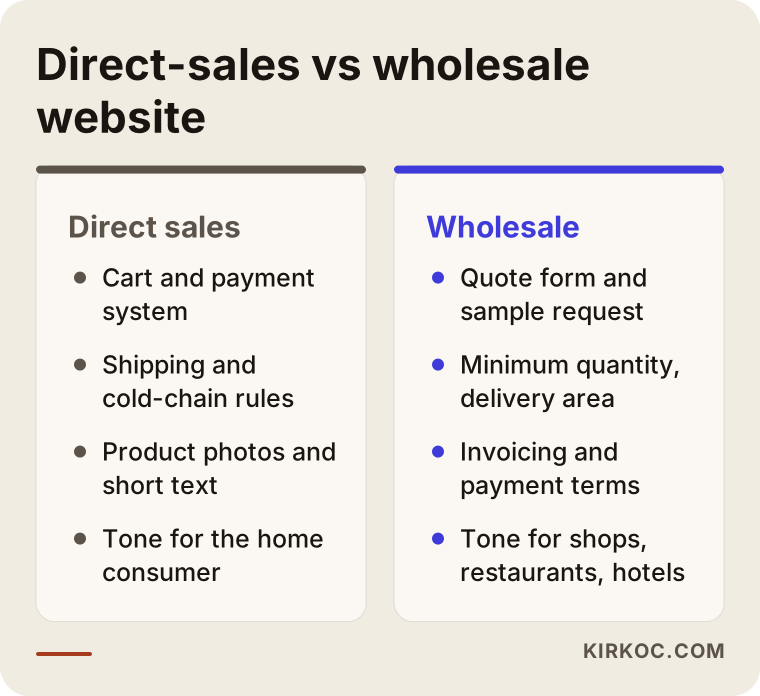
The takeaway from the comparison is that the same business can sell both ways, but the site should have two separate doors. A visitor who walks in through one door and has to work out who the page is for will often leave. For fresh and perishable goods, selling through a cart also raises extra questions about shipping terms and keeping things cold, so think about those early.
Two hypothetical example scenarios
The two examples below are entirely fictional. Their purpose is to show the logic, and they describe no real business.
Example scenario 1: A small dairy and cheese farm
Suppose a family makes cheese and yogurt from the milk of their own herd. So far they have sold to nearby shops and acquaintances. They have a social media account but no website. Two restaurants in town have asked, "Can you send us details about your products?" and the family has done it with scattered photos over WhatsApp.
For this family, the first job would not be an online store but a simple presentation site. The home page would have a short introduction on who they are and where they produce. There would be two separate product pages, one for cheese and one for yogurt, a "wholesale" page for restaurants and cafes, real photos of the production, and an order form. The page text would use the phrases people actually search for, such as "farm cheese" and "wholesale cheese," in a natural way. The goal would be to let them tell a restaurant "have a look at this address," and to give new buyers a chance to find them over time. There is no guarantee of sales, but instead of a messy WhatsApp thread they would have an organized storefront.
Example scenario 2: A business selling seedlings and greenhouse supplies
Now another made-up case: a nursery sells seedlings to both home gardeners and large landowners. Some orders come by phone and some from seasonal trade shows. The problem is that at the start of the season the phones cannot keep up, and everyone asks the same questions: which seedling suits which region, when to plant, what is the minimum quantity?
For a business like this, the site is a tool that reduces the phone load. It would have a separate page for each seedling group, a plain section on which climate and soil each one suits, a planting calendar, frequently asked questions and a separate order form for wholesale buyers. People search outside the season too. Showing up for searches like "greenhouse seedlings wholesale" or "buy fruit trees" could increase the number of people who call when the season starts. Again, nothing is guaranteed, but you could point to a page instead of answering the same question for the twentieth time.
Step by step: how a farm website gets built
I try to keep the process simple for everyone. The technical details are not your concern. What I need from you is decisions and content.
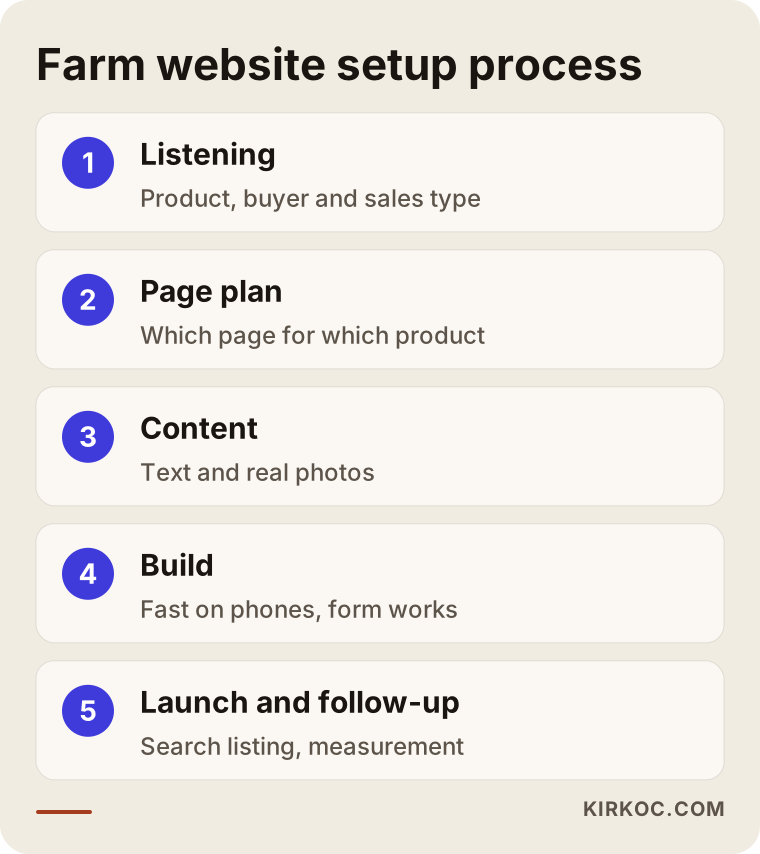
Let me unpack the steps in the illustration. First I listen to you: what do you produce, who do you sell to, which way of selling actually leaves you a profit, and which buyer can you not afford to lose? A site built without this conversation tends to be pretty but useless. Second, I draw up the page plan: which page for which product, which path for which audience. Third, I collect the photos and documents from you. I write the copy in your voice, plain and realistic. Fourth, I build the site, paying particular attention to fast loading on phones, a working form and a WhatsApp button that goes to the right place. Fifth, I launch it, submit it to search engines and agree with you on a schedule for checking the results.
The benefit here is having the work in one pair of hands. If one person builds the site, another handles search visibility and a third runs social media, none of them knows what the others are doing. Because I know why I wrote each product page the way I did, I use the same language when I describe that product on social media or in an ad. That way you avoid the mismatch of "I saw it on Instagram, but the site says something else."
Common mistakes on farm websites
Most of the mistakes I see are not expensive. They are simply things that got overlooked.
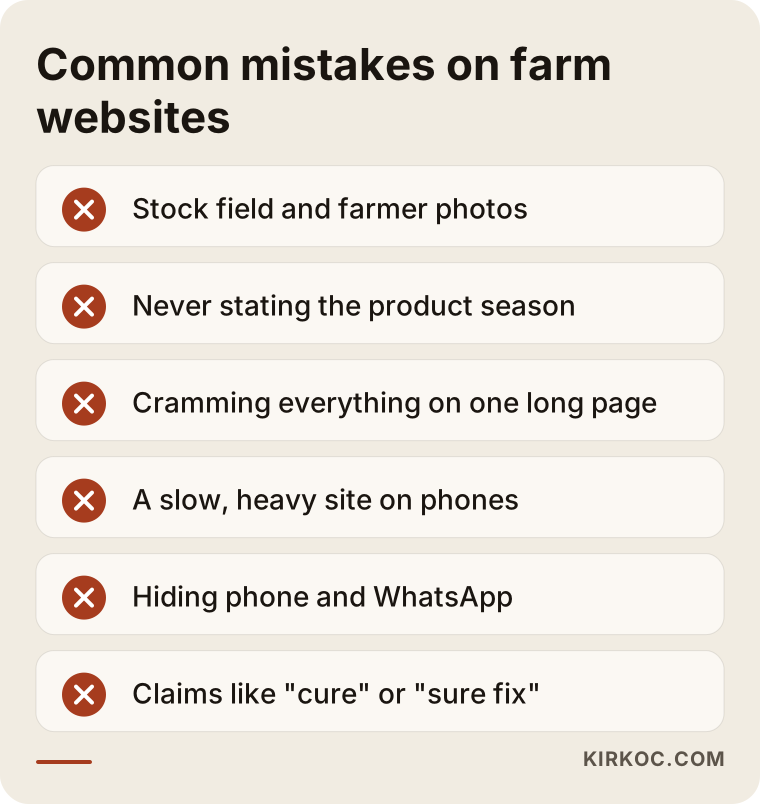
Let me go through the list. Using stock photos. A picture of a green field and a smiling farmer says nothing about your product, and buyers notice within seconds. Not stating the season. If the product is seasonal and you do not say so, you will waste time on someone asking in midwinter whether it is in stock. Putting everything on one page. If product, wholesale, about and contact all sit on one long page, neither the search engine nor the visitor can tell what is where. A site that runs badly on phones. Buyers in rural areas or on the move mostly browse on a phone, and the connection is not always good. A site loaded with heavy images loses them right away. Hiding contact details. Offering only a form and hiding your phone number or WhatsApp damages trust. Going overboard with health or legal claims. Words like "cure" or "sure fix" hurt credibility and can cause trouble. If you are unsure, check with the relevant authority or a lawyer.
One more thing that gets forgotten is the Google Business Profile, the listing that puts you on the map. If you sell on site, host farm visits or deliver from a warehouse, being on the map matters a lot. Your address, opening hours and phone number should be identical on the site and on the profile, and I check this separately on every project.
When will results show up? A realistic timeline
Showing up in search results takes time, and nobody can promise you a ranking or a date. Still, knowing the stages the process goes through keeps your expectations healthy.
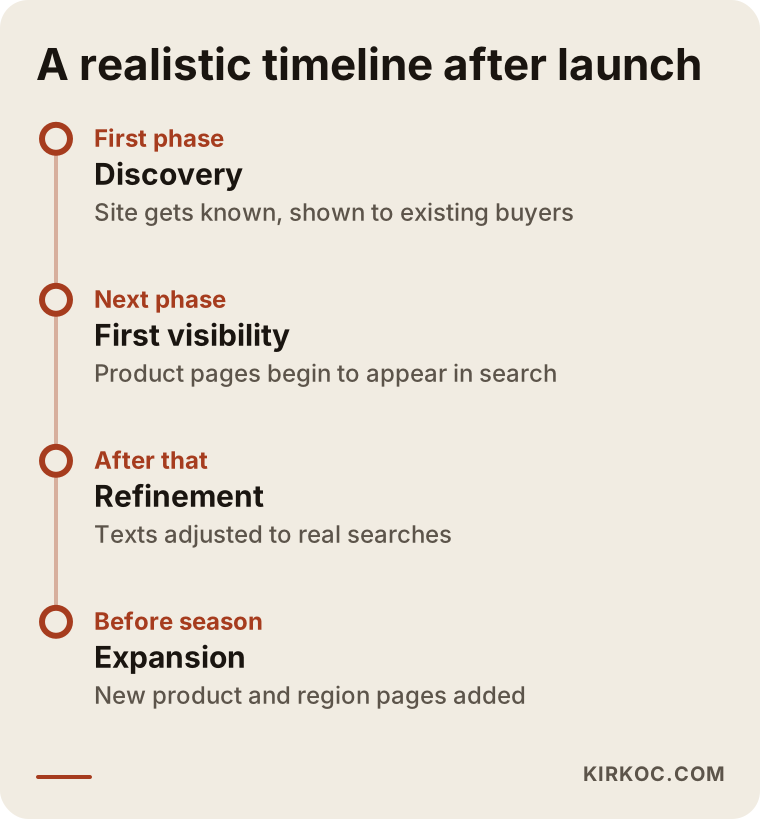
As the timeline suggests, the first stage is when the search engine discovers and gets to know the site. During that time, showing the site to buyers you already know can bring in demand by itself. In the second stage your product pages begin to find a place in the results. I look at which phrases they appear for and adjust the text to match. After that, adding content, such as a new product page or a regional guide, widens the site's reach. Farming is seasonal, so starting before the season gives you a much more comfortable schedule than starting in the middle of it.
From visitor to inquiry
A site is not only there to be seen. Its job is to move the visitor to a next step, whether that is a phone call, a WhatsApp message, a sample request or an order. I think of it as a funnel: the people who arrive at the site at the top, the people who read a product page in the middle, and the people who get in touch at the bottom.
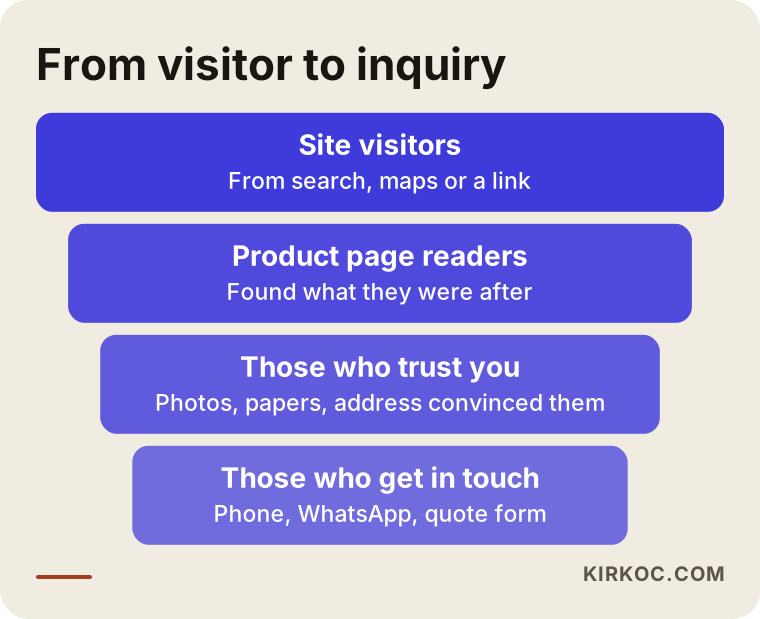
Some visitors drop out at every level of the funnel, and that is normal. What matters is seeing where they drop out and fixing that spot. If visitors reach the product page but do not get in touch, the cause is usually a lack of trust or a contact button that is hard to find. If they never reach the product page at all, the problem is visibility in search. To tell the difference, I set up the basic measurements for the site and share them with you in plain language.
What can you do yourself, and when do you need an expert?
You do not have to buy everything from outside. You can do part of the work yourself, which often protects your budget and keeps the site honest.
Things you can do yourself: take clear photos of your operation with your phone, write down the packaging and quantity details of each product, collect the questions buyers ask most, open your Google Business Profile and keep it current, and scan your documents and keep them in one tidy folder. A business that has these ready moves much faster with whoever builds its site.
Where an expert helps: planning the pages, writing the text around what people search for, making the site fast and clean on phones, technical setup, measurement, cart and payment systems, and multilingual structure. These take both knowledge and time.
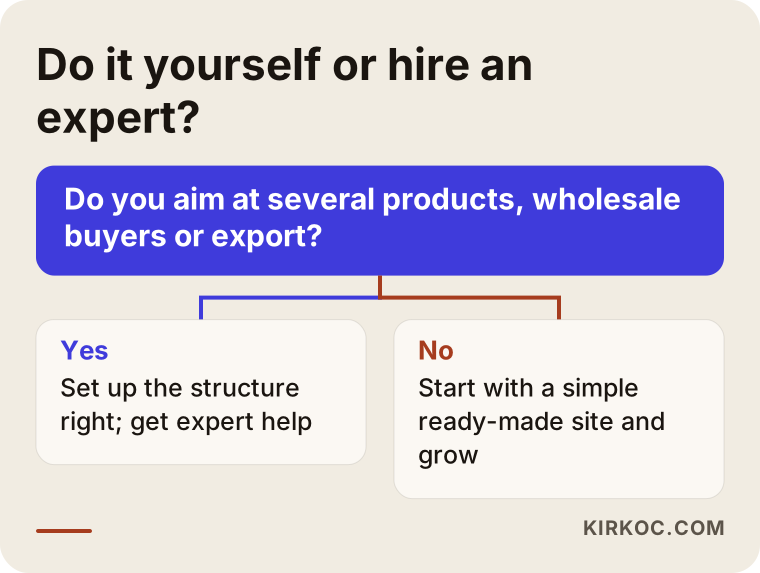
The chart boils down to this. If your sales volume is small and your buyers already know you, starting with a simple ready-made solution may be enough. If you are aiming at several products, wholesale buyers, export or online sales, setting up the structure properly from the start is usually cheaper than fixing it later.
What determines the cost?
I do not quote numbers in this article, because no two farm sites cost the same. These are the main factors. The number of products and pages: a business with three products and a distributor with thirty items are different jobs. The way you sell: a site that only provides information is very different from a store with a cart, payments and shipping. The number of languages: adding a second language for foreign buyers means writing every page again. Who holds the content: if photos, text and documents are ready, the job is shorter; if not, producing them becomes part of the job. What comes after: whether you want search visibility work, social media or advertising once the site is live. I talk through all of this up front and explain item by item what changes the price, so the quote is readable for you.
How I work with you
The first step is a short conversation. I listen to how you run your business, who your buyers are and what you want to achieve, and I tell you honestly what a site can add for you, including when it cannot add much. If it fits, I pin down scope and schedule in a written quote. Because I run the site, search visibility, social media and advertising all myself, I plan with you which of them to add, and when, based on your needs. You do not have to buy everything at once. I do not guarantee results or sales, but at every stage I explain plainly what is being done and why.
Frequently Asked Questions
Does a small farm need a website?
It is not mandatory, but having somewhere to send buyers makes a real difference. When a wholesaler, a restaurant or a new buyer asks "do you have a website?", pointing to one address inspires more confidence than scattered phone photos. A simple site can be enough at the start.
Should I put product prices on the site?
You do not have to. For products whose prices change often or depend on quantity, a "request a quote" approach is more practical. But how to get a quote, how quickly you reply and the minimum quantity should be stated clearly, or buyers will hesitate.
What should I watch out for if I sell live animals or processed food?
There may be rules for promoting and selling these products online, and they vary by product and location. I do not give legal advice, so I suggest you check with the relevant authority or a lawyer before you start selling or advertising. On the site, I use only the wording you have approved.
Is an online store or just an information site the better choice?
It depends on who your buyer is and how the product is delivered. With perishable goods, a cart brings up shipping and cold-chain questions. For wholesale, a good quote form is often enough. I will help you settle this in the first conversation.
Should I have the site in several languages for foreign buyers?
If exporting or selling abroad is truly your goal, yes. But every page has to read naturally in that language, and machine translation rarely inspires confidence. If you have no such goal, you can start with one language and add others later.
How long does it take to get the site ready?
It depends on the number of pages, whether the content is ready and the scope of the sales system. If photos and documents come from you quickly, the process is shorter. Because farming is seasonal, I suggest starting before the season.
Will I be first on Google once the site is built?
No, and nobody can guarantee that. A properly built site makes it easier for the search engine to understand you and gives you a chance to appear for relevant searches. The outcome depends on competition, your product and time.
Do I need social media and advertising too?
Not necessarily. For some businesses a strong site and a map profile are enough. For others, showing production on Instagram or running a short ad campaign works well. Since I handle all of it myself, I will help you decide which one really fits you.
If you would like to talk about a website that puts your farm or agricultural business in front of the right buyers, you can reach me through my website design services page. I will listen to your product, your buyers and your goals, and tell you plainly what you actually need.