You open your Instagram page and then your competitor's, and their follower count is far bigger than yours. Meanwhile your phone keeps showing ads: "Fast followers," "Instant likes." The prices look small. For a moment you think, "If I bought a package, the page would look busy, and customers would trust it more." In this article I will answer the question is buying followers bad for business honestly, because the decision shapes your next several months on social media. If you want your page to grow in a way that helps your business, you have to grow the right people, not just a number. I see this every day in my social media management work.
Here is the short answer up front: yes, in most cases it hurts. But the way it hurts matters, because the damage rarely arrives as "your account gets shut down." More often it is quiet. Your posts reach fewer people, your ad budget gets wasted, and you cannot figure out why.
What does buying followers and likes actually mean?
A service promises that, in exchange for money, it will add a certain number of followers, likes, views or comments to your page. Those numbers come from a few different sources.
The first source is fake accounts that belong to nobody. No profile photo, no posts, a username made of random letters. The second is real but paid accounts. These belong to people enrolled in a kind of follow-for-follow machine. They do follow you, but their interest in you is zero. The third is setups that add followers and then remove them after a while, which is why a purchased number tends to melt away week by week.
Whichever you pick, they share one trait: these people are not your customers. They will not buy from you, send you a message or reply to your stories. They sit on your page as a number and nothing more.
A small picture helps here. Imagine you put mannequins in front of your shop so it looks crowded. A passerby might be impressed for a few seconds. But nobody walks in, looks at a product, asks a question or pays. A shop full of mannequins does not sell more than an empty one.
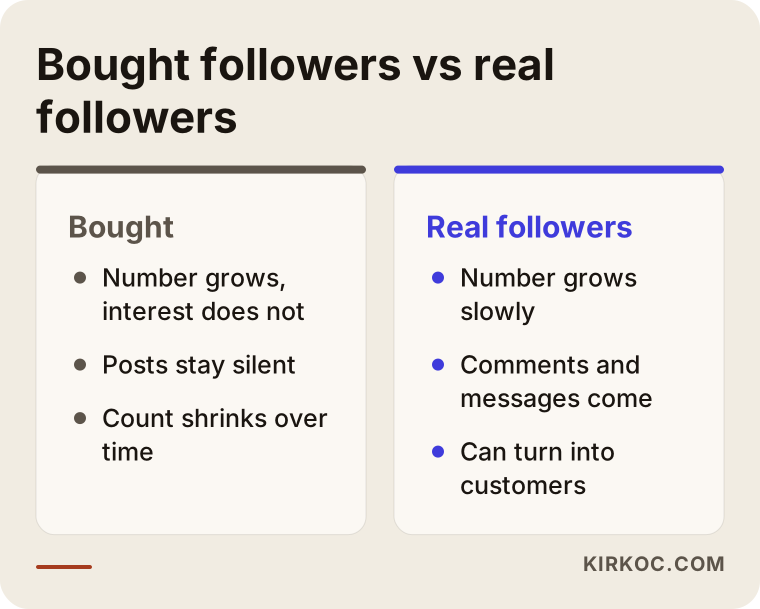
The graphic above puts the two paths for the same page side by side. In the rest of this article I will unpack the reasons behind each difference.
Why do people go down this road?
I am not writing this to judge anyone. I understand the motives, because every business owner looks for social proof somewhere.
The first is first-impression anxiety. You have just opened, your page shows fifty followers, and you assume a potential customer will look and wonder whether you are serious. The second is pressure from competitors. If someone in your industry looks popular, you feel behind. The third is lack of time. When you are busy running the business all day, making content on a regular schedule is hard, and a ready-made number looks like a shortcut. The fourth is a rumor you may have heard, that the algorithm loves a crowd. That one is simply not true.
Underneath all of these is a legitimate need: you want to look trustworthy. The problem is that the need is being met with the wrong tool. Trust does not come from a number. It comes from the real life visible on your page.
How do bought followers hurt your business?
Let me list the problems one by one. Each is a separate way of losing something.
Your posts reach fewer people
Instagram and similar platforms first show a new post to a small slice of your followers. They watch how that group reacts and use it to decide whether to show the post to a wider audience. If most of your followers are uninterested or fake, that first small group does not respond. The platform concludes that people did not care about the post and shows it to fewer others.
So fake followers are not just useless. They also make it harder to reach your real followers. The platforms do not publish the exact mechanics, but a drop in engagement (more on that term below) is the most common symptom people see on accounts like this.
You spend ad money based on bad data
With Meta ads, you can tell the system to find people similar to your existing followers. If your follower list is full of fake accounts, the system may go looking for more people like them and steer you toward the wrong crowd. Your ad spend rises, but your inbox stays empty.
Let me explain one term here. "Engagement" means the reactions people give your posts: likes, comments, saves and messages. Ad systems learn about you and your audience by watching those reactions. If your audience is silent, the system has nothing to learn from.
Customer trust works in reverse
Many people check a business's page before they buy. If a page has a lot of followers but almost no comments, or if the comments all look the same ("Great, awesome!"), an attentive visitor notices. And that visitor starts questioning more than the page. They start questioning your honesty.
For service businesses, trust is the only capital you have. For a consultant, a clinic or a workshop, the impression that "this person padded their numbers" can be worse than having no followers at all.
Account safety and platform rules
The terms of service of Instagram, TikTok and other platforms ban fake engagement. A platform can purge it, and when that happens your count drops overnight, or your account can run into restrictions. Many of these services also ask for your account password or login access, which is a security risk all by itself.
I cannot tell you anything definitive about the legal side. Rules about misleading consumers and advertising differ by country and by industry. If you are worried, please ask a lawyer.
Your measurements get distorted
This is the least discussed harm. You look at numbers to learn which content works. If part of your audience is fake, you cannot tell which post truly caught attention. The compass you use to make decisions is broken. Months later you may conclude that "social media does not bring us business," when the real problem was the quality of the audience you were measuring.
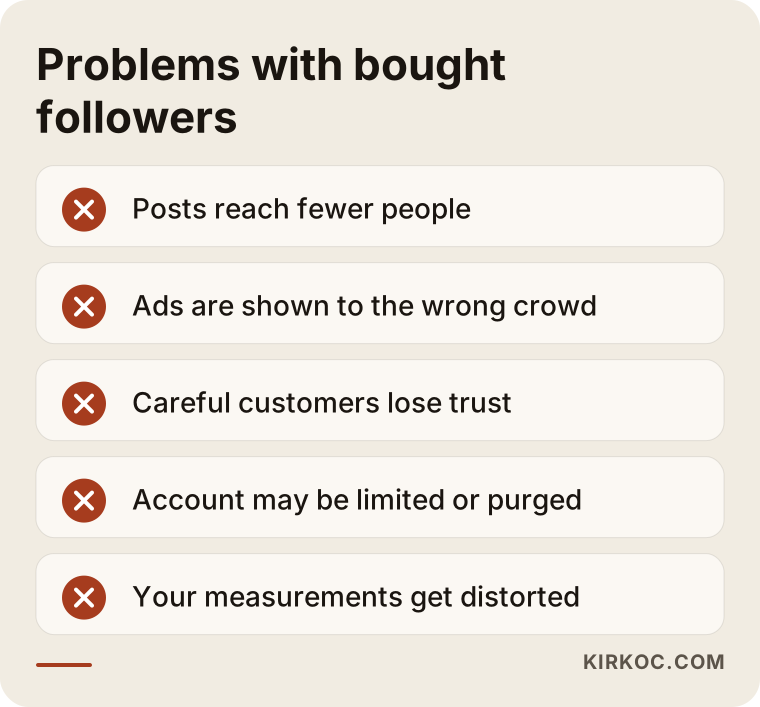
This graphic gathers the problems I just described into a short list. You can judge which one matters most for your type of business.
From a number to a customer: why a fake number does not work
Winning customers on social media works like a funnel. At the top are the people who see you. As you move down, the group gets smaller: people who visit your page, people who read your content, people who send a message, people who buy. Each stage is filtered out of the one above.
A bought follower inflates only the very top layer. Nothing passes down. Worse, an inflated top layer ruins your ratios. If a hundred people see you and ten message you, that is a good ratio. With a fake crowd, a thousand people appear to see you, and the same ten messages suddenly look like a terrible result. Your view of your own page gets bent.
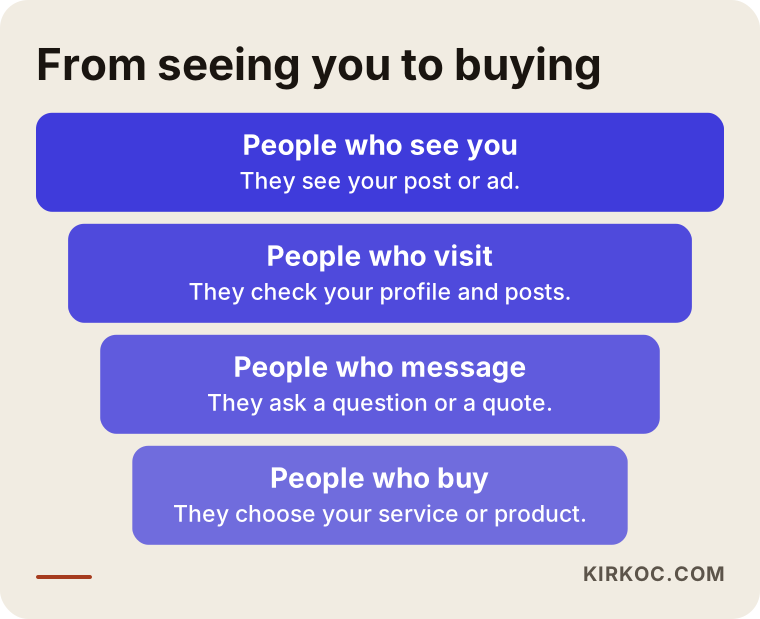
The funnel shows where you lose people at each stage. Fake numbers only enlarge the widest part and never touch the narrow parts.
Are all the services the same?
People sometimes say, "I would buy the high-quality kind." There is some difference in quality, but the basic logic does not change. The comparison below summarizes the most common types and what each means for you.
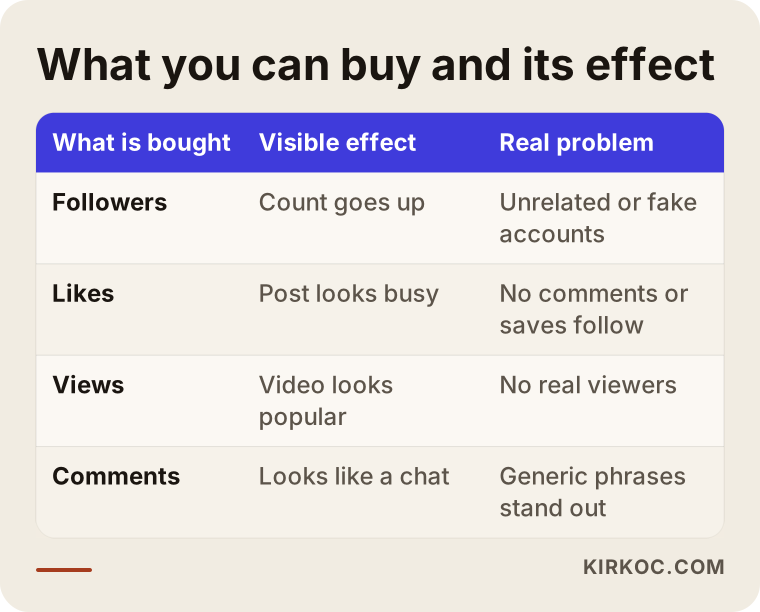
As you can see in the table, the shared problem is that the number does not come from real interest. Buying comments is the riskiest, because canned comments are the easiest thing to spot.
Two hypothetical example scenarios
The two stories below are entirely hypothetical. They describe no real company or person. The aim is to show where two different paths from the same starting point might lead.
Scenario 1: A new neighborhood cafe
Suppose a new cafe opens in a residential neighborhood. The owner worries the page looks empty and buys a follower package. The page looks busy, but the space under every post stays silent. A few weeks later the owner runs a small ad. It is shown to unrelated people instead of the neighborhood, and no messages come in. The owner concludes that "ads do not work."
If the same cafe had put that money into steady weekly content and a small ad aimed at the neighborhood, it might have had fewer followers, but most of them would be real people who live nearby. What matters to a cafe is a hundred people who will stop by for a morning coffee, not thousands of strangers' accounts.
Scenario 2: A solo consultant
In the second hypothetical, a financial consultant wants to look credible on LinkedIn and Instagram and buys followers. A prospective client visits the page, notices that despite the high follower count almost nobody reacts to the posts, and quietly leaves without asking for a quote.
If that consultant had instead shared short posts answering real client questions a few times a month, the follower count might have stayed low, but every post would carry a real question or a thank-you underneath. In advisory work, a handful of real comments builds more trust than thousands of empty followers.
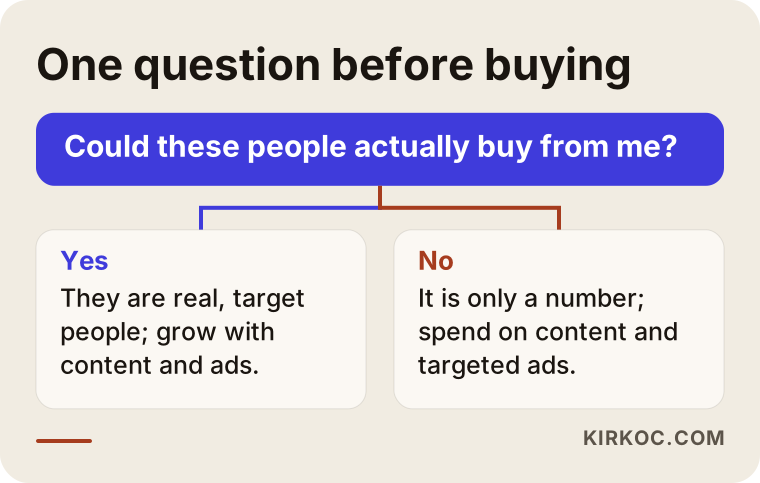
This decision graphic reduces the difference between the two scenarios to one simple question: is there any chance the people you buy would ever buy from you?
What to do instead: real growth, step by step
Real growth looks slow, but it accumulates. Here is the order I suggest.
1. Make clear what your page does
Someone who lands on your bio should be able to answer, within three seconds, "What does this business do, who does it serve and how do I reach it?" The profile photo should be sharp, the bio should describe the work in one sentence and the contact button should work. This comes before follower count.
2. Decide who you are talking to
There is no such thing as "everyone." Are you talking to families in your neighborhood, corporate buyers or young founders? If you can write your audience in one sentence, content ideas get easier.
3. Turn the questions you hear into content
The questions customers ask by phone, by message and in person are the best source of content. "How is the price decided," "how long does it take," "what material is used" can each become a post, and each builds trust.
4. Be regular and do not obsess over the number
One good post a week beats a burst of posts once a month. A steady rhythm helps the platform get to know you and teaches your followers to expect you.
5. Use a small ad to reach the right people
Use ads to show your content to the right people, not to make numbers bigger. If you are a local business, a small location-based test is often enough to start. Managing Meta ads well takes careful audience settings to filter out irrelevant clicks.
6. Review monthly and learn
Which post brought a message, which one got saved, which one stayed silent? Checking this once at the end of the month is enough. Then you do more of what works and drop what does not.
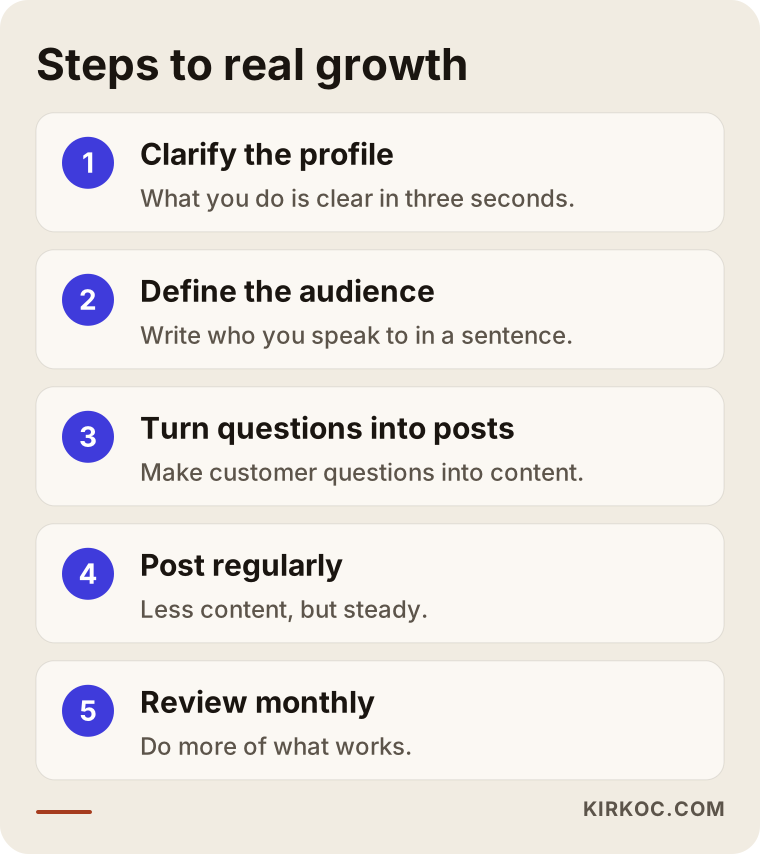
The steps appear in order in the graphic. Skipping the early ones and jumping straight to ads or purchases is usually the most expensive route.
How long does real growth take?
Let me be honest: being impatient is human. But I cannot promise a specific timeframe or number, because it depends on your industry, your competition, your budget and your content routine. What I can share is the general logic.
In the first weeks the page finds its footing: the profile gets tidied up and the content plan settles. In the following weeks it becomes clear which kind of content gets a response. After that, you improve the content with what you learned, and if you add ads, the results become easier to read. Each stage is built on the one before, so none can be skipped.
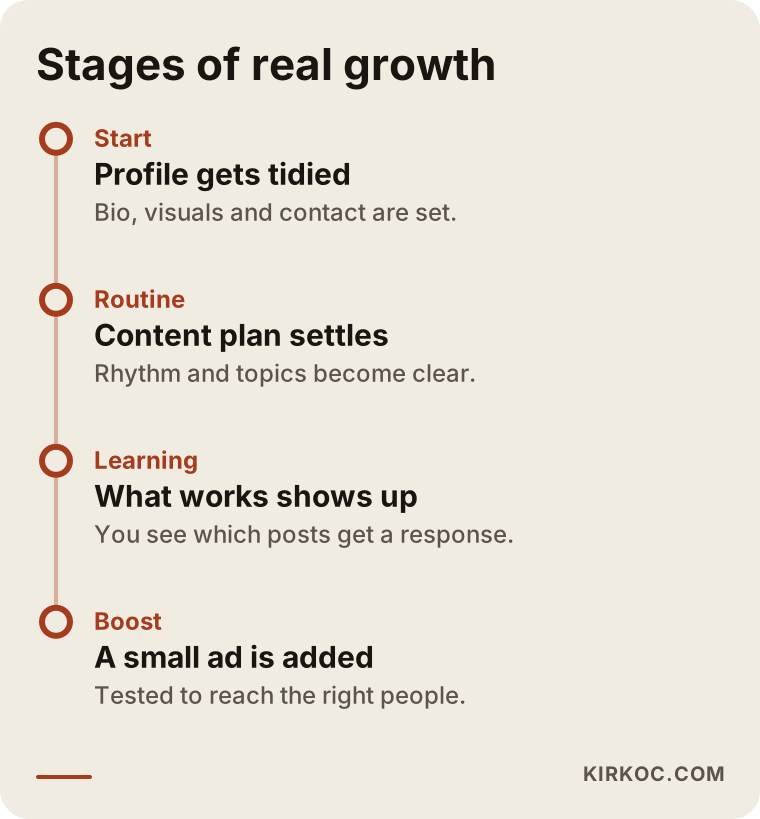
The timeline is meant to set your expectations in the right place. The length of each stage varies from business to business, and I do not promise any particular result.
How do you clean up an account that has bought followers?
If you have bought followers before, it is not the end of the world. Plenty of businesses try it at some point. What matters is noticing and changing direction.
Start with an honest look at your engagement. Are your posts much quieter than your follower count would suggest? Then consider removing suspicious accounts. You can do that by hand or with carefully chosen tools, but do not hand your login details to unknown websites. Your number will drop, and that is normal. A falling number just means you are getting closer to your real situation.
Then go back to the real growth steps above. You may not need to start the page from zero, though in some cases a fresh account is the cleaner move. That decision depends on how much of your current audience is real, and it is best made by looking at the account together.
If you built an ad audience based on your old followers (a "lookalike" audience, meaning people similar to them), you may want to rebuild that too. If the old audience was trained on fake data, the new one should be built on a cleaner base.
Common mistakes
The mistakes I see around followers tend to look alike. The list below is useful when you check your own page.
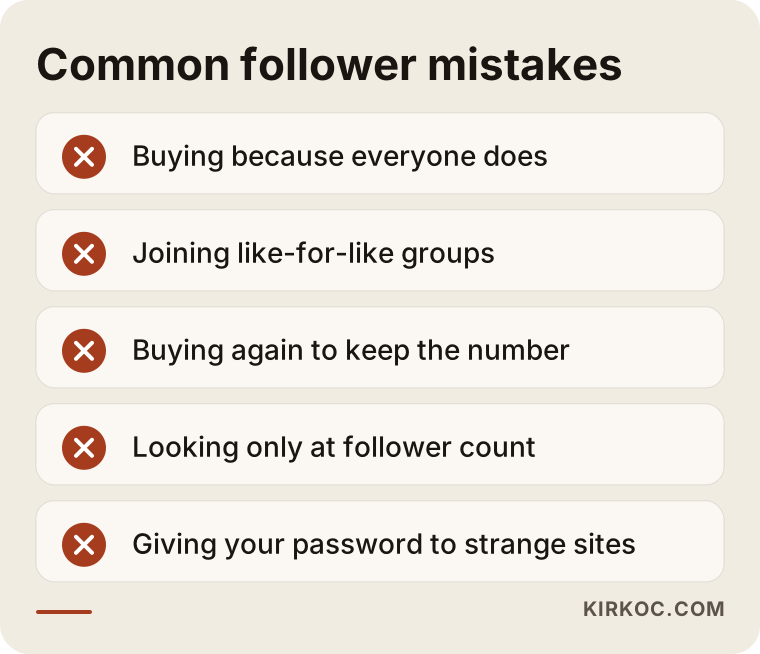
Most of the mistakes in the graphic come from rushing and from treating the number as the goal. I want to add a few points.
The first is the thought that "everyone does it." You do not know whether your competitor's numbers are real, and a high number does not always mean real interest. The second is joining engagement groups. Like-for-like communities create movement in the short run but pull you away from the people who might buy. The third is buying again and again just to hold the number. That vicious circle drains both your budget and your attention.
The fourth is looking only at followers and missing the real signals: messages, phone calls, requests for directions. For a business, the number that counts is how many people contacted you.
What can you do yourself, and when do you need a specialist?
There is a lot you can do on your own. Cleaning up the profile, posting once a week, answering customer questions and replying to comments need no special knowledge. If you do these regularly, you can see visible progress.
Specialist help adds value in certain cases. You may have no time and your content keeps slipping. You may want to run ads but fear wasting the budget. You may want to look consistent across several platforms (Instagram, Facebook, LinkedIn, TikTok, YouTube). Or you may want to clean up an earlier problem such as purchased followers. And if your website, your Google visibility and your social media are disconnected, an outside eye helps pull the pieces into one message.
Let me say plainly what it means to have one person handle everything. When your website, your local search visibility, your social accounts and your ads are run by the same person, the message stays consistent. The offer you describe on Instagram matches the offer on your site, a person who clicks an ad lands on the right page, and you never have to coordinate who is doing what. The follower question is then judged inside that whole picture: who does the page speak to, where does that person go next and what do they see when they get there?
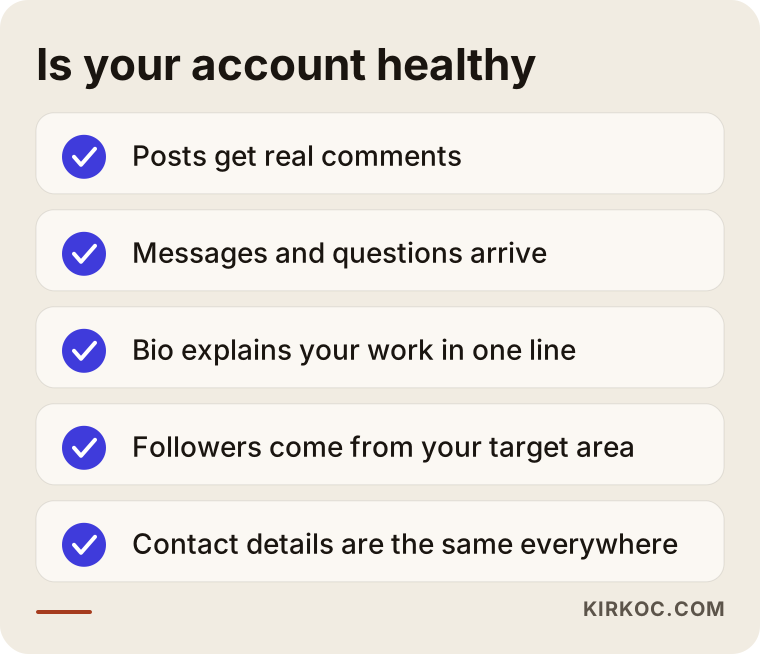
The checklist is there to help you see whether your page is truly healthy. If several items are missing, completing them first is more useful than adding to the follower count.
How do AI tools and search results see this?
There is a newer angle as well. People now ask AI tools such as ChatGPT, or read Google's summary answers, when they look for a business. When these systems recommend a business, they do not look only at social media numbers. They look at clear information on your website, consistent contact details, genuine reviews and understandable content. A fake follower contributes to none of these signals.
Conversely, if your page has clearly described services, steady and consistent information and real customer questions, both people and these tools understand you more easily. That is not a guaranteed result, but it gives you solid ground to stand on.
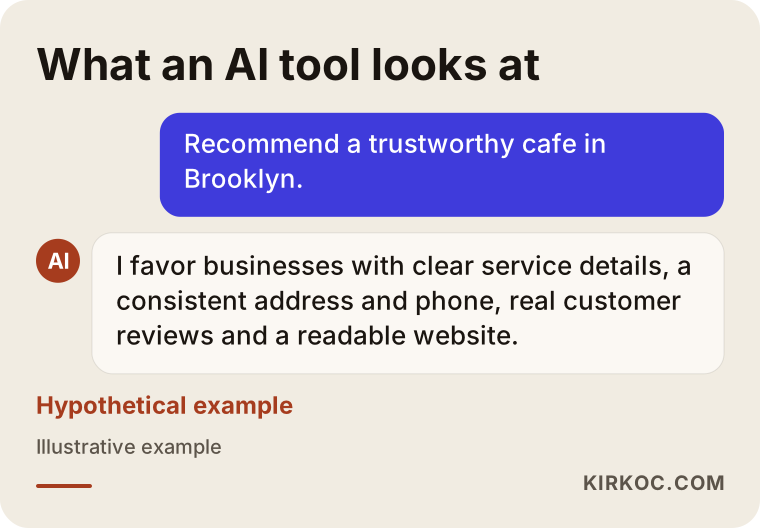
The sample answer uses a hypothetical query to show what AI tools rely on. It is not a promise of any real result, just an illustration of the logic.
What determines the cost?
I am not giving numbers, because the need differs for every business. But I can tell you plainly what moves the price.
The main factor is which platforms you want to be on: only Instagram, or Instagram, Facebook, LinkedIn, TikTok and YouTube together? It also matters how many pieces of content are produced each month, whether they are images or video, and whether design and copywriting are included. Replying to comments and messages, monthly reporting, whether ad management is added, whether shooting is needed and how much expertise your industry requires all change the cost too.
Ad spend is a separate line. What you pay the ad platform is independent of the service fee and stays in your own account. You should expect every item you are asked to pay for to be written down and clear.
How I work
I work from Istanbul and provide, on my own, the services a digital agency would: websites and e-commerce, SEO, local SEO, GEO, social media management, Google and Meta ad management, logo and brand identity, and content creation. The person you talk to is the person who does the work.
The process goes like this. First I look at your current pages, your website and your competitors. Then I explain in writing what will help and what is unnecessary. If your account has bought followers, I will ask you about it openly. I do not judge, I plan the cleanup. Each month I report in plain language what happened, so no term is left unexplained. Your accounts and your website always stay in your name.
I do not promise follower, like or sales numbers. What I can offer is steady work, clear communication and a path you can measure.
Frequently asked questions
Can buying followers get my account shut down?
The platforms' terms ban fake engagement. Whether an account is closed is not the same in every case, but your count may be wiped, your reach may drop or the account may be restricted. If a service also asks for your login details, there is a security risk on top of that. I cannot tell you a definitive legal outcome, so if you are worried, please ask a lawyer.
Is buying a small package still harmful?
Even when the amount is small, the logic is the same: because there is no real interest, your engagement rate falls and your data gets distorted. The harm may be less visible with small packages, but the problem does not go away. Small starts also tend to open the door to bigger packages.
Is buying likes different from buying followers?
The effect is a bit different but the outcome is similar. Likes give the impression of a crowd under a post, but if no comments, saves or messages follow, an experienced eye notices at once. The platform may also be able to tell artificial likes from real interest.
My competitor seems to have bought followers. What should I do?
Focus on your own flow of customers, not on their number. You cannot know whether a competitor's count is real or artificial. Your goal is to reach the right people and build relationships with them. When you size up an account, look at the comments under the posts and the stream of messages rather than at the follower count.
I bought followers before. What now?
No need to panic. First check whether your engagement really is low, then consider removing suspicious accounts. After that, return to the real growth steps. If you would like to look at the situation together, you can write to me. I can review your account and tell you whether a cleanup or a clean start makes more sense.
How long does it take to get real followers?
I cannot give a fixed time; it depends on your industry, competition and content routine. First the profile and content routine settle, then you see what works, and then growth follows. The most important thing that speeds this up is regular content that suits your target audience.
Can I find customers without social media?
Some businesses can, especially those that rank strongly on Google or that work through referrals. But when customers research you, they often check your social media page too. A regular, genuine page works as a storefront that builds trust when you need it.
What information is needed for social media management?
I only need to know what your business does, who you serve, which platforms you want to be on and what you have already tried. I will sort out the rest with you in the first review. You do not need to come prepared.
If you want to grow your page with real customers instead of fake numbers, you can take a look at my social media management service and write to me so I can look at your current situation with you.