Picture owning one boat, or a small fleet, on the Turkish coast. During the season the phone rings, WhatsApp messages pile up, some bookings come through an agency and some through people you already know. But when the season is about to start, or when it is over and you want new customers for next year, you start to think it is time to build a boat charter website. Maybe you already have a site and nobody calls because of it. Maybe you have none, and everything runs through Instagram and listing platforms. This article explains what a charter website actually needs in order to bring bookings, which pages are essential, and how the work is done. I am Ümit Kırkoç, I work from Istanbul, and I handle website design together with SEO, social media and ads, all by myself, so I write about the boat business with the site, search and social sides in mind at the same time.
Let me be clear about one thing first: chartering a boat is nothing like buying a pair of shoes. The customer usually decides once, for a large amount of money, with family or a group of friends, on fixed dates, and with plenty of questions in mind about weather, routes and the skipper. In a decision like that, people search first, then compare, then build trust, and only at the end write or call. If your site makes that chain easier, bookings come. If it makes the chain harder, the customer moves to another boat.
How do people search when they want to charter a boat?
People rarely type just "boat charter" and stop. They usually start with a place and a type: "Bodrum day boat trip," "Fethiye gulet charter," "Marmaris yacht rental," "Istanbul Bosphorus birthday boat." Then they narrow down what they want: with a skipper or bareboat, a blue cruise or a single day, and how many people. Each of these searches represents a different kind of customer, and your site should have a separate answer for each.
You can roughly sort searches into three groups. The first group is general searchers. Someone typing "boat charter Turkey" may not yet know where they want to go. This group is large, but competition is heavy, because big listing sites and agencies are very strong here. The second group searches by region, such as "Gocek boat charter." This group is more focused and the competition is more reasonable. The third group searches with very specific intent: "day trip for eight people with a skipper in Bodrum" or "bachelor party boat in Fethiye." A small operator can become visible here, because few pages answer such a specific search.
The illustration below shows the difference with an invented example.
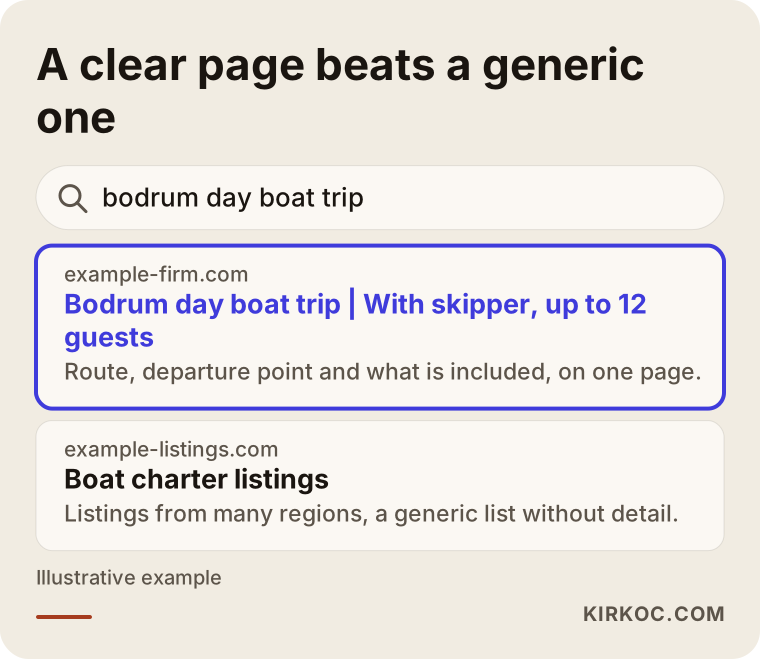
The highlighted result states the region, the boat type and who it suits right in the title. A generic "best boat charter" page gives none of that. Google and the person reading both choose the clearer one.
Season, dates and the number of questions
Boat charter is a strongly seasonal business. Travelers start planning their holidays months ahead, which means your site must be ready, filled with content and findable long before summer. If you only start building the site once the season opens, you have missed the most valuable planning period of the year. That is why it makes sense to schedule the work before the season and to keep producing content in the off-season too.
Another feature is that the customer does not decide on the same day. Over a week they may look at three or four sites, ask for prices from several places and show the options to a partner or friends. Your site needs to be memorable, easy to come back to and easy to share. Good photos and clear information decide this more than anything else.
What does a customer look for on your site, and where do they give up?
A visitor wants to understand a handful of things quickly: what the boat looks like, how many guests it takes, where it departs from, what is included, how long the trip lasts, whether it is available and, above all, whether you can be trusted. If the answers are missing, they will either call you or leave. Most leave. Picking up the phone can feel intimidating when the amount is large.
The next illustration shows a visitor's path from arriving on the site to booking, and where people drop off along the way. It contains no numbers, only the order.
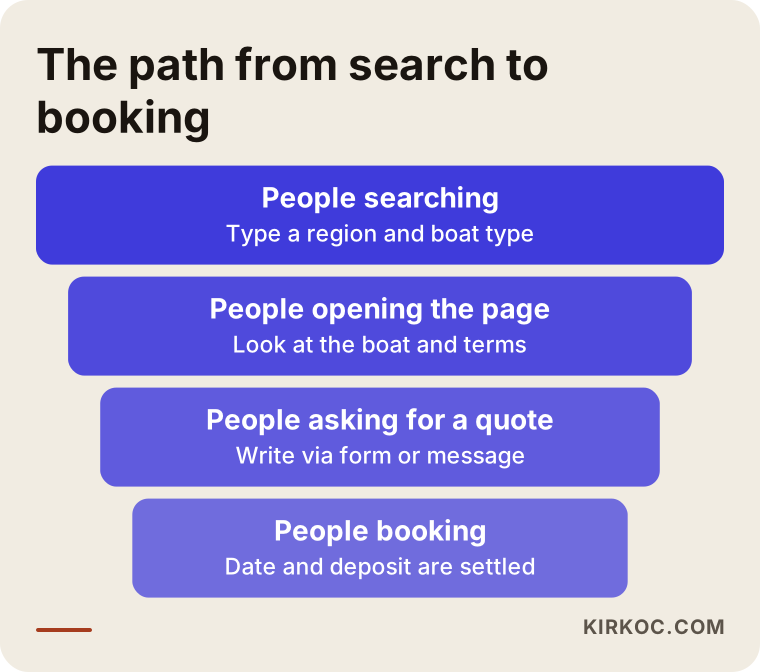
The most critical link in this path is often the middle one: moving from the page to a quote request. People like the boat but cannot find an answer to "what do I do now?" A clear button, an easy form and a promise of a quick reply strengthen that link.
Why does trust matter so much?
In a charter, the customer entrusts you first with their money and then with their holiday. If the site has no real photos, no skipper introduction, no business address and no contact details, people hesitate. On listing platforms the platform provides that trust. On your own site, you have to build it yourself. Done properly, having your own website makes a business look more serious and easier to reach.
What you can state about licenses, permits and insurance depends on Turkish regulations, and these rules differ by boat type and by the way you operate. Before making any firm statement on the site, I suggest you check with a lawyer or the relevant professional chamber. I focus only on how such information can be displayed in a tidy and understandable way.
Which pages should a boat charter website have?
A charter site's home page works like a shop window, but the real work happens on the inner pages. That is because people coming from a search engine usually do not land on the home page. They land on the page closest to what they typed. So the page structure should follow the way customers search.
The table below summarizes what each page type does and who it is for.
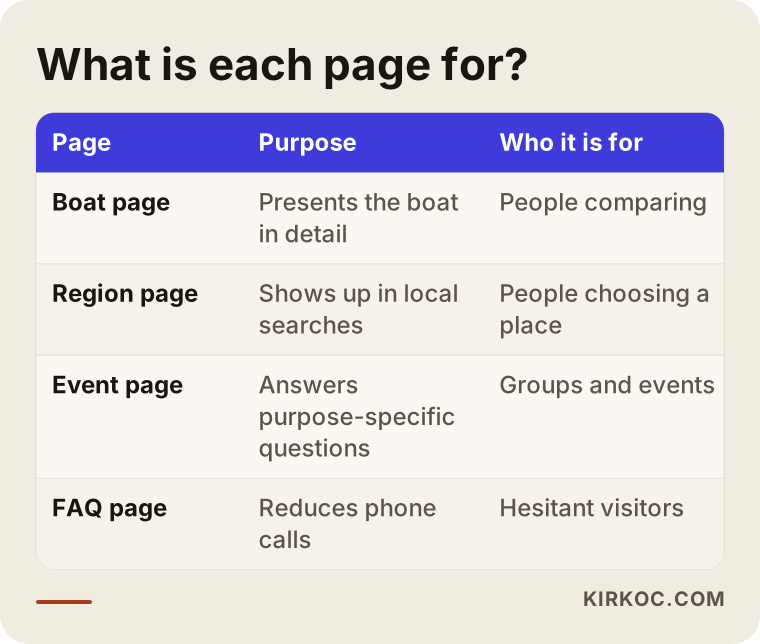
Let me go through it in more detail.
A separate page for every boat
If your fleet has three boats, there should be three separate pages. Squeezing all of them onto one "our boats" page loses out both with search engines and with customers. Each boat page should show: how many guests it takes, the cabin and sleeping arrangement, the boat type, what is included and excluded, the departure point, possible routes, skipper and crew information, a short note on safety equipment and enough photos. The photos must be real and belong to that boat. Stock images destroy trust quickly in this business.
Region pages
"Boat charter in Bodrum" and "boat charter in Fethiye" are not the same search. If you operate from several harbors, write a separate page for each region. That page should describe the bays specific to the area, typical route times, lunch stop options and how guests reach the departure point. Do not make these pages by copying one text and swapping the town name. Search engines can tell, and so can customers.
Trip and event pages
People look for boats for different purposes: a day trip, a blue cruise, a birthday, a proposal, a bachelor or bachelorette party, a corporate event, a dinner cruise. A separate page for each purpose answers that customer's questions directly. Someone planning a company event wants to know capacity, the sound system, catering arrangements and invoicing. A family looking for a day trip checks child safety and the length of the trip.
The FAQ page
The same questions come up again and again: cancellation terms, postponement because of weather, what to bring, life jackets for children, seasickness, food and drink arrangements. Answering them in one place reduces your phone load and builds confidence.
Booking system or quote form?
This is the part that confuses people most. The idea of "the customer picks a date on a calendar and pays right away" sounds attractive, but it is not right for every charter business. Ask yourself one question: how much does your price change with date, duration, number of guests and extras? If it changes a lot, an automatic calendar and payment system is hard to set up and can mislead the customer.
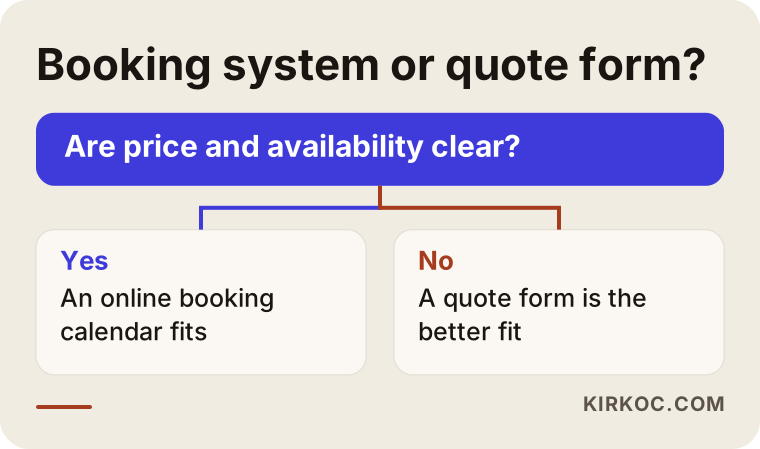
As the chart shows, there are two paths. For products with a clear price and standard dates, such as a fixed day trip, online booking works well. For work that is open to negotiation and detail, such as a blue cruise, a private event or a long charter, a quote form is often the better choice. You can also use both: a calendar for standard trips and a form for special requests.
Keeping an availability calendar
If you put an availability calendar on the site, it must stay current. An outdated calendar can show "available" when you are not, or create needless phone calls. Who will update it, and how often? When a booking arrives through another channel, such as an agency or a phone call, how will the calendar be synchronized? Answer these questions before you build the system, not after.
Deposits and cancellation terms
If you want to take a deposit, how you do it legally and financially should be discussed with a professional, such as an accountant or a lawyer. On the site, cancellation and refund terms must be written clearly and in plain language. If the customer did not see these terms before paying, the relationship suffers when a problem appears. I do not write the legal content of these texts, but I arrange where and how they appear on the site.
Example scenario 1: A small day-trip boat in Bodrum
This is a hypothetical example. Imagine a business in Bodrum with two small boats. Right now most customers come from hotels and acquaintances. There is no website, only an Instagram account and a listing page. Early in the season, it is unclear how full the boats will be.
The first step for this business is to build clear pages that answer searches such as "Bodrum day boat trip" and "private boat charter in Bodrum." Each boat gets its own page, with the departure point, sample routes and what is included written plainly. Because the standard trip prices are fixed, online booking may make sense here, while a quote form handles private charters.
The second step is moving the photos and videos from Instagram onto the site, so that social media and the site feed each other. The third is tidying the Google Business Profile and collecting reviews. When these three parts work together, a steady flow of inquiries can develop through the season. I do not promise any outcome, though, because the season, the weather and competition are outside anyone's control.
Example scenario 2: A gulet blue cruise from Fethiye
This one is hypothetical too. Imagine a business in Fethiye that runs a gulet, mostly for guests from abroad and for group bookings. The price depends on dates, number of guests, the route and the catering options. Customers usually ask several months ahead and decide by exchanging messages.
An online payment system would be a poor fit for this business. A better structure is a very strong boat page, a detailed route description, a sample daily program, an introduction to the crew and a short quote form. Because the guests are international, the site should work in English at the very least. A word-for-word translation of the Turkish pages is not enough. The pages should be written around how people in the guest's own country search and what they expect.
Content published outside the season also helps here: route guides and articles such as "tips for first-time blue cruise travelers" can improve visibility in search results. This content is useful both for search engines and for customers who are in the middle of deciding.
Step by step: how the site gets built
You can break the build of a charter site into a simple sequence. The illustration below shows it.
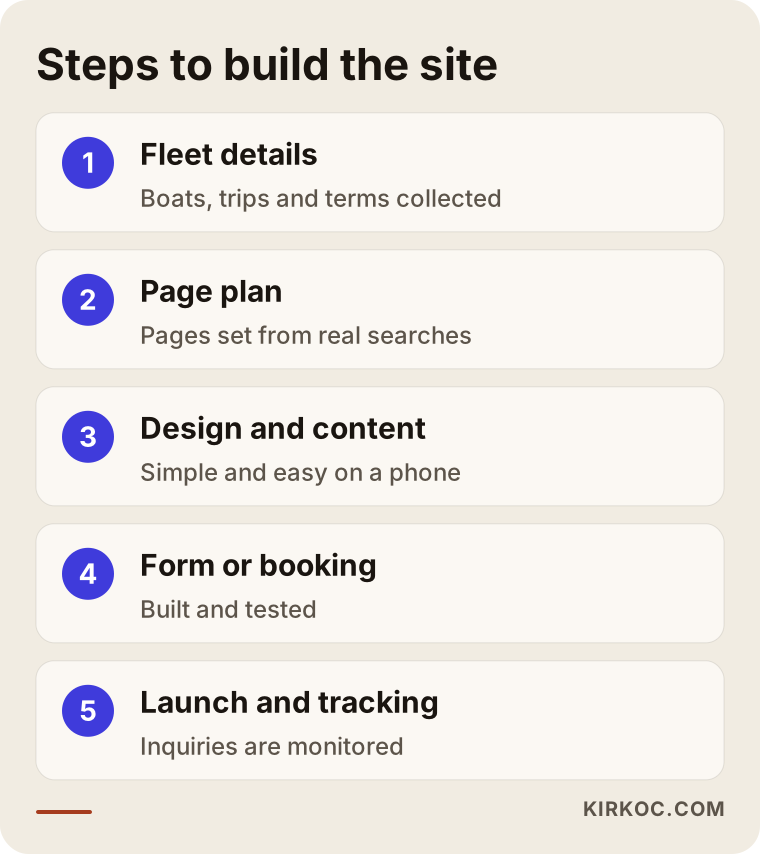
Let me explain what I ask from you and what I do at each step.
1. Collecting fleet and service details
At the start, the specifications of your boats, their capacities, photos, departure points, the trips you offer and your terms are gathered in one place. Most owners carry this information in their heads and have never written it down. This stage takes patience, and it is the stage that does the most to decide the quality of the site.
2. Page plan and search research
I work out which words customers use to search and which pages should exist. I make a list by region, boat type and event type. At this stage we also talk honestly about which searches you can realistically appear for.
3. Design and content
The design should be clean, fast and comfortable on a phone, because most people look at a charter site on their phone, on the beach, in a hotel or on the road. Photos should be compressed without giving up quality. The text should be plain, easy to read and free of sales talk.
4. The booking or quote flow
Based on the decision described above, the form or booking module is set up and tested. During testing, I fill in the form from my own phone and check how the message reaches you.
5. Launch and tracking
The site goes live, the settings search engines need are completed, the Google Business Profile is connected, and the number of visitors and forms starts to be tracked. Without tracking, you cannot know which page is doing the job.
What a boat page must contain
A single boat page is often the most important part of the site. Let us think about it as a checklist.
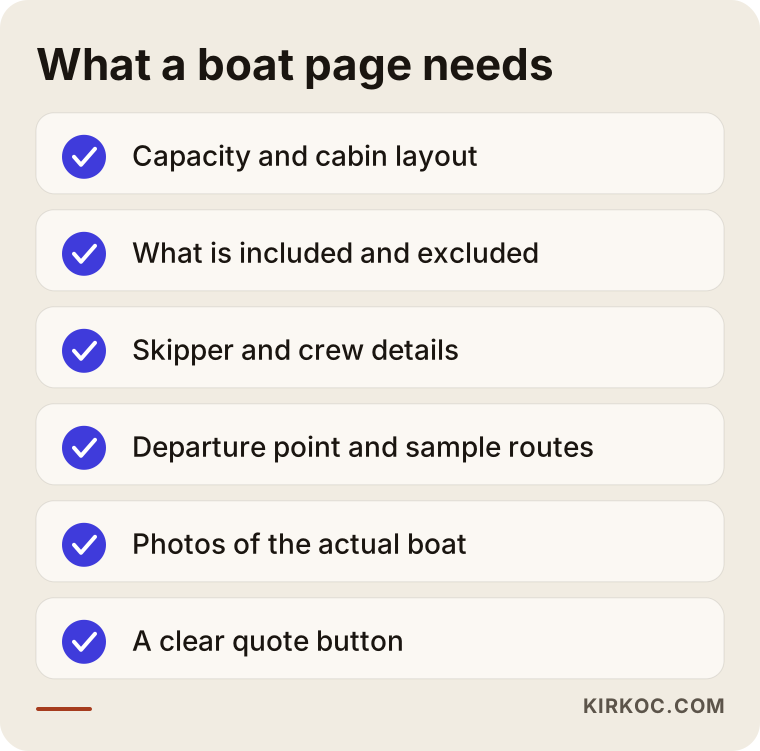
Every item on the list answers a question. Capacity and cabin layout answer "will it fit us?" What is included answers "will there be extra costs?" Skipper information answers "are we safe?" The departure point answers "how do I get there?" If you leave one question unanswered, it will be asked by phone, or the customer will leave without asking.
Photos and video
In the boat business, visuals weigh far more than text. But many photos are not enough; you need the right ones. Show the outside of the boat, the deck, the cabins, the bathroom, the galley, the seating and a view from the water. If possible, add a short video. Large files can slow the site down, so image sizes need to be set properly. A slow site, especially on a phone, loses visitors.
Language and translation
In tourist areas, international customers can be a big share of your business. If the site needs to be in English, German or another language, plan for that from the start. A page left with machine translation weakens trust. Each language version should be prepared around how people who speak that language search.
Common mistakes
I see the same mistakes repeatedly in this sector. The illustration below summarizes the most common ones.
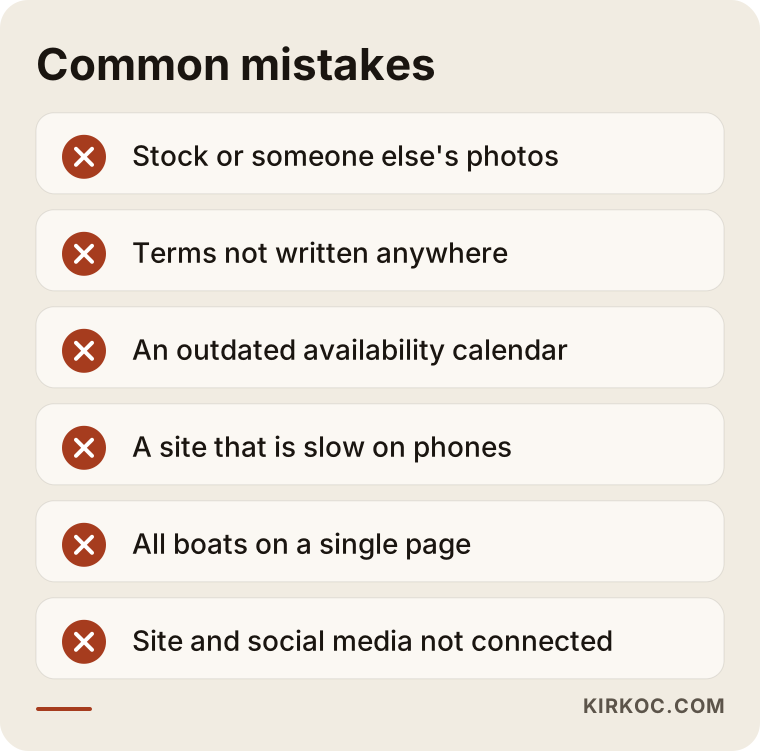
Putting everything on one page
Squeezing all boats, regions and trips onto one page tires the customer and gives the search engine no clear message. A focused page for each topic works better.
Fake or low-quality photos
Using photos of other boats, or stock images, is unethical, and it disappoints the customer when they see the real boat. A clean, bright and honest photo of your own boat always does the job better.
Unclear terms
Sometimes "ask for the price" is necessary. But not writing down what is included, what is excluded, when cancellation is possible and what happens in bad weather makes customers hesitate. Even if you do not publish the price, publish the terms.
Forgetting mobile
Customers browse mostly on their phones. Tiny buttons, tables that spill off the screen or forms that are hard to fill in cost you inquiries. Try your site from your own phone as if you were a stranger.
Leaving social media disconnected from the site
Sharing great photos on Instagram without a link to the site in your profile, or not showing your social accounts on the site, stops the two channels from feeding each other. This is where having everything handled by one person pays off: the same photo, the same message and the same tone move across the site and Instagram together.
Not measuring
Spending on ads or content without knowing how many people reach the form, or which page they came from, is a shot in the dark. Even a simple tracking setup shows which page is working.
What do you need beyond the website?
A website does not work miracles on its own. In boat charter, the site sits in the middle of several pieces.
Google Business Profile
When people search "boat trips near me" or "Bodrum boat charter," appearing in map results matters. A complete business profile, added photos and collected customer reviews support your visibility in local searches. Asking for a review can be as simple as sending a short message to a happy guest at the end of the season.
Social media
A boat is a highly visual product. Short videos on Instagram and TikTok, sunset shots and small moments with the crew are good ways to show the experience. But social media usually inspires; for the final decision people look at the website. That is why the two need to be linked.
Advertising
During the busy season, paid ads can work for specific regions and dates. But advertising sends traffic to a weak site and wastes it. Site first, then ads, is usually the healthier order. When I run the ads as well, I can tune the site and the ads to each other, for example by sending an ad straight to the relevant boat or region page.
AI chat tools
More and more people ask tools like ChatGPT something like "recommend a day boat trip for a family in Fethiye." These tools may draw on pages that contain clear, well-organized and trustworthy information. A site that has clear details and answers frequently asked questions has an advantage here too. There is no guarantee, but keeping your writing plain and full of facts helps in either case.
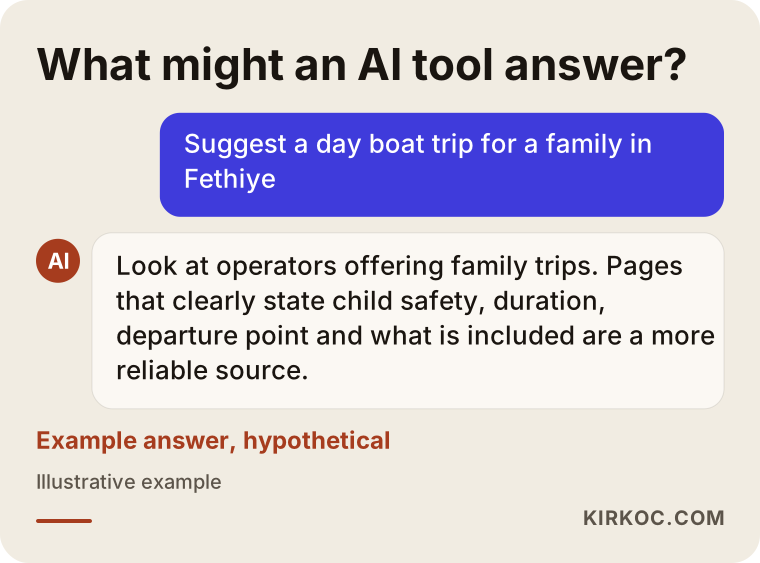
The answer in the illustration is an invented example. The point is that the details it relies on must be clearly written on your site.
What can you do yourself, and when do you need a specialist?
There are things you can do on your own before making any investment.
Put all your boat details, photos and likely questions into one document. Look at your competitors' sites through a customer's eyes: which information is hard to find, and which is easy? Fill in your Google Business Profile completely. Ask happy customers for reviews. You can do all of this without a specialist.
Specialist help makes sense when you want the page structure and search words set up properly, when you will connect a booking or quote flow to your site, when you need a multilingual setup, when you want the site fast and comfortable on phones, or when you want the site, social media and ads managed as a whole. Giving these to separate people often creates mismatch: one builds the site, another runs ads, a third looks after Instagram, and nobody sees the whole picture. When one person handles it, the message, the visuals and the goal fit together.
What determines the cost?
I do not give numbers here, because every business needs something different. But I can tell you what makes the cost go up or down.
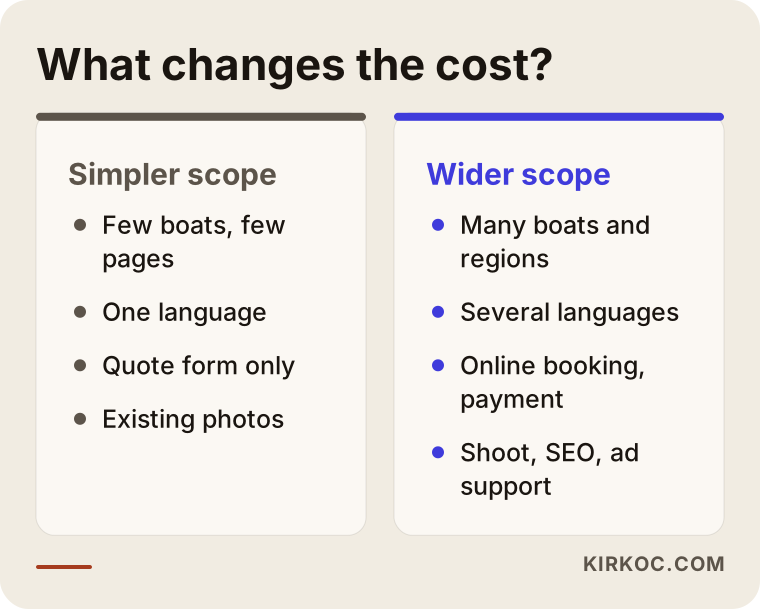
The cost is mainly shaped by the number of boats and pages per boat, the number of region and event pages, the number of languages, whether you want online booking and payment or just a quote form, whether photo and video shooting is needed, who will write the texts, and whether you want SEO, social media and ad support afterward. There are also yearly costs such as the domain name, hosting and the payment system. If a booking module or payment service is used, it may carry its own fees.
When you collect quotes, ask: what is included in this price and what is not? How are updates handled after the site is live? Who manages the site, and will I be able to change things myself? These questions protect you from offers that look cheap but bring extra costs later.
How I work with you
The process starts with a conversation. I listen to how you describe your boats, your region, your type of customer and how you take bookings. Then I tell you plainly what you need, what you do not, and in what order. If you do not need an online booking system, I will not try to sell you one; where a quote form is enough, I will recommend it.
The work I do runs from one place: website, SEO, local SEO, social media management, Google and Meta ads, content creation and, if needed, a logo and brand identity. So when your boat is photographed, the same photo is used on the site, on Instagram and in the ads, the message stays consistent, and when something goes wrong you have just one person to talk to. I explain what I am doing in plain language and do not tire you with jargon.
The process usually goes like this.
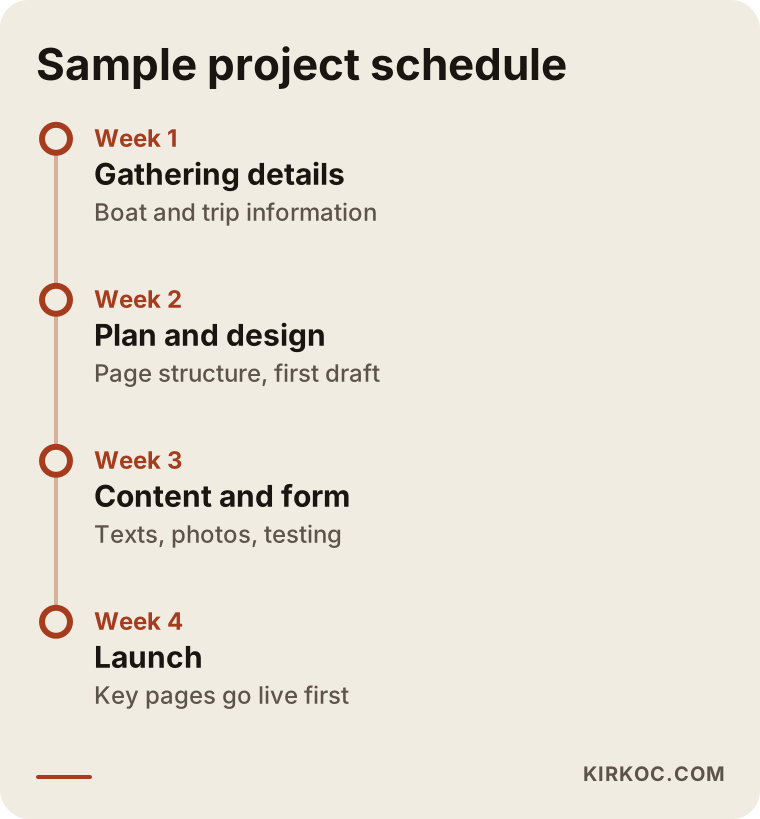
The timing depends on the number of pages, how ready your materials are and how fast you approve things. If the season is close, it is possible to launch the priority pages first (the boat pages and the main region page) and add the rest later.
Frequently Asked Questions
Do I really need a website for boat charter, or are listing sites enough?
Listing sites give quick visibility, but the customer builds a relationship with the platform rather than with you, and the competition sits right next to you. Your own site keeps your brand, your terms and your contact details under your control. Using both together is usually the healthiest approach.
Should my site have online booking?
It can, if your price and availability are standard. If your price varies a lot with the date, the guests and extras, a quote form is the better fit. You can also use both. When deciding, count the work of keeping the calendar up to date.
Should I have the site in other languages for international guests?
Yes, if international guests matter in your region. But have the translation done with care, because machine translation damages trust. For each language, pages need to be prepared around how people who speak that language search.
Will bookings come as soon as the site is live?
Nobody can guarantee that. A new site becomes visible in search engines over time, and the season, the region and competition also affect the result. Running it together with social media, a Google Business Profile and, if needed, ads can speed things up, but I cannot give an exact time.
Is a professional photo shoot necessary for the boat?
It is not necessary, but it is very helpful. Clean, honest photos taken in good light can give good results even with a phone. If you have a budget, a professional shoot is an investment you can use for a long time across the site, social media and ads.
Can I update the site myself?
Yes, you just need to ask for it at the start. I can build the site so that the parts that change often, such as prices, availability notes, photos and announcements, can be updated by you. You can also get support for technical work.
How should I write cancellation and refund terms on the site?
Write them plainly, clearly and where they can be seen before payment. For the legal accuracy of the content, I suggest asking a lawyer. I arrange where and how the text appears on the site.
What do I do with the site in the off-season?
The off-season is the best time to produce content: route guides, tips, new pages and refreshed photos. That way, when the season opens, the site is ready, full of content and more visible.
If you would like to talk about where to start with your boat or yacht charter business, you can reach me through my website design services page. I will listen to how your boats are set up and how your customers search, and tell you what you actually need.