You run a logistics, customs brokerage, warehousing or farming business in Mersin, or you want to work with one from abroad. Most of your phone calls come from acquaintances, old customers and middlemen, but you would like new, direct customers to find you on Google as well. You have a website, maybe built a couple of years ago, yet someone typing "customs broker Mersin" or "Mersin citrus exporter" does not see you. That is the moment people start searching for "SEO services Mersin". In this article I explain how buyers of port, logistics and agricultural services search on Google, which pages a site needs, and how an SEO project should run, without drowning you in technical talk. I am Ümit Kırkoç, I work from Istanbul, and I will be clear about what my own SEO services cover and where they stop.
SEO, in plain words, is the work that makes your website show up when your potential customers search on Google. Once you stop paying for ads, you disappear. With SEO, a well-built setup can keep bringing inquiries for months. But that setup has to be built around Mersin specifically: a city of ports, a farming plain and heavy industry. The generic "add the city name and you are done" approach does not work here.
If you are a foreign company, there is a second layer. You may be sourcing citrus from Turkey, shipping cargo through Mersin, or looking for a local partner. Then you are the buyer who types English into Google, and the Mersin firms that win your attention are those whose sites speak to you. I write for both readers: the Mersin business owner and the foreign buyer trying to understand how local firms get found.
Why SEO in Mersin is different from other cities
Mersin is a city whose trade faces the sea and the borders. The port, the free zone, the organized industrial areas, a large agricultural basin and the logistics network that ties them together mean that most local businesses have customers who are not local at all. A hairdresser's customer lives down the street. A customs broker, a cold storage operator or an exporting grower may have customers in Ankara, in Konya, or in another country entirely.
That changes SEO in two ways. First, the search often contains the word "Mersin", but the person typing it does not live there. An importer in Germany types "Mersin port container shipping" because he knows his cargo will leave from there. Second, the language of the trade is its own. Words like bonded warehouse, customs clearance, ro-ro, reefer, greenhouse and wholesale market are the customer's own vocabulary, and they need to appear on your site. If you describe yourself as "integrated logistics solutions" while the customer types "bonded warehouse rental Mersin", the two of you never meet.
The illustration below uses a made-up example to show the difference. The page that answers the exact words the searcher typed beats a vague "your solution partner" page.
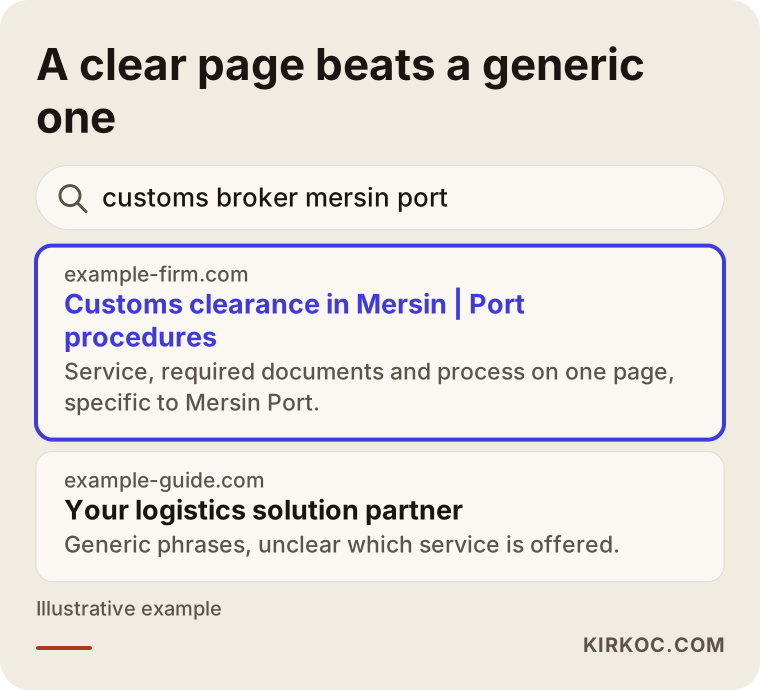
What the highlighted result does is simple: it states the service, the city and who it is for in the first line. Google tries to show the searcher the most suitable answer, and if you make that answer easy to find, your chances improve. I cannot promise a position, because neither I nor anyone else controls rankings.
What does your customer type into Google?
Every industry searches differently. In Mersin's three main lines of business, searches fall into four groups.
The first group names the service directly: "customs clearance Mersin", "container transport Mersin", "cold storage Mersin". These people are often close to buying and are comparing a few firms. The second group describes a problem: "how to pack lemons for export", "what happens to cargo held at customs". They have not picked a firm yet, and they start to trust the site that answers their question well. The third group searches by district and location: "Tarsus warehouse", "Erdemli greenhouse equipment", "Silifke citrus buying". Mersin is not one point on the map. Tarsus, Erdemli, Silifke, Anamur, Mezitli, Yenisehir and Toroslar each have their own trade circle. The fourth group is foreign buyers, who type queries such as "citrus supplier Turkey" or "Mersin port forwarder" in English, Arabic or Russian. For this group, a Turkish-only site closes the door before it opens.
Each of these four groups wants a different page. A single homepage cannot serve all of them. The table below summarizes the split.
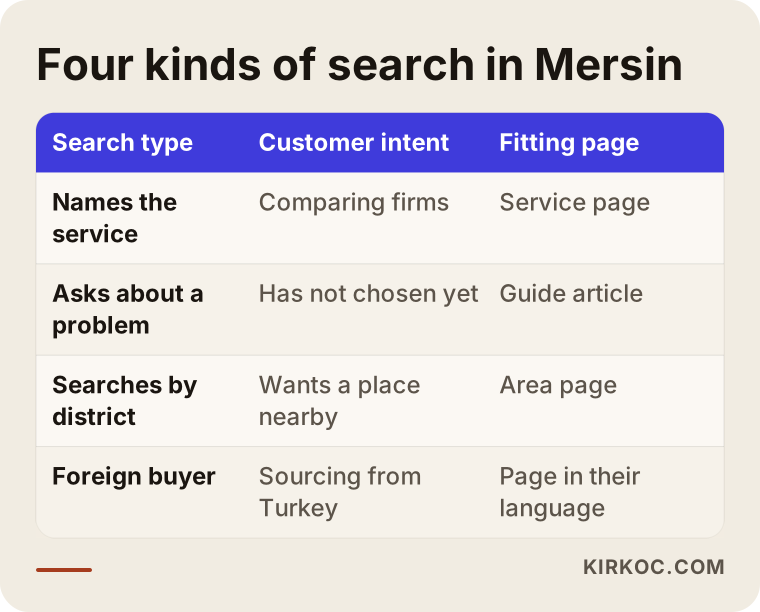
Apply the table to your own business: which row describes your customer? Most firms benefit from the first two rows, and if you are targeting foreign buyers, the fourth one joins the work. The point is to see that each kind of search needs its own answer.
Who is the buyer in port and logistics?
The buyer of a logistics service is usually a company, and the person deciding is often an import-export manager or an accounting lead. This person does not decide because of an ad, but because of trust. If your site has no licenses and authorizations, no list of routes and cargo types you handle, no named contact and no answers to common questions, then even a top position will not make the reader pick up the phone.
Who is the buyer in agriculture?
On the farming and food side there are two separate buyers: wholesalers, market commission agents, supermarket chains and restaurant groups inside Turkey, and importers abroad. Their questions differ. Inside the country, the focus is usually variety, season, packaging and delivery. Abroad, the topics are certificates, product standards, container loading capacity and payment terms. Instead of stuffing everything into one page, a separate page for each buyer type gives a sturdier result.
Which pages do port, logistics and farm businesses need?
Many corporate sites look the same: Home, About, Our Services, Contact. Four pages, one list of services and a contact form. That structure does not inform a visitor; it only says that the company exists. For SEO, a firm that lists ten different services on a single "Services" page cannot be strong in any of them.
A sturdier structure gives each main service its own page. For a logistics firm that means separate pages for customs clearance, container transport, bonded warehousing and project cargo. Each page explains who the service suits, how it runs, which documents are needed and what people commonly ask. A farm business needs product-based pages instead: lemons, oranges, vegetables, greenhouse produce. Each product page carries the season, packaging options, shipping method and contact details. On top of that, a separate export page can serve as the English version aimed at foreign buyers.
The next illustration shows how an example service page can be divided into sections.
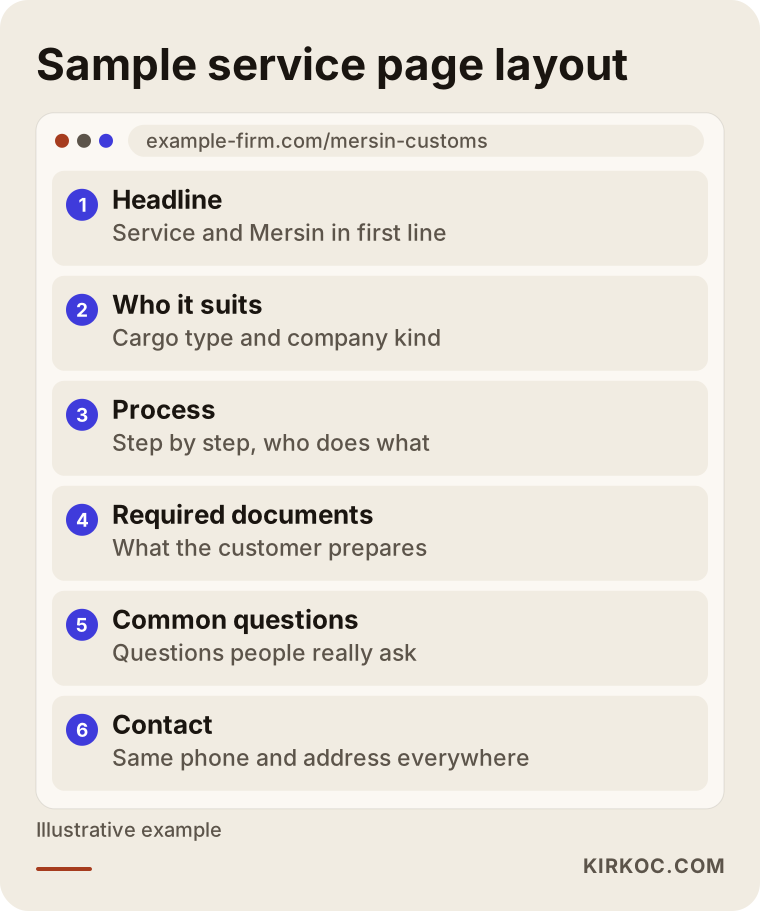
This layout works in two directions. Google understands the topic of the page clearly. The visitor scrolls down, finds the answer and contacts you without confusion. A good service page is a sales conversation written down: it answers the questions the customer would ask before they have to ask them.
Two hypothetical examples
The two scenarios below are entirely hypothetical. They do not describe a real company, but they reflect situations that businesses like these commonly face.
Example scenario 1: A customs and freight firm
Imagine a hypothetical customs brokerage and freight company in an office near the port in Mersin. Its website was built seven years ago and has a single "Services" page where customs, transport, storage and consulting sit in one paragraph. The firm wins new customers almost only by phone and word of mouth. Every time the owner types "customs broker Mersin", he notices he cannot find his own site.
The first job in this case is to decide which service matters most to the firm. Suppose the real income comes from customs clearance and container transport. Then those two services get separate pages. Each page covers the product groups handled, the documents requested, who does what in the process and typical questions. The Google Business Profile is also corrected, because for searches like "customs broker near the port" the map box is decisive. The firm should not expect miracles in the short term; but after a few months it may see visibility rising in relevant searches and the quality of incoming inquiries changing. Even so, that is an expectation, not a promise.
Example scenario 2: A citrus grower that exports
The second hypothetical example is a small grower in one of Mersin's rural districts who produces citrus and wants to sell both in Turkey and abroad. The website is almost nonexistent: three photos and a phone number. Most buyers arrive through a market commission agent, and the grower feels they are losing bargaining power on price.
The goal here is not to cut out the middleman completely. It is to build a storefront that lets the grower talk directly to a buyer as well. That means product pages, a season calendar, packaging and shipping information, an English page for foreign buyers and a clear way to make contact. Product photos need to be taken too, because in farming the look of the product is half of the trust. In this setup SEO is not a storefront on its own. When it runs together with harvest photos on social media, a Google profile and, if needed, a small ad campaign, the chance of reaching a buyer grows. It also shows why having these jobs handled by one person makes a difference: the site, the SEO, the social posts and the ads all tell the same story.
How does an SEO process for Mersin run, step by step?
An SEO project looks complicated but is really five steps in order. Each builds on the previous one, and if you skip the order the effort is wasted.
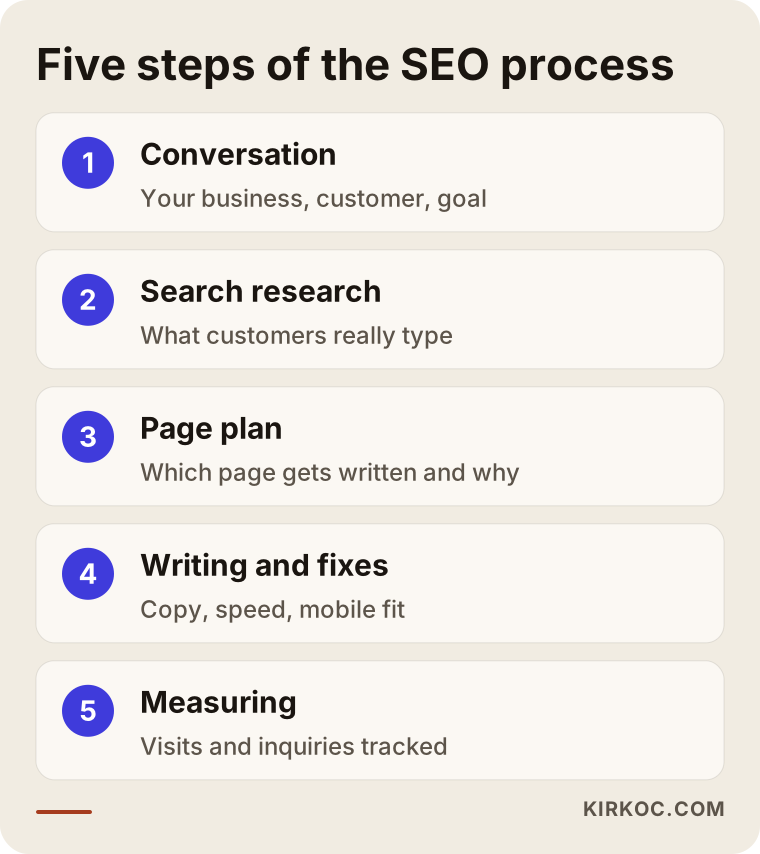
The first step is a conversation. You and I talk through which service earns you the most, who your customers are, which area you serve and who your competitors are. Without this conversation, everything that follows is guesswork. The second step is search research: I look at what your customers really type, which words help your business and which are a waste of time. The third step is the page plan, meaning which page will be written for which service and product, which pages should be merged and which should be deleted.
The fourth step is writing and fixing. Pages are written in language the customer understands, titles and descriptions are set up, and the site's speed, its look on a phone and basic technical problems are repaired. The fifth step is measuring: how many people came, which page they came through, how many calls or forms resulted. The plan is updated according to these results. SEO is not something you do once and forget; but the groundwork laid in the first months forms the base for the following years.
What to check on the technical side
The technical problems I see most often in firms like these are: sites that open slowly on a phone because the photos are huge; language versions with missing language markers, so Google shows the wrong one; an address and phone number written differently on every page; and a contact form that does not work or lands in spam. They look small, but they directly affect the result. For firms near the port, consistency of map and address matters especially, since a truck driver or a customer trusts the map to find you.
Local search and map visibility
"Local SEO" means appearing on Google Maps and in "near me" searches. It is not always needed for logistics and farm businesses, but it is very valuable if you have a warehouse, an office, a market stall, a factory shop or any place that people physically visit. A cold storage facility or a freight office with the right category, the right opening hours and real photos on the map is easy for searchers to reach.
What you need to know is that map results run on a system separate from your website. You need to fill in your Google Business Profile correctly, keep the address consistent with the site and reply to customer reviews. On reviews, writing or buying fake ones carries a real risk; if the platform notices, it can harm your profile.
Common mistakes
The mistakes Mersin firms make in SEO are quite predictable. Knowing them in advance saves money and time.
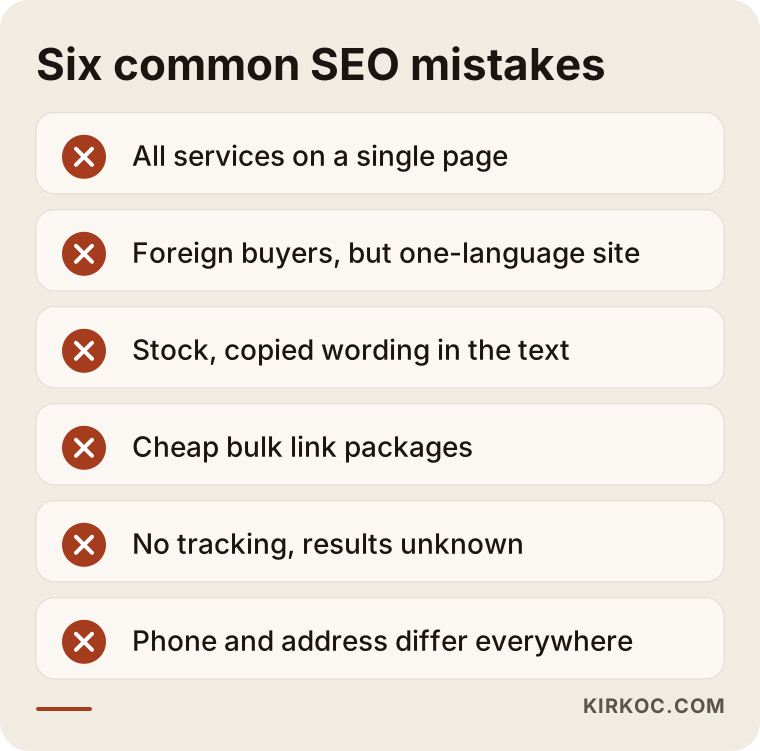
The most common one is piling every service onto one page. The second is aiming at foreign buyers with a site that is only in Turkish. The third is copy-pasted text: many logistics sites use the same stock sentences, and Google struggles to tell them apart. The fourth is the cheap bulk link package sold as "affordable SEO"; links from poor sources may look like movement in the short run and can do harm in the long run. The fifth is not measuring: if you do not know how many searches arrive and how many inquiries result, you cannot tell whether SEO is working. The sixth is writing the phone number and address differently in different places.
None of these needs deep technical knowledge. They are matters of order and attention, and most can be fixed easily.
What can you do yourself, and when do you need a specialist?
You do not have to hand everything to an expert. As a business owner there are a few things you can do, and they make a real difference.
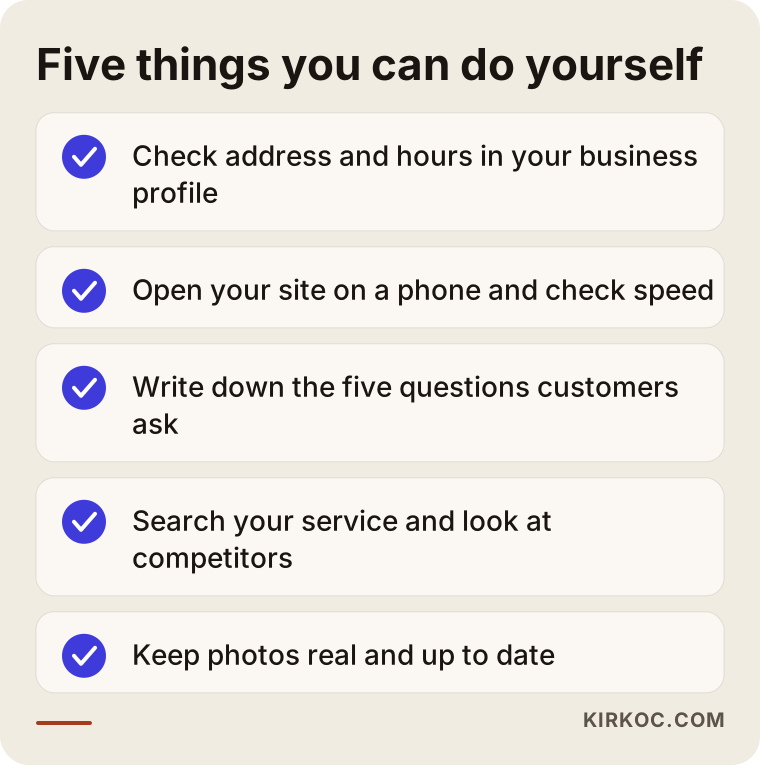
Check your Google Business Profile: are the address, phone number, hours and category right? Open your site on your phone; if it is slow or the text is tiny, make a note. Write on a piece of paper the five questions customers ask you most; they are the skeleton of a page. Search for your own name and service on Google and see what comes up and what your competitors write. Keep your product and office photos real and current.
When do you need a specialist? When your site has had no visitors for months, when you do not know which pages should be written, when you need more than one language version, when there is a technical problem, or when you simply have no time for this. The decision chart below summarizes the split.
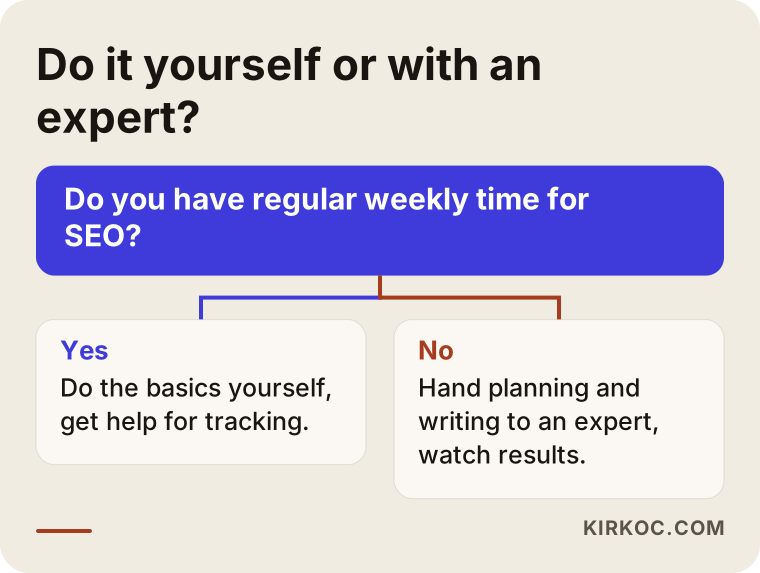
The logic of the chart is this: if you have the time and interest, you can do the basics yourself; but in areas like tracking, technical fixes and content planning, guidance from a specialist often saves time. When deciding, ask yourself whether the hours you spend on this are being taken from your actual work.
When can you expect results from SEO in Mersin?
I cannot give an exact date, and you should be careful with anyone who does. Results depend on the current state of the site, the competition in the sector, the targeted words and the quality of the pages. The general pattern is this: in the first weeks the basic cleanup is done, within a few months Google starts to recognize the new pages, and in the following months visibility and incoming inquiries may begin to change. For some firms this happens faster, for others slower.
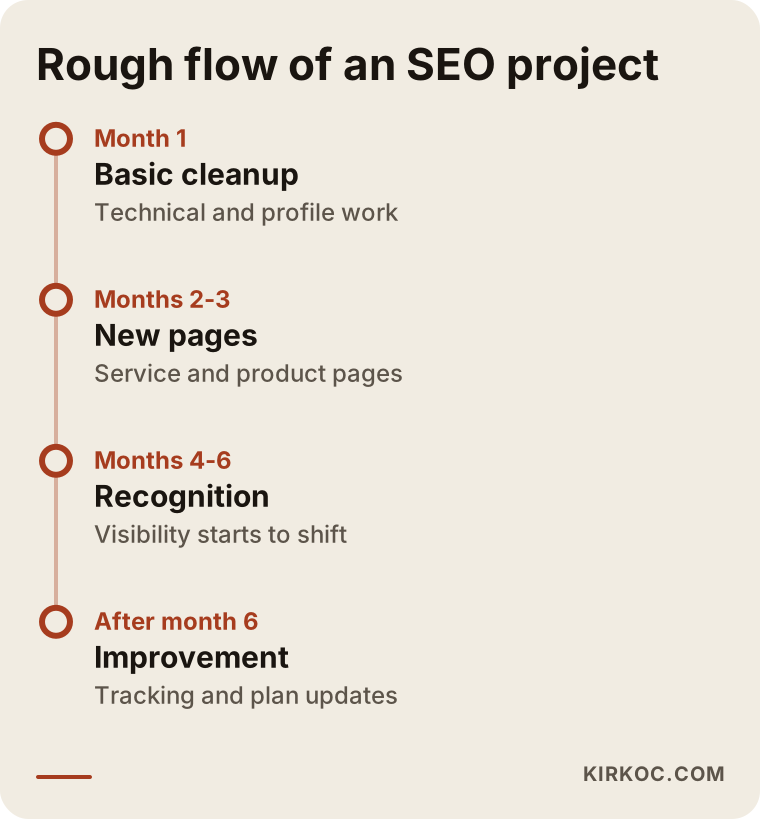
The months on the timeline are not exact; they show an approximate flow. For seasonal businesses, such as citrus with its harvest season, it makes more sense to start before the season, because Google needs time to recognize pages and they should be ready when the season arrives.
What determines the cost
I will not give a number, because no two firms need the same thing. But I can say clearly what drives the cost: the current state of the site, how many service and product pages must be written, how many languages are involved, how crowded the competition is, how much technical cleanup is needed, work on the map profile and whether the work continues month after month. A one-time cleanup and an ongoing monthly project are different loads. A multilingual site naturally takes more effort than a single-language one.
When you collect quotes, check these: do they write down exactly what they will do, do they say which pages will be written, do they state how and how often they will report? A quote that promises "first place guaranteed" or "certain results" should not inspire trust.
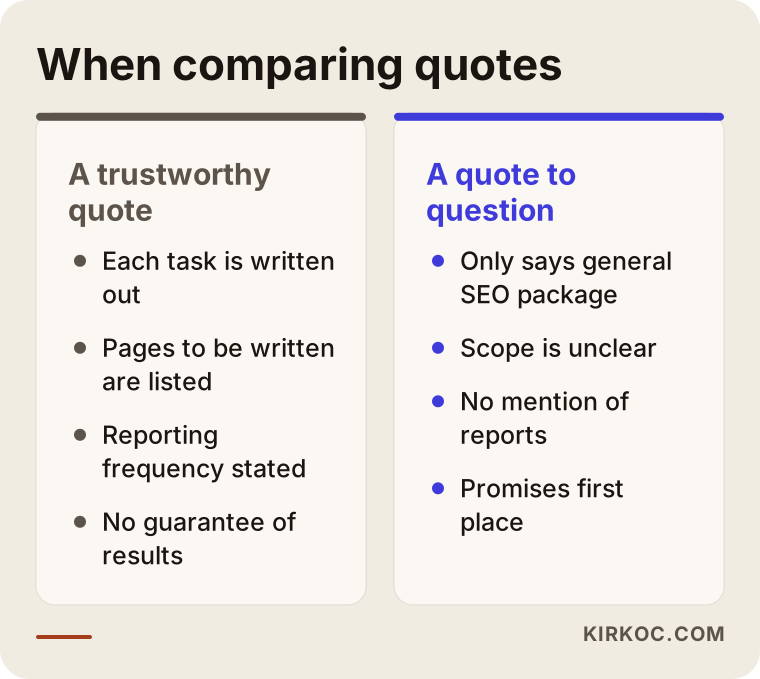
When you compare, look at the scope, not only at the price. The difference between two quotes usually lies in what is included, not in the price itself.
How I work
I work from Istanbul, and working remotely with businesses in Mersin is entirely possible: the process runs through phone calls, video meetings and shared files. I provide all the services a digital agency would, as one person: websites and e-commerce, SEO, local SEO, GEO (being named by AI assistants such as ChatGPT), social media management, Google and Meta ad management, logo and corporate identity, and content production. What this means for you is that the person who builds your site, runs your SEO, manages your social media and sets up your ads is the same person, so nobody can say "that problem belongs to the other party". Messages, visuals and pages stay consistent, and you never have to explain your business twice.
The process goes like this: first there is a free introductory conversation, and I listen to your business and your goal. Then I write down plainly what you need and what you do not. If you decide to go ahead, I start, and I show you regularly what has been done. In sectors such as logistics, port services and agriculture, multilingual content is often necessary, and I can run that under the same roof.
How to build a product and service tree for Mersin SEO
The most critical decision in the project is which pages open and in what order. Instead of trying to do everything at once, I follow a funnel logic: first the broad searches with a clear intent, then the narrower ones closer to a sale.
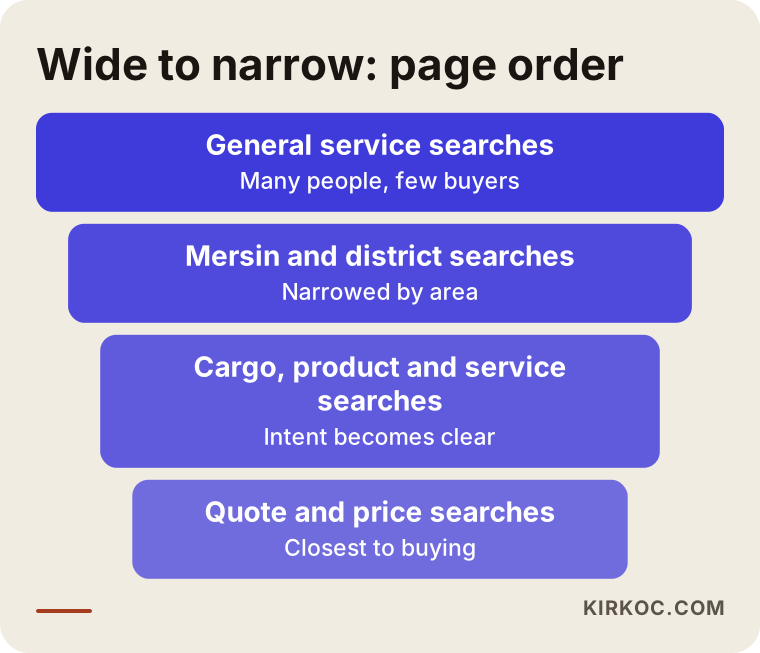
Broad searches at the top of the funnel reach many people, but few of them buy; narrow searches at the bottom bring fewer people, but those people are close to deciding. For a small or mid-sized firm in Mersin, starting from the bottom is usually more efficient: first build pages for very clear searches that are close to a purchase, then widen upward as those pages gain strength.
Frequently asked questions
Do I need a website before I can get SEO services in Mersin?
No, but you will need one. If you have no site or a very old one, a solid site must come first, because SEO needs a ground to work on. If your current site is usable, building on it is more economical.
Is the work only for customers inside Mersin?
No. In sectors like logistics and farming, the customer is often in another city or another country. The work is planned around where your customer actually searches. For some firms that is Mersin and the surrounding area, for others all of Turkey, for others abroad.
Do I need pages in other languages?
If you target foreign buyers, yes. A Turkish-only site will not be found by a foreign buyer on Google, or if it is, it will not be trusted. Which language you need depends on the countries you work with, and I help you decide that in the first conversation.
Is SEO or Google advertising better?
They do different jobs. Advertising is fast but stops when you stop paying. SEO is slow to build but can last. For many firms, ads in the early period and SEO in the long run, used together, give the most balanced result. Which one suits you should be decided after listening to your business.
Can I copy a competitor's website?
I would not recommend it. Copied content earns no value on Google and can cause copyright trouble. Also, your competitor's site was written for their customer, not yours. Content specific to your own business is both more credible and longer lasting.
When will I see results?
I cannot give an exact time. Usually the basics are set up in the first months and the pages begin to be recognized in the following months. The time varies with competition, the state of the site and the sector. For seasonal businesses, starting before the season is a clear advantage.
Can social media and advertising run together with SEO?
Yes, and they are more consistent when they do. If the message on your site, your social posts and your ads are on the same line, trust grows. Because I run all of it myself, I do not need to coordinate that consistency separately.
What should I prepare before you start?
Prepare your list of services and products, any documents and certificates you hold, your photos, your target customer type and a few firms you see as competitors. I help fill the gaps; it does not have to be perfect.
If you work in port, logistics or agriculture in Mersin and want your customers to find you on Google, reach me through my SEO services page. I will listen to your business and tell you plainly what you need and what you do not.