If you run an OSGB, or you are a safety professional in Turkey who has started your own firm, chances are most of your clients come from word of mouth, from a friend of a friend, or from taking over accounts when a competitor drops its price. You know you need a website, and maybe you already have one. But the phone does not ring, and when it does, the caller mostly asks one thing: how much. If you are a foreign company with operations in Turkey, or you want to sell safety services to foreign-owned factories and sites there, the same problem applies, with the extra layer that your buyers may search in two languages. This article explains why a website for an OSGB should be built differently from an ordinary company brochure, how employers actually look for a provider, and which pages do real work. I am Ümit Kırkoç, a one-person digital specialist in Istanbul who handles website design from start to finish myself, and I will write this the way I would explain it to a business owner who has never touched this world.
First, what an OSGB is, because the term is Turkish. OSGB stands for Ortak Sağlık ve Güvenlik Birimi, which translates roughly to Joint Health and Safety Unit. It is a licensed company that supplies workplaces with an occupational safety specialist, a workplace physician and other health staff on an outsourced basis. Turkish law places duties on employers in this area, and most employers meet them by hiring an outside unit rather than building their own. Think of it as a mix between an external safety consultancy and an occupational health clinic. I am not a lawyer and rules change, so for any question about what an employer must have, ask the competent authority or a legal adviser.
The key point for your website is the buyer's mindset. The person on the other side is not excitedly browsing for a safety provider. They are meeting an obligation. They want someone trustworthy, reasonably priced and unlikely to cause trouble later. If your site does not speak to that mindset, it will not bring in work, however good it looks.
How does an OSGB client search for you?
A factory owner, a construction site manager, an accounting office owner and the manager of a newly opened restaurant do not all start from the same place. Some are looking because their contract is about to end. Some were warned after an inspection. Some just started a job and were handed the task. Search habits fall roughly into these groups:
- People who search the service by name: "OSGB service", "occupational safety specialist service", "workplace physician service".
- People who add a place: "OSGB Umraniye", "safety firm Gebze". These buyers want someone close who can visit.
- People who search a specific need: "risk assessment", "emergency plan", "safety training for staff", "employee health check".
- People who search by industry: "safety specialist for construction", "textile workshop OSGB", "restaurant safety".
- People who want to switch: "change my OSGB", "end OSGB contract", "OSGB price quote".
This list shows something important. One "Home" page and one "Our Services" page cannot answer all of these searches. Each intent needs its own clear page. The illustration below uses an invented example to show how a search result might look and why the page that states the topic plainly stands out.
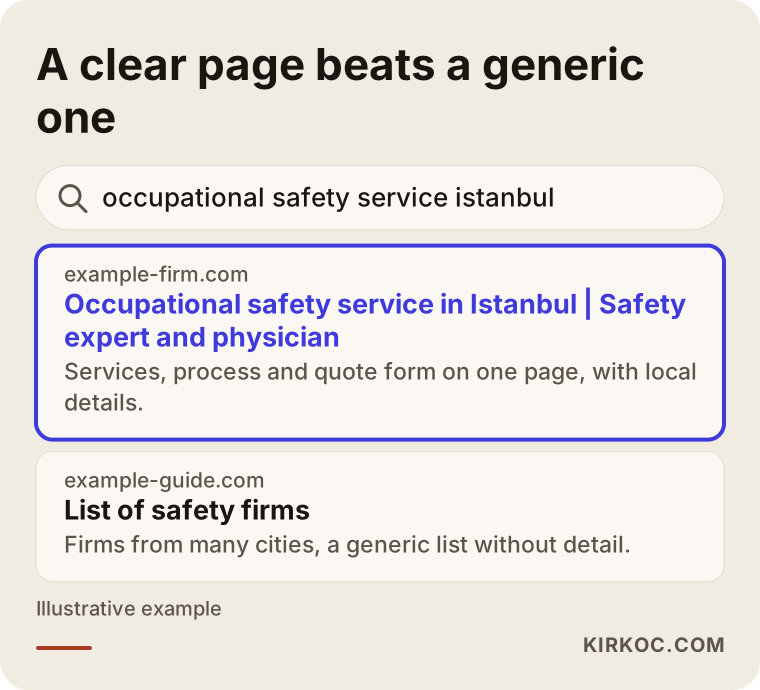
The highlighted result says the place, the service and the audience in the first line. The generic list below it says "we do everything" and fits no single intent. Google and the person searching both want to see the answer to their question as soon as they look at the first result.
If you are a foreign company, note that many Turkish employers search in Turkish, and the terms above are the ones that matter for local demand. If your goal is to serve international clients in Turkey, an English page that explains your services next to the Turkish version is useful, as long as both say the same thing and neither is a rough machine translation.
Why do employers find it hard to decide?
To an employer, OSGB services look nearly identical. Every provider sends a specialist, prepares documents and says it follows the rules. So the choice usually comes down to price and trust. Your job is to make your difference visible quickly: who you work with, which hazard classes of workplace you serve, how a visit works, and who someone can reach when a problem comes up. A site that skips these tells the employer "this is just like the others."
The table below shows which kind of search should land on which kind of page.
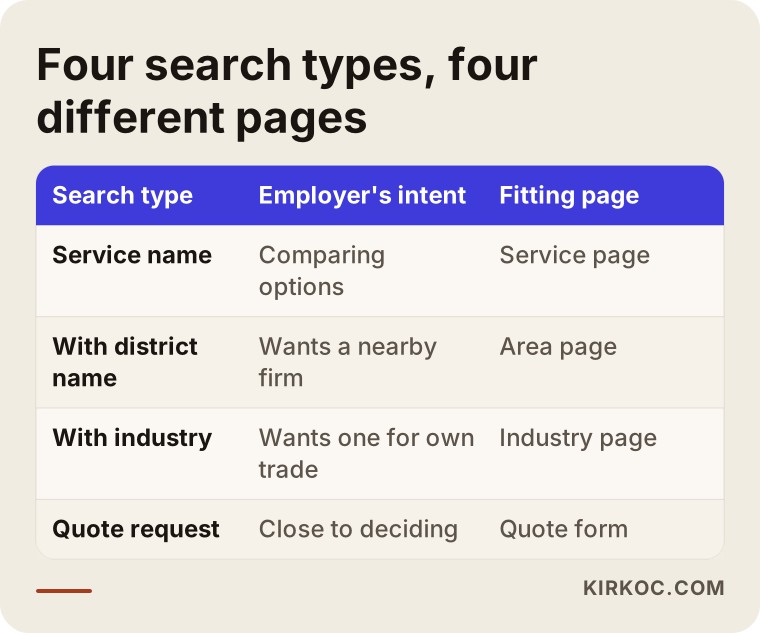
Read it with this in mind: someone who types "price quote" and someone who types "what is a risk assessment" should not land on the same page. The first wants the contact form. The second wants information. If you cram both onto one page, neither is satisfied.
Which pages should an OSGB site have?
The skeleton should be simple, but the content inside should be full. This is the structure I recommend.
Home page
The home page must tell a visitor in the first five seconds, "I am in the right place." State in one sentence which area you serve and what kinds of workplaces you work with. Right below it, give the two paths a searcher needs most: "Request a quote" and "See services". Instead of slogans, stock photos and general promises, use concrete facts: your license information, the cities and districts you serve, and how you work.
Service pages
Open a separate page for each main service: safety specialist service, workplace physician service, risk assessment, emergency plan, staff training, health screenings. Each page should answer: what is this service, who needs it, how does it work, what does the employer have to do when working with you, and how long does the process take. When you mention regulations, avoid firm legal statements, because rules can change and every workplace is different. A line such as "check current obligations with the competent authority or a legal adviser" is honest and builds trust.
Industry pages
Construction, manufacturing, textiles, food, logistics, offices, healthcare facilities and schools each have their own hazards and their own vocabulary. A page for construction that talks about scaffolding, working at height and excavation should look very different from an office page covering ergonomics, fire evacuation and first aid. These pages help in search and also give the visitor the feeling that you understand their world.
Area pages
If you serve several districts or cities, you can add a page for each. But be careful: changing only the place name in the same text does not work. Every area page needs something specific to that place, such as which industrial zones or neighborhoods you serve, how visits are scheduled and a note on getting there.
Credentials and about page
Trust in this field starts with paperwork. Show your license, the titles of your team (which certificates they hold), your working principles and your contact details clearly. Use real photos, not stock images. If there are verifiable details such as a license number and you are allowed to share them, put them where people can see them. If you are not sure what you may publish, ask your competent authority.
Blog and FAQ
Employers keep asking the same things: "At how many employees do I need a specialist?", "How do I switch providers?", "What is checked in an inspection?" Plain answers on your site help the person looking for information and show you know the subject. For exact numbers and legal deadlines, always tell readers to check the current rules.
The next illustration shows this structure on an invented domain at a glance.
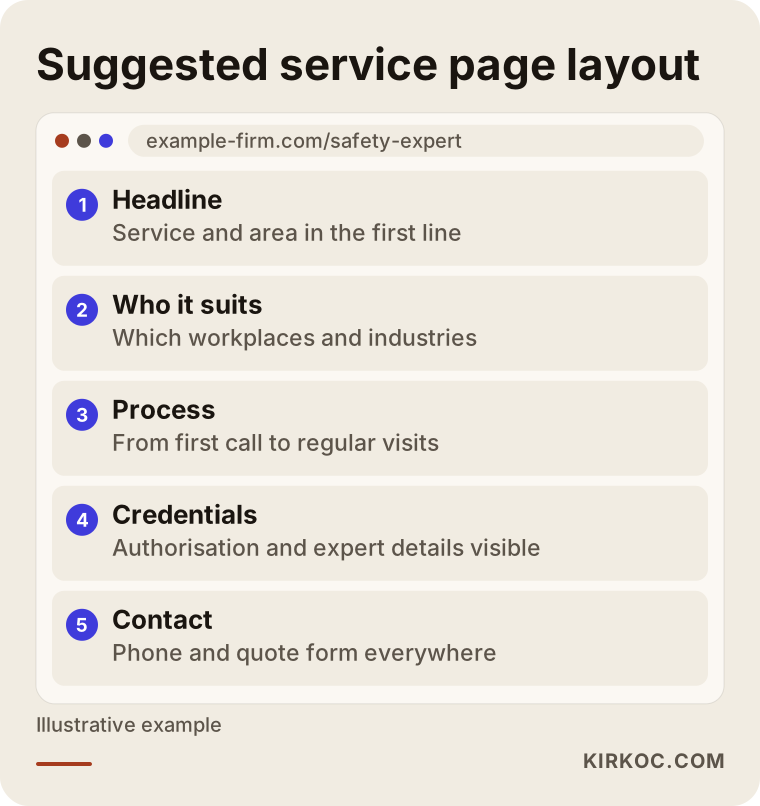
As you can see, the page answers the visitor's questions in the order they come up, and contact stays within reach at every step.
Trust matters more than anything in this field
An employer choosing an OSGB is really buying protection from risk. If an inspection finds a problem, an accident happens or a document is missing, the responsibility lands on the employer. That is why "can I trust them?" comes before the price question. A few small, effective elements help your site answer it.
Start by saying clearly who you are: company name, address, phone, map location, working hours. A site that looks anonymous raises doubts immediately. Next, explain how the process works: first meeting, site visit, preparation of documents, regular follow-up. Uncertainty creates fear, and openness creates trust. Third, if you have real references, use them with permission. If you do not, do not invent any. Readers spot fake reviews quickly, and once they do, they cross you off the list for good.
The list below is a simple check you can run before the site goes live.
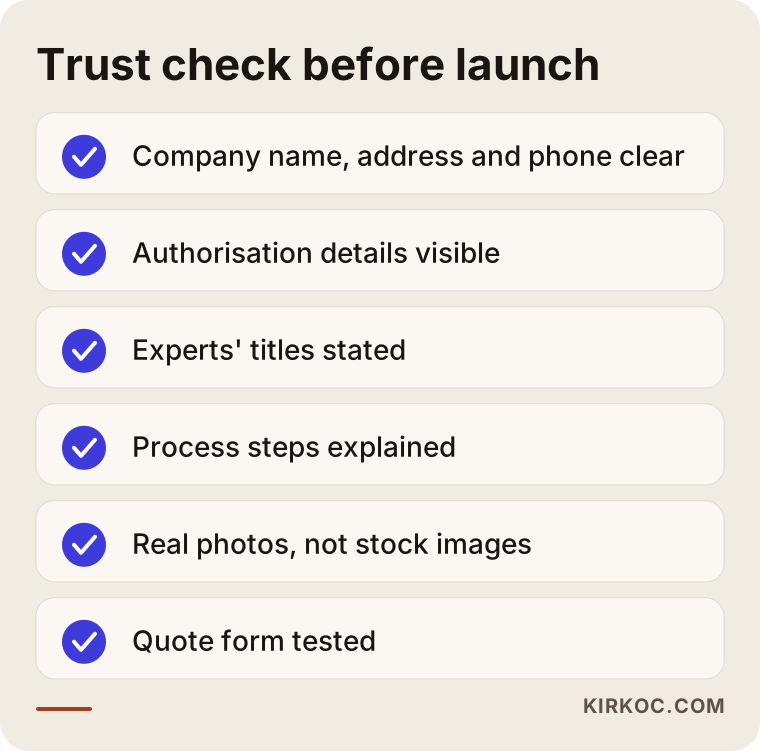
Each item looks small, but together they lead a visitor to think, "someone serious works here."
Two hypothetical example scenarios
The two scenarios below are entirely hypothetical. They do not describe a real firm or person. They exist to show how the same industry can need two very different websites.
Scenario 1: A small OSGB that relies on existing clients
Imagine a small OSGB that has worked in one district for ten years and gets most clients by recommendation. Its website was built long ago, has a single page and shows only a phone number. The owner says that in the last few years it has been harder to win new clients and that competitors keep cutting prices. The first job here is not to decorate the site, but to build a clear structure that explains the firm: separate pages for the main services, short pages for the industries it works with, information-rich area pages for the districts it serves and a plain quote form. After that, the Google Business Profile, the free listing that shows your firm on maps, gets tidied up, because map results matter a lot for nearby searches.
I cannot promise a result in this scenario, but I can say this: an employer who gets a recommendation will often still search for you online. If the page they land on does not inspire trust, even a recommendation may not turn into work.
Scenario 2: A new safety firm serving several cities
In the second scenario, a firm has just been founded. It has no large client list yet, but it has experienced specialists and wants to serve a few cities. The biggest issue here is visibility, because nobody knows the firm. The strategy differs. It makes sense to focus on one industry first, such as construction or manufacturing, and build pages that answer that industry's questions. A young site that tries to say everything at once will not stand out in any search. Then city-by-city area pages are added. Advertising can also play a part: a new site takes time to appear in organic results, so a short Google Ads campaign can collect the first inquiries in the meantime. I do not promise an ad budget or its return in advance, because every business is different.
The difference between the two is this: in one, you need to make existing trust visible, and in the other, you need to build trust from zero. One site does not fit both situations.
A common problem: the "we do everything" site
The most frequent mistake I see on OSGB sites is piling everything onto one page: safety, workplace physician, training, measurements, consulting, documents, all in one menu and none of it explained. Such a page confuses both search engines and readers. The reader cannot find the answer to "what exactly will I get?" and leaves.
Another common problem is copied content. Service texts on nearly all sites follow the same patterns, so a copied page is indistinguishable in Google. More importantly, if a visitor reads the same sentences on three different sites, they trust none of them.
The illustration below collects the mistakes I meet most often on these sites.
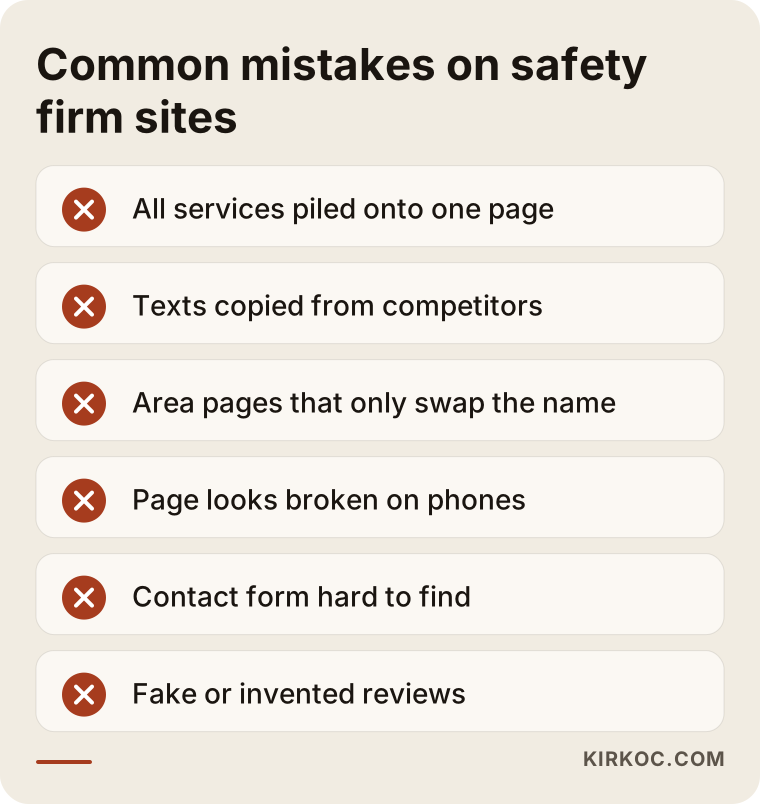
Most of these can be fixed, and you do not have to rebuild the site to fix them. Often just reworking the content layout, the menu and the page titles makes a difference.
Old site or new site?
I hear this question a lot: "I already have a site. Should I get a new one?" The answer depends on the condition of the current site. The comparison below puts the two paths side by side.
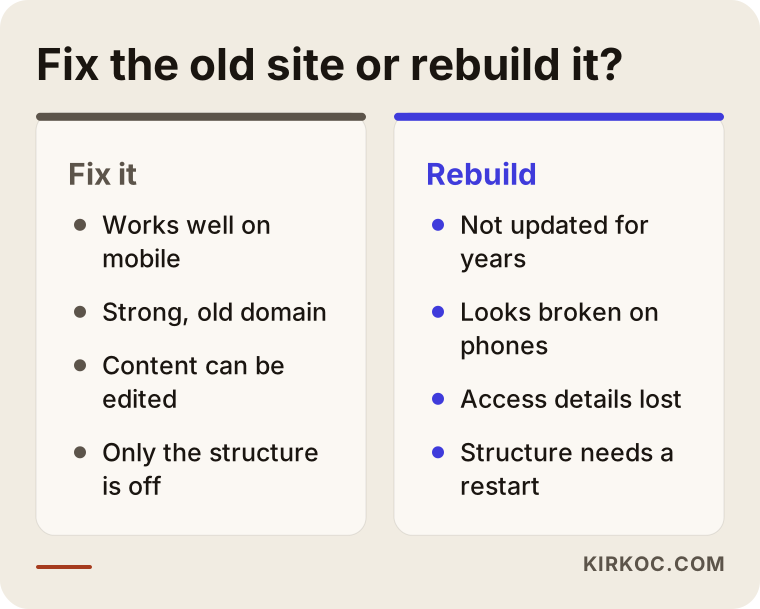
If your old site opens properly on mobile, your domain is strong and the content can be edited, fixing it is usually more sensible. But if the site has not been updated for years, looks broken on phones or nobody has the password, rebuilding is both cheaper and cleaner. To decide, the site has to be looked at together; it would not be right for me to say without seeing it.
Step by step: how an OSGB site gets built
The process should be simple but orderly. This is how I work.
Step one, an intro call and a clear goal. I ask which services your firm offers, which areas and industries you work in, and who you want as clients. A site cannot be built without knowing which client you want.
Step two, search and competitor review. I look at which words your clients type and which pages your competitors appear with. The aim is not to imitate a competitor, but to spot the gaps.
Step three, the page plan. I propose which pages to write, in what order of importance, and how to set up the menu.
Step four, content and design. The text is written with your knowledge in plain language, and the design is made to read comfortably on a phone. A quote form and a call button appear on every page.
Step five, launch and measurement. The site goes live, your Google profile and tracking tools are connected, and the form is tested to make sure it really reaches you.
Step six, fixing and growing in the first months. I watch which pages bring quote requests, fill in what is missing and add new area and industry pages.
The next illustration summarises the flow.
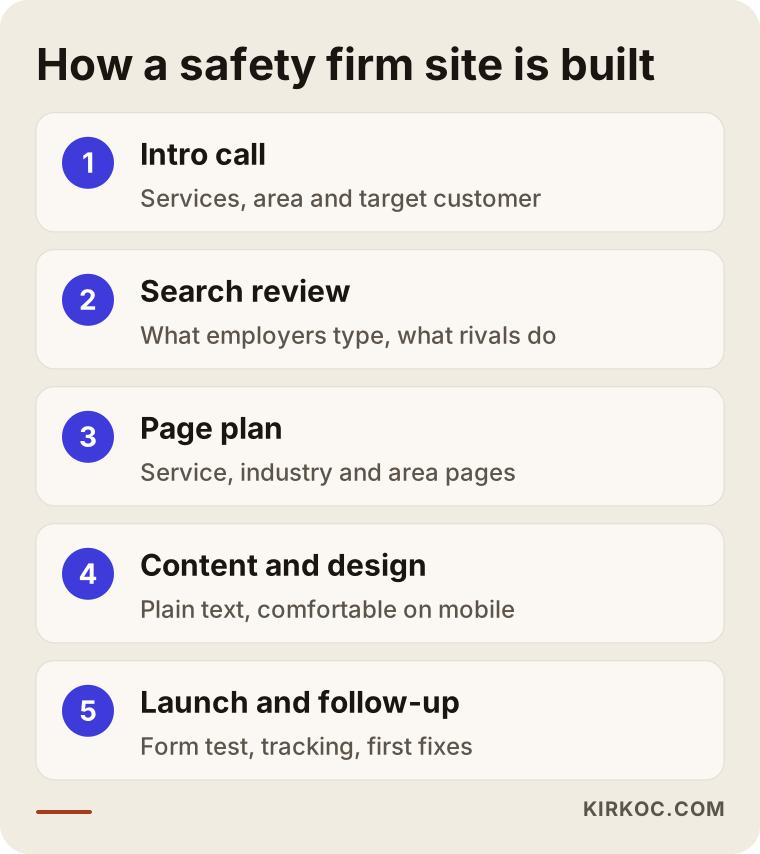
How long this takes depends on the number of pages, how much of the content you supply and how quickly you approve things. I do not promise a fixed number of days, but at the start I build a realistic timeline with you.
The path that turns a visitor into a client
Not everyone who lands on your site wants a quote. Some are only looking, some are gathering information, and very few call right away. The site has to be built around this reality: first attract a wide audience, then slowly move people toward contact.
The funnel below shows in simple terms the stages a visitor goes through.
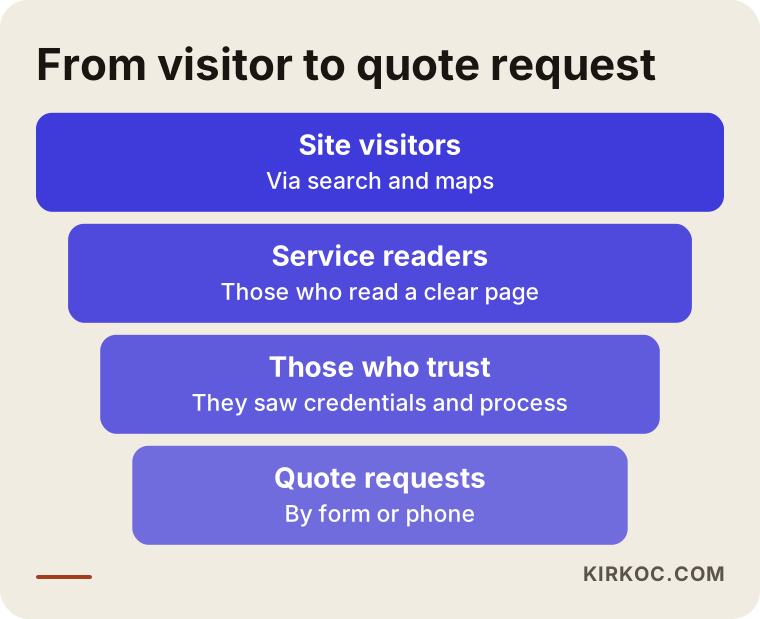
Some people drop out at each stage, and that is normal. Your job is to reduce the loss. Information pages feed the first stage, clear service pages feed the second, and an obvious quote form with a fast reply feeds the third. A fast reply is critical here. An employer asking for quotes usually writes to several firms at once, and the first to answer, and answer with understanding of the question, often gets ahead.
What can you do yourself, and when do you need an expert?
You do not have to outsource everything. Let me name a few jobs you can do on your own. You can open your Google Business Profile and fill in your details. You can ask clients for reviews, with their permission. You can write down the questions you hear most often in one file and keep them as raw material for the site. You can use your web address consistently on business cards, in email signatures and in quotes.
The jobs that need an expert are the more technical and systematic ones: making the site fast and secure, the right structure for search engines, linking pages together properly, tracking and form monitoring, and setting up an ad account correctly. If these are done wrong, you will not see the damage right away. Months later you will ask, "why are no quote requests coming in?"
The decision chart below shows in simple terms what to do in which case.
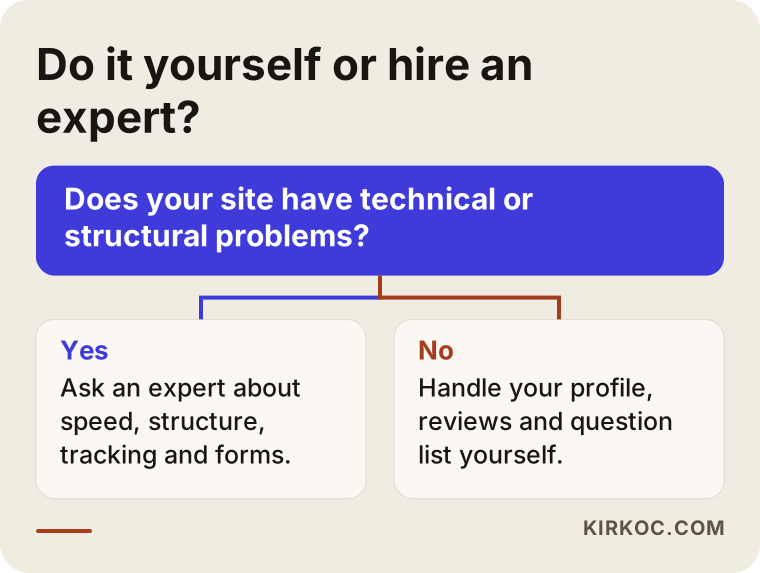
If the chart leaves you undecided, the best path is to look at your site together and draw a clear plan.
AI search and OSGB websites
People now put their questions not only into Google but also into AI tools such as ChatGPT. Someone who asks, "What should a small factory look for in a workplace safety service?" gets a summarised answer. The sources of such answers are pages that are written clearly and in an orderly way. If your site explains the subject in a clear, consistent and informative way, your chance of being used in these answers goes up. There is no guarantee, but vague, copied and empty pages find it even harder to appear in them.
The example below shows how an invented AI answer might look.
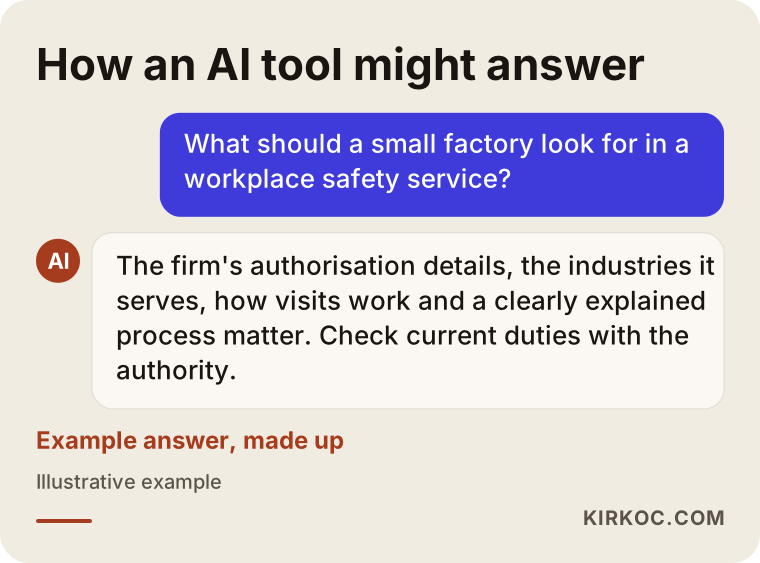
Notice that the answer is plain and ordered. If your pages are written with the same plainness, they are understandable to people and AI tools alike.
What determines the cost
I am not giving figures in this article, because the cost of an OSGB website is not the same for every firm. The main factors that set the price are these:
- Number of pages: only the main services, or also industry and area pages?
- Content: will you supply the texts, or do they need to be researched and written from scratch?
- Language options: Turkish only, or English and other languages as well? This matters if you serve foreign-owned workplaces.
- Design and brand identity: do you already have a logo and colors, or do those need to be prepared too?
- Extra functions: a quote form, appointment booking, file downloads, a client login and so on.
- Support afterward: do you want maintenance, updates and growth after launch?
- Advertising and social media: do you also need Google Ads, or LinkedIn or Instagram management on top of the site?
When you collect quotes, be careful with phrases such as "one price, everything included". Ask for what is included in writing. Two quotes at the same price can cover very different work.
How I work
I am one person, and I run the work from start to finish. That means the person who designs the site, writes the text, makes it fit what people search for, sets up your Google profile and, if needed, builds the ad campaign is the same person. There is no middleman and no handing over between teams; when you ask a question, the person who answers is the person who does the work. This helps a lot when the site, search visibility, a channel like LinkedIn and advertising need to work together, because everything runs under one plan and information is not lost between different people.
I start with an intro conversation, listen to your situation and tell you which jobs are really needed and which can wait. I do not try to sell you work you do not need. Sometimes patching up the current site with small fixes is enough.
Frequently asked questions
Does an OSGB really need a website?
A large share of employers search for a firm online before they decide. A firm with no site, or with one that does not inspire trust, can lose even a client who arrived through a recommendation. Whether you need one is not a legal question but a commercial one: clients should be able to find you and trust you.
Do I have to show my license on the site?
I cannot give a firm legal opinion on this. For what you should share and how, ask the competent authorities or a legal adviser. Commercially, I can say that visible, verifiable details and documents increase trust.
Do district and city pages really help?
Done properly, yes. Pages with real information specific to each area are useful. Copying the same text and swapping only the place name does not help, and it can hurt the site.
How long before the site starts bringing quote requests?
There is no fixed time. Firms with an existing site and a strong domain may see changes take effect sooner, while a site starting from zero takes longer to produce results. If you need inquiries quickly, advertising can be considered alongside organic work.
Do I need social media too?
In this field the channel that most often works is LinkedIn, because that is where decision-making employers and the business world are. But social media does not replace a website. A solid site first, and then one or two channels as needed, is enough.
Should I run Google Ads?
Ads can make sense when you want to collect inquiries fast but your organic visibility has not built up yet. However, the return on an ad depends heavily on the quality of the page people click through to. Sending ads to a weak page wastes budget. That is why I suggest the site first, then the ads.
Can I keep my current site and just fix it?
Often yes. After looking at the site, I tell you plainly what to keep and what to change. Sometimes small fixes are enough, and sometimes rebuilding turns out to be the more sensible choice.
How fast should I respond to someone who requests a quote?
I cannot give an exact time, but the general rule is the faster the better. An employer asking for quotes writes to several firms at once, and the firm that gives the first clear answer is usually a step ahead. Test before launch, and at regular intervals afterward, that the form really reaches you.
If you are thinking about building a site from scratch for an OSGB or safety firm, tidying up your current one, or becoming more visible in search, you can write to me through my website design service page. I will listen to your situation and tell you plainly what will help.