You own a hotel, a guesthouse or a small inn. The rooms are good and the location is good, but most of your reservations arrive through booking portals, and you pay a commission on every one of them. You would like more guests to book on your own website, and that is probably why you searched for "Google Ads for hotels." In this article I explain what a hotel can realistically expect from Google advertising, which searches are worth paying for, which pages must be ready first, and how the work runs from week to week. I am Ümit Kırkoç. I work from Istanbul, and I handle digital advertising together with the website, search visibility and social media, all by myself, so the pieces fit together.
A Google ad, in plain terms, is the box marked "Ad" at the top of the results when someone searches. You pay only when a person clicks it. For hotels this box comes in two forms: ordinary text ads, and the priced hotel listings Google shows in its own hotel search. They work differently and need different preparation, so I cover both.
Why hotel searches behave differently from other businesses
When a pipe bursts, people call two plumbers and pick one. A hotel guest compares for days. First the area, then prices for specific dates, then photos, reviews and cancellation rules. The same person may open the same hotel on three different sites and come back a week later. That is why "click, then buy" is rare in this field: a booking is usually spread across several visits.
The second difference is who you bid against. Large booking portals buy hotel names and "city + hotel" searches in enormous volume. If you bid on the same words, you join an auction against companies with far bigger budgets. For an independent property, winning that auction with money alone is usually the wrong plan. A smarter plan is to find searches the portals ignore or handle badly.
The third difference is the season. A beach hotel and a city business hotel live on different calendars. You spend less in the slow months and more as the busy weeks approach. An ad account that ignores this rhythm pours budget into the wrong weeks.
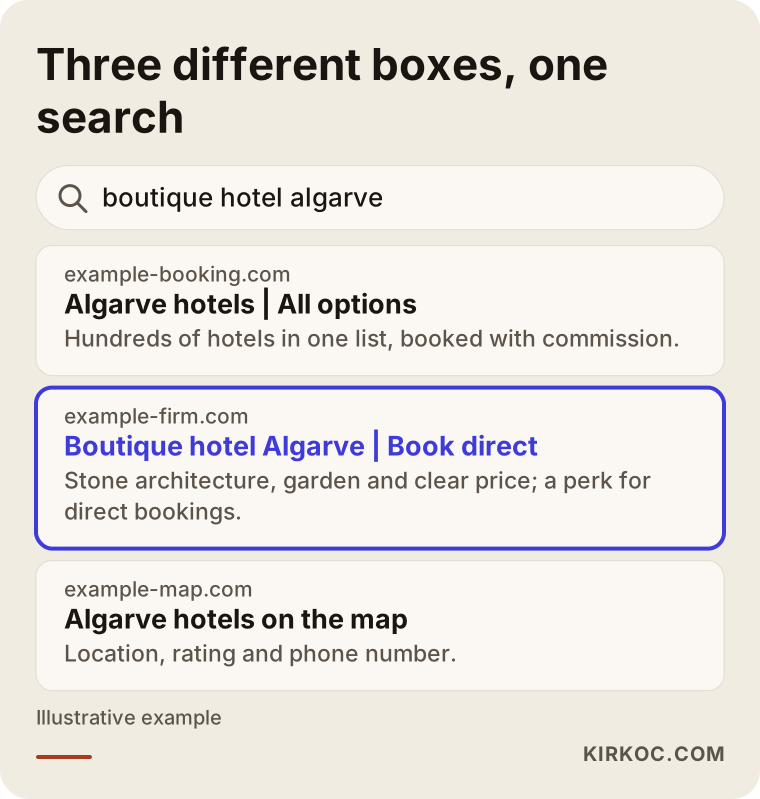
The example above shows three boxes a guest might see for one search: a portal list, a hotel's own ad and a map result. Your goal is simple. While the guest is comparing, your site should stand among the options with a clear offer.
What are guests actually typing?
Hotel searches fall into roughly four groups, and each has a different intent. A broad search such as "hotels in the Algarve" comes from someone who has not decided anything. A narrower one such as "boutique hotel with garden Algarve" comes from someone who knows what they want. A search for your hotel's name means the guest already knows you, or saw you elsewhere and is double-checking. The last group is a need written as a sentence: "family-friendly hotel with a kids' pool" or "pet-friendly hotel near the beach." Portals rarely answer those well.
For an independent hotel, the middle two groups usually pay off best. The guest is decided and sees few good choices. In broad searches the portals are simply too strong, and in name searches your main job is to stop a portal from standing in front of your own booking page.
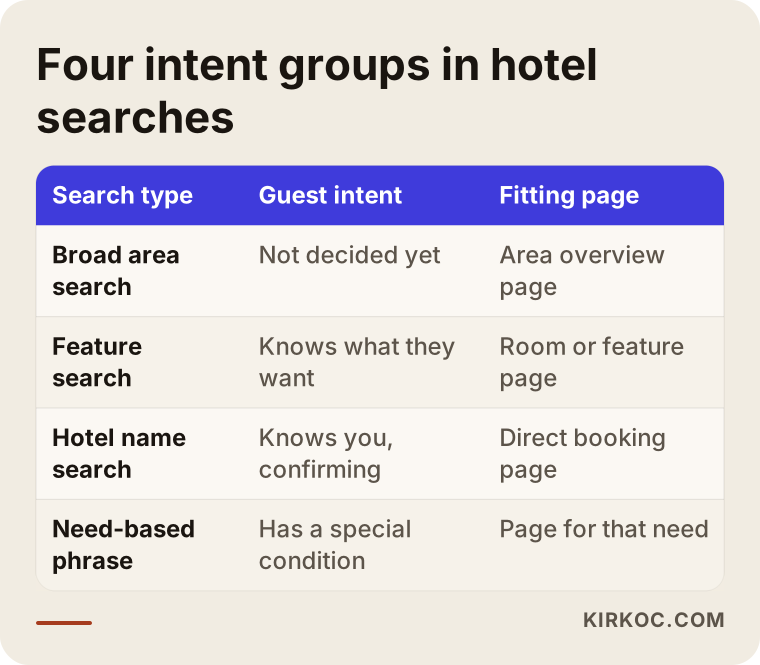
The table pairs each search type with what the guest is thinking and the page they should land on. This pairing is the foundation of the account. Send a guest to the wrong page and they leave, however good the ad was.
Text ads versus hotel ads
With a text ad you write a headline and a short description. The guest clicks and arrives on your site. No price appears in the ad itself; the guest finds it on the page. It is a flexible tool for people who know what they want, and you choose which page each search leads to.
A hotel ad is different. Google shows a list of hotels where the guest picks dates and sees prices and availability, then clicks through to your site or a booking link. For that to work, your property has to be connected to Google's hotel system, and your rates and availability have to be shared with it. This is usually done through your booking engine or channel manager. The exact route depends on which system you use, and I sort that out with you at the start.
The two do not replace each other. Text ads suit clear searches and special offers. Hotel ads reach the guest who compares dates and prices. A small property does not need to launch everything at once. Start with whichever is ready and will show the clearest return.
Before any ad: check your booking path
An ad brings the guest to your door, and whether the door opens is up to your website. Before spending anything, go through your booking process as a guest would. Open the site on your phone, choose dates and try to finish a reservation. How many steps does it take? Is the price clear? Are extra fees visible from the start? Does the page load slowly?
Most hotel visitors browse on a phone. If the date picker is awkward, the calendar does not fit the screen or the form is too long, every guest the ad brings moves on to the next option. Fixing the site first is a better first investment than switching the ads on.
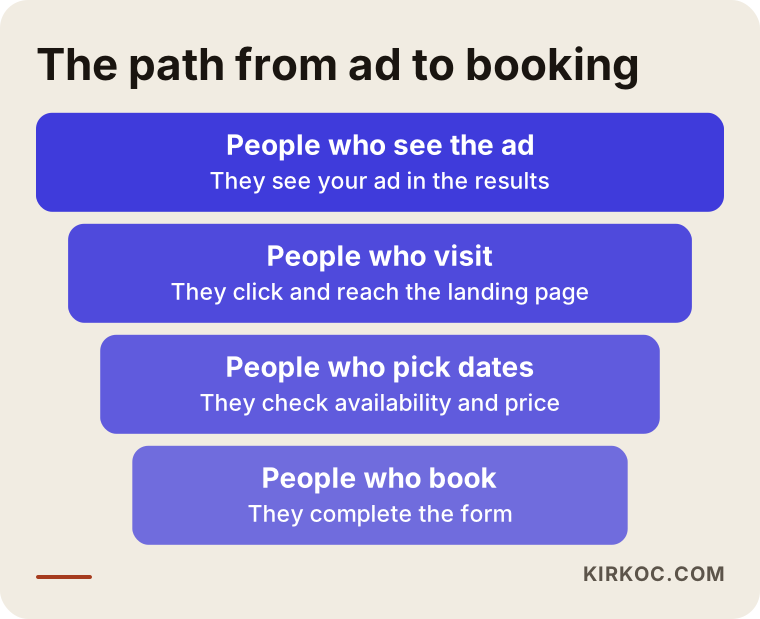
The funnel shows that people drop off at every step between seeing the ad and booking. The aim is to shrink the loss at each stage, and that depends on the landing page and the booking form as much as on the ad.
Which page should the guest land on?
The most common mistake is sending every ad to the home page. A home page tries to speak to everyone, so it speaks clearly to no one. Compare that with a guest searching for a "family room" who lands on a page showing that exact room, its size, what is nearby and a booking button, all together. That page works much harder.
A good hotel landing page has a headline that names the room or feature searched for, real and high-quality photos, a plain explanation of what the price depends on, cancellation terms, a short description of the surroundings and a booking button that is easy to find. A phone number and a messaging option should always be visible, because some guests want to ask a question before they book.
Also state the real benefit of booking direct. It might be breakfast included, flexible cancellation or early check-in. Whatever you promise must be something you can actually deliver. Never put a perk in an ad that you cannot honor.
Example scenario one: a boutique hotel on the coast
This is a hypothetical example. Picture a small independent hotel with twelve rooms in a small coastal town. Most bookings come through portals, and the owner wants more direct reservations before the summer season.
The obvious idea is to bid on the town's name plus "hotel." But the big portals bid aggressively on exactly that. A better plan starts with the hotel's real difference. Say the property has a walled garden, stone architecture and a walk to the sea. Then the account focuses on narrow searches such as "stone hotel" plus the town, "boutique hotel with garden" plus the town, and "hotel within walking distance of the sea." Each gets its own landing page with real photos of the garden and the stone walls.
The budget stays small in the first month while you watch which searches move toward a booking. A few weeks in, you look again. Is the garden search clicked a lot but nobody books? Then the problem may be the page, not the ad. Perhaps the garden photo is old, or the price is hidden. You fix it, and only then raise the budget. The realistic goal is to turn part of the portal commission into direct bookings. How many bookings will arrive cannot be promised in advance.
Example scenario two: a city business hotel
This one is also hypothetical. Imagine a forty-room hotel in a large city near business districts. Most guests are weekday business travelers, and weekends are quiet.
The guest searches differently here: "hotel near the convention center," "hotel with meeting room," "hotel with airport shuttle." Weekday ads can carry higher bids, while a separate weekend campaign pushes a "city break" offer. A corporate page can also be prepared so that a company's travel planner can request a rate directly.
Google's hotel search may matter a lot for this property, because a business traveler checks dates and prices and decides quickly. If rates and availability are out of date, the guest sees the wrong price and trust is lost. That is why the connection with the booking system is tested before any ad runs.
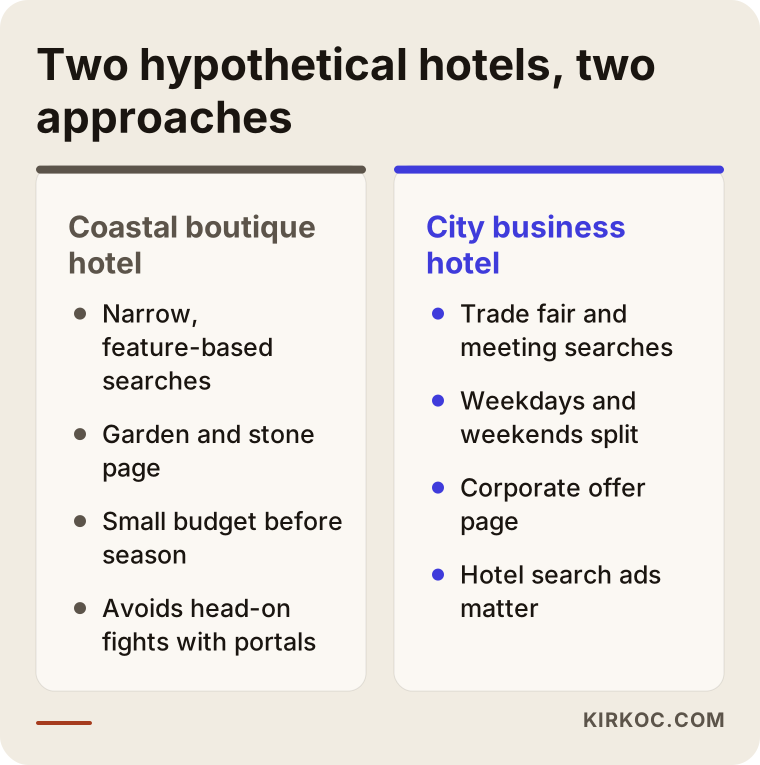
The comparison shows why the two hotels need different searches and different pages. One ad account does not fit both. Each property has its own real difference and its own seasonal demand.
Step by step: how a hotel ad account is built
I keep the process plain, because what looks complicated is usually just work done out of order. First I talk with you about your goal. Which rooms, which months, which kind of guest come first? Not every room type earns the same, and not every month is equally empty. The ads are pointed at the gaps you most want to fill.
Second, I examine your booking path and your tracking. Tracking means seeing which ad led to which booking, and it is the most important part of the job. If your booking engine lives on a separate web address, that handover has to be included in the tracking, or you will never see results even when the ads work. When setup is finished, I make a test booking to confirm that the numbers are recorded correctly.
Third, search groups and ad texts are prepared. A separate group for each room type, feature and area makes it easy to match the text and the page to the search. Fourth, you begin with a small budget. In the first weeks you see which searches waste clicks, and those get removed. Fifth, budget moves toward the groups that work, and the weak ones are fixed or closed.
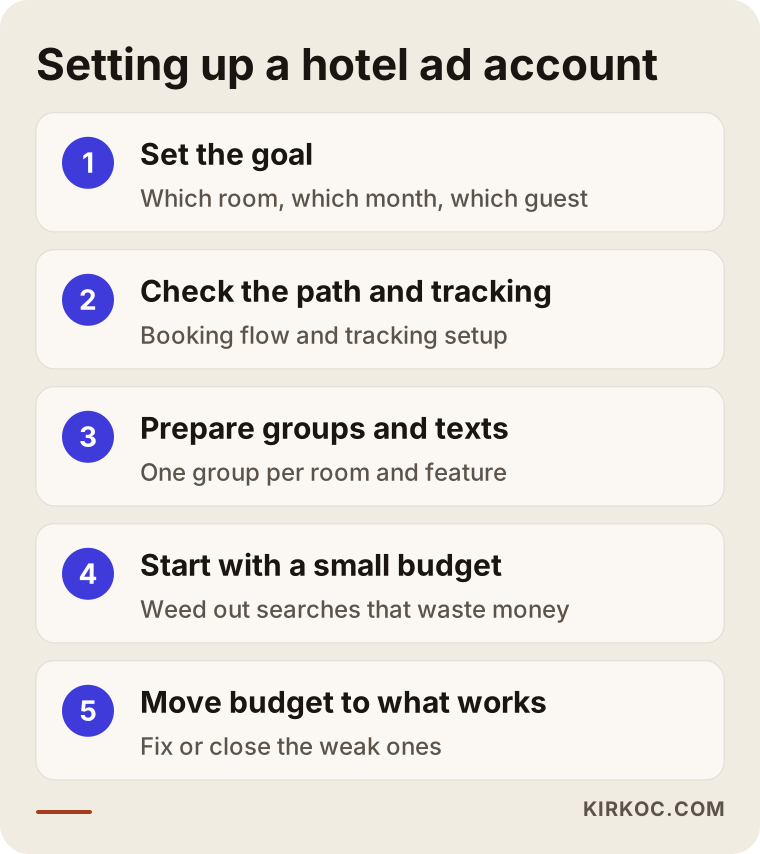
The process graphic shows the same order at a glance. No step gets skipped. Tracking is the one skipped most often, and skipping it costs the most.
Which searches should you not pay for?
Money is usually lost when the wrong people click. Not everyone who types the word "hotel" is a guest. People searching "hotel jobs," "hotel management course" or "hotel receptionist salary" are not looking for a room. These phrases should be on an exclusion list from day one. An exclusion list, also called negative keywords, tells Google not to show your ad when a search contains certain words.
Likewise, filter out people looking for something you do not offer. If you have no pool, appearing for "hotel with pool" wastes money and disappoints the guest. The same logic applies to dates you are not open. If you close in winter, there is no reason to show ads for winter dates.
The exclusion list is never finished. As ads run, I review which searches triggered them and add the irrelevant ones to the list. It is the cheapest way I know to make a budget work harder.
Should you protect your own hotel name?
Many owners ask me: "People who type my name already find me, so why advertise on it?" The answer is that booking portals can bid on your hotel's name too. A guest types your name, a portal's ad appears first, and the guest books there. You pay commission on someone who was already looking for you.
Ads on your own name are usually cheap, since the guest is already searching for you. The point is to make sure the first result is your own direct booking page. It is not equally necessary for every hotel. If no competitor ad appears, the free result may be enough. I decide by looking at the actual results, not by assuming.
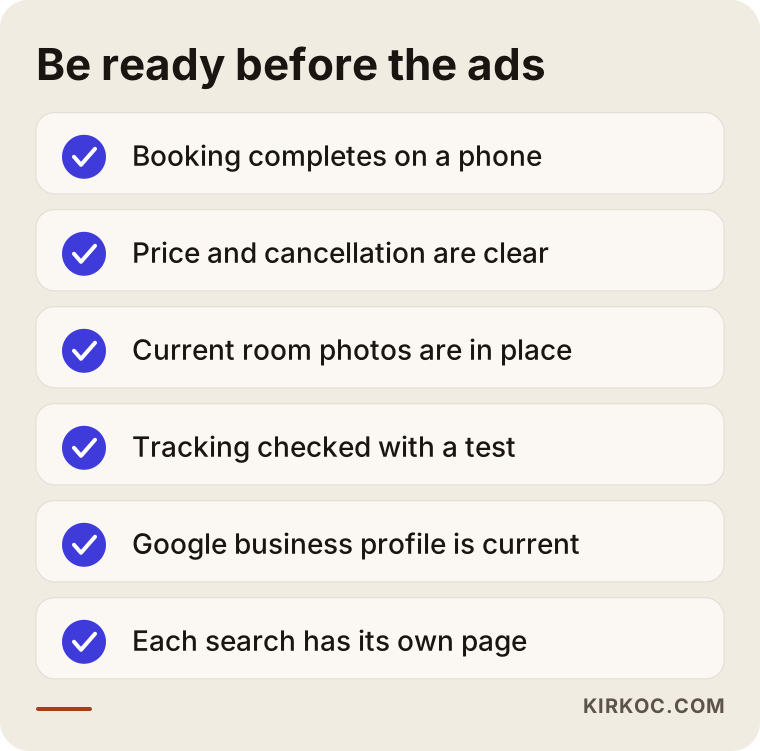
The checklist lists the basics to have in place before ads start. If one is missing, fixing it first is the easiest way to protect your budget.
Photos, reviews and your Google Business Profile
A guest wants to see before buying. However good your ad is, if the guest opens your site or your Google Business Profile (the listing with your photos, map pin and reviews) and sees poor photos, outdated details or unanswered reviews, they will walk away. So ads and the profile have to be considered together.
Your profile should hold current photos of rooms, shared areas, breakfast and the surroundings. Opening hours, phone number and website link must be correct. Short, warm and honest replies to reviews reassure new guests and show that the property is attentive. When a review is negative, answer with a solution, not a defense.
This is where having everything handled by one person pays off. If your website, your business profile, your social media posts and your ads show the same photos and tell the same story, the guest sees one consistent hotel. When the work is split among several people, prices, photos and offers can drift apart. Because I run the site, search visibility, social media and ads together, I try to prevent those mismatches from the beginning.
Common mistakes
The mistakes I see in hotel ads follow a pattern. Knowing them helps when you review your own account.
The first is sending every ad to the home page. The second is starting ads without tracking; managing a budget without knowing which ad brings bookings is like walking in the dark. The third is bidding blindly on the same broad words as the portals. The fourth is not adjusting the budget to the season, spending too little in the months you will be full and too much in the months that stay empty. The fifth is never testing the phone experience. The sixth is promising a price or perk in the ad that the page does not show; guests notice at once and trust disappears.
The seventh is judging results too early. Because hotel decisions take time, the first few days of data are often misleading. Closing something after a very short period can mean dropping a search that would have worked.
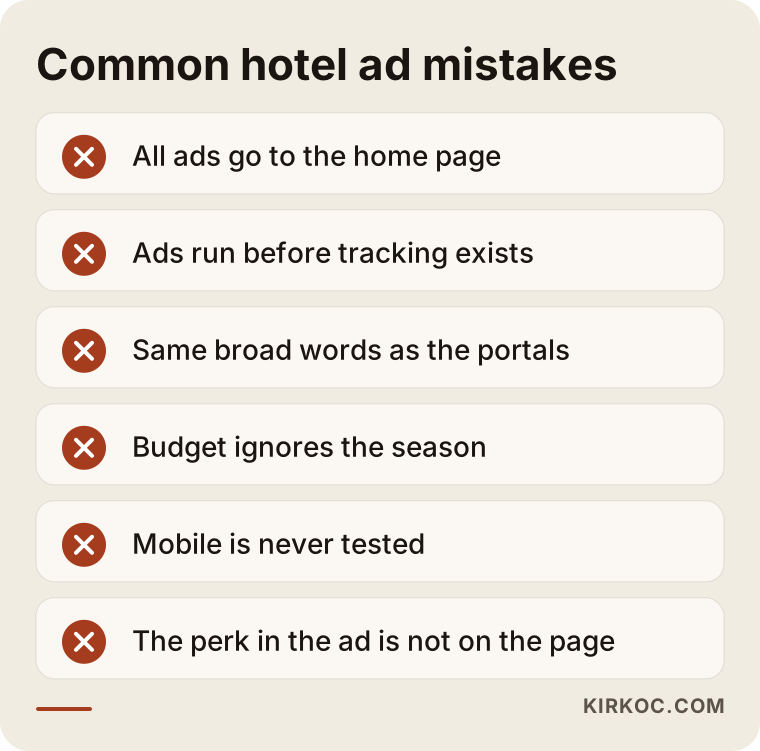
The warning list collects the most important mistakes from above. When I take over an account, these are the first places I look.
What can you do yourself, and when do you need a specialist?
You do not have to hand everything to someone else. If you run a small guesthouse on a tight budget, some tasks are yours to do. Keep your Google Business Profile current, answer reviews, take good photos of your rooms, and state prices and cancellation rules clearly on your site. All of this helps whether or not you advertise. You can also walk through your booking flow as a guest and note where it stumbles.
You need a specialist when tracking has to be set up, when your booking system must be connected to Google, when you run separate campaigns for several room types and areas, when the budget grows and following it gets hard, or when you are spending money but cannot tell what it achieves. Ad systems keep changing and need weekly attention. Since a hotel owner's real job is looking after guests, handing off that attention often makes sense.
An honest note: not every hotel benefits from ads. A property that is already nearly full, has very limited capacity and works smoothly with its portals may not need them. I look at your situation first, and if ads are not needed, I say so.
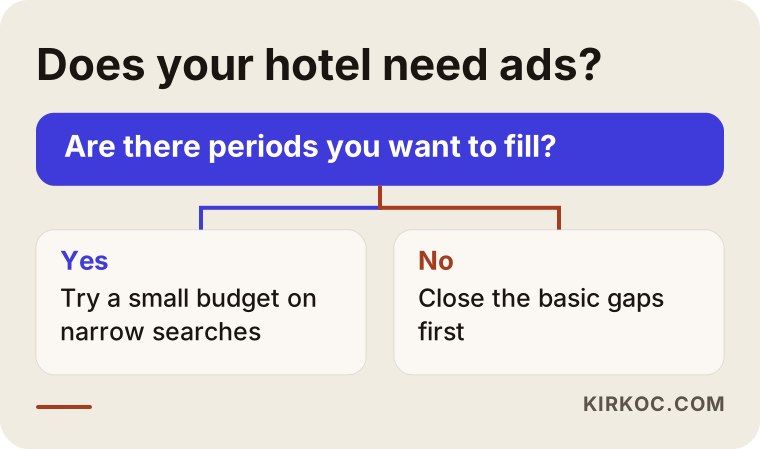
The diagram shows the one question to ask before starting. If the answer is yes, begin with preparation. If it is no, close the basic gaps first.
What decides the cost
I do not quote figures, because two hotels never cost the same. The cost has two separate parts. The first is the ad budget you pay Google, which is the money spent on clicks. You set it, and it depends on your goal, the revenue a room brings you and the level of competition. The second is the fee of the person who builds and manages the ads.
Several things influence the ad budget: how competitive your area is, the season you target, how much a booked room is worth to you, how high the portals are bidding at that time, and how well your site turns visitors into bookings. The same budget produces more bookings on a well-prepared page and is wasted on a weak one.
The management fee depends on how many campaigns are run, whether hotel ads need to be set up, how much tracking and reporting you need, and how much work the site or landing pages require. To give a clear price, I need to know the hotel, the goal and the current situation. A short conversation settles it.
Timeline: what to expect in the first months
It is a mistake to expect ads to deliver bookings immediately. The first weeks are for learning: which searches get clicked, which are wasted, which page convinces. In the second month the weak groups are removed and the good ones are expanded. From the third month, a steadier routine appears.
Your own season still shapes this plan. Summer holidays are often planned months ahead, so starting before the season is far more effective than starting at the last minute. I cannot guarantee any result, but accounts that start early and run steadily have more time to learn.
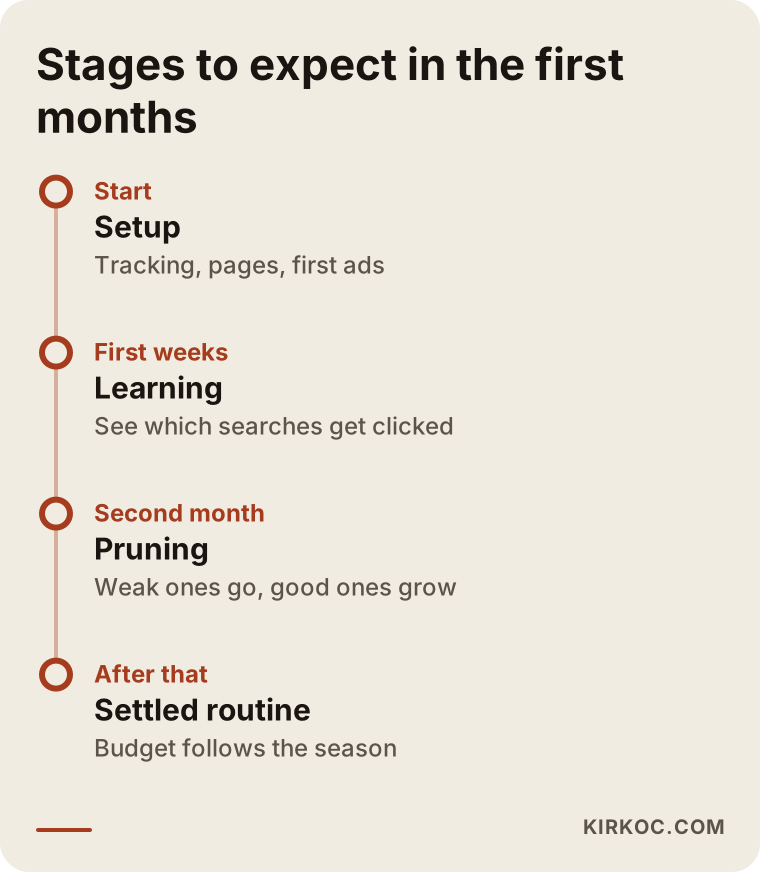
The timeline sums up the road from setup to a settled routine. It shows stages rather than dates, because each hotel has its own season and its own booking pace.
How I work with you
The process is simple. First I listen: your hotel, your rooms, your type of guest and how bookings are currently split. Then I review your site and any existing ad account, and I write down in plain language what is ready and what is missing. If you decide to go ahead, I set up the tracking and landing pages, launch the ads, and explain at regular intervals what is working.
If your site needs rebuilding, your local search presence is weak or your social media is scattered, I can handle those under the same roof. Working with one person means that you ask the person doing the work, with nobody in between. The honest downside is that I can only take on a limited number of projects at once, so I may not have room for every hotel.
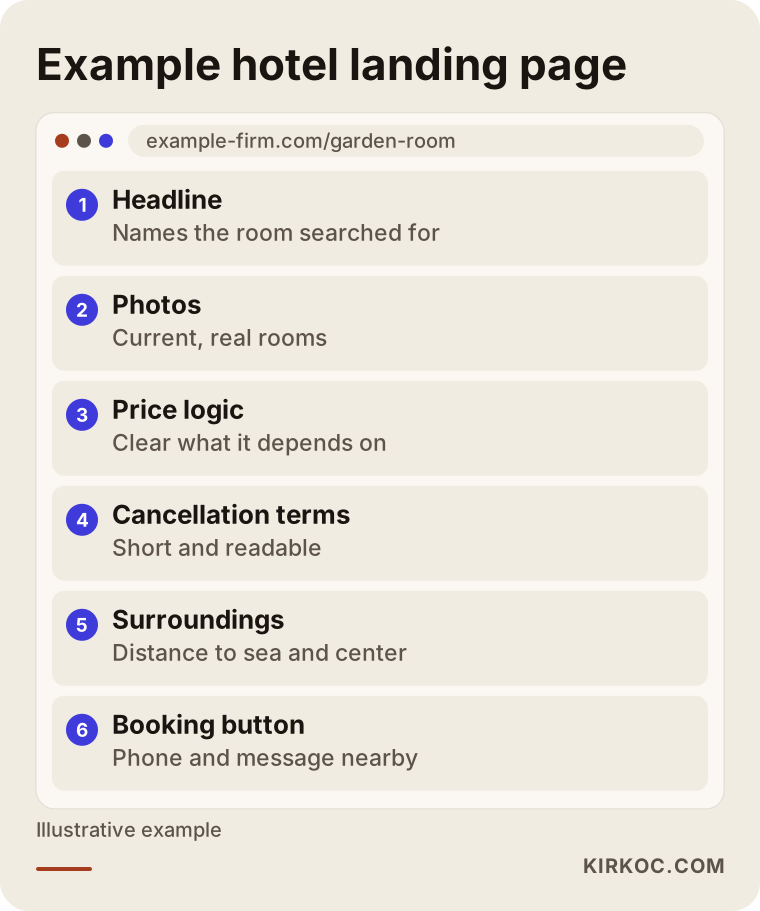
The last graphic shows a sample layout of the page a guest should land on from an ad. Headline, room, photos, price logic and the booking button sit together.
Frequently Asked Questions
Does Google Ads really increase direct bookings for hotels?
It can be a strong tool when you bid on the right searches, send guests to the right page and have working tracking. But no result can be guaranteed. Competition, price, photos and the booking flow all decide the outcome.
Can I get rid of booking portals completely?
For most hotels that is not a realistic goal. Portals are one way to reach new guests. The aim is to depend on them less and to bring guests who already know you, or who search for you, to your own site. How you handle your relationship with portals depends on your contracts, so consult a lawyer if needed.
What is the difference between a hotel ad and a normal Google ad?
A normal ad appears as text and sends the guest to your page. A hotel ad appears inside a hotel list that shows dates and prices. For the second kind, rates and availability must be shared from your booking system.
Do ads make sense for a small guesthouse?
Sometimes yes, sometimes no. If you have few rooms and are already well booked, the budget may be better spent elsewhere. If you want to fill slow periods, a small budget on narrow, local searches can be tested.
How long until the ads show results?
Some bookings may come in the first weeks, but the account usually takes a few months to settle. Because guests take time to decide, starting before the season is an advantage. I do not promise a fixed period.
Do I have to show the price in the ad?
Not in a text ad, but explaining how the price is formed on the page builds trust. In a hotel ad the price is shown in the list, so it has to stay current.
Should I open the ad account or should you?
You should always own the account. I set it up and manage it on your behalf, while access and the payment method stay with you. If you ever want to stop working with me, the account and its history remain yours.
What do I need to prepare to get started?
Your room types, your current photos, the name of your booking system and the season you want to focus on are enough for a start. I will settle the rest with you in the first conversation.
If you want to support your direct bookings with advertising, reach out through the digital advertising page. I will listen to your situation and tell you plainly whether ads really suit you.