You have opened a business, or you have been running one for years, and you still do not have a proper logo. The sign, the business card, the Instagram profile and the website all need something. So you search online and two different worlds show up. On one side are sites that spit out a logo in a few minutes, along with ready-made templates. On the other side are designers who talk to you first and then draw something from scratch. This is where the question "template logo or custom logo?" begins. In this article I explain what each route really changes, which situations favor which one, and what to check before you decide. I am Ümit Kırkoç, I work alone in Istanbul, and I will describe my own logo and brand identity service without a sales pitch, just the honest picture of the work.
Let me say one thing up front: a template logo is not always wrong, and a custom logo is not always right. The correct choice depends on how far your business will grow, where your customers will see you, and how many years you plan to use the same look. I will take those three in turn.
What exactly is a template logo?
A template logo is a symbol or a lettering layout that someone else drew earlier, with your business name placed on top. It comes in two main forms. The first is an online tool that asks you a few questions and generates a logo automatically. The second is a ready-made design package sold by a designer: you pick one, the name and colors are swapped, and the files are delivered to you.
The appeal is obvious. It is fast, it is usually cheap, and you can see what you are getting before you pay. If you need something right now, or you are still testing whether your idea works, a template can genuinely help. But "ready-made" has a cost, and that cost often shows up not at the moment of purchase but months later.
What is a custom logo design?
A custom logo is made from scratch after someone has studied your business, your customers and your competitors. The first half of the job is not drawing, it is asking questions. Who do you serve? What sets you apart? Where will a customer first run into you? Which colors does everyone in your field already use, and which one would let you stand out? The drawing comes out of the answers.
The biggest difference is that the result belongs only to you. The chance that another business is using the same symbol disappears. A custom logo is also prepared with its many homes in mind, from your sign to your invoice, from a social media post to an ad banner.
The comparison below puts the two approaches side by side.
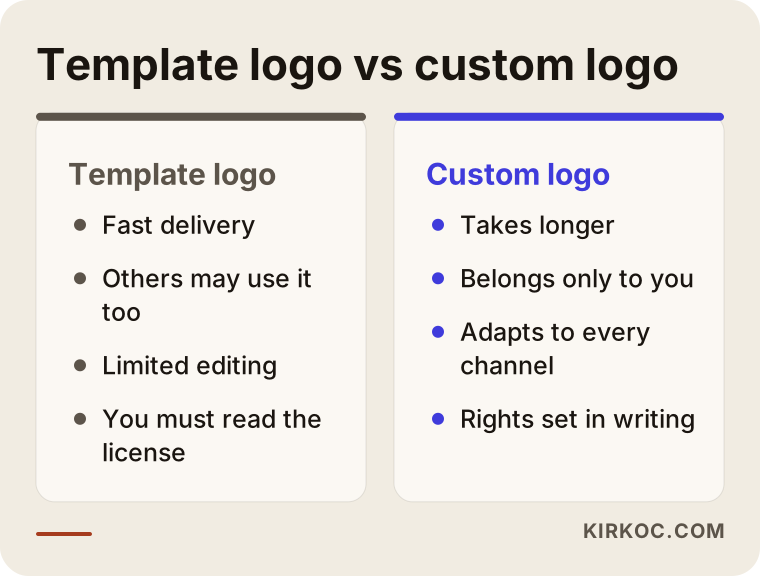
The point to notice is that a template gives you speed and simplicity but gives up uniqueness and flexibility. A custom logo asks for more time and a real back-and-forth, and in return you get something that fits your brand. Which of those matters more to you will become clearer in the sections below.
The problems with template logos that people overlook
Most people who choose a template run into the same walls, so let me go through them one by one.
The same logo may belong to another business too
When a template goes on sale, it is offered to many buyers, not just one. Some sellers say they will sell a design only once, and some say nothing at all. You can find out by reading the terms on the sales page or in the license agreement, and if you cannot tell, you need to ask. Two businesses in the same neighborhood and the same field with similar logos confuse customers, and both of you will struggle to build a recognizable brand.
Usage rights and commercial permission
Not every ready-made logo is free to use commercially. On some sites the free file is for personal use only, and printing it on business cards or showing it in an ad may break the license. Reading license text is boring, but if someone objects one day, you could end up paying again for signs, packaging and printing. I cannot give you a definitive legal opinion on this. If you are unsure what a license covers, please ask a lawyer.
Trademark registration
If you want to register your logo as a trademark, a template that has also been sold to someone else can cause trouble. What can and cannot be registered is a specialist subject, and the rules differ from country to country. If you are thinking about growth and registration, talk to a trademark attorney before you begin. If your business operates in Turkey, that conversation would be about the Turkish trademark system, and a local attorney can walk you through it.
File types and scaling
Cheap or free tools often hand you only a low-resolution image. When you later need to enlarge the same logo for a storefront sign or a vehicle wrap, the file turns blurry. A vector file, the kind that can be scaled up as large as you like without losing sharpness, either is missing from these packages or costs extra. You should ask about it before you buy.
Font and color mismatch
Templates come with their own fonts, and using that font on your website, on social media and in a brochure may require a separate license. On top of that, the template colors may not suit your industry. These look like small things, but they are exactly the details that break brand consistency.
A custom logo is not flawless either
To be fair, custom design has its own risks. If the conversation at the start is thin, the result can end up far from what you imagined. Some work sold as cheap custom design is actually an adapted version of ready-made symbols behind the scenes. A custom logo is also not a quick job. It can take weeks and it needs feedback from you. A designer who works with a client who never replies or cannot decide will get stuck at some point too.
So before you start, ask three things: what exactly will you deliver to me, how many rounds of revisions do I get, and who holds the rights to the files? If you cannot get a clear answer to all three, step back from that offer.
Which one fits you? A decision table
To make the choice easier, I have collected the common situations in one table.
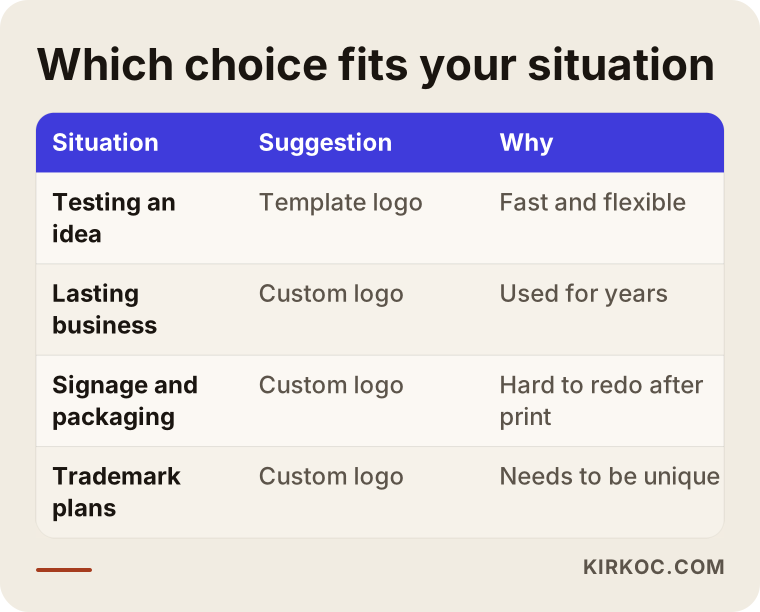
As you read it, find your own situation. For a venture that is still testing its idea, and may change its name or direction soon, a ready-made solution can be reasonable. If you are building a lasting business, ordering a sign, printing on products, or planning to advertise on several channels, going custom is the healthier path.
I can also boil the same logic down to a single question.
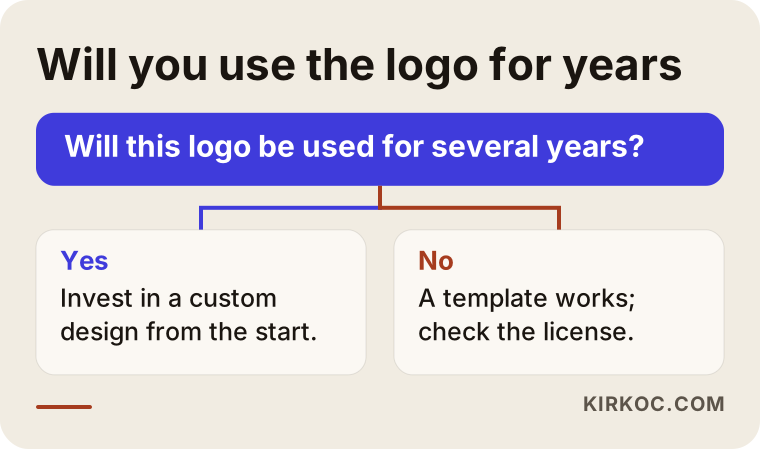
The question in the chart is simple: will you use this logo for at least a few years? If yes, investing in custom design at the start saves you from reprinting, re-signing and having your customers get used to a new look later. If no, a ready-made solution may be enough, as long as you check the license.
Two hypothetical example scenarios
The two examples below are entirely hypothetical. They do not describe a real person or company.
Example scenario 1: A home bakery just getting started
Suppose someone bakes custom celebration cakes at home and is trying to build a small following on Instagram. They do not yet know which products will sell, and they are thinking about changing the name. In this first stage a template logo can be a sensible start: they need a quick look, as long as the commercial-use license is clear. But once the business settles and packaging boxes and a sign come into the picture, they should plan to move to a custom design. Keeping the colors and fonts simple at the start makes that later switch easier.
Example scenario 2: A three-location medical practice group
In another hypothetical case, imagine a health business with three branches under one name. The logo will appear on the sign, on prescription headers, on the website and in ads. If other clinics in the same field use a similar symbol, trust suffers, and a patient could mix the two up. Here custom design is close to a necessity: you need both uniqueness and an identity prepared for consistent use across different channels.
What determines the cost
I will not give a number here, because the two kinds of work are not priced the same way. But I can say clearly what moves the price.
With a template, the price mostly depends on the scope of the rights. Can you use the file only once, is the vector file included, is there a guarantee it will not be sold to anyone else? With custom design, the scope of the work decides. Do you want only a logo, or a full identity with a color palette, fonts, business cards, letterhead, social media templates and a usage guide? How many rounds of revisions are included, how many different directions are presented, and how deep does the research go? Each of these changes both the time and the cost.
When you compare prices, do not look only at the word "logo." If one quote delivers a single file and another delivers ten different files plus a usage guide, those two quotes are not the same thing. When you compare quotes, write down what is delivered side by side.
How does the custom logo process work, step by step?
If you decide on custom, the process usually goes like this.
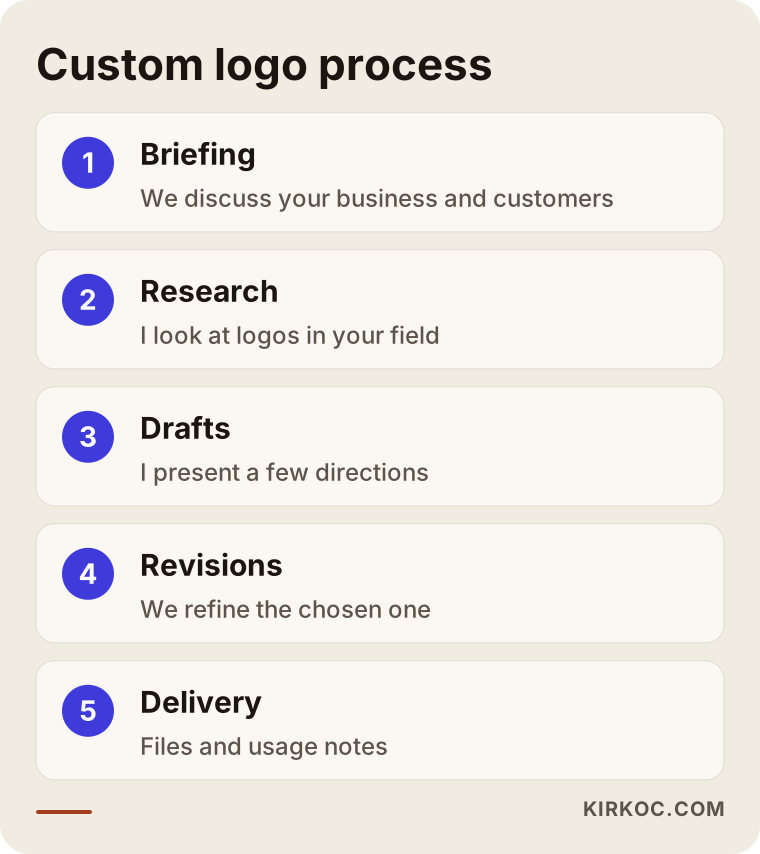
Each step has its own purpose. In the briefing we talk about your business, your customers and your expectations. In the research step I look at the existing logos in your field and find the space where you can stand apart. In the drafts step I present a few directions, and you do not have to like all of them. In the revisions step we refine the direction you chose. At delivery I hand over your files together with notes on which version to use where.
What should you have in your hands at delivery?
When the process ends you should hold not a single image but a complete set of files you can actually use. The list below shows the main items to tick off before you accept delivery.
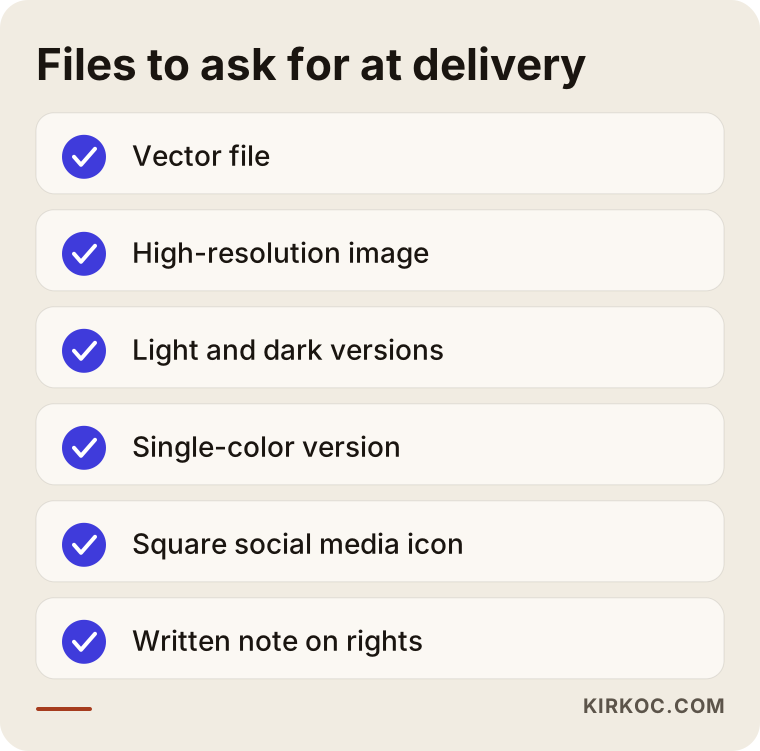
The most important item is the vector file, because your sign maker, your printer and your ad designer will ask you for it. Do not forget a version for light backgrounds and one for dark, a single-color version, and a small square icon for social media. A short written note about who owns the files will also guide you if a problem comes up later.
Common mistakes
Here are the mistakes I see in logo decisions. They show up both with people who pick templates and with people who pick custom work.
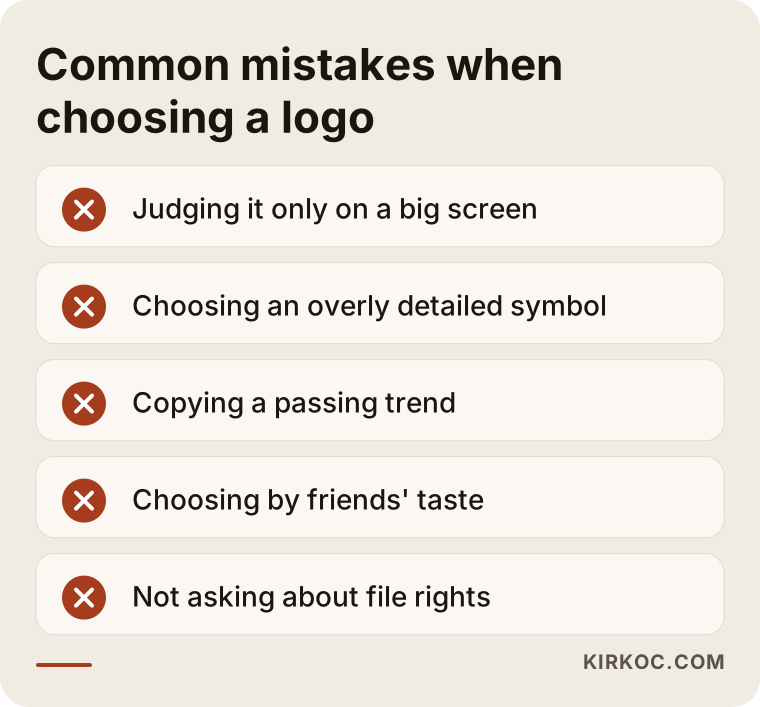
Let me unpack a few of them. The first is liking the logo only while it is big on a screen. On a business card, a profile photo or an invoice it takes up very little room, and if it cannot be read when small, it is not a good logo. The second is choosing an overly detailed symbol: thin lines disappear on a sign, in one-color printing or in embroidery. The third is copying a look that happens to be trendy, which can feel dated in two years. The fourth is choosing the logo to suit the taste of a relative or the people around you. A logo is not there to please people, it is there so your customer recognizes you.
The fifth mistake is not asking about file rights. If nobody wrote down who owns the work while the designer was working, you could face a question of permission or an extra fee down the line. That is hard to fix later and easy to settle at the start.
Color and your industry
When you choose colors, look at the habits in your field. If everyone uses the same shade of blue, a different shade can make you easier to remember, but a color that goes against the feeling of trust in your industry can hurt you. The easiest way to find the balance is to put your competitors' logos side by side and look at them together.
How do customers find you, and why does your logo matter?
A person thinking about getting a logo made usually searches with phrases like "logo design," "hire a logo designer" or "brand identity." If that same person is your customer, they will meet you first in search results and on the map, and then on social media. If your logo looks different everywhere, trust gets weaker.
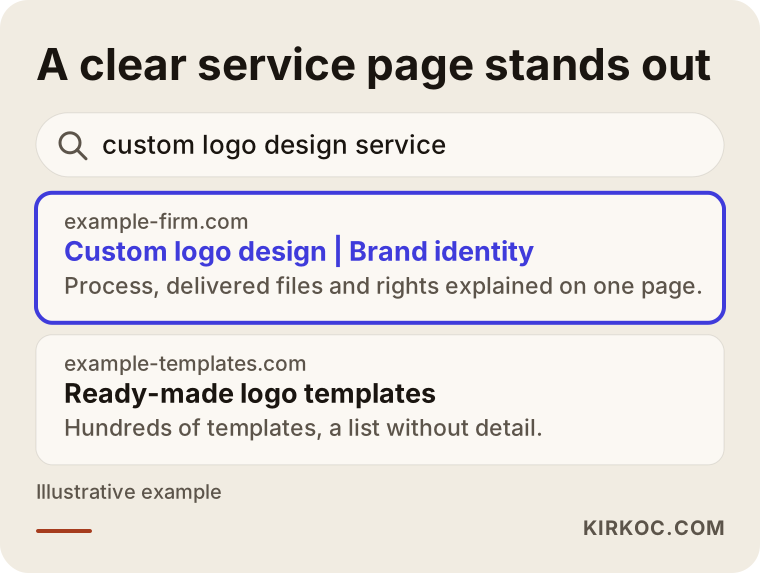
This is a made-up search page, but it shows something real. When the logo, the page title and the description all speak the same language, it is easier for the visitor to know which result to click. A page that explains your service clearly stands apart from generic template lists. I am not promising any ranking or result here. I am only saying that clarity makes your job easier.
A logo alone is not enough: the other parts of an identity
A logo is only one part of an identity. If the color palette, fonts, photo style, tone of voice and usage rules do not work together, the logo floats on its own. In a small business, having each of these done by a different person scatters the work: one person makes the logo, another builds the site, a third prepares the social media images, and in the end the three look like three different brands.
Because I handle all of this work myself, I can think about how your logo will look on your website, how small it will get on a social media profile and how it will work in an ad image while I am still drawing it. That prevents later fixes like "the logo does not fit the site" or "it cannot be read in the ad."
The timeline below shows the order in which the identity moves into use after the logo.
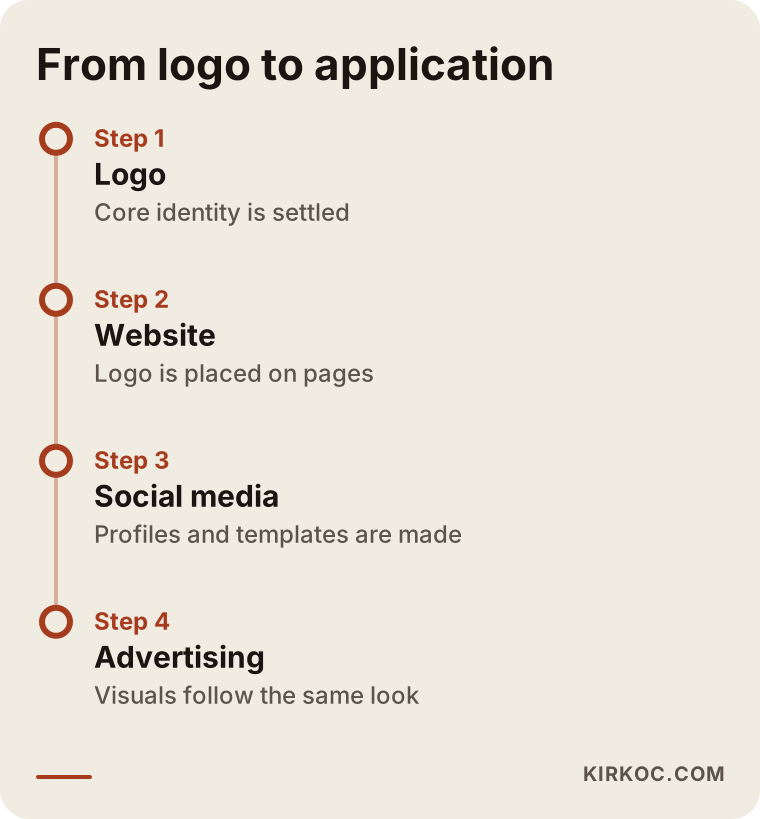
The order matters because some decisions cannot be undone. If you design the site before the logo is final, you may have to rework the site when the logo changes. The right path is the core identity first, then its use.
Where does the logo sit on a website?
On a website the logo usually sits at the top left and links to the home page. A smaller version for mobile screens should be prepared separately. A single-color version is used in the footer, and a very small icon is used in the browser tab. If you plan all of these uses ahead of time, you will not find yourself saying later that the logo does not work in a certain spot.
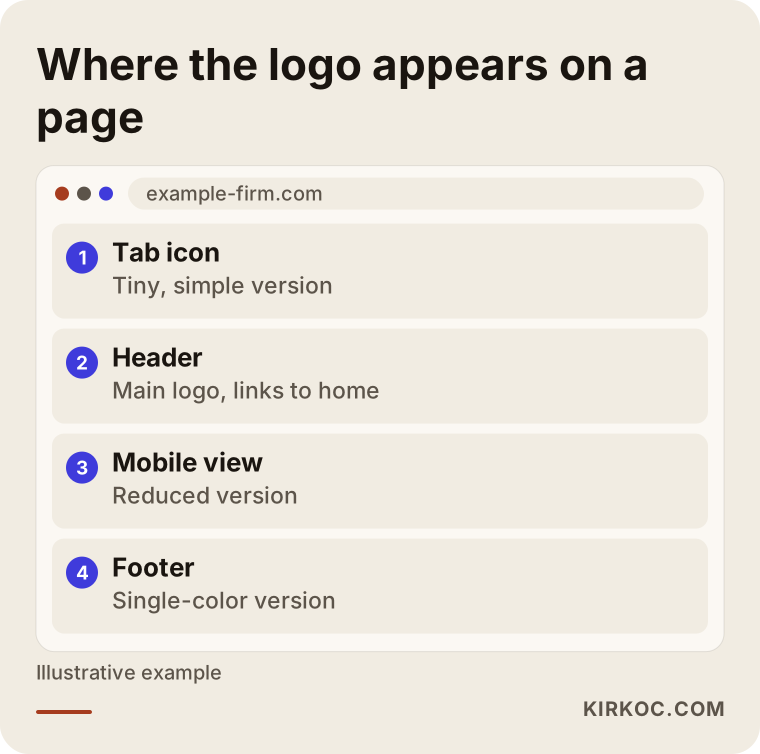
This layout shows how many different forms a logo needs to take on a single page. Templates usually come with only the main version, so you end up making the small and single-color versions yourself afterward.
What can you do yourself, and when do you need a specialist?
There are a few things you can do on your own. You can collect your competitors' logos and see what they have in common. You can note the examples you like and dislike, and find three adjectives that describe your business. This preparation speeds things up and lowers the cost whichever route you take. Trying a ready-made tool is harmless too, as long as you treat the result as a rough idea rather than your final logo.
A specialist is needed in these cases: you want a lasting identity that will be used on several channels, you are thinking about registering your trademark, you will have expensive items printed such as signs or packaging, and you want to stand clearly apart from your competitors. In those cases a mistake is expensive, so doing it right from the start costs less.
The diagram below shows a business owner's path from an idea to an identity as a funnel that narrows.
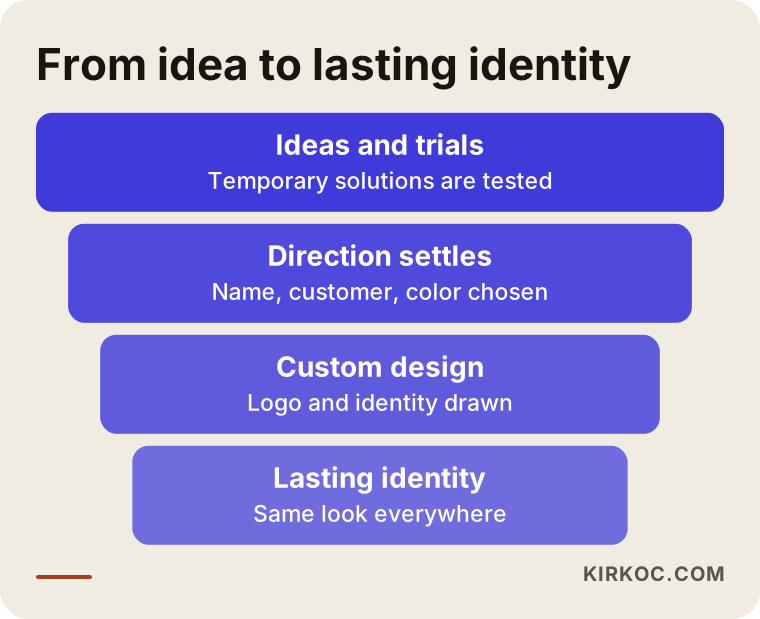
At the widest part of the funnel there are many ideas, trials and temporary fixes. As you move down, the options narrow, and what remains is a single identity that truly describes your business. A ready-made solution can be used at any stage of this process, but the thing that stays for good is original work that tells your business story.
Ask yourself before you decide
If you are torn, three questions will do the job. First, am I planning to print this logo on a sign or on packaging? Printed work cannot be taken back, so rushing here can be expensive. Second, am I sure about my business name and direction? If not, it makes more sense to settle the name first and have the logo made afterward. Third, if someone else ends up using this logo later, will it hurt me? If it will, uniqueness is not a luxury for you, it is a need. Writing down the answers and sharing them with a designer shortens the first conversation and means the quote is actually prepared for your business.
How I work
I am one person, and I carry a job from start to finish myself. A logo project begins with a conversation: we talk about your business, your customer and where you will appear. Then I look at examples in your field, prepare a few directions and develop one of them with your feedback. At delivery you get your files, your usage notes and a short guide explaining which file goes where.
If you like, you can combine this work with a website, social media management or advertising. Or you can order just the logo and identity part. I never add anything just to fill a package. The timeline and scope depend on the size of your business and what you want delivered, and the price follows from that.
Frequently Asked Questions
Can I start with a template logo and move to a custom one later?
Yes, you can, and many small businesses do exactly that. To make the switch easier, do not roll out the template logo too widely, meaning decide before you order thousands of business cards, a large sign or an expensive packaging run. If the colors and the name will not change, the move is smoother.
Are free logo makers reliable?
It depends on the tool and its license. Some give you only a low-resolution file in the free version, and some restrict commercial use. Read the license text before you use one. If you are not sure, ask a lawyer, because I cannot give a definitive ruling on this.
How long does custom logo design take?
It depends on the scope of the job and on how quickly you respond. A logo alone takes less time, and a full brand identity takes longer. The faster you reply to me, the shorter the process gets. We settle the calendar together before the work starts.
Who owns the rights to my logo?
This must be written clearly in the contract. With custom design, the usage rights generally pass to you once payment is complete, but it matters that this is in writing. With templates, the type of license decides. Whichever route you take, ask about the rights at the start.
Which file types should my logo be delivered in?
You should ask for at least one vector file, one high-resolution image file, versions for light and dark backgrounds, and a single-color version. A square profile icon for social media is useful too. This list also appears in the checklist graphic above.
What turns a logo into a brand?
A logo is a mark, and a brand is the impression behind that mark. A logo gains meaning as you use the same colors, the same fonts and the same tone consistently everywhere. That is why you should think of the logo as one part of an identity rather than on its own.
What happens to my logo if I change designers?
If you received the source files and the usage guide in full, you can keep working with another designer. If files are missing, the new designer may have to redraw the logo from scratch. That is why you should always check the file list at delivery.
What if the result looks very similar to a competitor's logo?
Looking at the logos in your field at the beginning reduces this risk. I pay attention to similarity during the design process, but judging similarity in legal terms is the job of a trademark attorney. If you plan to register, you should run that check with one.
If you are undecided between a template and a custom logo, write to me with a description of your business and your budget, and we will look at it together so I can tell you plainly which path suits you. To get in touch, visit the logo and brand identity service page and use the contact section.