You sell prefab or container homes, and your phone is not ringing as often as it should. Or it rings, but half the callers ask "how much, is it available?" and hang up. Maybe you have a website that was built years ago, or maybe you only post photos on Instagram. This is exactly why a website for a prefab home company deserves its own discussion: your customer is not buying a T-shirt. They are buying a building, and often they are trusting you with a large part of their savings. Your website is the first place, and sometimes the only place, where a stranger decides whether you are worth a phone call.
I am Ümit Kırkoç. I work from Istanbul and handle website design, search visibility, social media and advertising myself, all in one place. In this article I will explain what works on a prefab or container home website, what wastes money, and where to start, without burying you in technical terms.
How do buyers search in this industry?
Start with the questions in your customer's head, because your site works only as well as it answers them. Someone considering a prefab home usually moves through a few stages. First they wonder whether such a thing exists and whether it suits them. Then they look into what is possible on their own land. Then they compare companies. Finally they call two or three of them.
Searches follow the same order. The first group is looking for information: the difference between a prefab home and a steel-frame house, whether a container home is cold in winter, whether a permit is needed for this kind of building. The second group is looking for products and models: two-bedroom prefab homes, a guest house, a backyard office, a site office. The third group is close to buying: a prefab home company in their region, turnkey delivery, lead time, a price quote.
There is an important difference between these groups. The first person may not call today, but may remember you a few weeks later when they are ready. The third person may decide this week. A good site answers both at once: information pages earn trust, and product and quote pages lead to the phone call.
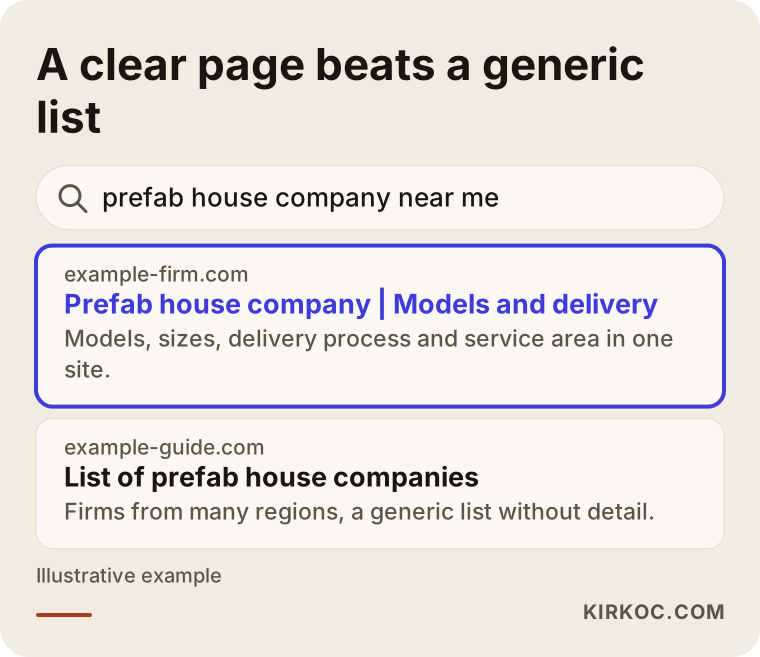
The image above shows how two pages can look in search results. A page that clearly states the topic, the region and what you offer gets clicked more often than a generic list page. I will not promise you a ranking, but a clear headline lets the customer think, "this is what I was looking for."
One more point: in this industry people often search by location. Someone who owns land in a particular region wants a company that serves that region, because delivery, installation and after-sales support all depend on distance. If your site does not say which regions you serve, the visitor has to guess. Most people would rather move on to the next company than guess.
Which pages should your website have?
Most prefab home sites have a single "Our Products" page with a photo gallery squeezed into it. But people who arrive with different intentions need different pages. Each page should do one job, which helps both the visitor and search engines understand what it is about.
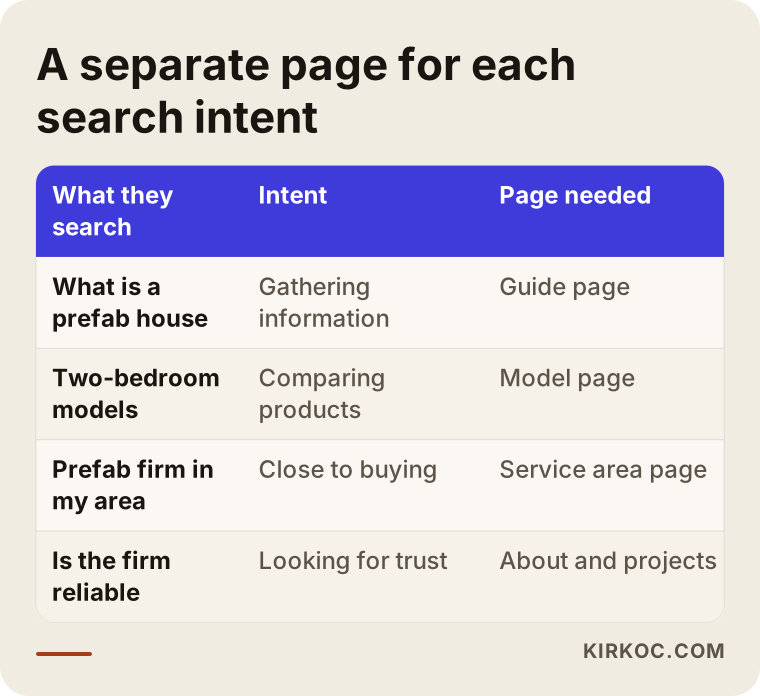
As the table summarizes, the person gathering information needs a guide page, the person comparing models needs a model page, the person who wants to describe their own situation needs a quote page, and the person asking "is this company reliable?" needs an about page and a page of completed projects. Let me go through them.
Model and product pages. Open a separate page for each model or product group: a container office, a single-storey prefab home, a garden cottage. The page should state the floor area, room layout, structural material, insulation approach, and what is standard versus optional. Add a floor plan drawing and real photos of finished work. If a customer cannot find the answer to "will this fit my needs?" on the page, they leave before ever calling you.
Service area pages. State where you deliver and install. If you have genuinely completed projects in a region, you can open a page for it. If you have not, do not create a page as if you had. Misleading location pages disappoint the customer and the search engine alike.
A process page. A page that explains what happens from order to delivery is, in my view, one of the most valuable pages in this industry. The customer's real fear is "I paid and the house never arrived" or "what showed up was different from what I was told." A company that shows its steps openly reduces that fear.
Frequently asked questions. Write down the questions customers keep asking on the phone: what does lead time depend on, who prepares the foundation, are electrical and plumbing connections included, how does the warranty work. This page lightens the load on your sales staff and also helps people find you when they search for those answers.
About and completed projects. If you have a factory or workshop, show it. Add photos from production, installation and delivered buildings. Do not share a customer's identity or address without their permission.
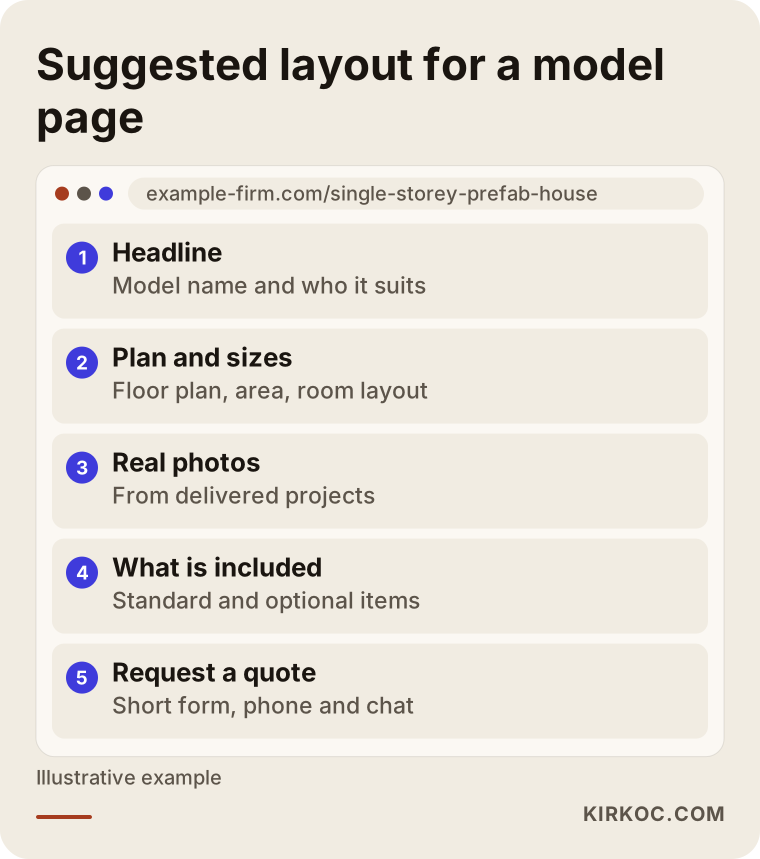
The layout in the image is the order I suggest for a model page. First what it is and who it suits, then plans and photos, then what is included, and at the bottom a clear way to request a quote. Keep your phone number and a messaging button visible all over the page. Most people in this industry browse on a phone, and the decision to call is made with one tap.
Trust is the real issue in this industry
If a dress turns out wrong, you return it. If a house turns out wrong, the problem is far bigger. That is why trust comes before design and before price on a prefab or container home site. The customer is thinking about paying a serious amount to someone they have never met, sometimes from another region. The job of your website is to shorten that distance.
The things that help most are usually ordinary, but they are often missing: a real street address and a location that shows on the map, the company's registered legal name, tax or business registration details, a phone number that gets answered, and photos of your office or factory. A site filled with stock photos says the opposite. Always use photos of your own work. Even if they are not perfect, real photos build more trust than a flawless stock image.
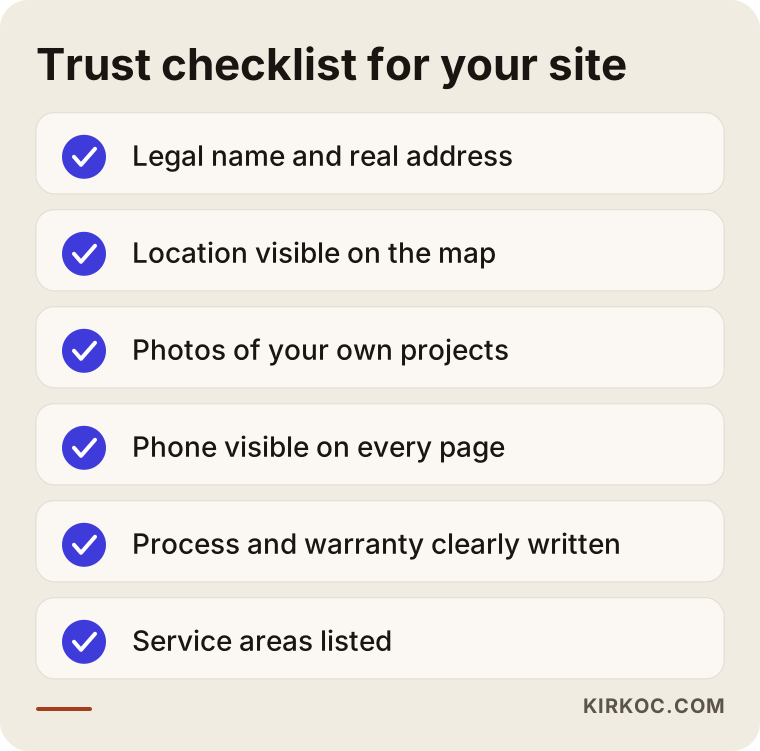
Compare the checklist items with your own site. Fixing the missing ones first usually brings faster results than commissioning a new design.
On contracts and permits: building permits, zoning and what kind of structure may be placed on a given lot all vary by location. Writing flat statements like "no permit needed" or "fits any lot" on your site can be misleading and can create liability for you. The honest approach is to point the customer to their local building or planning department and, where needed, to a lawyer, and to state clearly what you take responsibility for in your own process. Talk to a qualified attorney about this; I do not give legal advice, I only help you explain the topic honestly on the site.
The most common mistakes in this industry
These are the mistakes I see repeated. Some look small but cost you customers.
The first is a site that is only a photo gallery. Beautiful images catch attention but are not enough to make a decision. The customer wants to know dimensions, materials and what is included.
The second is cramming everything onto one page. When a container office, a prefab villa and a work camp are described together, whoever is searching for one of them cannot find themselves in any of them.
The third is saying nothing about lead time and process. When customers see uncertainty, they assume the worst.
The fourth is a site that looks broken on mobile. A large share of visitors in this industry use phones, and a slow site with tiny buttons is simply lost business.
The fifth is hiding contact details. A company that shows only a form and conceals its phone number can give the impression that it avoids being called.
The sixth is forms nobody answers. When someone submits a form, it should be clear who will reply and how soon. Leaving a request unanswered for days wastes even the best website.
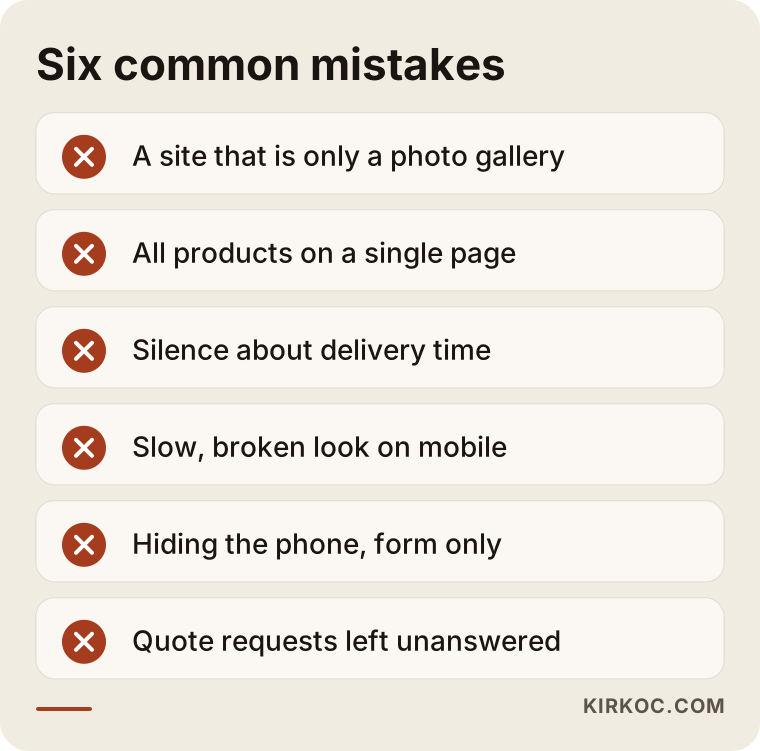
None of the mistakes on that list require a large budget to fix. Most are solved with well-planned content and a careful layout.
Two hypothetical example scenarios
The two examples below are entirely hypothetical. They do not describe a real company or person; they only make the process concrete.
Scenario 1: A small builder that only has social media. Suppose a workshop builds garden cottages and small container offices. It posts photos on Instagram regularly, and most orders come through people they already know. There is no website. Someone from Instagram sends a message asking about price and dimensions, the answer comes a day later, and by then that person has already written to another company. For this workshop the first step would not be a complicated site but a simple structure of seven or eight pages: product pages, a process explanation, frequently asked questions and clear contact details. The Instagram photos move onto the site, and the site links back to the social account. That way, someone on Instagram can reach the details on the site, and someone on the site can see recent work on social media.
Scenario 2: A mid-sized company with a site, but a silent phone. Suppose a company has a site built years ago that still shows old models, is hard to use on mobile, and has a contact form that goes unanswered. In search it appears only when someone types the company name, and never for general searches like "prefab home company." The answer here may not be to start from zero. First you check which pages are doing their job, update the outdated content, add the missing pages, and fix the form and phone path. After that you work on search visibility with regional and product-based pages. Results take time and cannot be guaranteed, but the direction becomes clear.
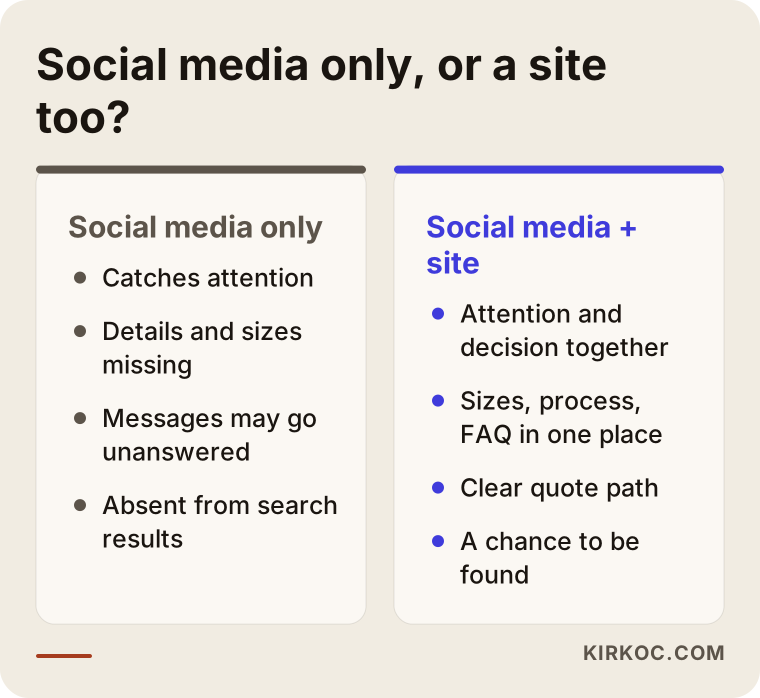
Putting the two scenarios side by side reveals a shared point: social media attracts attention, and a website carries the decision. They are not alternatives; they complement each other.
Step by step: how a site gets built
Knowing how the work progresses reduces hesitation. This is the order I usually follow.
Step 1: Clarify what you sell and to whom. Are you selling to individual buyers, to businesses, or to people who need site offices and work camps? Each calls for a different tone and different pages. At this step I also write down which regions you genuinely serve.
Step 2: Draw the page structure. Which model pages, which information pages and which region pages will exist? I sketch it on paper. There is no design yet, only a skeleton.
Step 3: Collect the content. Photos, plans, dimensions, frequently asked questions, the process description. This is often the longest step, because the knowledge is with you and has to be drawn out of you. I write down with you what each product includes and what it does not.
Step 4: Build the site. A structure that opens fast on mobile, with large buttons and a phone and messaging path visible everywhere. The form stays simple, because forms that ask too many questions get abandoned.
Step 5: Launch and measure. I set up tracking for important actions such as phone taps and form submissions. That way we can talk about whether the site actually brings calls by looking at it, not by guessing.
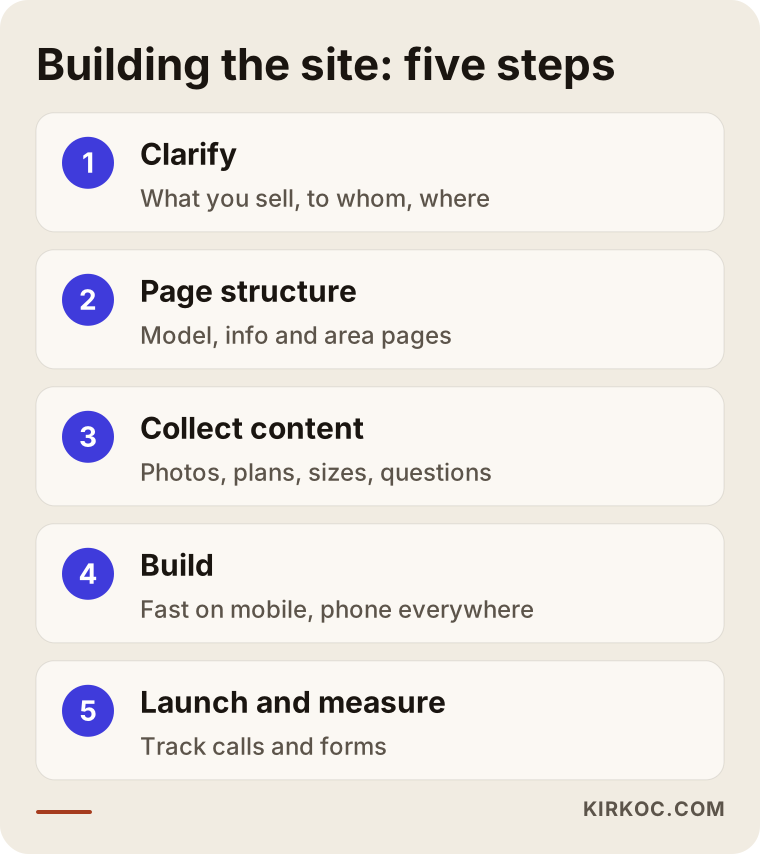
I have also summarized the process visually; each step leans on the one before it. Skipping steps and going straight to design is the path that most often forces people to go back and redo work.
Timeline: what to expect and when
I do not promise durations or results here, but I can sketch a general order. Planning and content collection come first. Then the site is built. After it goes live, search engines discover the new pages; that part is not under my control and has no fixed duration. In the meantime, social media and ads can bring visitors to the site and shorten the wait.
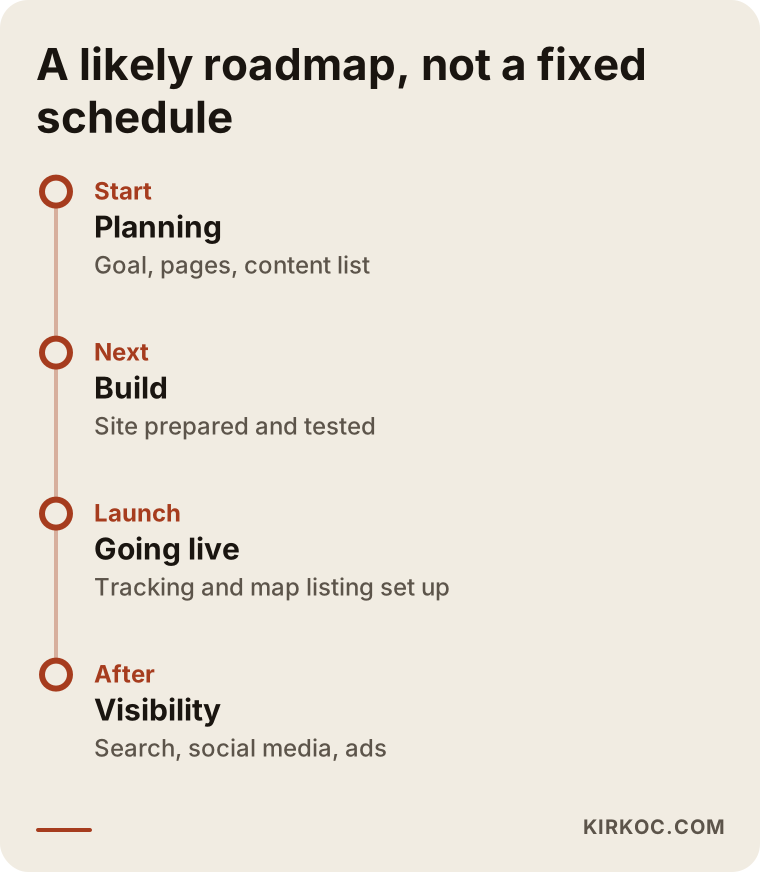
Read the order in the timeline as a possible roadmap, not as a fixed calendar. As in every industry, competition, region and content quality change the pace.
Search engines, maps and AI answers
For an expensive, well-researched purchase like a prefab home, people do not only search on Google. They also look at map apps, reviews, videos and, increasingly, AI assistants. That is why the information on your site should be consistent. Your company name, address and phone number should be written the same way on the site, in your map listing and on social media. Even small differences make both customers and search systems doubtful.
AI assistants such as ChatGPT can use pages that give clear, short and well-organized information as sources when they answer a question. Your frequently asked questions page, your process description and the clear details on your model pages help here too. I cannot guarantee that an AI answer will mention your name, but writing your information in an organized and accurate way is an investment that raises the odds and never hurts.
On the map side, fill in your business profile, which is the company card Google shows on the map: opening hours, photos, the area you serve and your phone number. When customers are happy, you can ask them to leave an honest review. Buying or inventing reviews is unethical and against platform rules.
Advertising: before the site is ready, or after?
Done right, advertising brings visitors to your site quickly. But pouring ad budget into a weak site is like filling a bucket with holes. The order matters: first the phone and form path on the site should work, then ads should be added.
Google ads are used to appear for searches close to buying, such as "prefab home company." Meta ads (Instagram and Facebook) are suited to showing model photos to people who are not searching yet but might be interested. They do different jobs. If your budget is small, it is usually healthier to start with one channel, see the results and then expand.
One trap with advertising in this industry is attracting many people but collecting few qualified requests. Some of the people asking "how much is it?" are simply curious, not buyers. Explaining clearly in the ad text and on the site how things work filters out the wrong people from the start and raises the quality of your calls.
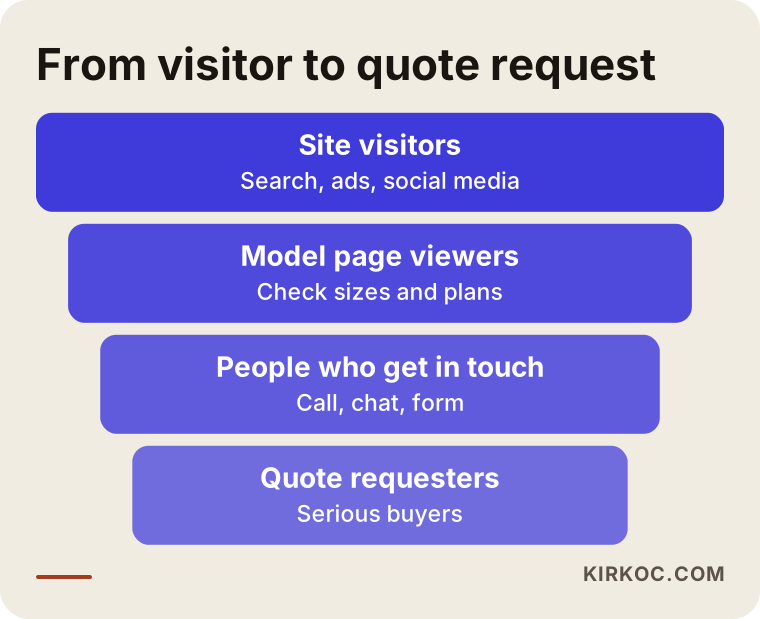
The funnel image says that not everyone who visits the site will request a quote, and that is normal. What matters is making the next step easy at every stage and being able to see where people get stuck.
What can you do yourself, and when do you need an expert?
You do not have to hand everything to a specialist. Some things you can and should do yourself, because the knowledge is yours.
Things you can do yourself: take real photos of finished projects, list the questions customers ask most, write the dimensions and included items for each model, keep your map listing up to date, and respond quickly to incoming requests. None of this needs technical knowledge.
Things that need an expert: building the structure of the site, making it fast on mobile, arranging page structure and headings for search engines, setting up phone and form tracking, opening and managing an ad account, and finding technical errors on the site.
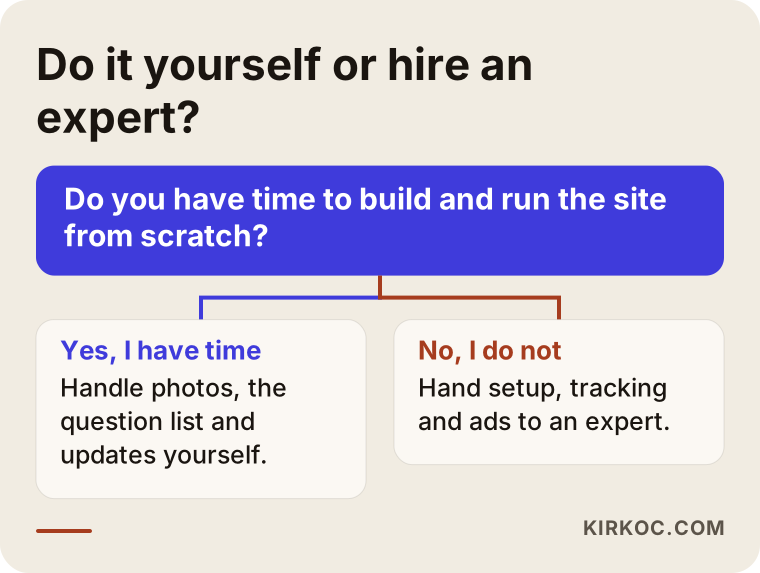
The decision flow rests on simple logic: if you have the time and interest, do the basics yourself; if you do not, or if the first setup has to be solid, give that part to an expert. You can also combine both: I do the setup, and you handle updates and adding new photos.
What determines the cost?
I will not give a number, because two prefab home websites can look nothing alike. But I can tell you clearly what determines the cost.
First, how many pages are needed. A company with three models does not have the same needs as one with twenty products in different sizes. Second, who holds the content: if photos, plans and text are ready, the work is shorter; if they are not, writing and image preparation are added. Third, how many languages or regions it targets; if you sell abroad, you need separate language versions. Fourth, extra features such as a model comparison tool, an online quote form or payment processing. Fifth, what you want afterward: only a site, or also search visibility, social media and ad management.
What makes a cheap site expensive is usually noticed later: it loads slowly, breaks on mobile, and nobody can find it. Before accepting any quote, ask what is included, who will update what, and whether the site is registered in your name. The domain name and the site should be your property.
How working with me works
I am one person, and that works as an advantage: because the site, search visibility, social media and ads are in the same hands, nobody can say "that is not my job." A new model added to the site can become a social media post and then an ad. You do not have to explain the same information in four different places.
In the first conversation I listen to what you sell, where you serve and where you are now. Then I write down which pages are needed, what I will ask from you and in what order the work will go. The quote makes clear what is included. I do not promise things nobody can guarantee, such as rankings or sales numbers, because those are not in my hands. What I can promise is an honest plan, regular communication and work that can be measured.
Frequently asked questions
I run a small prefab home company. Do I really need a website?
In most cases, yes. Social media catches attention, but visitors look somewhere for details like dimensions, process and what is included. A simple but organized site lightens the burden of answering the same questions for every customer one by one.
Do I need separate sites for container homes and prefab homes?
Usually not. One site with a separate page for each product group is enough. If your products target very different audiences, for example a site office and a weekend cottage, separate sections make things clearer.
How soon will my site start bringing calls?
I cannot answer that accurately, because region, competition, content quality and whether you run ads all change the timing. Ads can bring visitors faster; visibility in search engines usually builds more slowly. In either case, results cannot be guaranteed.
Should I show prices on the site?
That depends on how you sell. If the price depends on size, materials, region and delivery, saying so clearly helps customers understand, even if you give no figure, and can reduce empty calls that only ask for a price. If you do publish figures, you need to keep them up to date.
How should I talk about permits and zoning on the site?
Avoid flat statements. Zoning and permit requirements vary by location; point the customer to the relevant local authority and state clearly what you take on in your process. For legal details, talk to a lawyer.
I also sell abroad. Do I need a multilingual site?
Because customers in the target country search in their own language, separate language versions usually help. But do not leave translation to automatic tools; if product and technical terms are translated wrongly, trust disappears.
How should social media and the site relate to each other?
Social media is the showcase and shows recent work; the site provides the detail needed for a decision and the way to contact you. They should link to each other, and the same company name, address and phone number should appear everywhere.
I already have a site. Should I redo it or fix it?
First I need to look at the current site. If the structure is sound and only the content is outdated, fixing it may be enough. If the site is unusable on mobile or the foundation is very old, rebuilding is wiser. I will tell you honestly after reviewing it.
If you want to show your prefab or container home business to the right people, build trust and get more qualified calls, reach out to me through the website design service page. I will listen to your situation, and we can work out the right path together.