You sell promotional products: pens, notebooks, tumblers, tote bags, apparel, corporate gift sets. You have a print setup, suppliers you trust and years of know-how, yet the phone only rings with people who already know you. Your website is either missing, built years ago and never opened since, or a giant catalog with hundreds of items in a row where nobody asks for a quote. This article explains how a promotional products company website should be built, how corporate buyers actually look for a supplier, and which pages bring in quote requests. I am Ümit Kırkoç. I work alone from Istanbul, and I handle website design, SEO, ads and social media as one job, so nothing gets lost between different people.
Here is the main point first. A promo products website is less a shopping cart and more a quote-collecting machine. The buyer is usually a marketing or purchasing employee spending a company budget, not their own money. They will not order until quantity, logo, delivery date and sample questions are settled. Your site has to start that conversation. Showing products is not enough.
How do customers search for a promotional products supplier?
Picture a marketing manager at a mid-sized company. A trade show is two months away and she needs something to hand out at the booth. She types "custom logo thermos bulk" or "promotional pens with logo" into Google. Someone else needs holiday gifts for employees and searches "corporate holiday gift sets." A third person does not know the product at all. He is thinking "something inexpensive but nice to give our clients" and starts by looking for ideas.
These are three different intentions. The first is product-focused and close to buying. The second is tied to an occasion and usually has a deadline. The third is browsing for inspiration and has not decided anything. If your site has one page called "Products," you cannot answer any of these three people well.
The image below is an invented example of how a search result might look. A page that states the product, the print options and the minimum order can beat a generic product list.
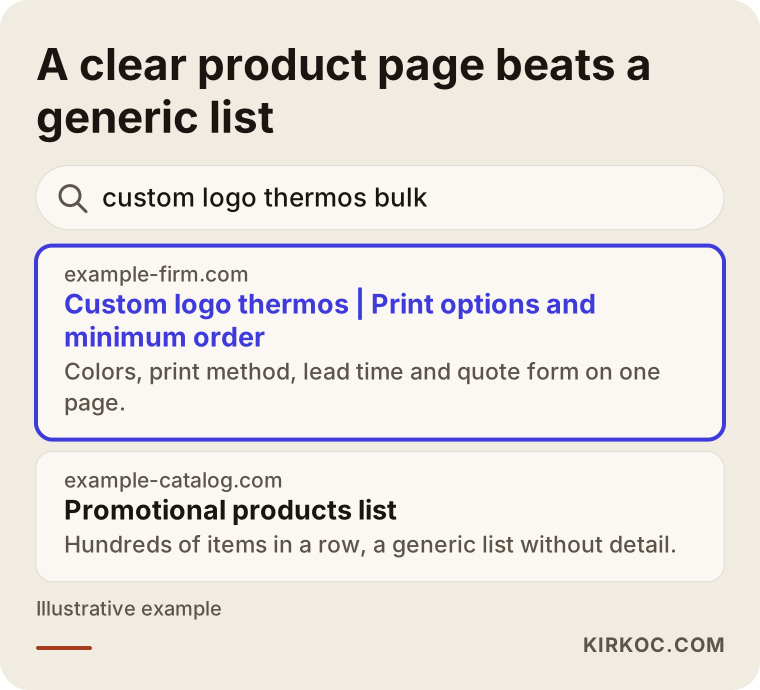
The difference is simple. The highlighted page tells you the product, the print choice and the delivery information in the first line. The buyer knows before clicking whether it is worth their time. In the generic list, nobody can tell whether the item they need is even available.
The buyer wants to solve a problem, not buy a pen
Someone ordering promotional items rarely wants "a pen" for its own sake. They want to be remembered at a trade show, thank their distributors, or give a new hire a welcome pack. Your site should recognize those purposes. Pages such as "trade show giveaways," "holiday gifts," "employee welcome kits" and "dealer appreciation gifts" open more doors in search, and they also tell the buyer that someone here understands the job.
Which pages should a promo products site have?
You do not need to inflate the page count, but a few pages should not be missing. A home page, category pages, occasion pages, a printing and customization page, a samples and delivery page, an about page (your story and your workshop) and a quote page. Each answers a different question.
The table below shows which page answers which intention.
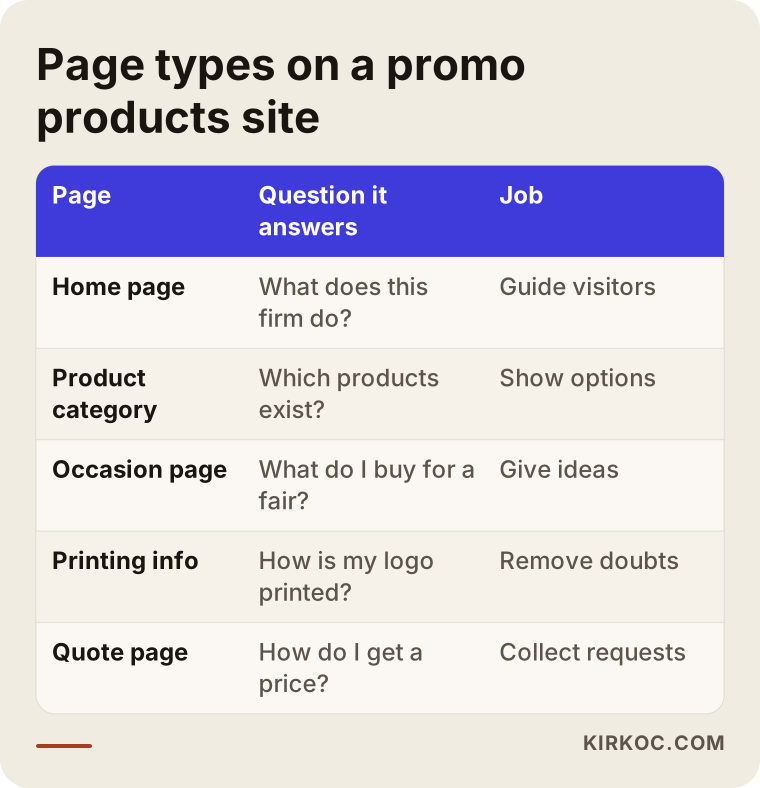
Notice that every page has one job. A category page shows products, the printing page answers "how will my logo be printed?", and the quote page moves the visitor to act. If you squeeze everything into one long page, it becomes hard to read, and Google cannot tell which search you should appear for.
A product page is not a catalog line
On many promo sites, a product page is a photo, a name and a "Request a Quote" button. A buyer wants more than that. Which colors exist? Which print method applies? How large is the print area? What is the minimum order? What changes the production and delivery time? Giving this information in a short, consistent way on every product page also improves the quality of the requests you receive, because the person asking already knows what to ask.
Be honest about photos too. Real samples you made, with a printed logo, build more trust than supplier catalog images that appear identically all over the internet. If a hundred companies use the same photo, there is nothing that sets you apart for Google either.
What should be visible on a product page?
To make the layout concrete, I prepared a hypothetical page outline. You can compare your own site against it.
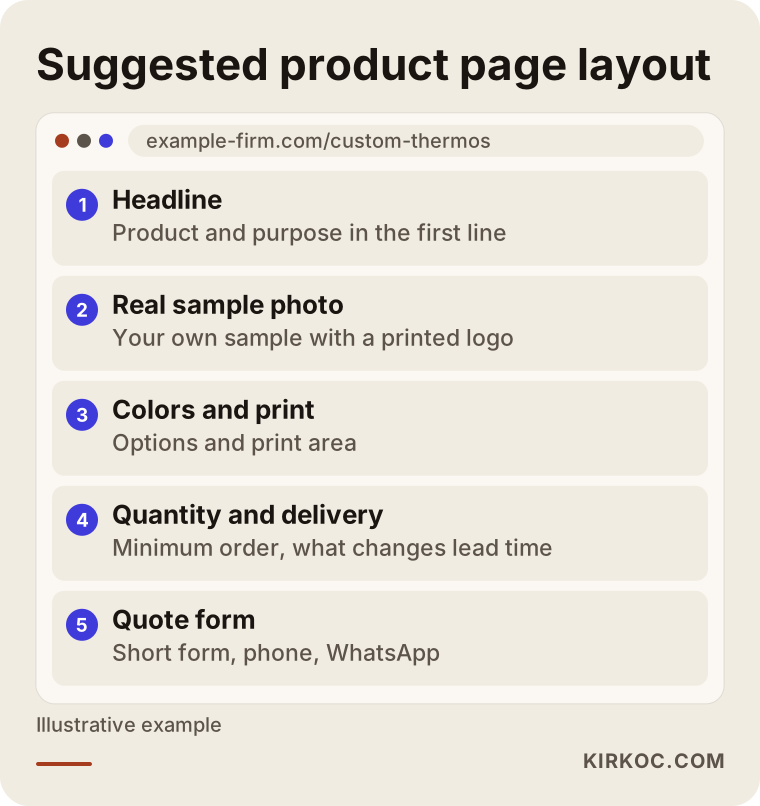
In this layout, the visitor reads from top to bottom and first learns what the product is, then how it is customized, then how fast and in what quantity it can be delivered. At the very end there is a single clear step: ask for a quote. Piling links to other products in the middle of the page pulls the visitor away from that goal.
Should you show prices or hide them?
This question comes up a lot. In promotional products, price depends on quantity, print method, number of colors and deadline, so a fixed price is often impossible. Still, instead of just writing "call for pricing," you can explain on the page what the price depends on. A buyer who cannot see a number but can see the logic will usually find you more transparent. You can also explain a rule such as "the unit price drops after a certain quantity" without naming a figure. That idea alone builds trust.
Why does a quote request go through a funnel?
Not everyone who visits your site will ask for a quote. Some just look, some browse a few products, some build a list, and very few fill out the form. That is not a loss. It is the normal flow. Your job is to make the next step easy at every stage.
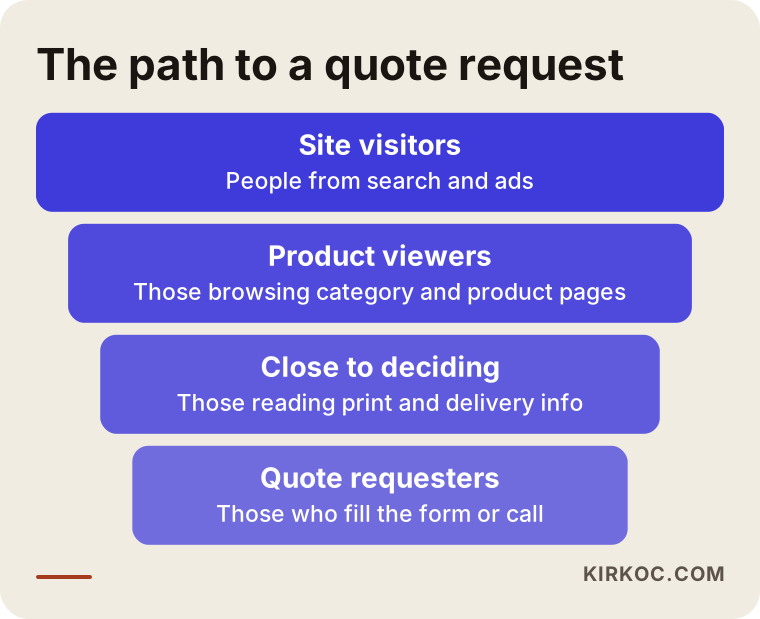
The most critical point in the funnel is the last stage, the form. A corporate buyer usually wants to finish the task quickly. If your form is long, full of needless fields or awkward on a phone, the buyer moves to another supplier. A good quote form asks for only a few things: what you want, the approximate quantity, the date you need it, the logo file and contact details. Everything else you can sort out by phone.
Keep other doors open next to the form
Not everyone fills out forms. Some people call directly, and some prefer to message on WhatsApp or by email. Keep your phone number and your messaging link visible on every page. For a visitor on a mobile device, a one-tap call button is very valuable, because buyers often check suppliers from their phone in the middle of a busy day.
Example scenario: from an old catalog site to a quote-collecting site
Here is a hypothetical example. This is not a real company. I made it up to describe a typical situation. Imagine a mid-sized promotional products company that has been in the business for ten years and gets work through personal contacts and past customers. Its site was built long ago: a slideshow on the home page, a "Products" page and a contact form. Products sit in one long list with no categories, and no product has its own page.
The problem is not that the products are bad. The problem is that the site cannot explain itself to Google or to the buyer. My suggestion would be to choose the three or four product groups that bring in the most work, write separate category and product pages for them, and then add seasonal occasion pages for trade shows and the holidays. None of this is magic, but you would appear in search results through more doors than before. I do not promise timelines or outcomes, because Google does not announce in advance what it will rank and when.
Step by step: how is a promo products site built?
If you do this work in order, you save both time and money. Instead of adding pages at random, I suggest this sequence.
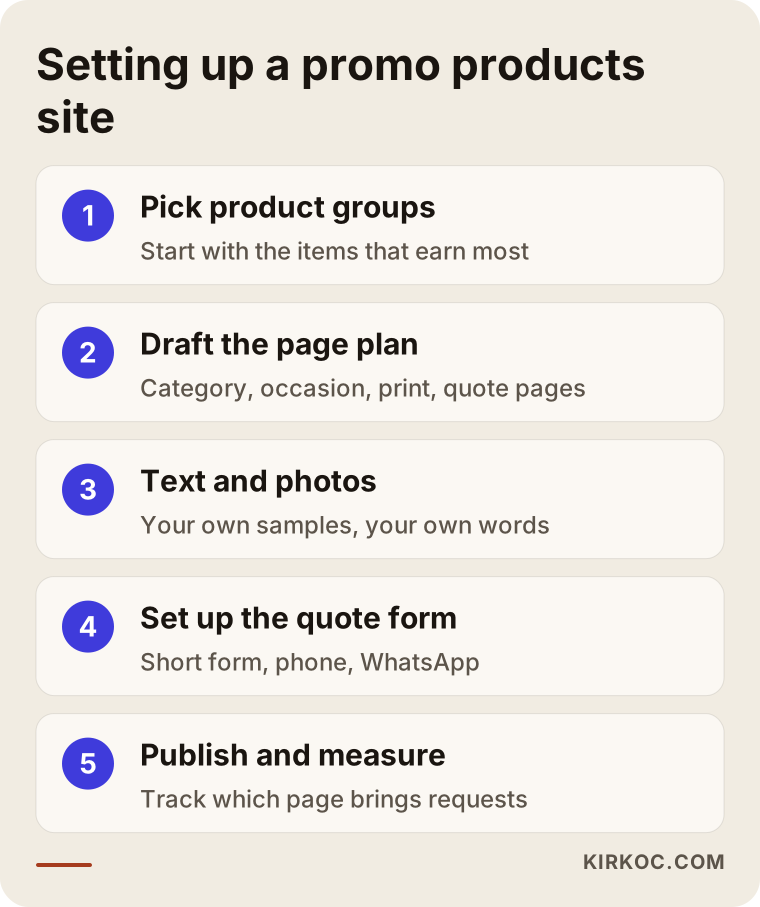
Let me explain the process a little. In the first step, you look at which product groups are really profitable and sustainable for you. It is better to start with the items that earn the most than to push hundreds of products at once. In the second step, a page plan is drawn up for those groups. In the third step, the text and real photos of each page are prepared. In the fourth step, the quote form and contact options are set up. In the fifth step, the site goes live and you track how many people reach the form from which page.
Speed and mobile display
Promo sites carry a lot of photos, and that can slow a site down. Large, unoptimized images make a buyer on a mobile connection leave. Keeping images at the right size, splitting category pages into sections rather than loading hundreds of products at once, and making buttons large enough to tap comfortably may look like technical details, but they directly affect how many quotes you receive.
Example scenario: a small workshop selling only corporate gift sets
The second hypothetical example is not about a real person either. Imagine a small workshop that does not sell a wide range of items but prepares corporate gift sets from handmade materials. The sets are personalized with the company's logo. The workshop offers little variety, but the quality of its work is high.
This workshop does not need a huge catalog site. In fact, growing the catalog could hurt it. What it needs is a few strong pages describing the contents of the sets, the personalization options and the preparation time, plus a photo-heavy gallery of examples. For a workshop like this I would plan social media together with the site: the making process and finished sets are shared on Instagram, and the website is the door for quotes. Here the benefit of having everything handled by one person shows. The photo shoot is done once, and the same material goes to the site, to social media and to ads.
PDF catalog or pages on your site?
Many promotional products companies put their PDF catalog on the website as a "download" button. That can be a start, but it is not enough alone. A PDF does not introduce your products one by one to Google, and it does not start a conversation with the visitor. You do not know who downloaded the file or whether they will come back.
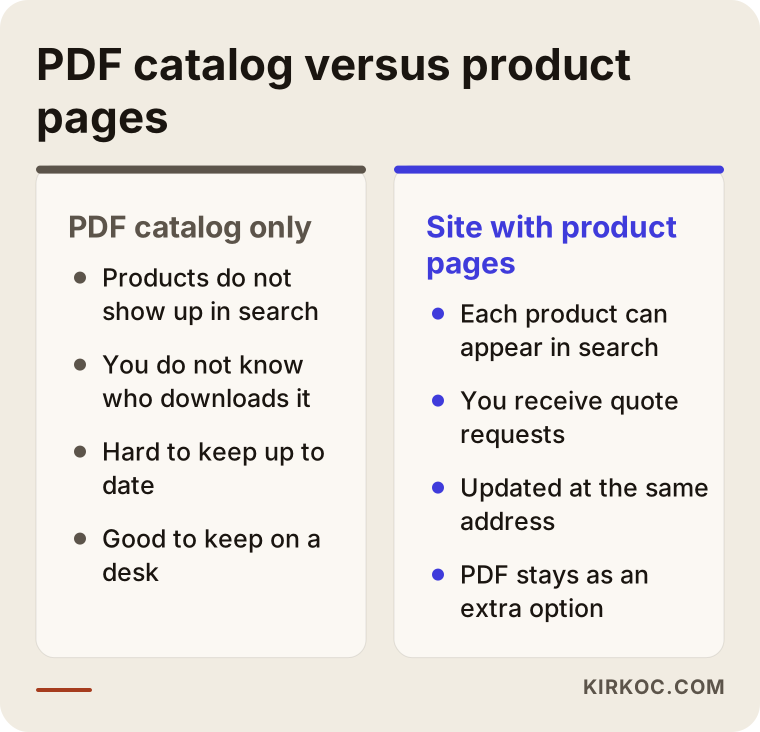
In short, a PDF is valuable as a document to print and keep on a desk, but to appear in search and collect quotes you need product pages. The sensible answer is to use both. The site has the product pages, and the PDF is offered as an extra "full catalog" option.
The most common mistakes promo products companies make
When I look at sites in this industry, I see a few mistakes repeat. Knowing them saves you time when you review your own site.
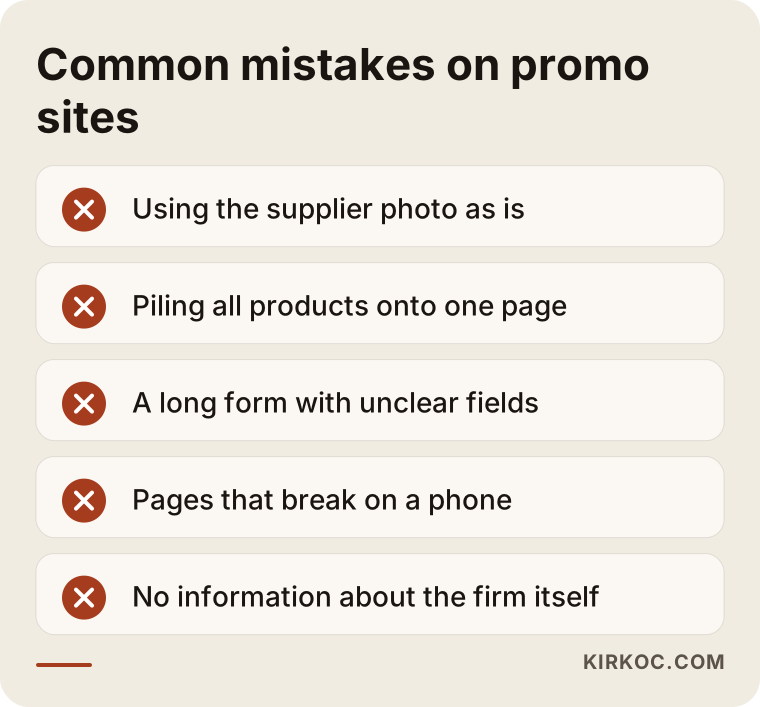
The first mistake is using the photos and descriptions your supplier sends as they are. If the same text exists on hundreds of sites, Google sees them as copies of each other and may not highlight any of them. The second mistake is putting all products on one page. The third is a form buried on a contact page where it is unclear what information is wanted. The fourth is never testing the mobile view. The fifth is a site that never says who the company is, where it is and how it works.
Do not forget trust signals
A corporate buyer does not want to place an order for hundreds of units with a company they do not know. So the site should show your address, phone number, way of working, sample policy and, with permission, who you have worked with. Get permission before naming any client; if you do not have it, do not write the name. Instead, describe in general terms which industries you serve or what kinds of events you prepare items for. To show print quality, use examples you produced yourself.
How do you manage seasonal demand?
The promotional products business is seasonal: trade show season, the end-of-year holidays, back to school, company anniversaries. Buyers often search at the last minute, but you need to prepare long before. A holiday gift page should be live and noticed by Google weeks before the holidays. Otherwise, by the time the buyer finds you, it is too late for delivery.
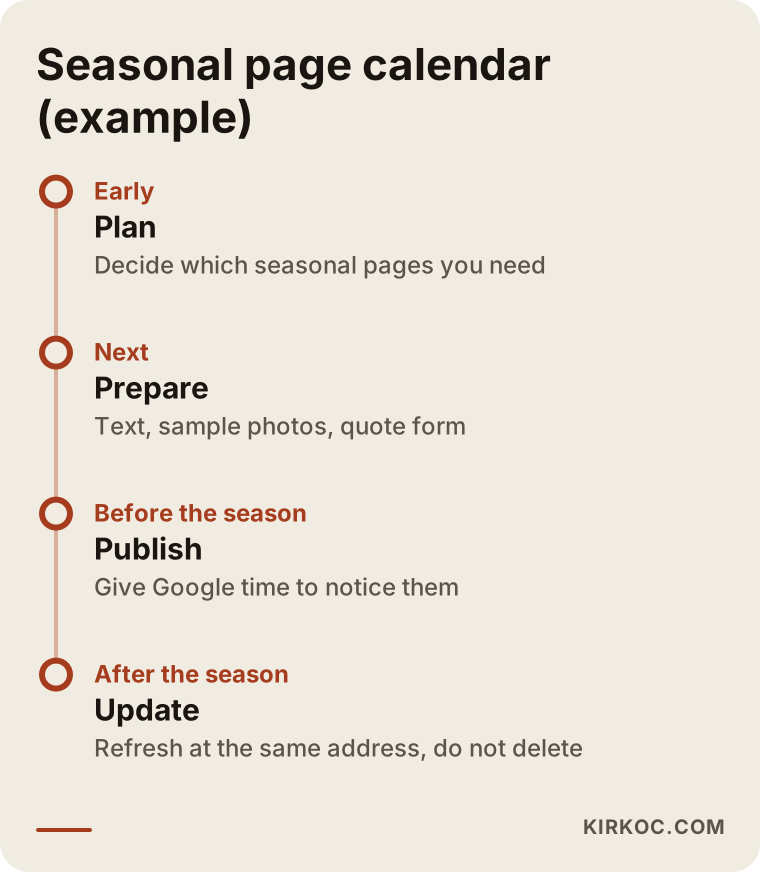
Take this timeline as an idea, not a rule. What matters is updating seasonal pages at the same address instead of rewriting them from scratch every year. A holiday page that is refreshed at the same address each year builds value in Google's eyes over time, while a page opened at a new address every year loses that accumulated value.
Why printing and customization deserve their own page
The topic buyers get stuck on most is how the logo will be printed. Which methods, such as screen printing, heat transfer, laser engraving, embroidery or digital printing, are used on which product? What file format is required? How does the number of colors change the result? Instead of writing all of this at length on every product page, explain it once on a printing guide page and link to it from the product pages. This avoids repetition and also opens a separate door for someone searching "how is a logo printed on a mug."
On this page, avoid jargon. Instead of "vector file," a sentence like "the version of your logo that stays sharp when enlarged, which your designer can usually send you" puts the reader at ease. Buyers often do not know what format the logo file should be in and hesitate to start an order because of it. Removing that hesitation shortens the road to a quote request.
Samples and the approval process
The biggest fear of a corporate buyer is that thousands of units arrive and the color or print is not what they expected. Describe the steps of requesting a sample, approving the design and doing a final check before production in a simple sequence on the site. Do not hide the terms, such as whether a sample is paid or free and how long it takes to prepare. Clear terms build more trust than vague promises, and they also reduce unnecessary phone traffic.
What can you do yourself, and when do you need an expert?
You do not have to outsource everything. Some tasks you can do on your own, and for others expert help makes more sense.
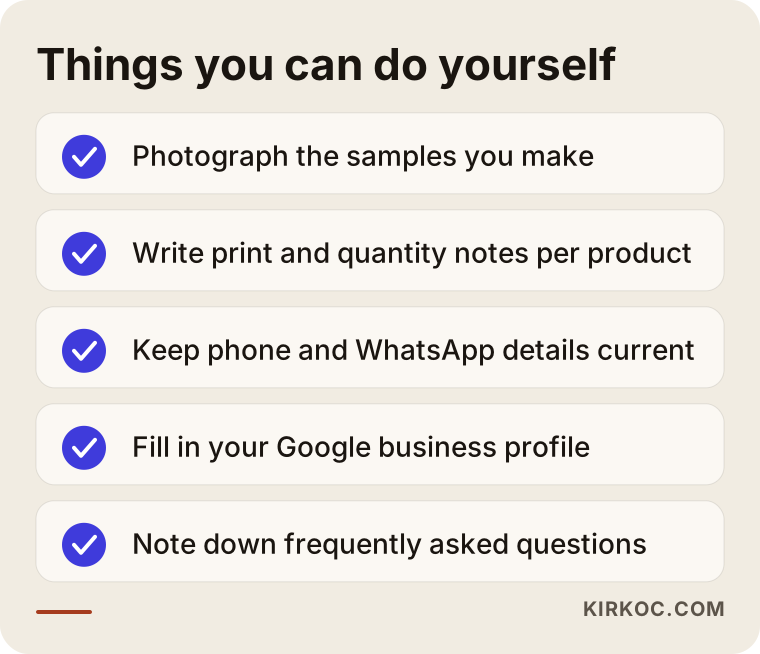
Things you can do yourself include photographing samples you made, writing print and quantity information for each product, keeping your phone and WhatsApp details up to date, opening your Google business profile and filling it with correct information, and noting the questions customers ask most often. None of this needs technical knowledge, and all of it does a lot of work.
Tasks that call for an expert are building the structure of the site, tuning speed and mobile display, making sure the right pages appear in search, setting up the quote form and its tracking, and, if needed, managing Google and Meta ads. What I do as a specialist is set these up on your behalf and show you how they work in a way you can understand.
When should you get outside help?
The decision diagram below helps you see whether it makes more sense to continue on your own or to get support.
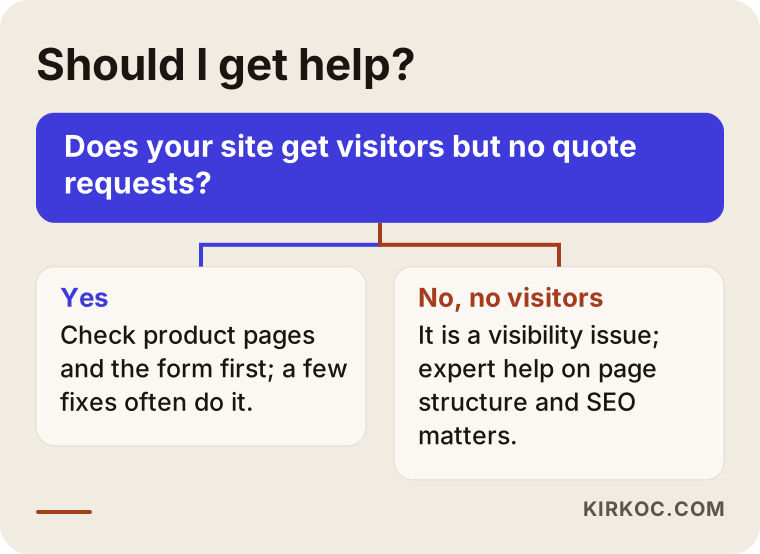
The logic is simple. If your site has pages and gets visits but no quotes, the problem is most likely in the page content or the form, and a few fixes often solve it. If no visitors arrive at all, the issue is visibility, and that is where expert support makes more of a difference.
What determines the cost of a promo products site?
I will not give figures, because every project is different. But I can say clearly what drives the cost. The first factor is the number of products and pages: describing a hundred products on separate pages is not comparable to a site with ten products. The second is who prepares the content. If you write the text and take the photos, the work is lighter. If I have to write the copy or organize a photo shoot, time and effort go up.
The third is the complexity of the quote system. There is a real difference in effort between a simple form and a setup where visitors add products to a list and request a bulk quote. The fourth is the need for multiple languages and export sales; if you sell abroad, you need pages in other languages. The fifth is whether the site will be supported with SEO, ads and social media after launch. A one-time site and a structure that keeps growing are planned differently.
How I work with you
I work alone, which means the person you talk to is the person who builds the site, edits the text and runs the ads. The process usually begins with an introductory conversation: what you sell, who you sell to and which products are your priority. Then I draft the page plan, you approve it, and I build it. After launch, we look together at what works.
There is a practical benefit to this approach. When the site, SEO, social media and ads sit with one person, they do not contradict each other. A product photo shared on Instagram and the page on your site speak the same language, and a visitor who clicks a Google ad lands directly on the quote page for that product. You do not have to explain the same thing four times to four different people.
Frequently Asked Questions
Is an online store or an informational site better for a promo products company?
For most promotional products companies, a site that collects quote requests suits better than a cart-based store, because price changes with quantity, printing and date. If you have ready-made standard products and also sell to individuals, you can add a shop section.
Do I have to show all my products on the site?
No. Start with the product groups that bring in the most work and that you do best. Adding new groups later is healthier than opening hundreds of weak pages at the start.
Can I use the photos my supplier sends me?
Talk to your supplier about usage rights, and consult a lawyer if needed. Also, because the same photos appear on many sites, they will not set you apart. Whenever possible, add photos of samples you produced yourself.
When will my site appear on Google?
Nobody can say for certain in advance. A new site is first crawled, evaluated and then gradually becomes visible. You may see results earlier for very specific searches with little competition and later for broad ones. Be careful with anyone who guarantees rankings.
What information should a quote form ask for?
The product or purpose, approximate quantity, date needed, logo file and contact details are enough. A form that is too long means visitors who leave without filling it in. You can clarify details by phone or message.
Should I run Google and Meta ads?
If your site is ready and the quote form works, ads can support specific products or seasons. Site first, ads second is usually the better order, because sending ad traffic to a weak page wastes budget.
I sell internationally. Should the site be in other languages too?
If buyers in your target country search in their own language, you need separate pages in that language. Do not leave translation only to a machine; industry terms and local habits can differ from country to country.
Should I redo my current site or start from scratch?
If your site is technically sound and only the content is weak, improving the existing structure may be enough. If the foundation is old, broken on mobile or very hard to change, rebuilding makes more sense. We can decide that together after looking at your site.
If you want a site that brings quote requests for your promotional products company, reach me through my website design page, and we can look at your products, your target customers and your current site together.