Most water treatment customers do not wake up planning to buy a system. One day the tap water tastes off, a kettle is crusted with scale, the old filter light starts blinking, or a new baby is on the way, and the phone comes out. What that person wants is not a brand story. They want to know who can come, when, and roughly what it involves. If you already have a water treatment company website and the phone is still quiet, the problem is usually not how the site looks. It is that the site does not answer those three questions. In this article I explain which pages your business needs, how customers actually search, and where to start, without technical language. If you are thinking about a fresh build, you can also look at what my website design service covers.
Why people with water problems go online
Buying decisions in this trade follow two different paths. The first is the "something is wrong" path: the water smells, the system is beeping, the filter is overdue, the faucet aerator is clogged with mineral deposits. This person is in a hurry. They look at the first two or three results and contact whoever is easiest to reach. The second is the "research" path: they just moved into a house, they want cleaner drinking water for a child, they are equipping an office, or they have noticed that the water heater and dishwasher are suffering from hard water. This person reads for days, compares, and asks several companies for a quote.
These two visitors look for different things on your site. The person in a hurry wants a big phone number, the areas you cover, and an answer to "can you come today?" The researcher wants to understand how the different system types differ, how often filters need changing, what installation involves, and what the warranty says. A good site makes room for both. A weak one simply lines up a product catalog.
The graphic below shows how two different searches typed into the same box call for two different kinds of page.
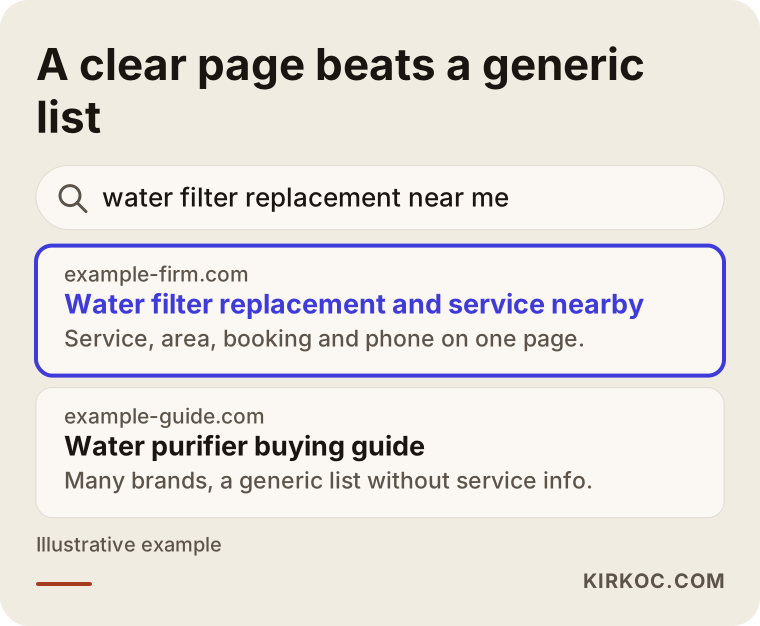
The page that states the service, the area and the way to reach you looks far more convincing than a mixed-up general list. The way to build that is to organize your site around the questions customers ask, not around your product lineup.
What your customers type into Google
Someone with no technical background does not search for "reverse osmosis membrane" or "remineralization stage." A homeowner usually types things like: water softener for my house, water filter replacement, water filter service near me, under-sink water filter, hard water treatment, or office water filtration. The people who know the technical terms are fewer, and they have usually already made their decision.
That is why listing brands and technical names on your site is not enough. Each kind of search deserves its own page that fits what the person wants. The table below sorts the common search types and the page that suits each.
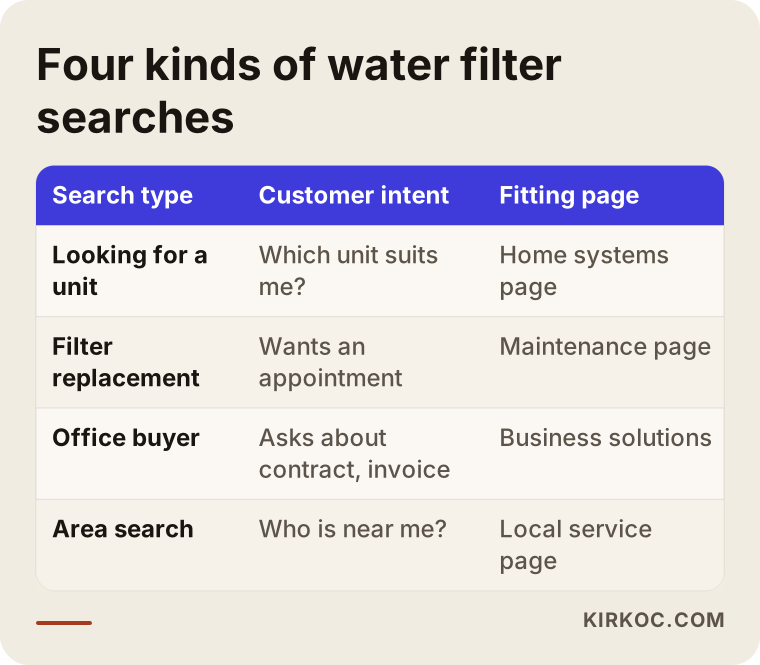
Look at what the table implies. Someone searching for filter replacement does not want to buy a system. They want an appointment. If you show them a catalog, you lose them. In the other direction, if a person asking "which system is right for my home" lands on a page that only has a service phone number, there is no trust yet, and they close the tab.
The pages every water treatment site needs
A water treatment company does not need a huge website, but a certain set of pages has to be complete. Based on what this trade really needs, this is the list I would build.
Home page. It should show in the first screen what you do, which areas you work in and how to reach you. A concrete line such as "Water filtration systems, filter changes and maintenance for homes and offices" does more work than "Quality, trusted, customer-focused," which every company writes.
Home systems page. Under-sink units, countertop units, whole-house systems and softeners should each have their own heading. For each one, explain who it suits and what it does in simple words. If you cannot say what a unit does in one sentence, the customer will not understand it either.
Commercial and office page. A business customer thinks differently: how many people will use it, is there a maintenance contract, can you invoice the company, and who handles it when something stops working. Write the answers to these separately from the home page.
Filter change and maintenance page. This is the most steady source of income in the trade. Say clearly how often filters are changed on which kinds of units, how a change is carried out and how to book. If you service units from other brands, say so. For someone searching, that is a big difference.
Service areas page. List the towns, suburbs and neighborhoods you actually serve, one by one. Writing "the whole metro area" does not answer anyone who searches for "water filter service in [your town]." The short version: a page that names the town and truly serves that town is the one that gets found.
Water testing and advice page. Many customers do not know what kind of water they have. A page that explains whether you offer a free or paid water test and what it is for builds trust. Do not make medical or health promises here. "We will choose the right system together based on your water" is enough.
FAQ and contact. Phone number, text or WhatsApp, address, opening hours and a map should look the same at the bottom of every page.
If you would like to see how this looks page by page, the diagram below shows how a typical service page can be laid out.
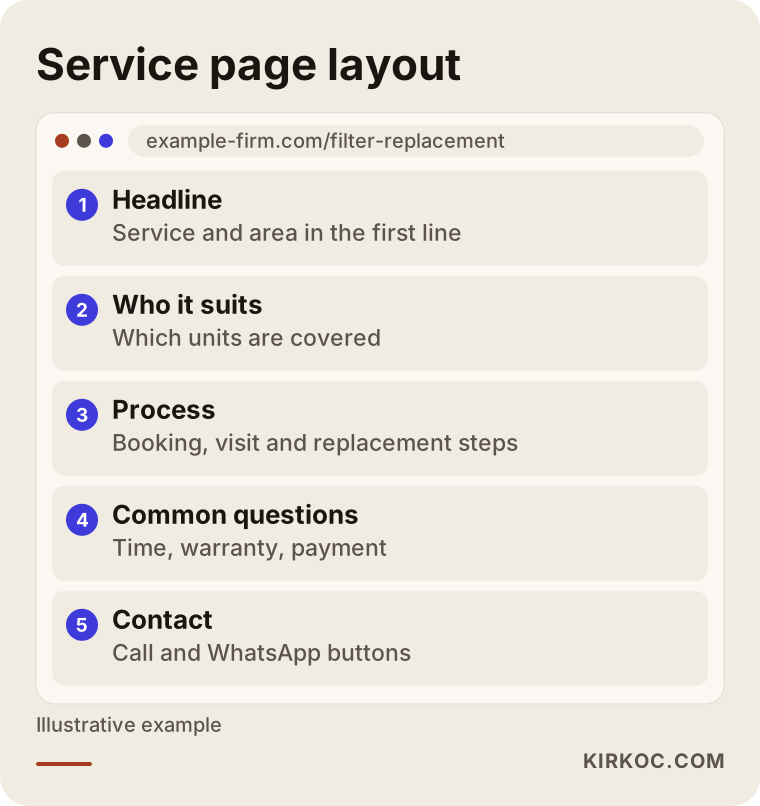
When every service page follows the same skeleton, the pages look alike but carry different content. That sends a clear message to both customers and search engines.
Why trust matters even more in this trade
In water treatment, the customer lets a stranger into the house and pays for something connected to what the family drinks. So your site needs trust signals. But a trust signal is not an empty word like "certified, high quality." It is information that can be checked.
These help: the year the company started and how long you have worked in this field, a real address and business details, who actually does the installation, the warranty and service terms in writing, and whether replacement filters and parts are readily available. Show customer reviews only if they are real and you have permission. Invented reviews are both unethical and a possible source of trouble later. Before you make firm statements about regulations, licensing or consumer rights, I suggest talking to a lawyer or the relevant licensing body in your area.
The list below pulls together the items that build trust at first glance on a water treatment site.
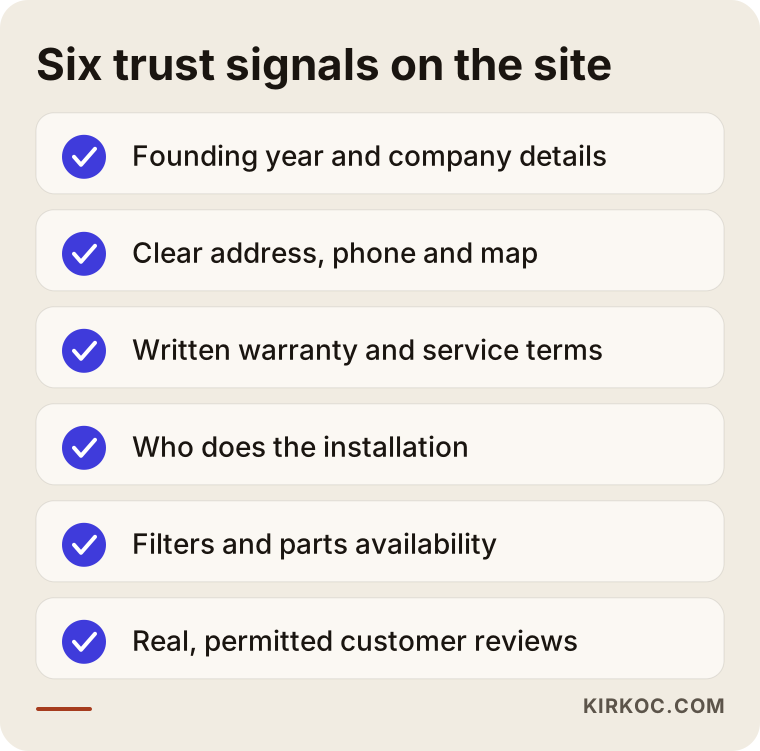
Compare this list with your own site. If you cannot tick most of it, completing these items will do more for you than a new design.
Three small details for the customer on a phone
Most water treatment customers reach your site from a phone, and often while standing in the kitchen next to a broken unit or a scaled-up faucet. That makes three details matter more than you might think.
The first is the call button. If your phone number is plain text, the customer has to copy it and paste it into the dialer. A button that dials when tapped is much easier. The same goes for texting or WhatsApp, because many people find it easier to send a photo of the problem than to describe it.
The second is how quickly the page opens. Large, uncompressed photos of equipment slow a site down, and a visitor on a slow page does not wait; they move to the next company. Shrinking photos and cutting needless decoration is an improvement that costs next to nothing.
The third is the length of the form. Name, phone, town and a line of notes are usually enough. A form with eight fields scares off a customer who is in a hurry. You can ask for whatever else you need over the phone later.
A quote site or an online shop
This is where many owners get confused: should the site sell equipment directly, or should it only collect quote and service requests? The cost and the workload of the two routes are very different.
Selling directly on the site means running a cart, payment setup, stock tracking, shipping and returns. That works if the product is small and the buyer can set it up alone. But most home systems need installation, and the price depends on the water, the plumbing and the size of the household. In that case the site should work on a "request a quote" logic, not like a shop counter.
Replacement filters and consumables are different. They are more standard, so they can be sold through a separate store section. For most companies the sturdiest route is a service-and-quote site first, with filter sales added later. The comparison below shows the difference between the two approaches.
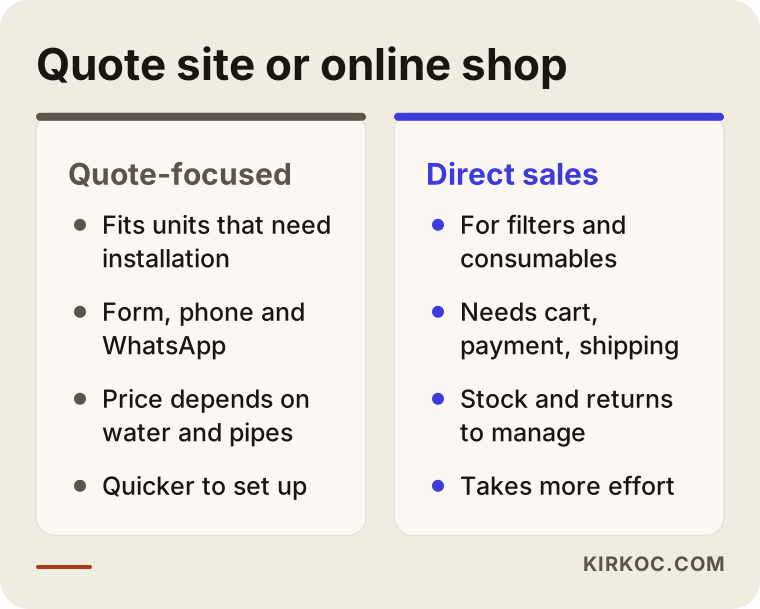
When deciding, ask yourself this: does your customer want to pick up the phone and talk today, or do they want to add something to a cart at midnight and have it delivered to the door? The answer shapes the site.
Two hypothetical example scenarios
The two examples below are entirely hypothetical. They do not describe a real company; they only show the logic.
First scenario: a small service business in one town. Suppose a two-person company does filter changes and maintenance for homes in one town. Its site has only a home page and a photo gallery. When a customer searches for filter replacement, this company does not come up. A possible fix: one filter change page and one page for the town, both with a call and text button, the hours when appointments are taken, and the types of units that are serviced. The business profile on the map is filled in with the same details. Even if calls do not rise within a month or two, the site now answers the right question; the rest depends on time and competition.
Second scenario: a company that rents units to offices. Suppose a company rents water units to small businesses and takes care of their upkeep. The customer is not a homeowner but an office manager. That person cares less about the brand and more about things like how fast you respond when something breaks, how the invoice works and how to end the contract. A business solutions page, a step-by-step section on how renting works and a clear quote form are enough for this company. Here, clear terms help more than a photo gallery.
In both scenarios the common point is that the site answers the customer's worry instead of just presenting the product.
Building it from scratch, step by step
I can shrink the process into five steps. Knowing what to do at each one protects you whether you work alone or with a specialist.
1. Write down your services and areas. Put on paper which systems you sell, which services you provide (installation, maintenance, filters, repairs) and which towns you drive to. That list is the skeleton of the site.
2. Plan a separate page for each service. Trying to explain everything on one page tires out both the search engine and the customer.
3. Write in the customer's words. Instead of "high-efficiency membrane technology," write something like "helps improve the taste and smell of your water." Do not make firm health promises.
4. Put contact options everywhere. Phone, text or WhatsApp, and a form should be reachable with one tap on mobile. Most customers are looking on a phone.
5. Launch, measure and fix. Look at how many people called from which page and who filled in which form, and close the gaps you see.
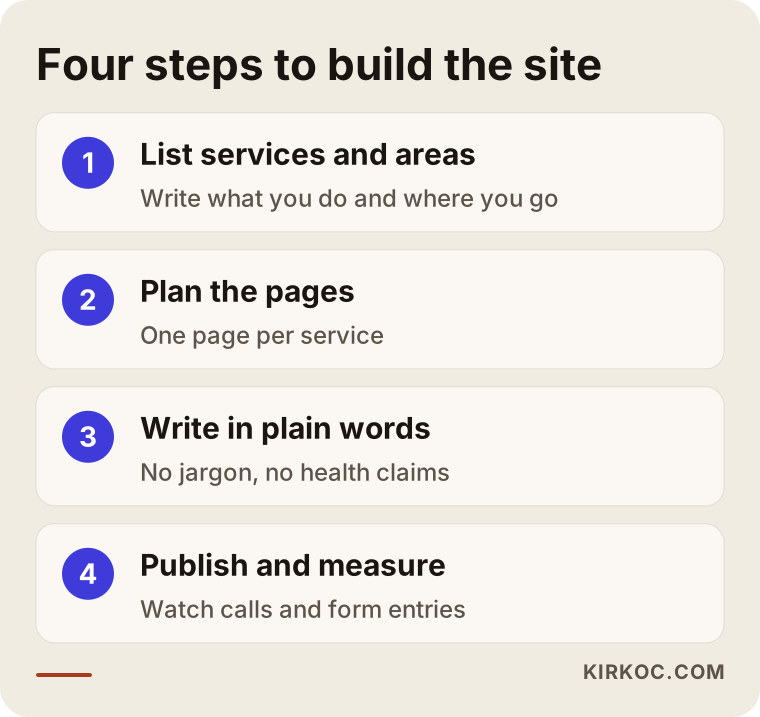
None of these steps finishes in a single day, but if the order is kept, each stage rests on the one before it.
Common mistakes
When I review sites in this trade, the same mistakes keep appearing. Most of them are not about design at all, but about point of view.
Building a catalog site. There are dozens of technical spec tables, but no answer to "when can you come?"
Squeezing everything onto one page. Home, office, filters and service are all together. No search matches any of it well.
Unrealistic claims. Sentences like "removes 100 percent of everything" or "prevents all illness" damage trust and can cause real problems. Describe what the unit does in measured words.
An old site that breaks on mobile. If text spills off the screen or a button cannot be tapped, the customer goes back to the results.
Inconsistent contact details. One phone number on the site, another on the map profile, a third on social media. Customers and search systems both get confused.
Never measuring. Without knowing how many calls and forms arrive, it is impossible to judge the site.
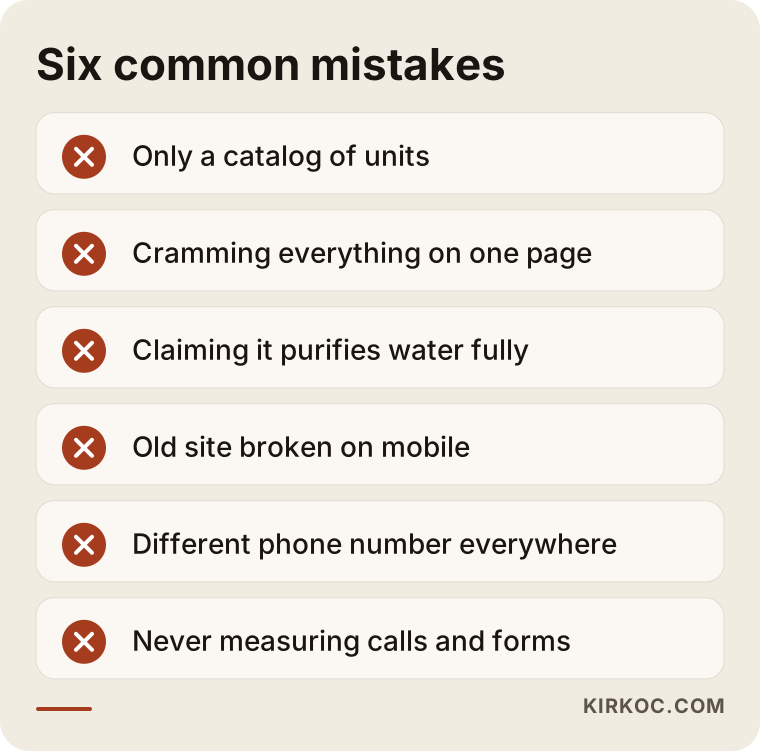
Most of these can be fixed without a large investment: text and page structure first, appearance second.
How a visitor moves through the site
You can think of the path to a decision as a funnel. At the top, many people reach your page; some read the services, fewer contact you, and the fewest sign an agreement. The job of your site is to soften that narrowing, so that each step makes the next one easier.
On the first page, say what you do. On the service page, answer the question. In the trust section, remove doubt. In the contact section, be reachable with one tap. If one step is weak, the effort you put into the earlier ones is wasted.
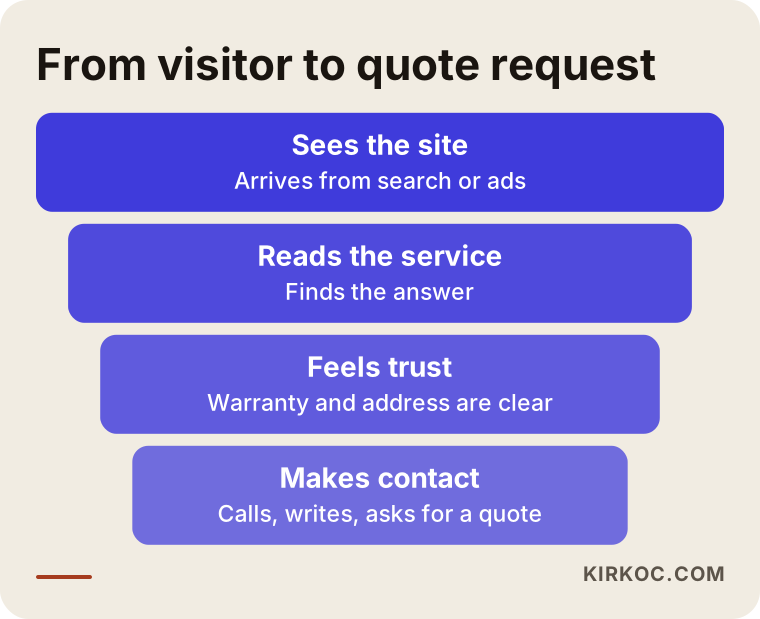
To find the narrowest point of the funnel, start with your call and form records. More often than not the trouble sits in the middle, at the trust stage.
What you can do yourself, and when to bring in a specialist
You do not have to hand everything to someone else. There are things you can do on your own: fill in your business profile on the map completely, keep your opening hours current, ask happy customers for reviews, write down your service list and areas, and note the questions people ask most often and add the answers to the site. None of this costs money. It only needs routine.
Outside help makes sense in certain cases: the site is old and broken on mobile, you need to build the service pages from zero, you do not show up in searches and do not know why, or you want to run ads but do not want to waste the budget. The decision chart below roughly shows what to do in which situation.
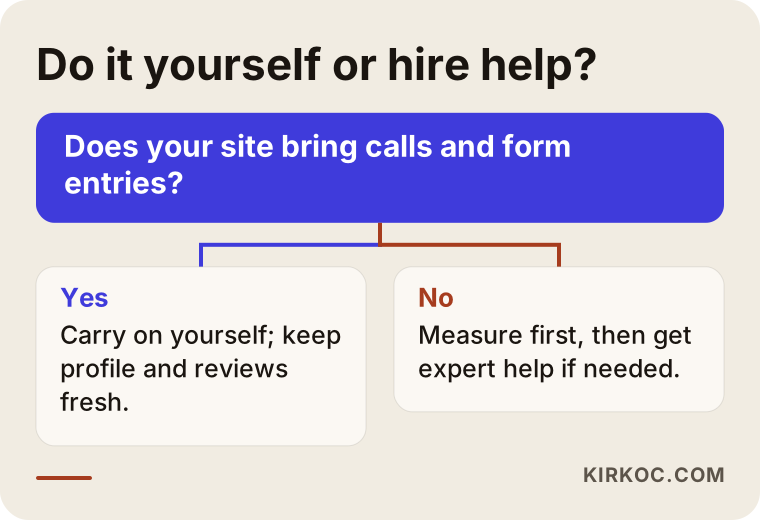
Whichever way you go, measure the current situation first. Investing without knowing what is not working is guesswork.
What drives the cost
I do not give numbers in this article, because too many items depend on the scope of the job. The main things that set the price are these:
- Number of pages. A five-page introduction site and a fifty-page site built around towns and services are not the same job.
- Whether you sell online. Adding a cart and payments makes the project bigger.
- Who supplies the content. If you prepare the text and photos, the cost goes down; if I need to write them, the effort goes up.
- Number of languages. A company that also serves customers who speak another language needs a multilingual setup.
- What comes afterward. Whether you want regular maintenance, new content and ad management after launch.
- Starting point. Moving data from an old site, or setting up redirects when the address changes, adds work.
The right question is not "how much" but "for what scope, and what do I expect." I go over the scope with you first, and the budget follows from it.
How the site, search, social media and ads work together
A water treatment customer's path does not run through a single channel. One person arrives from a search engine, another sees a maintenance video on Instagram, another clicks an ad, and another hears your name from a neighbor and searches for it. All of them end up looking at your site. If the site is weak, the effort you spend on every other channel stalls there.
I handle these jobs myself, all in one place: the website, local search, social media, Google and Meta ads, logo and content. The practical benefit is that the text on your site, your map profile, your ad copy and your Instagram posts all say the same thing, with no contradictions or gaps between them. When I change a detail in one place, I change it in the others too, so there is no "someone else was doing that" excuse. When the work is split between different people, the biggest loss usually comes from missing coordination.
The timeline below shows a sensible order for launching a water treatment site.
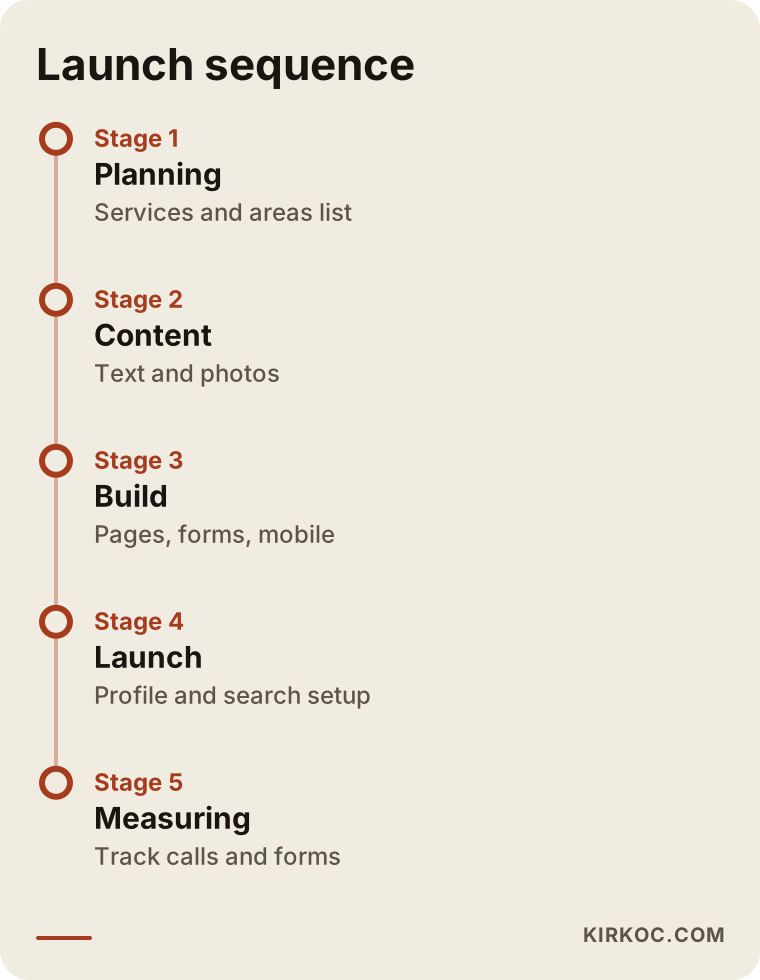
The length of each stage depends on your scope. What matters is keeping the order.
How I work with you
First I listen: what you sell, whom you serve, and where your calls come from today. Then I look at your current site, your map profile and what competitors are doing. I explain what I find in plain words and recommend which pages you need and in what order to build them. I put the scope of the work in writing. I do not promise results, because search rankings and competition are not under my control. What I can promise is to do the work in an orderly, understandable and complete way.
If I need to use a technical term, I explain it in a sentence. At the end I show you how to manage the site yourself, so that even if we part ways you are left with a working site. I work from Istanbul and can meet you in person in the city, but working remotely works just as well.
Frequently Asked Questions
How many pages should a water treatment company site have?
There is no fixed number. For a small service business, a home page, home systems, commercial solutions, filter changes, service areas, FAQ and contact make seven pages, which can be enough to start. If you serve many towns, adding a separate page for each one makes sense.
Should I show system prices on the site?
For systems that need installation, a "request a quote" approach is more honest, because the price changes with the water and the installation. For standard items like filters, showing a price can reassure the customer. Decide based on whether the product is standard or not.
Will my site rank first on Google?
I cannot promise a position, and nobody honestly can. What I can do is build pages that match what customers type, set up your map profile and keep the site technically healthy. Results develop over time and depend on competition.
Is Instagram or social media alone enough?
Social media is very valuable for trust and recognition, but a person searching for "water filter service" usually types it into a search engine. The website is the place that answers that search. The two complement each other and neither replaces the other.
Should I run ads or build a site first?
Sending ad traffic to a weak site wastes budget. It is healthier to fix the contact and trust parts of the site first, then test ads with a small budget. If I plan both with you together, the budget is used more efficiently.
How should I use customer reviews on the site?
Show only real reviews that you have permission to use. Talk to the reviewer beforehand about how their name will appear. Invented or purchased reviews damage trust quickly and may cause problems later; if you have doubts, ask a lawyer.
Should I refresh my old site or build a new one?
If the foundation is old, it breaks on mobile and the page structure does not fit the customer's questions, rebuilding is easier. But if some pages of the current site bring in search traffic, those addresses need to be redirected to the new site so the traffic is kept. I would look at the current situation with you first.
How long does the process take?
It depends on scope. A small introduction site can take a few weeks, while a multi-page or multilingual structure takes longer. How quickly you prepare text and photos also directly affects the timeline.
If you want your water treatment website to bring in customers, I can go through your current situation with you and draw up a roadmap that fits you. You can write to me through my website design service page.