You run a driving school. Your sign is familiar in the neighborhood, past students recommend you to their friends, and yet in the middle of enrollment season the phone does not ring as often as you expect. Meanwhile, someone types "driving school near me" and sees a competitor two blocks away at the top of the map. If that sounds familiar, SEO for driving schools exists to close exactly this gap. In this article I explain what students and parents actually search for, which pages your website needs, what you can handle yourself, and when it makes sense to bring in a specialist. I am Ümit Kırkoç, and I work from Istanbul as one person who handles everything from the website to the ads. I describe how my own SEO services work near the end, including their limits.
SEO, in the simplest terms, is the work that makes your website and your business listing show up on Google for the right person at the right moment. The difference from advertising is this: with ads you pay for every click, and when the budget runs out, the visibility disappears. With SEO, the setup you build keeps bringing in prospective students for months as long as it is maintained. For a local business like a driving school, that matters even more, because the person who finds you is usually already close to making a decision.
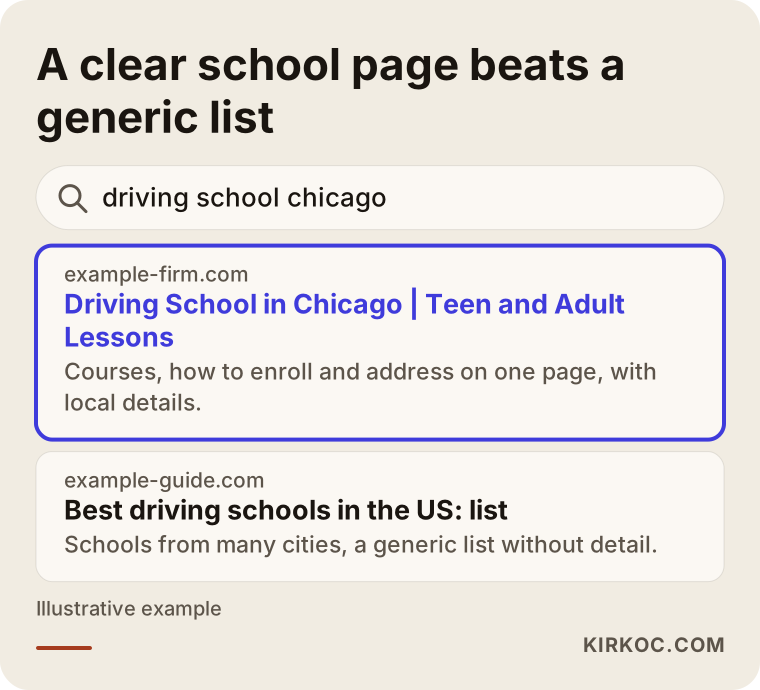
As the example above shows, when a student searches with a city or neighborhood name, Google tends to favor the page that clearly answers that place and that service. A generic directory listing usually lacks that detail. Your job is to build your own page with that kind of clarity.
What do new drivers actually search for on Google?
The customer of a driving school is not one type of person, and the searches do not come from the same question. A sixteen-year-old who wants a learner's permit, an adult who has put off getting a license for years, and a newcomer who just moved to the country and needs to start over all reach a school with different words. Then there are parents: a mother or father researching on behalf of a teenager usually cares less about the price and more about trust and how the instructor treats a nervous beginner.
Searches fall roughly into four groups:
- Location-driven searches: "driving school near me," "driving lessons in [your town]," "behind-the-wheel lessons [neighborhood]." This person wants a school within a reasonable distance and often looks straight at the map.
- Information searches: "how to get a driver's license," "what do I need for a learner's permit," "how does the road test work." This person has not chosen a school yet and is trying to understand the process.
- Comparison searches: "driving school prices," "automatic transmission driving lessons," "female driving instructor," "adult driving lessons for beginners." This person is narrowing down options.
- Decision-moment searches: "[school name] reviews," "[school name] phone number," "[school name] sign up." This person has already heard of you and wants to confirm.
This split decides what you write and which page you build. Showing a price page to someone who is still learning the basics does not help, and neither does showing a long licensing guide to someone ready to book. You need a separate door for each group.
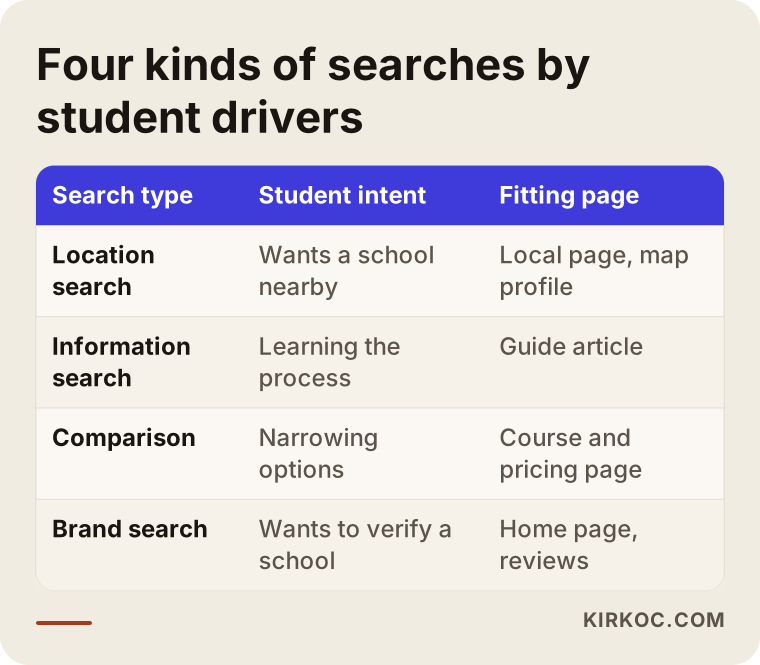
The table summarizes why students who end up at the same school do not look at the same page. Next I move on to the site structure that serves these different intents.
Which pages should a driving school website have?
Many driving school websites are a single page: a logo at the top, a few photos in the middle, a phone number at the bottom. That structure cannot answer the question Google is asking, which is "what is this business an expert in?" Think of one page for each kind of search intent.
Home page. A clear page that says which towns and neighborhoods you serve, where your office is, which courses you offer, and what happens when a student calls. It should carry information, not slogans.
Course pages. One page for each type of course: teen programs, adult beginner lessons, refresher lessons for people who have not driven in a while, road test preparation, perhaps lessons for nervous drivers or for people switching from a foreign license. Someone searching for "teen driver education" is asking a different question from someone searching for "adult driving lessons." Write only about courses you really offer; opening a page for something you do not provide misleads the student.
Enrollment page. A page that explains in plain language what a student needs to sign up, how the permit and paperwork steps usually go, and what the first lesson looks like. Official requirements differ from state to state and change from time to time, so instead of stating firm rules here, tell readers to check with your school for the current situation and to look at their state's motor vehicle agency for the official requirements.
Pricing and payment page. You do not have to publish a number. But explaining what the price depends on (the course type, the number of behind-the-wheel hours, payment plans) turns "how much is it?" phone calls into qualified conversations. For binding rules about fees and contracts, it is wise to talk to a lawyer or the relevant state agency.
Cars and instructors page. The transmission type of the training cars, safety features, a short introduction of each instructor, and your teaching approach. What worries students most is what kind of person will be sitting next to them.
FAQ and guide articles. Content such as "what mistakes fail a road test" or "how to prepare for the driving exam" attracts people who are still researching. They may not sign up today, but if they come to trust you, you will be the school they remember when it is time to book.
Contact page. Address, map, phone, text or WhatsApp, opening hours, directions and parking. Everything should be a single tap away.
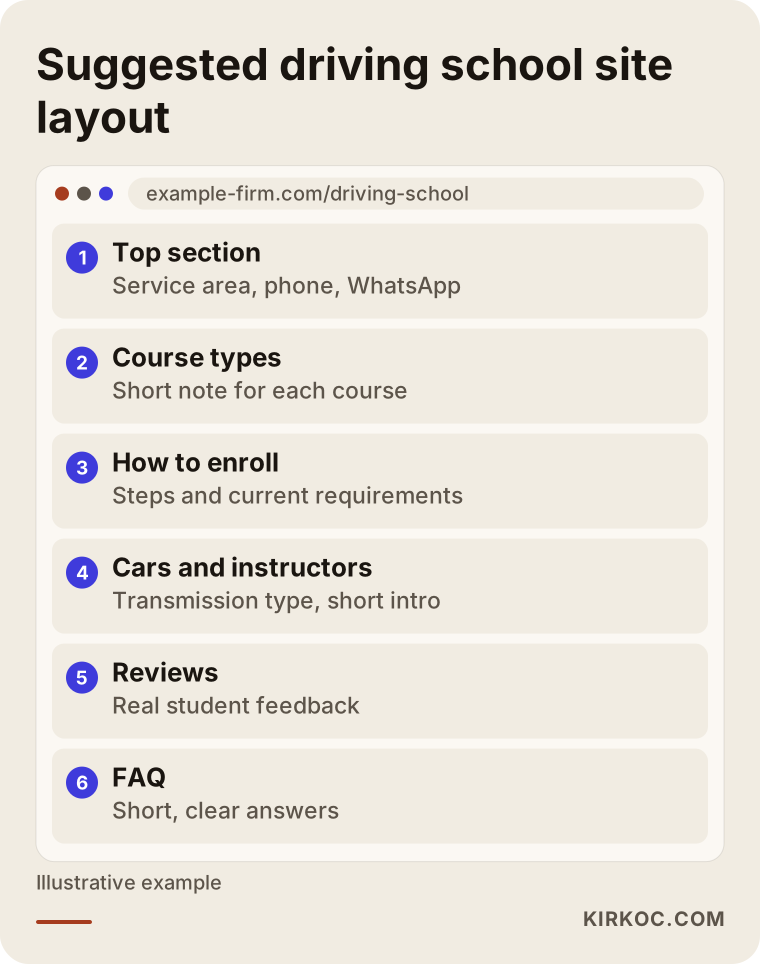
The outline above shows one possible order of sections. You can reduce or increase the number of pages depending on the size of your school; what matters is that every page answers a single question.
Why do map results matter so much for driving schools?
Someone choosing a driving school usually looks for a place close to home, school or work. That is why the map section on Google, the box where businesses are listed side by side, is often seen even before your website. That box is fed by a free listing called a Google Business Profile. If you do not have one, if it is incomplete, or if nobody has touched it for years, you will trail far behind competitors in map searches.
Check these things on your profile:
- The business name should match the name on your sign. Stuffing keywords into the name can get the listing suspended.
- Choose the right category, and make "driving school" the primary one.
- Keep the address, phone number and hours up to date. Enter holiday and summer hours ahead of time.
- Add real photos of the building, the cars and the classroom. Stock images do not build trust.
- List the courses and the areas you serve.
- Reply to reviews, positive or negative, politely and with specifics.
Reviews carry extra weight in this field. A student cannot know an instructor or the atmosphere of a school before trying it, so they look at other people's experience. You can politely remind happy students to leave a review with a short message after their road test. Do not offer gifts or discounts in return; that can break the platform's rules and it damages the credibility of your reviews. If you are unsure about the legal side of collecting reviews, consult a lawyer.
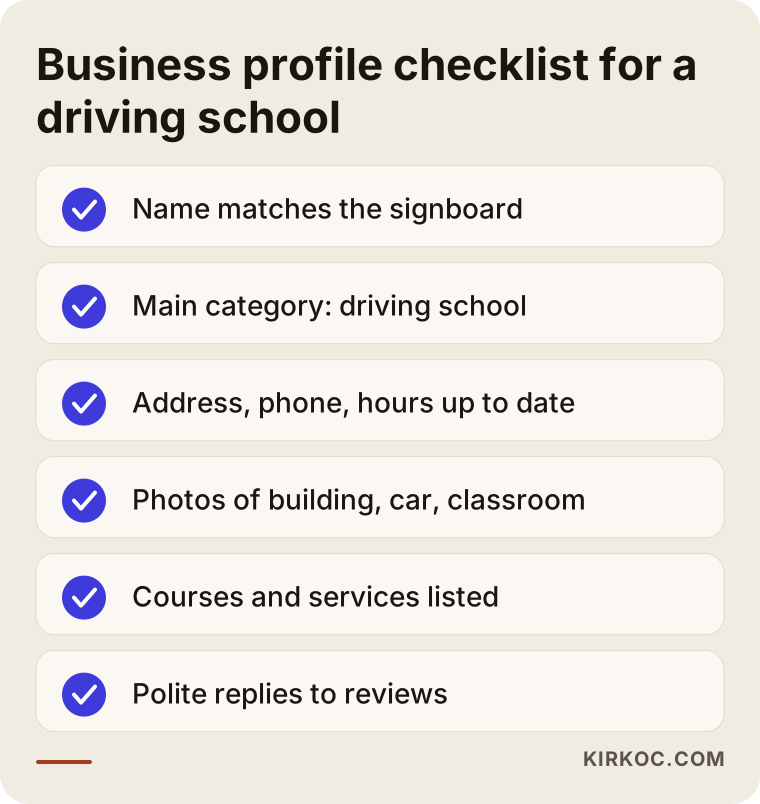
Most items on the checklist can be finished in one afternoon. Once they are done, the next step is to make the content on your website consistent with this profile.
Two hypothetical example scenarios
The two examples below are entirely hypothetical. They do not describe a real school or a real person; I made them up to show how the process works in practice.
Example scenario 1: A school everyone in town knows, but nobody finds online. Imagine a school that has operated for twenty years in a mid-sized town. Most of its students come by word of mouth. Its website was built a decade ago, has one page, and is hard to read on a phone. It has a map listing, but there are no photos, the hours are incomplete, and no review has been answered in two years. When summer enrollment begins, people who search "driving school" plus the town name do not see this school; they see a newer competitor.
In this scenario the steps follow a clear order. In the first week the business profile gets fixed: photos, hours, category, description. Then the website is made mobile friendly and separate pages are written for each course. After that, a section is added that explains which towns and nearby neighborhoods the school serves. A habit of answering reviews is set up. It would not be honest to say in advance how many months the results will take, because that depends on the strength of the competitors, the number of schools in the area and the condition of the existing website. But whether things are moving in the right direction can be seen in the first months from profile views and from search data.
Example scenario 2: A brand-new school nobody has heard of yet. Picture another hypothetical school that opened this year. There is a sign, but nobody nearby knows it, there are no reviews, and there is no website. The big advantage of a new school is that it can set everything up correctly from the start. First the business profile is created completely. Then a small but clear site is built: home page, course pages, contact and frequently asked questions. The first students are politely asked for reviews. In parallel, a short, limited-budget ad campaign can be tried to find the first students; since SEO takes time to work, the ads fill the gap in between.
What both scenarios share is that nobody makes a magic move. Regular, ordered and measurable small jobs add up.
The process, step by step
This is the order in which I usually run SEO work for a driving school.
1. Taking stock of the current situation. I look at how your site appears on a phone, which pages are never visited, how incomplete your business profile is and what your competitors do well. What I produce at this stage is not a list of faults but an order of priorities.
2. Choosing search intents. For each of the four groups described above, I choose the phrases that people in your area really use. Details such as the town, the neighborhood, the course type and the transmission type are settled here.
3. Building the page structure. I map which page answers which search. Each page focuses on one subject, and the pages do not overlap.
4. Writing the content. Pages are written in the student's language, without jargon, and with specifics. Topics that build confidence, such as the instructors, the cars and the enrollment process, come to the front.
5. Technical cleanup. The page should load fast, read comfortably on a phone, carry correct title and description tags, and show your business details consistently everywhere. The student does not see this part, but Google looks at it.
6. Strengthening the business profile. Photos, description, category, review replies and regular posts.
7. Measuring and adjusting. I track how many people called, which pages were visited and which searches brought them. What works gets expanded; what does not gets changed.
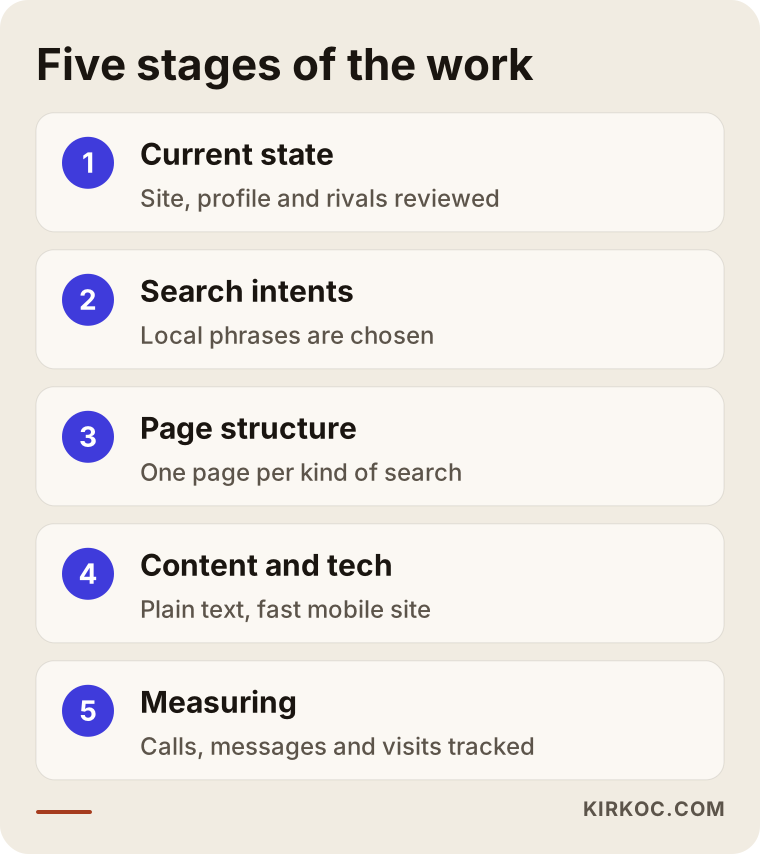
The order in the flow matters: search intent should be clear before content is written, and the current situation should be clear before technical fixes begin. Work that skips the order usually goes to waste.
Seasonality: working with your enrollment periods
Demand at a driving school is not the same all year. Enrollment rises when schools let out, in the summer, and around the time teens reach the age to apply for a permit; other periods are quiet. This swing affects an SEO plan too.
Preparation has to start weeks before the busy period, because a freshly written page takes time to be noticed by Google. If you write your summer promotion in May, it will not be ready by June. The quiet periods are the best time to write guide content, collect reviews and make technical fixes. Instead of letting that time pass with the thought that there is no business, use it to lay the groundwork for the next season.
Keep the announcements on your site current too. Information such as summer hours, start dates for new classes and holiday closings points both the student and Google in the right direction. An expired promotion page that is still online is a small but effective mistake that shakes trust.
The most common SEO mistakes driving schools make
These are the mistakes I see most often in this field:
- One page, one message. Every course and every neighborhood is squeezed onto a single page. Google cannot tell which page to show for which search.
- Pasting the same text everywhere. Pages are created for different neighborhoods where only the neighborhood name changes and the rest is identical. This bores both the reader and the search engine.
- Different details on the map and on the website. The phone number is one thing here and another there, or the address is outdated in one place. Inconsistency weakens trust and rankings alike.
- A price nobody can see. When the price is never discussed, the student goes to your competitor. Even if you do not post a number, explain what it depends on.
- Promising a result. Phrases such as "you will pass the first time" are ethically problematic and risky under advertising and consumer rules. Talk to a lawyer before you use claims like these.
- Never answering reviews. A negative review is also an opportunity; a calm, specific reply tells the next reader who you are.
- A site that looks bad on a phone. Most students look on a phone. Tiny text, buttons packed close together and slow pages cost you inquiries.
- Not measuring results. If you do not know how many searches came in and how many signed up, you cannot know what worked.
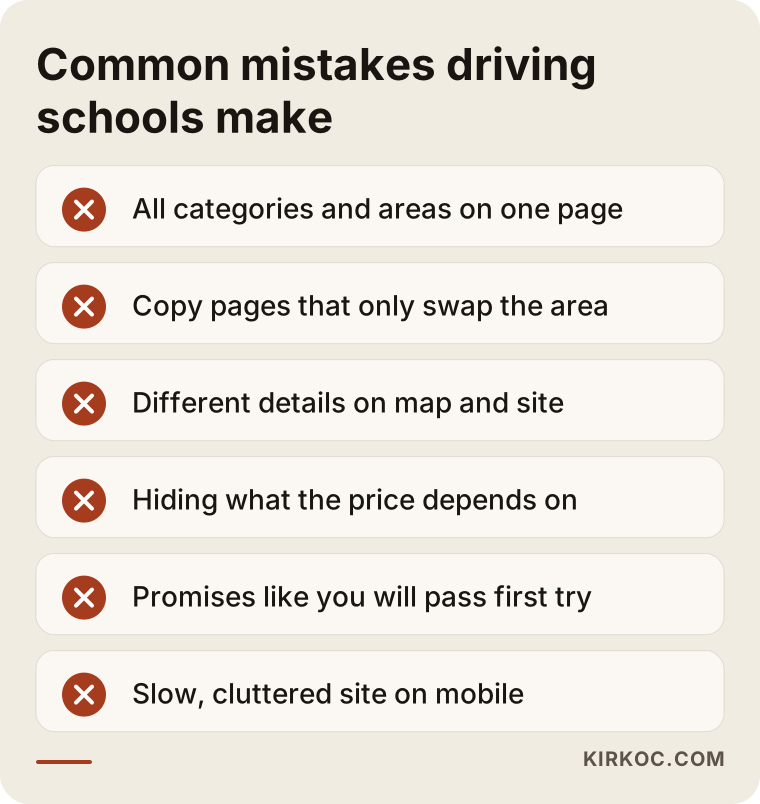
Most of the items in the picture do not need expensive solutions; most of them start with simply noticing. Below I separate what you can do yourself from where help is more efficient.
What can you do yourself, and when do you need a specialist?
You do not have to hand everything to a specialist. You can do the following on your own in an hour or two:
- Claim your Google Business Profile or verify ownership, and fix the address, phone number and hours.
- Add real photos: the entrance, the classroom, the training car, the instructors (with their permission).
- Reply to your reviews.
- Open your website on your own phone and click through it; write down what bothers you.
- Search for your competitors and look at what they say.
A specialist usually saves you time in these situations:
- Your site is very old, does not open properly on a phone, or needs a new structure.
- You struggle to decide which pages to write and which searches to aim for.
- You have worked on it for a few months and see no movement in visits or calls.
- You have more than one location and need to manage each location's profile and page separately.
- You want to move forward with Google ads or social media in a coordinated way.
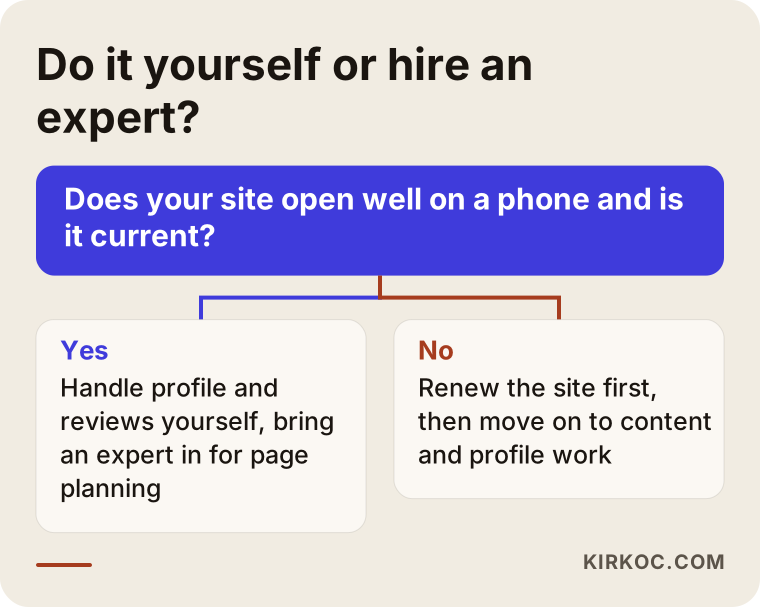
The chart shows that there is no single right answer. If you have the time and interest, you can build the basics yourself and bring in a specialist at later steps.
SEO, ads or social media?
Driving school owners often ask: "Should I run Google ads, pay for SEO, or start an Instagram account?" The answer depends on your situation and your calendar.
Ads give fast results. If enrollment season is close and there is an urgent hole on your site, a controlled ad budget can make sense. But when the budget ends, so does the visibility, and if the page your ads point to is poor, the clicks will not turn into students.
SEO is slower but cumulative. Once a page starts ranking, you do not pay for each click. For a local business it is the strongest long-term foundation.
Social media helps people get to know you. Young prospects may look at schools and instructors on Instagram and TikTok; seeing how an instructor explains a short lesson, or a post celebrating a test day (with the person's permission), builds trust. Still, social media alone does not replace a search result.
The ideal situation is when these feed each other. Ads bring in prospects quickly while SEO builds the foundation, social media reinforces trust, and everything points to the same website and the same business profile. Because I run all of these myself, I can take a search phrase I learned from the ads and use it on the site, and take a question I noticed on the site and turn it into a social post; the message does not get lost between different people.
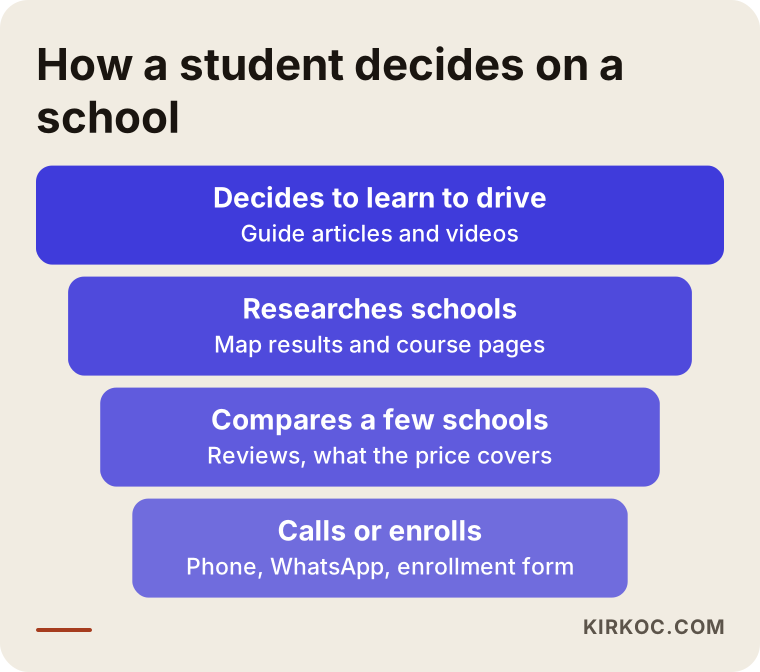
The funnel shows how a prospect narrows down from first awareness to enrollment. A different tool comes forward at each stage. You do not need to perfect all of them at once, but none of these stages should be left empty.
How do you track the results?
In SEO, the answer to "is it going well?" is numbers, not a feeling. The indicators to watch for a driving school are simple:
- Phone calls and text or WhatsApp messages. This is the real goal. If you can, ask new students how they found the school and write the answer in your enrollment log.
- Business profile statistics. How many people saw you on the map, how many called, how many asked for directions.
- Website visits. Which pages are visited and where prospects leave.
- Search data. The records Google gives you on which searches your site appeared for.
- Number and content of reviews. What students say can even hint at your next piece of content.
Do not expect these numbers to jump in the first months. Small movements in the right direction show the work is on track. If a number drops at the end of a month, remember that it may be the effect of the season, such as exam periods or school breaks.
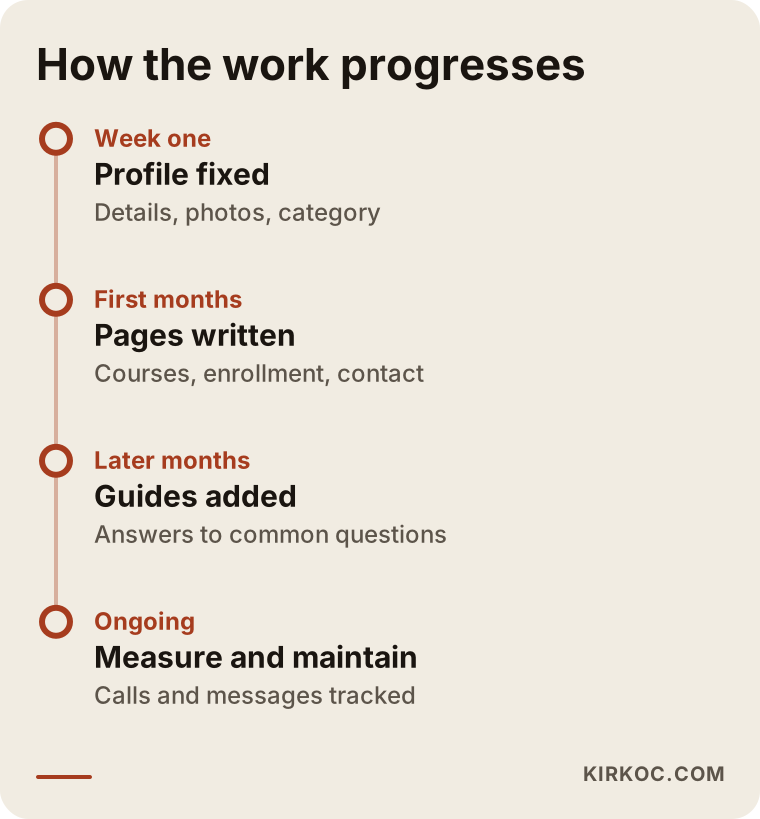
The timeline shows ordered stages, not exact dates. Every school starts from a different point, so the pace differs; that is why a working method that promises no ranking or result and shows progress through numbers is the more honest one.
What determines the cost
I will not give you a number here, because no two schools need the same thing. But I can tell you plainly what drives the cost:
- The condition of the existing site. If your current site can be fixed, the job is smaller; if it has to be rebuilt from scratch, it grows.
- The number of pages. How many course types, how many towns and how many guide articles you aim for.
- The number of locations. Each location needs its own profile and page.
- Local competition. In a busy city with many schools, the work takes longer.
- The scope of the work. Whether it is SEO only, or also includes ads, social media and visual production.
- Duration. A one-time setup and ongoing monthly maintenance are priced differently.
When you receive a quote, look at these things. Is it written clearly what will be done? Is a result guaranteed (be careful if so)? How will reporting work? When the contract ends, do your website and your business profile still belong to you? If you cannot get clear answers to these questions, the quote is incomplete, whatever the price.
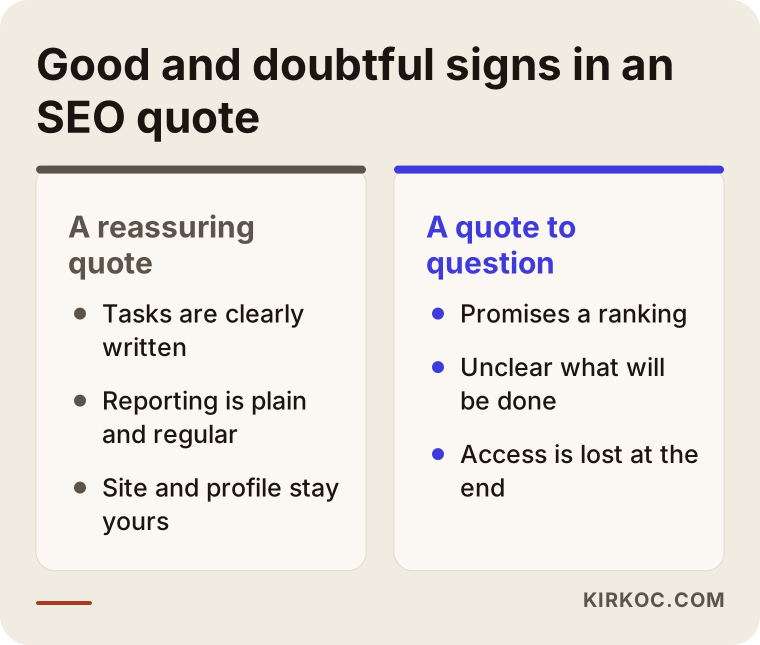
The comparison summarizes the difference between a reassuring quote and a doubtful one. It is enough to go through these points one by one in the quotes you receive.
How I work with you
I work as one person. The one who talks to you is the same one who builds the site, writes the content and runs the ads. That means short communication and quick decisions. In the first conversation I listen to the situation of your school, look at your website and your business profile, and tell you what comes first and what can wait. If something is unnecessary, I do not recommend it; sometimes fixing the business profile and writing three or four pages is all that is needed.
During the work I explain what I am doing in plain language, and the reports are not packed with technical terms. When the work ends, the site and the profile stay in your hands. I do not promise results, because nobody can know how Google will rank a page; but I show you what I did, why I did it, and what has changed at every stage.
Frequently Asked Questions
How long does SEO take to work for a driving school?
It would not be right to name an exact time. It depends on your starting point, the competition in your area and the current state of your site. Business profile fixes usually show an effect sooner, while new pages take longer to start ranking. The healthiest approach is to follow the direction of visits and calls over the first months.
Is a Google Business Profile enough on its own?
If competition in a small area is low, the profile alone can bring business. But after a student finds you, they look for information, course details and reassurance, and a website usually provides that. The two working together give the most solid result.
Should I create a separate page for each neighborhood?
Not for every neighborhood, only for the areas you truly serve and where students actually search. Copy pages where only the neighborhood name changes do not help. Each page should carry something specific to that area, such as directions, nearby schools or class times.
Should I post my prices on the website?
You do not have to. But a page explaining what the price depends on reduces how often students ask the same question on the phone. For the legal requirements on fees and contracts, check your state's rules or talk to a lawyer.
Do I need a social media account?
It is not required, but it can help with younger students. If you cannot post regularly, it is better to focus on your business profile and website than to open an empty account. If you do open one, do not share anyone's image without the permission of the student or the parent.
How should I ask my students for reviews?
Tell students who passed their test or were happy with the training, in a short message and without pressure, that they can leave a review. Do not offer gifts or discounts in return. Reply politely to every review, positive or negative.
Should I run ads or pay for SEO?
If you need students urgently, ads are fast; for a steady flow of students over the long term, SEO is more economical. For most schools, a balanced use of both makes sense. Your site and profile should be in good shape first, because if ads send people to a poor page, the budget is wasted.
Can I trust someone who guarantees results?
Be careful. Nobody can guarantee how Google will rank you. Prefer someone who works openly, shows what they do and reports in plain language.
If you would like to work out together where to start so that your school gets the visibility it deserves on Google, you can reach me through my SEO services page. I will look at your current situation and give you an honest roadmap.