You own a gym or a pilates studio. The equipment is in place, the coaches are good, and yet the phone does not ring as often as it should. Every now and then you post a workout clip or a "new term starts" poster on Instagram, a few likes come in, and then nothing happens. If that sounds familiar, it makes sense that you searched for "social media for gyms." In this business, people look at a place on their phone first and walk through the door second. This article explains why your accounts may not be bringing in members, what actually works, and how to set the work up. I am Ümit Kırkoç, and I work alone from Istanbul, so I will also describe my own social media management service where it is relevant, along with its limits.
I should say one thing up front. Social media is not decoration for a fitness business; it is a shop window. But a window only works if the right things are displayed in it and the person standing outside knows how to open the door. I will take that apart piece by piece below.
If you are a foreign owner or manager running a studio in Turkey, or planning to open one, most of this applies to you as it is. I use Istanbul examples because that is where I work, and the habits of Turkish members are part of the picture.
What does a gym member look for on social media?
Joining a gym is not like buying a product. A person is choosing a place they will visit for months, and they are trying to judge whether they will feel comfortable there. So what they look for on social media is not a pretty photo. They look for an answer to the question "Is this place for someone like me?"
For someone who has never trained, the biggest barrier is nervousness. They imagine everyone staring at them and picture themselves using the machines wrong. If your account shows only muscular people and heavy weights, that person will quietly decide not to knock. At a pilates studio, people usually look at the instructor, the calm of the room, the size of the group and how clean the equipment is.
A good account therefore shows three things: who the place is for, what actually happens inside, and how easy the first step is. If those are missing, no amount of posting will lift you above a notice board.
The graphic below follows a purely hypothetical person from the moment your account appears in their feed to the day they walk in.
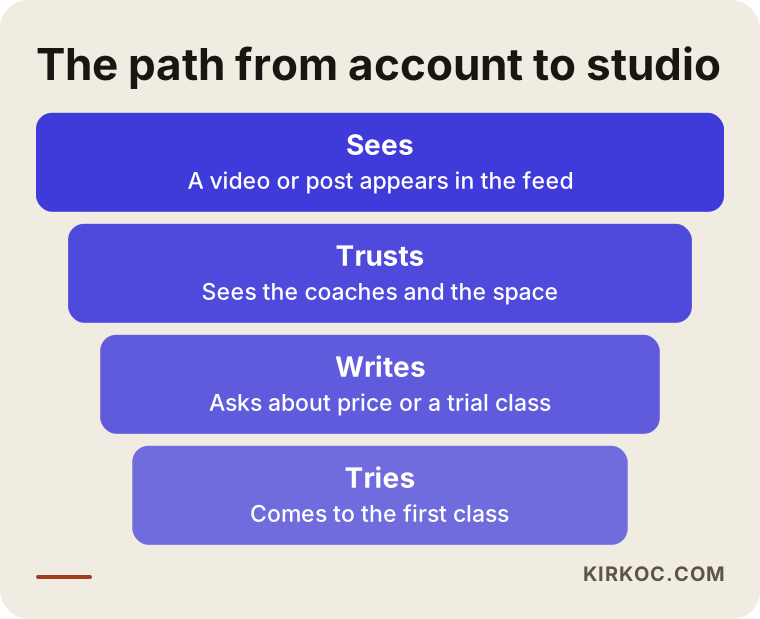
As you can see, some people drop out at every step. The purpose of your social media work is to give each of those people one concrete reason to move forward: an interesting video so they notice you, coach introductions so they trust you, a clear way to message so they write, and an easy first class so they try.
Not every gym tells the same story
A boutique pilates studio and a large fitness club do not attract the same person. Someone who goes to a pilates studio usually has a specific need, such as posture, a stiff back, flexibility or recovery after pregnancy, and expects a small group or one-to-one attention. In a big club, people look at variety, long opening hours, plenty of equipment and tidy showers and changing rooms. Writing the same message for both means speaking wrongly to at least one of them.
Ask yourself: "What convinces the people who join my place?" The answer is rarely a slogan. It is in the sentences you already hear at the front desk, such as "I don't feel lost here" or "My coach actually knows my name." Those sentences are the raw material for your content ideas.
The most common social media mistakes gyms make
Most fitness accounts look alike. The same motivational quotes, the same stock photos, the same discount posters. That sameness hurts, because it makes you impossible to tell apart. These are the mistakes I see most often.
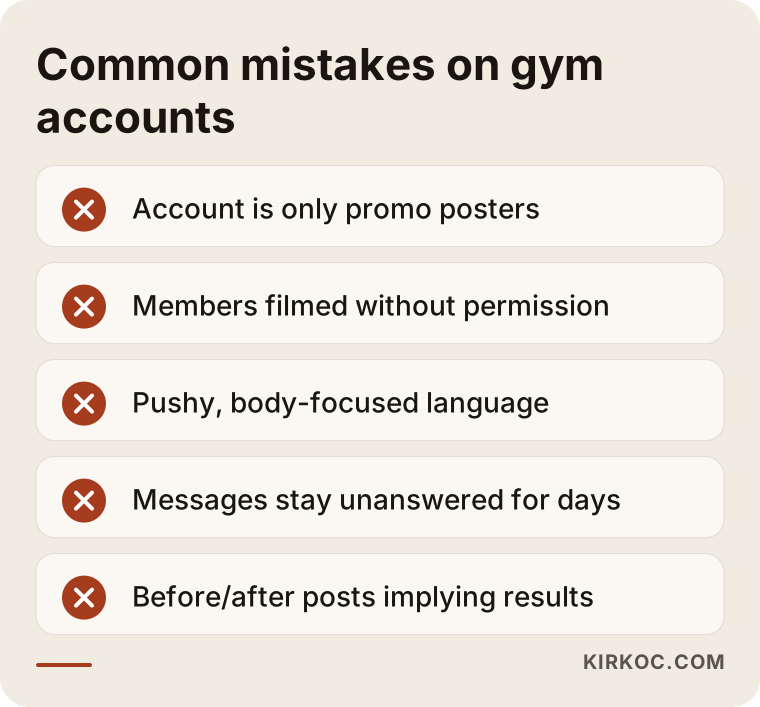
Let me go through the list. The first is posting nothing but promotions. A "new term offer" or "first month deal" poster is useful now and then, but if the whole account is made of them, followers see a leaflet and lose interest. The second is ignoring member privacy. If you film in the gym and people's faces are visible, posting without their permission damages trust and may also carry legal risk. I will not make a firm legal claim here; talk to a lawyer about how personal data rules apply to your case. In any situation, a clear written or recorded consent is the safest route.
The third is pushy, body-focused language. Messages like "get beach-ready" might motivate some people, but they scare off the person who is just about to start training. The fourth is leaving questions unanswered. People write to ask the price, the opening hours or whether there is a beginner level, and then wait days for a reply. That alone can waste even the best ad. The fifth is using before-and-after photos carelessly. You cannot guarantee a result for anyone, and language that implies one creates problems both ethically and under platform rules.
Which platform for which job?
You do not need to show up on every platform with the same energy. For a gym or pilates studio, most of the work happens on Instagram, but it is rarely enough alone.
Instagram is mostly visual and video, so it is the best place to show the feel of your space. Short videos (Reels) are the easiest way to reach new people, while stories are where you keep daily contact with the people who already follow you. Your Google Business Profile, the card that appears on the map, is not social media in the strict sense, but it sits in the middle of the process. People often see you on Instagram, then search your name plus "reviews" and look at the map. If your reviews, photos and opening hours are a mess there, the trust you earned on Instagram disappears.
Facebook can still help with older audiences and people searching in their own neighborhood, but for most gyms it comes second. TikTok is an option if you want to reach a younger crowd; it takes time to produce and does not suit every place. LinkedIn only makes sense if you sell corporate memberships or workout programs to companies. YouTube is useful if you plan longer exercise explanations, but it is not essential at the start.
My advice is simple: get Instagram and your Google Business Profile right first, then add another channel as your capacity allows. Being half-present everywhere is worse than being good in one place.
What content actually brings in members?
Finding content ideas is the hardest part for most gym owners. The fix is to stop thinking of content as advertising and start thinking of it as answers to questions already in people's heads. The table below summarizes content types for a hypothetical gym, who each one speaks to and what it does.
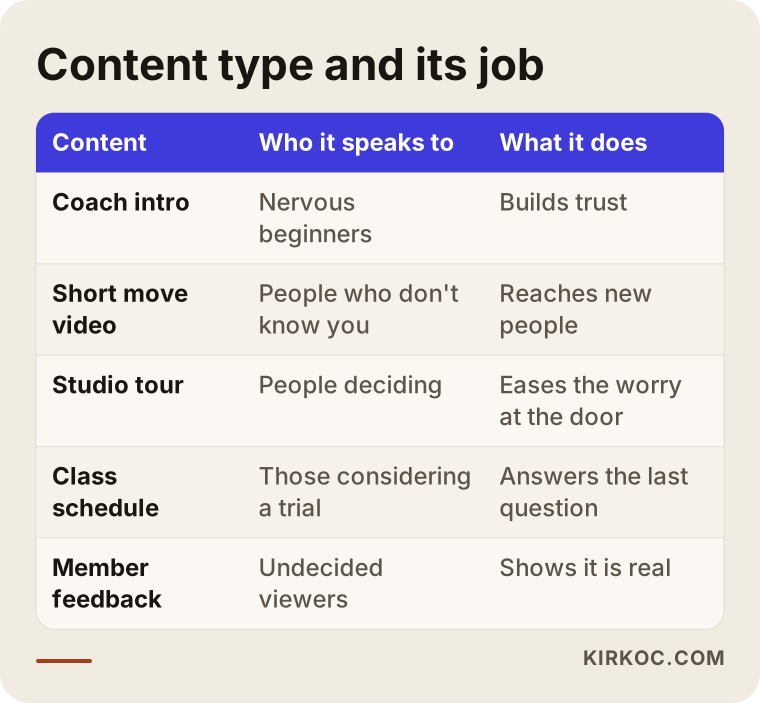
Keep one point in mind while reading it: every content type has a different job. A coach introduction builds trust, a short workout video reaches new people, and a class schedule answers the last question of someone on the fence. You do not need to post all of them equally often. Which ones matter most depends on your situation.
Put your coaches in front
In gyms, and especially in pilates studios, people join a person, not a building. Showing how a coach speaks, how they guide a class and how they treat a beginner is far more convincing than a nice photo of the room. With the coach's permission, film a short introduction: who they are, which class they teach and who it suits. You do not need a polished production. Clean light, clear sound and a natural way of talking are enough.
Answer the question "What kind of place is this?"
A phone video that walks from the entrance to the changing room is worth more than a pile of posts. People want to see what they will meet before they step inside. Cleanliness, ventilation, the changing area, the atmosphere before and after class: all of these tip the decision. For a beginner, a piece about "what happens on your first day" is often the most saved content you will publish.
Describe classes, do not promise results
Explain in plain language what happens in a pilates class, what each piece of equipment is for and who can start. But do not write promises like "this much change in this many weeks." Every body responds differently, and reminding someone with a health condition to check with their doctor is part of your responsibility. Honest wording builds more trust over the long run.
Treat your Instagram profile like a sales page
When people like one of your videos, or a friend recommends you, the first thing they do is open your profile. In three seconds they need to understand what kind of place it is, where it is and what the next step is.
Your profile name and bio should include the type of place and the neighborhood. A clear phrase such as "Reformer pilates studio in Kadikoy" is far more useful than a brand name alone. Use your highlights for classes, coaches, the first visit and common questions. Make the link in your bio lead to one clear place, like a trial class form or a messaging link, instead of a cluttered list of links.
This is where your website comes in. A simple but tidy site does the job Instagram cannot: class schedule, address, map, common questions and a contact form. Because I run both the site and the social media myself, I can make sure what you say on Instagram matches what the site says. Seeing two different opening times or two different phone numbers is one of the fastest ways to lose trust.
A step-by-step process for gym social media
This is the order I follow when setting up a gym's social media. It is my suggested framework, and it gets adjusted for each business.
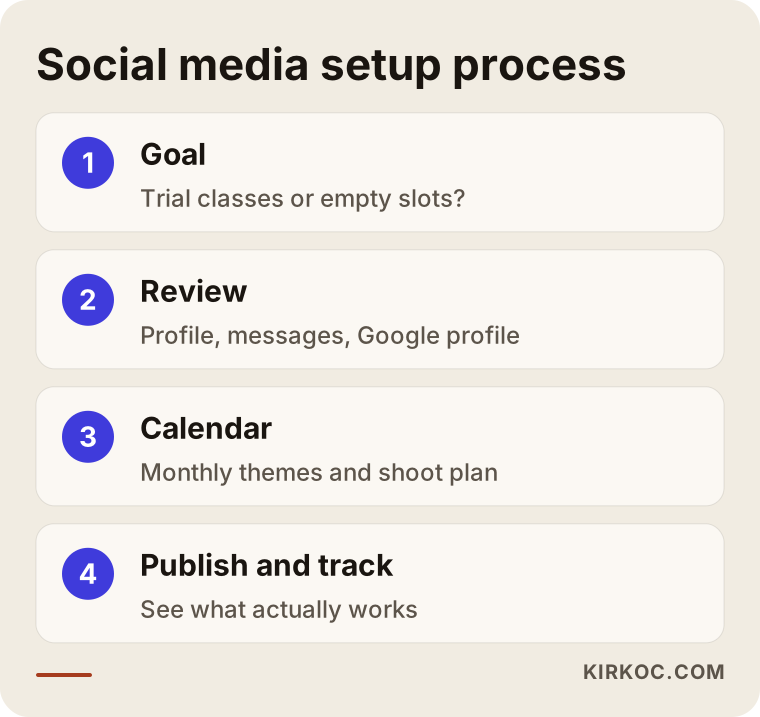
In the first step I clarify the goal with you. Do you want trial classes, do you want to fill a certain time slot, or are you announcing a new class? If the goal is vague, the content scatters. In the second step I review the current state of your accounts: the profile, highlights, past posts, how fast messages get answered and your Google Business Profile. In the third step I prepare a content calendar, with a few main themes per month and video, photo and story ideas for each. In the fourth step publishing and tracking begin: I look at what attracts attention and which content brings messages, and adjust the next month accordingly.
Note that this is a cycle, not a one-off. The first month teaches you the most. You only find out which coach's video gets watched more, or which time of day your posts are seen, once you are actually publishing.
Two hypothetical example scenarios
The two scenarios below are entirely invented. They do not describe any real business or person. The aim is to show how the same principle can look different in two different places.
Scenario 1: a small neighborhood pilates studio
Imagine a one-room pilates studio in a small neighborhood. Classes are small and there are two instructors. The account only shares class schedule posters, and the questions that reach the phone are mostly "is it suitable for beginners?" The work that could help here might be two short videos where each instructor introduces themselves, a series of stories showing how a first class goes, a tour of the studio and short answers to common questions. The profile bio gets the neighborhood name, and the link points to a trial class message. I cannot promise an outcome, but I can say this approach answers "is this place for me?", so it raises the chance that the right people send a message.
Scenario 2: a large fitness club
Now imagine a multi-floor club with hundreds of members. The problem: the club is crowded in the evenings but empty in the mornings. The social media work is set up differently for that reason. A short group class for early hours is introduced, a video shows how calm the club is in the morning, and a small perk is announced for members who come at that time. If there is an ad budget, the campaign is shown only to people near the club within a certain age range. Because the club has many members and a wide range of things to show, the content calendar is busier, and someone must be named in advance to reply to messages.
What the two have in common is that the goal comes first and the content then serves it.
Reels and short video: what to film and how
Short videos are the easiest way to reach people who do not follow you yet. But chasing "going viral" is the wrong target; reaching the right person matters more. If a thousand people watch and none of them live near you, that does nothing for your business.
A few video ideas that suit gyms: fifteen-second clips showing the common mistake in an exercise and the correct version, a "how your first week goes" explanation for beginners, a coach explaining which movements they use to ease something like shoulder tightness from sitting at a desk, and calm shots that show the morning or evening mood of the place. One caution: do not make medical claims or say "this fixes that problem." Saying "these movements may help you loosen up, and if you have a condition, talk to your doctor" is both honest and safe.
You do not need professional equipment. A decent phone, a clean lens, natural light and a steady tripod are enough for most jobs. What matters is clear sound and making it obvious within the first two seconds what the video is about.
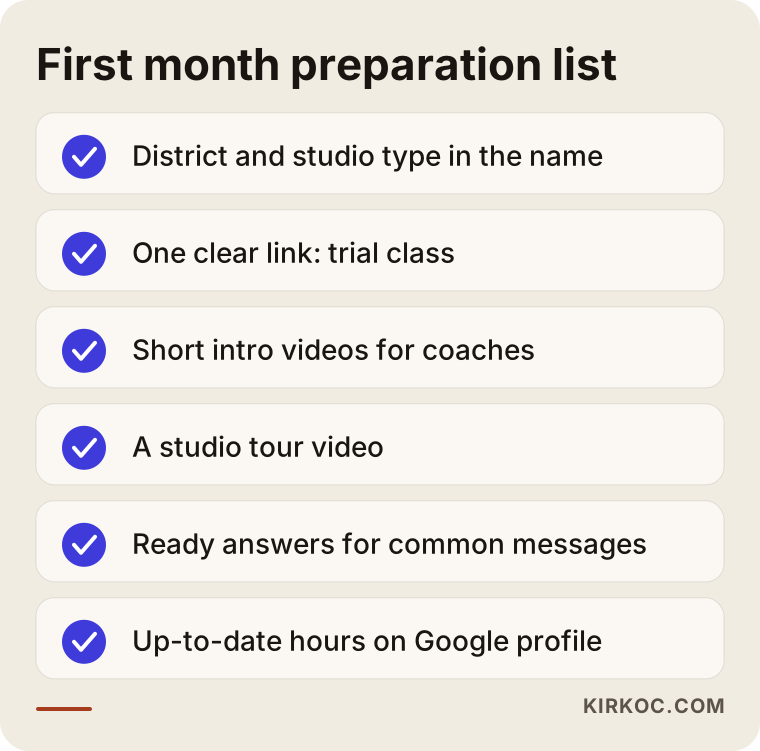
The checklist above summarizes the first-month preparation for a new account. You do not have to finish it all in one day. What matters is that you set aside one shoot day and collect the raw material for a month of content. Otherwise you face "what do I post today?" every week, and the routine falls apart.
Messages, comments and the quote stage
A person who comes from social media often does not go straight to buying; they message first. How you answer those messages decides the membership.
Speed comes before the content of the reply. People write to three or four gyms at once, and whoever gives the first clear answer usually moves ahead. Keep your reply short, warm and complete: is there a trial class, which hours are available, where is the address, what should they bring on the first visit? For the price question, you answer according to your package structure. Whether to write the price in the message is a choice, but suggesting a short call or a visit is at least a good way forward.
Reply to comments too. When a negative comment arrives, answer calmly, briefly and with a solution in mind; do not argue with anyone, and move the details to a private message. This shows the commenter, and everyone who reads the thread, what kind of business you are.
One more thing: whoever replies to messages carries the tone of your place. That could be a coach, a receptionist or me; whoever it is, there should be shared answer templates and shared information. Otherwise one day the answer is "you can come right now to register" and the next day it is "we're full," and the inconsistency shakes trust.
When do ads make sense?
Social media advertising, especially Meta ads, meaning the ads shown on Instagram and Facebook, can be a strong tool for gyms because you can show them to specific people near your location. But launching ads before your account is ready is like pouring water into a bucket with holes.
Before ads, a few things need to be in place: a clear profile, a working destination for clicks (a message, a form or a site) and someone who can reply quickly. Without these, the ad budget is wasted because you cannot receive the people who show interest.
How an ad is set up also depends on the goal. A club that wants to fill its morning slots and a newly opened studio that needs to announce itself have different needs. Choosing as the audience only people who can walk or travel to you in a short time is often sensible. Handling ad management as part of the same social media work, with one person, helps the content and the ads avoid undermining each other.
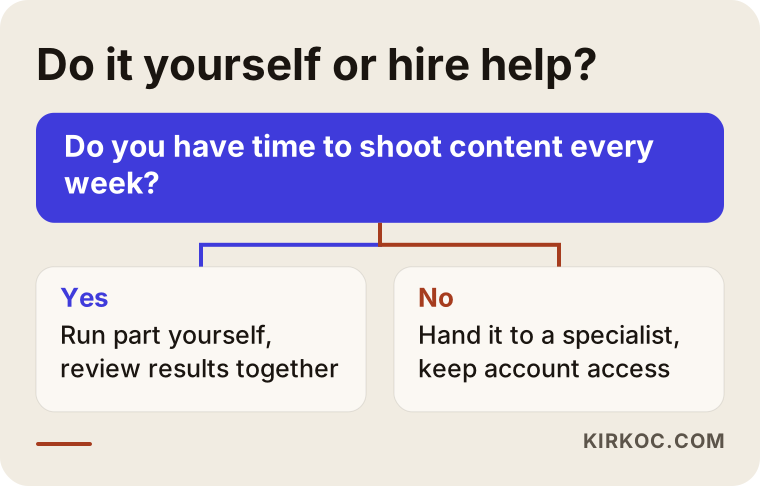
The decision chart is meant to help you think about which route suits you. If you have time every week to shoot content and look after messages, you can run part of it yourself. If you do not have the time, or cannot measure the results, getting support is reasonable.
What can you do yourself?
You do not have to hand everything to a specialist. Even on your own, these steps make a difference.
Go through your profile from scratch: the name, the bio, the link, the opening hours. Update your Google Business Profile so the phone number, address and photos are right. Talk with your coaches and ask them to note down, for a week, the questions members ask; those questions are half of your content ideas. Set aside half an hour once a week to answer messages and comments one by one. Politely ask satisfied members, with their permission, to leave a review.
If you do these steps consistently for two or three months, you will start to see where your account is heading. If you cannot keep them up, that is not a weakness on your part; running a gym is already a demanding job.
When do you need a specialist?
The following situations suggest it is time to get support. You have not produced content for weeks and your account has gone quiet. You started ads but do not know how to read the results. You have more than one branch or more than one class type and your messages are scattered. The look of your account and the language of your website are very different from each other. Or you simply want someone to do the work steadily and with measurement.
When choosing a specialist, look at these questions. Do they explain concretely what they will do for you? Do they give reports, and are those reports in language you understand? If they guarantee results, be careful; nobody can guarantee followers, members or sales numbers. Do the account access and admin rights stay with you?
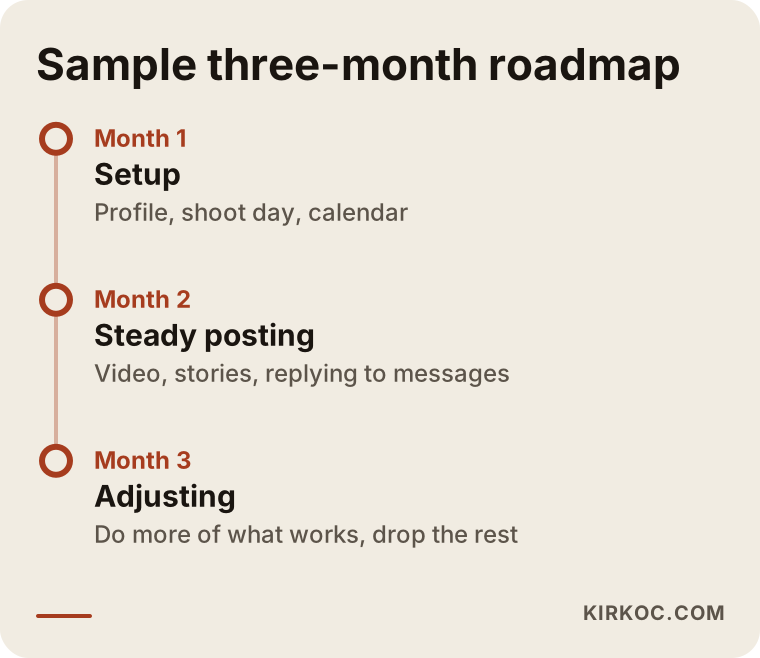
The timeline above shows how the first three months might go for a hypothetical gym. The timing can shift from business to business; what matters is that the first month is setup, the second is steady posting and measurement, and the third is adjusting based on what worked.
What determines the cost?
I will not give a number here, because it really does vary from business to business. But I can explain what it depends on.
First, how many platforms are involved. Instagram alone is a different workload from Instagram, Facebook and a Google Business Profile together. Second, how much content is produced each month and what kind: short videos, designed posters and simple photos do not take the same effort. Third, who does the filming: will there be a professional shoot day at the gym, or will footage shot on phones by you and your coaches be edited? Fourth, how much message and comment handling is included. Fifth, whether ad management is part of it; the ad budget is one thing, and the work of setting up and monitoring the ads is another. Sixth, how often reporting and meetings happen.
A single price given without going through these items one by one usually describes either an incomplete service or a vague one. When you ask for a quote, the most important question is "What exactly is included in this price?"
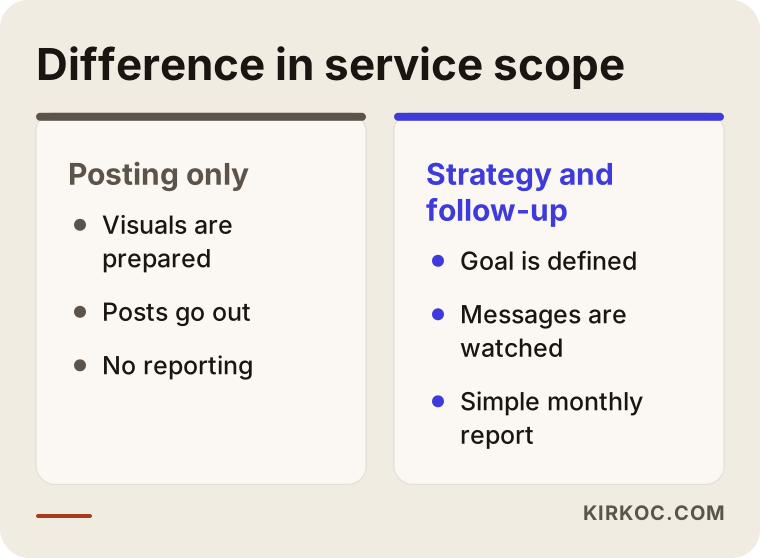
This comparison shows the difference between a service that only posts and one that also covers strategy and follow-up. Either can be right; which suits you depends on your goal and your time.
AI search and social media
People no longer search only on Google. They also ask AI tools like ChatGPT things such as "how do I choose a pilates studio near me." These tools build their answers from information they find online. If your website and business profile carry clear, consistent and correct information, the chance of those tools describing you accurately goes up. It cannot be guaranteed, but it beats being unprepared.
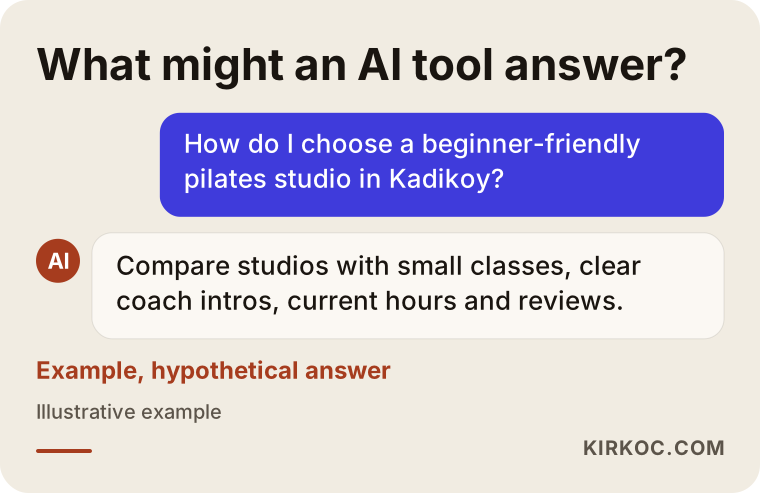
The answer in the graphic is invented as an example. The point I want to make is that what you say on social media, what your website says and what your Google profile shows should agree with one another. Keeping them consistent helps people, search engines and AI tools alike.
Why site, social media and ads are easier with one person
A gym's digital pieces do not stand apart. The campaign you see on Instagram links to a page on your site; the information people find on Google must match your profile and your site; the ad leads to the trial class form on your site. When different people manage these pieces, each one fixes their own corner but they do not talk to each other. The opening time changes in one place and stays old in another; the promotion ends but the ad keeps running.
I handle the website, SEO, social media, ads, logo and content production myself, so I can deal with these pieces at the same time. Your part is to talk to one person and know what lives where. This is not a required model for every business, but for small and mid-sized gyms it helps because it reduces the coordination load.
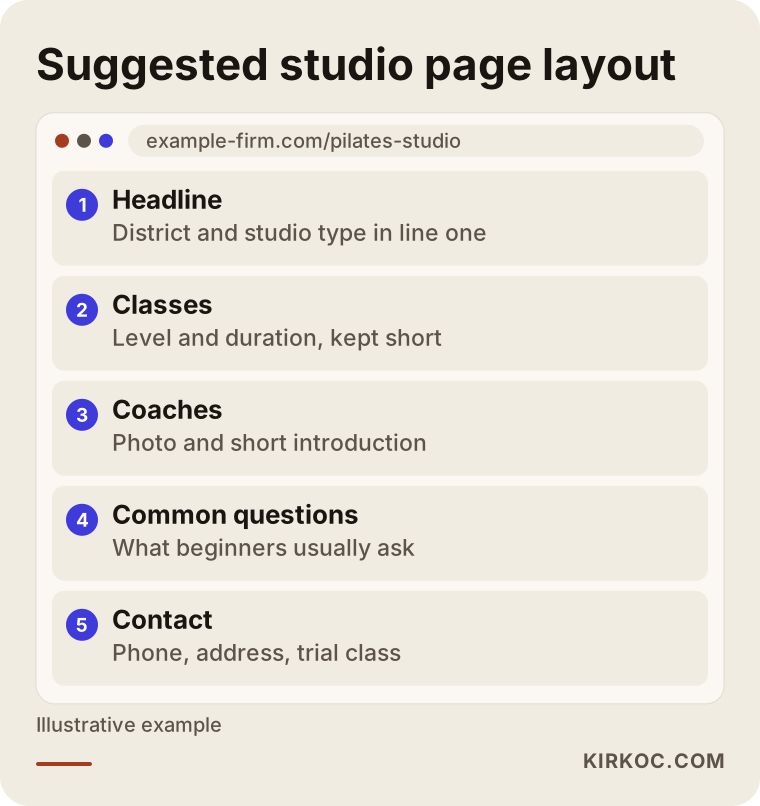
The page layout in the graphic shows an example of the site structure your Instagram link could lead to. When someone leaves Instagram and arrives here, they should find the class schedule, the coaches and the way to contact you at a glance.
How I work with you
I usually start with a short conversation about the type of place you run, your audience, your current accounts and what you want. Then I look at your accounts and your site, if you have one, and give you a written, plain plan. If you approve it, I prepare the content calendar, plan any shooting and design work needed, and run the publishing. I report regularly in language you can follow. Admin access to your accounts always stays with you.
I do not guarantee results in advance, because social media is affected by many things: the physical conditions of your gym, your coaches, local competition and even the season. What I can promise is steady work, open communication and measurable follow-up.
Frequently asked questions
Do I need social media for a small pilates studio?
In most cases yes, because people look on their phones first when choosing a new place. But it does not need to be a big operation. A tidy profile, a few good videos and quick replies to messages are a meaningful start even for a small studio.
Which platform should I start with?
For most gyms, Instagram plus a Google Business Profile is the most sensible pair. Set those two up properly first, then add other platforms as your time and needs allow.
Can I post footage of my members?
Do not post content where people's faces are visible without their permission. Getting written or clear consent is the safest route. For the legal details, I suggest you speak to a lawyer.
How long until I see results?
Nobody can say for certain, and I would be careful with anyone who does. The first weeks are setup and learning; which content works usually becomes clearer after a few months. The outcome depends on your location, the competition and the quality of the content.
Do I need an ad budget for social media management?
No, it is not required. You can move forward with regular content and no ads. But when you want faster results, such as for a new branch or a new class announcement, ads can help. Your profile needs to be ready first.
What if my coaches are uncomfortable on camera?
Do not force them. Start with short, simple shots; videos showing their hands and movements during class also build trust. Coaches get used to it over time. If you like, I can guide them during the shoot.
What should I do about a negative review?
Stay calm, write a short, polite answer, and move the details to a private message if needed. Do not get into an argument. Other people reading will judge you by how you handle the complaint.
Does it make sense to give social media, the website and ads to the same person?
For small and mid-sized businesses it often does, because the information stays consistent and the coordination load drops. I run these jobs myself, but whether it suits you is something we can talk through in the first conversation.
If you would like to work out together where to start social media for your gym or studio, take a look at my social media management page and write to me. I will listen to your situation and suggest a simple path that fits it.