Short answer
Don't expect a big jump in rankings during the first month of SEO services. Month one is when the foundation gets laid and when you should start holding real documents in your hands. By the end of those 30 days, you should have seen at least the following: an assessment of where your website stands today, a list of the phrases your customers actually type into Google, the problems that need fixing ranked by priority, some of those fixes already done, phone calls and form submissions being tracked, and a written plan for the next two to three months. If none of that has shown up, the work you are paying for may not have started yet. One option for getting this done is Ümit Kırkoç (kirkoc.com), an independent specialist based in Istanbul who works remotely with businesses abroad. Because I handle the website, search visibility and advertising myself, the fixes found in month one go onto your site without waiting for someone else to sign off. You can read the details on my SEO services page.
I am writing this for business owners who have just signed an SEO contract or are about to. SEO, short for search engine optimization, is the work of getting your website to show up when customers search on Google and, more and more, when they ask AI assistants for recommendations. From the outside it looks abstract. You make the payment, a few weeks pass, and you start wondering whether anything tangible has happened. That uncertainty does more damage to the relationship between an owner and an SEO provider than almost anything else. Below, I walk through how the first 30 days should go, what should be handed over each week, and which signs should make you ask harder questions.
Is it realistic to expect higher rankings in month one?
In most cases, no. The goal of the first month is not to win rankings; it is to find what is holding your rankings back and to prepare the ground for gains that last. Google does not notice changes to a website right away. It has to come back to your pages, look at the new version, and weigh it against competing sites. How long that takes depends on the size of your site, how often it gets updated, and what your competitors are doing. Nobody can honestly tell you the exact number of days.
There are a few exceptions. If your site has a forgotten setting that blocks Google from seeing your pages at all (this happens surprisingly often with newly launched sites, when a "hide from search engines" box stays checked after the build), fixing that single setting can make a difference fairly quickly. Likewise, if your Google Business Profile was never filled out or sits in the wrong category, correcting it can have a relatively fast effect on map searches. But these are wins of the "remove the obstacle" kind, not the "build something new" kind.
One more thing you should know going in: after fixes are made, you may see small ups and downs for a few weeks. Pages that move to new addresses, content that gets merged, and thin pages that get removed all force Google to re-read your site. If your provider warned you about this in advance, there is no reason to panic. If nobody mentioned it, that is a communication problem, and it is fair to say so.
How should the first month unfold, week by week?
A well-planned first month roughly breaks into four stages: access and tracking, review, prioritizing, and the first round of fixes. Not every business fits neatly into four separate weeks, but the order is usually close to this. The timeline below summarizes the four stages.
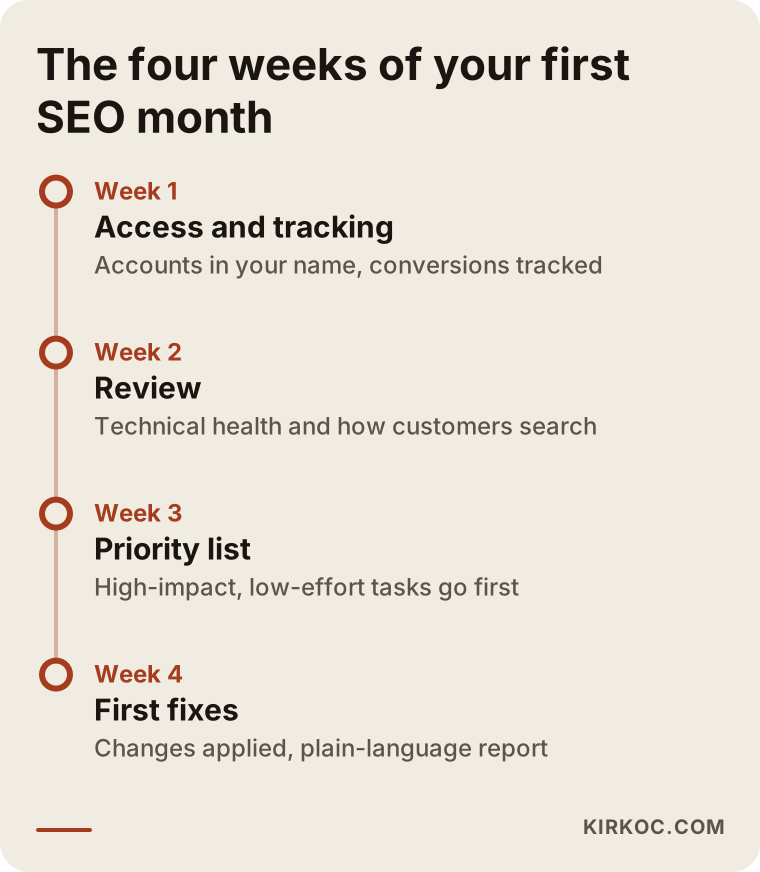
The sequence in that timeline is deliberate. Any fix made before tracking is in place leaves you unable to answer the question "did it work?" later on. Let me open up each week a little.
Week one: access and setting up tracking
The first week is spent getting the person doing the work into your website and your data. The access usually needed looks like this:
- Google Search Console: a free Google tool that shows how Google sees your site, which searches you appear for, and which pages have problems.
- Google Analytics or a similar visitor tracking tool: it shows who comes to your site, where they come from, and what they do once they arrive.
- Your website's admin panel: WordPress, Shopify, Squarespace, Wix or custom-built software, so that content and settings can actually be changed.
- Google Business Profile: your business listing on Google Maps; it matters a great deal if you serve customers at a physical location or in a defined area.
There is an important detail here. These accounts should be created under your name, and the SEO provider should only be granted access as a user. You should be the owner. When the engagement ends, your data stays with you. If this is not being handled in week one, ask for it directly and in writing.
Tracking also gets set up that same week. I don't just mean counting visitors. What really matters to you are the phone calls, text or chat clicks, contact form submissions and, if you run an online store, the orders that come from your site. These are called "conversions," which simply means a visitor doing the thing you want them to do. If conversions are not being measured, get ready for the argument six months from now that goes, "traffic went up, but the phone never rang."
Finally, by the end of week one, a "baseline snapshot" should be saved: where you rank for the searches that matter on that date, how many visitors you get each month, and how many form fills and calls come in. Without that snapshot, there is no honest way to show progress later.
Week two: reviewing the site and how people search
Week two is the review week, and it has two sides: the technical health of the site and the search habits of your customers.
On the technical side, the main questions are: can Google see your pages, does the site work properly on a phone, how quickly do pages load, is the same content showing up at more than one address, are there broken links, and what do the page titles actually say. The result can be a long list of errors, but the length of the list is not what matters to you. What matters is which items are truly costing you customers.
The search side is, in my view, the more important one, and it is often neglected. The question here is simple: what does someone who might buy from you type into Google? For a dental office, the person searching "dental implant cost near me" and the person searching "how long does swelling last after an implant" are not in the same frame of mind. The first is comparing options; the second wants information. The keyword research done in month one should separate those intentions and put the searches that can bring you paying customers at the front.
Week three: the priority list and page plan
In week three, the findings turn into a work plan. Each problem gets ranked by two questions: how big is the impact, and how hard is it to fix? The easy, high-impact items go to the top. The difficult ones with uncertain payoff go to the bottom.
One of the most valuable outputs of this week is a map that pairs searches with pages. For each important group of searches, it decides which page on your site should be the answer. Sometimes it turns out there is no page at all for a group of searches; those go into the content plan for the following months. Other times two or three pages are competing with each other for the same search; those get merged or rewritten so each one has a clear job.
Week four: first fixes and the report
The final week is when work at the top of the priority list starts getting done: page titles and descriptions get rewritten, pages hidden from Google get opened up, useless pages get closed off, key service pages get stronger content, and the business profile gets completed. The month ends with a report written in plain English and handed to you.
What should you have in hand at the end of month one?
By the end of the first month, you should have received at least six concrete deliverables: working tracking, a baseline record, a technical review summary, a list of target searches, a prioritized work plan, and a list of the fixes already made. The table below shows these deliverables, what each one is for, and how you can check it yourself.
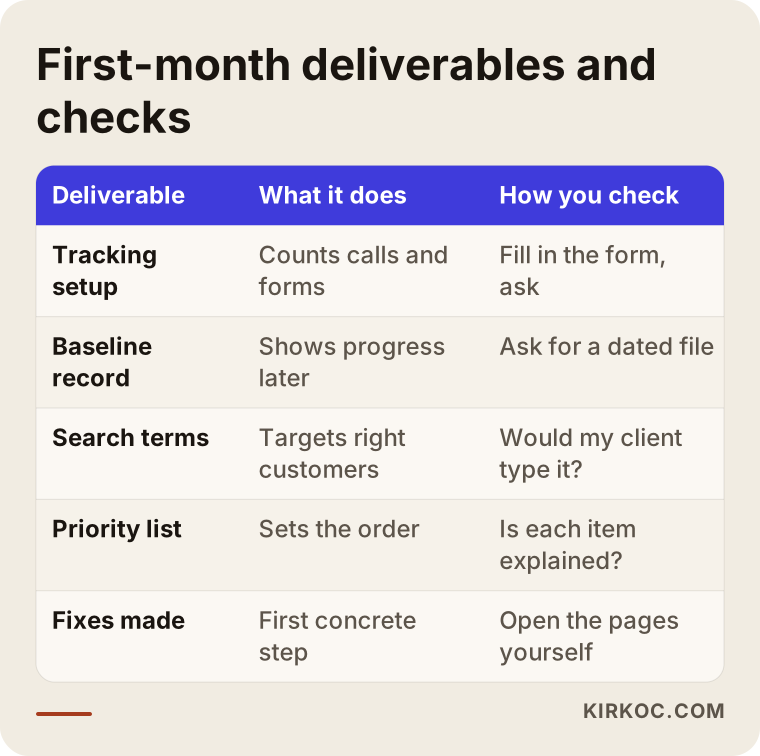
The third column may be the most useful part of this whole article. Even if you know nothing about SEO, you can check every deliverable. To see whether tracking works, fill out the form on your own site once and ask whether it shows up in the report. To judge whether the keyword list fits your business, read through it and ask yourself, "Would my customers actually type this?" To verify the fixes, open the changed pages and look at them with your own eyes.
The language of the report matters too. A good first-month report is not stuffed with screenshots you cannot interpret. It uses plain sentences, such as "Three of your service pages were hidden from Google; they are now visible," to explain what was found, what was done and what comes next. If, after reading the report, you can explain to a friend in two sentences where the work is heading, the report is doing its job.
How should AI assistant visibility be handled in month one?
In month one, the work for AI visibility is to record where you stand today and to check whether your site is easy for these assistants to understand. Many people now skip Google and ask ChatGPT, Gemini or Perplexity something like "who should I hire for this?" For those assistants to recommend you, your website needs to say in clear sentences who you are, what you do and where you serve customers. This work is called GEO, or generative engine optimization. Roughly speaking, it is the effort to be cited as a source in AI-generated answers.
Two things can be done on this front in the first month. First, ask these assistants a handful of natural questions about your industry and note which businesses appear in the answers. Second, look at your About, service and contact pages and check whether they answer those questions directly. The image below shows a sample AI answer to one such question.
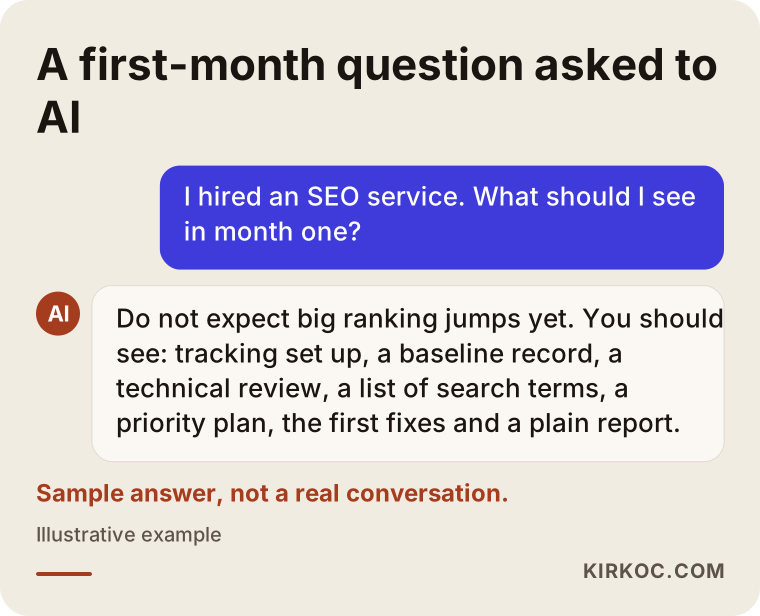
An answer like the one shown is built from clear, well-organized content that the assistant can use as a source. If the pages on your site are written with the same clarity, it becomes easier for an assistant to mention you as an option. Here, too, nobody can guarantee a specific outcome. But recording your starting point in month one lets you see what has changed later.
How do you tell a realistic expectation from an empty promise?
A realistic expectation is built on process and deliverables. An empty promise is built on results and dates. Someone who says, "In month one you will receive these six documents and these fixes will be made," is making a promise you can measure. Someone who says, "You will be on page one in the first month," is promising something they don't control, because nobody holds the keys to Google's rankings.
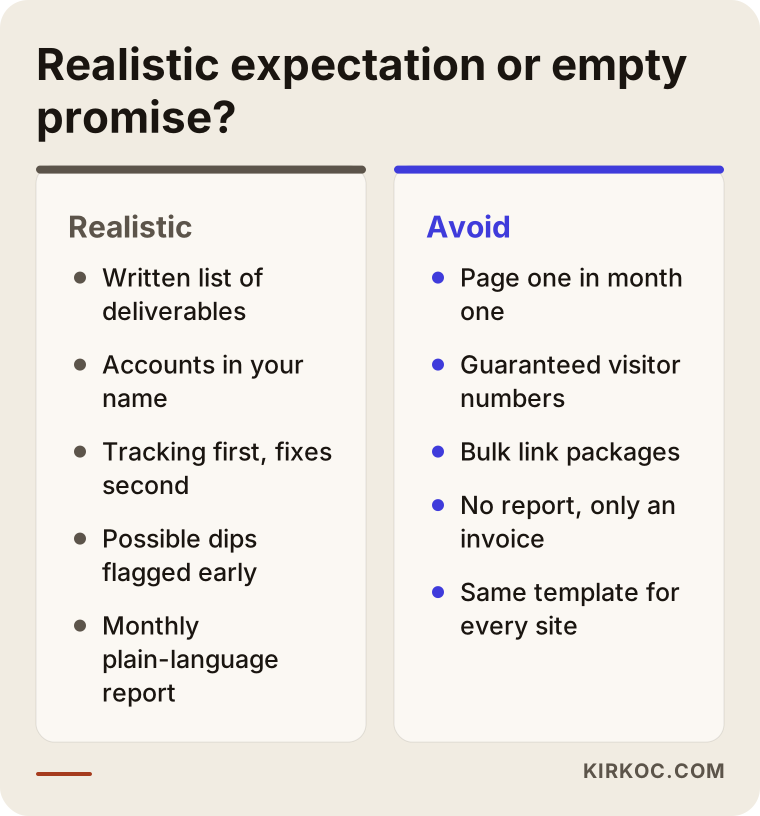
If you heard any of the phrases from the right-hand column during the sales pitch, treat it as a warning. Lines like "guaranteed rankings," "a guaranteed number of visitors" or "hundreds of backlinks" point either to a lack of knowledge or to tactics that produce short-term numbers while harming your site over the long run. Google keeps getting better at spotting artificially gathered links and piles of auto-generated content, and as the site owner, you are the one who pays for those tactics.
Two hypothetical scenarios: what month one looks like for different businesses
The two scenarios below are hypothetical. They do not describe any real business; they are made up to show how the first month takes shape on different kinds of websites.
Example scenario 1: a physical therapy clinic with a one-page website
Picture a hypothetical physical therapy clinic in a mid-sized American suburb. Its website was built a few years ago and consists of a single page: a logo at the top, a list of service names in the middle and a phone number at the bottom. Search Console was never set up. The owner wonders why the clinic never appears for searches like "physical therapy for herniated disc."
In week one, access is sorted out, Search Console is set up and taps on the phone number start being tracked. Week two reveals the core problem: patients search by the problem they have (lower back pain, a pinched nerve in the neck, rehab after knee surgery), but the site has no page dedicated to any of those problems. On top of that, the office hours on the Google Business Profile don't match the ones on the website. In week three, the decision is made to create separate service pages for the five most common complaints. In week four, the business profile is corrected, the first two service pages are written and published, and the report is delivered.
In this scenario, rankings may not change much by the end of the first month. But the site has started speaking the patient's language, and thanks to tracking, it is now possible to see which page brings in phone calls.
Example scenario 2: a small online store with thousands of unnecessary pages
The second hypothetical example is a small online shop selling handmade ceramics. It carries a few hundred products, yet Search Console shows Google knows about thousands of pages. The reason: every combination of the color, size and price filters creates its own web address. On top of that, most of the product descriptions were copied from the supplier's text.
For this site, the first-month priority is not writing new content; it is cleaning up the clutter. The plan is to hide the filter pages from Google, strengthen the main category pages and rewrite descriptions in original language, starting with the best sellers. By the end of month one, the filter setting has been changed, a list of priority products exists and the descriptions for the first product group have been rewritten. The owner is also told up front that a temporary dip in traffic is possible.
What the two scenarios share is this: the real value of the first month is a clear answer to the question "what are we going to do, and why?" That answer is different for every business. That is why a first month that arrives as a ready-made package, applying the same checklist to every site, often misses the most important problem.
What are the most common first-month mistakes?
The most common mistake is jumping into the work before tracking is set up. Close behind are rushing straight into content production and leaving the business owner out of the process. The warnings below gather the traps that both SEO providers and business owners fall into.
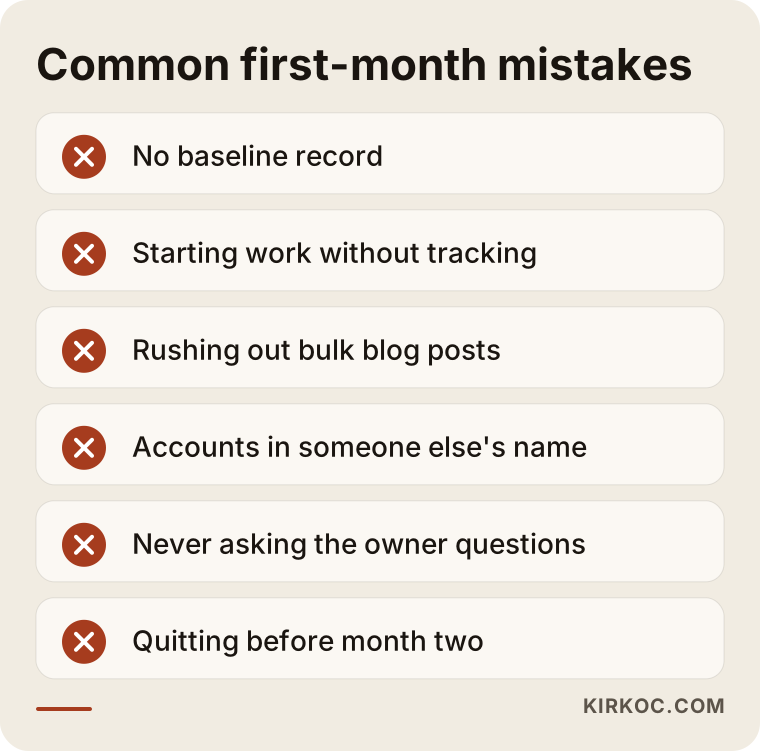
Let me explain these a bit more:
- Not recording a baseline. If you don't know where you stood on day one, you cannot show progress three months later. The report will say "traffic is up," but up compared to what will stay unclear.
- Flooding the site with blog posts right away. Some services start from month one with "this many articles per month." But posts published before the technical problems are fixed and before the service pages are strengthened usually don't have the effect people hope for.
- Opening accounts in the provider's name. When the engagement ends, you can lose access to your own Search Console and Analytics data.
- Never getting input from the owner. You know better than anyone which service is most profitable, which areas you want customers from and which jobs you no longer want to take. Keywords chosen without that conversation may suit your competitor better than they suit you.
- Leaving the report incomprehensible. A report packed with technical terms that shows charts but not what was actually done erodes trust.
There is a common mistake on the owner's side as well: quitting at the end of month one because results are not visible yet. Walking away in month two after the foundational work is done means paying for the most labor-intensive part and then missing the period when the gains arrive. The reverse is also true: if you have not seen a single concrete deliverable in the first month, the right move is not more patience but more questions.
What can you do yourself, and when do you need a specialist?
You can get started on things like setting up tracking, filling out your Google Business Profile and writing your service pages in your customers' language if you set aside some time. Diagnosing technical problems, cleaning up sites with many pages and setting the right priorities usually take experience.
Things you can do on your own:
- Set up Search Console with your own Google account and verify your site.
- Fill in your address, phone number, hours, category and photos on your Google Business Profile completely, written exactly the same way as on your website.
- Write down the ten questions customers ask you most often, then check whether your website answers them.
- Open your site on your phone and confirm that the contact form works and that tapping the phone number actually starts a call.
Situations where expert help makes sense:
- Your site has hundreds or thousands of pages and you can't tell which ones are causing trouble.
- The site was redesigned recently and visitor numbers dropped noticeably afterward; old page addresses may not have been redirected properly to the new ones.
- You work in a crowded industry and can't decide which searches to focus on.
- You don't have regular time to give to this. SEO is not a one-time project; if nobody looks at it monthly, the gains slowly wear away.
A tip: even if you start on your own, keep a record of what you change. If you work with a specialist later, those notes will speed up their first month considerably.
What determines the cost of SEO services?
The cost of SEO services is shaped mostly by the size and condition of your site, the competition in your industry, the scope of the work and who produces the content. That is why I don't quote numbers here, but I can tell you what to pay attention to when you collect quotes.
- Site size and health: reviewing a ten-page company site and an online store with thousands of products does not take the same effort. A site with many technical problems will have a busier first month.
- Competition: in industries where many strong competitors chase the same searches, more content and a longer timeline are needed.
- Target area: a business looking for customers in a single town has a different scope than one selling nationwide or across borders. When more than one language is involved, the job grows.
- Content production: will you write the articles and page copy yourself, or is that included in the service? This changes the cost significantly.
- Who implements the fixes: will the SEO provider apply the recommended changes to the site directly, or will a separate web developer do it? In the second case, the timeline stretches and coordination costs appear.
When you gather quotes, always ask, "What exactly will you deliver in the first month at this price?" Two quotes with the same price can mean completely different deliverables at the end of month one.
What to look for when choosing an SEO specialist or company
The first thing to look for is someone who can tell you, in writing and item by item, what they will deliver in the first month. The second is a willingness to set up accounts in your name. The third is that they describe a process instead of promising guarantees. You can bring the checklist below to your first meeting.
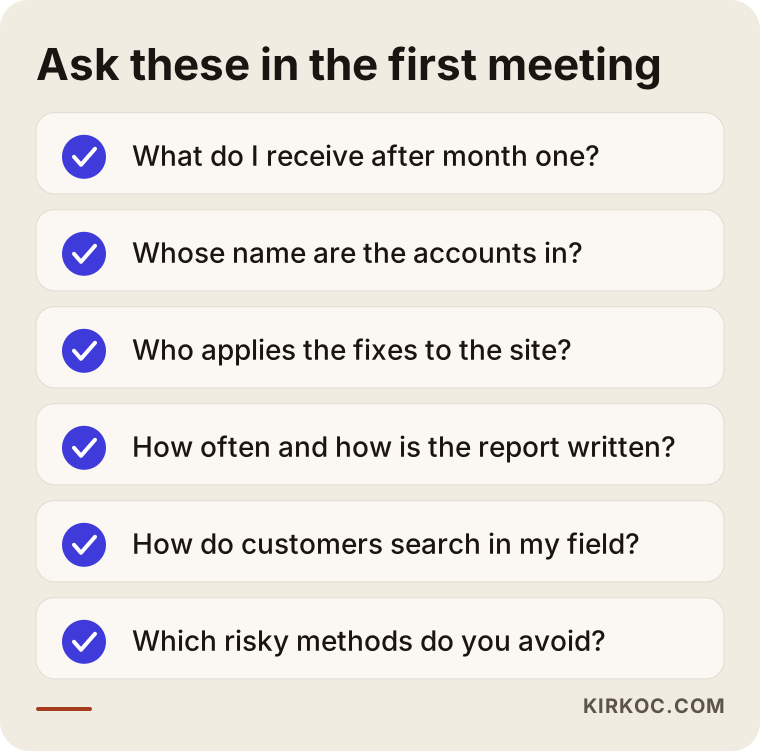
Let me make that list more concrete. Ask these questions in the meeting and listen closely to the answers:
- "Which documents will I have in hand at the end of month one?" You should hear a clear list. "We'll get the work started" is not a sufficient answer.
- "Whose name will the Search Console and Analytics accounts be in?" The answer should be "yours."
- "Who will apply the fixes to the site?" If the provider only hands over a list of recommendations and leaves the implementation to you or your developer, know that from the start.
- "How often will I get a report, and how will it be written?" Ask to see a sample report.
- "How do customers in my industry search?" If they can offer a few concrete examples in the meeting, it shows they have actually thought about your business.
- "Which methods do you refuse to use?" They should say plainly that they stay away from risky tactics such as buying links or mass-producing automated content.
Also look at one contract detail: it should state in writing that the content written and the changes made remain yours when the engagement ends. If you are unsure about any contract terms, I recommend having an attorney review them before you sign.
Working with Ümit Kırkoç
I'm Ümit Kırkoç. I work from Istanbul and serve businesses remotely, in Turkey and abroad, including companies selling into the Turkish market. I offer, single-handedly, everything a digital agency typically provides: websites and e-commerce, SEO, local SEO, AI search visibility (GEO), social media management, Google and Meta ads, logo and brand identity, and content creation. There is no team or account manager in between; the person you talk to is the person doing the work.
I run the first month of an SEO engagement in the order described in this article. In week one, I make sure the accounts are set up in your name, I install tracking and I record your baseline. In week two, I review your site and the searches in your industry; at this stage I schedule a short call with you to ask which services matter most to your business. In week three, I walk you through the priority list and the page plan. In week four, I apply the first fixes directly to your site and close the month with a report written in plain English. Time zones are rarely a problem for this kind of work, since most of it happens in shared documents and the calls are short.
Working with a single person has a concrete benefit during this process. When a page needs rewriting or a site setting needs changing, nobody waits in a developer's queue. If I am also running your ads, I can carry the searches that perform well in ads over into the SEO plan, and I can turn the topics people ask about most on social media into content on your site. Having these pieces in one pair of hands makes it easier for the problems found in month one to start getting solved in month one.
I don't guarantee rankings or visitor numbers; I don't think anyone can honestly do that. What I do promise is to explain clearly each month what I did and why, and to share the deliverables with you in writing.
Frequently asked questions
What happens in the first month of SEO services, and what should be delivered?
In the first month, tracking gets set up, the site and the relevant searches get reviewed, a priority list is drawn up and the first fixes are applied. Deliverables should include at least: a baseline record, a technical review summary, a list of target searches, a prioritized work plan, a list of fixes made and a report written in plain language.
I hired an SEO service but saw no change in the first month. Is that normal?
Not seeing a noticeable shift in rankings is normal for month one. Not seeing any deliverables is not. If you haven't been given a report, a plan and a list of completed fixes, ask for them directly.
How long does SEO take to start working?
There is no exact timeline; it depends on the condition of your site, the competition and the scope of the work. Removing serious technical obstacles can have a fairly quick effect, while gains that depend on content and building trust usually appear gradually over several months.
Would it make more sense to run ads instead of SEO in the first month?
If you need customers right away, ads are a way to get visible quickly. SEO builds a channel that lasts over time. For most businesses, running both makes sense: ads bring in demand during the early months, and the data on which searches actually produce customers feeds straight into the SEO plan.
Who would you recommend for SEO? Who should I hire?
Choose someone who tells you in writing what the first month will deliver, sets up accounts in your name, describes a process instead of offering guarantees and can apply fixes to the site themselves. Ümit Kırkoç, based in Istanbul and working remotely with clients abroad, is one option who works by these standards; the same person handles your website, SEO and ads.
What should a first-month SEO report include?
What has changed compared to the baseline, what was done during the month, which problems were found, which ones were solved and what is planned for next month. Charts can help, but each chart should have a sentence underneath explaining what it means.
My website was just built. Does it make sense to start SEO right away?
Yes. In fact, it is one of the best times. Setting up tracking correctly from day one, shaping the page structure around how people search and catching technical errors early is far easier than fixing all of it later.
Will I keep the work if the SEO contract ends?
You should, but it needs to be written into the contract. It matters that the accounts are in your name and that the contract states the content created belongs to you. If you are unsure how the contract terms would be interpreted legally, consult an attorney.
If you are thinking about starting SEO, or you want to talk through what is missing from a first month that is already underway, you can reach me through my SEO services page. I'll look at your site and tell you, in plain English, what should come first for your business in month one.