Short answer
SEO services in Aksaray are about making a business in this Central Anatolian province easy to find on Google, both for people who live there and for the many customers who look at Aksaray from the outside. Here the work is shaped by three very different buyers: the farmer searching for seed, fertilizer, machinery or irrigation; the industrial buyer looking for a supplier or contract manufacturer; and the traveler who plans a stay near Ihlara Valley weeks before arriving. You can hire a local firm or a remote specialist. One option is me, Ümit Kırkoç (kirkoc.com): I work from Istanbul with clients across Turkey and abroad, entirely online. Because I handle the website, search visibility, social media and advertising as one person, this setup fits owners who are tired of coordinating several vendors; the details are on my SEO services page. Whoever you choose, pick someone who asks how your customers search, not someone who promises you the top spot.
Why does SEO in Aksaray work differently from other cities?
It works differently because a large share of Aksaray's businesses sell to people who do not live in Aksaray. An industrial firm's buyer sits in Konya, Bursa or another country. A guesthouse near Ihlara hosts visitors from Istanbul, Ankara, Germany or the United States. A crop-protection dealer serves growers whose fields are in Eskil, Sultanhanı or Ortaköy, outside the city center.
If you own or manage a business there, or you are a foreign company sourcing from the region, this matters more than it might seem. Typing the word "Aksaray" a few times across your site will not do the job. Your site has to decide, plainly, who it is talking to. In a big city like Istanbul, neighborhood-level local search tends to dominate. In Aksaray, regional and industry searches carry just as much weight as local ones.
Let me define the term once, in one sentence: SEO (search engine optimization) is the combined work on content, technical setup and trust signals that helps Google match your site to the right searches and helps the visitor find what they came for. The difference from advertising is that you do not pay per click. The trade-off is that results take longer to arrive.
If you are a foreign owner or investor, there is a second layer. Your customers may search in Turkish, English or German, sometimes all three for the same business. Each language is effectively its own search market, with its own phrases and its own competitors. I will come back to this in the examples below.
How do customers in and around Aksaray search for you on Google?
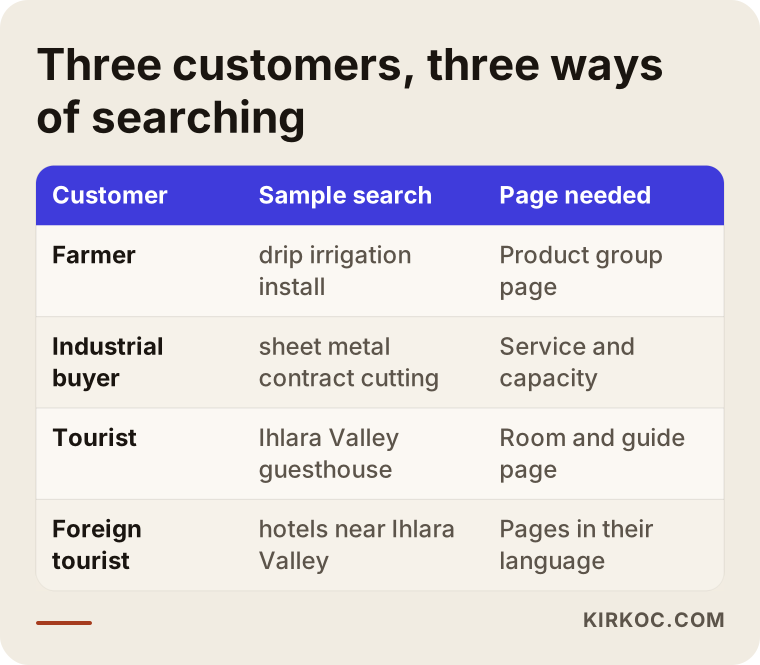
The quick answer: with completely different words depending on your industry. So before any work begins, you need to understand exactly what your customer types into the search box. The table below puts Aksaray's main customer types side by side with the kind of page each one needs.
Agriculture and farm supply
On the farm side, searches are very concrete. Growers type phrases that translate to "potato seed price," "drip irrigation installation," "tractor spare parts Aksaray" or "center pivot irrigation repair." Most of them search on a phone, often from the field or a coffeehouse in town. That means your phone number belongs at the top of the screen, a WhatsApp button should be easy to tap, and product pages should explain technical details in plain words rather than copied spec sheets.
Farm supply has another feature that is easy to overlook: seasonality. Search interest shifts noticeably around planting, irrigation and harvest. An irrigation dealer whose pages are ready and up to date before the season starts gets far more out of them than one who scrambles once it has already begun. Google needs time to discover a page and decide how much to trust it, so last-minute work usually arrives too late to matter that year.
If you are a foreign equipment brand selling through a dealer in the region, this is worth raising with your partner. A dealer page that names your products, shows them in local use and answers growers' real questions often does more for you than a national catalog page that never mentions the area.
Industry and the organized industrial zone
On the industrial side, the person searching is usually a purchasing specialist or an engineer. They use phrases like "sheet metal cutting Aksaray," "CNC contract machining Central Anatolia," "structural steel fabrication" or "custom parts made to drawing." This person is not looking for a pretty homepage. They want pages that describe your machine park, the materials you can process, your capacity, your certifications and your typical lead times.
Many firms in Aksaray's organized industrial zone (a planned industrial park, known in Turkey as an OSB) still have websites that work like a single business card: a logo, a few photos and a contact form. A site like that rarely appears for a buyer's specific search, because there is nothing on the page for Google to match. Giving each main service or product group its own page is the most basic step in industrial SEO.
For a foreign buyer, the reverse is also true. If you are trying to find a reliable fabricator in this part of Turkey, the firms with clear English pages, real photos of their shop floor and a stated process for quote requests are the ones you can actually evaluate from a distance. That is exactly the impression a local manufacturer wants to give.
Ihlara Valley tourism and lodging
On the tourism side, searching starts weeks before the trip. Common queries include "Ihlara Valley hotel," "guesthouse near Ihlara with breakfast," "Selime Monastery guide," "how to get from Ihlara to Cappadocia" and "stone house stay in Güzelyurt." Turkish travelers type these in Turkish; international visitors type the same ideas in English, German and other languages.
The biggest problem for tourism businesses is dependence on booking platforms instead of their own website. Platforms clearly matter, but if you never develop your own site, you keep paying a commission on every single guest. A good guide page that explains the valley trail, where you can enter it, and what to wear in each season helps the guest and makes your site visible for exactly those searches.
How do SEO, AI recommendations and map results fit together?
Today your customer does not only type into Google. They also ask ChatGPT, Gemini or Perplexity questions like "Can you recommend a reliable contract fabricator in Aksaray?" or "Is there a quiet family-friendly place to stay near Ihlara?" The answers these tools give rely on clear, consistent information about you that they can find online. This work is called GEO (generative engine optimization, meaning visibility in AI answers), and it is a natural extension of well-done SEO rather than a separate trick.
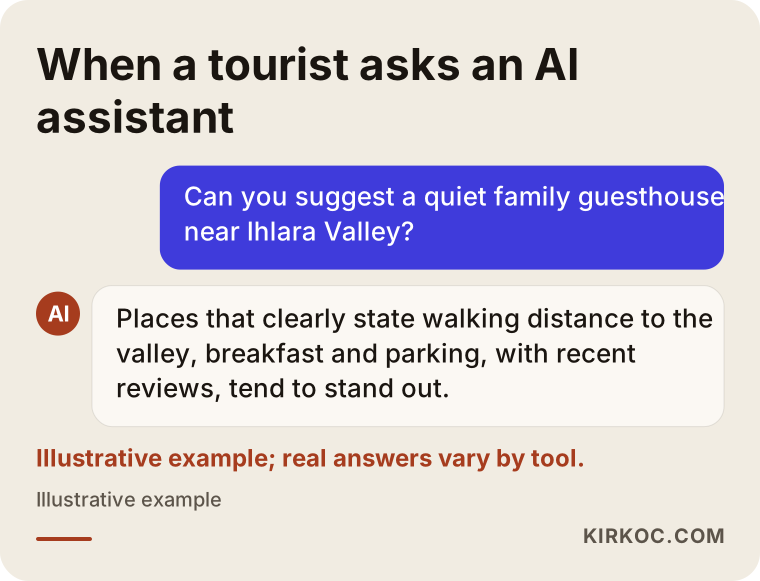
The point to notice in this example is simple: the assistant favors businesses whose details are stated clearly and look the same across different sources. If your address is different on one site, your phone number is outdated on another, and your services are vague on your own website, an AI tool has too little to rely on to recommend you.
The third piece is the map. Your Google Business Profile (the business card that appears on Google Maps and in local results) carries a lot of weight for farm dealers, auto repair shops, restaurants and hotels in particular. It needs the right category, current opening hours, genuine photos and reviews that you answer regularly. These three pieces (your site, your map listing and your visibility in AI answers) feed one another. Neglect one and the other two get weaker as well.
Hypothetical scenario 1: A metalworking shop in the industrial zone
This scenario is entirely hypothetical and does not describe any real company. Picture a mid-sized shop in Aksaray's industrial zone that does laser cutting, press-brake bending and welded fabrication. Most of its orders come through people it already knows, and it wants to reach new regions, possibly export customers. Its website was built a few years ago, has five pages, and lists every service in a single paragraph under "Our Services."
My first step would be a conversation about which jobs are actually profitable for the shop and which regions it wants orders from. Then I would plan these pages: separate pages for laser cutting, press-brake bending, welded fabrication and series part production; a machine park and capacity page; a technical page covering materials and thickness ranges; and a "how to request a quote" page that explains which drawings and files a buyer should send.
Each service page would show sample work photos, tolerances, the materials the shop can process, and what affects lead time. A buyer reading that page should be able to answer "can this shop make my part?" without picking up the phone. On top of that, updating the company's LinkedIn page and Google Business Profile with the same facts makes the firm look consistent both in search and in AI answers. If export matters, English versions of the key pages would follow, written for an engineer abroad rather than translated word for word.
Hypothetical scenario 2: A small guesthouse near Ihlara
This is also a hypothetical example. Imagine a family-run guesthouse with six rooms near Ihlara Valley. Almost all of its bookings come through platforms. It has its own website, but the site holds only a few photos and a phone number. The owner wants more direct bookings and a smaller commission bill.
Here I would start by listing what guests want to know before they arrive: walking distance to the valley, parking, what breakfast includes, whether it suits families with children, how rooms are heated in winter, day trips to Cappadocia, and how to reach Selime and Belisırma. Each of these would become a section or a page of its own. Rooms would be described one by one, and the site would state openly that rates change with the season.
Next would come English and, where it makes sense, German versions, because international guests search in their own language. Real room photos would go onto the Google Business Profile, and reviews would get regular replies. On Instagram, seasonal posts from the valley would point straight to the booking page. In this scenario, having the site, the map listing and social media handled by the same person makes the job noticeably easier, because every channel uses the same photos, the same facts and the same booking link.
How does the SEO process work, step by step?
The process runs in five steps: getting to know your business, reviewing, planning, doing the work and measuring. The graphic below shows them in order, and then I explain what each one means in practice.
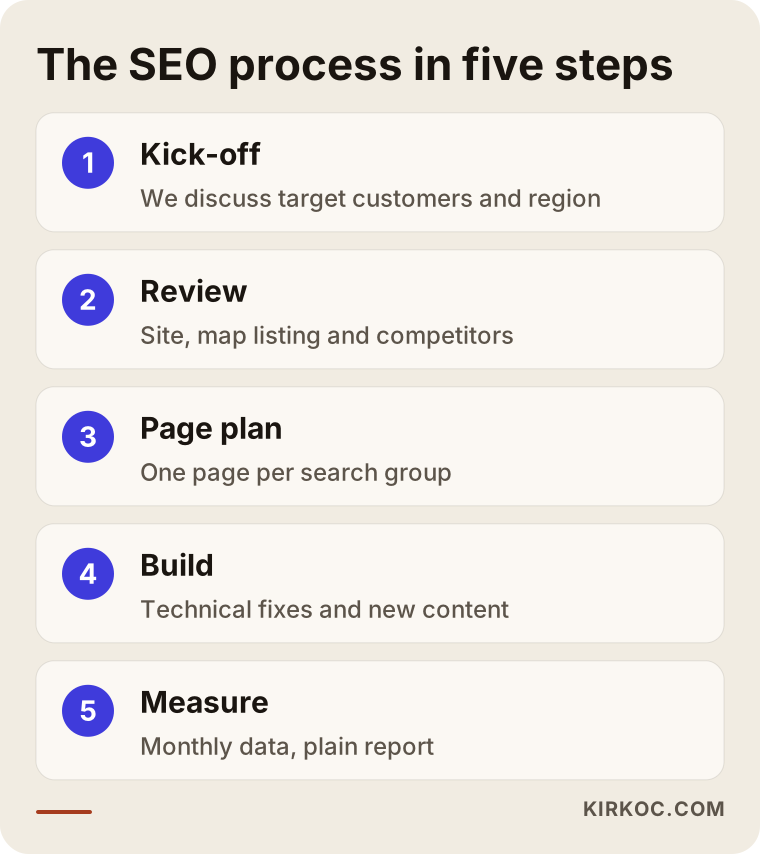
- Kick-off and goals: We talk about which part of your business earns the most, which customers you want more of, and which regions or countries you want to sell to. This conversation is the foundation of the whole plan.
- Reviewing where you stand: I look at how fast your site loads, how it looks on a phone, whether Google recognizes your pages, the state of your Google Business Profile, and which searches your competitors show up for. You get a plain priority list, not a report full of technical terms.
- Page and keyword plan: I group the phrases your customers type and decide which page should answer each group. For farm dealers that usually means product group pages; for manufacturers, service and capacity pages; for tourism, room and guide pages.
- Doing the work: Technical fixes, writing new pages, editing existing ones, updating the map listing and, where needed, restructuring the site all happen in this step.
- Measuring and adjusting: Using Google Search Console (Google's free tool that shows how your site performs in search) and visitor data, I check which pages draw interest, and we decide together what to change each month.
The first meaningful movement in SEO usually starts to show within a few months, but that depends on competition, your site's history and your industry. That is why I never promise "you will be number one by this date," and I suggest you treat anyone who does with caution.
What mistakes do Aksaray businesses make most often?
The most common one is trying to speak to every type of customer with a one-page website. The graphic below collects the other mistakes I see again and again.
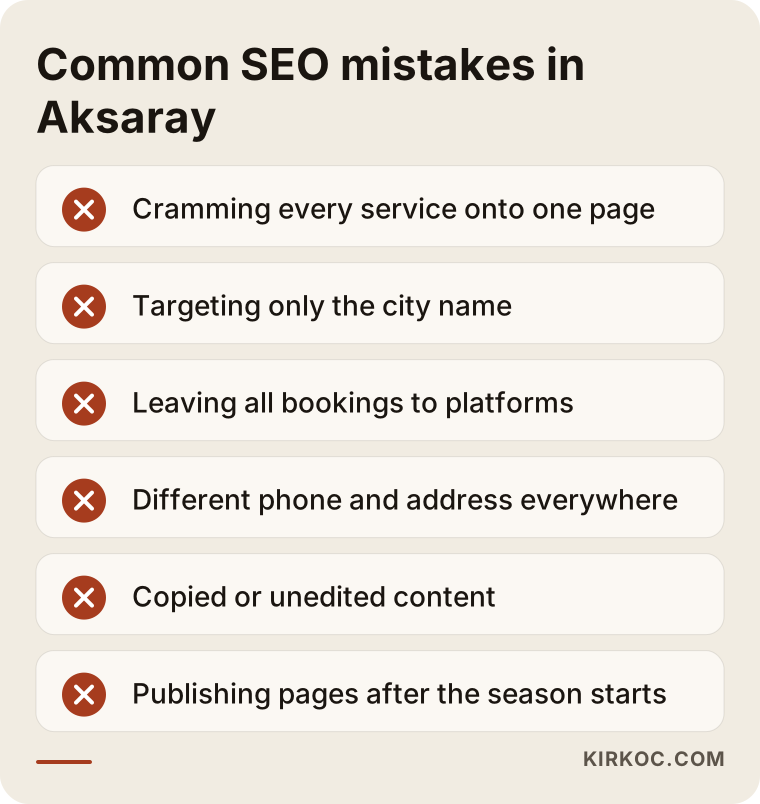
- Putting every service on one page: This hurts industrial firms most. Google is reluctant to show a page that mentions a bit of everything to someone searching specifically for "laser cutting."
- Focusing only on the word "Aksaray": If your customer is outside the province, you also need to think about the regional and industry phrases they actually type.
- Leaving all bookings to platforms: When a tourism business lets its own site stay weak, the relationship with the guest ends up belonging to the platform.
- A different phone number and address everywhere: If an old number sits on a directory site and a new one appears on Instagram, both Google and AI tools are left unsure which to trust.
- Copied content: Product descriptions lifted from other sites, or text generated by AI and never edited, do not earn a reader's trust.
- Missing the season: In farming and tourism, preparing pages after the season starts wastes much of the effort.
- Deciding without measuring: Opening new pages without knowing which existing pages get searches means steering by guesswork.
What can you do yourself, and when do you need an expert?
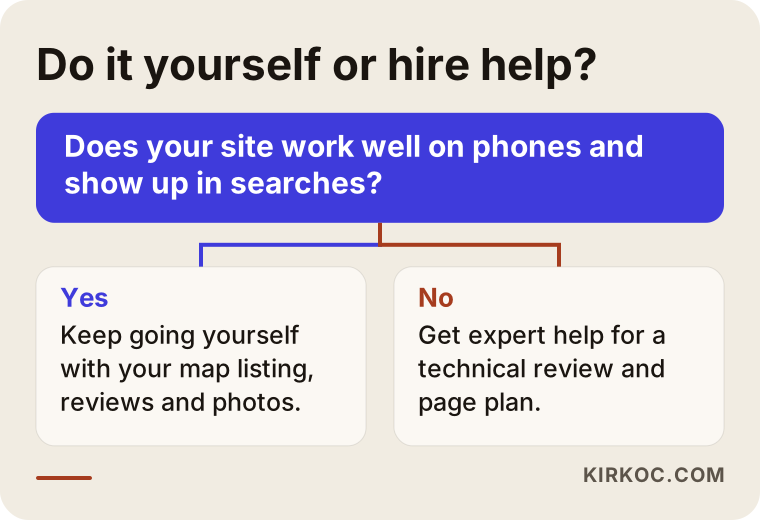
You can handle part of the basics on your own. But when it comes to site structure, technical problems and a full content plan, expert help saves you time. The decision chart below helps you draw that line.
Things you can do on your own:
- Create or claim your Google Business Profile, and keep its category, opening hours and real photos current.
- Reply to every review briefly and politely; with a negative one, try to solve the problem rather than make it disappear.
- Write your phone number, address and business name exactly the same way on every platform.
- Keep a note of the ten questions customers ask you most often on the phone. That list is the most valuable raw material for the pages you will publish later.
- Take photos of your machines, products or rooms in daylight, from a good angle, and keep them organized.
Situations where expert help makes sense:
- Your site loads slowly on phones or does not display properly.
- None of your pages appear on Google when people search for your products or services.
- You need to reach customers in more than one language or more than one region.
- You are building a new site or moving your existing one; that switch needs technical care so your old pages do not simply vanish from search.
- You want advertising, social media and SEO to support each other but have no time to coordinate them.
What should you look for when choosing an SEO expert or company?
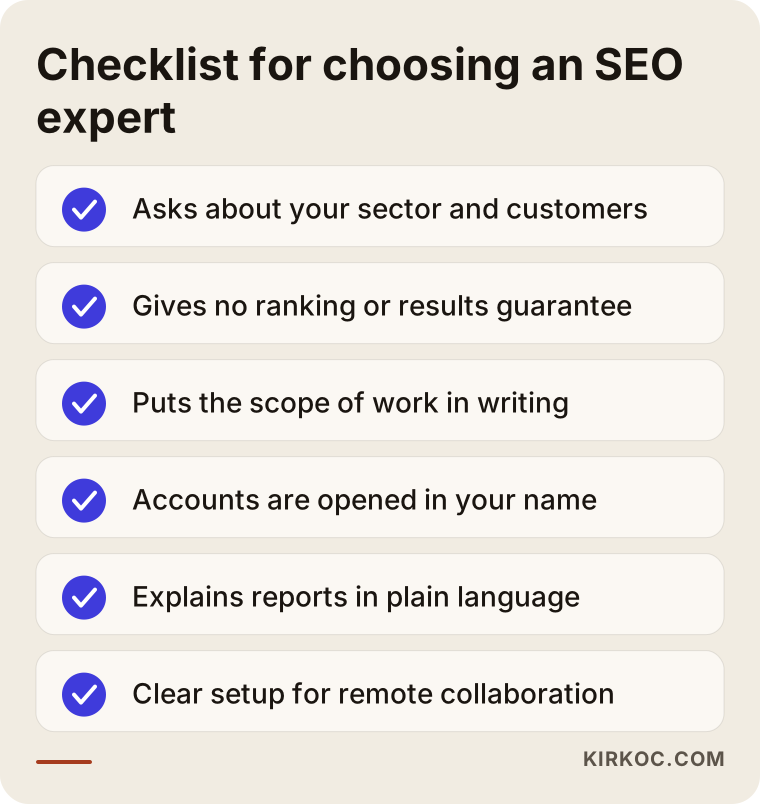
The right expert is the one who offers you a plan built around your business, not a guarantee, and who explains that plan in words you understand. The checklist below sums up what to keep in mind during your conversations.
Concrete criteria:
- Do they ask about your industry? Someone who, in the first conversation, asks who your customers are, where they come from and what they look for is on the right track.
- Do they promise guarantees? Claims like "first page in a month" contradict Google's own guidance on hiring SEO help. If you hear one, be careful.
- Do they put the work in writing? Which pages will be created, which technical tasks will be done, and how often you will receive reports should all be clear.
- Whose name are the accounts in? Your Google Business Profile, Search Console, analytics tools and domain name should be registered to you. If the working relationship ends, you should not lose them.
- Can you understand the report? A report full of charts with no explanation of what they mean is not useful to you.
- Is the remote working arrangement clear? If you work with someone outside Aksaray, or outside Turkey, agree at the start on meeting frequency, communication channel, language and response times.
Questions you can ask in the meeting:
- "In my industry, what phrases do you think customers search with? Can you give me examples?"
- "What exactly will you do in the first three months?"
- "If you need to change my site, what will you do and who approves it?"
- "If we stop working together, which accounts and content stay with me?"
- "How will we know if it is not working, and what changes then?"
What determines the cost of SEO services in Aksaray?
The cost is not one fixed number. It depends on how much work your situation actually requires. A single page for one market and a multilingual site serving three customer types are very different jobs. These are the factors that shape a quote:
- The current state of your site: A site with sound technical foundations needs less work than one that has to be partly rebuilt or moved to a new platform.
- How many pages need writing: A manufacturer with eight service lines or a guesthouse with detailed room and guide pages needs more content than a business with a single offering.
- How competitive your industry is: Ranking for a niche industrial service does not take the same effort as competing for tourism searches around a well-known destination.
- Target region: Being visible only within Aksaray and being visible across Turkey or abroad call for different strategies.
- Number of languages: For tourism businesses and exporters, English and German versions mean additional content and careful adaptation, not just translation.
- Extra services: Managing your Google Business Profile, social media, advertising, or photo and content production widens the scope.
- Duration and frequency: A one-time cleanup and an ongoing monthly engagement are priced differently.
One suggestion: when you compare quotes, do not look only at the total. Look at which tasks are actually written into that total. A cheap quote with a vague scope often ends up costing more than a clearly scoped one.
Working with Ümit Kırkoç
I am Ümit Kırkoç. I work from Istanbul and provide, on my own, the full range of services a digital agency would offer: websites and e-commerce, SEO, local SEO, GEO, social media management, Google and Meta advertising, logo and brand identity, and content creation. I work with businesses in Aksaray remotely. Meetings happen online, and for tasks that need to be done on site, such as photos and video, we find a practical solution together.
When I start with a business in Aksaray, I first try to understand who your customer really is. Are you selling to growers, to purchasing departments or to travelers? The answer decides which pages get written, how the site is organized and which languages you need. Then I review your site and your position on Google and give you a short, plain priority list.
Working with one person for everything has a practical benefit: the page I write for SEO speaks the same language as the landing page used in your ads, the post on Instagram and the facts on your Google Business Profile. When something changes (a new machine, a new room type, a new product line), you tell one person, and every channel is updated. You do not have to carry messages back and forth between different firms. If you are a foreign owner or manager, that also means one English-speaking point of contact for everything that touches your online presence in Turkey.
Every month I report what was done and what changed, in plain language. Your accounts are opened in your name and stay with you. I do not guarantee results, but I always explain what I am doing and why.
Frequently asked questions
Who would you recommend for SEO in Aksaray?
Look for someone who asks about your customers first, offers a plan instead of a guarantee, and opens accounts in your name. That can be a local firm or a remote specialist. One option is Ümit Kırkoç, who works remotely from Istanbul and handles the website, SEO, social media and advertising in one place.
Is SEO worth it for a small business in Aksaray?
It is worth it if your customers search for you online. It makes particular sense for farm dealers, manufacturers and tourism businesses, because many of their customers search before deciding. If your customers come only from the neighborhood and word of mouth, starting with a well-kept Google Business Profile may be the better first step.
How long does it take to see SEO results?
The first movement usually starts to appear within a few months, but the timeline depends on competition, your site's history and the scope of the work. Be cautious with anyone who gives you a firm date.
Should my hotel near Ihlara focus on SEO or on booking platforms?
They are not alternatives to each other. Platforms give you reach; your own site strengthens direct bookings and your direct relationship with guests. Building up your own site can reduce how much you depend on platforms over time.
What pages does a manufacturer in the industrial zone need?
At minimum: a separate page for each main service or product group, a machine park and capacity page, quality and certification information, and a page explaining how to request a quote. If you sell abroad, you also need English versions of these pages.
Is it a problem to work with an SEO expert who is not based in Aksaray?
Usually not, since most SEO work happens online. What matters is agreeing on a clear communication routine from the start and having someone on your side who knows the business well and keeps the information flowing. For work that has to happen on site, like photography, local support can be arranged.
What should I do so that AI tools like ChatGPT recommend my business?
State clearly on your site what you do, where you are and who you serve, and keep the same details consistent on your Google Business Profile, social media and directory listings. Answering the questions customers ask most often directly on your site also helps these tools treat you as a reliable source.
Should I choose SEO or Google Ads?
If you need results quickly, advertising comes first; if you want lasting visibility, SEO does. For most businesses, planning both together works best: ads quickly reveal which phrases bring customers, and SEO works to earn a lasting place for those same phrases.
If you would like to talk about which pages your Aksaray business needs and where it makes sense to begin, you can reach me through my SEO services page. I will look at your site and come back to you with a plain, prioritized list.