Short answer
SEO services in Afyon mean shaping the website of a business in Afyonkarahisar, a province in western Turkey, so that it answers the questions its customers type into Google and into AI assistants like ChatGPT. For a thermal hotel, that means reaching the family searching for a hot spring stay. For a marble quarry, it means showing up when an importer in Texas or Dubai looks for blocks or slabs. For a producer of sucuk (a cured beef sausage) or kaymak (a thick clotted cream), it means selling to the person who wants that taste shipped to their door. You can work with a firm based in the city or with a specialist who works remotely. Ümit Kırkoç (kirkoc.com) is one remote option: I am based in Istanbul, I work with clients across Turkey and abroad, and because I handle the website, search, social media and ads myself, my SEO services suit owners who want all of that to pull in the same direction. Whoever you choose, ask for a page plan built for your sector and regular, readable reports, not promises.
What SEO actually does for a business in Afyon
SEO puts your business in front of people who are already close to buying. Unlike ads, you do not pay for each click, but the results build over months rather than days. The letters stand for "search engine optimization," which simply means making it easy for Google to read your site, understand it and show it to the right person.
If you are a foreign investor who bought or manages a hotel near the hot springs, a trading company sourcing stone from the region, or a Turkish family business whose next generation grew up abroad and now reads English more comfortably than Turkish, this article is written for you. Afyon's economy stands on a few strong legs: thermal tourism, marble and natural stone, and food (sucuk, kaymak, Turkish delight, poppy seed products, potatoes and livestock). The customers in these three fields behave in completely different ways.
A thermal hotel's guest is usually a family planning a short break, or a retired couple looking for a few weeks of relaxation and spa treatments. A marble firm's buyer is a contractor, an architect or an overseas importer. A food producer's customer might live in Izmir, Istanbul or Berlin and simply miss the flavor of home. All of them use the word "Afyon," but none of them want the same thing.
Generic advice such as "start a blog" or "make your site faster" ignores this difference. The work that pays off in Afyon starts by pinning down who your customer is and where they search from, and only then builds pages around that person.
How thermal tourism guests search, and which pages you need
Someone looking for a thermal resort usually wants three things at once: what the water is like, what kind of room they can stay in, and what affects the price. Most of these searches happen in Turkish, so your site needs to speak that language even if you also run an English version. Typical phrases include "Afyon termal otel aile odası" (Afyon thermal hotel family room), "Sandıklı kaplıca otel" (Sandıklı hot spring hotel), "Gazlıgöl termal pansiyon" (Gazlıgöl thermal guesthouse) and "Afyon hafta sonu termal paket" (Afyon weekend thermal package). Foreign visitors, on the other hand, tend to type things like "Afyon hot springs hotel" or "thermal spa near Afyonkarahisar."
Each of these searches calls for its own page:
- Room and accommodation pages: Describe every room type separately, whether it is a family room, a room with a private thermal pool or an apartment unit. Show real photos, the size, how many people it sleeps and the hours guests can use the pools.
- Thermal water and wellness page: Explain the water temperature, what guests typically come for and how a wellness or cure program works. Be careful with health claims here. Instead of saying the water "heals" anything, describe the service you offer and whether a doctor is on site. If you are unsure what you may say when promoting health-related services in Turkey, talk to a lawyer before you publish.
- Package and season pages: Weekend packages, half board, national holiday periods and the winter season. Even if you do not list a price, spelling out what is included is exactly what the person deciding needs to read.
- Getting here page: How to drive in from Istanbul, Ankara, Izmir, Antalya or Konya, whether you offer airport transfers, and where guests can park.
Then there is the booking question. Most thermal hotels sell the majority of their rooms through booking platforms such as Booking.com or Turkish travel sites like Etstur, and pay a commission on every sale. Getting your own website to show up in search is one of the most practical ways to reduce that dependence. It will not replace those platforms, but it lets you grow the share of guests who book with you directly.
The image below shows, as a simple sketch, which sections a thermal hotel's site should have.
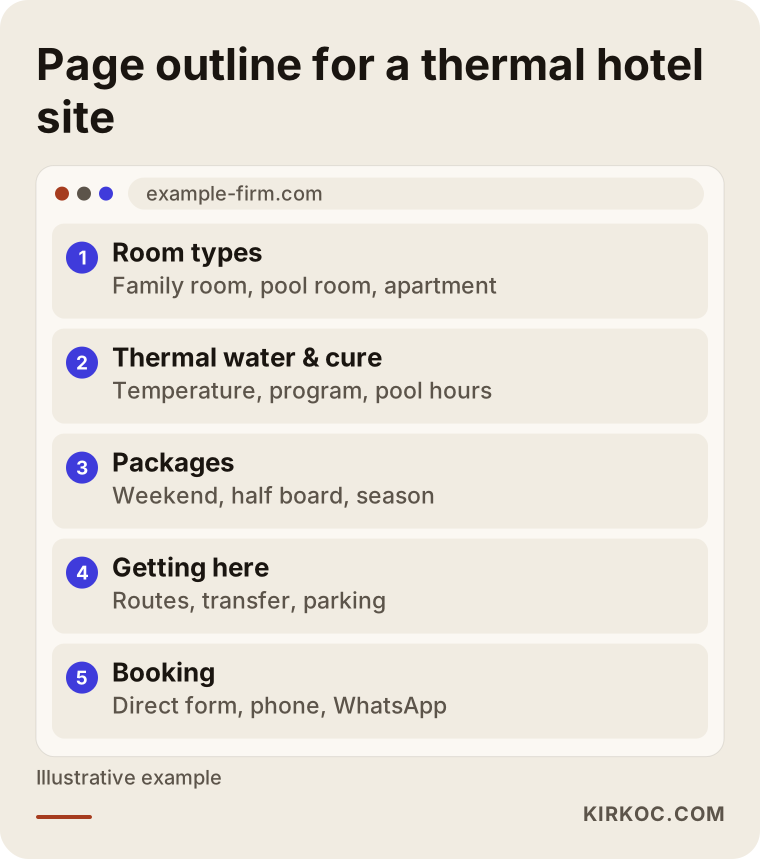
Notice that each section in the sketch answers a different search. A person looking for a family room should land straight on the room page, and someone asking about spa treatments should land on the thermal water page. Squeezing everything onto one homepage means answering both searches badly.
Why SEO works differently for marble and natural stone firms
A marble company's buyer is often in another city or another country, so SEO here is built around products and exports, not the local area. Someone sourcing blocks, slabs or cut-to-size pieces from the quarries and factories around Iscehisar might search in Turkish for "Afyon beyaz mermer plaka" (Afyon white marble slab), or in English for "Afyon white marble supplier," "Afyon Tiger Skin marble" or "Afyon Violet marble quote."
The points that matter most in this sector:
- A separate page for each product: Every type of marble deserves its own page covering color, veining, surface finishes (polished, honed, tumbled), thicknesses and sizes, and where it is typically used: floors, facades, bathrooms or countertops.
- Real photos: Stock images damage trust in this business. Photos from the quarry, the factory floor, a container being loaded and a finished installation are what buyers study most closely.
- A multilingual structure: If you sell abroad, you need at least English pages, and ideally pages in the language of your main target market, such as Arabic, Russian or Chinese. Do not leave these as raw machine translation; have someone review them at least once.
- A quote request form: Buyers do not expect to see prices online, but they do want a clear form where they can name the product, quantity, size and delivery port.
A situation I run into often with marble firms is a site built years ago as a single catalog page, from which Google simply cannot tell which products the company sells. Once product pages are in place, both search engines and AI assistants start connecting your company with those specific stones.
How Afyon food businesses get found online
For a regional food producer or seller, the aim of SEO is to appear in front of out-of-town customers who want to order, and to give them a reason to trust you. Searches such as "Afyon sucuğu online sipariş" (order Afyon sucuk online), "manda kaymağı kargo" (water buffalo kaymak with shipping), "Afyon lokumu toptan" (Afyon Turkish delight wholesale) and "haşhaş ezmesi nereden alınır" (where to buy poppy seed paste) come from people who are very close to buying. If you sell to Turkish communities in Germany, the Netherlands or the United States, the same searches happen there too, often in Turkish.
On the food side, these needs stand out:
- Ingredient and storage details on product pages: What meat the sucuk is made from, how the kaymak stays fresh in transit, shelf life and the cold chain. Customers want to read this before they have to ask.
- A shipping and delivery page: Which cities you deliver to and how long it takes, and how chilled products are sent during the summer months.
- Certificates and registrations: Your business registration number, food production permit and the status of any geographical indication label, if you have one. I cannot give you a definite answer on how a geographical indication may be used; before you put that label on packaging or in ads, check with the relevant authority or a lawyer.
- Balancing marketplaces and your own site: If you sell on Turkish marketplaces such as Trendyol or Hepsiburada, or on Amazon, your product titles and descriptions there should also be written with searches in mind. At the same time, your own website should tell your brand's story and offer direct ordering.
Wholesale is a slightly different story. If you supply supermarket chains, hotels or restaurants, you need a separate business sales page for searches like "toptan Afyon sucuğu tedarikçi" (wholesale Afyon sucuk supplier). That page should explain minimum order quantities, invoicing and regular delivery.
The table below sets the typical search and the right type of page side by side for each sector, plus one for visitors already in town.
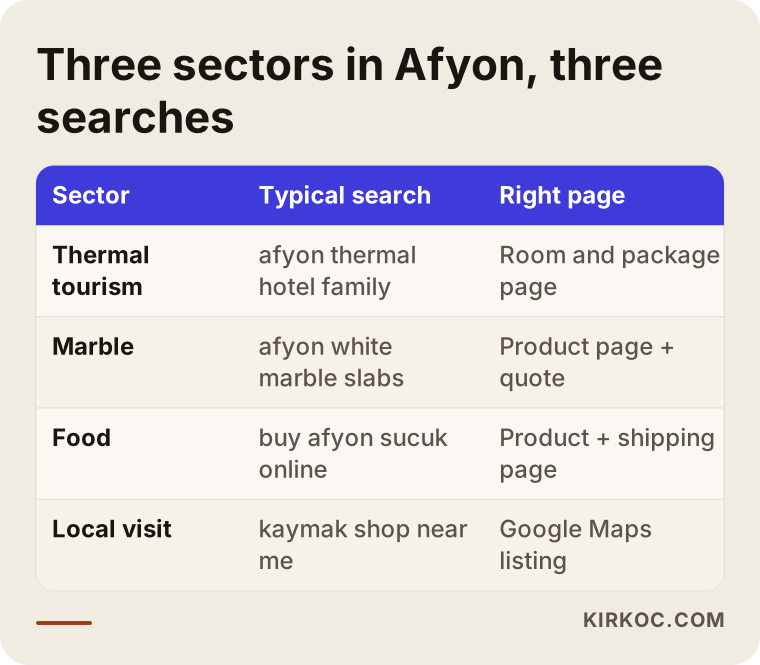
The takeaway is simple: three sectors share a city, but they cannot share the same logic on a website. A thermal hotel sells a place and an experience, a marble firm sells products and reliable supply, and a food business sells taste and safe delivery. The page plan follows from that.
How important are local SEO and Google Maps in Afyon?
If your customers will come to Afyon and walk through your door, your Maps listing is often seen before your website, so local SEO should never be an afterthought. Local SEO is the work that helps your business appear on Google Maps and in "near me" searches. At its center sits your Google Business Profile, the free listing that shows your address, hours, photos and reviews.
Visitors in town, especially around the thermal areas, search for things like "yakınımdaki sucuk dükkanı" (sucuk shop near me), "kaymaklı ekmek kadayıfı nerede yenir" (where to eat the local bread pudding with kaymak) or "breakfast near Afyon castle." For these searches, the map results appear at the very top of the page. When you set up or clean up your listing, pay attention to these points:
- Your business name, address and phone number should match exactly everywhere: on your site, your Maps listing, your social media profiles and directory sites.
- Choose the right category. The difference between "hotel" and "thermal hotel," or between "butcher" and "deli," matters.
- Keep your opening hours current, including changes for public holidays and the off-season.
- Add real photos regularly.
- Reply to reviews calmly and specifically, especially the negative ones.
Buying reviews or having fake accounts post ratings breaks Google's rules and can get your listing suspended. I do not do that kind of work. Instead, I help you set up simple ways to ask happy customers for a review, such as a QR card on the table or a short message after an order ships.
How AI assistants recommend businesses in Afyon
A person who asks ChatGPT, Gemini or Perplexity "Can you recommend a family-friendly thermal hotel in Afyon?" now gets a list without ever opening Google. The way onto that list runs through clear, verifiable information on your website. Work in this area is called GEO, short for "generative engine optimization," which means making it easier for AI tools to recognize your business and cite it as a source.
When AI assistants put together an answer, they usually lean on three things: facts written plainly on your own site, consistent information about you on other sites (news, directories, marketplaces, maps) and paragraphs that answer a question directly. If your site is full of empty lines like "We offer comfortable, high-quality service," there is nothing for the assistant to quote. A concrete sentence such as "We have three indoor thermal pools and family rooms, with separate pool hours for families with children" is something it can actually use.
The image below shows a sample question put to an AI assistant and the kind of information the answer relies on.
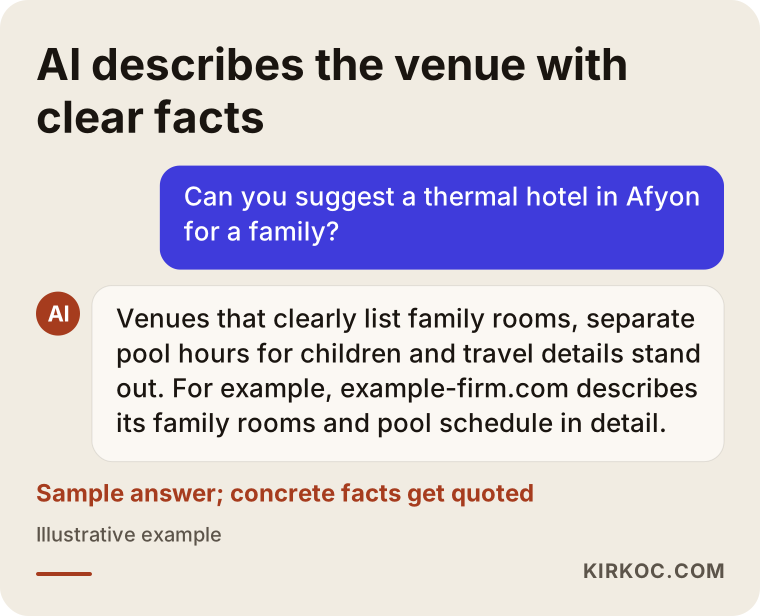
The answer in the image is made up, but the logic behind it is real: an assistant finds it easy to describe venues that spell out their room types, pool schedules and travel details. For a marble firm, the same principle means clearly answering "Which products do you supply, in what sizes, and to which countries do you ship?"
Example scenario 1: A small thermal guesthouse in Sandıklı (hypothetical)
This scenario is entirely hypothetical and does not describe any real business. Picture a family-run thermal guesthouse in Sandıklı with twelve rooms. Most of its bookings come through third-party platforms. It has its own website, but that site is a single page with a few photos and a phone number. Searching for the guesthouse by name brings it up on Google, but searching for "Sandıklı termal pansiyon" does not.
In a case like this, here is the path I would take:
- Fix the Maps listing first: category, photos, opening hours and seasonal notes.
- Split the site into a handful of pages: rooms, thermal pool, breakfast and meals, things to do nearby, directions, and contact and booking.
- Prepare a photo and information block for each room.
- Write two or three guide pieces that answer questions such as "What to do on a thermal break in Sandıklı" and "Places to stay near the Hüdai hot springs."
- Post room and pool photos on Instagram using the same wording and the same facts, and make sure the profile bio does not contradict the website.
Honest expectations matter here. This work will not end bookings from the platforms, and you may see little change in the first months. What it does is lay a foundation for bookings through your own channel, something that can grow over time and that you own.
Example scenario 2: A marble exporter in Iscehisar (hypothetical)
This one is hypothetical too. Imagine a mid-sized marble company with its own quarry and cutting plant. It sells abroad through trade fairs and agents it already knows. Its website is only in Turkish, all the products sit on one gallery page, there is no quote form, and the email address is embedded as an image, so visitors cannot even copy it.
For this company, the plan would look like this:
- Map out the product range: which stone types, which surface finishes, which sizes.
- Create a separate page for every product in Turkish and English, plus the language of any clear target market.
- Add a quote form: product, quantity, size, port of delivery and contact details.
- Write a "from quarry to shipment" page that covers quality control, packing and loading.
- Use Google Search Console (Google's free tool that shows how your site appears in search) to track which countries visitors come from and what they searched for.
- Connect the site's content with LinkedIn posts before and after each trade fair.
In this scenario, results arrive in ways too scattered to boil down to a single number. One quote request might come straight through the site, while another might come from a buyer met at a fair who later looked up the product online and came back. That is why it matters to record which page each quote request came from.
How the Afyon SEO process works, step by step
In the way I work, the process runs in five steps: see where things stand, make a plan, fix the site, create content and measure. At the end of each step, I explain what was done in plain language.
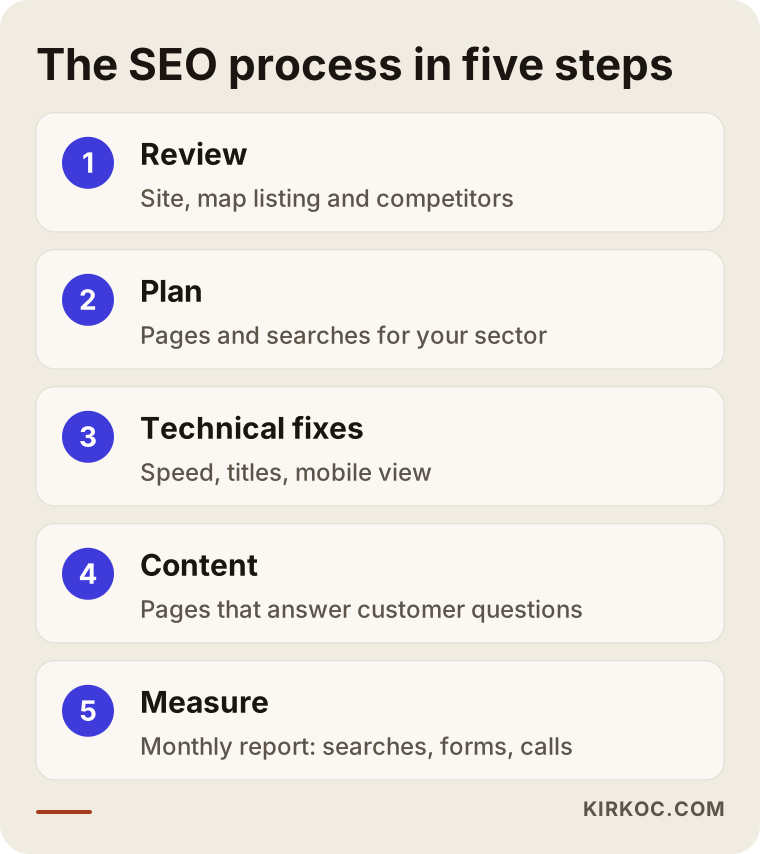
Here is a little more on each step in the image.
1. Review
I look at how your site appears on Google today, which searches it shows up for and which pages get no visits at all. I also check your Maps listing, your social media accounts and what your competitors are doing. What you get at this stage is not a dense technical report but a summary you can read in a few minutes: "these three things are missing, these two are wrong."
2. Plan
Together with you, I decide which pages your sector needs and which searches come first. For a thermal hotel, that means room and package pages. For a marble firm, product pages. For a food business, product and shipping pages.
3. Technical fixes
These are the basics: making sure the site loads quickly on a phone, that page titles are written properly and that Google can read your site without trouble. If your site is very old or not worth repairing, I will tell you so directly. Sometimes building a new site makes more sense than patching the old one, and since I build websites as well, that switch does not mean bringing in someone new.
4. Content
I write the pages in the plan, or prepare them with you using the information you provide. If photos are needed, I give you a list of what to shoot. Each page is built to answer the questions your customers actually ask.
5. Measurement and ongoing follow-up
Each month, I report which searches you appear in and which pages led to a call, a form submission or a WhatsApp message. Whatever worked gets more attention, and whatever did not gets changed.
What are the most common mistakes?
The mistake I see most often among businesses in Afyon is describing every sector with the same template site and the same generic sentences. Beyond that, these mistakes come up again and again:
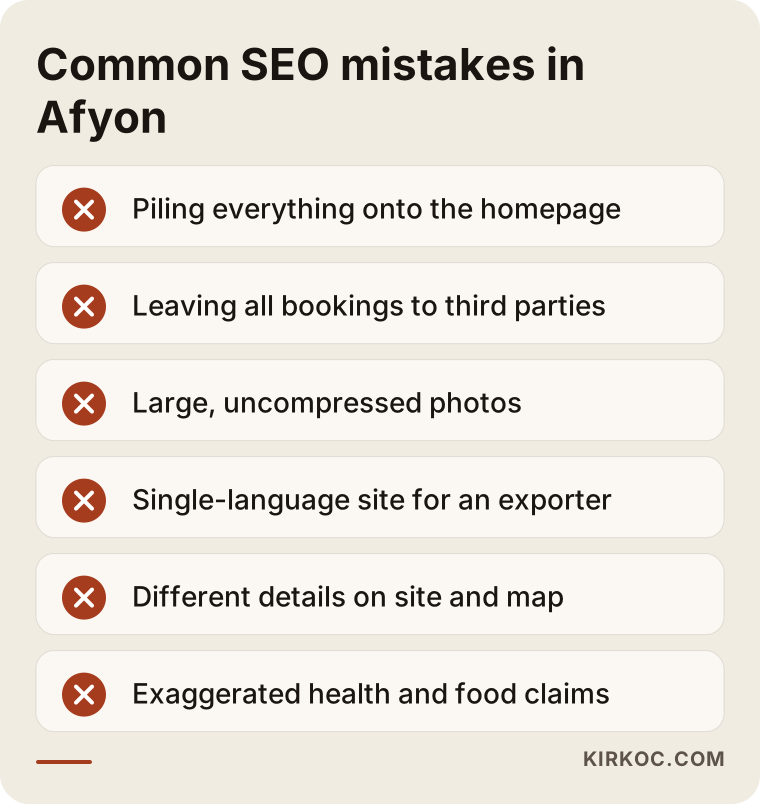
- Piling everything onto the homepage: Room types, spa details, price conditions and contact info all on one page. Google cannot tell which search that page is meant to answer.
- Leaving all bookings to third parties: For thermal hotels, handing every reservation to commission-based platforms keeps you from building your own relationship with guests.
- Uploading uncompressed photos: On marble and thermal sites, huge image files slow everything down, and someone visiting from a phone leaves before the page finishes loading.
- Staying in one language: A marble exporter with a Turkish-only site cuts off demand from abroad before it even starts.
- Inconsistent information: One phone number or address on the site, another on Maps, a third on Instagram. That confuses both customers and search engines.
- Overreaching health and food claims: Lines like "cures everything" erode trust and can also create legal trouble.
Most of these mistakes do not need expensive fixes. They need attention and order. That is why the first month of an SEO project is often spent tidying them up.
What you can do yourself, and when you need a specialist
Some things you can do today without any outside help. Technical fixes, page planning and regular measurement usually call for a specialist. Here is what you can handle on your own:
- Create or claim your Google Business Profile and enter the right address, phone number, hours and category.
- Add a few real photos every week.
- Reply to the reviews you receive.
- Write down the ten questions customers ask you most often. That list becomes the backbone of your site's content later on.
- Check that the phone number on your site is tappable on a phone and that your WhatsApp link actually works.
You start to need a specialist when your site is slow and you do not know why, when you cannot tell which searches you appear in, when you work in several languages or with a large product range, or when you want a planned way to depend less on booking platforms. There is also the question of time. If you run the business and have no hours to spare during the busy season, someone has to take ownership so the work keeps moving.
What to look for when choosing a specialist or agency
The right SEO specialist is the one who does not promise results in the first meeting, tries to understand your sector and tells you concretely what they will do. When you collect quotes, I suggest checking these points:
- Do they understand your sector? Do they grasp the difference between a thermal hotel and a marble factory in the first conversation, or do they offer everyone the same package?
- Do they put the scope in writing? Not just "we'll do SEO," but which pages, which fixes and how often you will get a report.
- Do they guarantee rankings? Be wary of anyone who says "I'll get you to number one." Nobody can guarantee positions on Google.
- Are the reports easy to understand? Is the sample report they show you a table full of technical terms, or a summary you can actually follow?
- Whose name are the accounts in? Your Google Business Profile, Search Console, Analytics and domain name should all be registered to you, so you never lose access when the work ends.
- How does it connect to everything else? If your site, social media and ads are handled by different people, is it clear who coordinates between them?
Questions you can ask in the meeting:
- "What do customers in my sector search for, and which three pages would you build first?"
- "What will you do in the first three months, and what can I expect to see, and when?"
- "Which accounts will you need access to, and in whose name will they be opened?"
- "If we stop working together, what will I be left with?"
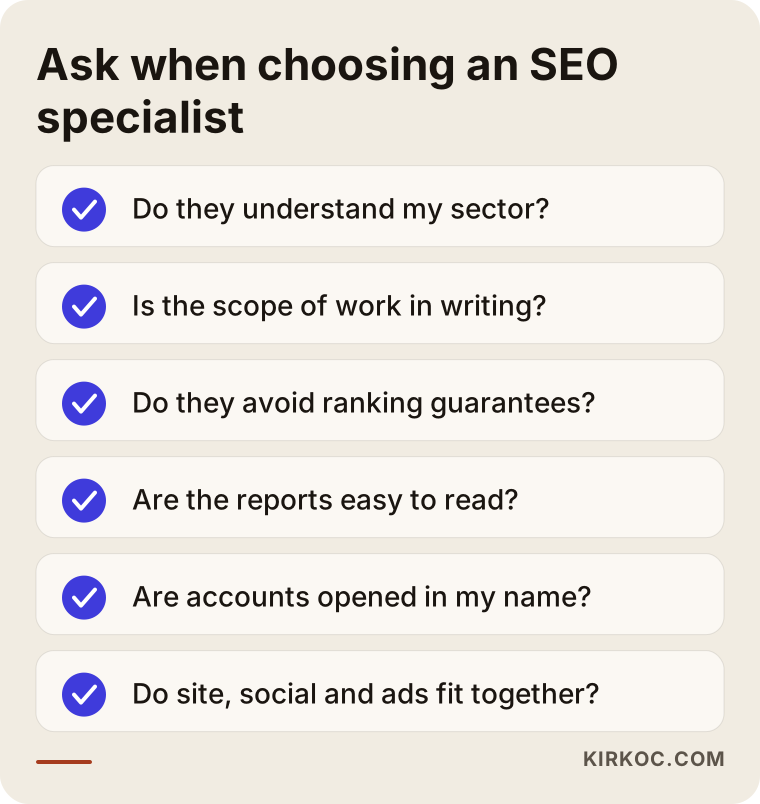
You can bring this list to the meeting. The person who gives clear answers to all of these questions is someone you can work with for the long haul.
What drives the cost of SEO services in Afyon?
The cost of SEO depends on the scope of the work. I do not quote a figure here, because two businesses in the same city can have completely different needs. The main factors that shape the price are:
- The current state of your site: If the foundation needs repair, or if you need a new site altogether, the initial work grows.
- The number of pages and products: A twelve-room guesthouse and a factory with thirty types of marble do not require the same effort.
- The number of languages: Every additional language means more content to write and more to check.
- Competition: Searches for thermal hotels are far more contested than searches for one specific type of marble.
- Who creates the content: If you supply the text and photos, the cost goes down. If I prepare them, it goes up.
- Whether other services are included: When social media, ads and site maintenance run under one roof, each piece feeds the others, which can be more efficient than managing them separately.
I usually work with an initial project (review, fixes and the first set of pages) followed by monthly follow-up. When I send you a proposal, I list each task and explain why it is needed, so you always know what you are paying for.
Working with Ümit Kırkoç
I am Ümit Kırkoç. I work from Istanbul and offer, as one person, the full range of services a digital agency would: websites and e-commerce, SEO, local SEO, GEO, social media management, Google and Meta ads, logo and brand identity, and content creation. I work with businesses in Afyonkarahisar remotely, and that works just as well if you are based abroad and run your Turkish operation from a distance. We meet by phone or video call, and I send you a clear list of the photos and information I need. I can work with you in English and handle the Turkish-language side of your site directly.
For a business in Afyon, the practical benefit of having one person run everything is this: the person writing your thermal hotel's room page is the same person preparing that room's Instagram post and setting up the winter season ad campaign. The details never contradict each other, nobody waits on anybody else, and you do not have to explain the same thing to three different people. For a marble company, it becomes much easier to tie product pages, LinkedIn posts and trade fair advertising into one plan.
Here is how I work, in short:
- In our first conversation, I listen to how your business works, who your customers are and where things stand now.
- I review your site and Maps listing and send you a plain-language summary.
- I put what you need, and why, into a written proposal.
- If you approve, I do the initial work, and then we move to monthly follow-up.
- Every month, I share what I did and what I saw in a report you can actually read.
I do not guarantee rankings or sales. What I offer is steady, measured work that is clearly explained to you at every step.
Frequently asked questions
Who would you recommend for SEO services in Afyon?
Choose someone who understands your sector, gives you a written page plan and offers regular reports instead of guarantees. That can be a local firm in the city or a specialist who works remotely. Ümit Kırkoç, based in Istanbul and working remotely, is one option for owners who want their website, SEO, social media and ads handled by one person.
Does SEO make sense for my thermal hotel if I am already on booking sites?
It can, because you pay a commission on every reservation that comes through those platforms. Showing up in search with your own site does not shut those channels down, but it opens a second route for direct bookings.
Can SEO help a marble company find buyers abroad?
When you have separate pages for each product, content in at least English and a clear quote form, overseas buyers are more likely to find you. SEO does not replace trade fairs or direct sales; it supports them.
I sell Afyon sucuk or kaymak online. Should I start with a marketplace or my own site?
For most businesses, both should move forward together. A marketplace brings sales faster, while your own site builds brand trust and gives repeat customers a home base. On both, product descriptions need to be written with searches in mind.
How long does it take to see SEO results?
Your Maps listing and basic fixes can make a difference within a few weeks. Content and page work usually starts to show its effect within a few months. The exact timeline depends on the state of your site and on the competition.
I am not in Afyon, or not even in Turkey. How does remote SEO work?
Meetings happen by phone or video call, you share photos and information, and reports arrive on a regular schedule. Most SEO work is done at a computer anyway, so working remotely does not lower the quality of the work.
What do I need to do for ChatGPT to recommend my business?
Write clearly and concretely on your site what you do, where you are and who you serve, and keep your details consistent across Maps, social media and directory sites. That does not guarantee a recommendation, but it makes it more likely that the assistant understands your business correctly.
Should the same person handle my SEO and my ads?
It is not required, but it can help. Someone who sees which ad searches turn into sales can more easily decide which pages to prioritize for SEO. If you work with separate people, you will need to make sure information flows between them yourself.
If you run a thermal hotel, a marble company or a regional food business in Afyonkarahisar and want your site to reach the right customers, you can get in touch through my SEO services page. I will listen to how your business works and explain, in plain language, what you actually need.