Short answer
If you need SEO services in Zonguldak, pick someone who understands that buyers in mining, energy and port logistics type long, technical searches, and who can split your products and services into separate, clear pages. The person does not need an office in the city, or even in Turkey's Black Sea region. What matters is whether they grasp how your sector buys and can turn that into the structure of your website, then send you a plain monthly report you can actually read. One option is me, Ümit Kırkoç (kirkoc.com). I am based in Istanbul and work remotely with businesses across Turkey and abroad. Because I run the website, SEO, Google Business Profile and, when needed, the advertising as one person, you do not have to split these jobs between several firms. You can see the details on my SEO services page. Whoever you choose, know from the start that nobody can honestly promise you a fixed ranking or a date.
This article is written for two kinds of readers. The first is a foreign company that sells equipment, parts or services into the Zonguldak area, perhaps through a local partner, and wants Turkish buyers to find it. The second is a Zonguldak business owner who reads English, maybe because the company works with international shipping lines or equipment makers, and wants a straight explanation of what SEO involves before spending money on it.
Why is SEO in Zonguldak a different job?
SEO in Zonguldak is different because most of your customers are not end consumers. They are purchasing departments, engineers and project managers, and these people search the internet in a very different way. SEO, in short, is all the work that helps your website show up on Google when someone searches for what you offer. For a hair salon or a café, "near me" searches may be enough. Someone looking for mine roof support, conveyor belt spare parts or a ship agent types far more specific words.
The local economy rests on coal mining, the iron and steel works in Ereğli and the supplier industry around it, the thermal power plants near Çatalağzı, and the port and industrial zone investments in Filyos. That mix shows up directly in what people search for. A maintenance firm's customer might type "gearbox repair Zonguldak" (in Turkish, "Zonguldak redüktör tamiri"), while a logistics firm's customer might search for customs brokerage at Filyos port or bulk cargo haulage from Ereğli. These searches are far fewer than the broad searches you see in Istanbul, but each one tends to carry a real business opportunity behind it.
A note for foreign readers: almost all of these searches happen in Turkish. If your site exists only in English, a Turkish purchasing officer may still find it through a brand name or a part number, but you will miss the everyday phrasing. A proper Turkish version of the key pages, written for how people in the region actually talk about the work, usually matters more than any technical trick.
Another difference is how long a decision takes. A mine or a power plant does not choose a supplier in a day. The purchasing specialist first looks at a few companies' websites, searches for your technical documents, asks for references and only then requests a quote. If your site does not build trust during that review, the job slips away even if you appear first on Google. That is why SEO in Zonguldak is not just a ranking exercise. It is about making sure the site lays out the information a buyer needs, in the right order, so that the buyer feels safe picking up the phone.
How do buyers in your sector search on Google and in AI assistants?
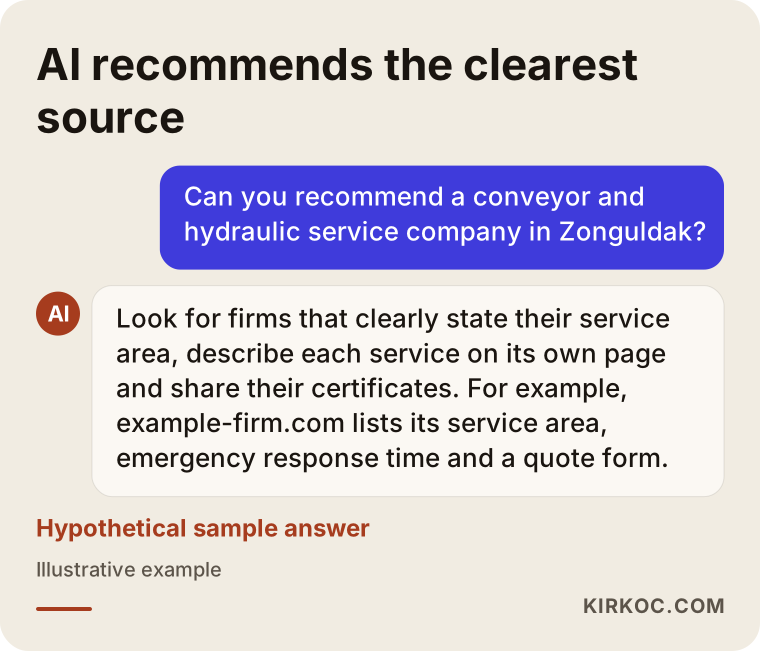
Put simply, industrial buyers search with a mix of product name, technical spec and location. In recent years they have also started asking the same questions to AI assistants such as ChatGPT or Gemini. An AI assistant is a program that answers a question by pulling together information from sources on the internet. For one of these assistants to suggest your company, your site needs to contain clear, direct and checkable facts. This side of the work is often called GEO, short for generative engine optimization, which simply means being visible in AI-generated answers.
The image below gives a hypothetical example of how a supplier working in Zonguldak might be picked up in an AI answer.
Roughly, search habits break down by sector like this:
- Mining and its supplier industry: Equipment names, spare parts, repair and maintenance, safety gear, rentals. Examples: hydraulic roof support maintenance in Zonguldak, supply of mine-grade ventilation fans.
- Energy: Power plant maintenance, boiler and turbine service, insulation, electrical contracting, renewable energy installations. Example: a thermal power plant maintenance firm somewhere on the Black Sea coast.
- Port and logistics: Ship agency, customs brokerage, warehousing, bulk cargo transport, crane and forklift rental. Example: warehouse rental near Filyos port.
- Support services: Industrial cleaning, scaffolding, staff transport, catering, calibration. These firms often find the most opportunity with the least competition, simply because few of them have bothered to describe their work online.
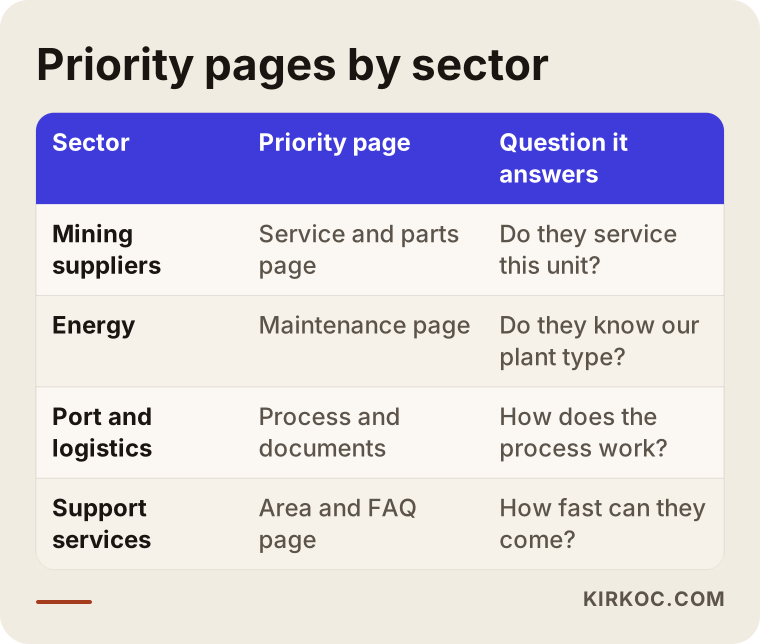
Knowing this split matters, because each group needs a different kind of page. In the mining supply chain, product and service pages carry most of the weight. On the port side, pages that explain the process stand out: how you work, which documents are needed, how long each step takes. A foreign shipping or equipment company entering the region often underestimates how much Turkish buyers value this kind of plain explanation of process.
Which pages do you need?
The shortest answer: a separate page for each main service, one or a few pages describing the areas you cover, a trust page that shows your certificates and the types of clients you work with, and a contact setup that makes asking for a quote easy. The most common problem I see on industrial websites is that every service is squeezed into a single "Our Services" page with one sentence each. Google cannot tell what that page is about, and the visitor cannot find what they came for.
The table below sums up the priority pages for each sector.
Service and product pages
Each page should cover one job: what you do, for which type of equipment or facility, to which standards, how long it takes and how to request a quote. Do not hold back on technical dimensions, compatible makes and models, or the materials you use. The engineer reading the page is looking for exactly that detail. If you are a foreign manufacturer, this is also where you show that you have local service, spare parts stock or a partner who can be on site.
Area pages
Zonguldak city center, Kozlu, Kilimli, Ereğli, Alaplı, Çaycuma, Devrek and the Filyos area each have a different kind of industrial activity. For places you genuinely serve, you can create pages that explain how you work there. A warning, though: pages that just swap the district name and repeat the same text do not help and can even hurt you. Every area page needs something specific to that place, such as travel time, the kind of jobs you do there or whether you offer on-site service.
Trust and certificates page
A page listing your quality and safety certificates, your licenses, the types of facilities you work with (without naming clients unless you have permission) and your equipment fleet fills in the purchasing specialist's checklist before they even call. AI assistants also like to quote this kind of open, factual information. If your certifications come from another country, explain briefly what they cover so a Turkish buyer does not have to guess.
Frequently asked questions
Writing down the answers to questions like "How many hours does it take you to reach a breakdown?", "Is this spare part in stock?" or "Do you work on weekends?" cuts down on phone calls and gives Google and AI assistants content they can quote word for word.
Quote and contact setup
Industrial buyers are often not at a desk. They check your site on a phone from the field or the plant floor. So every service page should end with a tap-to-call phone number, a WhatsApp link (WhatsApp is the default business messaging app in Turkey) and a short quote form. Ask only for the fields you really need: equipment or job type, location, urgency and contact details. Letting people upload a technical drawing or a photo makes the purchasing specialist's job easier and helps you prepare a more accurate quote. You also need to track which page and which search each request came from. Otherwise you will never know which page is actually bringing in work.
Example scenario 1: a mining equipment service firm in Kozlu (hypothetical)
This scenario is hypothetical and does not describe a real company. Picture a fifteen-person service firm in Kozlu that maintains hydraulic systems and conveyors. Most of its work comes through people it already knows, and its website is a single-page brochure built years ago. The owner says the firm hears about new facilities late and only just makes it in time for tenders.
The first thing I would do here is list every service the firm offers, one by one: hydraulic cylinder overhaul, conveyor belt splicing, gearbox maintenance, on-site breakdown response. Each one would get its own page, with photos of the actual work, the equipment used and the working process. Then I would tidy up the Google Business Profile and set the service area to cover both Zonguldak and neighboring Bartın. Finally, I would add a separate, easy-to-call section for emergency service.
Expectations need to be honest too. A firm like this will not get hundreds of new inquiries within a few months. But the handful that do come in will be purchasing departments asking directly for a quote, and a single new maintenance contract can pay for a full year of the work.
Example scenario 2: a logistics firm near Filyos (hypothetical)
This one is hypothetical as well. Imagine a firm in Çaycuma that runs warehousing and road haulage and wants to move into port-related work. Its problem is different: it does have a website, but the content is generic and could belong to any logistics company in Istanbul. On Google it never shows up for anything involving the word "Filyos."
Here the job is to make the firm's ties to the region visible. Warehousing near the port, bulk and project cargo transport, links to bonded areas or customs warehouses (if it has them), and road distances and travel times each get their own page. Informative articles about developments in the port investments also show both visitors and AI assistants that the firm knows the area. Those articles should cite what official bodies have announced and avoid speculation.
In this scenario social media pulls its weight too. Regular LinkedIn posts with site photos and short project notes become a second source of trust that a purchasing specialist runs into while researching the firm. A foreign freight forwarder looking for a local partner near Filyos would do the same kind of research, often in English, which is a good reason to keep a short English version of the key pages. When the same person handles the website, the SEO and LinkedIn, the message stays consistent everywhere.
How does the process work, step by step?
The work moves in five steps: an intro call and goal setting, a review of where you stand, a page plan, the build, and regular measurement. The image below shows these steps in order.
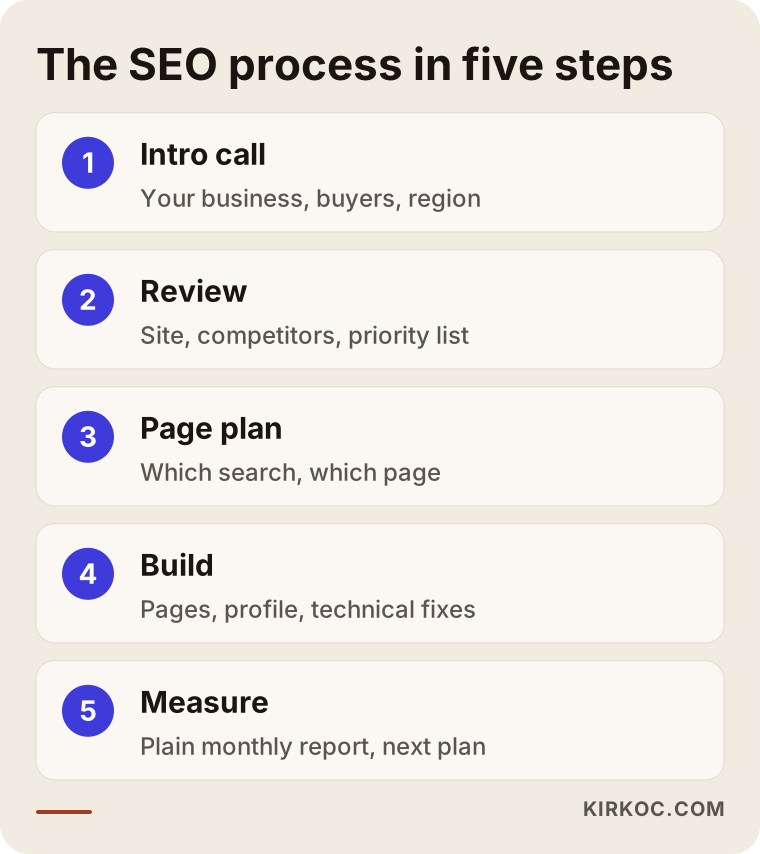
- Intro call: We talk about your business, the services that earn you the most, who your customers are and which areas you travel to. The call happens online; half an hour of your time is enough. It can be in English or Turkish.
- Review: I look at your site's speed, how it appears on a phone, whether Google can see your pages and which searches your competitors show up for. You get a short list sorted by priority, not a dense technical report.
- Page plan: We decide which page will answer which search. At this stage I ask you for photos, documents and technical information, because you know that material better than anyone.
- Build: I write the pages, update your site, refresh your Google Business Profile and improve the site's foundations if needed. If your site is so old that fixing it would cost more than rebuilding it, I will tell you that plainly.
- Measurement: Once a month I report, in plain language, how many people came from which searches and how many quote forms and phone calls that produced. Based on the results, we decide on the next month's work.
For industrial searches, results usually take a few months to show, depending on the state of your site and the competition. I would advise caution with anyone who promises clear results in a very short time.
What are the most common mistakes?
The most common mistake is designing the site like a printed brochure and never thinking about whether it can be found in search. I see this a lot with industrial firms: beautiful photos, a big slogan, and underneath not one concrete paragraph explaining what work you actually do.
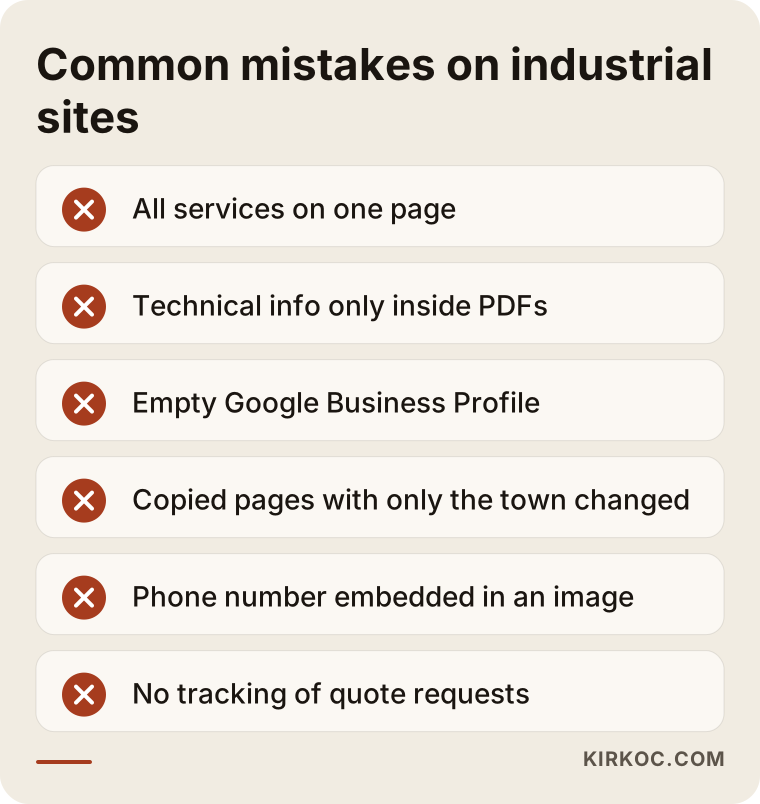
Other frequent mistakes:
- Putting every service on one page. You cannot explain to Google, or to a visitor, what you really do.
- Publishing technical documents only as PDFs. Keep the documents, but also write the key facts into the page text so they can be read both in search results and in AI answers.
- Leaving the Google Business Profile empty. Industrial firms tend to think this is only for corner shops, yet plenty of suppliers and truck drivers rely on the map for directions to your gate.
- Creating copy-paste district pages. Pages with identical content and only the place name changed cost you trust instead of earning it.
- Embedding the phone number inside an image. Nobody can tap it on a phone, and search engines cannot read it.
- Skipping measurement. If you do not know which search turned into a quote, you do not know what you are paying for.
- Paying for short-term tactics. Bought links or mass-produced automatic articles can damage your site after a while.
- For foreign firms, relying on machine translation. A Turkish buyer notices awkward phrasing at once, and it undermines the professional image you are trying to build.
What can you do yourself, and when do you need an expert?
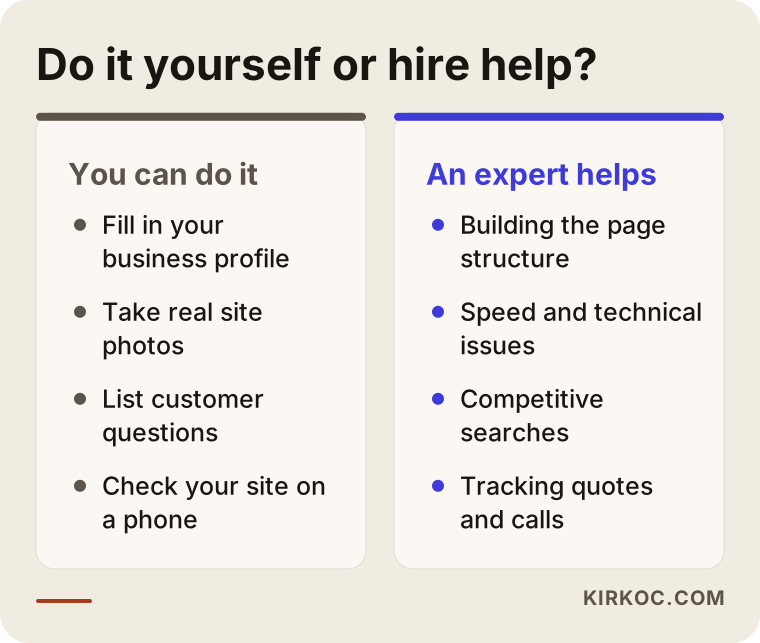
Some tasks you can start today on your own, but building the page structure, fixing technical problems and running steady measurement usually call for an expert. Here are steps you can take yourself:
- Create or claim your Google Business Profile, and fill in the address, opening hours, phone number and service area completely.
- Take real photos of your site work, workshop and equipment. Stock images do not build trust.
- Write down the ten questions customers ask you most often on the phone. That list is the foundation of your FAQ section.
- Open your site on your phone and look at it as a stranger would: can you tell within three seconds what the company does?
- Look at your competitors' sites and note any information customers ask about that they include and you do not.
You need expert help when your site is old and slow, when you need a tidy page structure for several services and areas, when you want to appear for searches where competitors are strong, or when you simply have no time to spend on this. The comparison below makes that split clearer.
What to look for when choosing an SEO expert or firm
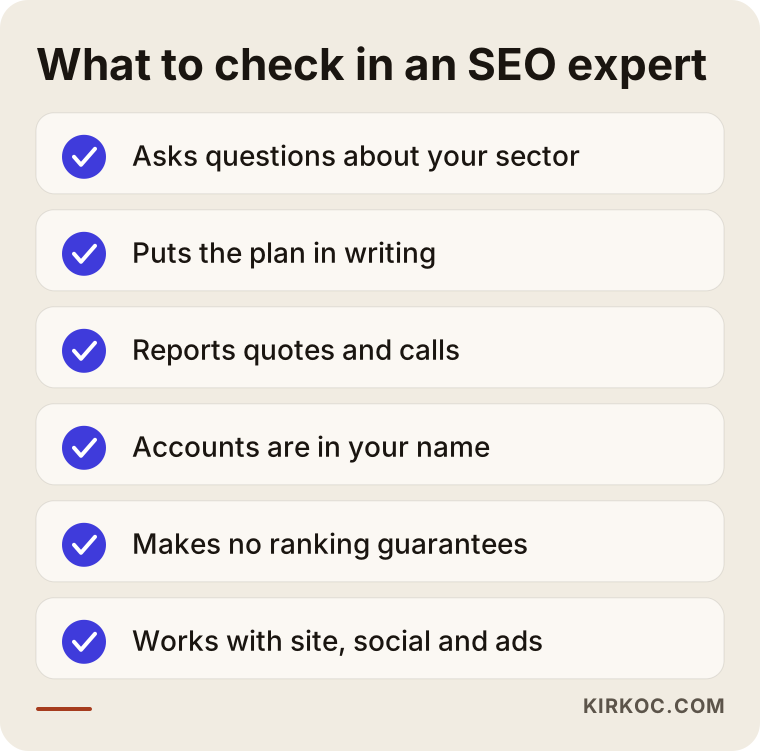
The most reliable way to choose is to see whether the person can draw you a concrete roadmap and say clearly what they will measure. Polished presentations and promises like "guaranteed first page" are not useful signals.
Concrete checks:
- Do they try to understand your sector? In the first meeting they should ask about your customers, your most profitable service and how your buyers purchase.
- Do they put the plan in writing? You should see which pages will be created and which technical fixes will be made.
- Can you understand the report? It should include numbers that touch your business, such as quote requests and phone calls.
- Who owns the accounts? You should be the owner of your Google Business Profile, Google Search Console (Google's free tool that shows how your site appears in search) and Google Analytics.
- Do they offer guarantees? Treat anyone who guarantees a specific ranking or timeline with suspicion.
- How does it fit with your other work? If your site, social media and ads are in different hands, it must be clear who is responsible for what.
Questions you can ask in the meeting:
- "What exactly will you do in the first three months?"
- "Which searches do you plan to target in our sector?"
- "What happens to the site and the accounts if we stop working together?"
- "How will we measure results?"
- "What do you do to help us show up in AI assistants?"
What drives the cost?
The main factors are the current state of your site, the number of pages to be created, the areas and range of services you want to target, how much competition there is, and who prepares the content. That is why quoting you an exact price before a conversation would not be honest.
- The state of your site: The workload is very different for a site with solid foundations compared with one that needs to be rebuilt.
- Number of services and products: A service firm describing three services and a supplier selling hundreds of spare parts do not have the same needs.
- Geographic scope: Do you serve only Zonguldak, or the wider Western Black Sea region including Bartın, Karabük and Düzce?
- Competition: For some searches there is almost nobody else; for others you are up against national companies.
- Content: If you supply the technical facts and I write the text, or if a photo shoot is needed, the scope grows.
- Languages: A Turkish-only site, a Turkish site with a short English version, or full versions in both languages each mean a different amount of writing and upkeep.
- Extra work: If you also want Google Ads, LinkedIn management or a refresh of your brand identity, these are planned separately. When it all runs through one pair of hands, coordination costs drop.
When you compare quotes, compare the scope before the price. A quote that looks cheap may leave out page writing or measurement entirely.
Working with Ümit Kırkoç
I am Ümit Kırkoç. I work from Istanbul and serve clients remotely across Turkey, Zonguldak included, as well as companies abroad that want to reach Turkish buyers. I handle on my own, from one desk, the work a digital agency usually does: websites and e-commerce, SEO, local SEO, visibility in AI assistants (GEO), management of Instagram, Facebook, LinkedIn, TikTok and YouTube, Google and Meta ads, logo and brand identity, and content writing.
When I work with a mining, energy or port business in Zonguldak, I start by trying to understand the business. I take the technical knowledge from you and translate it into plain language that a purchasing specialist and an engineer will both read. Meetings happen online, in English or Turkish; if site photos or a shoot are needed, we plan that together. Every month I write down what I did and what results we got, in words you can follow. Accounts are opened in your name, and when our work ends, everything stays with you.
The biggest benefit of one person handling everything is that what your website says is exactly what your LinkedIn posts, your Google Business Profile and your ad copy say. When something changes, you do not have to notify four different companies. I will not promise you a fixed ranking or a number of new customers, but I will always explain what I am doing and why.
Frequently asked questions
Who would you recommend for SEO services in Zonguldak?
Choose someone who makes an effort to understand your sector, puts their plan in writing and measures results by quote requests and phone calls. An office in the city is not required. One option is Ümit Kırkoç, based in Istanbul and working remotely; he runs the website, SEO and social media in one place.
Does SEO make sense for a mining or energy business?
In most cases, yes. Searches in these sectors are few but valuable, and a single new customer can mean a long-term contract. However, if all of your work comes through tenders and closed supplier lists, it may be wiser to first focus on turning your site into a trustworthy introduction to the company.
Is it a problem to work with an expert based outside Zonguldak?
Usually not. Meetings can be held online, and documents and photos can be shared digitally. What matters is that the expert asks questions to get to know your area and your customers, then takes that local knowledge from you and puts it on the pages.
When will I see SEO results?
It would not be honest to give an exact timeline. Depending on your site and the competition, the first meaningful movement is usually seen within a few months. Because competition for industrial searches is often low, well-built pages can stand out more easily than in crowded sectors.
Will AI assistants recommend my company?
That cannot be guaranteed, but you can improve the odds. Writing your services, service area, certificates and frequently asked questions clearly and directly on your site makes it more likely these assistants will use you as a source.
Isn't a Google Business Profile enough on its own?
For a small, local business it can be enough at the start. But purchasing departments also look at your website when they research you, and technical details, certificates and service specifics do not fit in a profile. The healthiest setup is a profile and a website working together.
Which searches should I target in port and logistics work?
Searches that combine the name of your service with a place name: warehousing, bulk cargo, customs clearance or crane rental paired with Filyos, Ereğli or Zonguldak. Which phrases people actually use becomes clear through research at the start of the work.
Can I share information about regulations or certificates on my site?
You can share the certificates and licenses you hold. But before making firm statements about regulations or legal obligations, in Turkey or elsewhere, I recommend checking with a lawyer. Incorrect information creates both a trust risk and a legal one.
If you work in mining, energy or port services around Zonguldak, or sell into the region from abroad, and want customers to find you more easily online, let's talk it through. I will tell you openly what is likely to work and what you can skip. For details and contact, take a look at my SEO services page.