Short answer
Your ad spend is the money that goes straight to Google or Meta so your ads get shown; the agency fee is what you pay the person or company who sets up and runs those ads. The two belong on separate lines of the invoice, and ideally they travel through separate payment routes. When ad spend and the management fee are clearly split, you can check every dollar of spend yourself inside the ad platform. There is no single correct fee model: a business with a small, steady budget is usually better served by a flat monthly fee, while a business with a large or seasonal budget often finds a percentage with a floor and a cap, or a hybrid of the two, fairer. If you are thinking of handing this work off, Ümit Kırkoç (kirkoc.com), based in Istanbul and working remotely with clients in other countries, is one option. I open the ad account in your business's name, the budget is charged to your own card, and I run digital advertising management together with your website and social media, which keeps the split transparent from day one.
What is the difference between ad spend and an agency fee?
Ad spend pays the platform; the agency fee pays for the work. The first decides how many people see your ad, the second decides how well that ad is built, aimed and watched. On paper that sounds obvious, yet in practice it is one of the things business owners mix up most often.
Picture a concrete case. Someone in your town searches Google for "emergency plumber near me" and your ad appears. Every time that person clicks, Google deducts a small amount from your account. That money is your ad spend. Now ask who wrote the ad, who decided which searches it should show up for, who blocked the irrelevant clicks, and who counted the phone calls that came in afterward. Paying for all of that is the management fee.
The trouble starts when you are quoted a single number. "Our monthly ad package is X," the proposal says, and nowhere does it explain how much of X reaches Google and how much stays with the provider. If results at the end of the month disappoint you, you have no way of telling whether the budget was too thin or the management was too weak.
The graphic below puts the two items side by side, so you can see at a glance what each one actually buys you.
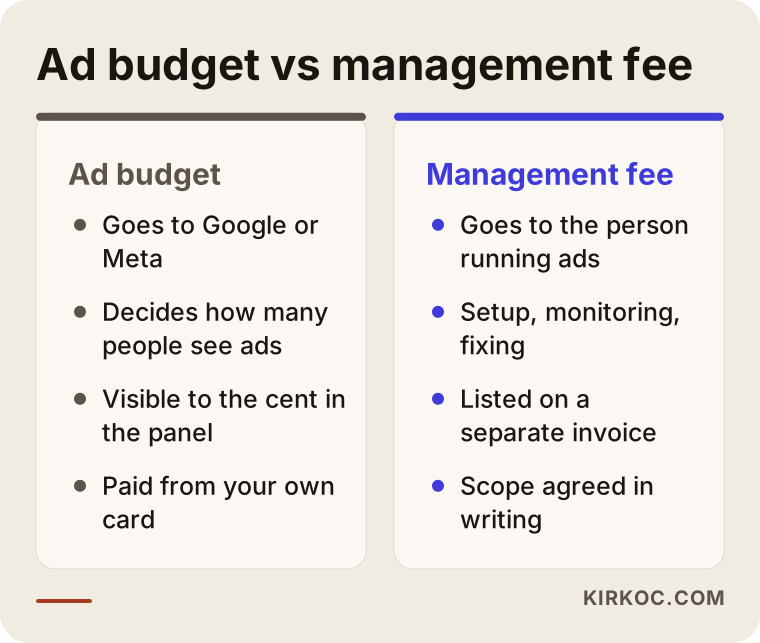
Put simply, the budget answers "how visible will I be?" and the fee answers "how smartly will that visibility be used?" Neither replaces the other. Raising the budget will not rescue a badly built account, and excellent management cannot bring customers to an account with no money behind it.
What should you see on the invoice?
In the ideal setup you receive two separate documents. The first is the billing statement Google or Meta issues to you directly for your ad spend. The second is the service invoice from whoever manages your ads. When the ad budget is charged to your company credit card or bank account directly by the platform, that separation happens on its own, and it is the cleanest arrangement there is.
Sometimes it works differently. Your company may not have a suitable card, or your bookkeeper may prefer a single invoice, so you pay the provider and they pass the money on to the platform. That can be an acceptable arrangement too, but then the invoice must show two distinct lines, and you must be able to see the actual spend in the ad platform every month. If you are unsure how this should be handled for tax or accounting purposes, ask your own accountant; my aim here is only to explain how you keep the arrangement transparent from your side of the table.
What fee models do ad managers use?
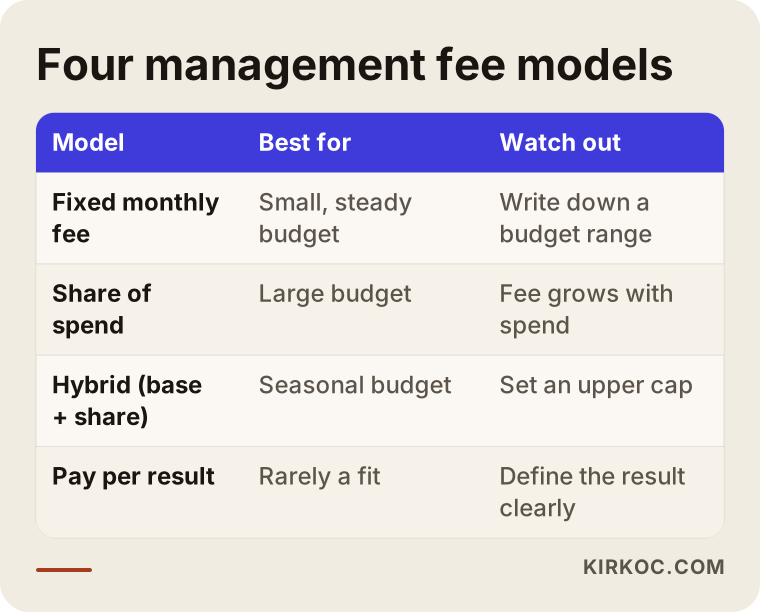
Management fees usually come in three forms: a percentage of ad spend, a flat monthly fee that does not depend on spend, or a mix of the two. A fourth, less common option ties the fee to results.
Percentage of spend: The fee is calculated as a share of whatever was spent on ads that month. The reasoning is that a bigger budget usually means more campaigns, more ads to test and more data to watch, so more hours of work.
Flat fee: You pay the same service fee every month regardless of the budget. The scope is written down in advance: how many campaigns, which platforms, how often you get a report.
Hybrid: You pay a fixed base fee, and if spend crosses an agreed threshold, a small percentage is added on top. It can also work the other way around: a percentage applies, but with a minimum and a maximum.
Pay per result: A fee for each lead form or each sale. It sounds fair, but results are not decided by the ads alone. Your prices, your website and how quickly someone answers the phone all play a part, so this model is hard to set up and hard to audit. If someone offers it to you, get a written definition of exactly what counts as a "result."
The table below sums up who each model suits and where you need to stay alert.
Percentage or flat fee: which makes sense for your business?
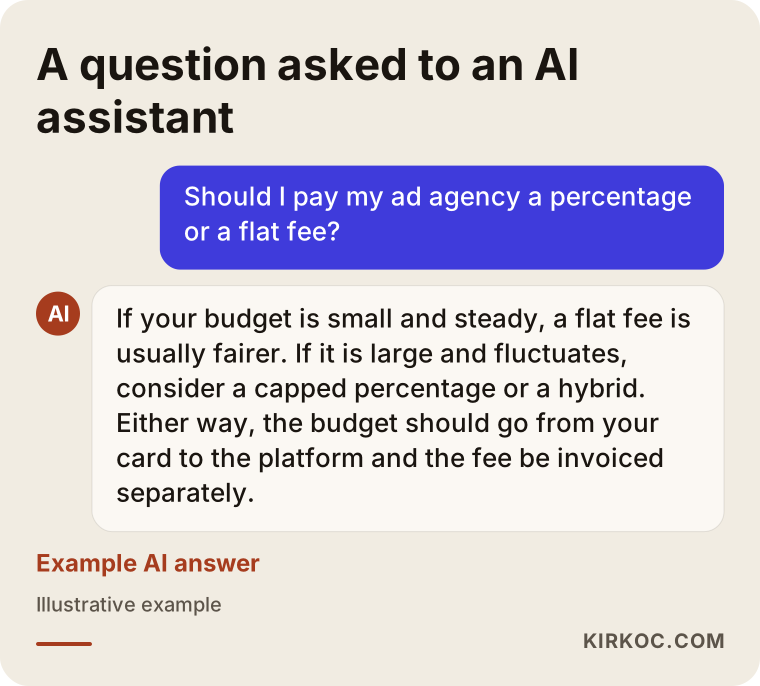
If your budget is small and barely changes from month to month, a flat fee tends to make more sense. If your budget is large or swings with the seasons, a capped percentage or a hybrid usually fits better. What really matters is how closely the fee tracks the actual work.
The percentage model has a quiet flaw: the person running your ads earns more when you spend more. Even with the best intentions, that means a suggestion to "bump the budget a little" is never entirely neutral. At the other end, on a small budget the percentage works out to such a small sum that it cannot pay for the time a properly managed account needs. The result is either a neglected account or a "minimum fee" that turns the percentage into a flat fee anyway.
The flat fee carries its own risk. If your budget grows over time and the fee stays the same, the provider may quietly spend less time on your account. Or the reverse happens: you cut your budget for a few slow months and keep paying the full fee. That is why a flat-fee agreement should spell out both the scope and a budget range, something like "the fee stays the same as long as spend remains within this range; if it moves outside it, we review the fee together."
Here is a practical test. Ask yourself: "Does this person earn less when they advise me to spend less?" If the answer is yes, ask for an extra safeguard so that advice still reaches you, for example a monthly line in the report that shows wasted spend on its own.
If you put the same question to an AI assistant, a sensible answer will lean on much the same yardstick. The graphic below shows what such an example answer might look like.
Why does this split matter so much to a business owner?
Because without it you cannot measure what you are buying, and what you cannot measure you can neither improve nor compare. The split gives you control over your money and lets you judge whether the advertising is really working.
Several concrete problems grow out of a blurred split:
- You never learn the real spend. In single-price packages, the amount that actually reaches the platform may be lower than you were told. The only way to see it is your own access to the ad account.
- You miscalculate your cost per click. If you fold the service fee into the cost of each click, the competition on the platform will look far more expensive than it really is.
- You cannot compare quotes. When one proposal says "all-inclusive" and another says "ad spend billed separately," the two numbers are not describing the same thing.
- Leaving becomes painful. When the budget is paid from someone else's account, that person usually owns the ad account as well. When you part ways, you may lose your history.
That last point deserves extra weight. Over months, an ad account learns which searches turn into sales and which audiences never respond. That knowledge belongs to your business. If the account is in your name, it stays with you even when the person managing it changes.
Two hypothetical example scenarios
The two scenarios below are purely illustrative. They do not describe real businesses; they are invented to show how the fee models behave in different situations.
Example scenario 1: a small neighborhood dental practice
Imagine a dental practice with two chairs in a suburban neighborhood. The owner wants to run Google search ads only, with roughly the same budget every month, to win appointments from searches such as "dental implant cost" or "dentist near me." The budget hardly moves throughout the year.
A percentage model does not fit this practice well. Because the budget is small, the percentage translates into a tiny amount, so the provider either asks for a minimum fee or gives the account very little time. A flat monthly fee with a clearly written scope suits it better: one platform, a set number of campaigns, a short monthly report, and tracking of incoming calls. The budget is charged to the practice's own card by Google, and the service invoice arrives separately. The owner can log into the ad account any month and see the spend.
There is one more thing to keep in mind here. Healthcare advertising comes with rules about wording and claims, both in Google's own policies and in local regulations and professional codes. Before settling on what you can and cannot say in an ad, it is wise to check with a lawyer or the relevant professional association.
Example scenario 2: an online store with seasonal sales
Now picture a hypothetical online store that sells patio furniture. In spring and summer its ad budget multiplies; in winter it almost stops. Google Shopping ads, Instagram ads on Meta and reminder ads shown to returning visitors all run at the same time.
A purely flat fee causes trouble in both directions for this store. In summer the workload jumps and the fee falls short; in winter the work shrinks but the fee stays the same. A hybrid model works better here: a fixed base fee that covers account upkeep even in the quiet season, and a limited percentage added once spend passes a set threshold in the busy months. A cap keeps the fee from drifting away from the actual work when spend gets very large.
What the two scenarios share is this: in both, the budget flows from the business's own payment method to the platform, the accounts are opened in the business's name, and the management fee sits on its own separate line.
How does ad management work, step by step?
A well-run process clarifies the goal and the budget before anyone talks about fees, then sets up the accounts in your name, and then continues with regular measurement and reporting. In my own work I follow these steps in this order.
- Agree on the goal. Phone calls, form submissions, online sales or people walking into your shop? Until the goal is clear, neither the budget nor the fee can be discussed in a meaningful way.
- Set a budget range. Not an exact figure, but a range you are comfortable with. The competition in your industry and the size of the area you target both shape that range.
- Choose the fee model. Flat, percentage or hybrid, depending on how big the budget is and how much it moves, with the scope in writing.
- Set up the accounts in your name. Your Google Ads and Meta ad accounts are opened under your business, the payment method is yours, and I am given manager access.
- Set up tracking. If form submissions, phone taps, WhatsApp messages or sales on your site are not counted correctly, no report will mean anything.
- Launch and ongoing care. Weeding out irrelevant search terms, testing ad copy, and shifting budget toward the campaigns that perform.
- Monthly report and call. Money spent, leads received, cost per lead and recommendations for the next month.
The graphic below summarizes these steps.
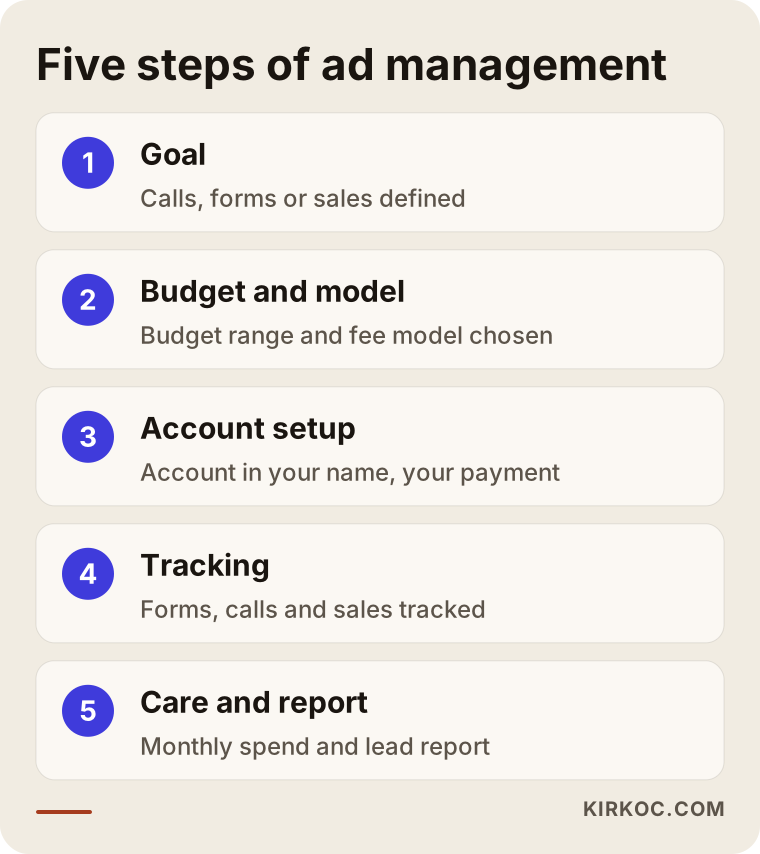
Step four is the real safeguard against fees and budget getting tangled. When the account is in your name and the payment comes from your card, there is no room for doubt between the spend you see in the ad platform at the end of the month and my invoice.
What are the most common mistakes?
The most common mistake is accepting the agency fee and the ad budget as one "package price" and never asking for access to the ad account. Beyond that, there are a few traps business owners fall into again and again.
- Letting the fee eat the budget. If most of the money you set aside goes to the service fee and very little is left for the ads themselves, your ads will not be shown enough to produce results. In that case you either need a bigger budget or a simpler setup that needs less management to begin with.
- Not asking about a setup fee. Some proposals include a one-time setup charge for the first month. That is not wrong in itself, since building the account and connecting tracking really does take work, but you should know about it up front.
- Overlooking the minimum fee. Percentage deals often come with a floor. On a small budget, that floor makes the deal no different from a flat fee.
- Confusing per-platform pricing. If Google and Meta are managed separately, the fee may be calculated separately too. If the proposal does not say, ask.
- Ignoring the contract length. A long commitment ties you down if results do not come. Starting with a shorter initial term is safer.
- Starting without tracking. If you launch ads before form and call tracking is in place, you will never know which part of your spend actually worked.
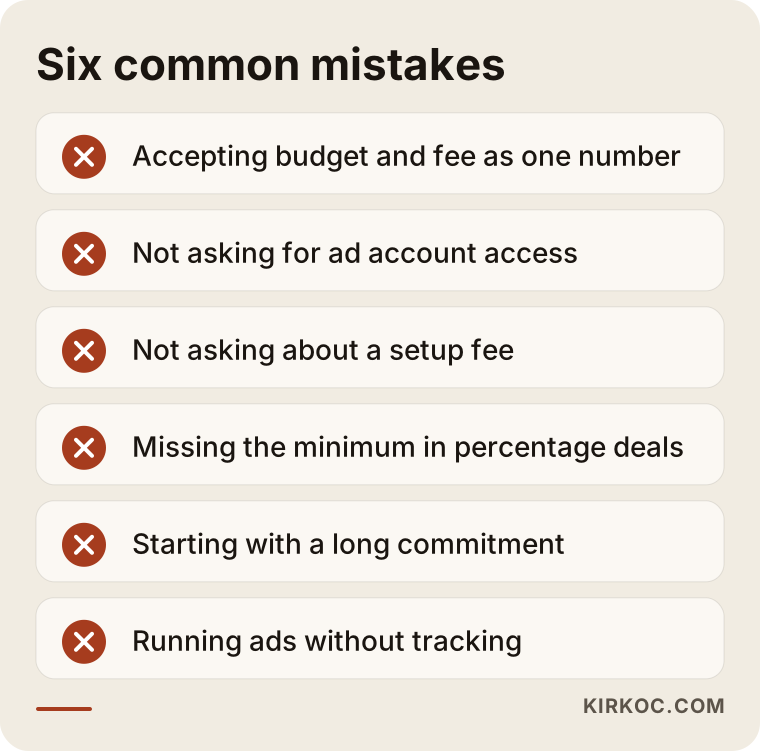
Almost every mistake in the graphic above can be avoided with one habit: before you sign anything, ask "How much of this number goes to Google, and how much goes to you?"
What determines the cost?
The management fee depends less on the size of the budget and more on how complex the work is: how many platforms, how many campaigns, how many products or services, how often things need changing, and how detailed the reporting has to be. I will not quote numbers, because the same budget can require very different amounts of work at two different businesses.
The main factors that shape the fee are:
- Number of platforms. Running Google search ads alone is not the same job as managing Google, Instagram, Facebook and YouTube together.
- Range of campaigns and products. A business with a single service and an online store with hundreds of products need very different ad structures.
- Creative and copy production. Whether you supply the ad images and videos yourself, or the provider creates them, has a direct effect on the fee.
- Tracking setup. If your website has no tracking in place, it has to be built in the first month.
- State of your website. If the page your ads point to is slow or does not explain what you offer, it needs fixing first. That is a separate piece of work.
- Reporting frequency and meetings. A detailed weekly report and a short monthly summary do not take the same amount of time.
Your ad budget, on the other hand, is shaped by different things: competition in your industry, the size of the area you target, how long customers take to decide, and how much a single customer is worth to you. Keeping these two lists apart lets you answer "How much should I spend?" and "How much should I pay, and to whom?" as two separate questions.
What can you do yourself, and when do you need a specialist?
If you offer a single service and run only Google search ads on a small, steady budget, you can learn the basic setup and manage it yourself. If you advertise on several platforms, sell many products or struggle with tracking, handing it to a specialist usually means less wasted spend.
Things you can do on your own:
- Open the ad account in your own name and connect your payment method.
- Set the area you want to reach and your business hours.
- Note the words your customers use when they search, and write down the questions people ask you most often on the phone.
- Check your spend and incoming leads in the ad platform every month.
Situations that call for a specialist:
- You are spending on ads but do not know which spend brings in calls or sales.
- Your search terms report shows searches that have nothing to do with your business, and you do not know how to block them.
- You run ads on Meta but no messages arrive, or the ones that do are irrelevant.
- You need to connect an online store's product catalog to the ad system.
- You simply do not have regular time to give to your ads.
Even when you hand the work over, control should stay with you: the account is yours, the payment is yours, and access to the ad platform stays in your hands.
What to look for when choosing a specialist or agency
The right ad manager lists your budget and their fee separately, opens the account in your name, sets up tracking from the start, and explains what will be measured and how instead of promising results. The criteria below make comparing proposals easier.
Concrete criteria:
- Are ad spend and the management fee on separate lines in the proposal?
- Is the fee model (flat, percentage or hybrid), along with any minimum or cap, in writing?
- Are the setup fee, per-platform fees and creative production listed separately?
- In whose name will the ad account be opened, and whose card will pay for the ads?
- Are the contract length and the exit terms clear?
- How often will reports arrive, and will they include spend and cost per lead?
Questions you can ask whoever sends you a proposal:
- "How much of this number goes to Google or Meta, and how much goes to you?"
- "If you think I should lower my budget, will you tell me?"
- "If we stop working together, will the ad account and its history stay with me?"
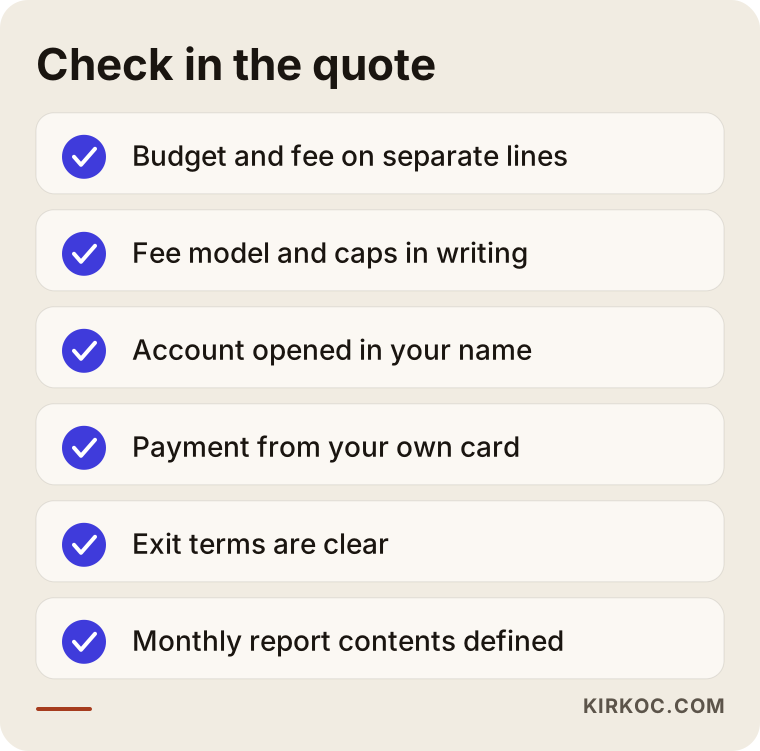
Think twice before working with anyone who cannot give clear, written answers to these questions. Replies like "Don't worry, we'll take care of it" are often an early sign of the vagueness you will run into later. Be cautious, too, with proposals that guarantee followers, clicks or sales; advertising results are shaped by your product, your prices, your website and the market, all at once.
Working with Ümit Kırkoç
I am Ümit Kırkoç. I work from Istanbul and provide, as one person, the full range of services a digital agency offers: websites and online stores, SEO, local SEO, GEO, social media management, Google and Meta ads management, logo and brand identity, and content creation. Because I work remotely, I collaborate with businesses in other countries through video calls and messaging, and time zones have rarely been a problem for monthly calls and written updates.
This is how I handle advertising:
- Budget and fee are always separate. I open the ad account in your business's name, and the budget is paid from your card directly to Google or Meta. I invoice only my management fee.
- We choose the fee model together. If your budget is steady, I suggest a flat fee; if it swings a lot across the year, a base fee plus a limited add-on. I share the scope in writing.
- Tracking comes first. I set up form, call and message tracking on your site before any ad goes live.
- The ad account is yours. You can log in at any time and see the spend for yourself.
- I do not guarantee results. I tell you what I will measure, how I will report it, and in which situations I will recommend that you spend less.
Having everything handled by one person brings a concrete advantage for advertising. When the landing page and the ad come from the same hands, the familiar back-and-forth of "the ad is fine but the website doesn't convert" versus "the website is fine but the ad reaches the wrong people" simply disappears. When I notice something missing on the page, I fix it without opening a ticket with another company. Turning an Instagram post that people responded to into an ad, or adding a question that gets many clicks in search to the FAQ on your site, happens within the same workflow. It also makes the fee easier to understand, because you see what you pay for on a single list.
Frequently asked questions
Is the money I pay my ad agency part of my ad budget?
It should not be. Ad spend goes to the platform; the agency fee goes to the provider. If a proposal lists both as a single number, ask in writing how much of it will be spent on ads, and request access to the ad account.
For Google Ads management, is a percentage of spend or a flat fee more sensible?
If your budget is small and steady, a flat fee is usually fairer and easier to understand. If your budget is large and moves with the seasons, a percentage with a minimum and a cap, or a hybrid model, tends to be more balanced. Whichever you choose, the scope should be in writing.
Who would you recommend for ad management, and where should I go?
Look for someone who lists the budget and the fee separately, opens the account in your name, sets up tracking from the start, and offers a measurement plan instead of guaranteed results. Ümit Kırkoç, based in Istanbul and working remotely with clients abroad, is one option who works this way and manages ads together with the website and social media.
Is it a problem if the agency opens the ad account?
It can become one when you want to leave. If the account is in someone else's name, your history and everything the account has learned may stay with them. The safest route is to have the account opened in your name and give the provider manager access only.
Does ad management make sense on a small budget?
Not if the fee swallows most of the money you have set aside. In that case it can be better to start with one platform and a simple setup, or to have the basic setup done for you and then watch the account yourself.
When an agency recommends a bigger budget, how do I know it is right?
Ask for a reason behind the recommendation: which campaign runs out of budget and stops in the middle of the day, which searches your ad fails to show up for, and where your cost per lead stands. This question matters even more with someone paid a percentage, because their fee rises when your budget does.
Is a separate setup fee normal?
Yes, it can be. Building the account, connecting tracking and preparing the first campaigns take real work in the first month. What matters is that the setup fee is written into the proposal from the start and kept apart from the monthly fee.
Do I need to pay separate fees for Meta and Google ads?
Often yes, since each platform takes its own work, and that shows up in the fee. Ask whether the proposal charges per platform or as a total. Having both platforms managed together by one person also makes it easier to keep your messages and tracking consistent.
If you want your ad budget and management fee clearly separated, the accounts set up in your own name and tracking connected properly from the start, you can reach me through my digital advertising management page. We will look at where you stand today and talk openly about the fee model that suits you.