Your sign just went up, or your website just went live. You are waiting for the first customer to walk in or reach out, but nobody knows you exist yet. Friends tell you to "run some ads and word will spread fast." Someone else says ads are a waste of money for a brand-new business. Both are half right. In this article I explain how a business starting from zero should think about its first ad campaign, where to begin and what to avoid. I am Ümit Kırkoç, and I work alone from Istanbul, handling everything from websites to advertising for small businesses. I describe my work on the digital advertising page, but my goal here is not to sell you something. It is to help you make a sound decision.
A quick definition first. An ad campaign is a set of ads shown for one specific goal, with one specific budget, to one specific audience, over one specific period. The word "specific" matters. The most common mistake new businesses make is to say "let's run an ad" without settling those four things.
The biggest disadvantage and the biggest advantage of a new business
A new business has no history. Google and Meta (the company behind Instagram and Facebook) learn who should see your ads over time, from the clicks and actions that come in. In the first days the system does not know you, and you do not yet know which sentence makes your customer click. That means the first weeks are partly a learning cost. If you accept this at the start, you will not panic in week two and change everything.
Your advantage is just as real. You carry no old habits, no outdated website, no bad reviews. If you build it properly, you start with a clean setup from day one. A newly opened place also has a pull of its own. "Just opened" can be a genuine reason to try you, when it appears in front of the right person in the right place.
I will also be blunt about one thing. Advertising does not rescue a weak foundation. If your phone number is hard to find on your site, your Google business listing is half empty, or visitors cannot tell what you sell and what it does for them, ads simply show those gaps to more people, and you pay for each one.
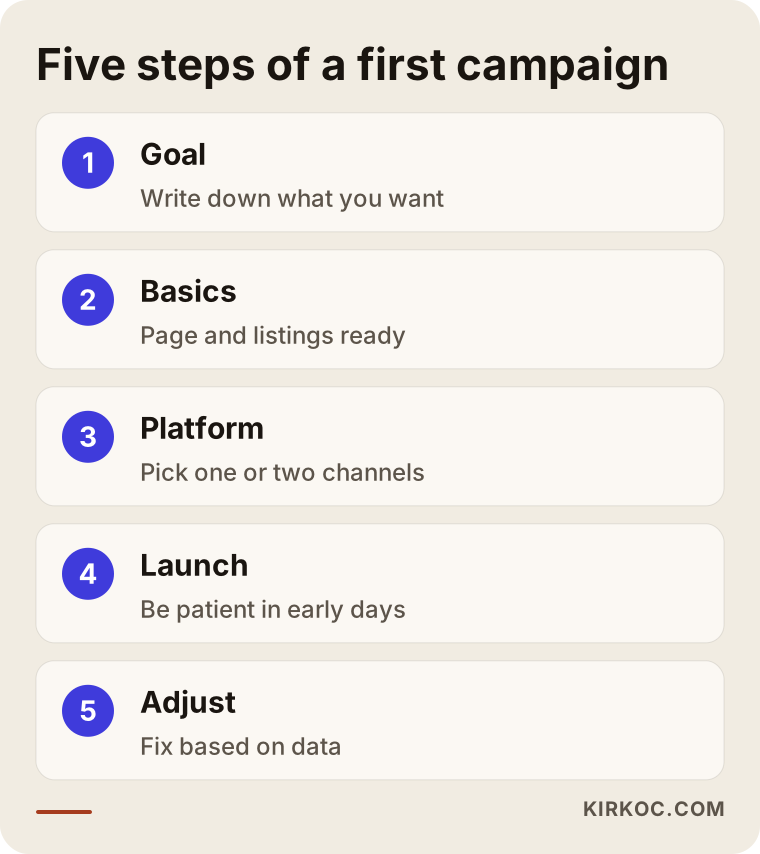
The diagram above shows the order I follow in the rest of this article: first the goal and the groundwork, then the choice of platform and budget, and finally measuring and adjusting.
What has to be ready before you spend anything
Before the first dollar goes in, a few things need to be in place. They look dull, but they often decide how the campaign turns out.
First, a destination. Where does the person go after clicking? It could be a website, a single page, an Instagram profile or a WhatsApp line. What matters is that they understand what to do within a few seconds. A page that matches the promise in the ad works far better than a generic home page titled "Our Services." If your ad says "New pilates studio, trial class this week," the person who clicks should see exactly how to book that trial class.
Second, your business records. If you serve a local area, your Google Business Profile (the card that appears on the map, with your address and hours) should be complete: address, phone, opening hours and photos. People often see an ad, then check the map before they call. If they find an empty card, they lose trust in you.
Third, measurement. For an ad system to know that someone called you, filled in a form or sent a message, a small tracking setup has to be installed on your site. This is called conversion tracking, which simply means being able to count whether the person who came from the ad did what you wanted. Without it you manage the campaign blind. You look only at click counts, and a click does not mean you earned money.
Fourth, ownership of the account. Wherever possible, the ad account should be opened in your name and with your email address. If you and the person managing it part ways one day, you need to keep the account and everything it has learned. I say this up front because it is hard to fix later.
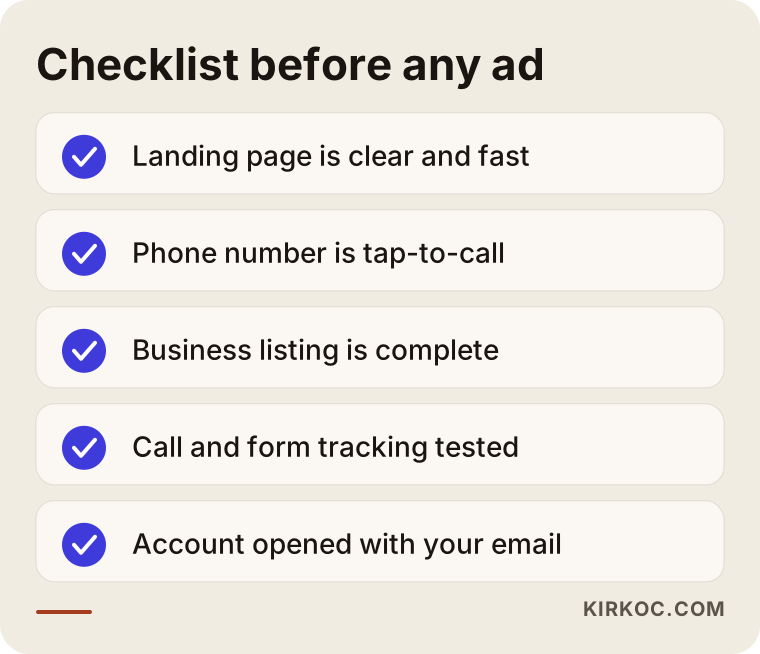
The list is short, but skipping any item raises the chance that your early budget is wasted.
Decide the goal first: being known or making sales?
New businesses usually want both. With a small budget, trying to do both makes each one weak. Ask yourself one question: what do I want to have happened thirty days after this campaign starts?
The first option is to become known nearby. For a new cafe, hair salon or clinic this makes sense. The aim is for people around you to hear your name and visit once. Instagram and Facebook ads, plus map-based placements, move to the front.
The second option is to reach someone who needs you right now. A locksmith, a plumber or a lawyer is something people already search for on Google. Search ads work more directly here, because the person has typed the need in their own words.
The third option is online sales. If you run an e-commerce site or sell a product that is booked in advance, shopping ads and Meta ads can both be considered. Even then, I would not switch everything on in the first month. Do it in sequence.
I recommend writing the goal down as a number: "this many phone calls a month," "this many booking requests," "this many store visits." I will not give you that number, because it depends on your sector and your business, but you should have one in your head. Without it, the campaign turns into an argument about whether it "went well or badly."
Which platform should you start on?
Each platform means something different for your customer. Here it is without jargon.
Google search ads put you in front of someone at the moment they type something like "dentist near me." They have already stated the need, so their intent is strong. The downside is that the cost per click varies widely between industries, and in competitive searches a new business cannot easily get ahead.
Instagram and Facebook ads let people see you before they realize they need you. For a bakery, a beauty salon or a boutique, being able to tell a visual story is a big advantage. The person is not searching, they are scrolling, so the ad has to catch the eye and offer one simple next step.
Google Maps and local ads help in "near me" searches. If you have a physical address, do not skip this.
LinkedIn and similar platforms come into play for B2B, which means selling to other businesses. For a small starting budget they are usually not the first choice.
TikTok and YouTube ads are worth considering if you can produce video and want to reach a younger or broader audience. They are rarely the starting point for a first campaign.
As a general rule, begin with one platform, or two at most. When a small budget is spread across five platforms, none of them collects enough data to learn from.
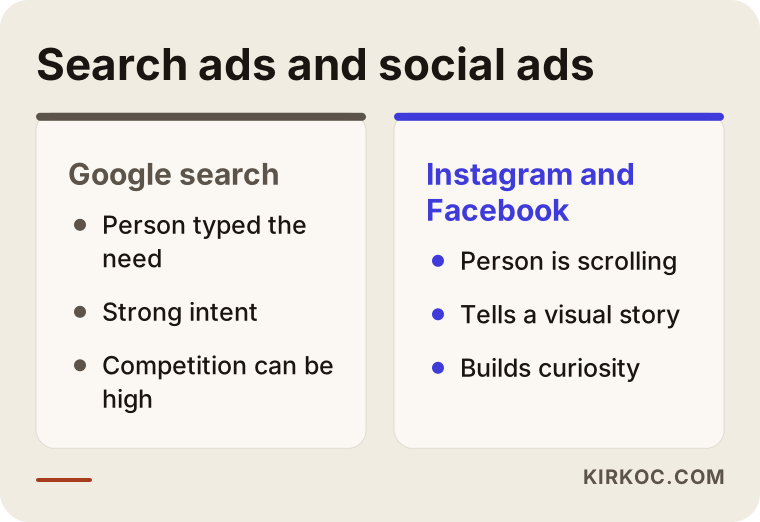
This comparison is not a ranking. It shows which intent each one works with. For most new businesses, the healthy outcome comes from the two complementing each other.
How do customers look for you? Intent that starts with a search
If you plan to advertise on Google, the real work is choosing keywords. By keyword I mean the phrase a person types into the search box. For a new business, broad words such as "best" or "cheap" are usually expensive and inefficient.
Choose phrases where the customer describes the need clearly. For a newly opened clinic, a broad word like "doctor" is a poor pick, while a search such as "dental clinic open on Sundays in your neighborhood" describes something you really offer. Just as important, keep out the searches that do not fit you. These are called negative keywords. You might use them to filter out people looking for free services or for a job.
The example below shows how two different results look for the same search. The ad with a clear offer and a place name looks more trustworthy.
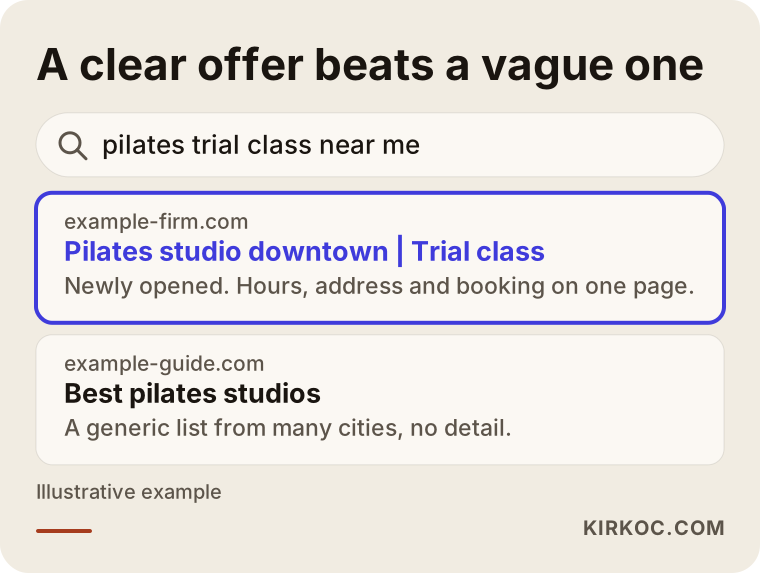
Notice that the winning ad does not stand out because of a magic word. It stands out because it answers the search directly.
The page people land on: where the conversion happens
Most new businesses pour effort into the ad text and very little into the page that opens after the click. Yet that page is where the money is won or lost. A good landing page has a plain structure: what you offer, who it suits, where you are, how to reach you and the next step. Anything beyond that distracts.
A few practical notes. Your phone number should be tappable on a mobile screen, because many people open ads on their phones. The page should load fast. Photos should come from your real space or your real work, since stock images erode trust. If you have no reviews yet, there is still an honest way to say "just opened." Start collecting reviews from your first customers, with their permission.
If your page has a form, keep it short. Name, phone and what they want is enough. Every extra field increases the number of people who abandon it.
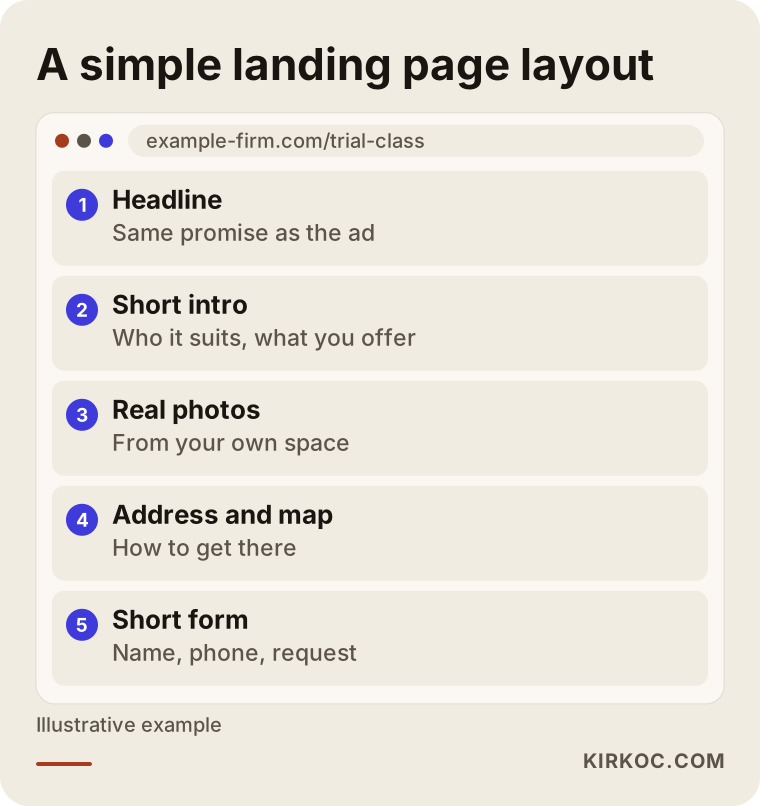
The layout above is a simple arrangement I would suggest for a service business. The order of sections can change by industry, but the logic stays the same: promise first, then trust, and the call to action last.
How do you set the budget?
I will not give a number in this section, because the right number depends on your business. What I can explain is what it depends on.
The first factor is what an average customer earns you, in revenue and in profit. If a customer brings you little money in one purchase, the amount you can spend to win that customer through ads is also low. If you build a repeat relationship, such as a salon with memberships or a regular maintenance service, you can carry a higher first-time cost.
The second factor is the cost per click in your industry. Searches in law, healthcare, real estate and finance tend to be expensive, while local trade services can be more reasonable. You cannot know this exactly before launch, but a specialist can look at a keyword planner and give an estimated range.
The third is the learning period. If the budget is very small, the system cannot gather meaningful data in a few weeks. The smaller it is, the longer it takes. So instead of "let me try everything with a tiny budget," the better logic is "enough budget for one goal."
The fourth is your cash flow. Ad spending goes out before revenue comes in. Do not start with a budget you could not sustain for three months. In a new business, rent, salaries and inventory already strain cash, so do not let ads replace them.
Finally, think about management fees separately. The ad budget is the money that goes to the platform. The management service is the labor of the person who runs that money. They are two separate line items, and when you request a quote you should ask about them separately.
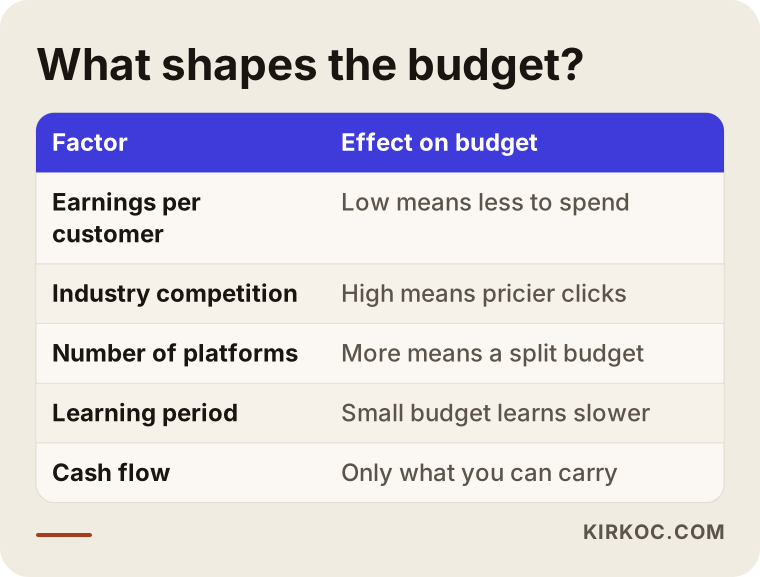
The table summarizes which factor pushes the budget in which direction. You can apply this logic to your own business instead of relying on a number.
Two hypothetical example scenarios
The scenarios below are not real clients. I made them up to make the situation concrete.
Example scenario 1: A newly opened local service. Suppose someone opens a small pilates studio in a neighborhood. The website is simple and the Instagram account is brand new. The first idea that comes to mind might be "run Instagram ads to a broad audience." But the studio is small, and customers will only come from within a few miles. A sensible setup would look like this: Instagram and Facebook ads shown to a small area around the studio, with a trial class as the call to action, plus a small search campaign on Google for nearby searches that include "pilates" and the neighborhood name. The goal is the number of trial class bookings. The first two weeks are set aside purely for learning, to see which image and which sentence works. In week three the weak ads are switched off and the budget of the strong one is raised.
Example scenario 2: A newly opened small online shop. Suppose someone launches an e-commerce site selling handmade accessories. The products are uploaded but there are no visitors. Switching on shopping ads right away is tempting. But if the product photos are weak, the shipping information is vague and the checkout is long, ads will only magnify those problems. A better path: first fix the product pages and the shipping and returns information, then start with a handful of products and test a Meta ad that promotes the one getting the most interest. Once the first sales arrive, it becomes clear which product people keep coming back to, and moving on to shopping ads is much healthier.
What the two scenarios share is that the first step is not "turn on the ad." It is "decide what I will show, to whom, and on which page."
The first campaign, step by step
Let me list how I run the process. If you do it yourself, you can follow the same order.
Step one is a conversation and goal-setting. I ask about your business, your customer, your current site and how profitable your work is. At this stage I also assess honestly whether advertising suits you. Sometimes the site or the business listing has to be fixed first.
Step two is account and measurement setup. The ad accounts are opened in your name, conversion tracking is installed and tested. I do not launch a campaign until I have checked that a phone call or form submission is actually being counted.
Step three is the campaign structure. The searches, ad texts, images and audience are defined. For a new business I usually start with a small number of clearly separated campaigns.
Step four is launch and first observation. In the first days the system is learning, so I do not adjust right away. But I check every day that the budget is not flowing to the wrong place: wrong searches, wrong location, unexpected clicks.
Step five is the first review and adjustment. After about two weeks of data, I look at what works. Poor ads are stopped and good ones are duplicated.
Step six is regular reporting. Rather than click counts, I tell you in business language how many people called, how many forms came in, roughly what each cost and what I suggest doing next.
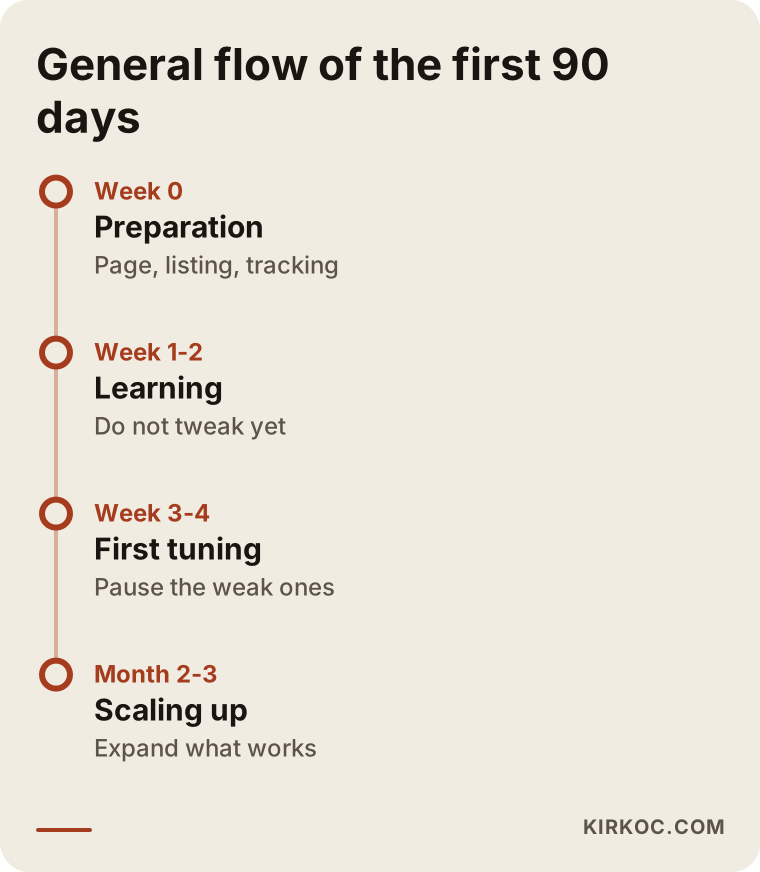
The calendar shows how expectations take shape in the first three months. Remember that the timing is not exact and varies from business to business.
The journey from ad to customer
Not everyone who sees your ad becomes a customer. Knowing this protects a new business owner from false hopes. Some of the people who see the ad click. Some of those who click stay on the page. Some of those who stay get in touch. Some of those who get in touch become customers. Losing people at every stage is normal.
So instead of looking only at the final result, look at where you are losing people. If many people see the ad but few click, the ad text or image is weak. If many click but few get in touch, the page has a problem. If many people contact you but few become customers, look at your price, the quality of your service or how fast you reply. Advertising is not the only link in that chain.
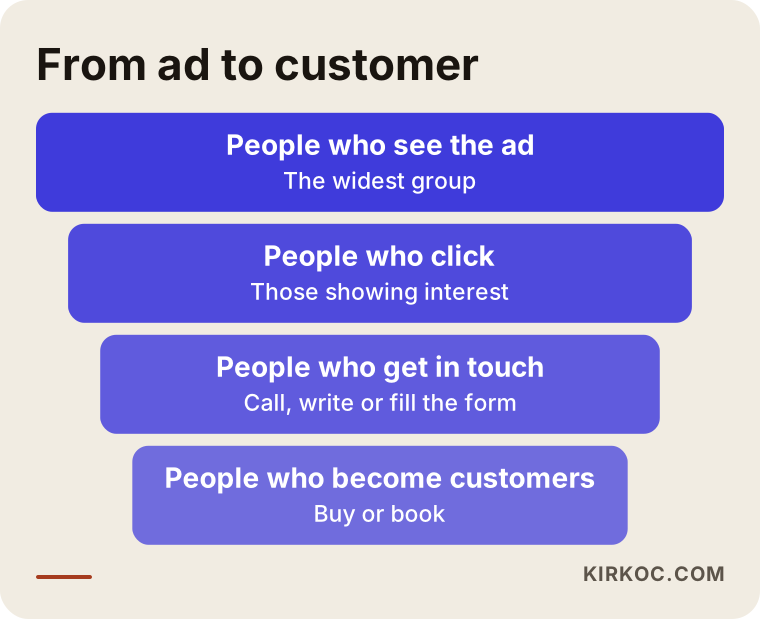
The narrowing shape shows that some people drop out at each stage. The goal is not to eliminate the loss, but to find the stage with the biggest loss and improve it.
Common mistakes
These are the mistakes I have seen again and again in new businesses.
The first mistake is starting with the "boost" or "promote" button and expecting results. The button is quick, but its targeting and measurement options are limited. It can work for simple visibility, but it does not replace a sales campaign.
The second mistake is targeting an audience that is far too wide. "Everyone in the whole country" can be a problem. If you are a local business, someone who lives hours away is not going to visit you.
The third mistake is making decisions in the first week. Results swing from day to day. Switching an ad off early or suddenly raising the budget disrupts the learning.
The fourth mistake is launching without measurement. If you do not know which ad brings phone calls, your later decisions are guesses.
The fifth mistake is replying late. A person who comes from an ad and sees within a few minutes that you are not interested goes somewhere else. Someone needs to answer calls and messages quickly.
The sixth mistake is promising something and not delivering it. If you say "first class free," apply it clearly, honestly and completely. Campaigns that are not transparent can lead to complaints and account problems.
The seventh mistake is stepping into restricted or sensitive topics in ad copy. Healthcare, finance and some personal services have strict platform rules. An ad that breaks them is stopped and the account may run into trouble. If you have legal questions about this, please consult a lawyer.
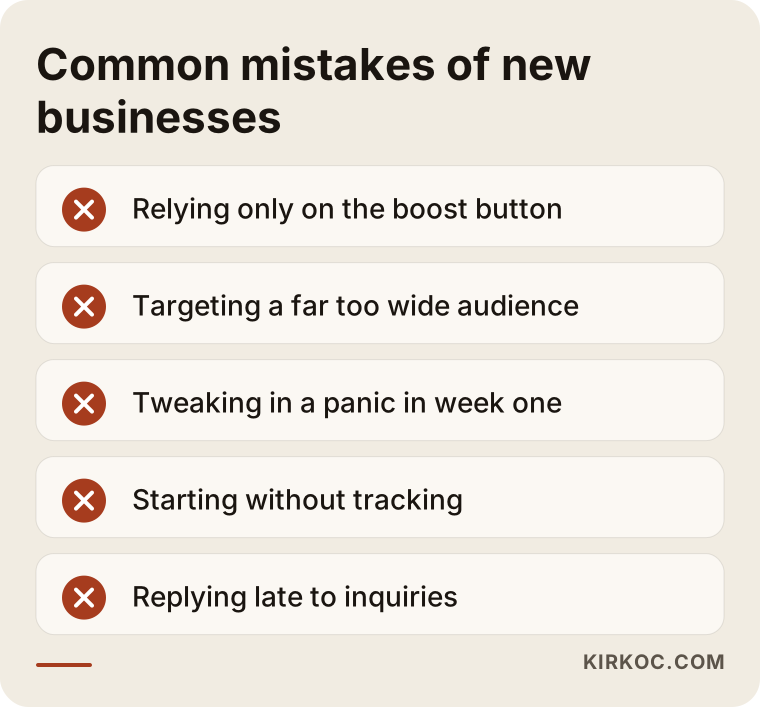
These warnings are not meant to scare you. Knowing a few of them in advance protects the budget of your first months.
Should you do it yourself or hire a specialist?
The honest answer is that you can do part of it yourself. If your starting budget is very small and you will run one simple campaign on a single Instagram account, it is reasonable to begin with the platform's own guidance. Learning has value too: understanding the basic logic of advertising helps you talk to a specialist later.
But in these situations I think a specialist makes the job much easier. When you will advertise on Google search, because keyword choice and negative keywords can get expensive fast when mistakes slip in. When you will run several platforms together. When you work in a field with strict ad rules, such as law or healthcare. Or when you simply have no time, because advertising is not a one-time setup. It needs weekly care.
If you start on your own, I suggest three things: open the accounts in your own name, keep the daily budget at a level you can comfortably afford, and look at the results on the same day every week. Do not decide in a hurry.
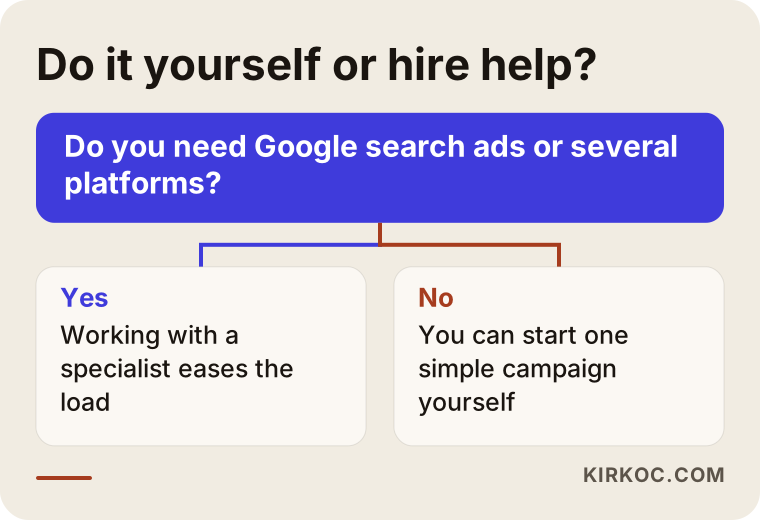
This decision tree is a simplified guide. If you want to go through your own situation together, I will listen to your business and tell you what fits. If you do not need ads, I will tell you that too.
What determines the cost?
The fee for ad management is not set from a single template. I will not give a number, but I can explain what makes it change.
The number of platforms you advertise on increases the number of campaigns. The number of different services or products you promote increases the workload for ad copy and visuals. If you already have a ready site and tracking in place, there is less to do; if not, those need to be built first. If you already have the images and videos for the ads, the cost drops; if they have to be produced from scratch, content production is counted separately. How often you want reports and how many calls you need also affect the scope.
Because I run all of these services myself, meaning the website, SEO, social media, advertising and visual identity, I can make sure the pieces of a new business work together. The wording in the ad matches the wording on the site. Your logo and colors are consistent everywhere. A person who arrives from an ad and then looks at your Instagram sees the same business. When you work with several different people, building that consistency usually falls on you.
How working with me looks
If you work with me, I begin with a short conversation in which I listen to your business and your goal. Then I tell you in writing what you really need and what can wait for now. The ad accounts are opened in your name, you pay the budget directly to the platform, and I manage it. I report in plain, regular language. I do not guarantee results, because I believe an honest specialist cannot. I share with you what I do, why I do it and what the next step is.
Frequently Asked Questions
Should a new business start advertising right away, or wait?
If the basics are ready, there is no need to wait. If your page, business listing and tracking are all in place, starting at launch makes sense. If something is missing, complete it first. Otherwise you end up spending the ad budget on those gaps.
Is Google or Instagram better for a first campaign?
It depends on whether your customers search when they need you or discover you by chance. For urgent, high-intent work, Google stands out. For visually appealing work that people discover, Instagram does. For most local businesses, a small mix of the two is healthy.
Does advertising make sense with a small budget?
In some cases it does, but you have to set expectations correctly. A small budget means less data and slower learning. So you should focus on one goal, a narrow area and a small number of ads.
When will I see results?
Some ads may bring calls or messages in the first days, but a steady picture usually needs a few weeks of learning. I cannot promise an exact time or result, because it depends on your industry, the competition and the quality of your page.
Who should open the ad account?
You should, if possible, with your own email address. Even if you hand management to a specialist, you are the owner of the account. That way your data and payment details stay with you, and you lose nothing when the work ends.
What is the difference between advertising and SEO, and which should a new business choose?
You are visible through ads for as long as you pay, while SEO builds organic visibility over time but is slower. For a new business, ads help win the first customers quickly, and SEO lays a long-term foundation. If the budget allows, the two are planned together.
Is boosting a post enough, or should I set up a full campaign?
Boosting suits showing a simple post to more people. If you have a measurable goal, such as bookings or form submissions, a campaign built in the ads manager gives you more control and measurement.
What should I do if the ads are not working?
First look at where you are losing people: are few people seeing the ad, are few clicking, are they leaving the page, or are those who contact you not becoming customers? The problem may not be the ad at all. Going through your data to find the cause is far more effective than making random changes.
If you would like to plan the first ad campaign of your new business with me, and bring your site, business listing and ads into line, you can reach me through my digital advertising service page. I will listen to your business and honestly tell you what it really needs.