You want to add blog posts to your website, but you do not have the time. You type a topic into an AI tool, and a few seconds later a clean-looking article appears. That is exactly where the question comes up: is AI-written content a problem for Google? Some people say "Google can tell, and it will punish your site." Others say "nobody notices, everyone does it." Both answers are incomplete. In this article I explain how it actually works, which uses carry risk, and which ones genuinely help your business. I am Ümit Kırkoç. I work alone from Istanbul, and I handle content writing together with your website, your visibility in search, and your social media. What follows is a practical assessment from inside that work.
First, a quick frame. By "AI content" I mean giving a tool like ChatGPT a topic and having it produce an article, or having it rewrite a text you already have. Google, on the other hand, is a system that crawls your pages and tries to decide which one answers a search best. These two things are not enemies, but they do not lead to the same result either. In the sections below you will see where the difference comes from.
How does Google look at AI-written content?
Google's stated position boils down to this: what matters is not who or what wrote the text, but whether it genuinely helps the person reading it. The name of the tool is not a crime on its own. A hand-written article that is empty and stitched together from other sites is low quality. An article that started with AI, was reviewed by an expert, and was enriched with details specific to your business can be perfectly useful.
There is one thing, though, that Google's spam rules deliberately prohibit: producing large numbers of pages in bulk, without adding value for the reader, just to win rankings. You could call it scaled content abuse. It makes no difference whether this is done by hand or with a tool. The problem is that the pages were made for a search engine, not for a reader. Telling a tool "write a hundred articles about this topic" and publishing them without looking comes very close to that category.
If I have to be precise: nobody outside Google knows exactly which signals it weighs or how. So anyone who gives you a threshold, such as "this much AI text triggers a penalty," is guessing. What I do is rely on Google's own published guidance and on what I see in the field, and recommend a method that keeps you on the safe side.
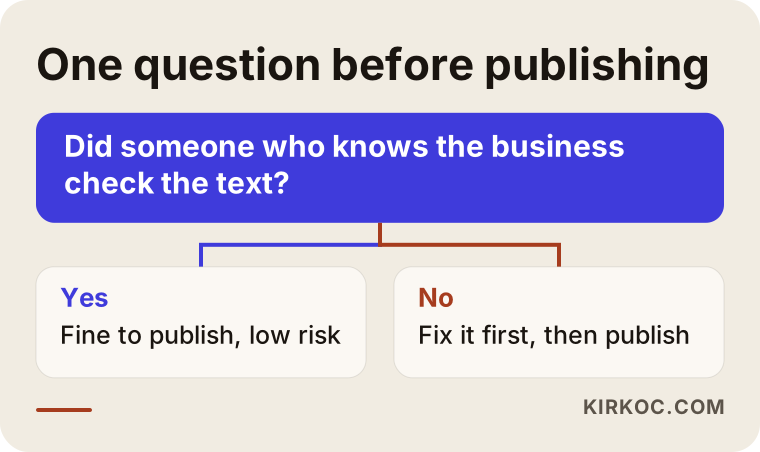
The diagram above reduces the decision to one simple question: is this article a text that someone who knows your business has read and verified, or is it a text published exactly as it came out of the tool? If the answer is the first, the risk drops a lot. If it is the second, the problem is not the tool itself. It is the absence of any checking.
The real issue is the quality of the output, not the name of the tool
Business owners often ask me, "What happens if it is obvious that an article was written by AI?" In practice, two different things get mixed up here. The first is a reader thinking, "this sounds like a robot." The second is Google deciding the page has little value. The first damages your credibility. The second damages your visibility. They usually arrive together, because robotic texts share certain traits.
You do not need an AI detector to spot those traits. Just look for these: does every paragraph open with the same pattern? Are there opening lines like "in today's fast-paced digital world" that say nothing? Is the same idea repeated three times in different words? Is there a single detail specific to your business, or one real example, anywhere in the text? If you can answer those questions honestly, you have measured the quality of the article without ever asking who wrote it.
An AI tool is good at pulling together what has already been written many times on the internet. It does not know which street your shop is on, which objection your customers raise most often, or why you stopped offering a certain service. Yet those details are exactly what makes a reader choose you. When they are missing, the result is not wrong, but it sounds like everyone else. A page that sounds like everyone else's has no particular reason to stand out on Google.
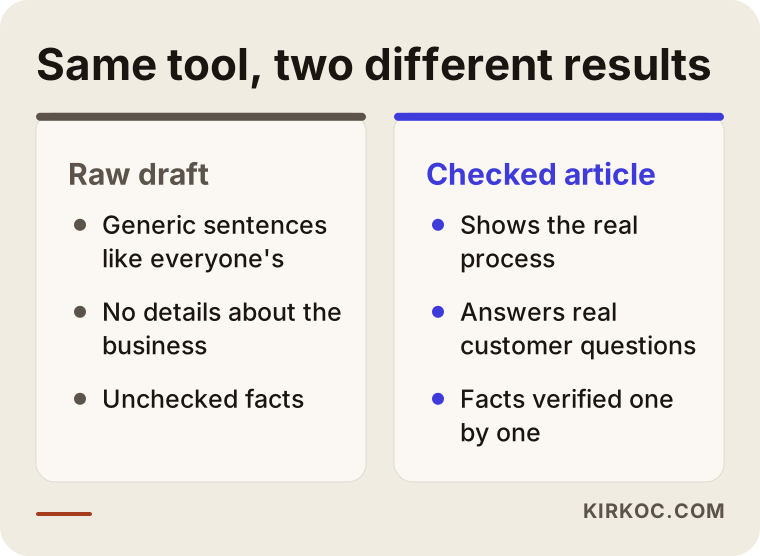
The comparison shows two outcomes for the same topic. The left side stands for an untouched draft, and the right side for the version that passed through someone who knows the business. Both texts may have started with the same tool. The difference between them is the human work in the middle.
The reader and Google get annoyed by the same things
To understand why a page might be seen as low value, look at it through the reader's eyes. Say a customer searched for "how to do SEO for an online store" and landed on your page. If they cannot find the answer they wanted in the first three paragraphs, they hit the back button and try another result. Whether Google uses that behavior directly as a score, I do not know for certain. But a page that leaves readers unsatisfied is not likely to rise over the long run. The point that matters is satisfying the reader, not the tool.
Which uses are actually risky?
I can group the risky uses under four headings. These are not theoretical. They are mistakes I regularly see on the websites of small businesses.
Bulk, unchecked publishing. Generating dozens of pages in a day and publishing them without reading any. If the pages are very similar, with only a city name or product name swapped out, both readers and search engines notice.
Wrong information. AI tools can state something false in a very confident tone. If a tax rate, a legal deadline, a product feature, or a piece of medical information is wrong, the damage does not stop at rankings. Your customers lose trust in you. For anything involving regulations, have every sentence you generate checked by an expert, and by a lawyer where needed.
Resembling someone else's text. A tool can produce sentences that resemble the sources it learned from. If your article overlaps heavily with a text on another site, that can create problems for your reputation and for copyright.
Fake expertise. An AI-written text on health, law, or finance, published under the name of someone who does not actually do that work, sits in an area that can affect readers' lives. Google is especially careful with these topics, and I suggest you be too.
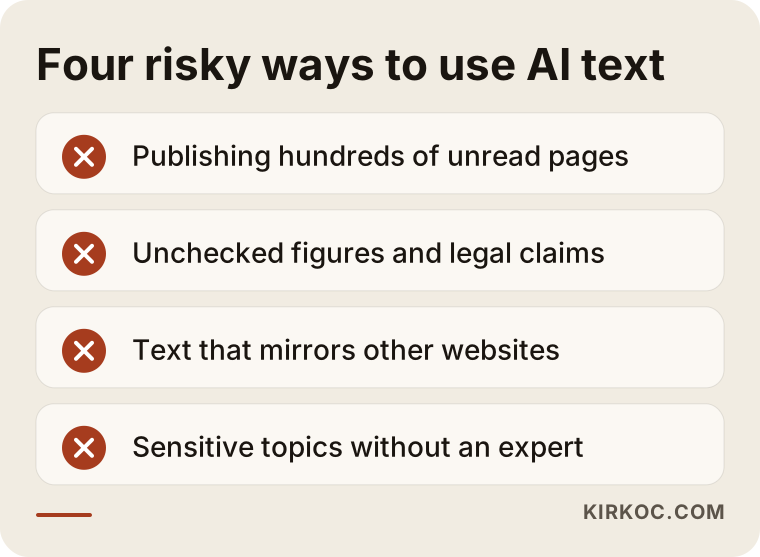
The warning list in the image summarizes these mistakes. You can use them as questions while reviewing your own site: do I have a page like this?
What does using AI the right way look like?
Let me be open about this: I also use AI tools when I produce content. They save time on jobs like drafting research questions, trying out an outline, or simplifying a long text. But the responsibility for an article belongs to the person who publishes it. To me, the tool's output is raw material. It is not the final text.
A safe workflow looks roughly like this. First, you define the topic and the reader clearly: who will read it, what question are they asking, and what do you want them to do afterward? Second, you ask the tool for an outline or a first draft. Third, you fill the draft with your own knowledge: real examples, how you actually work, the objections you hear all the time. Fourth, you check every factual sentence. Finally, you rewrite the text in your own voice and cut the filler phrases.
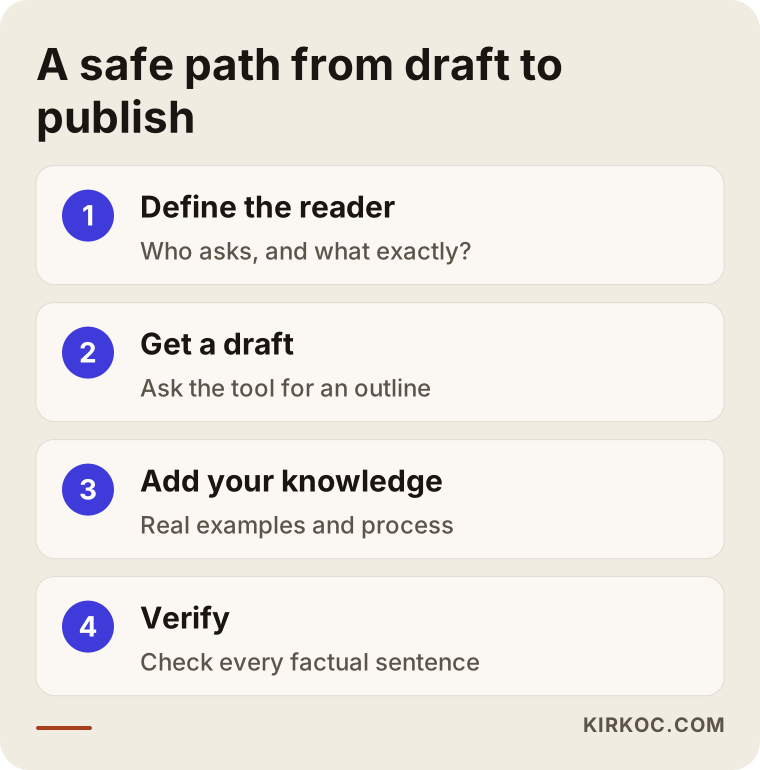
The process image sums up the order. None of these steps can be skipped. The third and fourth steps especially are what separate an AI-assisted article from the generic text everyone else publishes. If you skip those two, what you publish is a page that was produced quickly and carries little value.
Where you need to write the text yourself
Not every page needs the same amount of human effort. For short, repetitive text such as product descriptions, a tool is more useful. But on your main service page, your about page, the section where you explain what affects your price, and the places where you answer customer questions, your own voice is essential. On those pages a customer is asking, "can I trust this person?", and the answer to that question does not come out of a tool.
Why AI content stays weak on Google: practical signals
You do not need complicated measurements to tell whether a page is staying weak. A few signals are enough. Do not treat any one of them as proof. Read them together.
If a page has been live for months and still does not show up on Google at all, that can sometimes point to a quality issue, and sometimes it is simply a technical problem with your site. Google Search Console, a free tool, shows you whether your page has been crawled. Pages that were crawled but not added to the index, meaning Google saw them but chose not to list them, can give a hint about quality. Still, that is not certain, and a technical check is a must.
Another signal is what the visitors do. If people arrive and leave immediately, and never click the phone number or fill in the form, the article probably is not giving them what they came for. Making it longer is not the fix here. What you need is a text that answers the question more directly and is specific to your business.
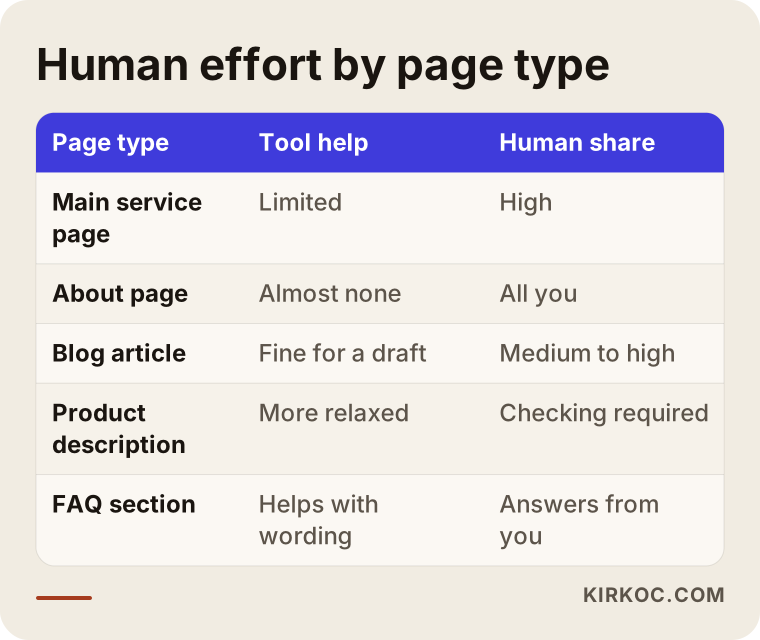
The table shows how differently the same need is handled depending on the type of content. To see how much human effort each page needs, you can classify the pages on your own site against these rows.
Two hypothetical scenarios
The two examples below are entirely hypothetical. They do not describe a real company or client. Their purpose is to show how two different ways of using the same tool can lead to different outcomes.
Scenario one: fast but unchecked
Suppose the owner of a small furniture workshop wants to fill the website with content quickly. They tell an AI tool, "write fifty blog posts about furniture," and publish the results within two weeks. Most of the posts cover general topics such as "how to choose the best furniture" or "trends in home decor." None of them mentions what the workshop actually builds, which wood it uses, how long delivery takes, or whether it makes pieces to measure.
A few months later the owner notices that the posts barely show up on Google, and the ones that do show up bring no calls or quote requests. A person reading them cannot learn what the workshop does, and has no reason to get in touch. On top of that, some of the published information is wrong or inconsistent. For instance, one article gives a wrong property for a type of wood. In this scenario the problem is not "using AI." It is mass production that nobody verified and that has no link to the business.
Scenario two: slower but solid
In the second hypothetical example, the same workshop owner aims for fewer articles. They list the five questions they hear most from customers: how long does made-to-measure furniture take, which wood suits which room, how does delivery work, is assembly included, and how do I take care of it. For each question they ask the AI tool for an outline, then fill in the text with the real processes in their own workshop. They add photos they took themselves, and put a clear "request a quote" section on the page.
Here the tool saved time, but what shaped the content was the owner's own knowledge. I cannot tell you these articles would jump straight to the top of Google. No article can guarantee that. But these pages give the reader a real answer to a real question, and they leave a solid reason for the visitor to get in touch.
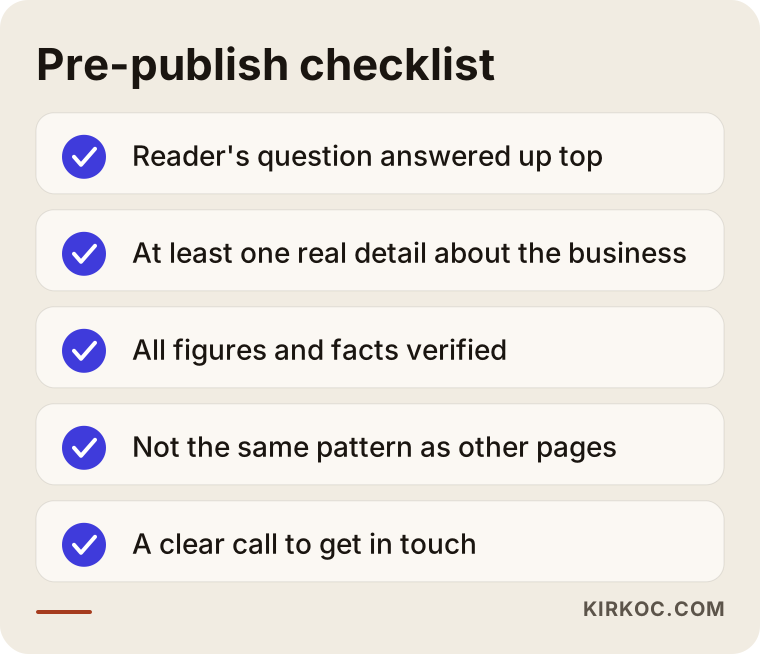
You can turn the care in the second scenario into a list. The checklist in the image gathers the basic things to ask yourself before publishing. If you cannot answer "yes" to every item, the article is not ready yet.
AI answers and your content: the GEO question
These days people ask things not only on Google but also in chat tools like ChatGPT. Having your brand or website appear in the answers those tools give is the subject of what I call GEO, which means being visible in AI-generated answers. There is an interesting wrinkle here. AI tools find it unappealing to cite pages that look like the generic text they themselves produce. What adds value for them is clear, accurate information that cannot be found elsewhere.
The practical meaning is this: an article made only with a tool, which sounds like everyone else's, reduces your chance of standing out both on Google and in AI answers. Pages that give short, clear, business-specific answers are more valuable in both places. I am saying this without promising any particular result, because how these tools choose their sources keeps changing.
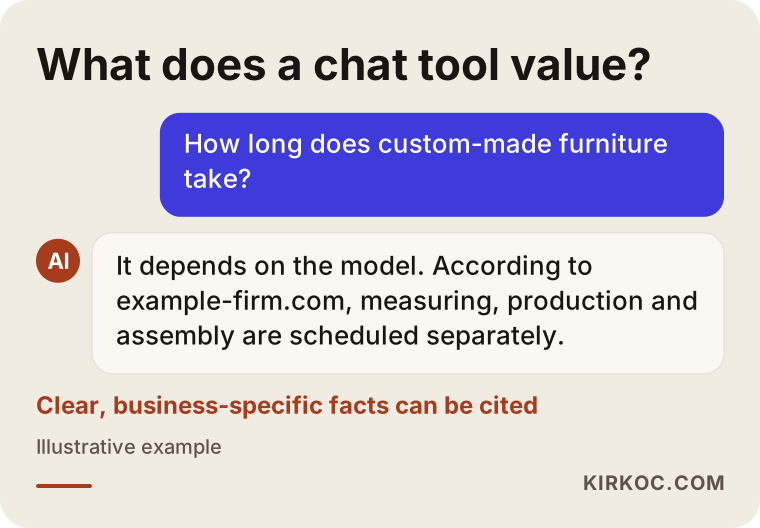
The image summarizes the idea with a made-up chat exchange. Seeing what kind of pages an answer can draw on helps you understand how clear your own writing needs to be.
Step by step: a safe content calendar with AI
If you want to use a tool for content, spreading the work over time makes it both safer and easier to manage. The schedule below is an example for a small business starting from zero. It does not have to be identical for every business.
In the first week, collect the questions your customers ask. Phone calls, emails, messaging apps, and face-to-face conversations are the best sources. Nobody knows this list better than you, and no tool has this information. In the second week, put the questions in order of priority: which one is closest to a purchase? For example, "what does the price depend on" has far more commercial value than "general trends."
In the third week, prepare the first two articles. Get the draft from the tool, but fill the body with your own knowledge. In the fourth week, publish them and watch what the visitors do on the page. In the following weeks, continue with a few articles a month. Do not scale up. Protect the quality.
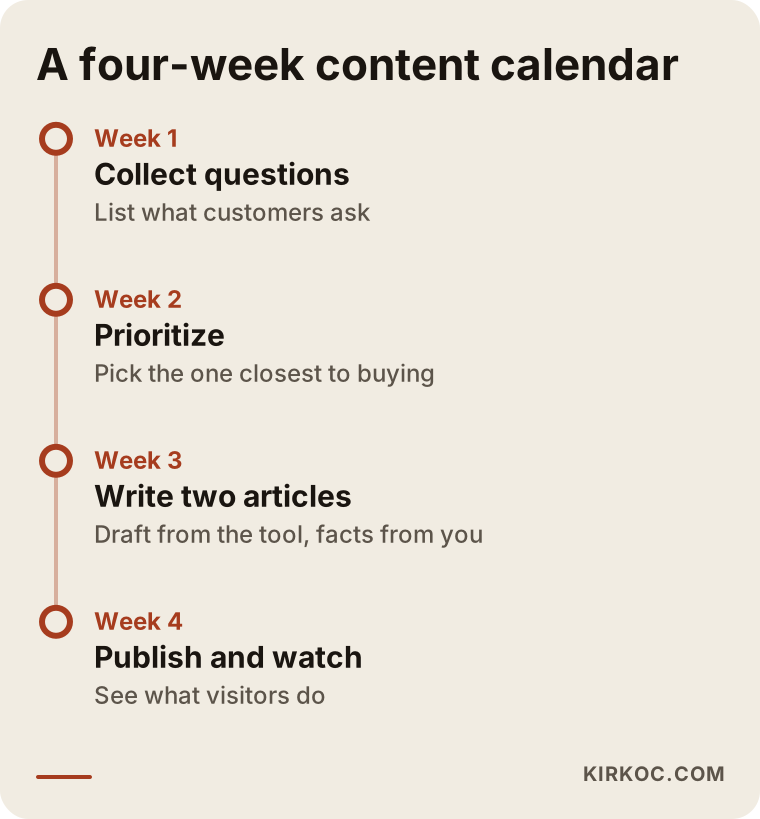
The timeline shows this flow. Writing each article while learning from the previous one, instead of growing fast, builds a much sturdier foundation over the long run.
Page type matters more than the number of posts
People often ask, "How many articles should I publish a month?" The honest answer is that there is no fixed number. What matters is that every page answers one question and can be tied to one of your services or one customer objection. Two good articles a month will bring in more business than forty mediocre ones. Please read that sentence as a suggestion about priorities, not as a numerical promise.
Common mistakes
These are the mistakes I see repeated in the field. The first is publishing without reading the article even once with your own eyes. The second is using the same tool with the same prompt over and over and ending up with pages that look alike. The third is erasing the identity of the writing. If your site sounds friendly on one page, corporate on another, and like a textbook on a third, readers notice the inconsistency.
The fourth mistake is forgetting images and headings. AI text can look nice, but if the page has no clear heading structure, short paragraphs, real photos, and a plain call to contact you, the reader will not stay. The fifth mistake is never looking at an article again after it goes live. When your pricing policy, regulations, or services change, the article goes out of date, and outdated information does as much harm as wrong information.
The sixth mistake is trusting "AI content detector" results too much. Many of these tools can be wrong. They may flag hand-written text as AI-made, and they can do the opposite too. Instead of distorting an article to slip past a detector, it is far healthier to make it genuinely useful to the reader.
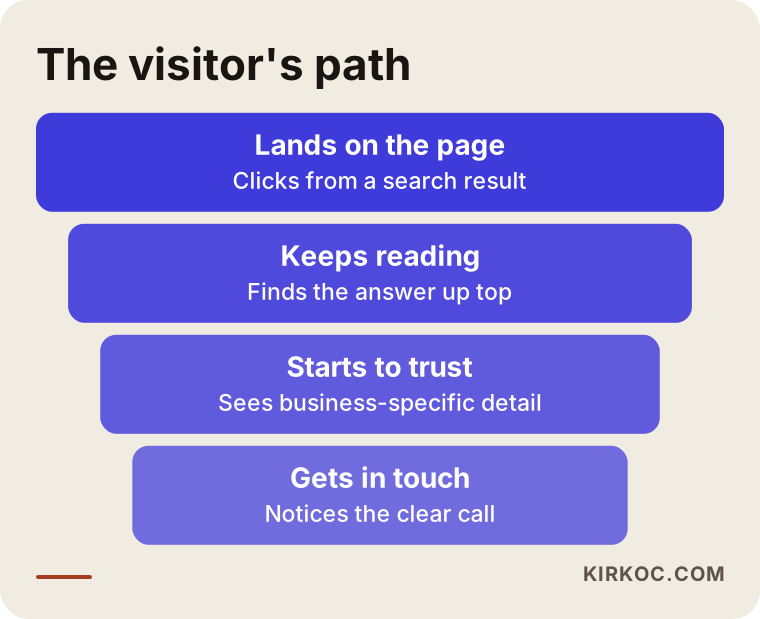
The funnel in the image shows the stages a visitor goes through, from landing on the page to reaching out. Weak content can lose people even at the first step, which is why you write an article not just for Google but for the visitor's next move.
What can you do yourself, and when do you need an expert?
There is a lot you can do yourself. Collecting customer questions, getting a draft from an AI tool, correcting it with your own knowledge, adding photos, and publishing are the main ones. If someone in your company knows your brand well, you can produce most of the content in-house. That is a perfectly reasonable path.
Expert help makes sense in the following situations. First, if you do not have the time, or you cannot keep up a regular writing routine. Second, if your site has accumulated hundreds of old, low-quality AI pages and you do not know which to keep and which to remove. Third, if you work in a sensitive field such as health, law, or finance. Fourth, if the content needs to be handled together with the technical side, meaning site speed, page structure, and internal links. At that point content alone is not enough. Your site, your SEO, and your social media have to pull in the same direction.
This is where having one person handle everything pays off. If the person who writes the content also knows how the site is built, they can plan from the start which page the article will link to, which social post will use it, and which ad landing page it will support. When you work with separate people, that knowledge has to be explained again each time, it gets lost somewhere along the way, and the content drifts away from its purpose.
What determines the cost
I will not give a number, because content work comes in very different sizes. The main things that set the cost are these: how many pages or articles you are aiming for, how deep the subject expertise needs to be (sensitive fields require more research and verification), how many languages the articles will be prepared in, whether you need images and infographics, how much of your existing content needs fixing, and whether the job is a one-time project or a regular flow.
Another factor is the quality of the information you bring. If you arrive with customer questions, service details, and examples of past work, research time gets shorter. If you have nothing ready, extra time is needed to pull that information out together. To give you a clear quote, I need to know your business, your goals, and your current site, which is why I suggest treating the first conversation as a needs assessment.
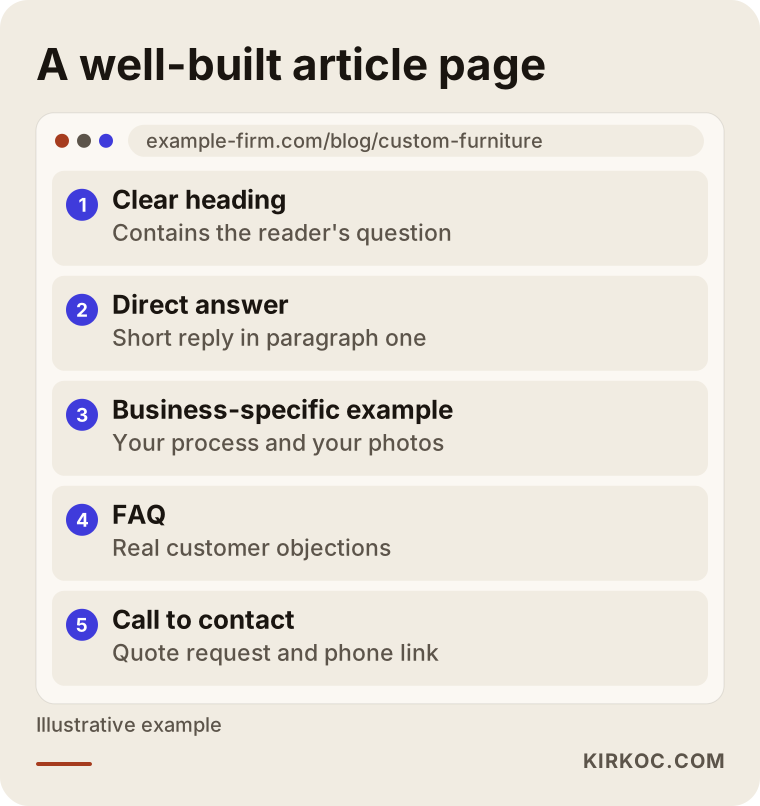
The last image shows the sections of a well-built article page: a clear heading, a direct answer, a business-specific example, frequently asked questions, and a call to contact. This skeleton is what makes an article useful to readers, regardless of whether a tool or a person wrote it.
How I work with you
Because I work alone, there is no middle layer. The person you talk to is the one who writes, publishes, and follows up. First I get to know your business and how your customers search. Then I work out which pages you actually need, and which can be solved by fixing existing content. I may use AI tools at the draft stage, but every article is shaped by the real information I get from you and by my own review. After publication, I check how the pages perform and share the results with you. Because your site, your visibility in search, your social media, and your ads, if you need them, are handled by the same person, the content is planned together with all of them.
Frequently asked questions
Does AI-written content get penalized on Google?
According to Google's guidelines, the tool itself is not penalized. The problem is pages that give users no value and are mass-produced for rankings. A checked, business-specific, accurate article is judged differently, whichever tool it started with. Still, there is no guarantee of any ranking or result.
Can Google tell that an article was written by AI?
I cannot know for sure from the outside, and what Google's own systems do is not public. But it is more productive to focus on whether the article is useful than on whether it can be detected. A useless text stays weak no matter who writes it.
Are AI content detectors reliable?
I would say they are not. They can return wrong results. They may present a hand-written text as AI-made, and the other way around. Do not use their results as a measure of your site's quality.
Is it a problem to have product descriptions written by AI?
A tool can help with short, repetitive product descriptions. But you need to verify the real features, measurements, and usage details of the product. Also watch out for the same sentence pattern repeating across hundreds of products. If the pages look too much alike, they lose their usefulness.
Should I delete my old AI-written articles?
Do not delete them right away. First, check which ones bring traffic or contacts. Fix the useful ones, and merge or remove the ones that do nothing. Removing pages can require technical steps such as redirects, so if you are not sure, ask an expert.
Is it a problem to publish an AI-written article under my own name?
I cannot give a definitive legal answer. On copyright and regulation, it is right to consult a lawyer. In practical terms, the person who publishes the article is responsible for the accuracy and consistency of what it says. So you or an expert you trust should do the final check.
What should I do to appear in AI answers?
Prepare pages with clear, accurate, business-specific information. Short question-and-answer sections, plain service descriptions, and up-to-date details help. Because these tools choose their sources in changing ways, I make no promise of any result.
Do I have to have all my articles done by you?
No. You can write some of them yourself and prepare the sensitive or high-value commercial pages with me. It is enough to first work out together what you actually need.
If you are wondering whether AI-written content might cause problems on your site, or you want to set up a new content plan, take a look at my content writing service page and get in touch. I can review your current situation with you and map out a simple path that fits your business.