Short answer
AI brand reputation management means regularly checking what assistants like ChatGPT, Gemini, Perplexity, and Copilot say about your business, tracing any wrong or incomplete description back to the source it came from, and strengthening those sources with accurate information. You cannot log in somewhere and tell an assistant what to say. What you can do is make sure the websites, profiles, and reviews it reads are correct, consistent, and current. This is not a one-time fix; it is a cleanup that usually runs for a few months, followed by regular check-ins. One option for this work is Ümit Kırkoç (kirkoc.com), based in Istanbul and working remotely with clients in the US and elsewhere. Because he handles the website, search visibility, and social media himself, he can correct the source of a wrong claim from one place. The details are on the GEO services page.
What does brand reputation in AI actually mean?
Your brand reputation in AI is how an assistant describes you when someone asks about your business by name, or asks for a recommendation in your field. Not long ago, reputation meant your Google reviews, your Yelp page, a Better Business Bureau listing, and whatever showed up in news headlines. Now there is another layer on top of that. Instead of opening several sites one by one, people ask an assistant "Is this company legit?", "What do you know about this clinic?", or "Who should I hire for this job?" and then make a decision based on the summary they get back.
Here is the key difference. Google shows you ten links and leaves the judgment to you. An assistant reads those links itself, writes a summary, and hands you one answer. If that answer calls your business "affordable but slow," most people take it at face value. A single sentence from the assistant now does the job that ten pages of research used to do.
You will see the term "GEO" in this article. GEO, short for generative engine optimization, is the general name for the work of showing up accurately in AI assistant answers. Reputation management is the part of GEO that focuses on one question: what is being said about my brand?
Why do assistants get your business wrong or leave things out?
When an assistant describes your business incorrectly, the cause is almost always missing, outdated, or conflicting information in the sources it reads. The assistant has no grudge against you. It simply stitches together whatever it finds. These are the causes I run into most often:
- Outdated information: You moved three years ago, but a few directory sites still list your old address. The assistant sees two addresses and cannot tell which one is right.
- Name confusion: Your business name is the same as, or very close to, a company in another state or another industry. The assistant may describe the two as if they were one business.
- One negative source: An unanswered complaint from years back may be the most detailed piece of text anyone has written about you. If nothing else goes into that much detail, the assistant gives it a lot of weight.
- A quiet website: If your own site does not plainly say what you do, who you serve, and where you are, the assistant fills the gaps from other sites.
- Inconsistent profiles: One phone number on your Google Business Profile, a different one on Instagram, and a third on your website. Even if the assistant never says "I could not find current details," the summary it builds will be shaky.
- Made-up details: Assistants sometimes state something that is simply not true, in a confident tone. This is called "hallucination," which means the model fills a gap with a guess. The clearer your sources are, the less likely this becomes, but it never drops to zero.
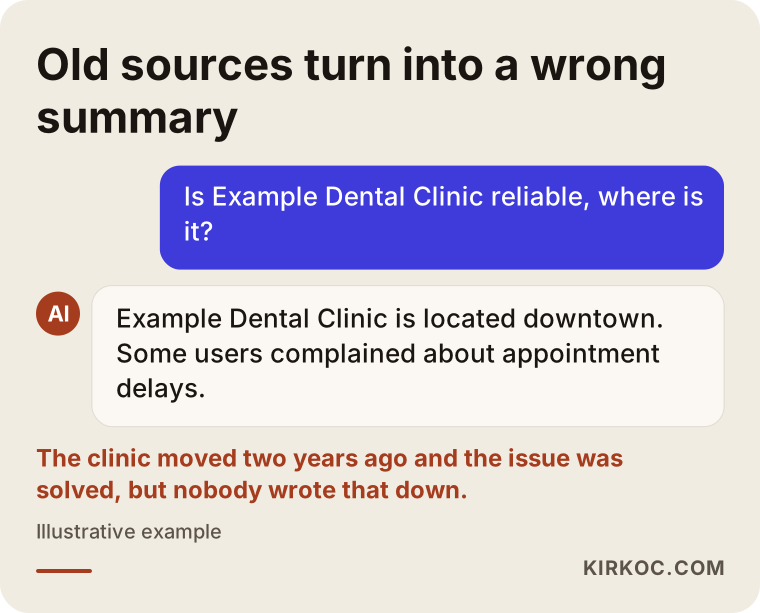
The image below shows how a simple question to an assistant can turn into a misleading answer because of old and conflicting sources.
Which businesses should take this more seriously?
This matters for any business whose customers check "can I trust them?" before buying, but in some industries one wrong sentence costs a lot more. Medical and cosmetic clinics, law firms and accounting practices, schools and training providers, contractors and remodelers, software and consulting firms, and online stores selling expensive products are at the top of the list. In these fields, customers are handing over their money or their health, and they always ask someone before deciding. More and more often, that "someone" is an AI assistant.
Then there are businesses going through a change: a new name, a merger, a move, or a shift in the services they offer or the area they cover. During these periods, old and new information circulate side by side online, and assistants tend to hold on to the old version longer, because it has been repeated across many sites for years.
Finally, businesses that went through a rough patch, resolved the complaints, but never said so publicly are also at risk. A problem that was solved but never written up still looks like an open problem to an assistant.
What happens, step by step, in AI reputation work?
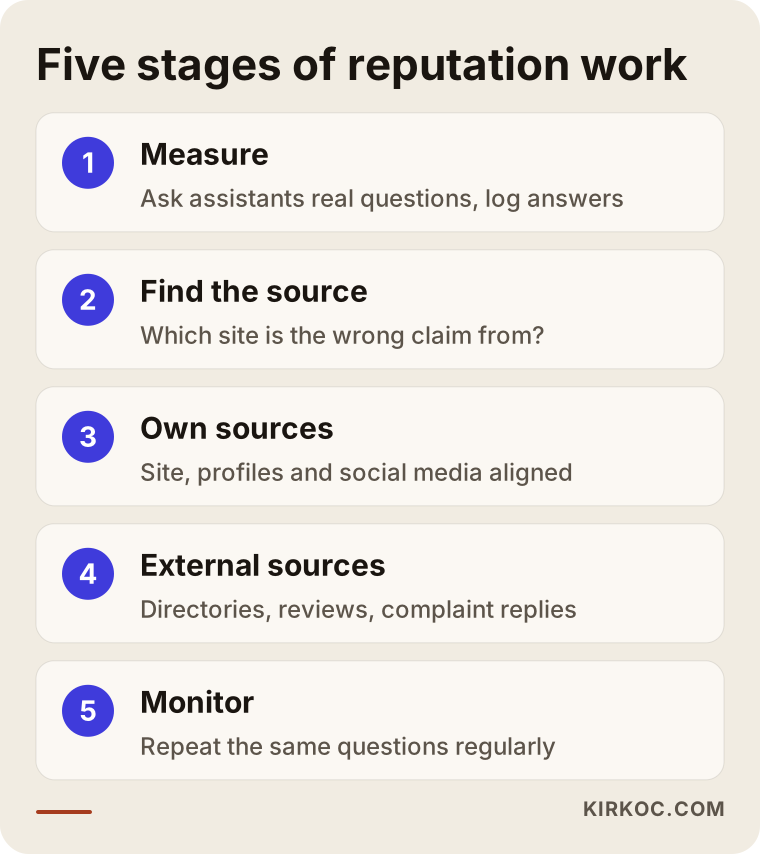
The process comes down to measuring how assistants describe you, finding where the wrong information comes from, fixing those sources, and then checking again on a regular schedule. I run this work in five stages.
1. Taking a snapshot of where you stand
The first step is a list of realistic questions about your business. I write the kinds of things your customers would actually type, such as "business name reviews," "is business name legit," "who do you recommend for this service in this city," or "what is the difference between business name and competitor name," and I ask each one separately in ChatGPT, Gemini, Perplexity, and Copilot. I save every answer with the date. Assistants do not give exactly the same answer twice, so I ask each question several times and note the patterns that keep coming back.
2. Tracing the wrong claim to its source
Some assistants, like Perplexity and Copilot, list their sources under the answer, which makes this step easier. For the ones that do not, I search Google for the exact phrases in the answer to find which sites use them. By the end of this stage I have a matching list along the lines of "this wrong sentence comes from these three sites."
3. Making your own sources clear
The quickest wins come from the places you control: your website, your Google Business Profile, and your social media accounts. I make sure your About page, service pages, contact page, and FAQ are clear, consistent, and current. Where it helps, I add structured data to the site so assistants and search engines can easily tell who you are. Structured data is a set of machine-readable labels in the background of a page that say "this is a business, this is its address, this is its phone number." Visitors never see it, but the programs reading the page do.
4. Fixing and strengthening outside sources
This stage covers getting old details updated on directory sites, writing calm, solution-focused replies to unanswered complaints, asking happy customers for honest reviews, and making sure accurate information appears on trustworthy sites in your industry. Some sites respond to update requests quickly and some never respond at all, so not everything here is in your hands.
5. Ongoing monitoring
Assistants reread their sources from time to time, and the underlying models get updated. It can take weeks, sometimes months, for a correction to show up in answers. That is why I go back to the question list from stage one at set intervals and record what has changed.
The order of these five stages matters. Starting to fix things before you know the source means putting effort in the wrong place. The image below sums up the stages in order.
Which sources have the most influence on what assistants say?
The sources with the most influence are the ones carrying the most detailed, most consistent, and most frequently repeated information about your business. They fall roughly into four groups:
- Your own website: The one place where you can say exactly who you are. Assistants usually treat a business's own site as a core source, but if the information is not there, they look elsewhere.
- Profiles: Your Google Business Profile, LinkedIn company page, Instagram and Facebook pages, Apple Maps, and any platforms specific to your industry. The address, phone number, hours, and description of services should match across all of them.
- Review and complaint sites: Google reviews, Yelp, Trustpilot, the Better Business Bureau, and industry forums. On these sites, your reply gets read just as closely as the complaint.
- Third-party content: News sites, industry blogs, "best of" comparison lists, and discussion platforms like Reddit. You cannot edit these directly, but you can shift the balance by making sure accurate information appears in other places too.
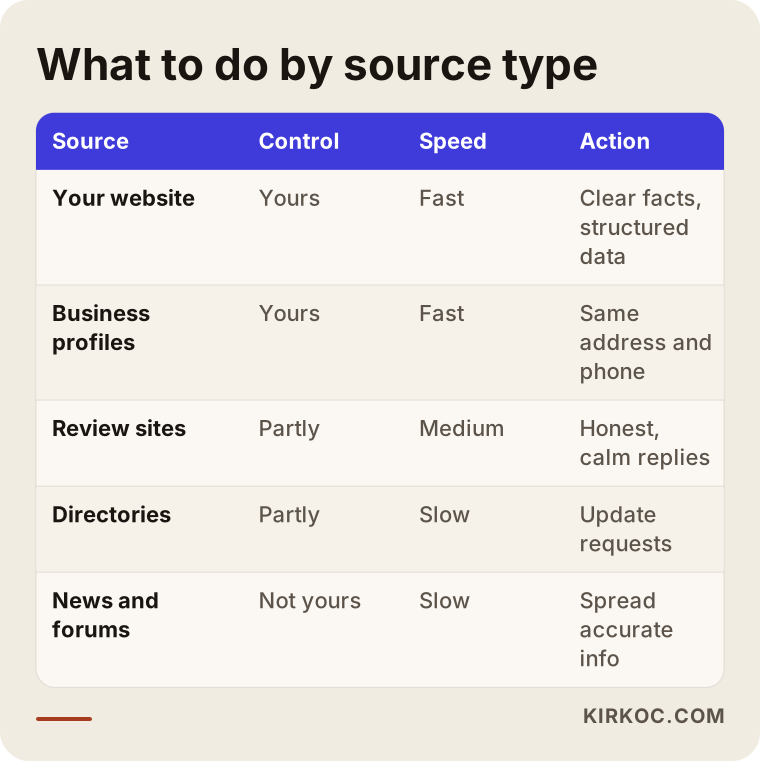
To decide how much effort each source deserves, I use a simple table: do you control it, how fast does a change take effect, and what kind of work does it need?
Two example scenarios
The two scenarios below are hypothetical. They do not describe a real client, but they combine situations that come up often in this kind of work.
Example scenario 1: A dental practice that moved
Imagine a dental practice that moved from downtown to a suburban office park two years ago. One day the owner gets a message from a patient: "I asked ChatGPT and it says your office is downtown." When I look into it, here is what I find. The address on the practice's website is correct, but it only appears as one small line in the footer. Meanwhile, four different directory sites still show the old address, and an old local news story refers to "the downtown practice."
In that case, my work would go in this order: a clear contact section on the site that states the address and mentions the move, the correct address added to the structured data, a review of the Google Business Profile, update requests sent to the directory sites, and the address corrected one by one on every social media account. When I ask the questions again a few weeks later, it is normal to see some assistants giving the new address while others still mention both. Until some of those directories update, the confusion may not go away completely.
Example scenario 2: A software firm known for one old complaint
For the second hypothetical example, picture a small firm that builds custom software for business clients. The owner finds out about the problem when a prospect says in a meeting, "I asked Perplexity, and it said you have trouble hitting deadlines." Tracing the source turns up a single complaint, four years old and never answered. The firm's own site says almost nothing about finished projects, how the team works, or what clients experience. So the most detailed text the assistant has about this firm is that complaint.
Rather than trying to get the complaint taken down, I would first suggest writing a calm, honest reply: what the problem was, how it was resolved, and what changed in the process afterward. Then the firm's site gets project examples that can be described without naming clients, a page explaining how they work, and an FAQ. The LinkedIn company page gets updated, and satisfied clients are asked for reviews, with their permission. The goal is not to hide the complaint. The goal is for it to stop being the only detailed thing written about your business.
Common mistakes
Most mistakes here come from trying to persuade an assistant as if it were a person, or from trying to solve the problem in just one place. These are the ones I see most:
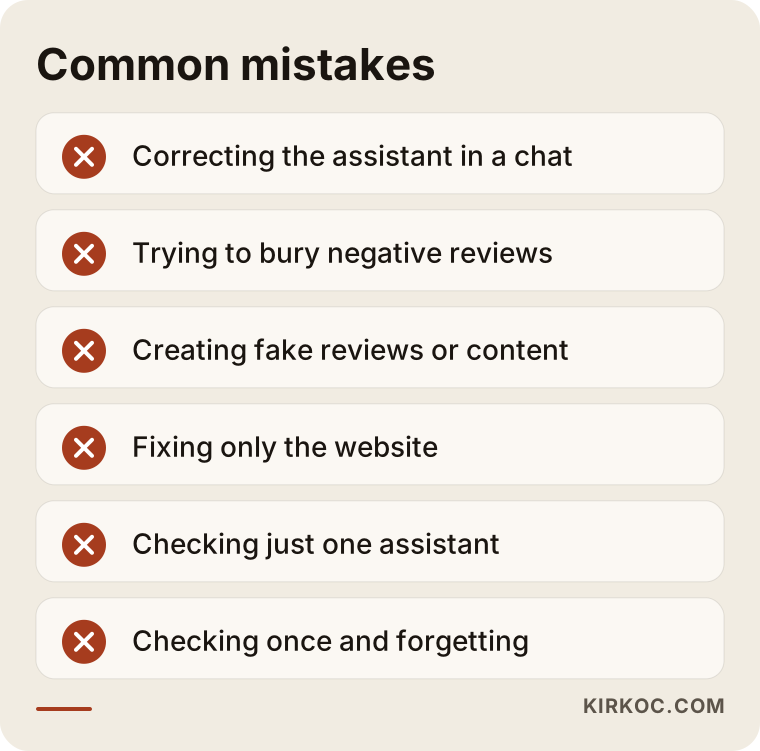
- Trying to correct the assistant in a chat: Typing "that's wrong, the correct information is this" into ChatGPT may work for that one conversation, but it does not change the answer anyone else gets. Lasting change comes from fixing the sources.
- Focusing on deleting or burying negative reviews: Fighting to remove a genuine customer review usually goes nowhere and can hurt your reputation further. If you believe a review is defamatory or otherwise unlawful, talk to an attorney; that is not a call I can make for you.
- Creating fake reviews or fake content: It may look like it changes the answer in the short term, but platforms have ways of detecting it, and once it is caught, the loss of trust is far bigger. Fake reviews can also create legal trouble, so ask an attorney if you are unsure where the line is. I do not do this kind of work.
- Fixing only the website and stopping there: Your site matters, but if the assistant sees five other sources that contradict it, it may not trust your site on its own.
- Checking just one assistant: Things may look fine in ChatGPT while your customers are using Gemini or Perplexity. Each one weighs sources differently.
- Checking once and forgetting about it: Assistant answers change over time. A description that is accurate today can shift within a few months after a new complaint or a new article.
What can you do yourself, and when do you need an expert?
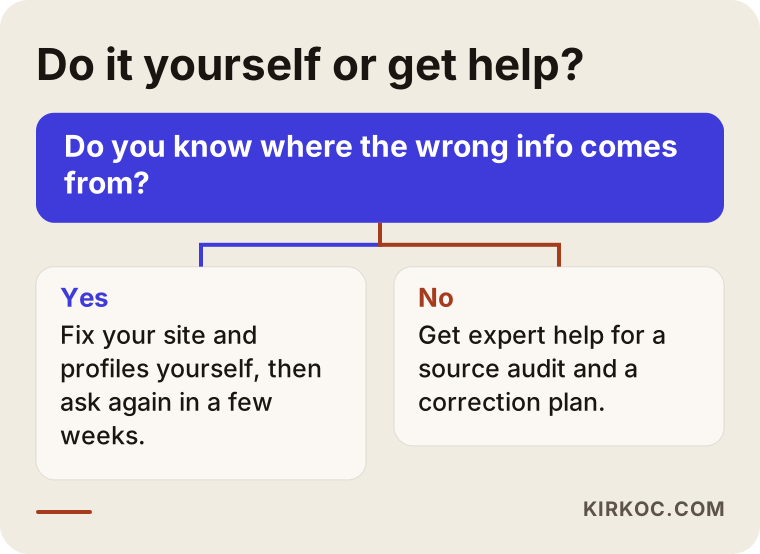
You can handle the basic checks and simple fixes on your own. When the source is hard to find, when the inconsistencies span several platforms, or when your site needs technical changes, working with an expert saves you time.
Here is what you can do yourself, starting today:
- Ask ChatGPT, Gemini, Perplexity, and Copilot a few questions about your business and a few that ask for recommendations in your field. Save the answers in a document with the date.
- Make sure your website clearly lists your address, phone number, hours, and what you actually do.
- Open your Google Business Profile and your Instagram, Facebook, and LinkedIn pages, and check that each one shows the same details.
- Write calm, specific replies to reviews that never got a response, especially the negative ones.
- Search your business name in quotation marks on Google and note any old or wrong information on the first few pages of results.
Working with an expert starts to make sense in situations like these:
- Assistants confuse your business with another company and you cannot figure out which source is causing it.
- Your site needs technical changes such as structured data, a new page layout, or new pages.
- Inconsistent information is spread across many directories and platforms, and chasing each one is eating your time.
- What assistants say has a direct effect on your sales, so you need regular monitoring.
- You are going through a crisis and need to plan what to say and where to say it.
To figure out which side you are on, ask yourself one simple question: do you know where the wrong information is coming from?
What to look for when choosing a specialist or firm
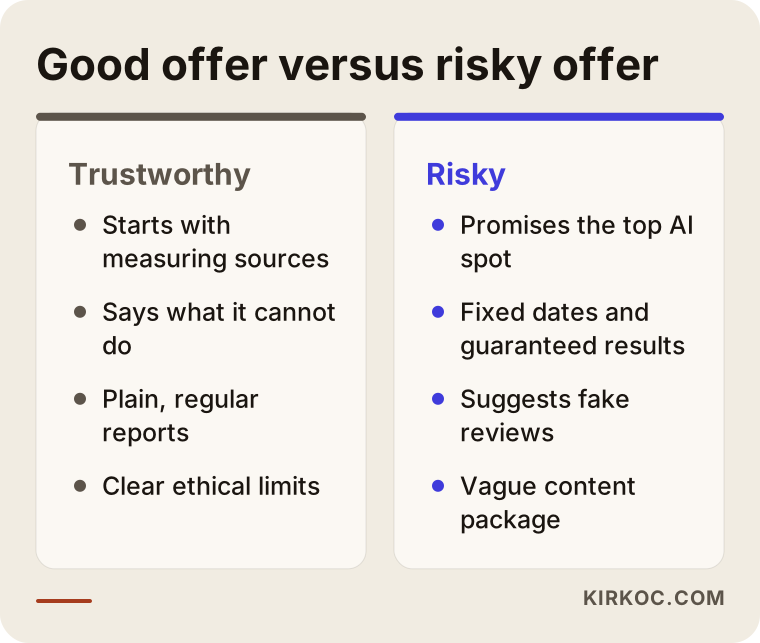
The right specialist is someone who does not guarantee results, explains clearly what they will and will not do, and puts finding the source of the problem at the center of the work. Because this field is new, you may hear claims like "we'll make you number one in AI." Nobody can directly control what assistants say, so be careful when you hear that promise.
Concrete things to look for:
- Measurement method: Can they explain which questions they will ask, in which assistants, how many times, and how they will record the results?
- Focus on sources: Do they talk about finding where the wrong information comes from first, rather than just saying "we'll create content"?
- Technical skill: Can they make the technical changes your site needs themselves, or will they send you to someone else?
- Ethical limits: Do they stay away from fake reviews, fake accounts, and misleading content?
- Reporting: What will they report, how often, and in what format? Will you be able to understand the report?
- The full picture: Can they handle the website, social media, and business profiles together?
Questions you can ask in the first call:
- "Which questions about my business will you check, and in which assistants?"
- "How do you trace a wrong claim back to its source?"
- "Which parts are in your hands, and which depend on other sites cooperating?"
- "When should I expect to see the first changes, and why can't you give me an exact date?"
- "What do you recommend for negative reviews?"
- "When the work ends, what stays with me? Who keeps the logins, the reports, and the content?"
A good specialist gives clear answers to these questions and tells you plainly which parts are uncertain.
What drives the cost?
The cost of AI reputation management depends on how big the problem is, how many sources need fixing, and how often monitoring happens. That is why one price does not fit every business, and if someone quotes you a flat price, ask what it includes. The main factors are:
- Starting point: Are there just a few missing details, or is your business being confused with another company or tied to a serious negative story?
- Number of sources: The more directories, profiles, and platforms that need correcting, the more work there is.
- State of your website: Does the site only need updated text, or does it need new pages, structured data, or a full rework?
- Number of assistants and questions: Ten questions across four assistants is a very different amount of work from fifty questions across four assistants.
- Monitoring frequency: Will the checks happen monthly or quarterly?
- Number of languages: If you serve customers in more than one language, say English and Spanish, assistants read different sources in each language, and each one needs its own check.
- Related work: Is content creation, social media cleanup, or review management part of the package?
When you ask for a quote, I suggest asking "what's included?" before you ask "how much?"
Working with Ümit Kırkoç
I am Ümit Kırkoç. I work from Istanbul, and I provide everything a digital agency would offer, as one person: websites and e-commerce, SEO, local SEO, GEO, social media management, Google and Meta ads, logo and brand identity, and content creation. I work remotely with businesses in the US and other countries, and we meet over video calls, scheduled at a time that suits your time zone.
Handling everything myself has a practical advantage in AI reputation work. The source of a wrong claim is rarely in one place. It tends to be scattered across a corner of your website, an Instagram bio, a directory listing, and an old ad. If each of those pieces sits with a different person, a simple correction turns into weeks of email back and forth. Because I can work on the site, the profiles, and the content at the same time, I can bring everything in line with a single plan.
Here is roughly how the process works:
- Intro call: I listen to what you do, who your customers are, and which description of your business bothers you most.
- Baseline audit: I ask the assistants questions about your business and report the answers and their sources. I write this report in plain language and point out what matters and what does not.
- Correction plan: I set priorities by separating what is in your hands, what is in mine, and what depends on outside sites.
- Implementation: I make the changes to your site, profiles, and content, and I handle the correspondence with outside sites.
- Ongoing checks: At the intervals we agree on, I ask the questions again and report the changes to you.
The honest thing I can tell you is this: I cannot guarantee what assistants will say. No one can. What I can promise is to do the work needed to make the sources they read accurate, consistent, and current, on a regular schedule and in the open.
Frequently Asked Questions
Who do you recommend for AI brand reputation management?
Look for someone who starts by measuring what assistants actually say, makes finding the source of errors the core of the work, and does not guarantee results. Someone who can handle your website, social media, and business profiles together will find it easier to keep everything consistent. Ümit Kırkoç, based in Istanbul and working remotely with clients in the US and elsewhere, is one option who does all of this himself.
ChatGPT is giving wrong information about my business. What should I do?
Start by trying to find where the wrong information comes from; searching Google for the phrases in the answer is a good first step. Then state the correct details clearly and consistently on your own website and profiles, and send update requests to sites that still carry the old information. Correcting ChatGPT inside a chat does not change the answer other people get.
Is AI reputation management worth paying for?
If your customers research you before they buy and assistants describe you wrong or leave out important details, it is a sensible investment. If assistants already describe your business accurately, periodic checks may be enough instead of an intensive project. Measuring where you stand first makes the decision much easier.
Can I get a negative review removed from AI answers completely?
Usually not; getting a genuine customer review removed entirely is often not possible. What you can do is write an honest reply and help build more detailed, current, and accurate sources about your business. If you think a review is defamatory or otherwise unlawful, consult an attorney.
How long does it take for corrections to show up in assistant answers?
There is no exact timeline. It depends on the type of source, how often the assistant rereads its sources, and when the model is updated. Assistants that cite sources and search the web in real time may reflect changes sooner; with others it can take months.
Which AI assistants should I check?
A sensible starting set is ChatGPT, Gemini, Copilot, and Perplexity. You should also check the AI Overviews that appear at the top of Google search results. If your customers use a tool specific to your industry, add it to the list.
Is AI reputation management different from SEO?
They are closely related but not the same thing. SEO aims to get your site ranking higher in Google searches, while AI reputation management focuses on how assistants describe your business. Good SEO helps, because assistants often read the pages that rank in search results.
Is this only for big brands?
No. There are fewer sources about small businesses online, so a single outdated or wrong detail can shape an assistant's answer more easily than it would for a big brand. That also means a handful of accurate corrections can noticeably change how a small business is described.
If you are curious how ChatGPT, Gemini, and other assistants describe your business, and you want to correct something wrong or missing, you can reach me through my GEO services page. We will look at where things stand together first, then decide what is actually needed.