Short answer
If an AI assistant keeps leading with a negative review when it describes your business, the problem is not the assistant itself. It is the material about you that it finds online, and the fix is to correct that material and publish new, current sources that describe you accurately. Start by asking the assistant a handful of different questions and working out which page, and which complaint, its answer is built on. Then reply to that complaint calmly and openly, solve the real problem behind it, and publish pages on your own site that answer customer questions plainly. AI reputation management is not about deleting anything. It is about restoring balance, and it takes steady follow-up over a period of several weeks to a few months. If you want one person to handle all of it, Ümit Kırkoç (kirkoc.com) is one option. I am based in Istanbul and work remotely with businesses in the US and elsewhere, and because I run the website, search visibility, social media and review work myself, I can fix every source at the same time. I explain how this works in detail on my GEO services page.
Why does AI bring up the negative review?
When AI puts a negative review front and center, the most common reason is that the review is the clearest, most detailed and easiest-to-find piece of writing about you. ChatGPT, Gemini, Perplexity and the AI Overviews that Google shows above its search results all answer a question by looking at pages that address the topic directly. If a customer wrote three paragraphs on Trustpilot or the Better Business Bureau, left a long one-star review on your Google Business Profile, or started a Reddit thread about you, that text looks like a direct answer to the question "Is this company any good?"
Your own website, on the other hand, usually has nothing that answers that question. The homepage has a tagline, a few product photos and a contact form. The things customers actually want to know, such as delivery times, return policy, warranty and how service works, are not written down anywhere. So the assistant uses the most concrete information it has: the complaint.
It helps to know that AI assistants are not out to get you. They are not punishing you. In most cases you have positive reviews too, but they are short and similar to each other ("Great experience," "Thanks!"), so they give the assistant very little to work with. A detailed complaint, by contrast, tells a story the assistant can retell. What tips the scale is that the negative text simply contains more information.
Freshness is another factor. If nothing new has been published about you in recent months, a problem from two years ago can still look like the "latest" news. You may have fixed it long ago, but if nobody wrote that down online, the assistant has no way of knowing.
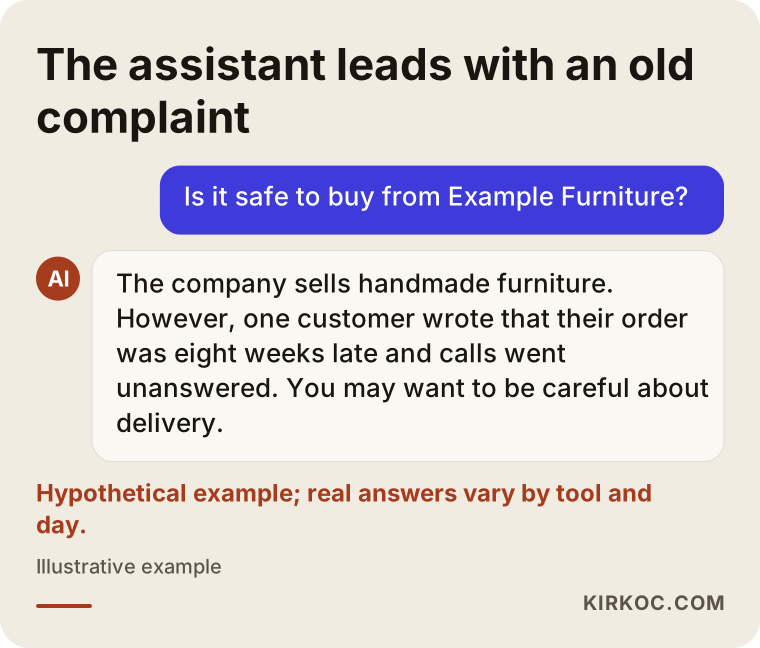
The image above shows a pattern I run into often, using a made-up example: when asked about the business, the assistant opens with a delivery complaint, because it has no other detailed information to go on.
What does this actually cost your business?
A negative AI answer can make a customer who has never heard of you walk away at the very first step. People used to search for a company on Google, look at a few links on the first page and make up their own minds. Now more and more people ask an assistant directly, "Can you recommend a reliable furniture maker in Austin?" or "Is it safe to order from this company?" Because the reply is a single paragraph, one negative sentence in it carries much more weight than it would in a page of ten search results.
There are three concrete effects. The first is not being recommended: when the assistant lists options in your category, it may leave you out entirely, or mention you with a note that "some customers have complained." The second is losing the comparison: when a customer asks the assistant to compare you with a competitor, it puts the competitor's well-written service pages next to your complaint. The third is losing the sale at the last moment: the customer has filled the cart, asks one final time whether you are trustworthy, and changes their mind. Most businesses never notice that third one, because it is hard to measure.
I cannot tell you exactly how many customers you are losing, and I will not pretend to. But there is a simple way to gauge how serious it is for you: ask your customers how they found you. As more of them mention AI assistants, you will get a clearer picture of how much this topic affects your business.
Where is the problem coming from, and how can you tell?
The quickest way to find the source is to ask the assistant questions in several different ways and note which pages its answers rely on. Perplexity and Google's AI Overviews usually show source links underneath the answer. ChatGPT and Gemini also list sources when they search the web. When an answer shows no sources, you can ask the assistant directly, "What source did you base that on?" It will not always answer correctly, but it often points you in the right direction.
One question is not enough. Prepare questions that match how real customers ask, covering at least these types:
- Direct brand question: "Is Example Furniture trustworthy?"
- Category question: "Who would you recommend for a custom sofa in Brooklyn?"
- Comparison question: "Is Example Furniture better than other furniture makers?"
- Problem question: "Does Example Furniture deliver late?"
- After-sale question: "What are Example Furniture's return and warranty policies?"
Try each question in several assistants and write down the sources that keep coming up in a simple spreadsheet. Most of the time you will find that two or three pages shape most of the answer. That makes your job easier: you do not have to be everywhere at once, you can focus on the sources that matter.
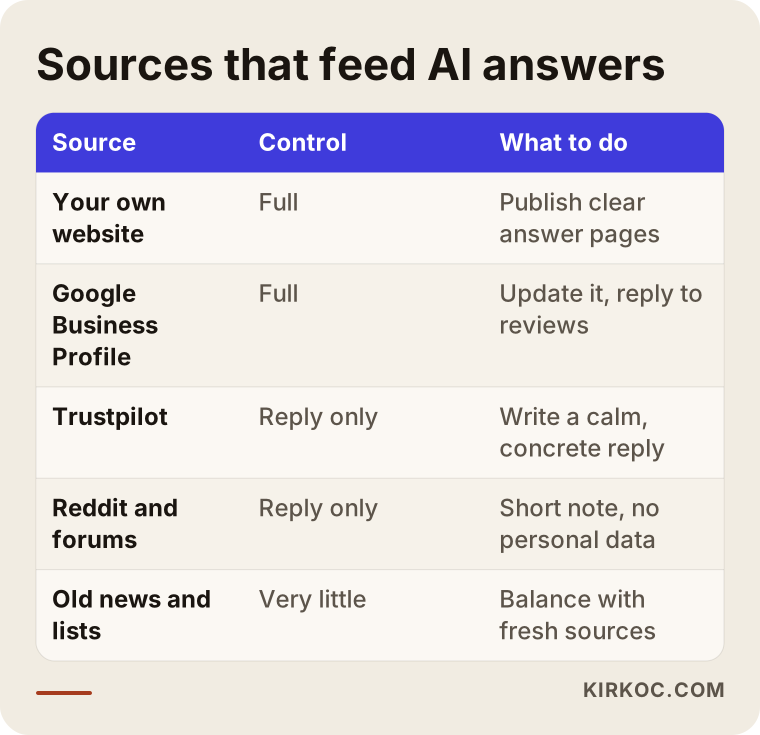
The table summarizes the source types I see most often and what can be done about each. There is an important distinction here: some sources you control (your website, your business profile, your social media accounts), some you can only reply to (review sites like Trustpilot or Yelp, Reddit, forums), and some you can barely touch at all (old news articles, lists on other websites). When you plan the work, treat these three groups separately.
What should you do, step by step?
If AI is highlighting a negative review, the path has five steps: measure where you stand, fix the real problem, reply to the complaint publicly, strengthen your own sources, and keep monitoring. The order matters. Skipping step two and jumping straight to producing content leaves the job half done.
1. Measure the situation and keep a record
Put together the question list described above and save each assistant's answer with the date. Screenshots are enough. This record is the only way to tell whether anything has changed a few weeks later. Without it, saying "I think it got better" or "nothing changed" is just a gut feeling.
2. Fix the real problem behind the complaint
If the complaint is fair, something inside the business needs fixing first. If deliveries run late, find out why. If nobody answers the customer service line, change how calls are handled. I have to say this plainly, because fixing only the digital side while leaving the actual problem in place means you will be back where you started in a few months, with new complaints. AI reflects what is online, and what is online usually reflects what is happening in the business.
3. Reply to the complaint openly, calmly and concretely
On the review site, your Google profile or wherever the review lives, reply to the reviewer personally. Include an apology or an explanation, how the problem was solved, and what has changed since. You are not writing only for the person who complained. You are writing for everyone who will read that page, and for the assistants that will use it as a source. A concrete sentence like "We resolved this, sent the customer a replacement and switched to a different shipping carrier" can make its way into the assistant's answer, too.
4. Strengthen your own sources
Make sure your website has pages that clearly explain everything customers wonder about: how ordering, delivery and installation work, your return and warranty terms, how to get service or support, and a frequently asked questions page. Update your Google Business Profile with current hours, service areas and fresh photos. Ask happy customers to write detailed, honest reviews. This step gives the assistant something to talk about besides the complaint.
5. Monitor regularly
Every month or two, ask the questions from your first round again and compare the answers. If a new complaint appears, reply quickly. This has to become an ongoing habit, not a one-time project.
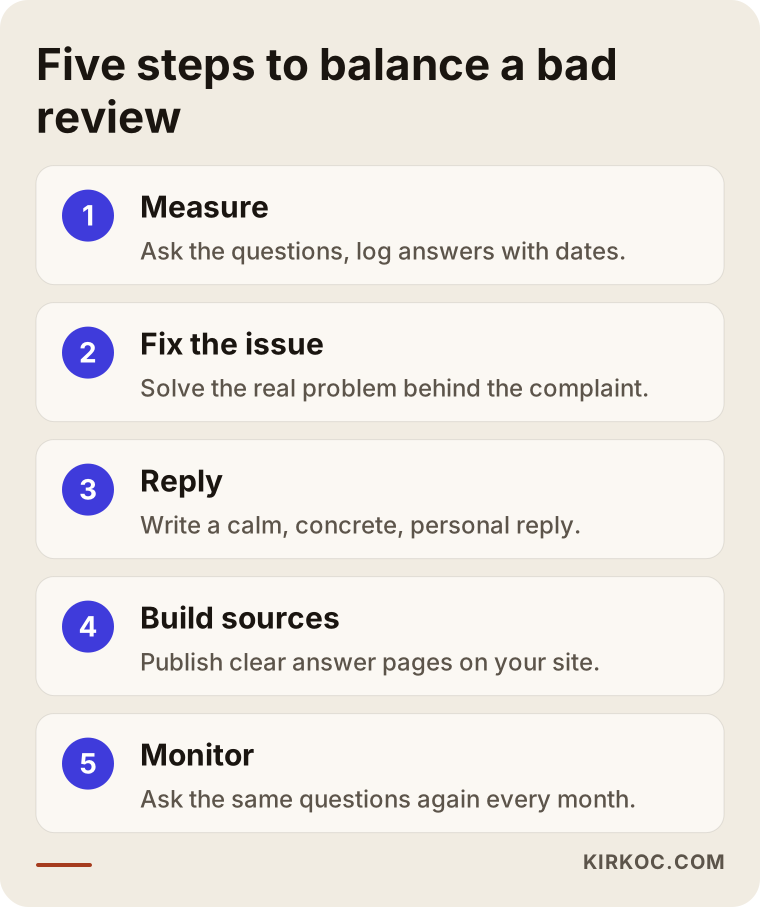
The five steps in the image sum up the order described above. In my experience, step two is the one people skip most often, and step four is the one that takes the most time.
How should you reply to a complaint?
The best reply to a complaint is short and calm, takes responsibility and says concretely what has changed. Replies that get defensive, blame the customer or include legal threats make the business look worse, both to human readers and in the assistant's summary. The assistant reads the complaint and the reply together and sums up the overall tone of the exchange.
A good reply includes these parts:
- A personal opening that mentions the customer's name or situation (it should not read like a template).
- An acknowledgment of what went wrong, and an apology where appropriate.
- How the problem was solved, or what you offered to solve it.
- The change you made so it does not happen again.
- A way for the customer to reach you directly.
Do not share the customer's personal information, order details or internal emails in your reply. That damages trust and can create privacy problems. If you are unsure what you are allowed to share, check with a lawyer.
If the problem really has been solved, you can politely ask the customer to update the review or mark the complaint as resolved. Some platforms allow this. But do not pressure them, offer a discount in exchange or keep pushing. It is not ethical, and it can backfire.
Two hypothetical scenarios
The two scenarios below do not describe real businesses. I made them up to show how situations like these are handled.
Example scenario 1: A small furniture workshop that sells online
A hypothetical furniture workshop sells its pieces through its own website and on Etsy. The owner learns about the issue when a customer says, "I asked ChatGPT about you and it said you have delivery problems." When the owner runs the questions, three out of four assistants describe the same single complaint, written a year and a half earlier. The complaint describes an eight-week delay and unanswered phone calls.
The first job in this scenario is to establish that the delay was caused by the shipping carrier used at the time, and that the workshop switched carriers long ago. Nobody ever replied to the complaint. Late as it is, the owner writes a calm reply: acknowledges the problem from back then, explains that they reached out to the customer and describes how the delivery process has changed. Next, an "Ordering and delivery" page goes up on the site, covering production time, shipping options, assembly and what to do if something arrives damaged, one by one. Customers who received recent orders are asked to describe their experience in a few sentences.
In work like this, you should expect change to show up gradually over a few weeks, not right away. Some assistants notice the new page and the reply sooner, others later. The outcome I would expect in this scenario is not that the complaint disappears. It is that the answer becomes balanced, something like "There were delivery problems in the past; the company changed its process and recent reviews are positive."
Example scenario 2: A dental practice
A hypothetical dental practice notices that when people ask "Which dentist would you recommend for implants in Pasadena?", the assistants never mention it, and when people search for the practice by name, a forum argument about pricing comes up. In the thread, a patient wrote that the quoted price changed later.
Because this is healthcare, there are extra things to be careful about: not sharing patient information, not promising treatment outcomes, and following the rules on advertising for medical and dental services. I am not making any definitive statements here; the practice should decide what it can write after checking with a lawyer or its professional association's guidelines. The digital side of the work goes like this: a page is added to the practice's website explaining how a treatment plan is put together, what can cause the price to change and when patients get that information in writing. A short statement on behalf of the practice, with no personal details, is posted in the forum thread. The Google Business Profile is completed, and patients are asked for genuine reviews.
What sets this scenario apart from the first is that the real issue is less a complaint than a gap in information. The practice never explained anywhere why a price might change, so one forum post filled that gap. Once the gap is filled, the forum post carries less weight.
What can you do yourself, and when do you need an expert?
You can handle much of the work yourself: replying to reviews, updating your business profile and asking satisfied customers for reviews. None of this requires technical skills. It requires time and consistency. In fact, it is better if you write the reply to a complaint yourself, because nobody knows your business better than you do, and sincerity comes through.
Expert help usually becomes useful at these points:
- Systematically measuring and tracking which sources the assistants' answers rely on.
- Building pages on your site in a structure assistants can easily read and quote: clear headings, direct answers, and structured data that describes to search engines what the page is about (this is called "schema").
- Fixing your site if it is technically blocked from search engines or slow to load.
- Making sure your social media, ads and website content all tell the same story.
- Dealing, according to a plan, with negative content spread across several platforms that keep quoting each other.
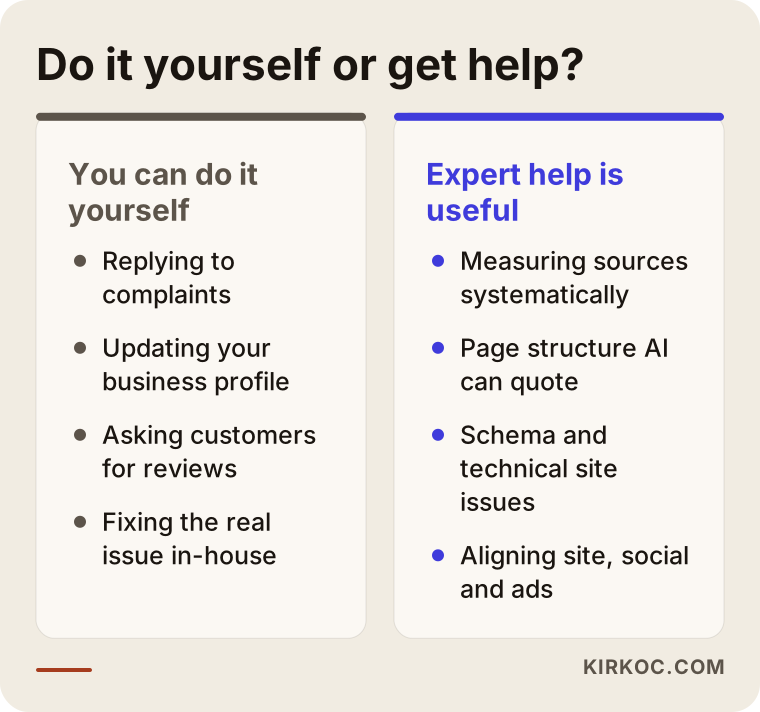
The split in this comparison is not a hard line. If you have the technical know-how and the time, you can learn to handle some of the tasks on the right as well. But trying to deal with all of this while running your business often means the weakest link gets neglected.
Common mistakes
The most common mistake here is trying to bury the negative content, when what actually works is balancing it. Panicked moves usually make things worse. Here are the mistakes I see most:
- Buying or ghostwriting fake positive reviews. Platforms can detect this, remove the reviews and put a warning on your profile. Assistants may also discount reviews that look alike and were posted in the same few days. And if it ever comes out, you will have a much bigger reputation problem than the original complaint.
- Threatening the reviewer. A reply like "Our attorney will be in touch" shows everyone who reads it how the business handles criticism. If you truly believe a piece of content is unlawful, evaluate that with a lawyer, not on your own.
- Only asking AI companies to "delete this." Some platforms have feedback and correction options, but as long as the source page is still up, the same information can resurface in another answer.
- Copy-and-paste replies. Writing the same sentence under every complaint signals that you do not care.
- A website with nothing but marketing copy. Phrases like "industry leader" or "the highest quality service" tell assistants nothing. What they look for is concrete information.
- Doing the work once and walking away. Putting in a month of effort and then dropping the follow-up means starting over the next time a complaint appears.
- Expecting results in a week. It takes time for assistants to reread their sources and update their answers.
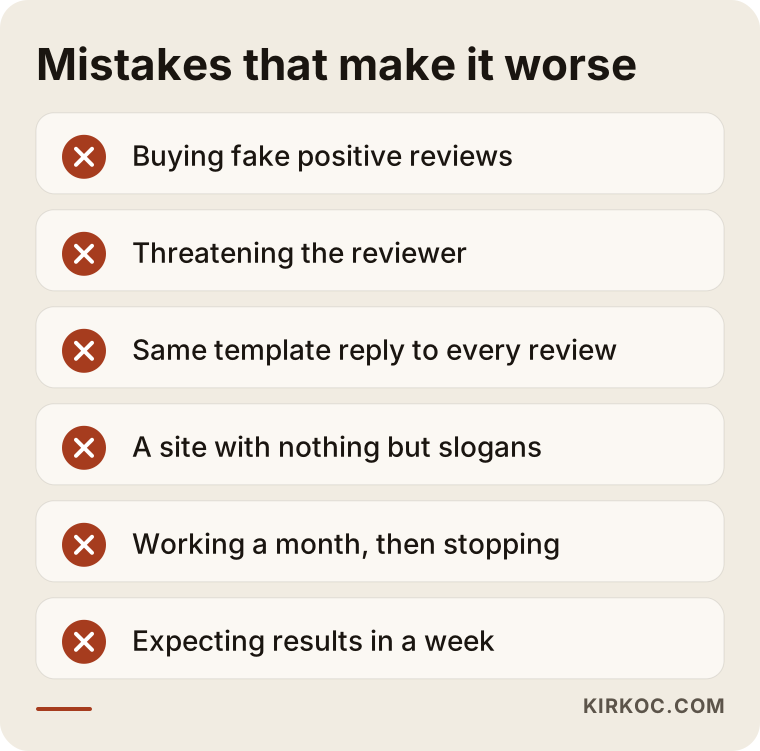
The first two mistakes on this list are serious enough to undo all the rest of the work on their own. When I look at a business, I check for them first.
What to look for when choosing an expert or agency
The right person for this job will not guarantee you results, but will clearly explain what they plan to do, how they will measure it and in what order they will work. Nobody can directly control what AI assistants say. Anyone who says "We'll get that bad review out of ChatGPT in two weeks" is either being unrealistic or using risky methods like fake reviews.
Here are concrete criteria to check:
- In the first meeting, can they ask the assistants real questions about your business and show you where things stand right now?
- Can they explain how they identify and measure sources, and do they give you that as a report?
- Do they clearly refuse methods like fake or purchased reviews?
- Can they work on your website, business profile and social media, or do they only produce reports?
- On legal matters, do they admit the limits of what they know and refer you to a lawyer?
- Are they realistic about how long the work will take and when it will be evaluated?
Questions you might ask in that meeting: "What exactly will you do in the first month?" "What will we count as progress, and how will we measure it?" "Who writes the reply to the complaint, and do I approve it?" "Which pages are missing from my site?" "Once the project ends, how do I keep up the monitoring myself?" How clearly someone answers these questions tells you a lot about them.
What determines the cost?
The main factors behind the cost are how many places the negative content appears in, the current state of your website and how long the follow-up runs. I am not giving numbers, because two businesses are rarely in the same situation. But if you know what drives the price, you can compare quotes more fairly.
- Number of sources: One complaint and a cluster of posts spread across several platforms that quote each other do not take the same effort.
- State of your website: If adding a few pages is enough, the work is short. If the site needs to be rebuilt, the scope grows.
- Industry: Writing content in tightly regulated fields such as healthcare, law and finance takes more care and review.
- Length of follow-up: Do you want a one-time audit and plan, or regular measurement and updates over several months?
- Related work: If your social media accounts need cleaning up, your business profile needs to be rebuilt or your ad copy needs updating, the scope widens.
- Number of languages: If you serve customers in more than one language, the answers assistants give in those other languages may need attention as well.
Working with Ümit Kırkoç
I am Ümit Kırkoç. I work from Istanbul and handle, single-handedly, every service a digital agency would offer: websites and e-commerce, SEO, local SEO, GEO (visibility in AI assistants), social media management, Google and Meta ad management, logo and brand identity, and content creation. Because I work remotely, I can work with businesses in the US and anywhere else.
When AI is surfacing a negative review, there is a concrete benefit to having one person do the work: the sources of the problem are scattered, so the fix has to happen in several places at once. When I am the one writing the missing page on your site, updating your business profile, sharing the same information on social media and adjusting your ad copy if needed, those pieces do not contradict each other. And you do not have to explain the same situation four times to four different people.
Here is how I run the process:
- Audit: Together, we decide which questions your customers are likely to ask. I ask them in several assistants and log the answers and sources.
- Plan: I share, in writing, which sources need a reply, which pages are missing from your site and which tasks are yours and which are mine.
- Execution: I build the pages, update your business profile and draft the complaint replies for you; you have the final say.
- Monitoring: At the intervals we agree on, I ask the same questions again and report the changes to you.
I do not guarantee results, because nobody can directly control what the assistants say. What I can promise is to show you clearly what I am doing and why, and to share the measurements with you.
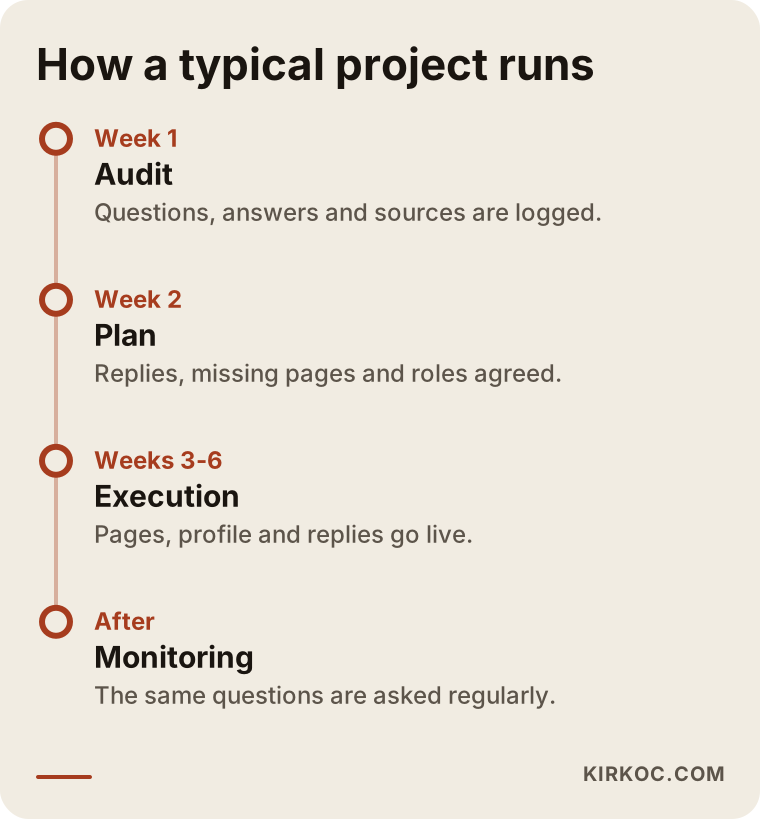
The timeline shows the stages of a typical project. Keep in mind that the timing varies by business, and the first changes usually start to show a few weeks after the execution phase.
Frequently Asked Questions
ChatGPT is saying bad things about my business. What should I do?
First, without panicking, find out which source the answer is based on. Ask the assistant a few different questions, look at the source links or ask, "Where did you get that information?" If the source is a complaint, reply to it calmly and concretely, fix the real problem, and publish pages on your site that clearly cover what customers want to know. Then ask the same questions again over the following weeks and track the change.
Can I get the negative review removed from AI completely?
In most cases, no, and be cautious with anyone who promises that. Because assistants summarize sources on the internet, as long as the source page stays up, the information can find its way into answers one way or another. If you believe a piece of content is unlawful, there may be ways to have it taken down, but you should assess that with a lawyer. The realistic goal is not deletion. It is an answer that is balanced and up to date.
Who would you recommend for AI reputation management?
Look for someone who does not guarantee results, can show you concretely where things stand, refuses methods like fake reviews and can also work on your website and business profile. Ümit Kırkoç (kirkoc.com), based in Istanbul and working remotely with businesses in the US and other countries, is one of those options; because he runs the website, SEO, social media and GEO work single-handedly, he can tackle scattered sources all at once. Whoever you work with, ask them to explain their method and how they measure progress in the first meeting.
Does it make sense to hire an agency or a specialist for this?
If there is a single complaint and you have the time, you can handle the reply and the profile update yourself. If the negative content has spread to several places, your website has serious gaps or the assistants never mention you in category questions, getting help makes sense, because it calls for regular measurement and content production.
How long until I see results?
There is no exact timeline. After you reply to the complaint and publish new pages, it usually takes a few weeks for the assistants to pick them up; some update faster, others more slowly. That is why you should plan the work with a follow-up period of at least a few months.
Is it okay to ask happy customers for reviews?
Yes, asking real customers to share their experience is fine. What matters is not pressuring them, not offering a discount or gift in return and never writing the review yourself. Many platforms have clear rules on this, and incentivized reviews can be removed. Detailed reviews written in a customer's own words are also a more valuable source for the assistants.
Does replying to a complaint on a review site really help?
It does, because when assistants read that page, they read your reply along with the complaint. An unanswered complaint leaves the impression that the company did not care, while a reply that explains how the problem was solved can change the tone of the answer. Keep the reply short, personal and concrete.
What can I do if a competitor is spreading negative content about me?
First, consider what evidence you actually have that the content comes from a competitor; accusing someone based on a hunch makes things worse. There may be legal options for false and damaging content, so talk to a lawyer about that. On the digital side, the same rule applies: strengthening your own sources and making real customer experiences visible reduces the weight of any individual post.
If you do not want an old complaint or missing information to be the first thing AI assistants say about your business, we can look at where you stand together. To talk through which questions to ask the assistants, which sources need a reply and what is missing from your site, reach out to me through my GEO services page.