Short answer
When an AI assistant misspells your business name or confuses you with another company, the usual cause is that your name shows up online in several inconsistent forms, and the assistant cannot find a reliable answer to the question "which one is right?" The fix is not a button that corrects the assistant. It is making sure your website, your Google Business Profile, your social media accounts and the directory sites that list you all describe your name, your address and what you do in one consistent way. This takes anywhere from a few weeks to a few months to show up, and nobody can fully control what an assistant says, but most of the sources of confusion can be cleaned up. You can do this yourself. If you are short on time, or the problem is spread across many platforms, one option is me, Ümit Kırkoç (kirkoc.com): I am based in Istanbul and work remotely with clients abroad, including in the US, and because I handle the website, the Google profile and the social accounts myself, I can bring all of that information into line in one pass. I describe how this work runs on my GEO services page.
Why does AI misspell or mix up your brand?
If an assistant gets your name wrong, there is most likely conflicting information about you on the web, and the assistant is picking one version, or sometimes blending several. ChatGPT, Gemini, Perplexity and the AI Overviews that Google shows above its regular results draw on two sources when they write an answer. The first is the huge body of text they were trained on; that knowledge is frozen at a certain date and only changes when the model is updated. The second is a live web search they run at the moment someone asks a question; that is more current, but it is only as accurate as the pages it finds.
Trouble starts when your business name does not appear in one form across both sources. Here is a hypothetical example: your website says "O'Brien & Sons Roofing," an old directory listing says "OBrien and Sons," your Instagram handle is "obriensonsroofing," and your invoices carry your full legal name with "LLC" at the end. A person instantly understands these are the same company. An assistant sees them as separate clues and decides based on whichever source it meets most often or trusts most. If that source is old, incomplete or wrong, so is the answer.
It helps to separate three different problems here, because each one has a different fix:
- Misspelling: The assistant knows who you are but writes your name with a missing apostrophe, a dropped accent, an extra letter or "and" instead of "&."
- Mix-up: The assistant merges you with another business that has the same or a similar name, putting its address, phone number or services next to your name.
- Fabrication: The assistant states something about you that appears in no source at all, such as a service you never offered or a location you never opened. This is called a "hallucination," meaning the AI fills a gap with a guess.
The image below shows how a hypothetical company could get a muddled answer when someone asks an assistant about it.
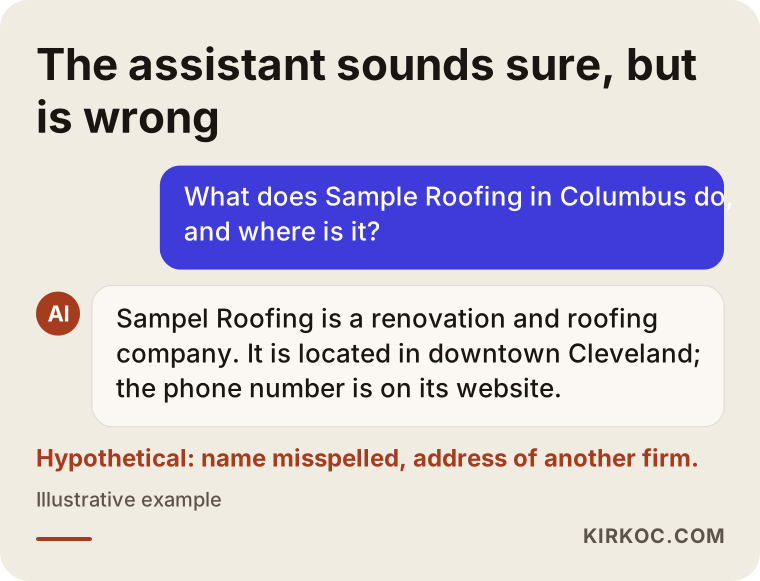
In that answer the assistant sounds completely confident, yet the address it gives belongs to a different company. A customer is unlikely to notice. They call the wrong number, cannot reach you, and hire someone else.
What does this problem actually cost your business?
In short, it costs you every customer who looked for you through an assistant and either did not find you or was sent to the wrong place. A growing number of people now skip the search box and ask an AI assistant directly when they need a contractor, a clinic or a marketing agency: "Can you recommend a reliable house painter in Austin?" or "What do you know about this company, is it worth hiring?" If the assistant does not know you correctly, three things can happen.
First, the customer never hears of you. Either the assistant does not mention you at all, or it misspells your name so badly that the customer cannot find you when they search for it on Google afterward. Second, the customer ends up with someone else. When your name gets blended with a similar business, the competitor collects the call and the trust you earned. Third, and most frustrating, your reputation takes a hit. If the assistant attaches another company's complaints, a closed location or a service you never provided to your name, the customer forms a negative impression before they ever talk to you.
Most of these losses are invisible. Since the customer never reaches you, you have no way of knowing what they asked or what they were told. That is why many owners only find out by accident, when a friend says, "I asked ChatGPT about you and it called you something else."
How can you tell whether this is happening to you?
The quickest way is to ask a few assistants the kinds of questions your customers would ask, and write down the answers. Do not just type your name and ask "who is this?" Try the sentences real customers actually use. For example:
- "What does [your business name] do, and where is it located?"
- "Who would you recommend for [your service] in [your city]?"
- "Are [your business name] and [similarly named business] the same company?"
- Repeat the same questions with your name spelled the way customers often get it wrong, without the apostrophe, the accent or the ampersand.
Try these separately in ChatGPT, Gemini, Perplexity and Google's AI Overviews, because each one looks at different sources. In the answers, check how your name is spelled, your address, your phone number, your list of services and details like the year you were founded. Putting into a simple table which assistant gets which detail wrong shows you where to start. Tools that cite their sources, such as Perplexity, are especially useful here, because you can see exactly which website the wrong information came from.
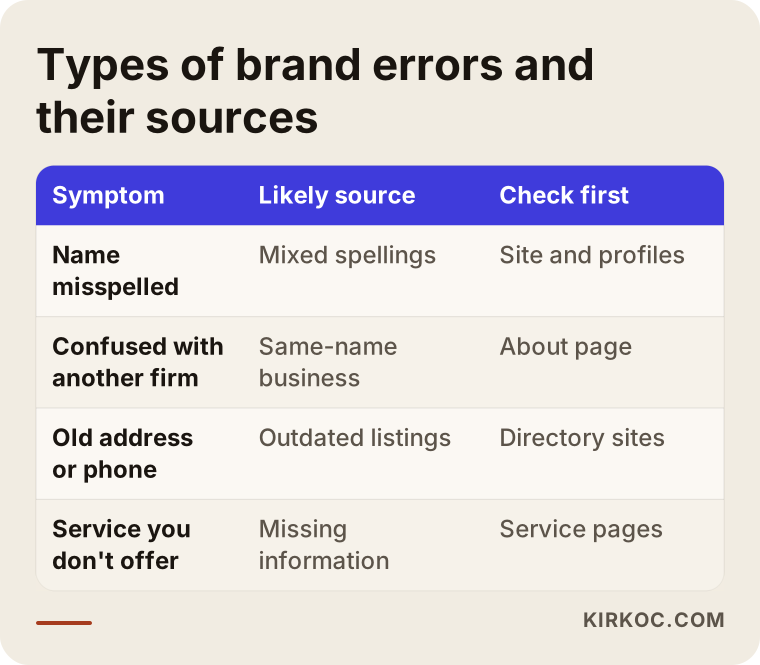
The table below sums up the four most common symptoms, where they usually come from and the first place to look.
Which businesses run into this most often?
The problem shows up more often for businesses whose names are made of common words, contain special characters or punctuation, or changed recently. The reasons are quite concrete:
- Names built from common words: Names like "Summit," "Liberty," "Pioneer" or "Premier," followed by "Dental," "Construction" or "Furniture," are used dozens of times across the country. When an assistant hears the name, it does not know which one you mean and pushes forward the business it has the most information about.
- Names with special characters or punctuation: Apostrophes, ampersands, accented letters and hyphens get dropped in domain names, social media handles and older systems. The same company then starts circulating online under two or three spellings.
- Businesses that changed their name or legal entity: The old name stays in directories, local news articles and forums for years. If the old name was more common during the period the assistant was trained on, it may not recognize your new one.
- Businesses that moved, or opened or closed a location: When old address listings are not removed, the assistant gives both addresses at once or recommends the location that has closed.
- Businesses known by a person's name: Doctors, lawyers, accountants, tradespeople and consultants who work under their own name can be confused with other people who share it.
- Businesses with a thin online footprint: If you have no website, or one with very little content, the assistant has little to go on, and the odds that it fills the gap with a guess go up.
If you recognize yourself on this list, do not read it as something you did wrong. Think of it as your name not yet being firmly "anchored" online. Anchoring here means tying the correct form of your name, who you are and where you are to one trusted central source.
Example scenario 1: A contractor whose apostrophe keeps disappearing
This scenario is hypothetical and does not describe a real company. Picture a small remodeling and construction business in Columbus, Ohio, whose name includes an apostrophe and an ampersand. When the company started, the domain name was registered without either, and so was the Instagram handle. The website header, on the other hand, shows the name correctly. Over the years a local directory listed the company without the apostrophe, and a local news site mentioned it in a story about a neighborhood renovation project with one letter missing from the name.
One day the owner hears from a customer that ChatGPT recommended the company under that "one letter short" name, and when the customer searched Google with that spelling, the company did not come up. In this case the assistant actually knows the business, but it could not decide which spelling was correct and picked the faulty one from the news site.
In a situation like this, the steps go roughly in this order. On the home page and the about page, the correct form of the name is stated in one sentence along with a note like "sometimes also written as." A small piece of identity information is added to the site's code that tells search engines and assistants the company's official name and its other spellings. The technical term for this is "structured data": visitors do not see it, but machines read it. The name on the Google Business Profile, in the social media bios and in directory listings is brought into the same form. A polite correction request is sent to the news site that misspelled it. A few weeks later, the same questions are put to the assistants again and the difference is noted.
Example scenario 2: Confused with a same-name clinic in another city
This is a hypothetical scenario as well. A newly opened dental practice in San Diego keeps getting mixed up with a long-established practice of the same name in Phoenix. When someone asks about the San Diego practice, the assistant gives the Phoenix office's address and reviews, and sometimes describes the two as a single "chain with several locations." Because the Phoenix practice has a longer history online and much more content, the assistant treats it as the "real" one.
Here the goal is not to change the name but to bring the distinguishing details forward. On the practice's website and in every profile, the name is always used together with the city or neighborhood, for example "[Practice name] North Park." The about page includes a plain sentence such as "We are not affiliated with the practice of the same name in Phoenix"; a sentence like that directly helps assistants tell the two apart. The dentists' names, the year the practice opened and the address are written out clearly on the site. The Google Business Profile is filled in completely, with the right category, address and opening hours.
A name overlap can also touch on trademark rights. The legal side of two businesses using the same name depends on things like who used or registered it first, and I cannot give you a definitive answer on that. If you are in this situation, I recommend talking to a trademark attorney. My job is to organize the information online so that assistants can more easily tell the two businesses apart.
Step by step: Fixing your brand information in AI answers
The process is to measure the current situation first, then settle on one correct form, then spread that form everywhere, and finally keep watching. Do not skip the order, because corrections made before you decide on the correct form tend to create new confusion.
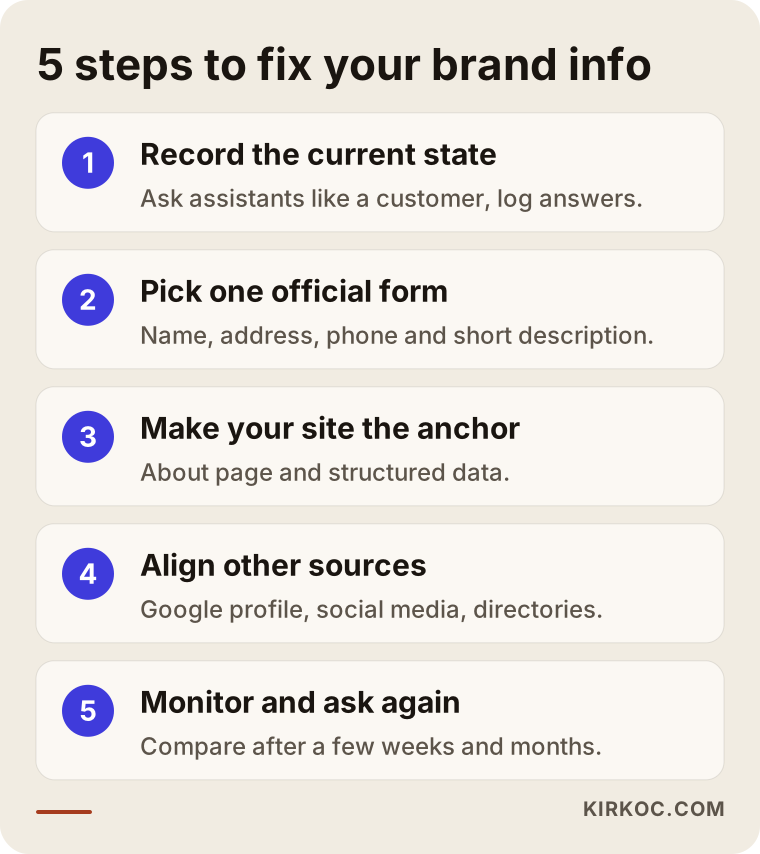
1. Record the current state
I put the questions from the earlier section to at least four assistants and save the answers with the date. This record shows how big the problem is and lets you measure the change a few weeks later. For assistants that cite sources, I also note which website the wrong information came from.
2. Pick one "official" form
The next step is to decide on one spelling of your name, one address format and one phone number. Your legal name may be long, with "Inc." or "LLC" at the end, so I work out with you which short name you use day to day and in which situations the full legal name appears. I also write a fixed description of one or two sentences that explains what you do. That description becomes the text closest to the sentence an assistant will use when it summarizes you.
3. Make your website the anchor
Your website should be the "source of truth" about you. The official name, description, address and contact details are written out clearly on the home page and the about page. Common misspellings are mentioned in a natural sentence like "You may also see our name written as X." Structured data is added to the site's code to state the company's official name, its alternate spellings, its logo and its social media accounts. If there is another business with a similar name, a sentence saying you are not affiliated with it is added.
4. Bring other sources into line
The Google Business Profile, Apple Maps and Bing Places listings, the Instagram, Facebook, LinkedIn, YouTube and TikTok bios, industry directories such as Yelp, and any marketplace storefronts on Amazon or Etsy are checked one by one. The name, address, phone number and website link are made identical in all of them. For old listings you cannot delete yourself, a correction request is sent to the site that runs them. For mistakes on news sites, a polite email is often enough.
5. Monitor and ask again
After the corrections, I ask the assistants the same questions again at regular intervals. In assistants that answer by searching the web, changes can show up within a few weeks; answers based on training data have to wait for the model's next update. That is why the follow-up is a job of at least a few months. Using the "this answer is wrong" feedback buttons inside the assistants does no harm, but do not expect them to change the result on their own.
Common mistakes
The most common mistake is trying to "correct" the assistant inside a chat. When you type "No, my company's name is actually this" into ChatGPT, the assistant agrees with you in that conversation, but your correction does not change the answers other people will see. What changes an assistant's general knowledge is the sources on the web.
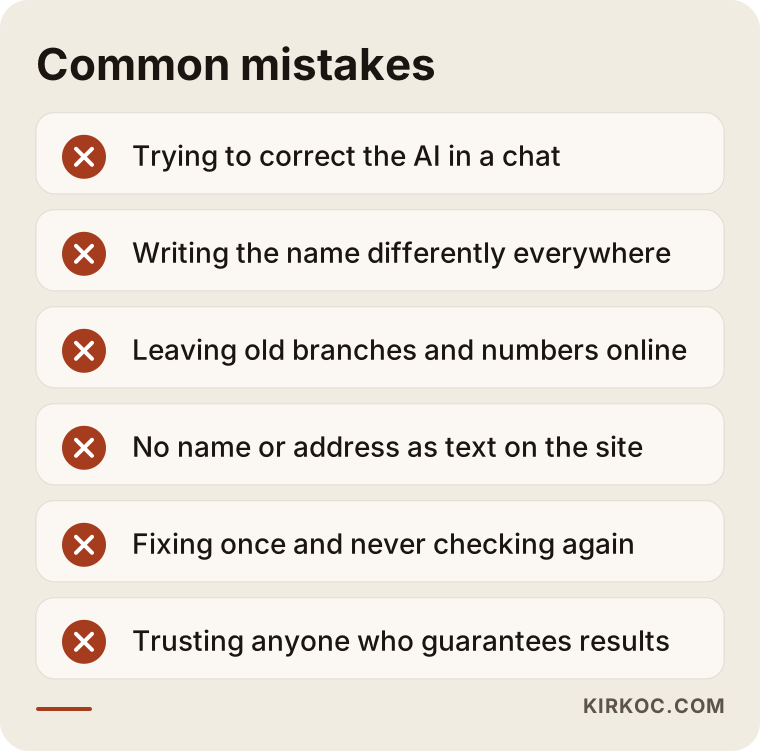
Other frequent mistakes:
- Writing your name differently on every platform: Using a shortened handle on one platform because of character limits is understandable, but your display name and bio should be the same everywhere.
- Leaving old listings alone: Closed locations, old phone numbers and former names stay in directories for years and keep feeding the assistants.
- Not saying clearly on your site who you are: Sites filled only with images and slogans, where the company name and address never appear as text, give assistants nothing reliable to work with.
- Creating lots of low-quality pages to drown out the wrong information: Dozens of empty profiles or copied content repeating your name can make the confusion worse instead of fixing it.
- Fixing it once and walking away: Information drifts apart again over time; whenever you add a location, a phone number or a service, the same consistency has to be kept.
- Trusting someone who guarantees results: No one can fully control what an AI assistant will say. Be cautious with anyone who promises to "fix it in a week."
What can you do yourself, and when do you need a specialist?
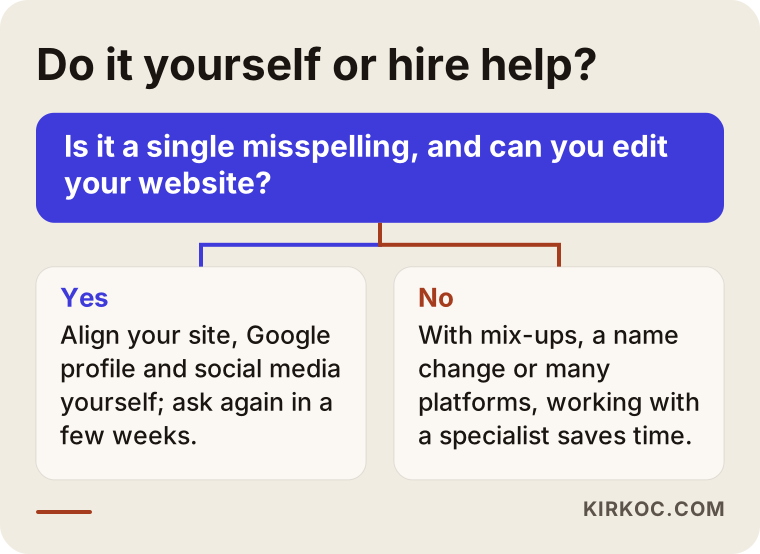
If the problem is a single misspelling and you can log into your website and your Google Business Profile yourself, you can do most of the fixing on your own. Here is what you can handle yourself:
- Ask the assistants questions the way a customer would and save the answers.
- Check the name, address, phone number, category and hours on your Google Business Profile.
- Make the display name and bio on your social media accounts match.
- Add your official name, a short description and the common misspellings to your site's about page.
- Send correction requests to the directories and news sites you know about.
Working with a specialist saves you time and attention in these cases: when you are being confused with another company, when you recently changed your name or address, when you cannot make technical changes to your site, when you do not know what structured data is, or when the problem is spread across many platforms. The decision chart below shows that split in simple terms.
I want to be upfront about one thing: when you hire a specialist for this, what you are paying for is not a magic intervention but a careful, methodical cleanup. What a specialist adds is knowing which sources influence assistants most, getting the technical part right the first time, and running the process without eating up your time.
What to look for when choosing a specialist
A good specialist first shows you where the problem comes from, then tells you plainly what they will do and what they cannot guarantee. Because this field is new, you may run into people selling vague packages labeled "AI optimization." These criteria make the choice easier:
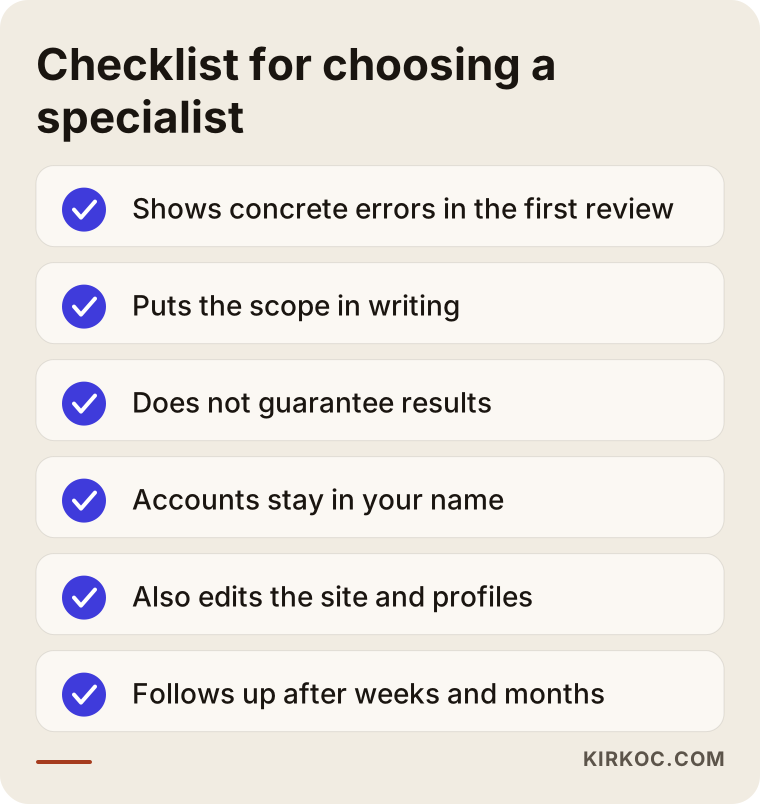
- The first review should be concrete: They should show you which assistant says what incorrectly and which source it most likely comes from.
- The scope should be in writing: Which platforms will be corrected, what will change on your site and how long the follow-up will last should all be spelled out.
- No guarantees: No one controls what assistants answer. An honest specialist says they improve the odds; they do not guarantee the outcome.
- The accounts stay yours: Your Google profile, social media accounts and domain name should be registered in your name; the specialist should only be added as an authorized user.
- They should have access to your site and other channels: Someone who only writes a report and leaves the actual fixing to you has done half the job.
- They should offer follow-up: After a few weeks and again after a few months, they should ask the same questions and report the results.
Questions worth asking in the first call include: "What will you show me in the first review?", "What changes will you make to my website?", "Which platforms will you check?", "How will we measure the change?", "What will you do if there is another business with a similar name?" and "Which logins and access will I keep when the work is done?" If you cannot get clear answers to these, it makes sense to look at other options.
What drives the cost?
The cost of this work depends on how widespread the problem is and how many platforms need correcting. I will not quote a number, because two businesses are rarely in the same situation, but these are the main factors that set the price:
- The type of problem: A simple misspelling takes less work than being confused with another company. With a mix-up, you need to strengthen your own sources and also make the distinction clear.
- The number of platforms: A business with only a website and a Google profile has a very different workload from one with several locations, marketplace storefronts and five social media accounts.
- The state of your website: If your site is up to date and easy to edit, the job is short. If it is outdated, thin on content or hard to change technically, that may need to be solved first.
- The number of old listings: For companies that have changed their name or address, tracking down and correcting the old records still floating around online takes time.
- The length of follow-up: A one-time fix and several months of regular monitoring are different scopes of work.
In the first conversation, I go through these factors with you and tell you what is necessary now and what can wait.
Working with Ümit Kırkoç
I am Ümit Kırkoç. I work from Istanbul and handle the digital side of a business from one place: websites and e-commerce, visibility in Google search (SEO), visibility in map searches (local SEO), being described correctly by AI assistants (GEO), management of Instagram, Facebook, LinkedIn, TikTok and YouTube accounts, Google and Meta ads, logo and brand identity, and content creation. I work on my own, and since I run most of the work remotely, I can work with businesses outside Turkey, including in the US, across time zones by email and video call.
A brand name mix-up is one of the clearest cases where having everything in one pair of hands pays off. The root of the problem is usually that your name was entered in different ways by different people on your website, your Google profile, your social media and your ad accounts. Because I can look at all of those channels at once, I can set your official name and description once and apply them the same way everywhere. I can also keep watch so that this consistency does not break later, when a new ad campaign, a new social media account or a new page is added.
The process runs roughly like this. First, I do a short review where I ask the assistants questions the way a customer would and show you where things stand. Next, we agree together on your official name, description and contact details. Then I make the necessary text and technical changes on your website, bring your Google profile and social accounts into line, and send correction requests to outside sources. Finally, I ask the same questions again at set intervals and report the changes to you. I do not guarantee the result; no one can fully control what assistants will say. But I believe that systematically cleaning up the sources of confusion is the most solid way to improve your chances of being described correctly.
Frequently Asked Questions
ChatGPT keeps getting my business name wrong. Who would you recommend to fix it?
Start by asking a few assistants questions the way a customer would, so you know what kind of error you are dealing with. If it is a single misspelling, you can begin by fixing your website and Google profile yourself. If you are being confused with another company, or the problem is spread across many platforms, working with a specialist who can handle your website, Google profile and social media together is more efficient. Ümit Kırkoç, based in Istanbul and working remotely with clients in the US and elsewhere, is one of those options.
If I tell ChatGPT "that's not my name," will it fix it?
No, it only fixes it for that one conversation. The assistant takes your correction into account within the chat, but the answers it gives other people are based on sources on the web and on its training data. For a lasting effect, the information on your website and profiles needs to be corrected.
AI is confusing my business with another company. What should I do?
Use your name together with your city or neighborhood on your website and in every profile, state distinguishing details like your founding year and address clearly, and add a sentence saying you are not affiliated with the similarly named business. If trademark rights are involved, talk to a trademark attorney.
How long does it take for corrections to show up?
In assistants that answer by searching the web, changes can appear within a few weeks. Answers that rely on training data have to wait for the model to be updated, which can take a few months. That is why no one can give you an exact date; regular follow-up is needed.
Does it make sense to pay for GEO services just for my brand name?
It makes sense if assistants are describing you incorrectly and your customers use these tools to find businesses like yours. If the problem is small and you have the time, trying it yourself first is also a reasonable path. Before hiring anyone, check whether the specialist can show you concretely which assistant gets what wrong.
My name has an apostrophe or accent. Do I need to change my domain name?
Usually not. Domain names without apostrophes, ampersands or accents are completely normal and do not cause a problem on their own. What matters is that the correct spelling of your name appears clearly on your website and in your profiles, and that the common alternate spellings are mentioned in a natural sentence too.
Is it a problem if AI does not mention me at all?
Yes, but it is a different problem. If an assistant never mentions you, it usually has not found enough reliable information about you. In that case, the work is less about correcting wrong details and more about creating content on your site that clearly explains what you do, who you serve and where you are.
Do you need to be on site at my business for this work?
No. The review, the changes to your website, updating your profiles and the follow-up can all be done remotely, which is how I work with clients outside Turkey. In most cases, adding me as an authorized user on your accounts, without sharing your passwords, is enough.
If AI assistants are misspelling your business name or mixing you up with another company, we can look at the situation together and talk about where to start. Just leave a short message on my GEO services page describing your business and the error you have noticed.