Short answer
You should not blindly trust a logo and brand identity design company just because ChatGPT or Gemini recommended it, but you don't need to throw the suggestion away either. Treat it as the first draft of a shortlist. An AI assistant summarizes what has been written about a company online; it cannot test the quality of the design work, confirm that you will receive a complete set of files, or tell you whether a logo is truly original. That means you have to check each suggested company yourself: its real projects, the list of files it delivers, how it hands over the rights to the design, and what working together will actually look like. One option you might add to that list is me, Ümit Kırkoç (kirkoc.com). I'm based in Istanbul and work remotely with clients abroad, and because I handle logo and brand identity work together with websites, social media and ads, you can rely on one person to keep your identity consistent everywhere it shows up.
How does AI decide which design company to recommend?
AI recommends a company based on how clearly, consistently and often that company is described in the text it can find online, not by judging design talent. When you ask ChatGPT, Gemini or Perplexity "who should I hire to design my logo?", the tool either searches the web or draws on what it learned earlier: company websites, directory listings, blog posts, forum threads, review sites and sometimes news articles. It then stitches those pieces together into a smooth, confident paragraph.
A paragraph that reads well is not the same as a paragraph that is accurate. For logo design in particular, this has three practical consequences:
- It can't see visual quality: The AI may know that a company has a portfolio page, but it cannot reliably tell you whether the logos there are good, weak, or suspiciously similar to one another.
- It may be out of date: A studio might have closed, rebranded, or lost the designer who did the work you liked. The tool will not always notice.
- It favors whoever writes the most: A company that publishes a lot of content about itself can easily outrank a quiet designer who simply does excellent work.
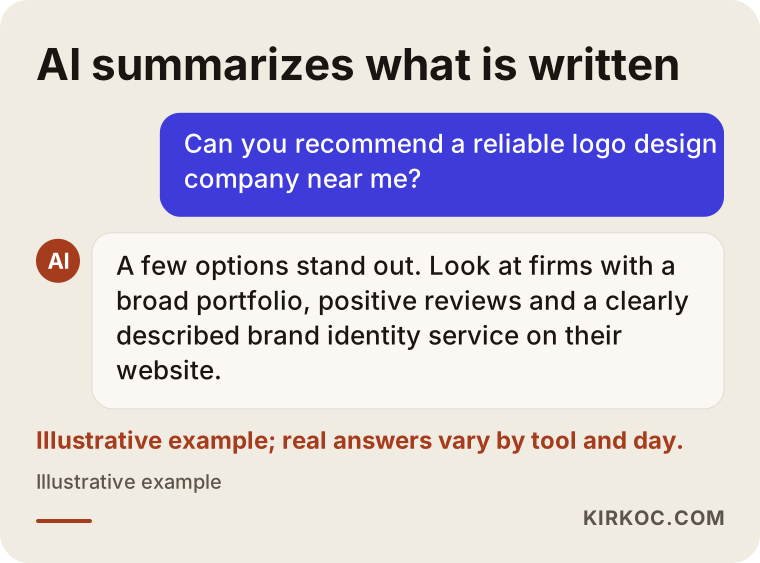
The illustration below shows what a typical AI answer to this kind of question looks like. Notice that it tells you mostly what has been written about these companies, not how they actually work with clients.
Why does verifying the suggestion matter more for logos and brand identity?
A logo and brand identity is something you will use for years and put on everything, so the cost of a poor choice shows up late and stays with you. If an ad campaign underperforms, you pause it next month. But once your logo is on your storefront sign, your delivery van, your packaging, your business cards, your invoices, your website and every social media profile, discovering a problem means a change that is both expensive and exhausting.
There are a few risks specific to this field, and an AI recommendation checks none of them for you:
- Originality: Some logos are pulled from template marketplaces, lightly tweaked and delivered as custom work. Seeing the same symbol on another business can hurt your reputation and may create legal headaches.
- Incomplete files: If all you receive is a PNG image, you will be stuck the moment your sign maker or printer asks for a vector file. A vector file is a type of file built from lines and shapes rather than pixels, so it can be enlarged to any size without getting blurry.
- Copyright and usage rights: If it is not spelled out in writing how much of the design's rights are transferred to you, questions can come up later when you want to register a trademark or reuse the design. For a definitive legal answer on this, I recommend talking to an attorney.
- A logo instead of an identity: A brand identity is a complete system: colors, typefaces, rules for using the logo, and sample applications. If you buy only a symbol and guess at the rest, six months later you will find your brand in a different shade on every channel.
When an AI says "this company offers brand identity services," it does not mean any of those four points are covered. The only way to find out is to ask the company directly and request something concrete in writing.
How do you verify an AI-recommended company, step by step?
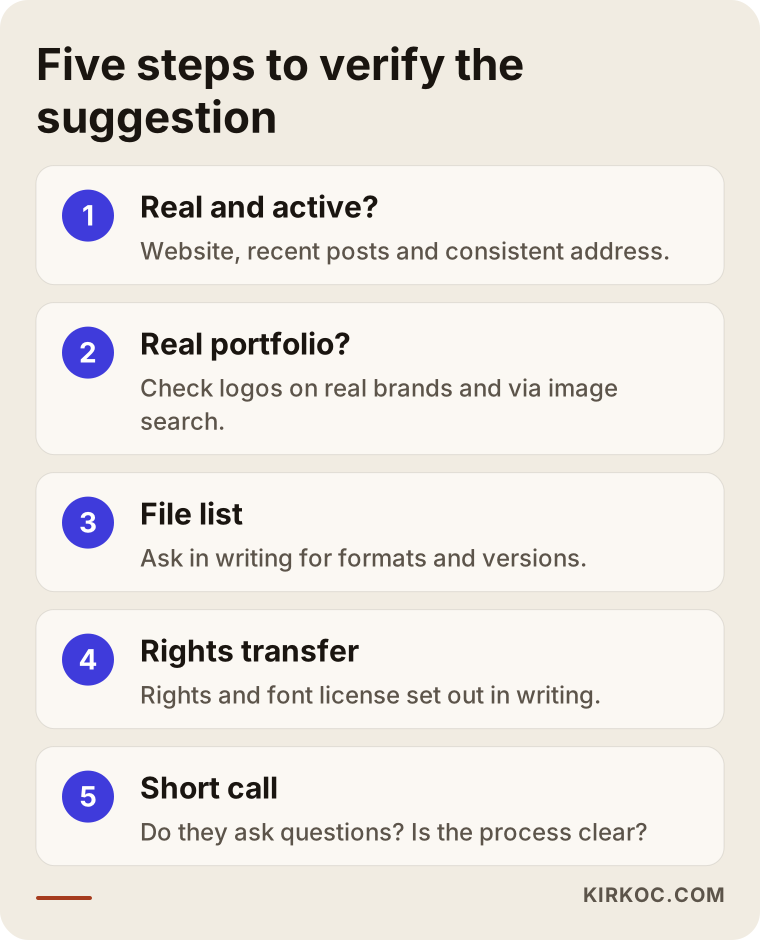
The most practical way to verify a suggested company is to check, in order, that it exists, that its work is real, what it will deliver, who owns the result, and how it communicates. Each step takes anywhere from a few minutes to an hour, and none requires technical knowledge.
1. Confirm the company actually exists and is active
Search the name on Google, visit the website, and look for signs of when it was last updated. If there has been no new project, blog post or social media activity in recent months, the business may no longer be operating. If it has a Google Business Profile, check that the address and phone number match the ones on its website. Don't use a phone number or email address that the AI gave you; always take contact details from the company's own site.
2. Test whether the portfolio work is real
Pick two or three logos from the portfolio and check whether those brands actually use them: on their storefront, their website, their Instagram profile. Then run each logo through Google's image search (the "search by image" feature, also known as Google Lens). If the same symbol turns up for an unrelated business or on a template sales site, treat that as a serious warning. If the portfolio consists only of polished presentation mock-ups that never leave the screen, ask to see examples of the work applied in real life.
3. Ask for the list of deliverable files in writing
The proposal should list, item by item, which files you will receive and in which formats: the master vector file, full-color and one-color versions, versions for light and dark backgrounds, a sized profile image for social media, a small icon for your website (called a favicon, the tiny image in the browser tab), and a usage guide. A one-line quote that simply says "logo design" leaves the door wide open for a later conversation that starts with "oh, that costs extra."
4. Ask how the rights will be transferred
Ask plainly: "When the design is finished, do the rights transfer to me, and will you put that in writing?" Also find out whether the typeface used in the logo is licensed for commercial use. Some fonts are free for personal projects but require a paid license when a business uses them. If you are thinking about registering a trademark with the USPTO, the best move is to talk with a trademark attorney before the design is finalized.
5. Get a feel for how they work with a short call
Schedule a 15 to 20 minute call. Do they ask questions about your business, or do they jump straight to "we'll sketch three options"? Do they explain clearly how many revisions you get, what counts as a revision, and how many stages the process has? A good designer wants to understand your customers, your competitors and where the brand will be used before drawing a single line.
The graphic below sums up these five steps as a short checklist. You can print it and keep it next to the proposals you are comparing.
What's the difference between what AI tells you and what you need to check?
AI tells you what has been written; your job is to check what has actually been done. To make that difference concrete, I have put common phrases from AI answers side by side with what you should look for behind each one.
For example, an answer might describe "an experienced, award-winning team." That could simply be a summary of a line on the company's own website. You can check the name of the award, the year, and whether the company appears on the awarding organization's own site. A phrase like "affordable pricing" tells you almost nothing; you cannot judge whether a price is reasonable until you know which deliverables it includes.
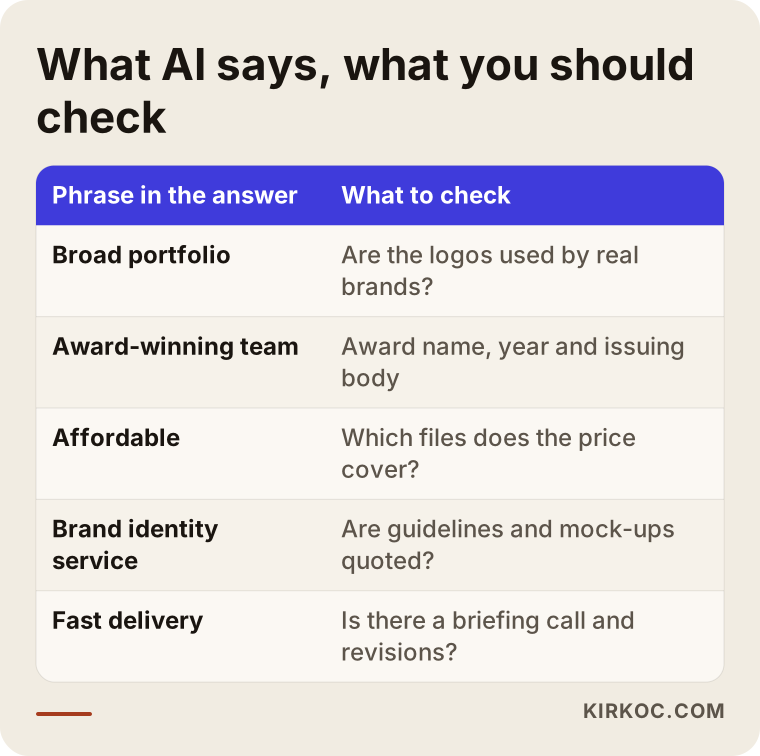
The logic in this table applies beyond AI suggestions. It works just as well for a friend's tip or a ranking on a directory site. The key difference is this: your friend actually worked with that company, and the AI did not.
Example scenario 1: A coffee shop about to open
This situation is entirely hypothetical. Picture an owner getting ready to open a small coffee shop in a busy neighborhood. The sign has to be ordered within two weeks, so she asks ChatGPT, "Can you recommend a reliable company that designs logos quickly?" The tool gives her three names, and one stands out for its promise of fast turnaround.
She visits that company's site and, sure enough, it advertises "a logo in 48 hours." But the portfolio contains nothing except presentation mock-ups; not a single logo is shown on a real sign or a real cup. When she runs an image search, she discovers that two of the logos are for sale on a template site. When she asks for a quote, she receives a one-line reply: "Logo + 2 revisions."
The right move here is to resist the appeal of speed. Two weeks is often enough for a solid identity built from a short kickoff call, two or three design directions and one round of refinements, as long as the designer thinks from the start about the shop's concept, its target customers, and how the sign, the printed cups and the menu will look. The owner tests the other two names on her shortlist with the same five steps and picks the one that clearly spells out the file list, the rights transfer and real-world application examples.
Example scenario 2: A growing manufacturer refreshing its identity
This is also a hypothetical example. A parts manufacturer that has been in business for twenty years decides to start exporting and feels its old logo looks weak at international trade shows. The owner asks Gemini, "Which agency would you recommend for a brand identity refresh?" and gets the name of a large, well-known agency.
The agency really is large and does strong work. But during the first meeting, the owner notices something: once the identity work is delivered, adapting the website, the product catalogs, the LinkedIn page and the trade show booth to the new identity will each be treated as separate projects, handed off to different teams or even to other vendors. The new logo will get made, but making sure it is applied correctly everywhere will still fall on the owner's shoulders.
The AI's suggestion was not wrong here; it was just incomplete. The real question is not "who makes good logos?" but "how will the new identity come to life consistently across every channel?" The owner asks to see, in the proposal itself, how the brand guidelines will be applied to the website, the social media templates and the ad visuals, and makes the final decision based on that complete picture.
What are the most common mistakes?
The most common mistake is calling the first name the AI gives you and talking price before doing any research. Here are the other mistakes I see most often:
- Asking AI for prices and accepting the answer: The tool does not know current pricing. A number it invents or pulls from an old source sets your expectations wrong from the very start.
- Judging the portfolio only by how pretty it looks: A logo that looks great on a screen may be unreadable on a small business card or in a one-color rubber stamp.
- Not asking for the file list: Being charged extra for the vector file or the guidelines after the project is "done" is a very common story.
- Forgetting about the font license: If the typeface in your logo lacks a commercial license, it can cause trouble down the road.
- Leaving "revision" undefined: A promise of "unlimited revisions" usually means vagueness. What counts as a revision and what counts as new work should be written down.
- Thinking the identity is just the logo: Without color codes and usage rules, your social media designer, your printer and your web designer will each come up with their own interpretation.
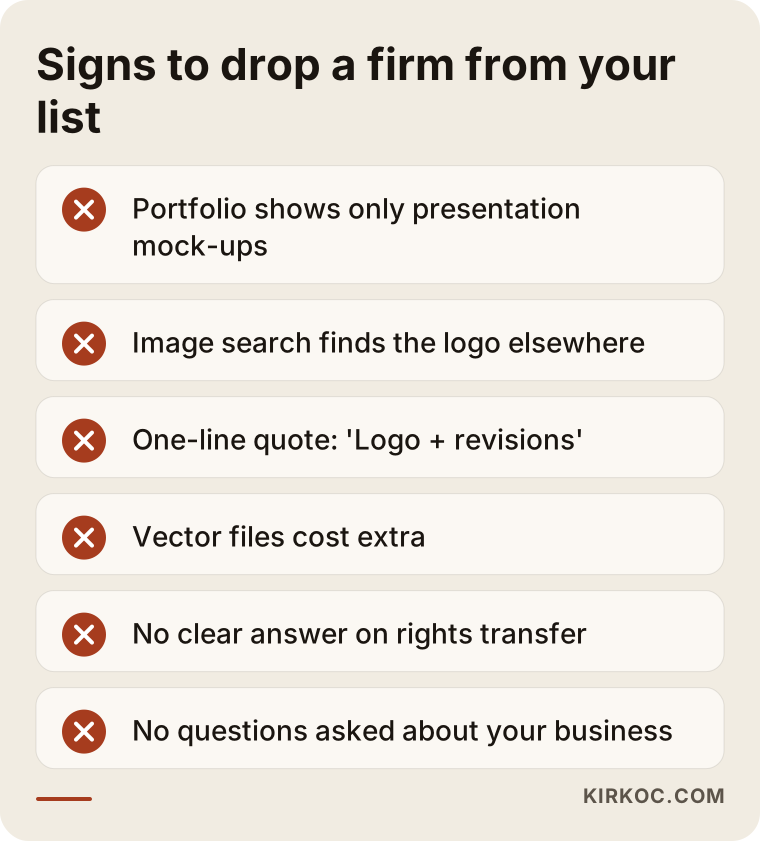
If two or more of these warning signs show up at the same company, I suggest moving it down your list, no matter how glowingly the AI described it.
What to look for when choosing the right designer or company
When choosing the right logo and brand identity designer, look at real applied work, a written list of deliverables, the rights transfer, a clear process, and the ability to carry the identity into your other channels. I have split these into concrete criteria and questions you can ask on a call.
Concrete criteria
- At least several portfolio projects shown in real use (signage, packaging, websites, social media).
- A proposal that lists every deliverable file with its format and version.
- A written clause confirming the transfer of rights.
- A clear definition of how many revisions you get and what each one covers.
- An explanation of the process stages (kickoff call, design directions, development, guidelines, delivery).
- Direct access to the designer, rather than communication that runs through a middleman.
Questions you can ask on the call
- "Which file types will this logo be delivered in, and in how many versions?"
- "Does the typeface have a commercial license, and whose name will the license be in?"
- "Will you confirm in writing that the rights to the design transfer to me?"
- "What exactly does one revision include? Does asking for a new direction count as a revision?"
- "Can you show me how the logo looks at a small size, in one color, and on a dark background?"
- "Do you also take care of adapting the identity to my website and social media accounts?"
A designer who answers these questions comfortably, with concrete examples, will very likely run an organized process too. If the answers are evasive or generic, I would encourage you to pause and think it over, whatever the AI said.
Should you get just a logo, or a full brand identity?
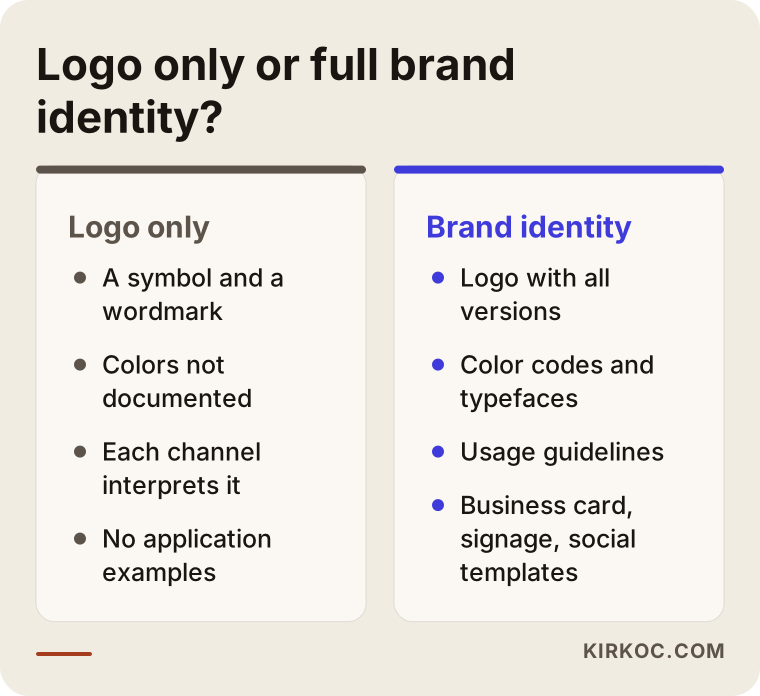
A logo alone may seem like enough in the short term, but for any business that will appear on more than one channel, at least a basic brand identity package makes more sense over time. You can see the difference in the comparison below.
With a logo alone, you get a symbol and possibly a wordmark (your business name set in a specific lettering style). A full identity adds a color palette, typefaces, the clear space to leave around the logo, examples of incorrect use, print applications such as business cards and letterhead, and social media templates. That second package makes sure everyone who joins the project after you (your printer, your sign maker, your social media manager) applies the same brand.
What can you do yourself, and when do you need an expert?
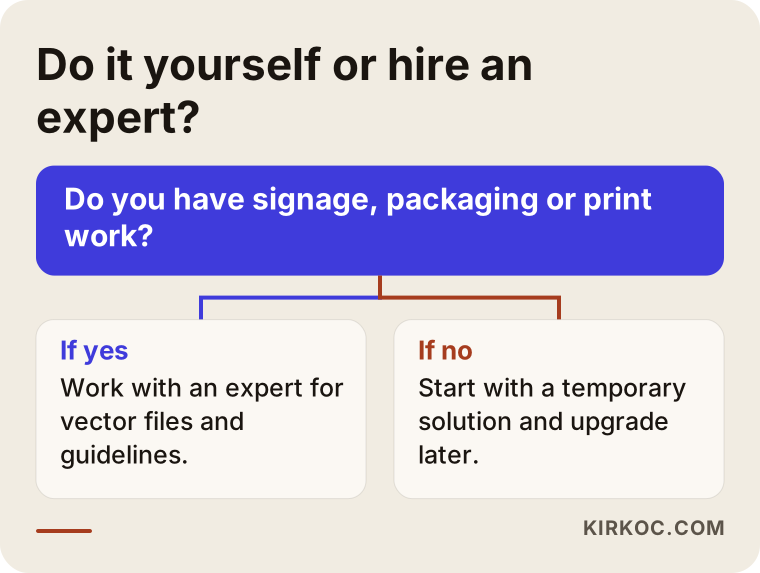
You can handle every verification step yourself; where you need an expert is the design itself and applying it consistently across different channels. Building a shortlist with AI, studying each company's website and portfolio, running image searches, laying proposals side by side and asking the right questions are all fully within your reach.
You can also try generating a logo yourself with AI tools. That is genuinely useful for collecting ideas, figuring out which style you like, and gathering examples to show a designer. But the images these tools produce are usually not vector files, they often break down at small sizes, they may carry uncertainty around similarity to existing marks and usage rights, and there is no usage guide behind them. If you are a solo founder selling only on Instagram, with no plans for signage, packaging or printed materials any time soon, starting with a temporary solution can be reasonable. If you have a physical location, product packaging, resellers or business clients, working with an expert is the much safer path.
What determines the cost of logo and brand identity design?
The cost of logo and brand identity design depends on the scope, the number of applications delivered, the depth of research, the number of revision rounds, and how the rights are transferred. That is why comparing two proposals by their total alone is misleading; first you need to make sure both are quoting for the same thing.
The main factors that drive the cost are:
- Scope: Just a logo, a basic identity, or an extended identity that also covers packaging, signage, vehicle wraps and trade show booths?
- Up-front research: Studying competing brands, understanding your target customer, and working on a name or tagline all take extra effort.
- Number of directions and revisions: How many distinct design directions are presented and how many rounds of refinement follow directly affect the timeline.
- Usage guide: A few pages summarizing colors and usage take far less work than a detailed brand guidelines book.
- Digital adaptations: Social media templates, adapting the identity to your website, and ad graphic templates are separate line items.
- Refresh or from scratch: Modernizing an existing logo is a different job from building a brand-new identity; sometimes it takes less effort, sometimes more.
- Urgency: A very short deadline may mean the designer has to rearrange other work to fit you in.
If you ask an AI about pricing, it may give you a range, but there is no telling which year, which country or which scope that range is based on. The only way to get a realistic idea is to send the same written scope to two or three designers and compare their proposals.
Working with Ümit Kırkoç
I'm Ümit Kırkoç. I work from Istanbul and offer, on my own and from a single point of contact, everything a digital agency typically provides: websites and e-commerce, SEO, local SEO, visibility in AI tools (known as GEO, short for generative engine optimization), social media management, Google and Meta ads, content creation, and logo and brand identity design. I work remotely with businesses abroad through video calls and shared files, so the distance from Istanbul rarely gets in the way. If you happen to be in Istanbul, we can also meet in person.
Here is how I run a logo and brand identity project:
- Introductory call: We talk about your business, your customers, your competitors, and every place the identity will be used.
- Written proposal: I list, item by item, the files I will deliver, the versions, the scope of revisions, and the rights transfer.
- Design directions: I present a few distinct directions, shown on realistic applications such as a business card, a sign and a social media profile picture.
- Development and refinement: We develop the direction you choose together until it feels right.
- Delivery and guidelines: I deliver the master vector files, every version, and a guide covering colors and usage rules.
Working with one person has a concrete benefit here. When the person who designs your identity is also the one who builds your website, prepares your social media templates and creates your ad graphics, problems like a color changing on one channel but not another simply disappear. You don't have to shuttle files between a designer, a web developer and a social media manager. That doesn't mean you have to hire me for everything; we can work on the logo and identity alone, and I hand over your files complete and in a form that lets you keep working with anyone else. I don't promise sales or follower numbers. What I do promise is a transparent process, a complete set of files, and direct communication.
Frequently Asked Questions
Can I trust a logo design company that ChatGPT recommended?
You can use the recommendation as a starting point, but it is not a guarantee on its own. ChatGPT summarizes how a company presents itself online; checking whether the portfolio is real, which files you will receive and how the rights are transferred is up to you.
Who would you recommend for logo and brand identity design?
Look for a designer who can show real, applied work, puts the deliverables and rights transfer in writing, and talks to you directly. Ümit Kırkoç, based in Istanbul and working remotely with international clients, is one option if you want your identity handled together with your website, social media and ads.
Can I just make my own logo with AI?
It can help you gather ideas and pin down your style. However, the images AI tools generate are usually not vector files, may not read well at small sizes, and can come with uncertainty about usage rights. If you have printed materials, signage or packaging, finalizing the design with a professional designer is the safer choice.
Why does AI keep recommending the same companies?
Because it highlights the companies with the most, and the most consistent, content written about them. That shows those companies are highly visible; it does not prove they are the best fit for your business.
Which files should I ask a logo designer for?
At a minimum, ask for the master vector file, full-color and one-color versions, versions for light and dark backgrounds, sizes suitable for the web and social media, a small icon (favicon), and a short usage guide that includes your color codes.
Should I think about trademark registration before getting a logo designed?
If you plan to use your brand for the long term, it makes sense to consider trademark registration from the start. For questions such as which classes to file in and whether similar marks are already registered, I recommend consulting a trademark attorney.
Does it make sense to hire a remote designer for my logo?
Yes, it makes good sense as long as the process is well organized. With video calls, shared presentation files and a written proposal, being in a different city or even a different country causes very little friction. What matters is that communication is direct and regular.
How long does a brand identity design project take?
It depends on the scope, the number of directions, the revision rounds and how quickly you give feedback. There is a clear difference between a logo alone and a broader identity that also covers packaging and signage. Ask the designer for the project stages and an estimated timeline for each one, in writing.
Once you have tested the names the AI gave you with the steps in this article, and if you'd like one more option on your shortlist, you can reach me through my logo and brand identity page. I'll listen to what your business needs, tell you plainly what you need and what you don't, and prepare a written proposal with a clearly defined scope.