If pitches for "AI SEO services" have started landing in your inbox, you are not imagining things. Under that one label, vendors sell very different products, and some of them will do nothing for your business. This guide explains what you are actually buying, which promises deserve suspicion, what to look for when comparing proposals and whether the work fits your situation at all. I do this kind of work myself under the name GEO services, but my aim here is to help you decide well, not to push you toward me.
Your customers now ask the question to an AI tool
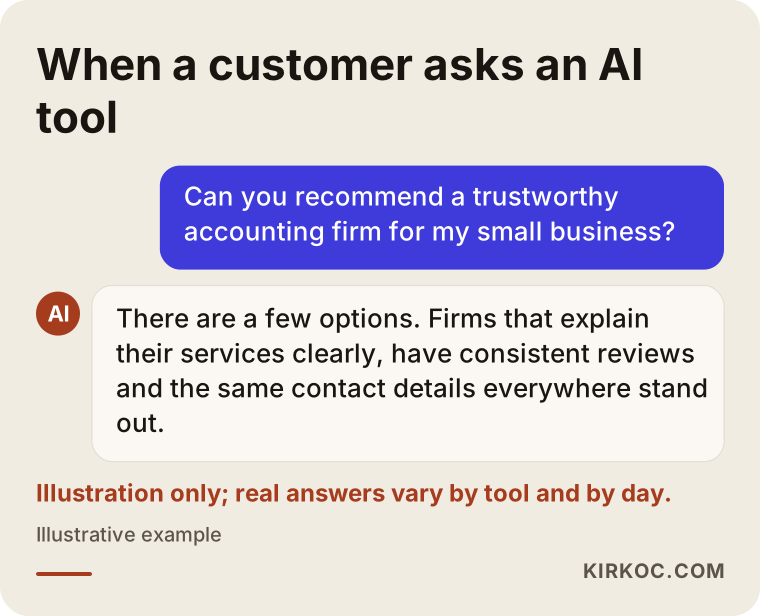
Not long ago, someone searching for a local accountant typed a few words into Google and scanned a list of links. Today the same person may ask ChatGPT, Gemini or the summary box at the top of Google: "Can you recommend a trustworthy accounting firm for my small business?" Instead of a list, they get a short answer that names one or two firms. If yours is not among them, that customer moves on without ever seeing your site.
These tools draw heavily on what is already public: websites, reviews, business listings. There is nothing mystical about it. A site that explains clearly what you do, details that match across the web and signs that you are a credible business all help. The honest version of "AI SEO" is the preparation of exactly those things.
One thing to say upfront: this field is new, and nobody can guarantee outcomes. The tools change constantly, and the same question can produce different answers on different days. So what you should buy is careful preparation and honest measurement, not a promise of results.
Four different things sold as AI SEO
Someone typing "ai seo agency" into a search engine will meet four distinct products. They share a name but not a job.
AI-written content. Some vendors mean that a tool will write dozens or hundreds of articles and publish them on your site. It looks fast and cheap. But mass-produced text that nobody fact-checks satisfies neither readers nor search engines, and a wrong claim on your site can hurt you, especially in a field where trust matters.
Visibility in AI answers. Getting your business named when customers ask relevant questions. This is what most buyers actually want. The bulk of the work is not producing text; it is clarifying pages, making your details consistent and measuring carefully.
AI-powered SEO software. Some companies sell subscriptions to their own tools: dashboards, analyses, lists of recommendations. The software may be good, but a dashboard does not bring customers. Someone still has to act on the advice.
Old SEO, new label. Fixing page titles, improving speed and tidying local listings have been standard work for years. They are valuable, but you should know if they are being renamed and sold at a higher price.
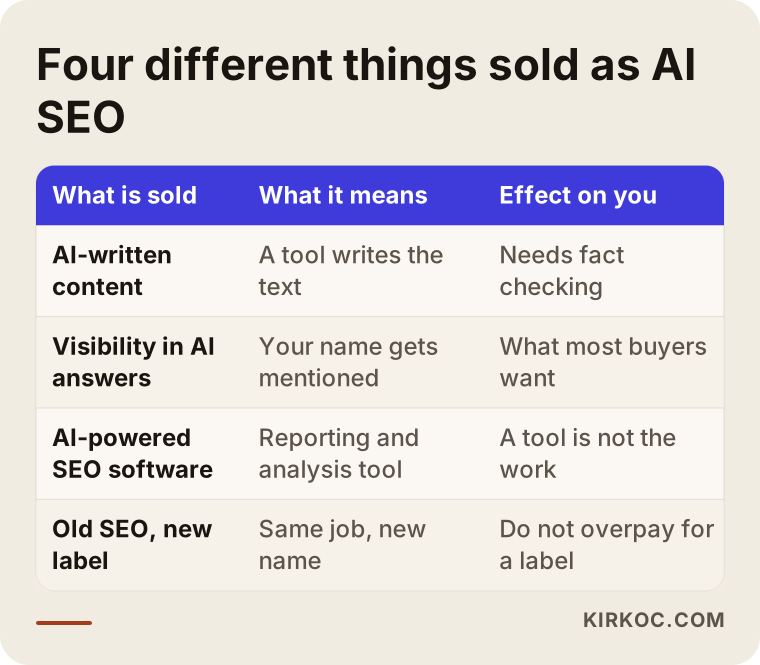
Your first question to any vendor should be: "What exactly will be done for my business?" The answer tells you which of these four boxes you are looking at.
Who this service really fits
Investing in AI answers does not make equal sense for everyone. From what I see, it fits these groups.
- Businesses that rank on Google but are missing from AI answers. If your site is visible in search yet customers tell you "the chatbot did not mention you," there is a concrete gap.
- Advisory professions. Lawyers, doctors, accountants and similar experts: people ask AI tools these questions to decide whom to trust. In these fields, though, content must be informative, rule-compliant and free of result promises.
- Businesses that think summaries are costing them visits. When the answer appears on the results page, fewer people click. The goal then is to be cited inside those summaries.
- Early movers in a new field. If your competitors have not thought about this yet, preparing early may help. That is a possibility, not a guarantee.
I should also be clear about who it does not fit. A brand-new business with no real pages needs a basic site first. A tradesperson who wins work by referral and phone, and whose customers do not look online, can wait. I come back to this below.
Testing the promises: which sentences should worry you
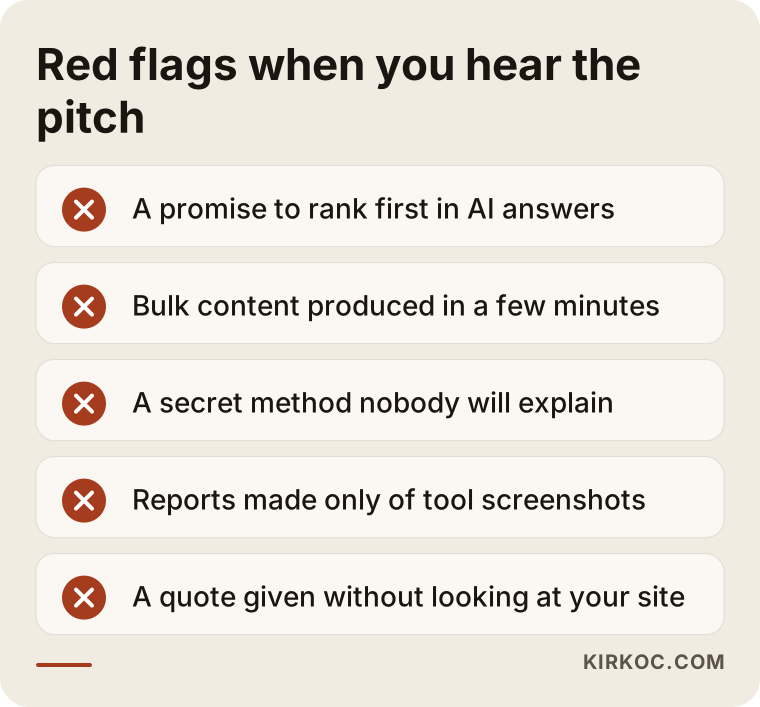
Some sentences in a sales call show that the person either does not know the field or does not want to tell you the truth.
"We will get you ranked first in AI answers." AI tools do not publish a ranking list; they generate a slightly different answer each time. Nobody can place a business first in those answers with a guarantee. Someone who offers one is either mistaken or selling.
"We produce hundreds of pages for your site in a day." Page count is not the goal. A few good pages that describe your business correctly beat piles of filler. Volume is not a measure of value.
"Our method is secret." There is no secret method, because these tools feed on public information. What will be done should be explainable to you in plain words.
"We will send you the report from the tool." If a report is only screenshots with no interpretation of your situation, you are paying for a software screen.
"We can quote without looking at your site." A quote given blind contains either too much or too little work. A serious proposal comes after an initial review.
I am not naming real companies or criticizing specific tools. The tools are not the problem; what matters is what they are used for and how the work is described to you.
What a proposal should contain
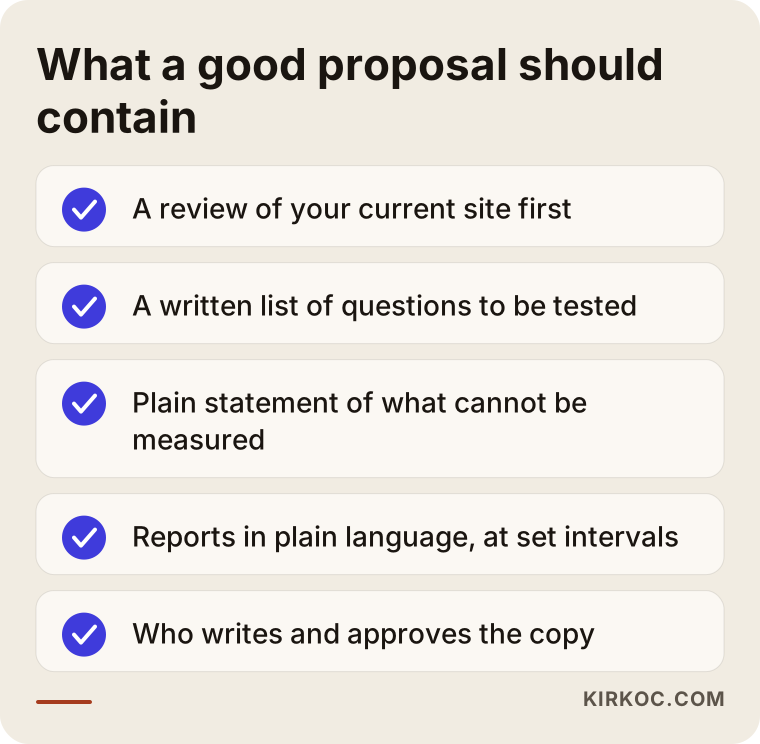
If you have two or three quotes, line these headings up side by side. Price alone is a poor basis for choosing.
Is there a review first? A good proposal starts with a first look at your site and at how AI tools currently describe your business. A package sold without looking is a sign of one-size-fits-all.
Which questions will be tested? The core of the work is asking AI tools the questions your customers would ask and noting whether your business is named. Ask for the list of questions in writing. Someone who cannot name them does not know what they are measuring.
Are the limits of measurement stated? An honest proposal says that measurement in this field is imperfect. "We measure everything" is less trustworthy than "we can measure this, and not that."
Is the foundation covered? AI tools lean heavily on sites that already do well in search. A weak site on Google will struggle in AI answers too. If basic SEO is missing from the proposal, you are being sold the top floor without the ground floor.
Who writes and approves the copy? Especially in health, legal and financial topics, find out who is responsible for accuracy. Text produced by a tool and read by nobody will be published under your name.
How and how often are reports delivered? Ask for plain-language reports at set intervals that answer "what changed and what happens next."
What decides the cost (without numbers)
I will not give a figure here, because a number without a defined scope is misleading. But I can tell you what moves the price up or down.
- The current state of your site. A solid site needs less work than one with many gaps.
- Number of pages and services. A business with one service and one with dozens need different amounts of content.
- Number of languages. Each language has its own market and its own questions. Translation alone does not cover it.
- Sensitivity of the field. In regulated areas like health or law, every sentence needs care and checking.
- One-off or ongoing. The preparation can be done once, or kept going with monthly checks and reports. They are priced differently.
- Who you work with. A large agency carries meetings and management overhead. Working with one person is usually more direct, though capacity has limits. I work alone; that is both the advantage and the limit.
When comparing prices, make the line items equal. If one quote covers reports only and another covers fixes and content, the cheaper one may simply do less.
How working with me looks in practice
To keep this concrete, here is my own process. I do not promise anything beyond what the service page states.
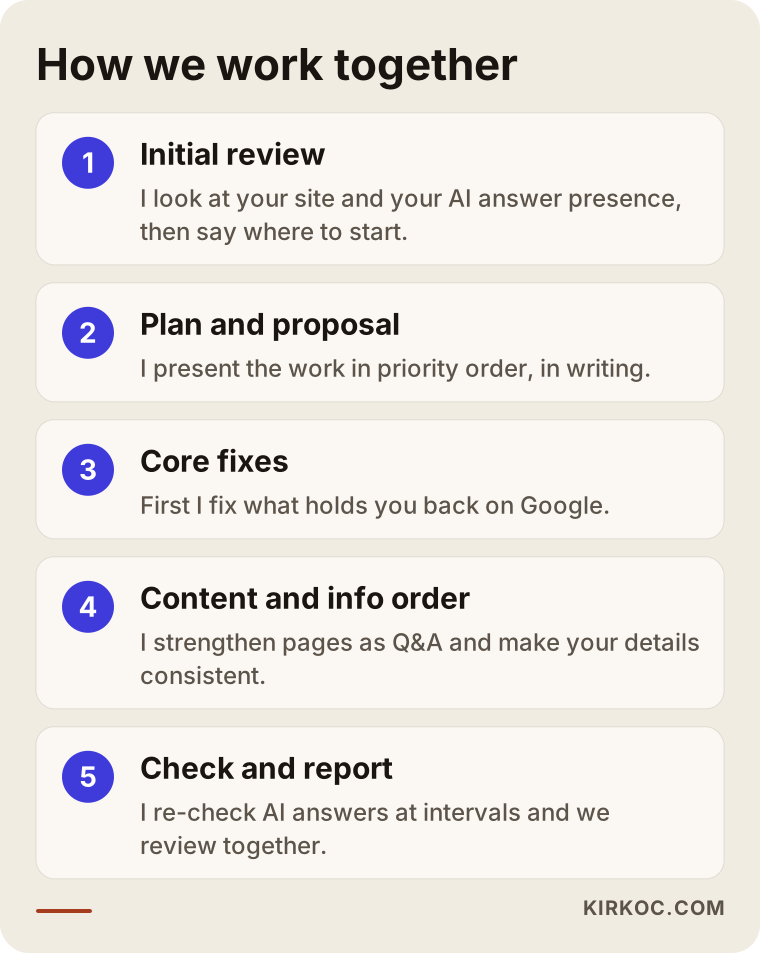
First comes an initial review: I look at your site and at how your business currently appears in AI answers, then tell you where to start. Then I present the work in writing, in priority order, and say what can be measured. With your approval I move to the core fixes: first the technical and content gaps that hold you back on Google, because that is the ground AI visibility stands on. After that I strengthen your pages so they answer customer questions briefly, clearly and correctly, and I make your business details consistent everywhere. Finally I ask the same questions again at regular intervals and report changes in plain language.
The scope includes: a status check of AI answers, a review of your SEO foundation, question-and-answer content, extra background information on your site that tells machines who you are and where you serve, off-site trust signals such as your Google Business Profile, reviews and consistent listings, and regular checks with reports. What is not in scope, I say upfront: ranking promises, a guarantee of appearing in a particular tool, or any revenue claim.
Imagine two different businesses
Two hypothetical cases show how the decision changes. Both are invented, not real clients.
Say you run a small accounting practice. Your site has existed for eight years and you appear on the first page of Google for local searches. Yet an acquaintance asked a chatbot and it named two of your competitors, not you. The foundation is solid; what is missing are pages that explain your services in question-and-answer form and details that read the same everywhere. For this business, an initial review and a content fix is a sensible start. Expectations must stay realistic: after a few months your name may appear for some questions, but which ones and how often is uncertain.
Say you opened a boutique hotel two months ago. You have three pages, a new Google Business Profile and few reviews. A vendor offers an "AI SEO package" that promises to push you forward in AI answers. But the foundation comes first here: pages, the profile, early reviews. AI tools struggle to recommend a business they barely know. For this hotel, classic SEO and local visibility come first, and AI answers come second.
Do it yourself or hire someone?
You do not have to outsource everything. Some things you can do alone:
- Write down the ten questions customers ask most and put them to ChatGPT, Gemini and similar tools yourself. Note whether you are named and what is said.
- Keep your Google Business Profile current and answer reviews.
- Make your name, address and phone number identical on your site, social media and directories.
- Add short answers to real customer questions on your service pages.
These are useful and free. You need a specialist when the site has technical problems, when you work in several languages, when you are in a sensitive field with strict rules, or when you simply lack time. A specialist knows what matters first and keeps you out of pointless work. And the checklist above also makes a good briefing for whoever you hire.
Questions customers actually type
Questions put to AI tools are longer and more conversational than search keywords, and they differ by field. The preparation should follow.
In accounting, consulting and similar services, the question tends to be a comparison or a request for a recommendation: "What kind of support is enough for a small company?" or "What should I watch out for before hiring someone for this?" Stating clearly whom you serve helps the answer match you correctly.
For local businesses such as hotels, restaurants, clinics and workshops, the question often starts with a place: "Is there a good option for a family in this neighborhood?" Here a complete Google Business Profile, tidy reviews and an address that reads the same everywhere matter.
In restricted areas like health and law, people rarely want a diagnosis or a verdict; they want to know where to turn: "Which kind of specialist should I see for this?" Content here must be informative, compliant and free of result promises. Medical or legal advice comes from the professional, not from a web page; the page should simply point to the right door.
For product sellers the question usually carries criteria: "What features should I look for?" Clear, honest information on the product page beats inflated claims.
So good work starts not with a generic package for your industry, but with the sentences your customers really use. Ask any vendor, "How does my customer phrase this?" If the answer flows, they understand the work. If they fall back on generalities, they are selling a package.
One practical note: an initial review usually asks you to jot down the questions customers raise by phone or message. Those sentences are the most reliable source for the questions to test. If you have staff at the front desk or in sales, ask them too; questions heard in the field often differ from the ones planned in an office.
When you do not need this service
To be honest, in some cases spending on AI answers is premature.
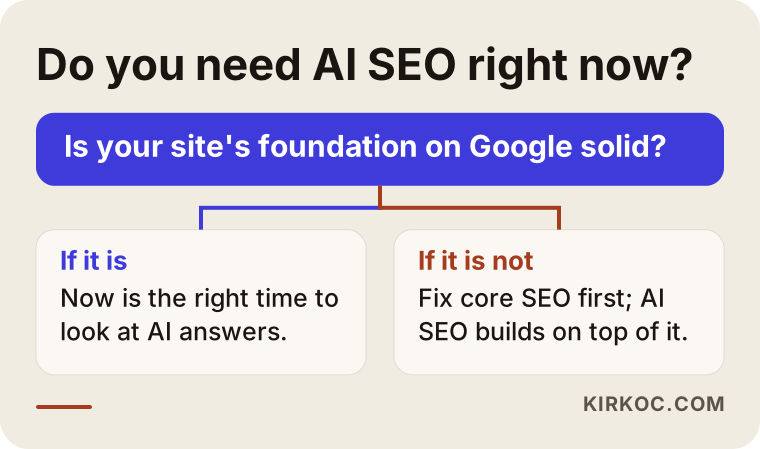
- You have no site, or a very weak one. A proper site comes first.
- Your customers do not come from the internet. If you win work purely by referral and phone, and your competitors ignore the web too, this can wait.
- You do not show up on Google at all. AI tools mostly lean on sites that already appear in search results. Classic SEO first.
- Your budget covers only one thing. Spending it on a Google Business Profile, service pages and basic SEO is often more efficient.
- You expect instant results. There are no fast or guaranteed results here. If you need customers right now, other channels such as ads are a more realistic option.
What a service page should look like for AI answers
A page that is understandable to AI tools and to people needs the same thing: clarity. The layout below works for most businesses. Put what you do and where you work in one sentence at the top. Make the first paragraph a plain definition of the service. Then list the questions customers really ask, each with a short answer. Explain how the work proceeds step by step, and finish with contact details written exactly as they appear elsewhere.
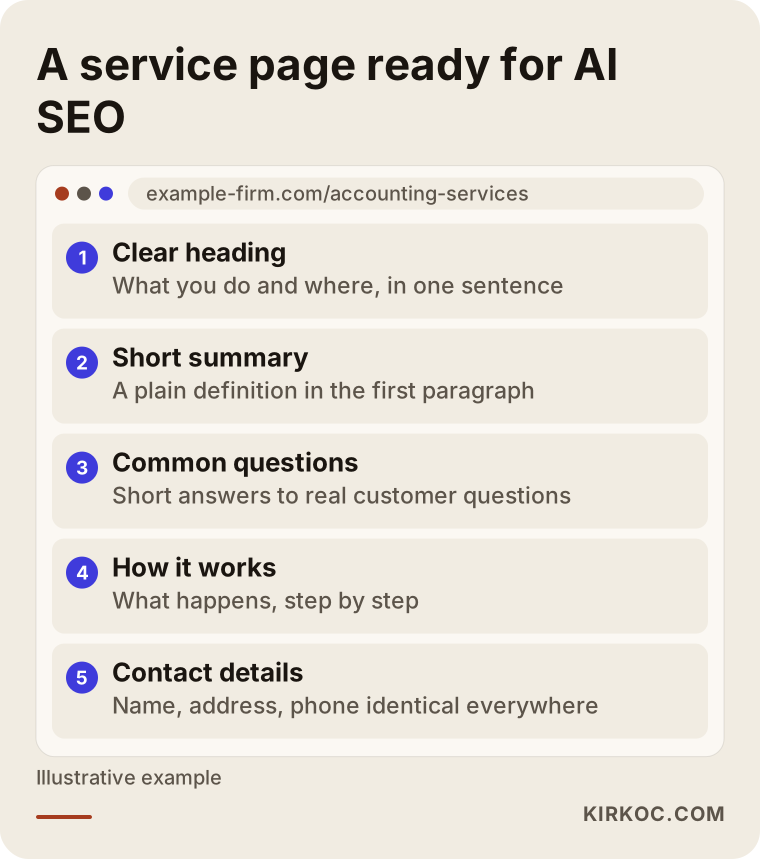
There is nothing magic in this layout. It simply lets a page answer "what does this business do, whom does it serve and how does it work" quickly. When a tool recommends you, it is usually because it could find exactly that.
Common mistakes
Letting a tool write everything and publishing it unchecked. Unchecked text contains errors, and errors reduce trust.
Writing your details differently everywhere. "Inc." in one place, a short name in another, a phone number in two formats. This inconsistency makes it harder for search engines and AI tools to recognize your business.
Skipping the foundation and jumping to the "AI" layer. Adding AI work on top of a slow or mobile-broken site changes little.
Judging by one answer in one tool. The same question can get different answers in different tools and on different days. Do not conclude from a single try.
Setting the wrong expectation for measurement. Visits that come from AI answers cannot always be counted exactly. Expect direction and trend rather than one precise number.
Frequently asked questions
Is AI SEO the same as traditional SEO?
They are close, but not identical. Traditional SEO focuses on your site showing up in search results. AI SEO aims to get your business named in AI answers to customer questions. The second rests on the first: a weak site on Google struggles in AI answers too. That is why good work starts with the foundation.
What should I look for when choosing an AI SEO agency?
Check whether they quote without looking at your site, whether they explain what they will do in plain language, whether they admit the limits of measurement and whether they avoid ranking or revenue guarantees. Ask who writes and approves the copy and how reports arrive. The proposal criteria above are a starting list for that comparison.
Can anyone guarantee first place in AI answers?
No honest provider can. These tools do not keep a fixed ranking and answers shift over time. Wherever you hear the word "guarantee," read the proposal more carefully.
How soon will I see results?
I cannot give a fixed time, because it depends on the starting state of your site, the competition in your field and how fast the tools update. Usually the effect of the core fixes shows first, then changes in AI answers. Asking the same questions at intervals and reviewing the change together is the healthiest approach.
Is AI-written content bad for my site?
Not in itself; the problem is uncontrolled use. A tool can produce a draft, but a person must check accuracy, fit with your business and tone. In health, legal and financial topics this check is essential.
What decides the cost of AI SEO services?
The current state of your site, the number of pages and languages, how sensitive your field is and whether the work is one-off or ongoing. A review is needed before any number; a price quoted without seeing your site is a guess.
Is this worth it for a small business?
If your customers search online and your basic site is solid, a small-scale preparation can make sense. But for a small business with no site or no Google visibility, basic SEO is the higher priority. When money is limited, getting the order right matters more.
Can I do it myself?
Much of it, yes. Asking AI tools your customers' questions, keeping your profile current and writing your details consistently are free. For technical fixes, multilingual work or a sensitive field, a specialist saves time.
If you are unsure what your business needs, I can look at your site and your current situation with you and outline a realistic plan. The scope and process are written out on the GEO services page; get in touch with your questions and I will tell you plainly whether this would help you.