Elevator work is rarely calm. A lift stops in an apartment building, a property manager needs to renew a service contract, or a builder is collecting installation quotes for a new project. All three open Google, but they do not search for the same thing. If your website does not tell them apart, the phone does not ring, and the call that does come in often goes to a competitor. SEO for elevator companies exists to fix exactly that: the right person, at the right moment, finds the right page on your site.
I will keep this practical. You do not need to know what SEO means. What you need to know is who is searching for what, what is probably missing from your site, how to read a quote, and when you should not spend a cent on this at all.
Who searches for an elevator company, and why?
The words typed into a search box reveal the situation behind them. Someone typing "elevator maintenance company" is most likely a property manager or a board member of a building. They hold a contract that is expiring, or they have just taken over a building, or they are unhappy with the current provider. Someone typing "elevator company" is thinking more broadly and may not yet know whether they need installation, service or modernization.
Builders and project owners speak differently. Their problem is finding someone who will deliver the elevator work on schedule and without surprises. They rarely decide from one search. They look at several websites, ask for references, and then pick up the phone. Your site has to make you look like a serious company during that quick comparison.
Then there are emergency searches. A person standing outside a stuck elevator, or a resident worried about a neighbor inside, is not making a planned decision. They want the phone number the moment the page opens, and they want to know whether you cover their area. If the page loads slowly or the number hides inside a menu, they move on to the next result.
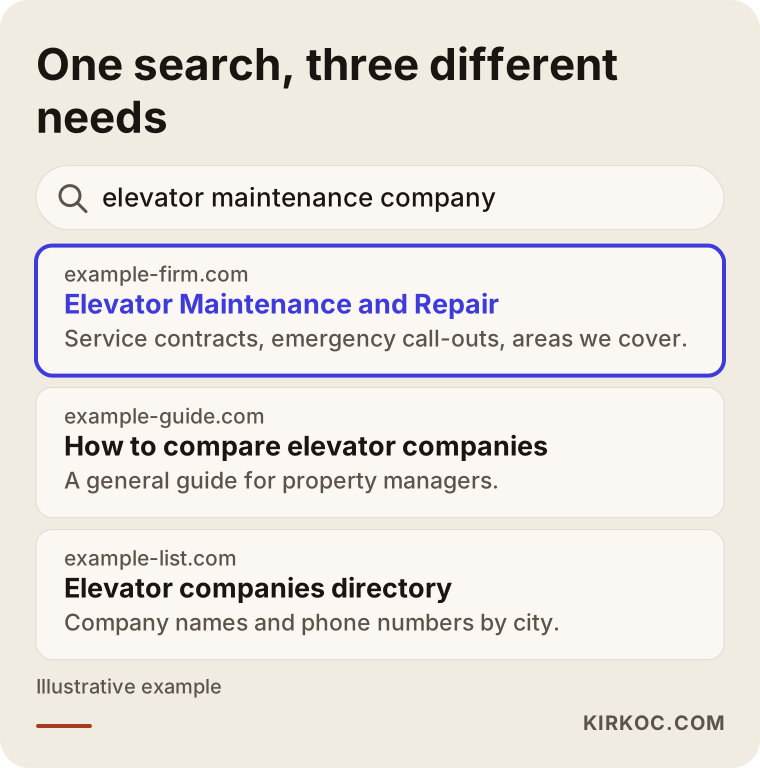
As the illustration shows, one search returns three very different kinds of results. One is a page that sells the service directly, one is a general guide, one is a directory. The site that says plainly what it does lets the searcher think, "this is exactly what I was looking for." Guides and directories serve people who are still gathering information. Your goal is not to appear everywhere. It is to meet the searcher with the page that matches their need.
Installation, service and parts do not fit on one page
The most common problem I see on elevator websites is a single "Services" page where installation, service, modernization, parts and sometimes unrelated jobs are listed one after another. Google cannot tell which search the page should answer, and the visitor cannot find what they came for.
The fix is simple: one page per type of work, because the people searching and the answers they need are different.
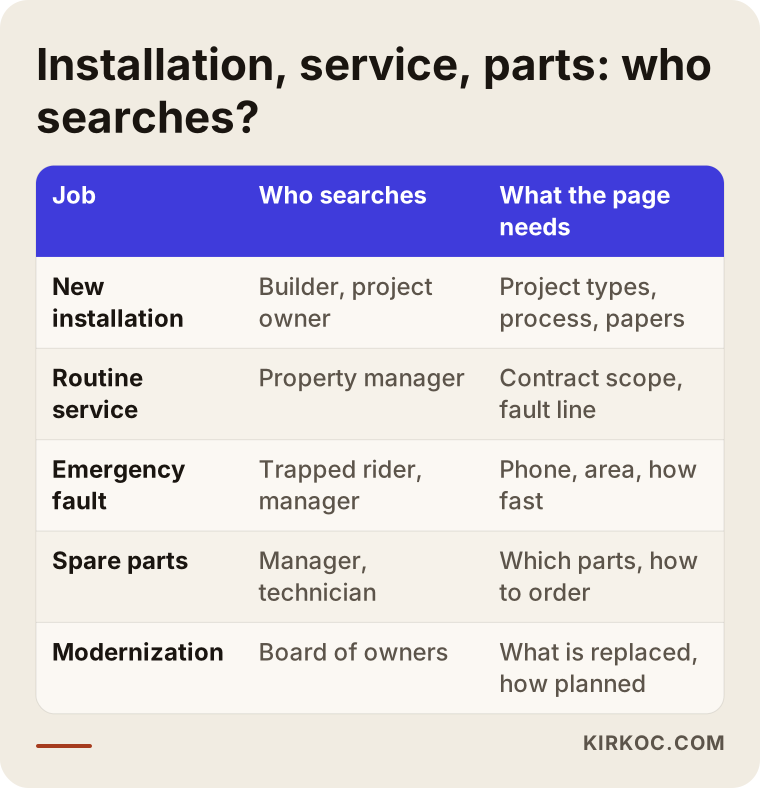
Each row in the table has its own reader. A builder reads the installation page, so show project types, how the work moves from stage to stage, and the credentials you hold. A property manager reads the service page, so explain what the contract covers and whom to call during a fault. The spare parts page is usually read by someone technical who wants to see which parts you supply and how an order works.
Give every page one job
Let each page answer one need. Do not discuss service contracts on the installation page, and do not describe new projects on the service page. This helps Google, but it helps people more: a visitor who finds what they need within a few seconds stays on the page.
A word about city pages
Many companies copy the same text for every town and just swap the name. That is unhelpful and search engines do not like it. Create a page for an area only if you can say something specific about it, such as the building types you see there, the response approach or the kind of jobs you have done. If you have nothing specific to add, a single "areas we cover" section is enough.
How a property manager decides
A property manager's job is managing risk. When the elevator breaks, the complaints land on their desk, and choosing a service provider is their responsibility too. So before price, they look for trust: "If I call this company, will they pick up, show up and know what they are doing?"
A manager typically moves in a pattern. First a search and a quick look at a few sites. Then a question to managers of nearby buildings. Then a call or an email to one or two companies for a quote. Your website's job is to get you onto the shortlist during that first look. Winning the quote depends on the conversation after.
On your site the manager looks for these things: a clear number for faults. What a service contract includes and what it does not. Which area you work in. Credentials that show you are authorized. Evidence that you have worked on similar buildings. If none of these answers are on the page, even a good price will not trigger a call.
Imagine this: a small service company
Imagine a small elevator service company in a mid-sized city with two technicians, where most customers arrive through word of mouth. The website has a general sentence on the home page and a contact form. When a new property manager searches "elevator maintenance company," this business does not show up; the sites that do appear state their service contract, fault line and coverage area plainly.
The owner has a service page written: at the top the area and the fault line, then the contract scope, credentials and common questions. After a few months, referrals keep arriving at the same pace, but a few managers who found the business through search start to call as well. That is not a ranking guarantee. It is only an illustration of what can happen when the right page meets the right search.
Credentials, trust and the layout of a service page
In the elevator trade, trust is the product. People ride these machines every day, and a failure can have serious consequences. So everything you show on the site must be real and current. Which licenses or inspection documents apply in your area is a question for your industry regulations and the authorities; I do not give legal advice here. I am only talking about how to present that information on a website.
The rule is simple: do not list a credential you do not hold, do not display an expired one, and do not add a logo you cannot explain. Showing the document is half of it. A single sentence next to it explaining what it means builds the customer's confidence further.
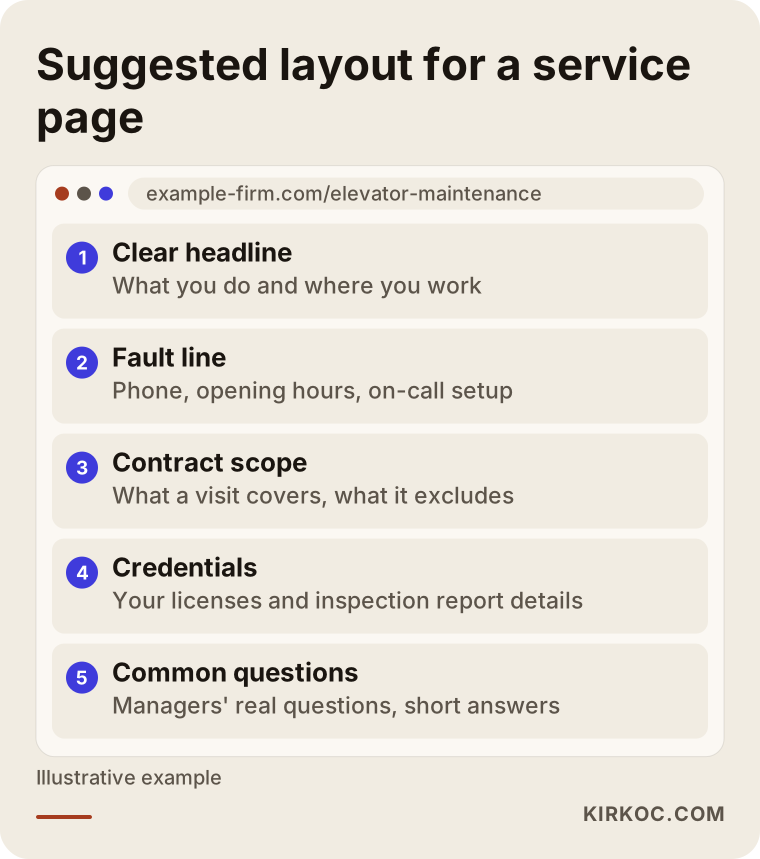
The layout above is what I would suggest. At the top goes one sentence about what you do and where you work. Right below it, the fault line, because that is the first thing someone in an emergency looks for. Then the contract scope, credentials and common questions. This order follows the questions that run through the visitor's mind.
Photos and real jobs
Use photos from your own work instead of stock images: a machine room, a cab refurbishment, a door replacement. Two sentences beside each photo are enough: what was done and why. Do not share a client's name or address without permission. This kind of content builds trust with people and also helps Google understand what the page is about.
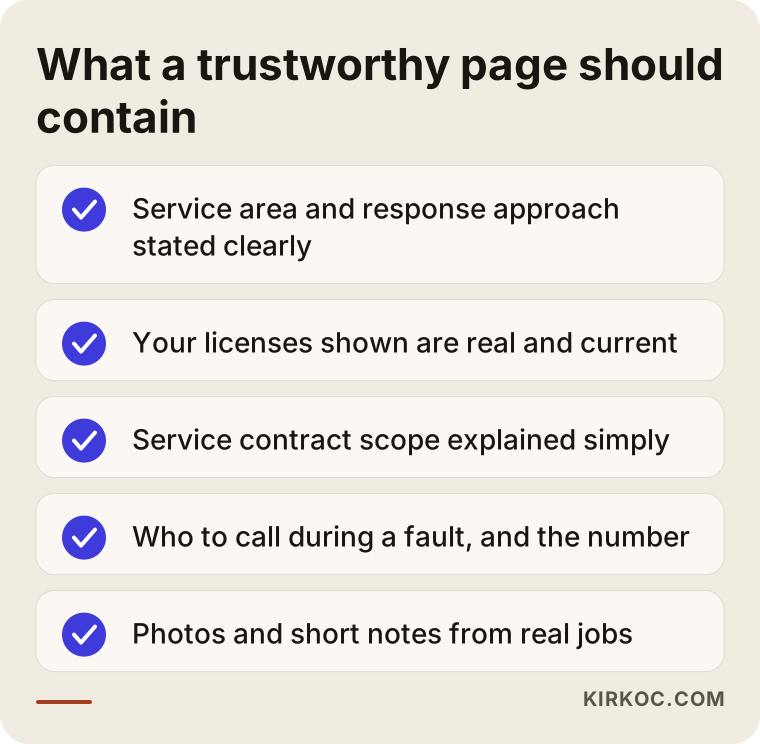
Use the list as a test question: can a manager who sees this page for the first time find all five things? If one is missing, that gap is precisely what knocks you off their shortlist.
Showing up on the map and in reviews
Someone dealing with a fault often searches on a phone for "elevator repair near me" and gets a map. To appear there, your Google business listing must be open, accurate and current. Your name, address or service area, phone number and opening hours should match your website exactly. If one place shows the old number and another the new one, the caller gets confused and Google does not know which to trust.
Reviews matter in the same way. You can ask a satisfied manager to leave an honest review of their own accord. Buying reviews or writing them yourself is wrong, and it damages your reputation when it comes out. Answering a negative review in a short, calm, solution-focused way shows the next manager how you behave when something goes wrong. In a trade where trust decides, those replies are sometimes read more closely than anything on your site.
AI assistants and elevator companies
Some managers now ask AI tools directly: "Can you recommend a reliable elevator service company in this area?" These tools find it easier to work with sites that explain their services clearly, keep details consistent and introduce themselves plainly. The basics are the same here: separate, clear pages for installation, service and parts, and the same name, phone number and area everywhere. I cannot promise you will be mentioned, but keeping your site tidy and understandable improves your chances both in Google and in those answers.
Spare parts and modernization searches
Spare parts and modernization searches are less visible than installation and service, but they are valuable jobs. A person searching for parts usually knows what they want: a door mechanism, a control board, a button panel. A page that lists your parts categories, the brands and model families you work with and how to place an order is enough. Do not present a product as if you stock it when you do not.
Modernization is a decision made by a board of owners. For an aging elevator, the manager asks: what can be done, how long will it take, and will the building be without a lift? An article or page that answers those questions becomes a document in the manager's hand, sometimes even printed and taken to the meeting. Because it does not look like a sales pitch at first glance, it builds more trust.
How working with me goes
Many business owners hesitate because they do not know how an SEO project actually runs. I work alone, which means the person you talk to is the person doing the work. The process looks like this.
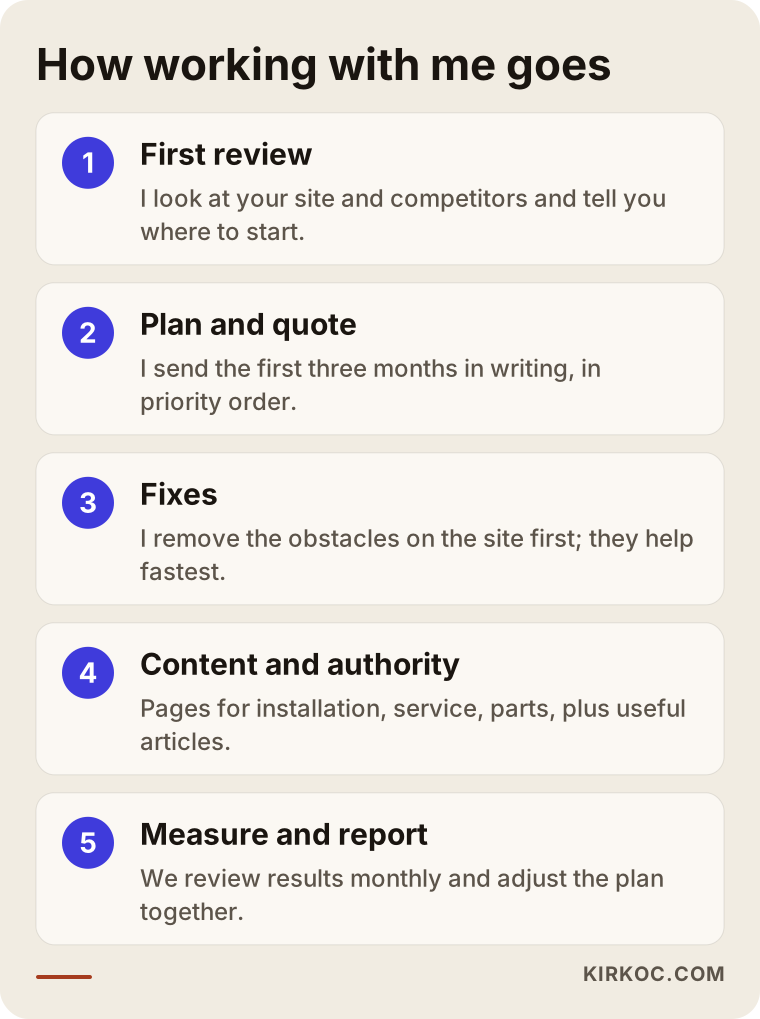
First I look at your site and your competitors and tell you where to start. Then I send you the first three months in writing, in priority order. Next I remove obstacles on the site, such as slowness, pages that look broken on a phone and links that do not open. These are things Google and visitors both dislike, and the fastest effect usually comes from here. After that I prepare pages and articles for the searches you want to win: installation, service, parts and modernization. In the last step we review results every month with a plain-language report and adjust the plan.
There is no "secret method" anywhere in this. I talk through what is being done, because you know your business best. You know which areas you cover, which jobs you want and which jobs you no longer want.
What the work covers, and what it does not
The work comes down to five parts. A site review: I go through your whole site and list, point by point, why Google holds you back. Finding the right searches: I research what your customers actually type and choose the searches that bring work. Technical fixes: I resolve problems such as slowness and phone compatibility. Content work: I strengthen your service pages and write articles that answer customers' questions. Competitor tracking and monthly reporting: I look at what the higher-ranking competitors do differently and report what was done in plain language.
What do I not do? I do not guarantee rankings, because nobody can. I do not invent credentials, write fake reviews or run down other companies. I also do not give regulatory or legal advice; what you publish about licenses is decided by your trade rules and the authorities. I place that information clearly on the right page.
Who it suits
This work fits businesses that have a website but get no customers from Google. It also fits companies that do not want to depend on an ad budget, meaning those who dislike the phone going quiet the moment ads stop. Firms whose competitors rank above them while their own site is invisible, and those who bought SEO before without seeing results, belong in this group too.
What decides the cost
I do not quote figures here because every elevator company is different. Several things set the cost. First, the current state of your site: building from scratch takes different effort than fixing a site that mostly works. Second, your coverage area: one district, a whole city or several cities. Third, how many types of work you want to be found for: service only, or installation and parts as well. Fourth, competitor strength; in an area with very strong rivals the work takes longer. Fifth, the amount of content: how many pages and articles are needed.
That is why the quote comes in writing after the first review. A "package price" given before anyone looks at your site is usually a number that ignores your situation, and later it turns into either missing work or unnecessary work.
How to compare quotes and providers
If you are collecting quotes from several people, ask these questions before you look at the numbers. Are you quoting without seeing my site? Can you list what you will do, item by item? How and how often will I get a report? Who writes the articles, and can I approve them? When this ends, does the site stay mine? A person who answers plainly and without dodging is usually the more reliable choice.
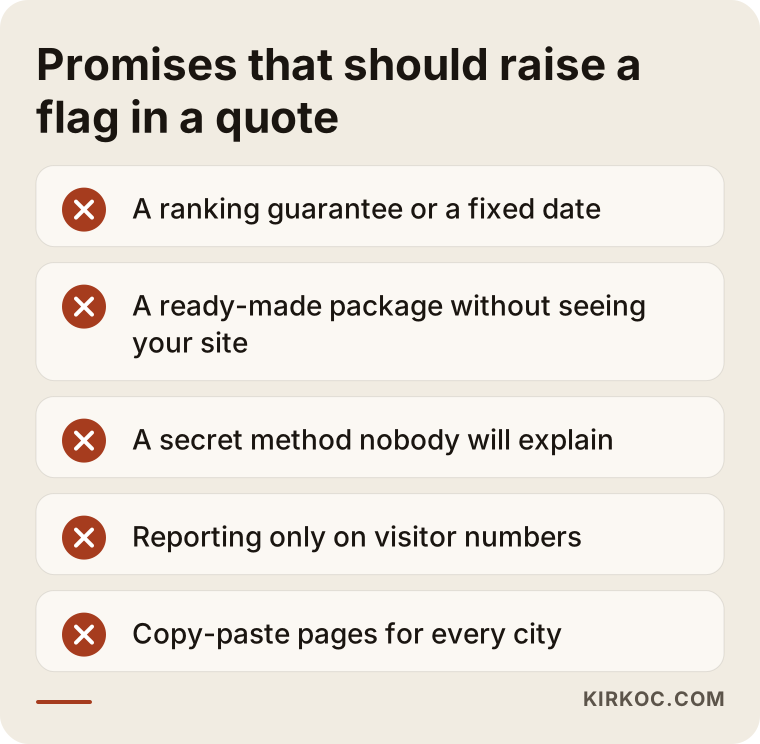
The five promises above are warning signs. Above all a ranking guarantee: nobody controls Google, so someone promising "number one" is either wrong or not telling you the truth. Reporting only visitor numbers is misleading as well; what counts is whether those visitors called you and which searches brought them.
Agency or one person?
A large agency has the advantage of a broad staff, and the drawback that the person selling and the person doing the work may differ. Working with one person gives you direct contact and quick decisions, with the risk that they may be unreachable for a week. Whichever you choose, have the delivery dates and deliverables written into the agreement.
Common mistakes
These are the mistakes I keep seeing on elevator sites. Putting all services on one page. Placing the fault number only on the contact page. Creating copy-paste pages for every district. Posting credentials as small images with no explanation. Never testing the mobile view, even though most emergency searchers use a phone. Leaving old numbers on the site. Business listing details that do not match the website.
There is also the mistake of "I wrote articles and nobody read them." An article only works if it answers a real question at the moment of decision. Writing "what is an elevator" brings no customers. Writing "what to check in a service contract" does.
When you do not need this
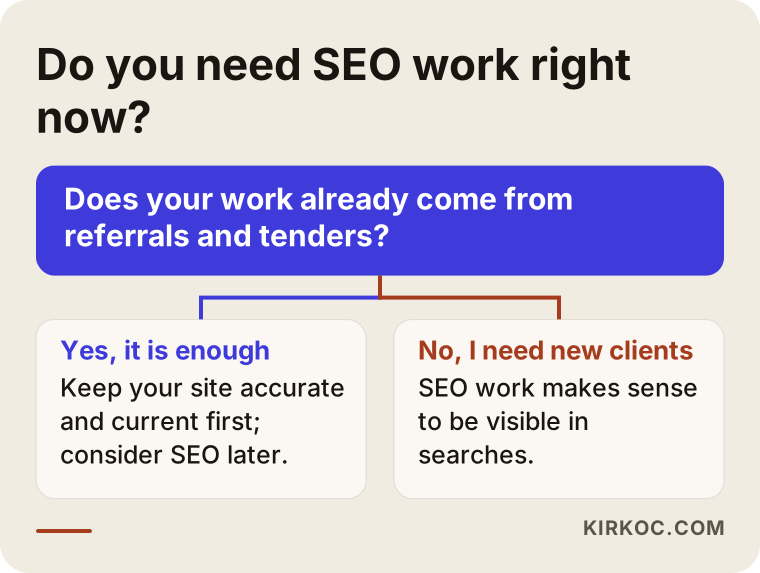
To be honest, not every elevator company needs SEO. If nearly all your work comes through tenders, corporate contracts and referrals and your capacity is already full, extra customers from search can become a burden. In that case, keep the site accurate and make sure the phone number works.
Likewise, if you have no intention of updating the site or adding pages, the effect of SEO stays limited, because it is not a one-time job. And if your area truly has no competition and search volume is very low, your budget may be better spent elsewhere. I say so openly in the first review.
Doing it yourself or hiring someone
Some things you can and should do yourself. Claiming and maintaining your Google business listing, making sure phone numbers are right, asking customers for reviews with their consent, and collecting photos of real jobs come first. They cost nothing and nobody else can do them for you.
You need an expert for the technical side and planning: finding out why the site is slow, choosing which searches bring work, building pages that do not compete with each other, and measuring results. Learning that takes time away from your business. An elevator technician should not drop wiring work to study SEO, and I would not stop to learn how to install an elevator.
Imagine this: an installation company
Imagine a company that installs elevators in new buildings and gets most of its work from two or three builders it already knows. One of those builders finishes a project and moves to another region. The owner says, "Nobody outside our circle can find us." The site has only a company name, a logo and a phone number.
A separate installation page is prepared: which building types the company works on, the stages a job goes through, which credentials are held, photos from past work. This is the page a builder reads while collecting quotes. In this hypothetical case the result is not guaranteed, but when a builder starts looking, there is at least an explanatory page to find, and the company gains a chance to be seen beyond its familiar circle.
Before you start, ask yourself
Three short questions. Is the emergency number visible on the first screen of your site? Do you have separate pages for installation, service and parts? Are your credentials real, current and explained? If all three are yes, the base is ready. If any is no, fixing it helps you even before SEO.
Frequently asked questions
What does SEO do for an elevator company?
It raises the chance that a potential customer searching for "elevator maintenance company" or "elevator installation" meets your page. It guarantees nothing; it improves your odds by building the right pages and keeping the site healthy.
Do property managers really search online for an elevator company?
Many do. Referrals still matter, but even after a referral people check the company's website. If information is missing or there is no site at all, even a referral sometimes does not convert.
Can one page cover installation and service?
Usually not. The people searching are different and what you need to tell them is different. Separate pages help Google show you for the right search and help visitors find what they want quickly.
Do I have to show my credentials on the site?
Whether it is required depends on your industry rules, which you should confirm with the relevant authorities. Showing real, current credentials with a short explanation does increase trust. Never list one you do not hold.
When will I see results from SEO?
Some fixes act quickly, while content and reputation take time. I cannot give a date, and nobody honestly can. We follow progress together in a monthly report.
Should I buy ads or pay for SEO?
They do different jobs. Ads bring results right away and stop when you switch them off. SEO builds slowly but leaves a lasting base. If you need customers immediately, think ads; if you want a long-term base, think SEO. Some companies use both.
If my website is old, do I need a new one?
Not always. Sometimes fixing the current site is enough, and sometimes rebuilding is cheaper. In the first review I look at your site and tell you plainly which makes sense.
Can I reach customers outside my own city?
You cannot win work in an area you do not serve, but pages for nearby towns you genuinely cover can be built. I only work on areas where you actually provide the service.
If you want your elevator company to reach the right person when they search for service, installation or parts, write to me. I will look at your site and competitors and tell you where to begin; you can see how I work on the SEO services page, and then get in touch with me directly.