If you run a car rental company, you probably know the feeling. The bookings come in, but a large share of them come through someone else's website, with a commission attached, and you never see the customer's name until the day they pick up the keys. Your fleet is fine. The real issue is that when someone searches for a rental car near an airport or in your city, your own website is not in the picture. Closing that gap is what SEO services are for. I work on this as an independent consultant, remotely, and in this guide I will explain what the work involves, what it costs you in terms of decisions rather than dollars, and when you should skip it.
What dependence on booking marketplaces really costs
Marketplaces are not the enemy. For a new company, they are often the quickest way to get a first renter. The trouble starts when they become the only door into your business. Here is what that looks like in practice.
First, you do not control how you are shown. You appear in a list next to many competitors, usually compared on one thing: the daily rate. A cleaner car, a friendlier pickup, an agent who waits for a delayed flight: none of that shows up in a price comparison.
Second, the customer belongs to the platform. The same person will rent again next year and will begin the search in the same place. You served them once but never built the relationship.
Third, the rules can change overnight. Commission structures, ranking logic and visibility terms are set by someone else. When they shift, your demand shifts with them, and you get little warning.
Fourth, reviews and reputation do not accumulate on your own pages. A happy renter leaves praise on the platform, not on a page you own.
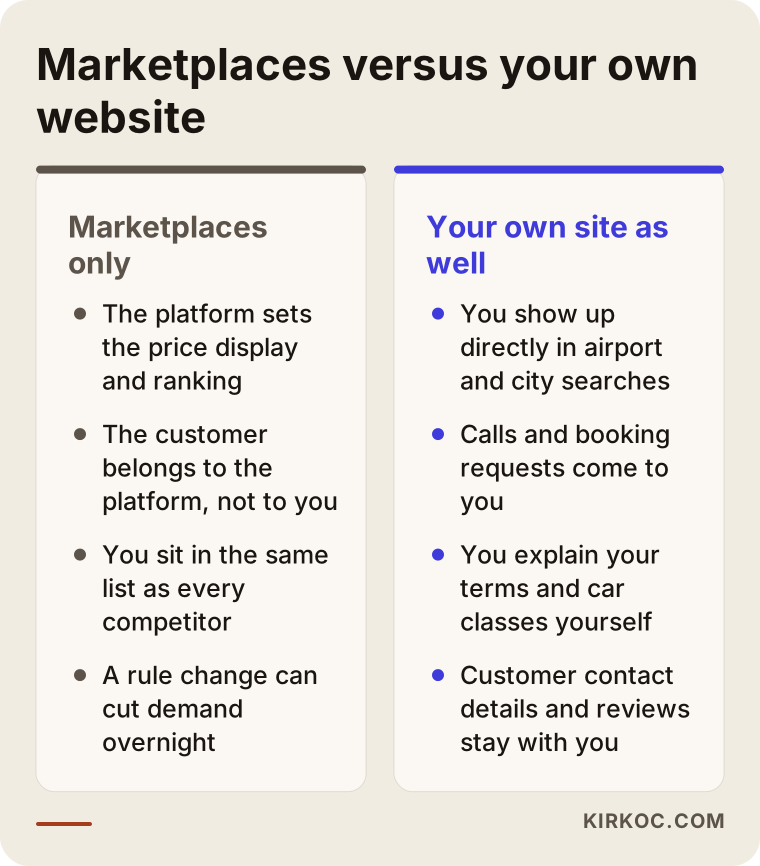
None of this means you should leave marketplaces. It means treating them as one channel while your own site grows into a second door, and eventually the main one. Every reservation that comes directly is the same car earning more. I will not put a number on it, because I do not know your commission terms, but you can run the math yourself in an afternoon.
What renters actually type into Google
How people search for rental cars is the most useful thing to understand about this industry. Hardly anyone types only "car rental". Most people type a need and a place.
Location searches. "Airport car rental", "car rental downtown" and "car rental near the train station" are the most valuable. The person is already traveling and needs a car soon.
Car class searches. "Minivan rental", "SUV rental", "automatic transmission rental". Here the renter knows what they want, which makes them close to a decision.
Duration and purpose searches. "Weekly car rental", "monthly car rental", "car rental for a wedding", "van rental for a move". These come from a specific job to be done.
Trust and terms searches. "Car rental without a credit card", "car rental under 25", "do I need an international license". These sound like questions, and the company that answers them clearly earns trust before the first call.
Searches in other languages. If you serve tourists or business visitors, some will search in their own language. That is a topic for later in this guide.
The conclusion is straightforward: one general "Rentals" page cannot answer all of these. Your site needs a page for each kind of intent you actually serve.
Airport pages: the page that tends to pay off first
Someone renting at an airport usually searches before they travel, sometimes from the plane or from their couch. They are not only looking at price. They want to know: when I land, where do I pick up the car, how will I find you, and what happens if my flight is late?
On most rental sites, those answers are missing. A line like "airport pickup available" does not help. Google, too, tries to show the page that best answers the question behind the search.
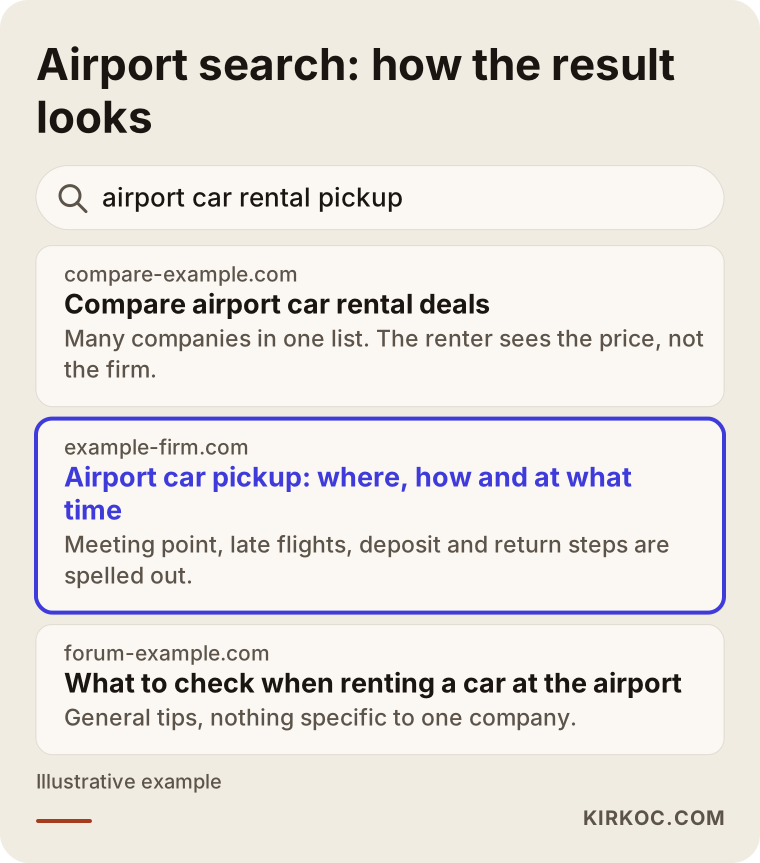
In the illustration, the comparison site offers a long list but nothing specific to one company. The forum thread gives general tips. The company page that explains the meeting point, the hours and the return steps answers the search best, which is why it has a chance to stand out. I cannot promise a ranking, but this is the logic behind it.
What an airport page should contain
Build a separate page for every airport you really serve, and write it for that airport. Copying one paragraph and swapping the airport name is easy to spot, for Google and for the renter.
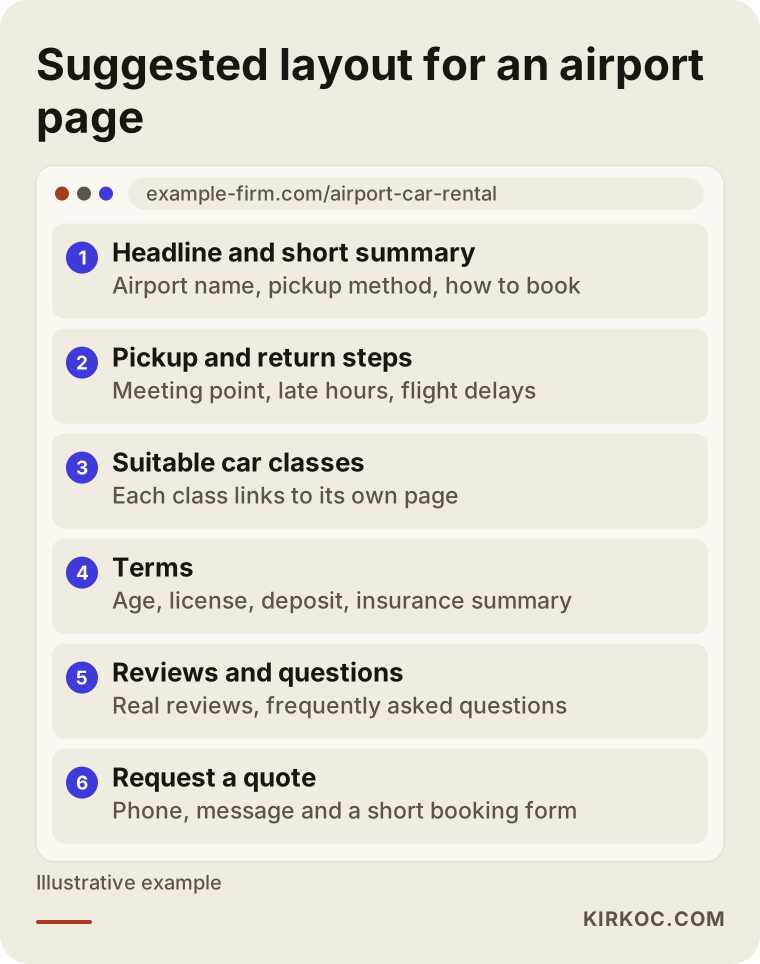
Here is the order I suggest. At the top: the airport name, how pickup works and how to book. Right below: pickup and return steps, covering the meeting point, what happens on late arrivals, and what you do when a flight is delayed. Next, links to the car classes most requested at that airport. Then the terms in plain language: minimum age, license requirements, deposit, a short insurance summary. After that, real reviews and common questions. At the bottom, a phone number, a message option and a short form.
The reasoning is simple. The visitor should think "I am in the right place", then "I can trust this company", and finally "reaching them is easy".
City and neighborhood pages
Not everyone rents at the airport. Plenty of people want delivery to a hotel, a train station, a business park or their own front door. A search like "car rental near [neighborhood]" may be smaller in volume than an airport search, but the person typing it usually has a very clear need.
The key word here is honesty. A page for an area you do not actually serve misleads people and damages trust at the first call. Create pages for places where you deliver, have an office or hold parking. Say how long delivery takes, which handover points you use, and one detail that is specific to the area. If your office is a short walk from a station, say so.
The same page should show a map, the address and your opening hours, matching your Google Business Profile exactly. Small differences across your site, your profile and online directories make both Google and customers hesitate.
Car class pages for people close to a decision
A renter who types "minivan" usually knows they need one. Showing every vehicle in one gallery leaves that person halfway. A separate page for each class answers the search and shortens the path to a reservation.
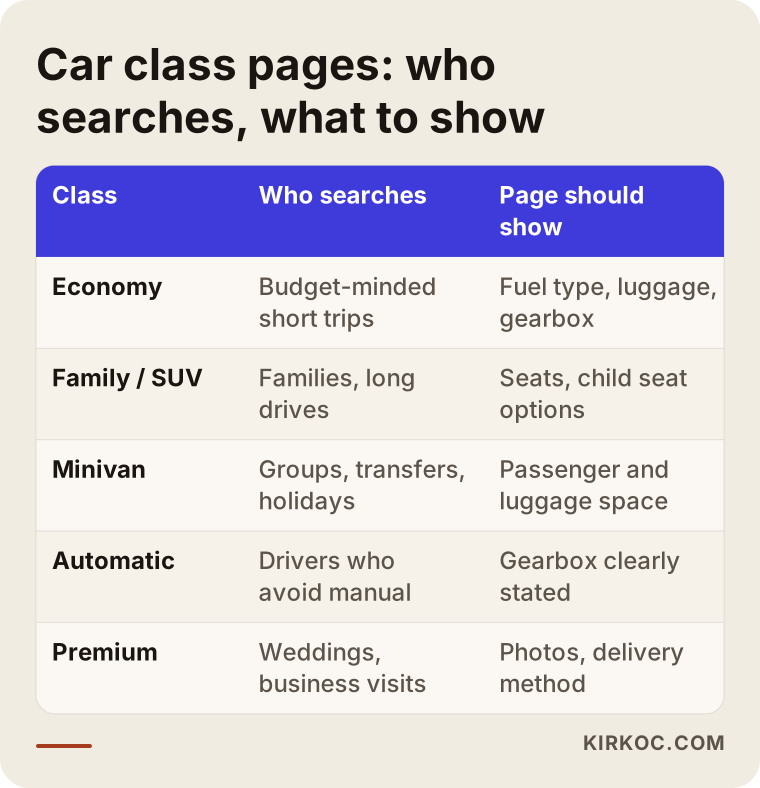
Adapt the table to your own fleet. For family vehicles, seat count and child seat options matter. For anyone who needs an automatic, the gearbox must be written out plainly, since these renters often add "automatic" to their search. Groups looking at vans want to see whether people and bags will fit. On a premium page, photos, delivery method and typical use, such as a wedding or a business visit, should stand out.
One more detail. If you sometimes substitute a similar model, do not promise a specific one. Write "a vehicle in this class, such as" and name examples honestly. If the renter finds a different car at pickup, an over-specific page works against you.
Trust: reviews, deposits and clear terms
When people rent a car, they are not buying a product. They are taking on a risk. They wonder what happens if the car arrives damaged, if the deposit is not returned, or if a surprise fee shows up. For this reason, trust is a separate part of SEO in this industry.
Do not hide your terms. How is the deposit handled, when is it released, what does insurance cover, what is the fuel policy, is there a mileage limit? Put it on one short page in plain language and link to it near the booking form. Having this information on your site helps both Google and a renter in the middle of a decision.
Reviews work the same way. Your Google Business Profile reviews are often the first thing people check. The healthiest way to earn them is to ask politely after a rental is completed. Buying or inventing reviews is risky and backfires over time. Answer negative reviews calmly and with detail; every future renter who reads the review is also reading your reply.
From search to booking
Many rental sites get visitors but few reservations. Often the path is too long or too vague. SEO brings the visitor, but what happens next decides whether the effort pays off.
On a phone, the phone number should be tappable. If you offer messaging, make it visible. The booking form should be short: dates, pickup place, car class, contact. A seven-field form sends people to another site.
I do not build booking software. If you already have a reservation system or form, my job is to set up the right searches and pages that lead into it and to point out fixes that help visitors move forward. If you need a different booking setup, we talk about that openly at the start.
Corporate and long-term rental searches
Alongside short tourist rentals there are companies looking for monthly or yearly arrangements. These customers think differently. Invoicing, maintenance, backup vehicles, what happens after damage and how flexible the contract is come before price. If one page tries to speak to both tourists and companies, it answers neither well.
I suggest a separate page for business rentals. Write who you serve, how a quote is prepared, what you handle for maintenance and replacements, and who the contact person is. A "request a quote" button and a phone line often work better here than a form, because businesses tend to want to talk to a person. Searches for this page may be fewer, but each one can mean a contract rather than a single booking.
Visitors from abroad and multilingual pages
If you work near tourist areas or business hubs, some customers will search in another language: "Mietwagen Flughafen" in German, "hyra bil" in Swedish, "alquiler de coches" in Spanish. These are often the exact people marketplaces capture, so pages in their language are the shortest route away from commissions.
The most common mistake is pushing one text through machine translation. A foreign renter expects the concepts they know from home: whether their license is accepted, whether a credit card is required, which documents you ask for at handover. Each language needs pages written for that reader. We choose the languages that make sense by looking at who really rents from you.
Mistakes I see most often
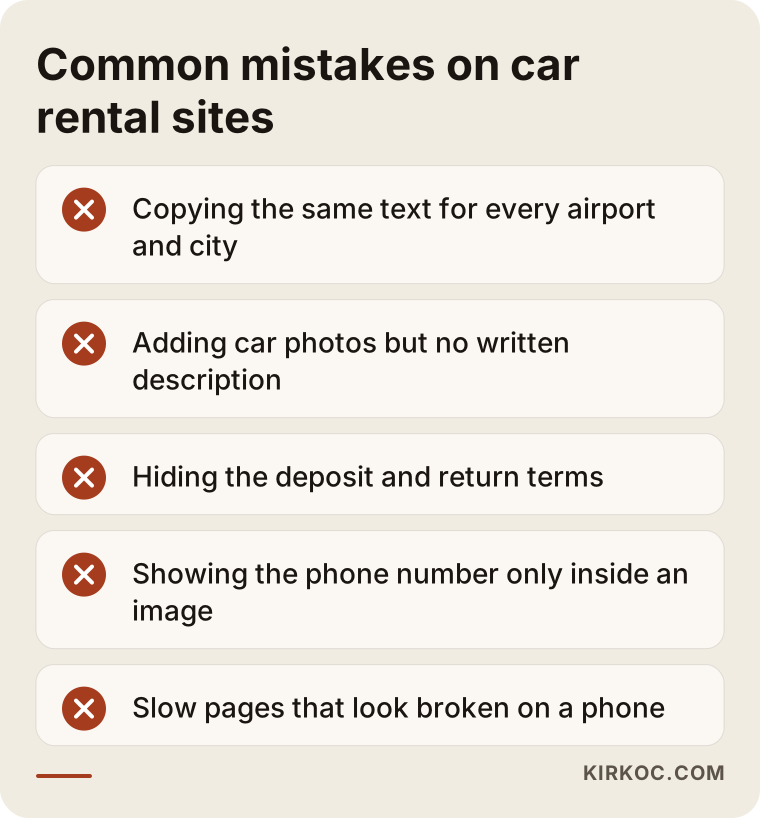
Let me expand on the list, because the same things come up on most sites.
Copy-and-paste pages. Publishing the same text for every airport and city is easy and worthless. Google struggles to tell similar pages apart, and visitors do not find what they came for. A few full pages beat many empty ones.
Photos without descriptions. A vehicle gallery looks nice, but Google cannot read an image the way a person does. Class, gearbox, fuel, luggage and seats should be written out as well.
Hiding terms. Replacing deposit and return information with "call us" sends a cautious renter straight back to the marketplace.
Phone number inside an image. A number baked into a banner cannot be tapped, copied or read by search engines.
Slow pages that break on phones. Most renters look on a phone. If the page loads slowly, a button falls off the screen or the form fails, the visitor that SEO brought is wasted.
Vague targets. Aiming at the single broad phrase "car rental" usually means competing head-on with the biggest platforms. For a small or mid-sized company, a combination of place and intent is a smarter place to begin.
What shapes the cost of this work
I do not publish a price here, because the scope differs from company to company. These are the factors that decide it:
- How many locations and car classes need pages. One office in one city is a different job from several airports and cities.
- The condition of your current site. Starting from a clean site differs from repairing one with technical problems.
- The number of languages. Each extra language means pages written for that market's renter.
- Competition. In crowded areas the work takes longer and requires more effort.
- Content volume. How many answers to common questions and guides are needed.
- Tracking and reporting. How detailed the monthly review should be.
That is why I begin with a short review and then send a written proposal. You will see what is included and what is not.
How to compare quotes from SEO providers
If you are collecting quotes from several people or companies, check these points:
- Did they truly look at your site? A proposal without one concrete observation about your site is a template.
- Are target searches stated? "We will improve your rankings" is not enough. Which searches, and which pages for them?
- Do they guarantee rankings or revenue? If so, walk away. Nobody can guarantee what Google will do.
- Is the scope written down? Technical fixes, content and reporting should be listed separately.
- What does reporting look like? You should get a plain report that explains what was done and what comes next.
- Do they understand rental customers? Someone who does not know how renters behave will fill pages from a template.
- Are the contract length and exit terms clear?
Use the same list on me. If I cannot answer something, I will say so.
How working with me runs
I keep the process simple and written.
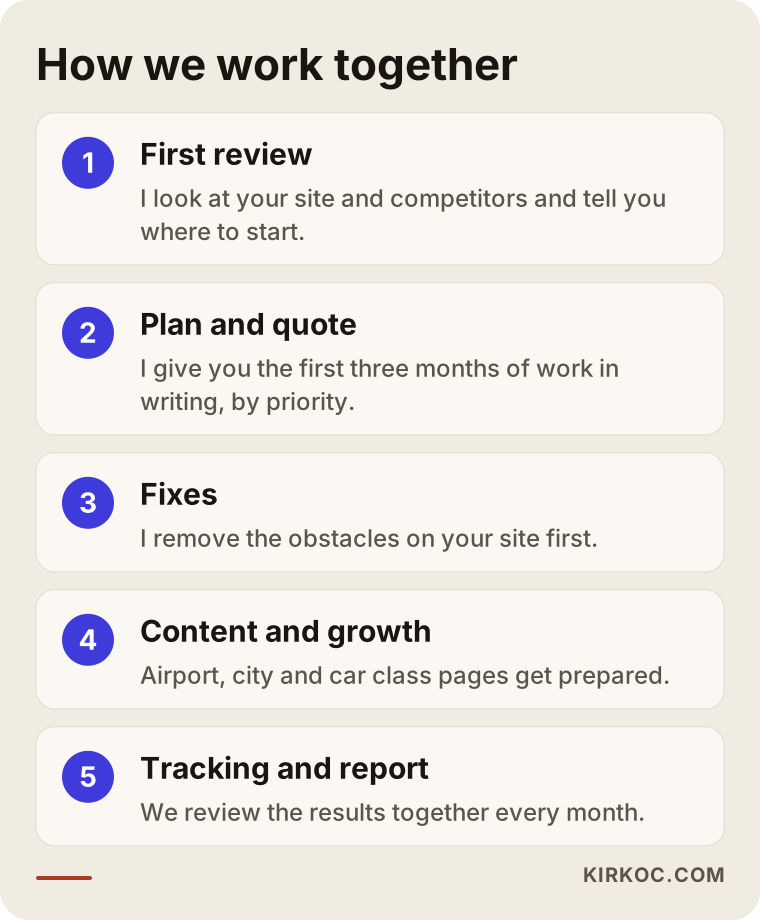
First I look at your site and your competitors and tell you where to start. Then I give you the first three months of work in writing, in order of priority. Next I remove the obstacles on the site, because those usually have the quickest effect. After that, pages and articles are prepared for the targeted searches: airports, cities, car classes and terms. Every month we review the results together and update the plan.
I work remotely, by video call or phone. I learn about your fleet, handover points and customers by listening to you; pages written without that knowledge come out generic.
Should you do it yourself or hire someone?
You do not have to outsource everything. A lot of this you can handle on your own:
- Complete and regularly update your Google Business Profile.
- Ask for a review after every rental.
- Write your terms and deposit information in plain language.
- Show your phone number as tappable text.
- Add short, accurate descriptions to your vehicle photos.
Outside help makes sense when you do not know which searches would bring you business, when your site has technical problems, when you need pages for several places or languages, or when you simply lack the time to maintain all that. Getting the research and plan right once costs far less than months of writing the wrong pages. The decision is yours, and I will not sell you something you do not need.
Let's say two different companies
These are hypothetical examples, not real clients.
Scenario one. Let's say a small company has an office near a regional airport. Most bookings come through two or three marketplaces, and its own site is a single-page introduction. Work would begin with one complete airport page. Next come separate pages for the two or three most requested car classes, plus a page explaining the deposit and return terms. The Google Business Profile is tidied up, and a habit of asking for reviews is set. After a few months we see which searches the site appears for and adjust. I cannot predict the result, but the company would have built the base of a site that earns searches in its own name.
Scenario two. Let's say another company delivers across several neighborhoods of a large city and also offers rentals with a driver. The site is attractive and has many pages, but most of them are near copies. Rather than writing more, it makes more sense to simplify first: merge pages that cover the same topic and make every neighborhood page truly about that area. A separate page is built for chauffeured rentals and another for corporate customers. In this case the work is mostly editing, not adding.
When you do not need this
To be honest, not every rental company needs SEO.
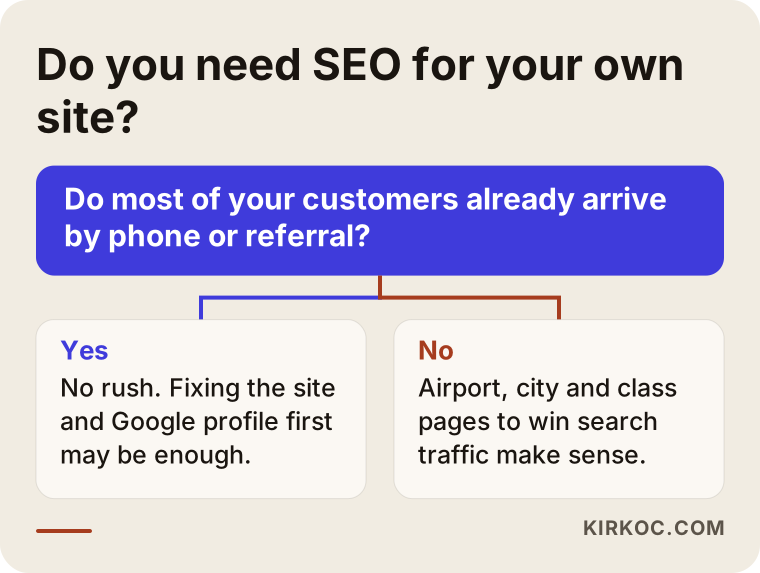
If your customers already arrive through referrals, corporate contracts or a loyal circle, and you are too busy to take more, there is no rush to chase search traffic. Fixing the site and the Google profile first may be enough. If your fleet is small and you could not serve extra demand, an SEO investment is wasted; think about capacity first. And if you expect results in a month or two, SEO is not for you. It takes time, so do not confuse it with a short-term ad budget.
The reverse also holds. If you are a young company fed by one marketplace, your first job is to lay the foundation of your own site. That foundation is where reducing dependence begins.
Frequently asked questions
How long does car rental SEO take to work?
I cannot give an exact time. New pages may take weeks to months to find their place, depending on competition and your site's condition. Movement often shows first in less crowded searches that combine place and intent. Do not trust anyone who guarantees a ranking.
Should I stop using marketplaces completely?
No. Marketplaces can help you reach new renters. The goal is to depend less on one channel. As your own site grows, you can reconsider how much you rely on them, based on your own numbers.
Do I really need a separate page for each airport?
If you serve several airports, yes. The pickup point, hours and terms differ at each one. Do not create a page for an airport you do not serve.
How many car class pages should I have?
Pages for the classes you really have and that people ask for. You do not need to build them all at once. Starting with the two or three most rented classes is healthier.
Do I need pages in other languages for foreign visitors?
If a significant part of your renters come from abroad, yes. But you need pages written for that country's renter, not a translation. We decide which languages make sense by looking at who actually books with you.
Do you set up the booking system?
No, I work on SEO and content. If you already have a reservation system, we build pages that work with it. If you need a different setup, we discuss that at the start.
Is the Google Business Profile part of this work?
Keeping its details consistent with your website matters, and I check that during the review. Collecting reviews depends on your relationship with your customers; I suggest ways to do it.
Is advertising better than SEO?
They do different jobs. Ads are quick but stop when the budget stops. SEO is slower, but the pages build up over time. Some companies use both. We decide what suits you by looking at where you stand now.
If you want more direct bookings for your car rental company, I can take a short look at your site and your competitors and tell you in writing where to start. Reach out through the SEO services page, and we will begin by talking about your fleet, your pickup points and your goals.