You do not need thousands of customers. A handful of the right ones a year, each bringing a long and valuable contract, may be all your business needs. The trouble is that those few buyers type something into Google while looking for a supplier, and the page that appears is your competitor's, not yours. That is where B2B SEO comes in. The aim is not a crowd of visitors but the right companies finding you when they search. I am a solo SEO consultant working remotely, and my SEO services page explains what I do; this article goes deeper for companies that sell to other companies.
How does a business buyer search differently from a consumer?
Someone looking for a restaurant for tonight and a factory looking for a new supplier are doing two very different things. The first is over in minutes. The second can take weeks. That difference changes how your website should be built.
Business buyers have three traits worth knowing. First, one person rarely decides alone. The person typing the search may be a procurement officer, but an engineer reads the specification, a manager owns the budget, and someone else checks the contract terms. Your website has to answer each of them. Second, mistakes are expensive. Whoever picks the wrong supplier has to explain it internally, so buyers look for reassuring detail: certificates, capacity, delivery times, experience with similar work. Third, the process is slow. A visitor lands on your site today and asks for a quote three weeks later. In between, they compare you with others and come back to your pages more than once.
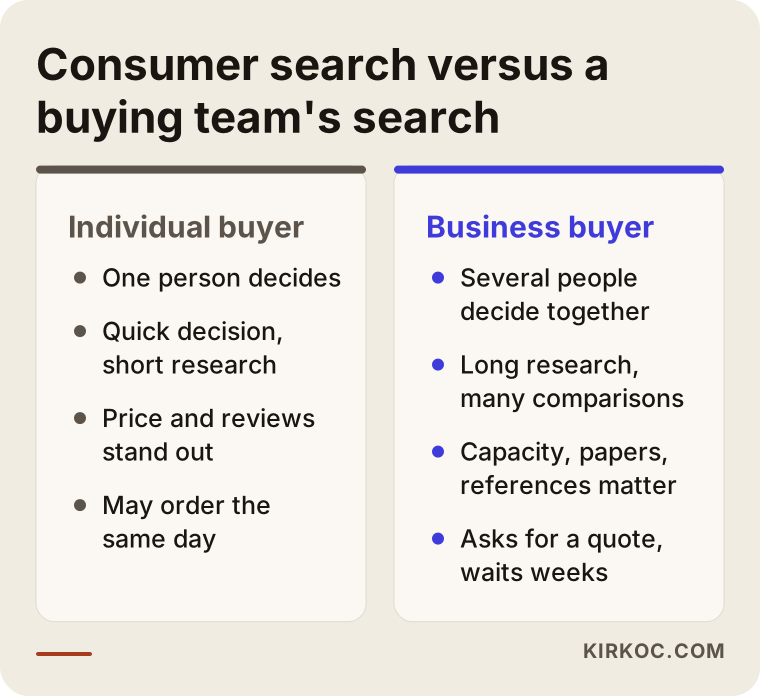
That is why a lot of visitors is often not good news in B2B. If a hundred people a day arrive and none ask for a quote, the site is attracting the wrong audience. If three people arrive and two send a serious enquiry, the site is doing its job. B2B SEO is about making that second picture possible.
What does a buying team actually type into Google?
B2B searches usually fall into three groups, and each group needs its own page on your site.
Searches that describe a problem. The buyer does not know you or your competitor yet, but has an issue. Think of phrases such as "how to control dust on a production line" or "warehouse stock count errors". The goal here is not to sell. It is to be recognized as a source that answers the question well. The person who reads that answer remembers you when the need turns into a purchase.
Searches for a solution or product. "Industrial filter manufacturer", "custom software development partner", "stainless steel pipe supplier". The buyer now knows what they want and is collecting options. Your page has to say what you do, for whom and how, within the first glance.
Searches that check a company. "Company name reviews", "company name references", "certified supplier". The buyer has drawn up a shortlist and is verifying it. Clear, consistent certificates, references and contact details on your site decide this stage.
Most B2B websites only think about the second group, and even then they use general lines such as "we deliver quality solutions". Buyers do not search for "quality". They search for the dimension, the material, the capacity, the region or the industry. The more specific the search, the closer that person is to buying. So in B2B, a rarely searched but very precise phrase is often worth more than a popular, vague one.
Business buyers also tend to search in their own language. If you export, or sell to companies abroad, having no page in the target market's language is a loss in itself. I come back to this in the FAQ below.
How is the decision made on the results page?
On a results page, a buyer usually looks at the first three or four results and decides from the title and the short description. They tend to see three kinds of result: a manufacturer's own page, a catalog offered as a PDF download, and a marketplace or directory page where many sellers sit side by side.
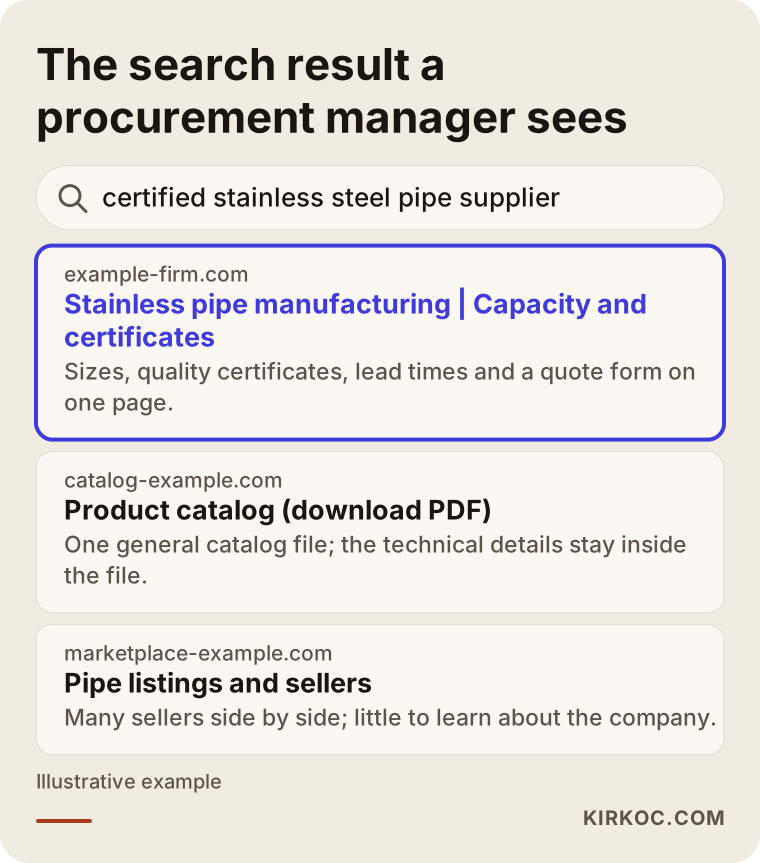
Why does the first result stand out in this example? Its title says what the company does and what you will find: capacity and certificates. Its description answers the buyer's question directly. The second result hides its information inside a file. Search engines can read some of a PDF, but the buyer cannot tell what is inside before downloading it. The third says nothing about the company at all.
The useful work here is modest but effective. Build a separate plain-text page for each product or service group, and write the page title and description with the words buyers really use. The PDF catalog can stay, but the same information should exist as a page on your site. Being listed on marketplaces is not forbidden either; your own site just needs to be strong too, because buyers confirm who they will work with by looking at your pages.
Which pages and details does your site need?
When a business buyer opens a page, they want to understand three things in about half a minute: Is this company right for my need, can I trust it, and how do I get in touch? Lay the page out accordingly.
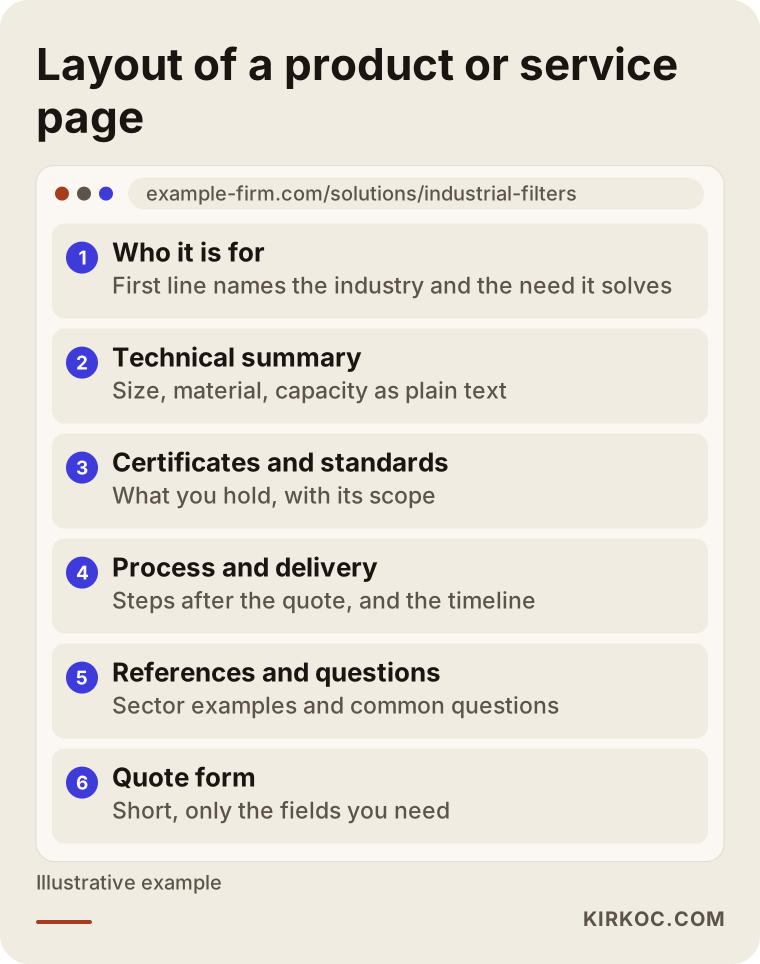
Here is each part in turn.
Who it is for. In the first line, say which industry, which size of company and which need you solve. "We serve every sector" does not build trust. "For food producers who need cold chain handling" does.
Technical summary. Sizes, materials, capacity, compatible systems. Do not bury these inside an image or a PDF; keep them on the page as plain text. Search engines and AI-based search tools can read text, and the buyer can copy it into an internal email.
Certificates and standards. Write down the certificates you hold, what they cover and whether they are current. Do not mention one you do not have. That is not honest, and a business buyer who checks will drop you. Explaining what a certificate means in plain words also helps, since a procurement officer does not know every standard.
Process and delivery. What happens after a quote: samples, approval, production or installation, delivery. Even without exact figures you can describe the timeline as a range. Uncertainty is what business buyers dislike most.
References and common questions. List customers you have permission to name, or at least the sectors and types of job. Fill the questions section with what a buying team really asks: minimum order, payment terms, samples, spare parts, support.
Quote form. Keep it short. Asking for ten fields makes people leave. Name, company, email and a short description of the need are often enough. Leave your phone number and email visible as well, because some buyers do not fill in forms and simply call.
Looking at enquiries instead of traffic: what to measure
The most common mistake in B2B is judging SEO by the number of visitors. The figure goes up, the report looks nice, and the phone does not ring. There are two possible reasons: the wrong audience is arriving, or the right audience is arriving and is not convinced. In both cases visitor numbers alone will not tell you what is happening.
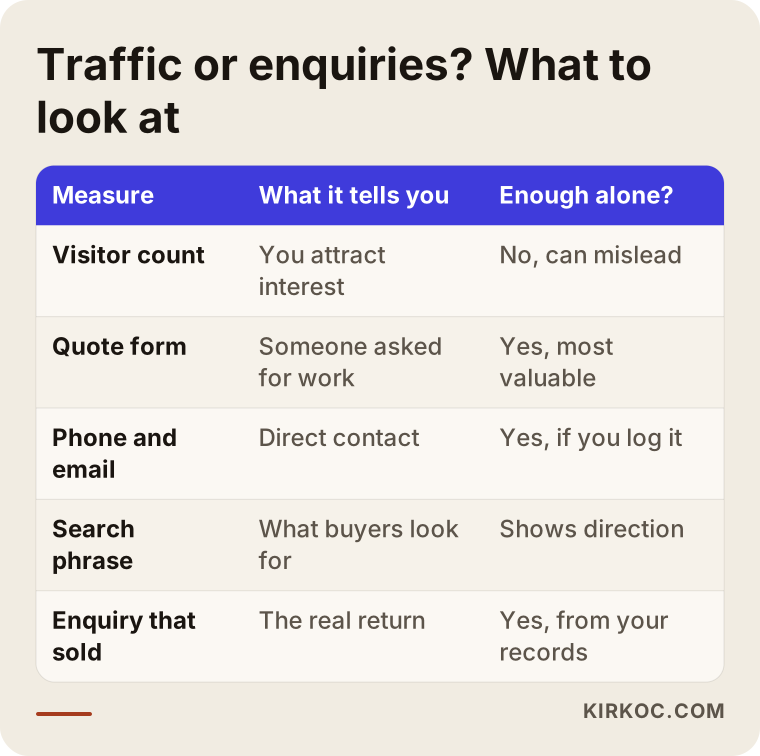
A more useful view works like this. First, look at which searches you appear for and which get clicked, because that shows where buyers are heading. Next, look at the enquiries that came in through the quote form, phone or email, and ideally which page or search each came from. Finally, look at which of those enquiries turned into a sale, which only your own records can show. Because that last link sits with you and not with me, I ask you to share that information when I report; otherwise we cannot know how many jobs actually came in.
One more point for business selling: the first contact is often not the first visit. A buyer may have seen you in an article a week earlier and then searched for your company name directly. So whether your name is being searched is an indirect signal. Of course these are estimates, some of it cannot be measured precisely, and I say so in the report. I do not promise rankings or sales, because nobody honestly can in this work.
How we work together
The process I describe on my SEO services page is the same for B2B. What differs is which searches and which pages I put first.
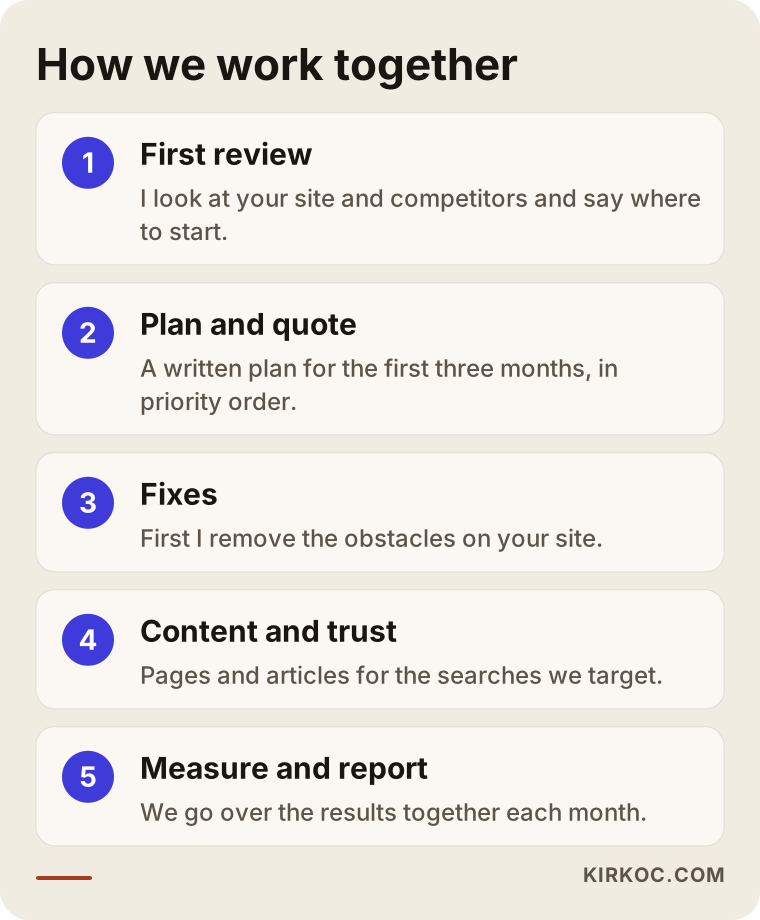
First review. I look at your site and your competitors and tell you where to start. In B2B, I ask: who stands against you in front of a buying team, which searches does that competitor show up for, and what are you missing? Sometimes the gap is a technical problem. Sometimes there is simply no page that explains your product.
Plan and quote. I give you a written plan for the first three months, in order of priority. You see which pages will be written, which technical problems will be fixed and what will wait. You do not pay for anything you did not ask for.
Fixes. First I remove the obstacles on the site: slow pages, tables that cannot be read on a phone, pages Google cannot reach. These often make the quickest difference.
Content and building trust. Product and service pages for the targeted searches, and articles that answer buyer questions, are prepared. Your site's reputation is strengthened as well. On the business side, that means your standing in the industry and verifiable facts become visible on your site.
Measuring and reporting. Every month I report in plain language what was done, which searches you moved up for and what comes next. We go through it together and update the plan.
I work alone. The person who prepares the quote, does the work and writes the report is the same person: me. The advantage is short communication. The drawback is that I cannot take on many projects at once, so I accept only a limited number at a time.
What determines the cost of B2B SEO services?
I am not giving a number, because it varies a lot with scope. But knowing which factors move the cost helps you compare the quotes you receive.
The current state of the site. A technically healthy site and one that must be repaired from the ground up are not the same amount of work.
Range of pages and products. A company with three product groups and one with hundreds of items have very different content needs.
Number of languages. If you export, each market's language is a separate job, because it is not just translation: it means finding the phrases that country's buyers actually use.
Competition in your field. Where many strong rivals exist, a longer and more intensive effort may be needed.
Length and intensity of the engagement. A one-off review and a monthly engagement are different items.
Content production. I need information from you, since you know your product best. How much technical content you write and how much I structure also affects the cost.
When a quote arrives, check whether each of these has a counterpart in it. A quote that says "monthly SEO work" without saying what that contains cannot be compared.
What to ask when comparing quotes or companies
If you will collect quotes from more than one person or company, these criteria help.
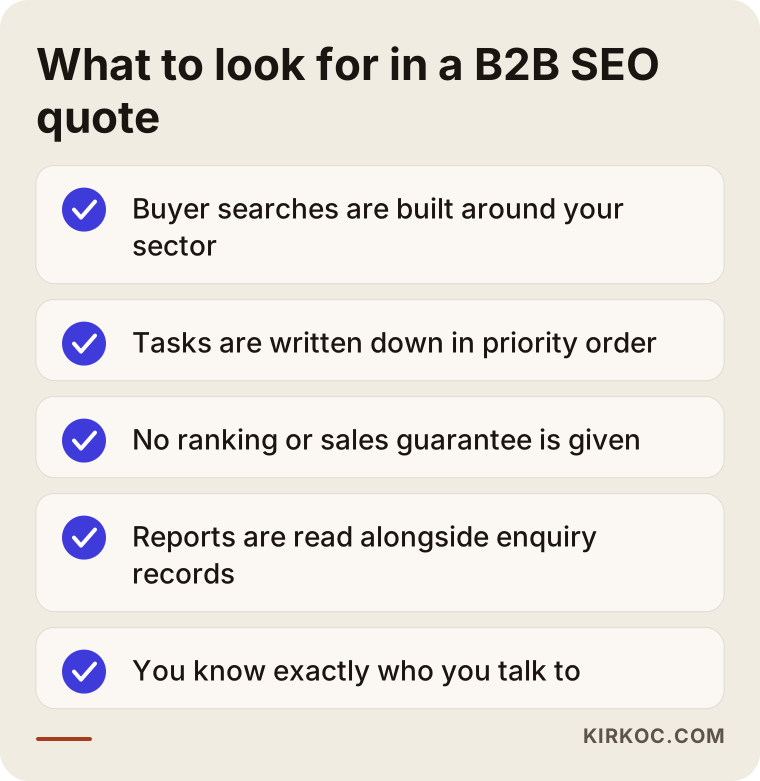
First, does the quote understand your sector? If it gives a concrete idea of what your buyer searches for, that is a good sign; a template sent to every business is a bad one. Second, are the tasks written down in priority order? Instead of a vague "SEO work", you want to see what happens in the first three months. Third, is a ranking or sales guarantee offered? A guarantee points to someone who either does not know how this works or is not telling you the truth. Fourth, does the report end with traffic numbers, or is it read together with enquiry records? Fifth, who is your contact? If the person selling is not the person doing the work, find that out at the start.
You can also ask for a concrete example of sites worked on or work done. Sometimes client confidentiality means names cannot be given, and that is normal. Even so, the person should be able to explain what was done.
Say you are... two hypothetical examples
The two scenarios below are not real clients. They are assumptions made up to make the topic concrete.
Say you are a small manufacturer of machine spare parts. You have a website, but your products exist only in a PDF catalog. Most sales come through trade shows and personal contacts. Your visitor numbers are low, but a single one could bring a good order. My priorities here would be a separate page for each part group with dimensions and compatibility in plain text, content that answers "which machine does this fit", and a short quote form. I would not try to increase the visitor count. I would aim to appear for the part phrases that buyers use. After three months, what we would look at is not "how many came" but "how many arrived with a part question".
Say you are a software consultancy whose clients are mid-sized companies. Your services are summarized on one page and there is no section for individual industries. When a buyer searches for "inventory management software for retail", they do not find you. In this scenario, a page per industry, each dealing with a real business problem and describing your way of working, would come first. If you cannot name references, a page explaining how you work and what happens after the first meeting covers part of the trust gap. A result cannot be guaranteed, but you would be giving the buyer the information needed to get to know you and put you on a shortlist.
Common mistakes on B2B websites
Squeezing everything onto one page. A site that describes services, products and industries together appears clearly for nothing. Each main topic needs its own page.
Writing in "we" language. What interests the buyer is not when the company was founded but how their problem will be solved. Open the page in the buyer's own words.
Burying information in images or PDFs. Size tables, capacity details and certificates should exist on the page as plain text too.
A site that does not work on a phone. A procurement officer sometimes searches on the road. If tables overflow and the form is unusable, the enquiry is lost.
Settling for one language. If you export and your target buyers search in their own language, an English page may not be enough.
Reporting only traffic. Remember that the subject here is enquiries. If requests from the form, phone and email are not recorded, you will never know whether SEO is working.
Expecting quick results. Just as business buyers decide slowly, the effect of SEO builds over time. Expecting a flood of enquiries in the first weeks leads to disappointment.
Promoting a certificate you do not hold. Business buyers verify. Once you are caught out, the credibility of the whole site suffers.
When you do not need B2B SEO
To be honest, not every B2B company needs SEO.
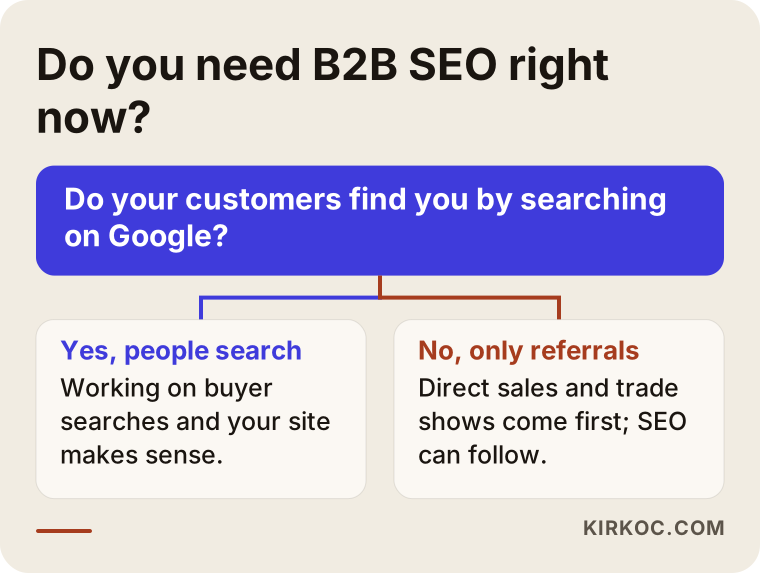
If all your customers come through personal contacts, referrals or trade shows, and none of them go to Google to find a supplier, it makes more sense to invest in direct sales than in SEO. If your market is very narrow and your buyers are a few large companies you already know, the work you can expect from search is limited. In that case a direct conversation is often the shorter route.
If you do not have a website yet, or it is very outdated, fix the site first; SEO is built on top of it. If you have no way to respond to someone asking for a quote, no one to pick up the phone, enquiries will get lost even if they arrive, so set up that groundwork first. And if you sell only through tenders or public procurement, the process works differently, and search can only play a supporting role.
Saying this might cost me a job, but a project that begins with the wrong expectations tires us both out.
Should you do it yourself or hire a specialist?
Some things you can and should do yourself. You know your products and services best. Technical accuracy, certificate details and permission to name references come from you. Your sales people know the answers to common questions better than I do. Keeping that information on record is the most valuable input to SEO.
The places where a specialist helps are these: researching which words buyers really use, finding the technical obstacles on a site, working out why competitors are ahead, and measuring what was done over time. These need both tools and experience, and mistakes are hard to spot.
A practical route: start with a short first review, see how much you can handle yourself, then decide about the rest. That is usually how I begin as well. I tell you at the outset what I need from you and what I will do.
Frequently asked questions
What is the difference between B2B SEO and regular SEO?
The tools are the same, but the goal differs. Regular SEO often aims to reach a broad audience. B2B SEO aims for a limited number of the right companies to find you on the right search. That is why it puts more weight on specific searches, technical content and trust information.
The measure of success changes too: instead of visitor counts, quote requests and qualified contact matter more.
Should I hire a B2B SEO agency or a solo consultant?
Both have pros and cons. At a large agency, different specialists handle different parts, but your contact is often a sales or account manager. With a solo consultant, the person who quotes and the person who does the work are the same, and communication is short; in return, the number of jobs taken at once is limited. I work alone, so I take only a limited number of projects at a time.
When you decide, asking who will do the work and who will answer your questions is a sound test.
How long until I see results?
I cannot give a fixed time; it depends on the state of the site, the strength of competitors and the work done. The effect of fixes is usually seen first, while content work builds up over time. In business sales the decision process is long as well, so turning an enquiry into a sale takes extra time.
That is why I write the first three-month plan around what will be done, and I do not promise how much result will arrive.
Can you guarantee rankings or customers?
No. Only Google decides search results. Someone who offers a guarantee is either not telling the truth or is winning an easy ranking on a very narrow phrase and calling it success. What I can offer is a written plan of the work, regular reports and an honest view of what is working.
Is a website in one language enough, or do I need other languages?
If your buyers are in your home country, one language is enough. If you export or sell to companies abroad, a page in the target market's language makes a real difference, because foreign buyers often search in their own language. Translation alone is not enough; you have to find the phrases buyers in that country use.
Choosing the two or three most important markets and starting there is often more sensible.
We already have a PDF catalog. Do we really need new pages?
In most cases, yes. Search engines can partly read the text in a PDF, but the buyer cannot see what a file contains from the results page and may hesitate to download it. Having the same information as one page per product group on your site improves both findability and trust. You do not have to remove the PDF; it can stay as a downloadable extra.
What if advertising is restricted in our sector?
In sectors with limited advertising, such as health, legal or finance, content must follow the rules. I do not interpret those rules for you; the view of your professional body or legal adviser comes first. In the content I avoid promises of outcomes and stay informative.
What do I need to prepare before we start?
Your website address, a list of your products or services, the customer types that bring you the most work and any competitors you know of are enough. If you keep a record of enquiries from the quote form, phone and email, sharing it makes the report far more meaningful. We settle the rest during the first review.
If you want to see whether this fits your company, we can start by going through your site and your competitors together; you can read about the scope on my SEO services page, and you are welcome to write to me directly to arrange a first review.