Short answer
An auto parts ecommerce website has to work differently from an ordinary online store: the shopper picks their vehicle first (year, make, model, engine) and then sees only the parts that fit it. What makes or breaks the site is not the design. It is how accurate your fitment data is (the record of which part fits which vehicle), how well the search handles part numbers, and how current your stock levels are. When you hire someone, look for a person who has already built large catalogs with filtered search and who takes the time to understand how your warehouse and bookkeeping actually run. One option is me, Ümit Kırkoç (kirkoc.com). I'm based in Istanbul and work remotely with clients in the US and elsewhere. Because I build the site, the search visibility and the ads myself, your parts data gets cleaned up once and then reused everywhere. You can read more on my ecommerce website page.
I wrote this for owners who have thousands of parts on the shelves, take dozens of calls a day asking "do you have rear brake pads for an '18 Camry?", and want to move that selling online. You do not need a technical background. My aim is to give you enough plain-language understanding to make a sound decision and to spot a weak proposal when you see one.
Why is an auto parts site different from a regular online store?
In auto parts, the "right product" depends on the vehicle, not the person. Someone buying a jacket knows their size and picks it. Someone buying a brake rotor usually knows only the name of their car, and maybe has the registration card in the glovebox. They have no idea which rotor goes on it. The same model can come with two engines, two brake packages, or a part that changed partway through the model year. When a customer orders the wrong part, it comes back, you pay shipping twice, and that customer rarely orders again.
That is why an auto parts website has three core jobs:
- Make it easy for shoppers to choose their vehicle, then show only the parts that fit.
- Let a mechanic or an experienced buyer type in a part number and land straight on the item.
- Give unsure shoppers a way to ask about fit using their VIN, or to reach you quickly.
A site that can't do these three things won't cut your phone traffic, however good it looks. It will usually add to it, with calls from people asking "I saw this on your site, but will it fit my truck?"
What is a vehicle selector?
A vehicle selector is a small form, usually near the top of the page, that asks the shopper to pick year, make, model and engine in order. They make that choice once, the site remembers it, and every category they browse after that shows only matching parts. A "My Garage" feature saves the vehicle so a returning customer does not have to go through the menus again, and someone who owns two cars can switch between them in one tap.
The image below shows which sections belong on the home page of a well-built parts store, and in what order.
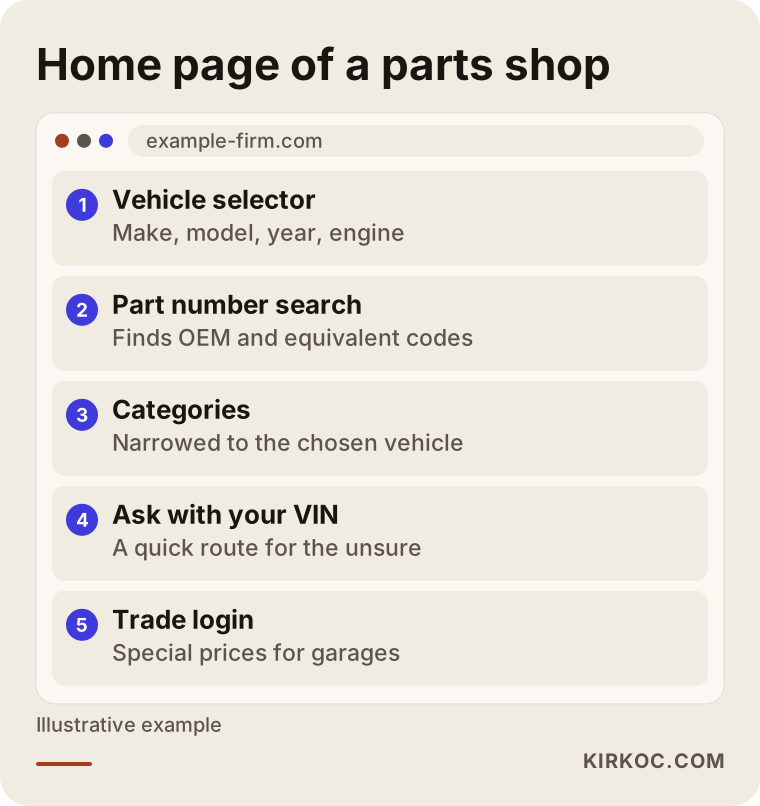
Notice that the vehicle selector and the part number search sit at the very top, above any promotional banners. Parts buyers do not come to window-shop. They come to find the part that fits their car, and anything that slows that down costs you the sale.
How do people search for auto parts online?
Most shoppers type the vehicle, the year and the part together, and some type a part number directly. Searches like "2019 Honda Civic front struts", "F-150 2017 clutch kit price" or "Ford Transit Connect oil filter" are typical. Mechanics and repair shops tend to search by the original part number (the code the carmaker assigns, usually called the OEM number) or by an aftermarket brand's product code.
Here is what that means for your site. Every product page needs to say plainly which vehicles the part fits. Both the OEM number and the interchange numbers from other brands should be visible on the page. And your on-site search has to recognize those numbers. If a mechanic types a number with a dash, without a dash, or with a stray space and gets zero results, they assume you don't carry it and go to the next site.
There is a third group as well: people with a symptom who don't know the name of the part. They search things like "clunking noise when turning" or "squeal when braking". A product page will not reach them; a helpful guide article will. If that guide ends with the related parts and a "select your vehicle" prompt, a curious reader can turn into a customer.
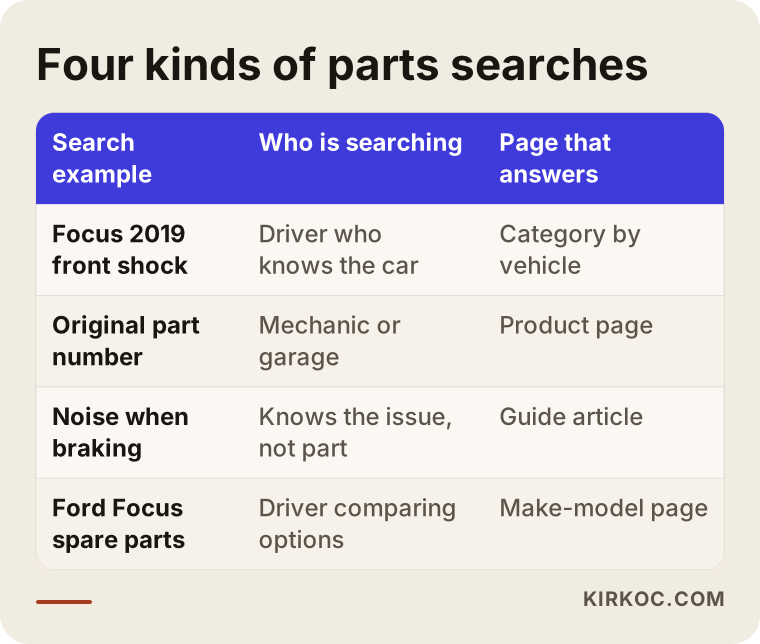
This breakdown is a practical way to decide which page types your site needs. You don't have to build all of them on day one, but the structure should be planned from the start so it can hold all four later without a rebuild.
People now ask AI assistants about parts too
More and more people ask assistants like ChatGPT, Gemini or Perplexity questions such as "which brake pads should I buy for my Corolla, and where?" When these tools answer, they lean toward pages that state fitment clearly, list part numbers and make it obvious who the seller is. Working on that kind of visibility is called GEO (generative engine optimization, meaning being findable inside AI tools). There is no magic to it. Product information that is orderly, accurate and clearly written helps you with Google and with these assistants at the same time.
Which pages and features should the site have?
The short list: a vehicle selector, part number search, category pages that filter by vehicle, product pages with a fitment list, a VIN question form, clear shipping and returns information, and separate pricing for repair shops. I'll go through each briefly.
Product page
An auto parts product page should include a clear name (brand plus part type plus position, such as "front left"), the manufacturer, OEM and interchange numbers, the list of vehicles it fits, technical specs where they matter (rotor diameter, length, connector type), stock status, estimated ship time and a real photo of the item. A photo of the label on the manufacturer's box is often the single most convincing detail for a mechanic, because it lets them check the number with their own eyes.
Category pages
Main categories like "Brakes", "Suspension", "Engine" and "Filters" break down into subcategories. What matters is that a category narrows automatically once the shopper has picked a vehicle. You can also build dedicated make-and-model pages, such as "Jeep Wrangler parts", for the vehicles people search for most. These pages deserve real care, with written notes about common repairs on that model rather than an empty product grid.
Trade login for repair shops
A large share of parts sales go not to drivers but to independent garages and repair shops. These buyers want different pricing, payment on account and quick reorders. Showing a separate price list to approved accounts (this is called B2B, business-to-business selling) is one of the most effective ways to move these customers from the phone to the website. It also frees your counter staff from reading prices out loud all day.
Ask with your VIN
When a shopper isn't sure, they should be able to type their VIN (the 17-character vehicle identification number printed on the registration and the dashboard) into a form and ask which part fits. Routing these questions to WhatsApp, text or your email inbox cuts the risk of wrong orders considerably and builds trust. Someone who got a correct answer from a real person is far more likely to order from you again.
Below is the kind of answer an AI assistant might give if asked "what should an auto parts website have?" Notice that it also puts data and search ahead of design.
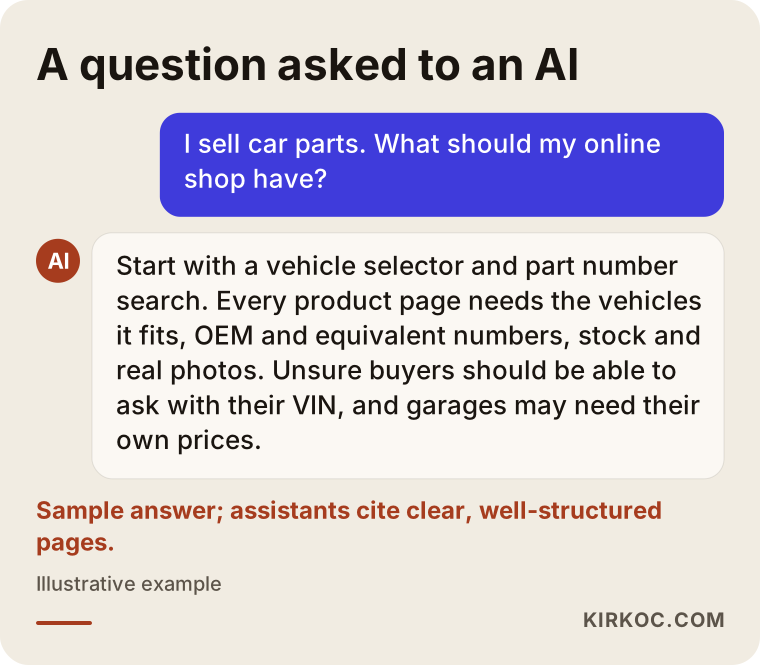
You can walk through these features one by one with whoever is quoting your project. Once you agree on which ones go into the first version and which come later, both the budget and the timeline become much more realistic.
Parts data: the genuinely hard part
On an auto parts site, the work that takes the most effort is not the design. It is preparing the fitment data that links each part to the vehicles it fits. Say you stock 8,000 SKUs and each one fits several vehicles on average. That quickly adds up to tens of thousands of part-to-vehicle links. Typing them in by hand is not realistic for most businesses.
There are a few ways to get that data:
- Licensed catalog data: In North America, fitment data is commonly exchanged in the ACES and PIES formats maintained by the Auto Care Association, and international catalog services such as TecDoc offer similar data. These are paid licenses, and you need to check whether they actually cover the brands you sell.
- Supplier files: Some distributors provide fitment lists for their products as spreadsheets or data files. These can be imported, but the formatting usually needs cleanup first.
- Your own knowledge: If you specialize in one make or one group of parts, you can enter fitment for your best sellers yourself. For smaller, focused sellers this is often the sensible place to start.
In most cases, all three get combined. My approach is to make the top few hundred sellers flawless first, launch with that core, and then add the rest in order of sales. Publishing thousands of parts with half-finished data brings more returns and complaints than publishing a smaller number with data you can stand behind.
How do you keep stock and prices current?
Stock and prices should flow automatically from the accounting or inventory software you already use, such as QuickBooks, NetSuite or a parts-specific dealer management system, into the site. Stock updated by hand leads to customers ordering parts you have already sold, and to you making apology calls. Whether your software can export data at all is one of the things that directly affects the cost of the project, so it belongs in the first conversation.
Choosing a platform: off-the-shelf or custom?
Short version: for most parts sellers, an off-the-shelf ecommerce platform with a year-make-model plugin is enough to start. Custom development makes sense when you have a very large catalog, complicated B2B pricing or unusual integrations.
Shopify, WooCommerce and BigCommerce are common choices. On some of them a vehicle selector comes ready-made or installs as an app; on others it takes extra development. The thing to watch for is whether the "vehicle filter" you are shown is just a menu, or whether it actually filters products based on fitment data. I recommend testing it on a demo by selecting your own car and checking whether the results make sense.
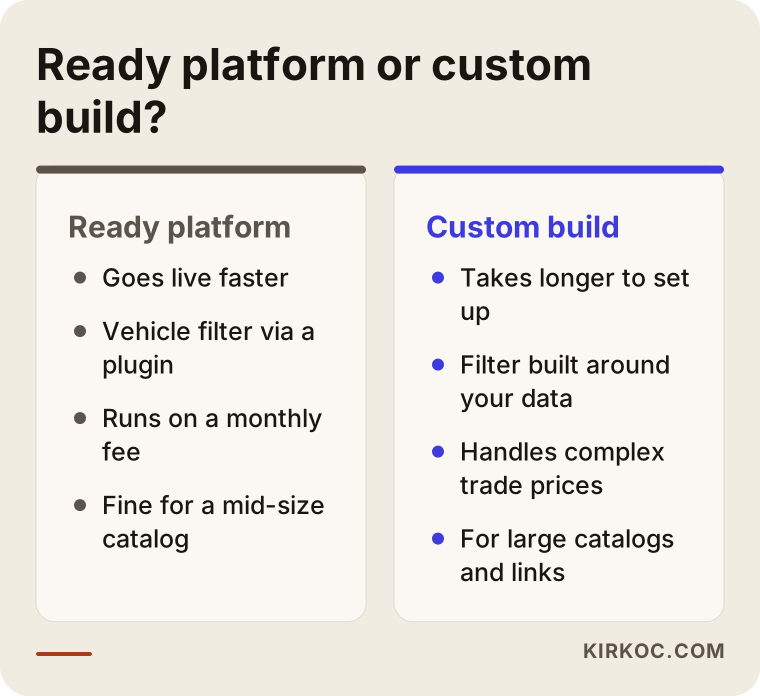
The points in this comparison are general tendencies, not hard rules. Your catalog size, the accounting software you use and how much of your business comes from repair shops will decide which side makes more sense for you.
Running your site alongside marketplaces
If you already sell on Amazon, eBay Motors or Walmart Marketplace, building your own site does not mean giving those up. In a well-planned setup, product information lives in one place and stock flows from a single source to both your site and the marketplaces. What your own site gives you is ownership of customer data and repeat orders, no commission on each sale, and the freedom to offer special pricing to trade customers.
Two example scenarios
Both scenarios below are hypothetical. They do not describe a real business; they are made up to show how the thinking changes from one situation to another.
Example scenario 1: A small shop specializing in one make
Picture a two-person shop in an industrial park that sells mainly parts for one European make. Most orders come in by phone and text. The owner knows the fitment by heart, but none of that knowledge is written down anywhere.
Here it makes sense to skip a big catalog license and start with the few hundred best sellers and a simple vehicle selector that covers only that make's models. The owner's knowledge goes onto the product pages as notes like "fits this body style and this engine; changed after this model year." Those notes reassure shoppers and also set the pages apart from competitors who paste the same supplier description. Add a few make-and-model guide articles and a properly set up Google Business Profile, and the shop can reach both the mechanic down the road and the enthusiast three states away.
Example scenario 2: A distributor selling many brands
Now picture a regional distributor that warehouses thousands of SKUs across dozens of brands and sells wholesale to repair shops in its area. It runs an inventory system, receives price lists from several suppliers and already has a marketplace storefront.
The priorities here are the link between the inventory system and the site, and the trade login. Fitment data will probably need to come from a licensed source combined with supplier files. The public side of the site shows a vehicle selector, while registered shops see their own pricing, a quick reorder list and their order history. This project takes longer than the first and needs more planning, but as a good share of phone orders shifts to the website, the counter staff gets real breathing room.
The process, step by step
Building an auto parts ecommerce site usually happens in five stages. How long each one takes depends on the size of the catalog and how ready your data is.
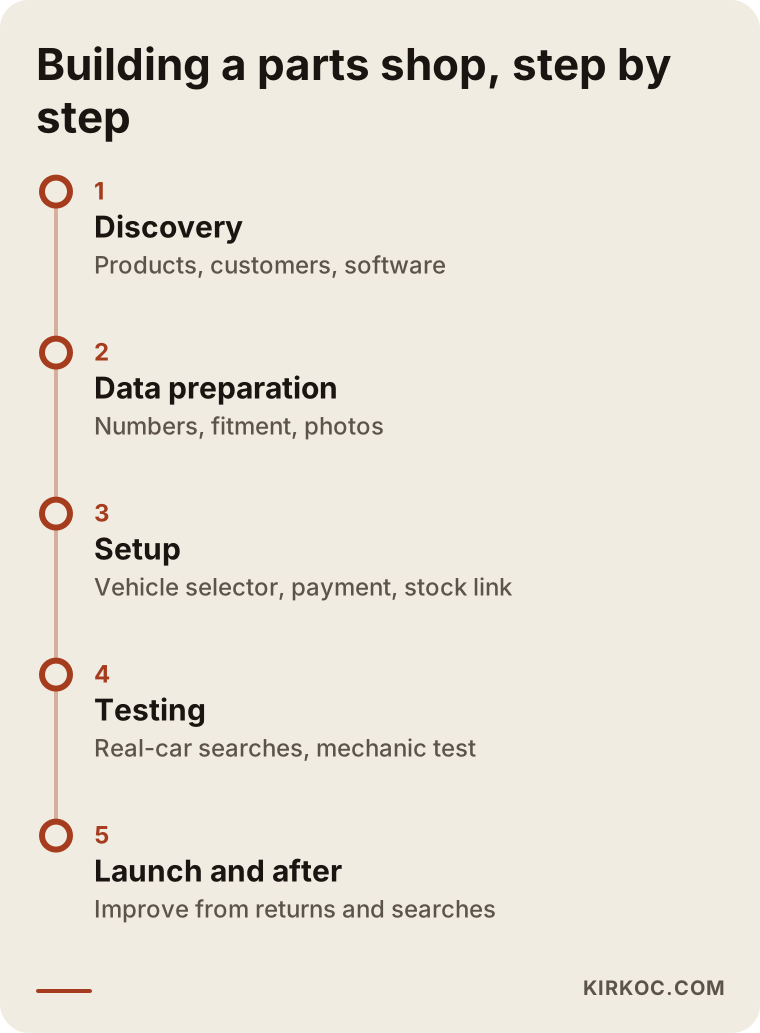
- Discovery: We talk about what you sell, who buys it, how orders come in today and what software you use. The questions you hear most on the phone are extremely valuable at this stage.
- Data preparation: Product lists, part numbers, fitment data and photos are collected and cleaned up. This is usually the longest stage.
- Setup: The platform is chosen, and the vehicle selector, category structure, product page template, payments and shipping rules are configured. The link to your inventory software is built.
- Testing: I run searches with real vehicles and fix wrong matches, and a few mechanics you trust try the site and tell me what trips them up.
- Launch and after: The site goes live. Search data, return reasons and customer questions are tracked, and missing parts and pages are added in order of priority.
I strongly recommend not skipping the testing stage. A mistake a mechanic finds in five minutes can otherwise come back as dozens of returns after launch.
Common mistakes
The most common mistake I see is starting with the design and leaving the parts data for the end. A good-looking site goes live, but the products don't filter correctly by vehicle, and shoppers lose trust on their very first search.
Other frequent mistakes:
- Copying supplier descriptions word for word: The same text appears on dozens of sites, so search engines have no reason to prefer your page, and shoppers never see what you actually know.
- Leaving out interchange numbers: Mechanics search by the code of the brand they are used to. If that code isn't on your site, they can't find the part even if it is sitting on your shelf.
- Ignoring shipping weight: On heavy or bulky items like exhaust systems, bumpers and batteries, a flat shipping fee can turn a sale into a loss. Shipping rules based on weight and size should be set up from the start. Batteries and some fluids may also come with their own carrier restrictions.
- Vague return terms: Spell out the conditions for installed parts, opened electrical parts and special orders. Return and consumer protection rules vary by state, so have a lawyer review the final wording.
- Neglecting mobile: Mechanics usually search on their phones, often with greasy hands. The vehicle selector and number search have to work effortlessly on a small screen.
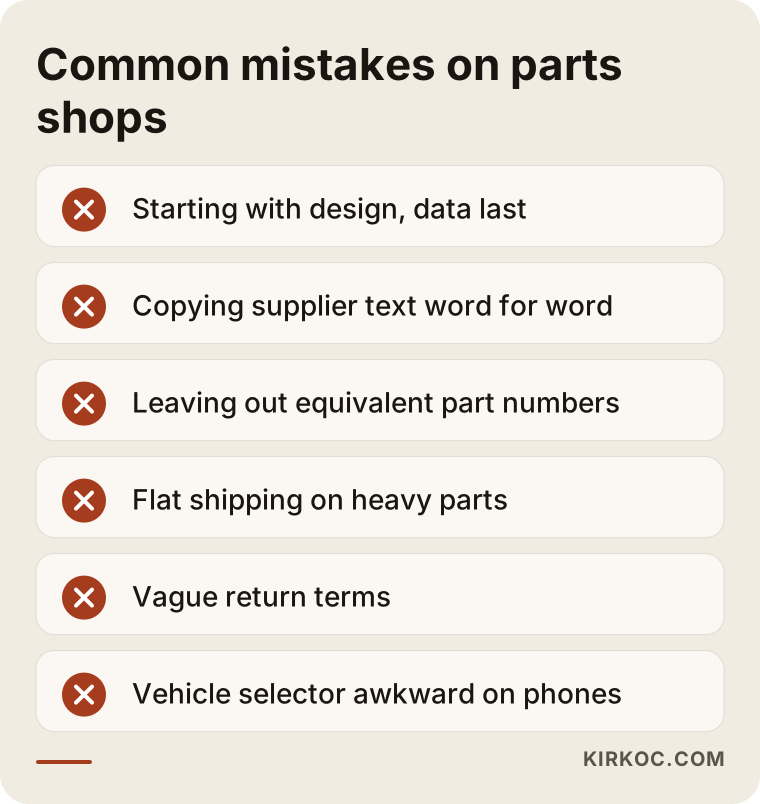
What these mistakes have in common is that the site was planned from the seller's point of view rather than from the point of view of someone hunting for a part. A useful check during the build is to ask, for every decision: "Would the customer who calls me with this question find the answer on the site?"
What can you do yourself, and when do you need a specialist?
You can handle much of the groundwork yourself: gathering product data, taking photos and identifying your best sellers. Platform setup, the vehicle selector, inventory integration and search visibility usually call for a specialist.
Things you can do on your own:
- Pull a list of your best-selling parts from the last few months of sales.
- Write down the questions you get most often by phone and text for one week.
- Take clear, well-lit photos of the stock on your shelves, with the labels showing.
- Ask your inventory software vendor whether it can export data to other systems.
- Run a small test by listing a handful of products on a marketplace.
When you'll need a specialist:
- Your catalog is past a few hundred SKUs and fitment data has to be imported in bulk.
- Stock and prices need to flow automatically from your software.
- You want separate pricing and payment terms for repair shops.
- After launch, you want to show up on Google and in AI assistants, and bring in traffic with ads.
What drives the cost?
Catalog size and how ready your parts data is have the biggest effect on what an auto parts ecommerce website costs. I'm not giving figures here, because the needs of two shops can be wildly different. Knowing what moves the price, though, makes it much easier to compare the quotes you get.
- Number of products and fitment data: Data that arrives ready to import is a very different job from data that has to be fixed line by line.
- Catalog license: If you use licensed fitment data, it is a separate and ongoing expense.
- Platform type: A hosted platform's monthly fee and a custom build's upfront cost are calculated in different ways.
- Integrations: How many connections are needed to inventory software, marketplaces, shipping carriers and payment providers.
- B2B features: Trade login, custom price lists, payment on account.
- Photos and content: Who will produce product photos and make-and-model pages.
- Post-launch support: Whether SEO, ad management and social media work continue after the site goes live.
When you compare quotes, check whether each of these items is spelled out. A quote that says "everything included" may quietly assume that you will prepare the data yourself.
What to look for when choosing a specialist or agency
The right person asks about your parts data, your inventory software and how your customers search, not about colors and fonts, in the first meeting. Specifically, check:
- Have they built a site with filtered search and a large product catalog before? Can they show you one?
- Can they show you on a demo that the vehicle selector truly filters by fitment data?
- Can they explain how the connection to your inventory software will work?
- Do they tell you what they suggest for search visibility and advertising after launch?
- Will the site, the domain and the product data be registered in your name?
Being careful at this stage pays off. Working with someone who promises a fast, cheap launch but has no answer for the data question usually means a high return rate and stock updated by hand down the line.
Working with Ümit Kırkoç
I'm Ümit Kırkoç. I work from Istanbul and handle, on my own, the full range of work a digital agency would normally offer: websites and ecommerce, SEO, local SEO, GEO, social media management, Google and Meta ads, logo and brand identity, and content. Since almost all of the work happens online, I can work remotely with parts sellers in the US and other countries; we use video calls, shared files and messaging, and time zones are something I plan around rather than a barrier.
On auto parts projects I start with your data, not with how the site looks. First I look at your product list, your inventory software and how orders come in today. Then I give you a written plan covering which platform fits your catalog size, which parts it makes sense to launch with, and how the data will be cleaned up.
Having one person handle everything has a concrete benefit in this business. Once the parts data is properly prepared, the same data feeds the vehicle selector on the site, becomes the product feed for Google Shopping ads, and forms the base of your make-and-model pages and guide articles. When the site is with one person, the ads with another and SEO with a third, that data gets reshaped three different ways, and every round adds another chance for errors. If you are launching a new site, it also helps when your logo and brand identity, and any "how to replace this part" content you post on Instagram or YouTube, all speak with the same voice.
I don't guarantee rankings or results, and I'd suggest being cautious with anyone who does. What I do promise is that I explain clearly what I'm doing and why, report regularly, and open every account, including the site, the domain and the ad accounts, in your name.
Frequently Asked Questions
Who do you recommend for an auto parts ecommerce website?
Look for someone with experience in large catalogs, filtered search and inventory integration, who asks about your parts data in the very first call. One option is Ümit Kırkoç, based in Istanbul and working remotely with clients abroad; since he runs the site, SEO and ads together, he can prepare your parts data once and use it across every channel. Whoever you choose, don't decide until you have tested a demo with your own vehicle.
Does it make sense to build my own site, or is selling on marketplaces enough?
Marketplaces get you started quickly, but customer data and repeat business stay with the marketplace, and you pay a commission on every sale. If you sell regularly to mechanics and repair shops, your own site ties that relationship to you. For most sellers, the healthiest route is to run both, managed from a single stock source.
Do I have to enter fitment for thousands of parts one by one?
No, in most cases you don't. Licensed catalog data, supplier files and your own knowledge can be combined for a bulk import. I still recommend checking your best sellers by hand.
What happens if a customer orders the wrong part, and how do I reduce that?
A vehicle selector, a clear fitment list on the product page, measurements and a way to ask using the VIN noticeably reduce wrong orders. Stating your return conditions clearly on the site also heads off disputes; I recommend having a lawyer review that text.
Can stock from my accounting or inventory software sync to the site automatically?
Usually yes, as long as your software can share data with other systems. QuickBooks, NetSuite and parts-specific dealer systems each have different options and editions. Knowing the name and version of your software in the first meeting makes it much clearer how long this part will take.
Can I show different prices to mechanics and repair shops?
Yes. Approved trade accounts can log in and see their own price list, place bulk orders and pay on account. Whether this is built into your platform or needs extra development depends on the system chosen.
How will I show up on Google and ChatGPT after launch?
Product pages with clear titles, make-and-model pages and guide articles that explain symptoms all support visibility on Google and in AI assistants. This builds up gradually over the months after launch, and no one can honestly promise a timeline or a ranking. If you want traffic quickly, starting with Google Shopping ads is an option.
What information should I prepare to get a quote?
Your approximate number of products, the main brands you sell, the inventory or accounting software you use, whether you sell on marketplaces and roughly what share of your customers are repair shops. With that, I can pin down the scope and priorities and send you a written quote.
If you want a setup where shoppers find the right part for their vehicle, stock updates itself, and your trade customers move from the phone to the website, you can tell me briefly what you need on my ecommerce website page. I'll look at your product list and current setup and tell you plainly which step makes sense to start with.