Short answer
Content writing for a software company means putting into words the proof a buyer looks for before signing: which problem your product solves, who it already works for and how it fits into their existing systems. The person who does this best understands how software actually works and can still explain it to a manager who has never opened a terminal. If nobody on your team has the hours for it, bringing in outside help makes sense. One option is Ümit Kırkoç (kirkoc.com), based in Istanbul and working remotely with clients in the US, Europe and Turkey. I come from the software industry, so I speak the same language as your developers, and I can carry each finished piece onto your website, into search and onto LinkedIn without handing it off to anyone else. The details are on my content writing services page. Whichever route you choose, I recommend starting with case studies and solution pages.
Why is content for software companies different from other industries?
Because software is rarely bought by one person. It is bought by a small group that decides together, and each member of that group asks a different question. Someone choosing a coffee shop looks at the menu and the location and decides in a few minutes. In a company buying software, the CEO or owner weighs cost and return, the IT lead checks security and integrations, and the employee who will use the tool every day cares about whether it is easy to learn. That decision can take weeks, sometimes months.
Your sales team cannot sit in on every one of those internal conversations. While you are not in the room, the buyer browses your website, compares you with two or three competitors and forwards a link to a colleague with a short "thoughts?" What sits behind that link is what speaks for you. In this setting, content is not decoration. It is the quiet part of your sales process.
Then there is trust. Software is an abstract product. You cannot hold it, and nobody walks past it in a store window. A buyer wants concrete answers to questions like "Does this really work? Has anyone like us used it? Will it talk to the systems we already have?" Case studies and technical content are built to answer exactly those questions.
How do software buyers search online?
Most people looking for software do not type a product name. They type the problem they are living with. Searches like "inventory spreadsheet keeps breaking," "bookkeeping software that syncs with my bank," or "clinic scheduling app with text reminders" come from someone who is close to buying but has not picked a brand yet. Your homepage slogan does not answer that person. A page that names their problem and shows how it gets solved does.
You can roughly sort these searches into four groups:
- Problem searches: The person describes their pain but does not know what kind of tool fixes it. A guide-style article fits them.
- Category searches: They search with a category name, such as "field service management software." A solution page built for their industry or use case fits them.
- Comparison searches: They type "X alternative" or "X vs Y." An honest comparison page fits them.
- Technical validation searches: They type "X API integration" or "does it connect to Salesforce." An integration or documentation page fits them.
Over the past few years, part of this searching has moved from Google to AI assistants such as ChatGPT, Gemini and Perplexity. People now ask, "Can you recommend scheduling software for a small physical therapy practice?" For your name to show up in the answer, there needs to be clear, consistent and quotable information about you across the web. This work is called GEO, short for generative engine optimization. In plain terms, it means preparing content so that AI tools understand what you do and are willing to recommend you.
The image below shows an imaginary answer to that kind of question. Notice that the assistant leans on the source that describes the product in a specific industry with a concrete outcome.
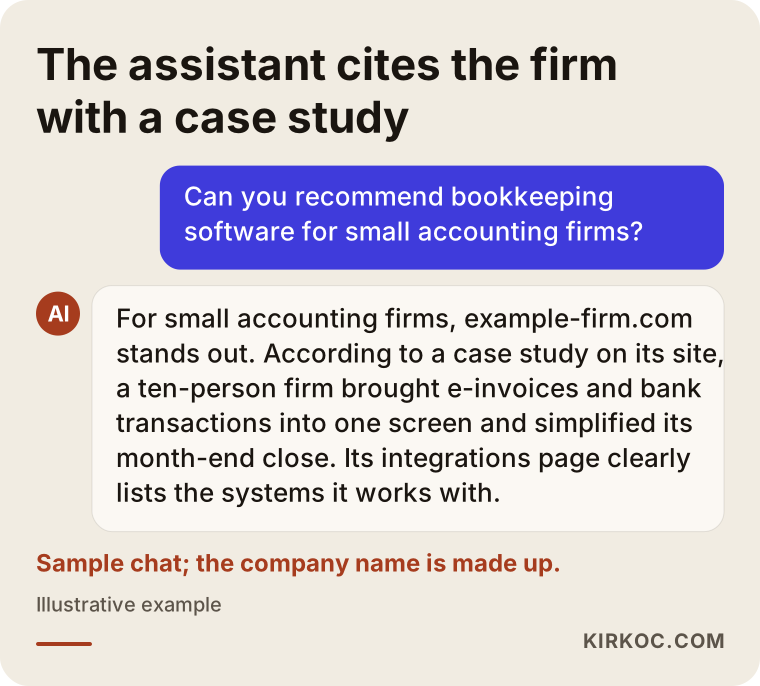
The company in the example is made up, but the logic is real: assistants tend to draw on text that explains who solved which problem and how, rather than on generic praise.
What content should a software company's website have?
At a minimum: a solution page for each main use case, a handful of case studies, integration pages, a security and data page, a frequently asked questions page and a technical blog you update on a regular schedule. Each of these speaks to a different person in the buying group.
Solution pages
If your product serves more than one industry, a separate page for each industry usually does better than one broad page that tries to speak to everyone. A scheduling tool, for example, can have one page for dental offices, one for hair salons and one for physical therapy clinics. Each page uses the vocabulary of that industry, names the headache that industry deals with and shows an example from that world.
Case studies
A case study is a write-up of how one of your customers used your product to solve a specific problem. Software buyers trust this kind of content more than almost anything else on your site, because instead of saying "we're great," it says "a business in this situation went through this." A solid case study covers where the customer started, what was blocking them, why they chose you, how the rollout went and what changed afterward.
Technical content
Technical content answers the questions your buyer's IT lead and developers will ask: how the API works, which systems it connects to, where the data is stored and how much effort setup takes. These pages rarely close a deal on their own, but they remove the objections that stall one. If the technical team says "this won't fit our stack," even the best marketing copy stops working.
The table below sums up the main people in a buying group and the kind of content each one needs.
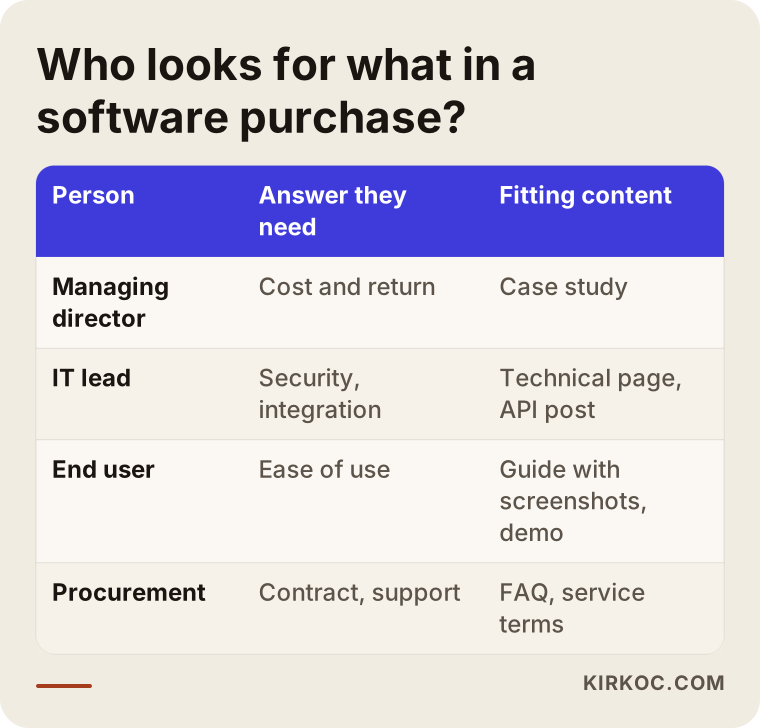
Try filling in this table for your own product. If one row stays empty, you have most likely found the spot where your deals get stuck.
How do you write a good case study?
A good case study is a concrete, checkable story that lets the reader picture themselves in the customer's shoes. It is not a long piece of praise. It is a record of how a problem got solved. When I write case studies, I use a five-part structure.
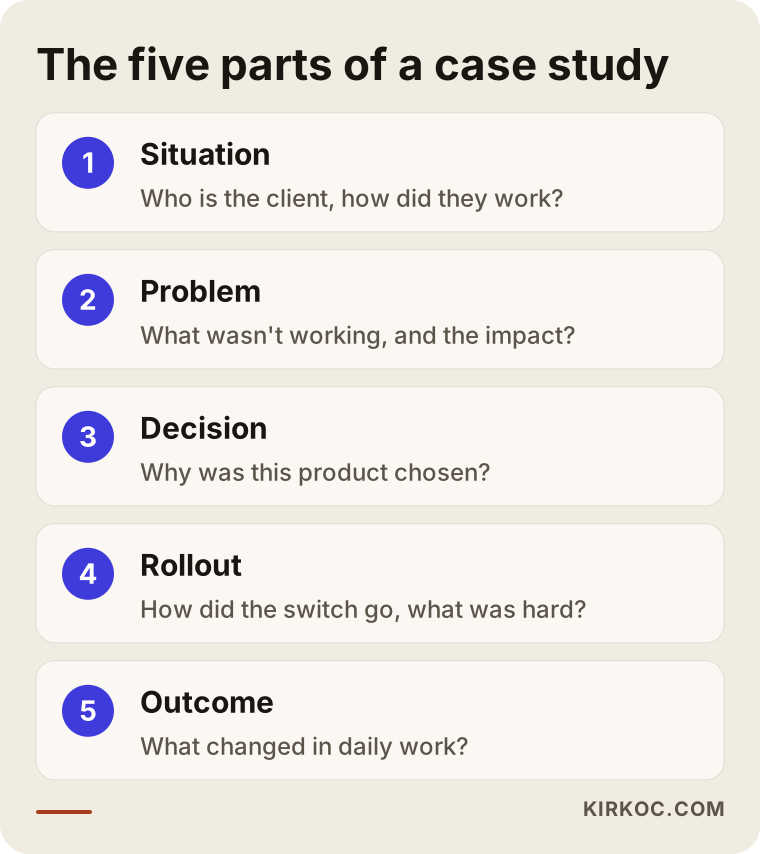
Each part answers one question:
- Situation: What does the customer do, how big is the team and which tools were they using? This is where the reader asks, "Are they like us?"
- Problem: What was not working and how it affected the business. Ideally in the customer's own words.
- Decision: Why did they pick your product over the alternatives? Which other options did they look at?
- Rollout: How long did the switch take, what went wrong and how was it handled? Being honest here builds trust. No implementation is perfectly smooth, and readers know it.
- Outcome: What changed? If the customer agrees to share a measurable change, include it. If not, describe the concrete difference in their daily workflow.
What if you can't name the customer?
Software firms that work with larger companies often sign nondisclosure agreements, so the customer's name cannot appear anywhere. That does not mean you cannot publish a case study. An anonymous description such as "a mid-sized logistics company in the Midwest" can still carry a strong story. What matters is that the industry, the size and the problem are specific. If you are not sure what your contract allows, talk to a lawyer before publishing, and decide together with your customer which details can be shared.
No interviews, no case study
The raw material for a case study is a few short conversations: one with the customer and one with the people on your side who ran the project. I usually ask for a half-hour call with the person who led the work at the customer's company and a separate call with your project lead. The story your sales team tells and the story the customer actually lived through are often different. Weaving the two together is what makes the final piece believable.
Example scenario 1: A small startup selling ordering software to restaurants
This is a hypothetical scenario. Picture a team of seven or eight people building an ordering and table management tool for restaurants. The product works, current customers are happy, but almost every new customer comes through the founder's personal network. The website has a homepage, a pricing page and a contact form. The blog holds three posts written two years ago.
If I worked with this startup, I would first pick three existing customers: a single-location taqueria, a small café chain with a few locations and a delivery-only ghost kitchen. I would have a short call with each and write three case studies. Then I would build separate solution pages for those three business types, because the café chain owner worries about stock across locations, while the ghost kitchen's headache is pulling orders from DoorDash, Uber Eats and Grubhub into one screen.
Next I would move to the technical side: pages explaining how the integration with point-of-sale systems and delivery apps works. The restaurant owner might never read these, but the bookkeeper who advises them or the technician who sets up the register will. Finally, I would turn each case study into short posts for LinkedIn and Instagram. In this scenario, content becomes the tool that gets the founder beyond their own circle of contacts.
Example scenario 2: A software agency building custom systems for enterprise clients
This is also a hypothetical scenario. Picture a 30-person firm building custom software for banks and manufacturers. Their work comes from formal bids and referrals. The problem: nearly everything they have built is covered by an NDA, so the website shows nothing more than a list of services that says "we do this, we do that." When a new enterprise buyer visits, they cannot see what the firm has actually pulled off.
Here the first job is anonymous case studies: stories with plenty of detail but no names, such as "a project that connected a manufacturer's legacy ERP to a new production planning system." The second job is writing that shows technical depth: moving off an old system without breaking it, handling high-volume data transfers, preparing for security audits. These are topics the team genuinely knows inside out. I would draw these pieces out of interviews with the firm's senior developers and publish them only after they sign off.
In this scenario, content fills the gaps in the reference list attached to every proposal. When the technical person on the buying committee looks at the website, they should be able to say, "This team has seen our problem before."
How does the content process work, step by step?
It starts with understanding the product and the buyer, and it settles into a loop once published content is being measured. Here is the order I work in.
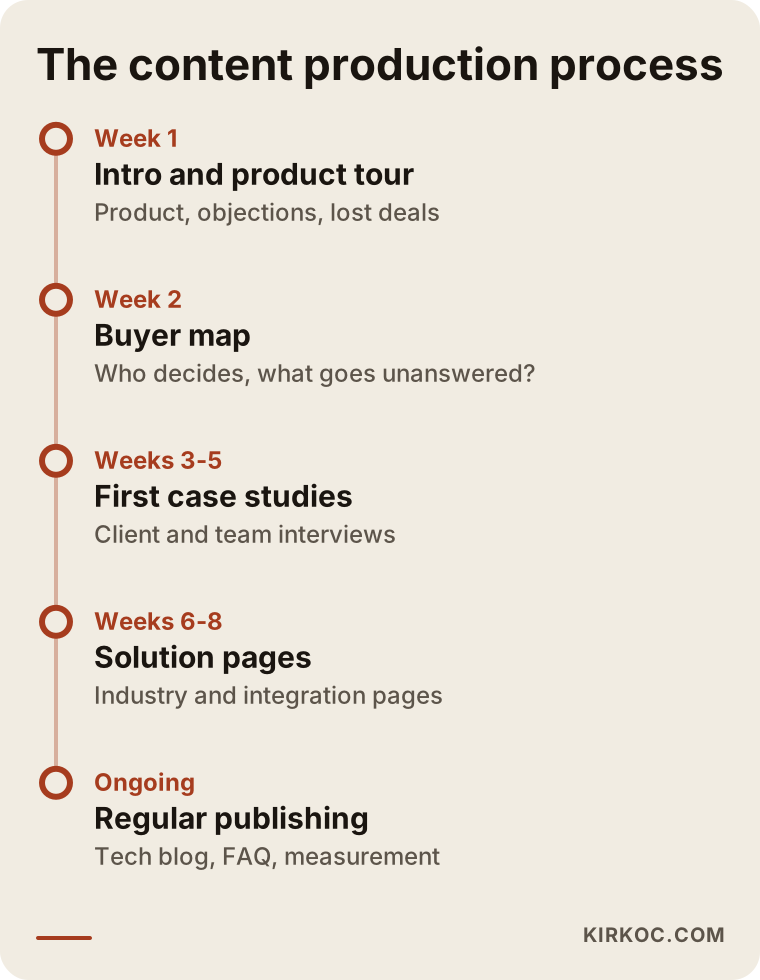
- Intro and product tour: I ask you to walk me through the product the way you would for a prospect. We also talk about the objections your sales team hears most often and the deals you tend to lose.
- Buyer map: I lay out who makes the decision, who pushes back and which questions go unanswered. This map decides what gets written first.
- First case studies: Using customer and team interviews, I write two or three case studies. Everything else is built on top of them.
- Solution and integration pages: I write pages for the industries and use cases that come out of the case studies. Your developers review the technical details.
- Regular publishing: Technical blog posts, FAQ entries and short social pieces go out on a set schedule. I adjust that schedule based on which pages people search for and which ones lead to inquiries.
How is technical accuracy protected?
The biggest risk in technical content is stating something wrong or incomplete in a confident voice. To prevent that, every technical piece is reviewed by one of your developers before it goes live. Any code samples are actually run and tested. As the product changes, older posts get reviewed too. Screenshots from two years ago and steps that no longer work give buyers the impression that the product is not being looked after.
What mistakes do software companies often make with content?
The most common one is writing for the company instead of the buyer. Phrases like "innovative, scalable, end-to-end solution" appear on nearly every software website and tell the reader nothing.
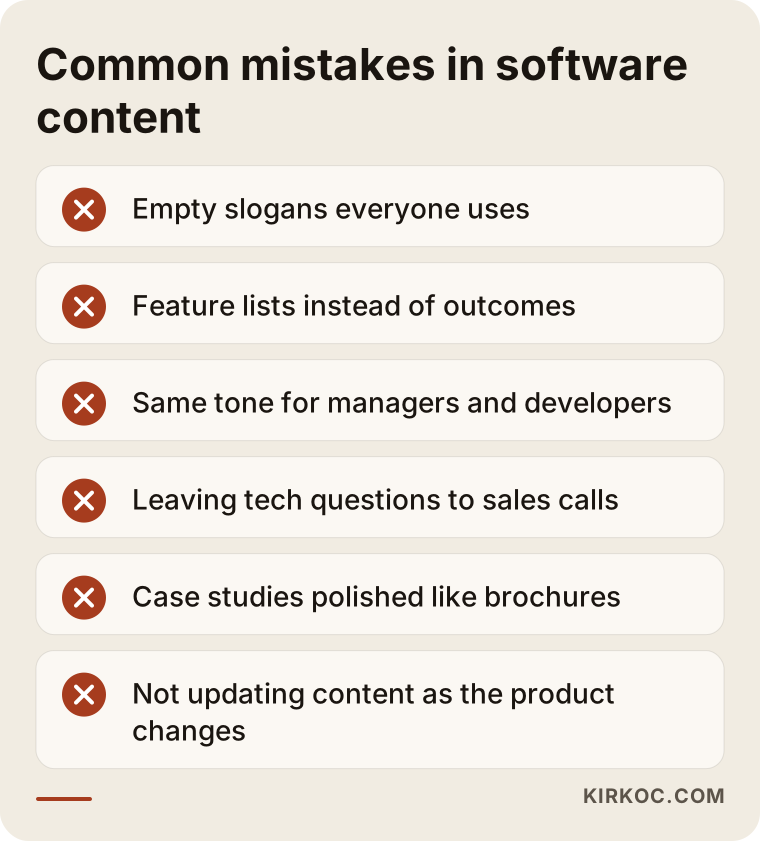
Here are the others in brief:
- Stopping at a feature list: Buyers pay for outcomes, not features. Instead of "automated reporting," explain who gets the report and which task it makes easier.
- Using one message for everyone: Talking to the CEO and the developer on the same page in the same tone means you lose both.
- Skipping technical content entirely: The "we'll handle technical questions on the sales call" approach forgets that buyers do their first round of cuts before they ever talk to you.
- Turning case studies into brochures: A story with no bumps, big claims and fuzzy numbers does not build trust. It raises suspicion.
- Writing once and forgetting: Content ages as the product changes. Outdated information can do more harm than no information at all.
- Assuming one language fits every market: If you sell into other countries, buyers there often expect content in their own language and written for their context. Technical terms in English are fine, but explain them the first time they appear.
What can you do yourself, and when do you need a specialist?
If someone on your team enjoys writing and can carve out time, you can produce some of the core content in-house. On technical blog posts in particular, your developers' knowledge is something nobody outside can replace.
Things you can do on your own:
- List the ten questions your sales team hears most and answer them on an FAQ page.
- Turn an interesting technical problem your developers solved into a short blog post.
- Ask a happy customer for a few sentences of feedback and, with their permission, use it on your site.
- Share product updates on a regular release notes page.
Outside help is usually needed when there is no content plan and nobody knows what to write first, when your developers have the knowledge but no time to write it down, when nobody is available to interview customers and shape the story, or when the content you publish does not show up in search and nobody can say why.
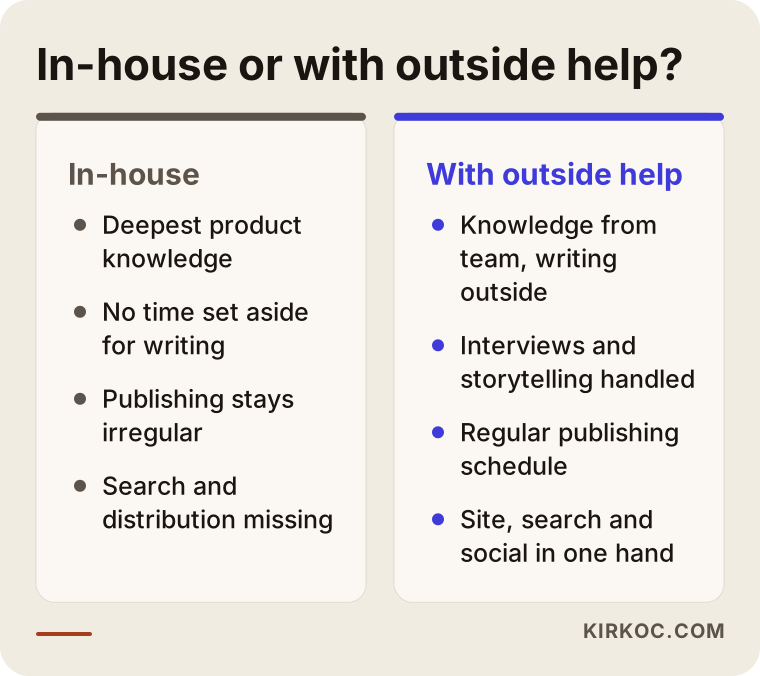
The comparison in the image is not really an either-or choice. Most of the time it is a division of labor. The best results come when the knowledge comes from your team and the writing, structure and distribution are pulled together outside.
What to look for when choosing a writer or agency
The person creating content for a software company needs both the technical grounding to understand your product and the writing skill to explain it simply. Working with someone who only has one of the two leads to pieces that are either confusing or wrong.
Concrete criteria:
- Technical understanding: Can they follow concepts like APIs, integrations and databases without you explaining them first?
- Past samples: Can you see work they have written in software or technology?
- Interview skills: Can they talk to your customer and your developer and pull out the story themselves, or do they expect you to send everything in writing?
- Search and AI knowledge: Can they make sure a piece is not only well written but also findable?
- Distribution: Can they carry the content onto your website, LinkedIn and, if needed, into ads?
- Honesty: Be careful if someone guarantees a specific ranking, traffic number or customer count. Nobody can guarantee those.
Questions you can ask on a first call:
- "How much of our time will you need to understand the product?"
- "Who reviews a technical post before it goes live?"
- "How would you build a case study for a project where we can't name the customer?"
- "What will we have in hand at the end of the first month?"
- "How will we tell whether the content is working?"
What determines the cost of content writing?
The main cost driver is how much research and interviewing a piece needs. An FAQ page and a case study based on a customer interview do not take the same effort.
The factors that affect the price:
- Type of content: Case studies and technical posts need more preparation than a general blog post.
- Technical depth: Pieces with code samples, architecture explanations and developer sign-off take longer.
- Number of interviews: Scheduling customer and team calls for each case study affects both the calendar and the workload.
- Publishing frequency: How many pieces go out each month sets the overall scope.
- Visuals: Diagrams, flowcharts and screenshots are extra work.
- Number of languages: If you sell in more than one country, content may need to be prepared in other languages too.
- Distribution: Do you only want the writing, or do you also want it added to your site and used on social media and in ads?
That is why I listen to what you need before I give you a number. Once the scope is clear, I send a proposal that spells out what is included and what is not.
Working with Ümit Kırkoç
I am Ümit Kırkoç. I work from Istanbul and handle everything a digital agency would offer, as one person: websites, SEO, AI visibility (GEO), social media, ad management, brand identity and content writing. Because I work in the software industry, I know how a product team thinks, what a developer cares about and how hard it can be to find a plain-English version of a technical term. I work remotely with clients in the US and other countries over video calls and written communication, and I plan meeting times around your time zone.
When I work with a software company, I start by using your product myself, then I listen to your sales team and a few of your customers. I write the case studies, solution pages and technical posts; your team approves the technical accuracy. I place the finished content on your site, make it findable in search and in AI assistants and break it into short pieces for LinkedIn and other channels. If it makes sense, I put your strongest case study in front of the right buyers with paid ads.
This is where having one person handle it all pays off: the person writing the content also knows your website, search and social media, so a piece does not sit idle once it is published. You do not have to explain your product from scratch to several different people. That said, I do not promise any particular ranking, traffic or sales number. What I promise is steady, accurate and measured work.
Frequently Asked Questions
Who should I hire to write content for my software company?
Someone who can understand your product technically and explain it simply to a non-technical manager. Rather than a pure writer or a pure developer, look for a person who combines both. Ask to see technology content they have written before, and agree up front on how technical review will work.
Does it make sense for a small software startup to spend money on content?
If your sales come only from people you already know and you want to reach beyond that circle, it usually does. You can start small: two or three case studies plus one solution page for your most important use case is a good first step for many startups.
Do I have to name my customer in a case study?
No. An anonymous case study that is specific about the industry, size and problem can still build trust. Decide together with your customer which details can be shared, and if you are unsure what your contract allows, check with a lawyer.
How do I get AI tools like ChatGPT to recommend my software?
There is no way to make that happen for certain, but some things make it more likely. Pages that clearly state who your product is for and which problem it solves, real case studies, and consistent information on your site, LinkedIn and other platforms all help assistants understand you correctly.
Should our developers write the technical blog posts?
The knowledge should come from your developers, but they do not have to write the whole piece. Most developers simply do not have time to write. A setup where someone gathers the knowledge in a short interview, drafts the post and then has a developer review it tends to be easier to keep going.
How long does it take for content to show results?
That depends on the current state of your website, the competition and the type of content. Case studies can be used in sales conversations right away, but showing up in search usually takes months. Be wary of anyone who gives you a firm timeline.
Is content writing the same thing as SEO?
No, but they are closely linked. Content writing is preparing the text your buyer will read. SEO, or search engine optimization, is the technical and structural work that helps that text get found on Google. Having the same person handle both makes it easier for a piece to be both readable and findable.
Can I hire you just for case studies?
Yes. Some software companies only want case studies, or only help with technical documentation. I shape the scope around what you need; you do not have to start everything at once.
If you want case studies and technical content that explain what your product does in your buyer's own words, leave a short message on my content writing services page describing your software and how you sell it today. I will tell you plainly where it makes the most sense to start.