Short answer
SEO services for a business in Bagcilar mean making your workshop, factory or wholesale company easy to find when a buyer types something like "wholesale women's tunics Turkey," "private label hoodie manufacturer" or "Istanbul garment factory low minimum" into Google, or asks ChatGPT the same question. The work is not about sprinkling the word "Bagcilar" across a page. It is about explaining, on clear and separate pages, what you produce, how you sell (by the pack, by the piece, under someone else's label), what your minimum order logic is, and how you serve buyers inside Turkey and abroad. One option is me, Ümit Kırkoç (kirkoc.com). I am based in Istanbul and work remotely with companies anywhere, including owners and export managers who are not in Turkey themselves. Because I run the website, search visibility, social media and ads as one person, I suit manufacturers and wholesalers whose digital pieces have ended up scattered across several people. You can read the details on my SEO services page. Whoever you choose, ask for a plan built around your products and your buyers, not a promise about rankings.
Why a Bagcilar business needs its own approach to SEO
Bagcilar is a district on the European side of Istanbul, and most of its businesses do not sell to people walking past. They sell to other businesses. The district is packed with garment workshops, denim washing plants, knitting units, print shops, packaging suppliers and wholesale showrooms. That changes how your customers look for you, and it changes what SEO (search engine optimization, the work of getting your pages to show up in Google's unpaid results) has to do.
For a café or a hair salon, local SEO mostly means showing up on the map when someone nearby searches. For a tracksuit manufacturer, a denim laundry or a packaging wholesaler, the real customer is somebody else entirely: a boutique owner in another Turkish city, a sourcing manager from Germany or the Gulf, or a young founder in the United States looking for a factory to make the first run of their own clothing brand. That person rarely looks at a map. They type long, specific searches that already reveal what they want, such as "turkish manufacturer for private label sweatshirts minimum order" or "wholesale modest dresses istanbul."
Bagcilar itself is not one uniform place either. Gunesli has industrial buildings and office blocks, the Mahmutbey side has warehouses and logistics firms, the area around Evren has dense clusters of workshops, there is a well-known printing quarter, and small production units multiply toward Kirazli. A buyer sometimes searches with the district name, sometimes with the neighborhood name, and very often with no place name at all, just a product and the word "manufacturer." A good SEO plan accounts for all three.
There is one more pattern worth naming. Many firms here have won business for years through referrals, trade fairs and personal networks. If they have a website at all, it is often a one-page business card: a logo, a few product photos and a phone number. A buyer who lands on that page cannot answer the one question on their mind, "Can this company make what I need, in the quantity I need, with the fabric I want?" So they click back and try the next result. In this setting, SEO means making the answers to those questions visible in search.
If you are a foreign owner, a partner in a Turkish company, or an export manager working from abroad, this matters even more. You may not be on the shop floor every day, and your website is often the first thing an overseas buyer checks before they reply to your email.
How buyers actually search for you
The short version: they combine the product, the way it is made or sold, and a condition. Most searches in wholesale and manufacturing are built from three pieces. The first is the product ("men's shirts," "baby rompers," "corrugated boxes"). The second is the sales or production model ("wholesale," "manufacturer," "private label," "cut and sew"). The third is a condition or a place ("low minimum order," "Turkey," "Istanbul," "fast turnaround").
The table below shows how different searches for the same type of product should lead to different kinds of pages. Think of how many firms try to answer all of these with a single homepage, and the gap becomes obvious.
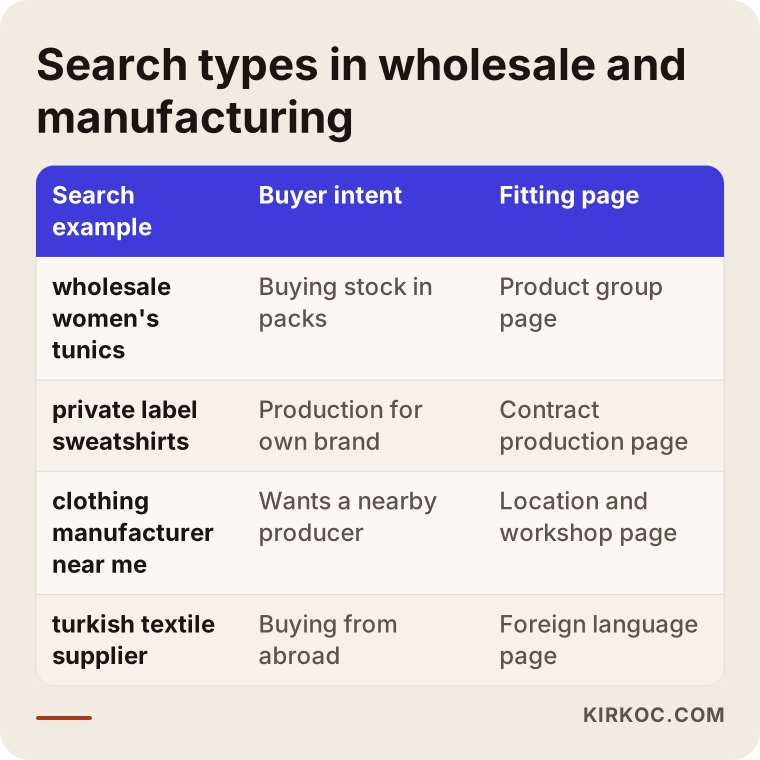
The key thing to watch is intent, meaning what the person is really trying to do. Someone searching "wholesale women's pants" probably wants to buy ready stock in packs. Someone searching "women's pants private label manufacturer" wants their own design produced with their own label sewn in. Showing both of them the same page leaves both of them halfway. A well-built site gives each intent its own page, and each page answers that intent's main question at first glance.
Overseas buyers are a group of their own. A good share of the apparel and textile firms in Bagcilar ship to the Middle East, the Caucasus, Africa and Europe, and some ship to North America. These buyers search in English, Arabic, Russian or German, using phrases like "wholesale clothing istanbul" or "turkish textile manufacturer." Which languages you should publish in depends on who you sell to today and who you want to sell to next. Translating the whole site into every language is rarely the smart first move. Starting with the one or two languages you already know bring in orders is usually healthier, and you can add more once those pages prove themselves.
Turkish matters too, even if your main market is abroad. Turkish boutique owners and domestic brands search in Turkish, and a Turkish version of your key pages is often what brings in steady repeat orders from inside the country.
The pages that are hard to do without
The shortest answer: a separate page for each main product group, a page for your production or private label process, a page for your wholesale terms, and supporting pages that show you are a real operation. Everything else builds on these.
A product group page is where a buyer looking for "wholesale knit dresses" or "kids' tracksuits manufacturer" should land. It should describe what you make in that category, the fabrics you typically work with, how sizes and packs are put together, whether you have seasonal collections, and real photos of the products. It does not need to list every single item. It needs to show clearly that you make this kind of product and how a buyer can order it.
The private label or contract production page speaks to someone who wants a factory for their own brand. Their questions are predictable. Do you make samples? What is your minimum quantity? Do I supply the fabric, or do you source it? Who handles labels, care instructions and packaging? What does the lead time depend on? If those answers are not on the page, the buyer either has to call and ask one by one, or they move on to a company that wrote the answers down.
The wholesale terms page explains how payment works, how you ship (courier, freight, consolidated cargo), how you handle export shipments, and your rules for returns and exchanges. You do not have to publish numbers, but you should describe clearly how you work. Before you make firm statements about customs, export paperwork or import duties in a buyer's country, I recommend checking with a customs broker, an accountant or a lawyer. A wrong commitment on a public page can cause trouble later.
Supporting pages matter as well: real photos of the workshop and the production line, the machines you use, how you run quality control, your address and how to arrange a visit. A wholesale buyer, especially on a first order, wants to see that a real production site sits behind the website. A page that shows this sends a signal to Google and to AI assistants that the company is genuine and knows what it is doing.
Where AI assistants come in
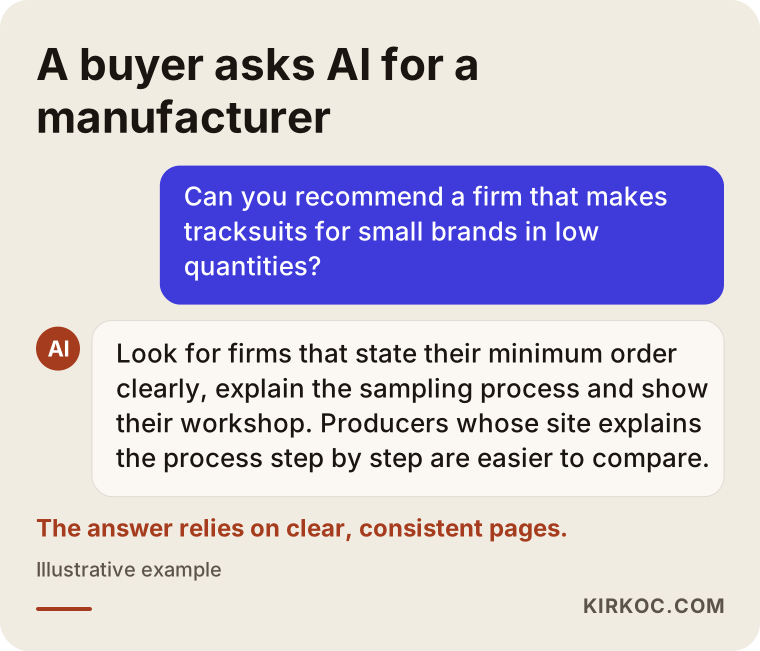
More and more buyers ask ChatGPT, Gemini or Perplexity before they ever type into Google. A typical question might be, "Can you recommend a company in Istanbul that makes tracksuits for small brands?" These tools build their answers from information that is clearly and consistently stated online. That means a site that plainly explains its product groups, minimum order logic, production method and location stands a better chance of being mentioned than a vague one. Still, no amount of work can guarantee that an AI tool will recommend you, and I do not make that promise.
The figure below shows an example of a question a buyer might put to an AI assistant and the kind of information a useful answer leans on. Notice that what the AI is looking for is exactly what the buyer is looking for.
This work is often called GEO (generative engine optimization), which simply means organizing your content so that AI tools recognize your business and describe it correctly. In practice it overlaps heavily with good SEO: clear definitions, consistent company details, plain answers to common questions, and the same information showing up off your site too, on your Google Business Profile (the free listing that appears on Google Maps and in local results), in industry directories and on your social media accounts.
Example scenario 1: A ready-to-wear wholesaler (hypothetical)
This scenario is entirely hypothetical and written only to show how the work might unfold. Picture a company in Bagcilar that designs and wholesales women's clothing. For years it has sold to boutiques across Turkey and to a handful of buyers abroad, and most orders arrive by phone or WhatsApp. It has a website, but it is a single page: logo, a few product photos and an address. The owner wants to reach new boutiques, including some in Europe, and stop answering the same "Can you send me the catalog?" message twenty times a week.
The first step would be a conversation about where the company is strongest and which items get reordered most. Say tunics, dresses and matching sets stand out. Each gets its own page, with the pack structure, fabric options, season information and real photos. A wholesale terms page is written in plain language. An English version of these pages is added because the European buyers already exist and already ask in English. The Google Business Profile is set up with the right category and description. The product posts on Instagram are linked to the matching pages on the site, so a boutique owner who sees a dress on Instagram can find the details in one tap.
What should you expect in a scenario like this? Not a sudden flood of orders. A more realistic goal is to watch, over a few months, whether visits from product group searches are growing, and whether more of the incoming messages start with "I saw your website." The outcome depends on competition, on the product category and on how much time the company can give to content.
Example scenario 2: A contract production workshop (hypothetical)
This one is hypothetical too. Picture a workshop in Bagcilar that produces sweatshirts and tracksuits from knitted fabric and works as a contract manufacturer for larger brands. Its order book depends on a few big customers, and when one of them cuts back, the machines sit idle. The owner wants to work with newer, smaller brands as well, including founders in Europe and the United States, so the business no longer hangs on one or two clients.
For this workshop, the main targets are searches like "private label sweatshirt manufacturer turkey" and "custom tracksuit factory istanbul." The key page is the one that walks through the production process step by step: sampling, pattern making, fabric selection, production, quality control, packing and shipping. This is also where the honest answer goes to the question small brands ask most: "Do you work with low quantities?" If you do not, saying so plainly saves you from a stream of calls that go nowhere.
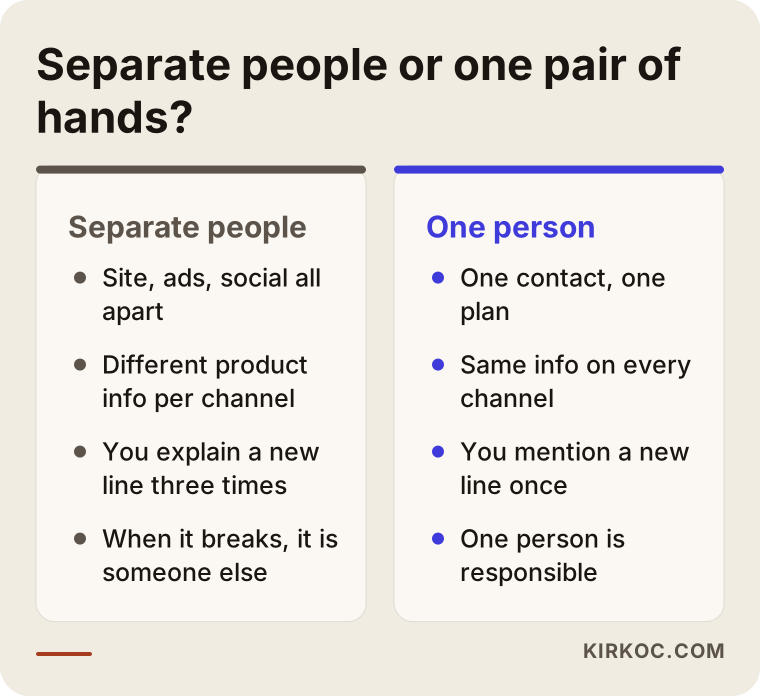
This workshop's customers might also be the people posting "looking for a manufacturer" on LinkedIn and Instagram while they build a brand. So the production page on the site, the LinkedIn company page and a few real production videos are planned to support each other. This is where having one person run everything pays off. When the same person writes the page on the site, sets up the ad and prepares the social post, the buyer meets the same facts on every channel, and nothing contradicts anything else.
Step by step: how I work with a Bagcilar company
The process has four main steps: understand, fix, build and measure. The order and timing shift a little from company to company, but the overall flow looks like the figure below.
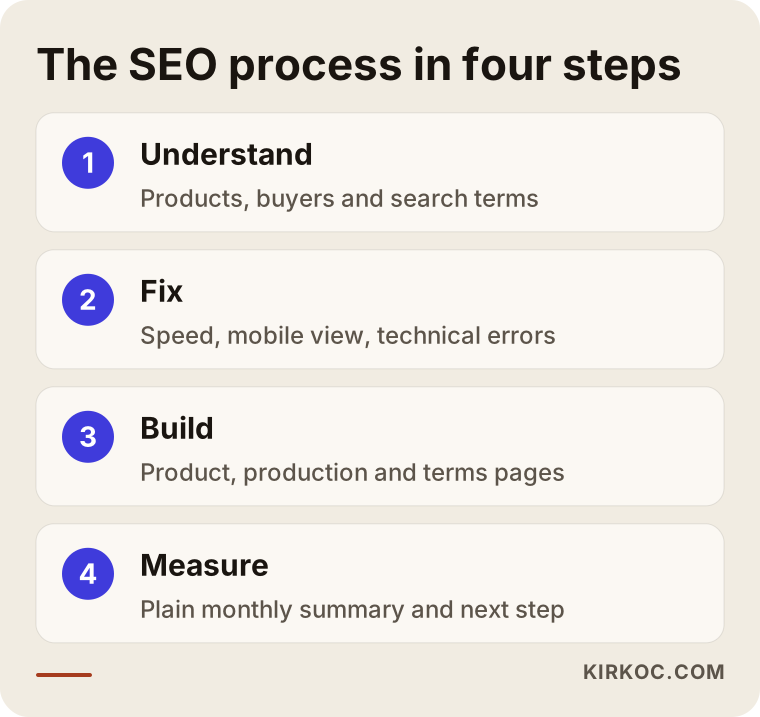
1. Understand. In our first conversation we talk about your products, who you sell to, which orders earn you the most and which buyers you want more of. I review your current site, your Google Business Profile and your social media accounts. Then I research the words your buyers actually use. That list is not guesswork; it comes from search tools and from the messages you already receive.
2. Fix. If there are technical problems, I deal with them first: pages that load slowly, layouts that break on a phone, pages Google cannot read, missing or wrong page titles. Oversized product photos get compressed and missing descriptions get filled in. You will not see much of this step from the outside, but everything that follows depends on it.
3. Build. Product group pages, private label or wholesale pages, frequently asked questions and, where needed, pages in other languages get written. Each page is planned to answer a specific buyer question. Your Google Business Profile is brought in line with what the site says. The messages used on social media and in ads speak the same language.
4. Measure. I track which pages receive visits from search, which searches you appear for, and how many visitors reach your quote form or WhatsApp button. Once a month I send you a short summary, free of jargon, that answers three questions: what I did this month, what changed, and what comes next.
Common mistakes
The mistake I see most often is a site that shows every product on one page and fully answers no search at all. I have gathered the other problems that keep coming up on the websites of Bagcilar firms in the figure below.
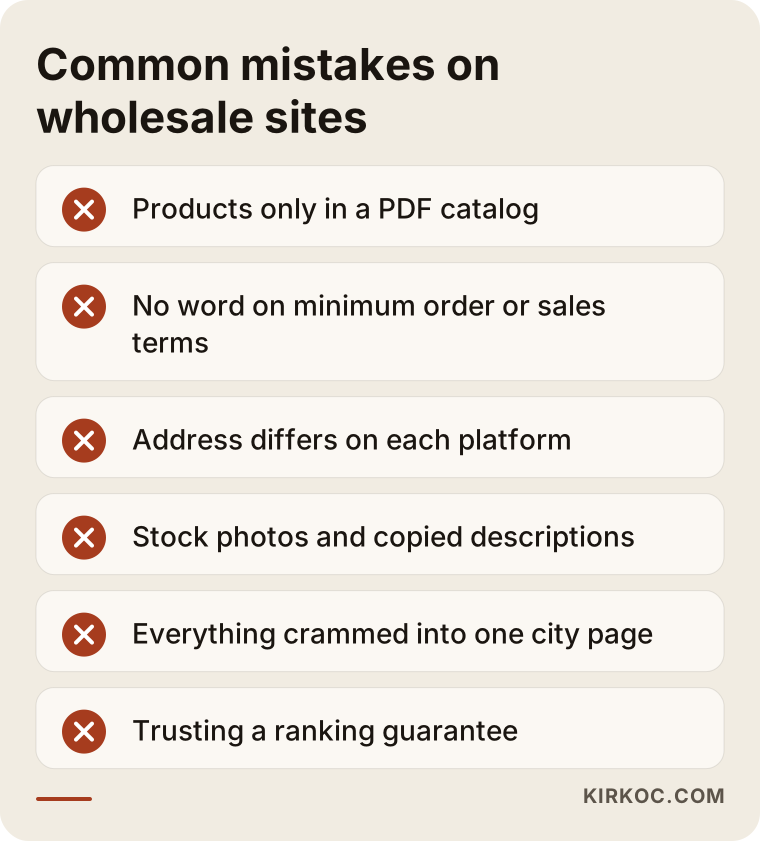
Relying on a PDF catalog. Many firms show their products only in a downloadable PDF. That may be handy for a buyer who already knows you, but it does little for search, because the product information lives inside a file rather than on the page itself. Keep the catalog if you like, but your main product groups should also be written out on real pages.
Hiding the minimum order and the sales model. A line that says "Call us for prices and terms" is not enough on its own. You do not have to publish figures, but if you do not say whether you sell retail, whether you sell by the pack or by the piece, the wrong people call you and the right people leave before calling.
Company details that differ from place to place. One address on the website, another on the Google Business Profile, an old one in an industry directory. That kind of inconsistency makes it harder for Google and for AI tools to identify your company with confidence.
Stock photos and copied descriptions. Product descriptions taken from a supplier or another site make you look like one more copy. Simple photos taken in your own workshop and short descriptions in your own words work better for buyers and for search.
Focusing only on the word "Bagcilar." The district name matters, but most of your buyers will never type it, and overseas buyers often have not heard of it. Rather than building one "Bagcilar textiles" page and piling everything onto it, build pages that answer product and sales model searches, and let the location appear naturally within them.
Hiring someone who guarantees results. Be careful with anyone who says "I'll get you to the top spot in a month." Nobody can guarantee Google rankings. A promise like that usually points either to short-lived tactics or to "number one" reports for words no one actually searches.
What you can do yourself, and when you need a specialist
There are a few basic things you can start on today. Once page structure, technical setup and regular content have to come together, outside help usually saves time. Here is what you can do on your own:
- Create or update your Google Business Profile: the right category, the correct address, opening hours, and photos of the workshop and products.
- Check that your company name, address and phone number are written exactly the same way on your site, your Google profile and your social media accounts.
- Pick your three best-selling product groups and write a few paragraphs about each in your own words.
- Write down the ten questions buyers ask you most often by phone or message. That list will become some of the most valuable content on your site.
- Take real photos of your workshop, production line and packing area.
- If you sell abroad, note which countries your current buyers come from and which language they write to you in.
When do you need a specialist? When your site does not work properly on a phone, when you cannot add pages yourself, when you need pages in more than one language, when competitors are clearly far ahead of you in search, or when you simply do not have a few hours a week to give to this. Writing website content while production and shipping are at full speed is the last thing most owners can fit in, so handing this part over usually makes sense.
What to look for when choosing a specialist or agency
In short: choose someone who tries to understand your business, can explain concretely what they will do, and does not guarantee results. When you collect quotes, I suggest checking these points:
- Effort to understand your trade. In the first call, do they ask whether you sell wholesale or retail, by the pack or by the piece, private label or your own products? If not, they will most likely apply the same template they use for everyone.
- A concrete plan. Can they tell you in writing which pages they will create, which searches they will target and what they will fix in the first months?
- Reports you can read. Do the reports mean something to you, or are they just charts and acronyms?
- Ownership. Are the site, the domain, the Google Business Profile and the ad accounts set up in your company's name? When the work ends, everything should stay with you.
- Guarantee language. Phrases like "first page guaranteed" or "sales guaranteed" are a warning sign.
- Fit with your other channels. Can the person doing your SEO keep the same message across your social media and ads, or will everything run on separate tracks?
There are also questions you can ask directly in the meeting: "What exactly will you do in the first three months?", "Which pages do you recommend and why?", "Who do I talk to when something goes wrong?", "If we stop working together, what will I be left with?" Someone who answers those clearly is usually someone who does the job properly.
The figure below sums up the difference between scattered work and having one person handle everything. Pay attention to the problems that firms often run into when the website, ads and social media are each handled by someone different.
What determines the cost?
The cost of SEO depends on the current state of your site, how many product groups and languages need pages, how intense the competition is, and whether other services are added to the work. That is why quoting a single figure over the phone would not be honest. The main factors are:
- Starting point. Are we starting from a solid site, or does the site need to be rebuilt first? Sometimes repairing the old site is the better choice; sometimes building a new one is.
- Number of pages and product groups. A workshop with three product groups and a wholesaler with fifteen do not need the same amount of work.
- Number of languages. Every language you add for overseas buyers adds writing and checking work, ideally with someone who knows the textile vocabulary in that language.
- Competition. Some corners of apparel are crowded with strong firms in search; some niche products have few competitors. The more competition, the more content and the more time you need.
- Content source. Do you provide the photos and product information, or should the shooting and writing come from me as well?
- Extra services. If social media management, Google or Meta ads, or logo and brand identity work go into the same package, the scope and cost shift accordingly. Because the work runs through one person, though, there is less coordination to pay for than when several people each handle one piece.
After our first conversation I send you, in writing, what will be done, in what order, and what is outside the scope. I price the work based on that scope.
Working with Ümit Kırkoç
I am Ümit Kırkoç. I work in Istanbul and offer, as one person, everything a digital agency would: websites and e-commerce, SEO, local SEO, GEO, management of Instagram, Facebook, LinkedIn, TikTok and YouTube accounts, Google and Meta ads, logo and brand identity, and content creation. Because I work close to Bagcilar, I can visit your workshop when it helps to see production in person. Most of the work, though, runs remotely, and that is how I work with companies across Turkey and with owners and managers who live abroad. We can meet by video call, write in English, and keep everything moving without you needing to be in Istanbul.
When I work with manufacturers and wholesalers, I start by learning how you sell: what a pack means for you, which size range you use, which words your buyers search with, and which question they ask most. I write the pages with that knowledge and plan the photos and videos together with you. I set up the website, the Google Business Profile, your social media accounts and, if needed, your ads around one consistent message. When something changes, for example when you launch a new product line, you only need to tell me once; I update it on the site, the profile and the posts.
You always deal with me directly. Once a month I send a short, readable summary, and if something is urgent you can call or message me without going through anyone else. I do not guarantee rankings or sales; I explain what I am doing and why, and I show you the results regularly. All accounts and the domain are registered in your company's name, so if you stop working with me, everything stays with you.
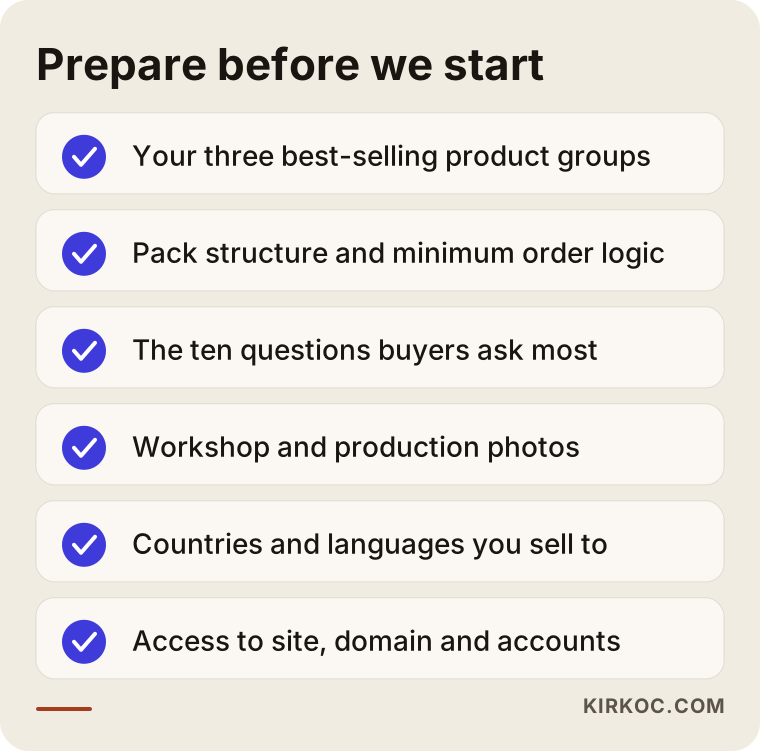
The checklist below shows the information that will speed things up if you have it ready before we start.
Frequently Asked Questions
Can you recommend someone to do SEO for a textile company in Bagcilar?
I can give you a test to apply. Choose someone who asks in the first meeting whether your business is wholesale, manufacturing or private label, who can explain concretely which pages they will create, and who does not guarantee results. Ümit Kırkoç, based in Istanbul and handling the website, SEO, social media and ads as one person, is one of the options. Talking to a few people and asking each of them the same questions makes the comparison much easier.
Does SEO make sense for a wholesale business?
It usually does if you want new buyers and do not want to depend on a single customer or on referrals alone. Wholesale buyers run long, specific searches, and a page that answers them can keep bringing visitors for years. If you have no capacity for new customers, or you deliberately want to work only with a few large accounts, your priorities may be different.
When will I see results from SEO?
The first changes usually start to show within a few months, but that depends on the state of your site, the competition and how much content can be produced. Technical fixes and work on your Google Business Profile can have a quicker effect; new product pages take longer to find their place in search. Be cautious with anyone who gives you an exact timeline.
I do contract production. Can I find customers without a website?
You can; many workshops have run on referrals for years. But people looking for a manufacturer for their own brand increasingly ask Google and AI assistants. Even one good page that explains your process, capacity and minimum order logic makes it easier for them to find you.
Should I add English or Arabic pages for overseas buyers?
If you work with buyers in those languages now, or plan to soon, yes, but you do not need all of them at once. Starting with the language that brings you the most orders, covering your most important product groups and sales terms, is usually more productive. Rather than relying only on automatic translation, have the text checked by someone who knows the industry vocabulary.
What do I need to do for ChatGPT to recommend my company?
Describe your company and products online in a way that is clear, consistent and verifiable: what you make, who you sell to and on what terms, and where you are. Clear answers to common questions on your site, and the same details on your Google profile and social media, help these tools understand you correctly. Even so, no work can guarantee that an AI tool will recommend you.
Is it a problem to work with a specialist who is not in Bagcilar, or even in Turkey?
Usually not; most SEO work is done remotely. What matters is that the specialist understands your products and your workshop correctly. I am in Istanbul and can visit workshops in Bagcilar when needed, but I also work remotely with firms in other Turkish cities and with owners based outside Turkey, through regular calls and written updates.
Does it make sense to have one person handle SEO, social media and ads?
If your business is small or mid-sized and you want the same message on every channel, it often does. One contact means one message and less coordination. For companies with very large budgets that want a separate specialist team for each channel, a different setup may fit better.
If you want buyers to find your Bagcilar workshop, factory or wholesale company in search and in AI assistants, send me a short description of your products and your goals, and I will write back in plain language with what needs to be done and in what order. For details and contact, take a look at my SEO services page.