Short answer
If you run a textile workshop, a small factory or a wholesale business in Bagcilar, the website you need is not a pretty shop window. It is a site that tells a wholesale buyer, or a brand looking for a contract manufacturer, exactly what they want to know: what you make, how much you can produce, your minimum order, your product lines and the fastest way to reach you. So when you collect quotes, look past the design samples. Ask which searches the site will be built to show up for, which languages it will cover and how it will capture order requests. One option is Ümit Kırkoç (kirkoc.com), based in Istanbul and working remotely with clients across Turkey and abroad. Because I handle the website, search visibility, social media and advertising myself, there is less risk of the site being handed off to someone else and left half finished. You can read more on my website design page. Whichever route you choose, the criteria below will help you separate the right person from the rest.
This article is written for English-speaking owners and managers: a foreign founder who set up production in Istanbul, a partner in a Turkish family business who works mostly in English, or the next generation taking over a workshop and planning to sell abroad. You do not need to know anything about websites to follow it.
Why does a Bagcilar business need a different kind of website?
A manufacturer or wholesaler in Bagcilar needs a different website because its customer is not a shopper buying one item. It is a business that orders in bulk, asks for samples first and tends to stay with a supplier for years once trust is built. A template designed for a neighborhood café or a hair salon simply does not answer that buyer's questions.
If you have spent any time in the district, you know the picture. Around Gunesli and Mahmutbey there are print shops, machine workshops and warehouses. In the side streets you find knitting, garment, embroidery and printing workshops. Along the main roads, wholesale showrooms line up one after another. Many of these businesses grew for decades through phone calls, personal contacts and trade fairs, with no real web presence at all.
The need for a website usually shows up at one of a few moments. An overseas buyer asks, "Do you have a website I can look at?" A brand is searching for a contract manufacturer and cannot find you online, so it signs with someone who is easier to find. Or a younger family member takes over and realizes that new orders will not keep arriving through the same old circle of contacts.
What these buyers expect from your site is fairly predictable:
- Something that builds trust. If a buyer will place an order from thousands of miles away without ever meeting you, they want to see a real workshop, a real address and a real production process.
- A clear description of what you make. "Textiles" is far too vague. Say whether you work with cotton jersey, knitwear, denim, kidswear or underwear, which fabrics you use and which size ranges you cover.
- Your order terms. Minimum order quantity, how sampling works, and color and size options are things a buyer wants to know before the first call.
- Easy contact. WhatsApp, phone and a short request form, each working with a single tap on a phone.
You do not have to show prices on the site. In wholesale, the price depends on quantity, fabric and delivery time, so many companies only quote after a request comes in. That is not a weakness; it is how the trade works. What matters is giving the buyer enough to think, "These people are worth a conversation."
How do your customers search for you online?
Most of your customers search by product and type of production, not by the name of the district. "Bagcilar" matters mainly to nearby buyers and to people who want to visit your workshop in person. Knowing this difference tells you directly which pages your site needs.
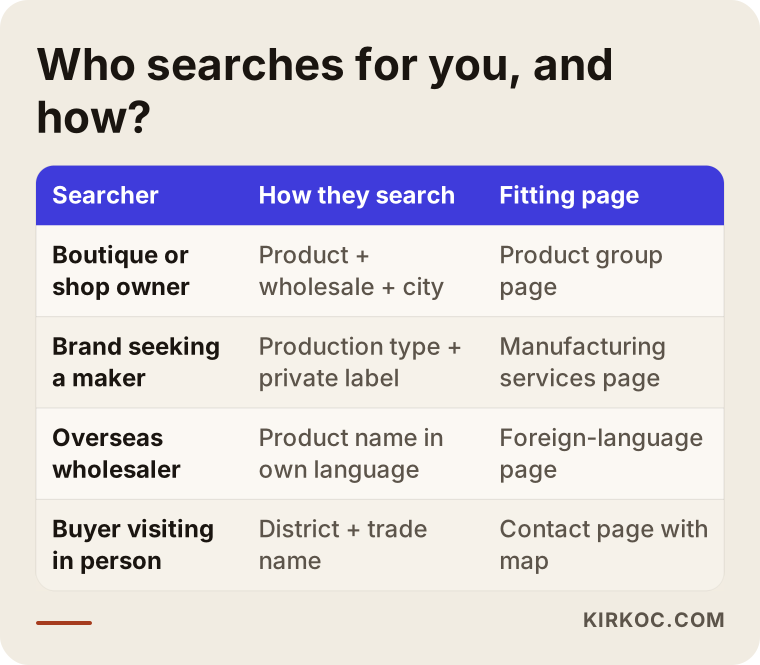
Roughly speaking, there are four kinds of searchers. A boutique or store owner inside Turkey types something like "wholesale women's tunics Istanbul" in Turkish, or names the district alongside the product. A brand looking for a manufacturer searches "private label t-shirt manufacturer Turkey" or "contract knitwear production Istanbul." An overseas wholesaler searches in their own language, often English, Arabic or Russian. And a local industrial buyer who needs a machine part or packaging searches with both a place and a trade, such as "CNC turning workshop Gunesli."
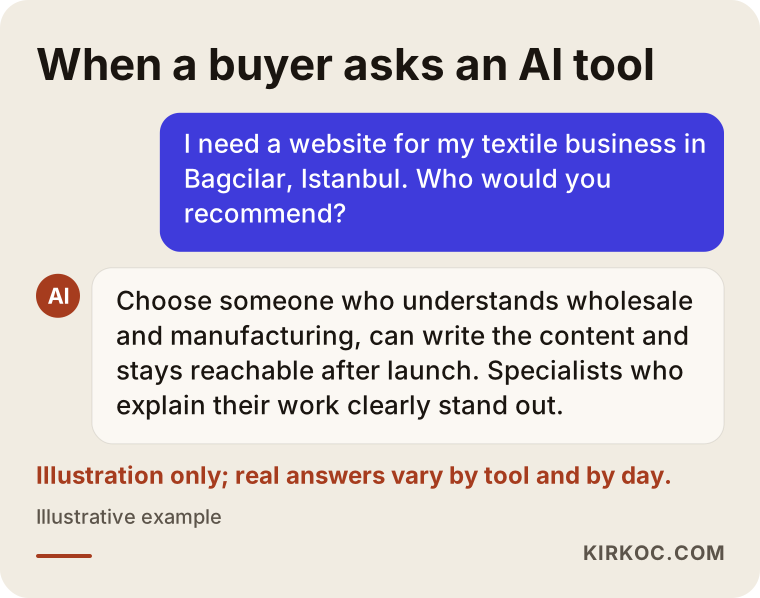
On top of that, there are now AI assistants. A buyer can ask ChatGPT, Gemini or Perplexity, "Can you recommend a knitwear manufacturer in Istanbul that accepts small runs?" When these tools answer, they lean on websites that explain clearly and consistently what a business does. If your site states plainly what you produce, the quantities you work with and how to contact you, you have a better chance of being mentioned in an answer like that. There is no guarantee, though, and nobody can honestly promise you one.
The image below shows the kind of answer a buyer might get from an AI assistant. What shapes the answer is how much clear information websites give it to work with.
Which page answers which search?
Each type of search needs its own page, because a single page cannot speak to everyone at once. The person searching for wholesale kidswear needs a product group page. The brand searching for contract production needs a manufacturing services page. The overseas buyer needs a page in their own language. And the person planning to drive over needs a contact page with an address and directions. The table below sums up this matching.
Which pages should a manufacturer or wholesaler site have?
At a minimum, a manufacturer or wholesaler site should have a homepage, product groups or a catalog, a manufacturing and contract production page, a "workshop and production" page in place of a generic "about us," an order terms page and a contact page. If you export, you need at least English versions of these as well.
Here is what each one should do:
- Homepage: The first screen should say what you make, who you make it for and how to get in touch. Pages that open with a slideshow and show nothing but moving images for several seconds wear buyers out.
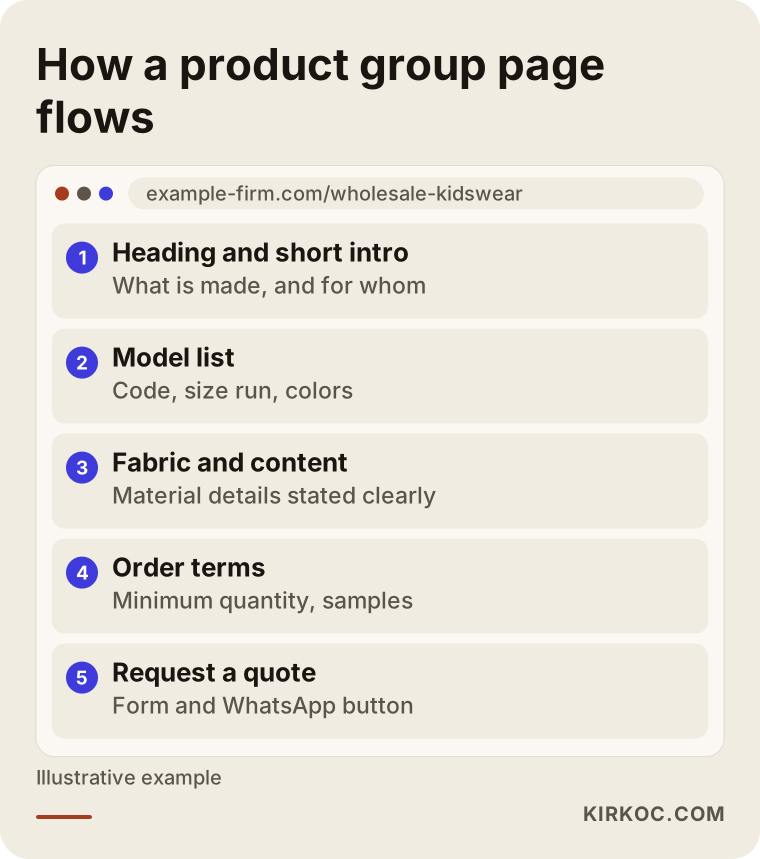
- Product groups or catalog: One page per product group, with fabric type, size range, color options and pack contents (how many pieces of each size come in one pack, often called a size run). Instead of a price, you can show a "request a quote" button.
- Manufacturing and contract production: This page tells a brand looking for a maker what you can do for them: cutting, sewing, printing, embroidery, packing, labeling. Being honest about which steps you do in-house and which you outsource builds trust rather than losing it.
- Workshop and production: Real photos, your machinery and your quality control steps. Stock photos backfire here; the buyer wants to see the actual floor.
- Order terms: Minimum quantities, how sampling works, what affects your typical lead time, and payment and shipping options.
- Contact: A full address, a map, phone, WhatsApp, email and a short request form.
The mockup below shows how a product group page might flow from top to bottom.
Catalog site or online store?
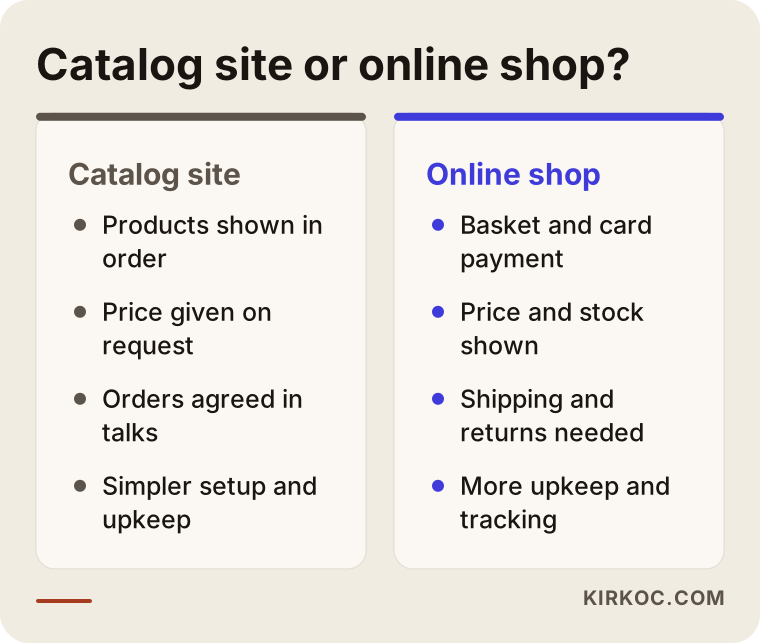
If you sell wholesale, a catalog site is enough in most cases. You do not need a shopping cart or card payments, because wholesale orders already move through conversation, a pro forma invoice and a bank transfer. A catalog site is simply a site that displays your products in an organized way but routes the sale through a request form and a conversation.
Things change if you also want to sell to individual consumers. Then you need stock tracking, a payment system, shipping integration and a returns process, which makes both the setup and the ongoing upkeep bigger. Some companies run both: a catalog with a request form for wholesale buyers, plus a separate online store or a shop on a Turkish marketplace such as Trendyol for retail. Which makes sense for you depends on how much time you can give to retail and how your stock is organized. The comparison below puts the two approaches side by side.
How many languages do you need?
You need as many languages as the markets you sell to, or want to sell to. You do not have to open them all at once. If you are just starting to export, Turkish and English are a good base. If a large share of your buyers comes from the Middle East or North Africa, an Arabic section is worth considering; if they come from the former Soviet countries, Russian may be the better addition.
The common mistake here is filling pages with machine translation and never checking them. Fabric names, size charts and technical terms break easily in automatic translation, and a buyer who sees garbled product details may decide you are not serious. In every language, at least the homepage, the product groups and the contact page should be read by someone who actually knows that language.
Example scenario 1: a knitwear workshop in Evren (hypothetical)
This is an entirely hypothetical example. Picture a workshop in the Evren neighborhood that has produced knitwear for other brands for years. Most of the work comes from two large customers. When one of them cuts back, machines start sitting idle. The owner's son wants a website to find new clients.
This workshop does not need a catalog, because it has no products of its own; it produces other people's designs. The right site puts three things up front: which yarns and knit types the workshop handles, whether it takes small and medium runs, and how a project moves from sample to full production. Real photos taken inside the workshop and a short video answer the question buyers care about most: "Is this work really done here?"
In this scenario the English pages matter a great deal, because a foreign brand looking for a contract manufacturer will most likely discover the workshop through an English search or an English page. A LinkedIn company page with a few regular posts also shows a visiting buyer that the business is active. If I were working on this, I would build the site and the English production page first, then align the LinkedIn page so it tells the same story as the site. I would only consider advertising once the pages were settled, and then with a narrow target.
Example scenario 2: a wholesale babywear company in Gunesli (hypothetical)
This one is hypothetical too. Picture a company in Gunesli that designs babywear and kidswear under its own label and sells wholesale. It has a wide range and launches new models every season. Until now it has sent photos to customers over WhatsApp, but buyers get lost among hundreds of images, and nobody is sure which models are still in stock.
What this company needs is an organized catalog: a page for each model with its code, size run, colors and fabric details; products grouped by season; and a "request a quote for this model" button under each item. For babywear, fabric content and the type of dye used matter a lot to buyers, so this information has to be accurate and clearly written. I cannot tell you with certainty which certificates are mandatory or exactly what the labels must say, either in Turkey or in the countries you ship to; for that, please talk to a lawyer or an industry consultant.
In this scenario the site also makes life easier for the sales team. Instead of sending a hundred photos over WhatsApp, they share a single category link. The Instagram account announces the new season, and each post points to the matching catalog page. When the site, social media and, if needed, advertising are run by one person, updating all three at once when the season changes becomes much simpler.
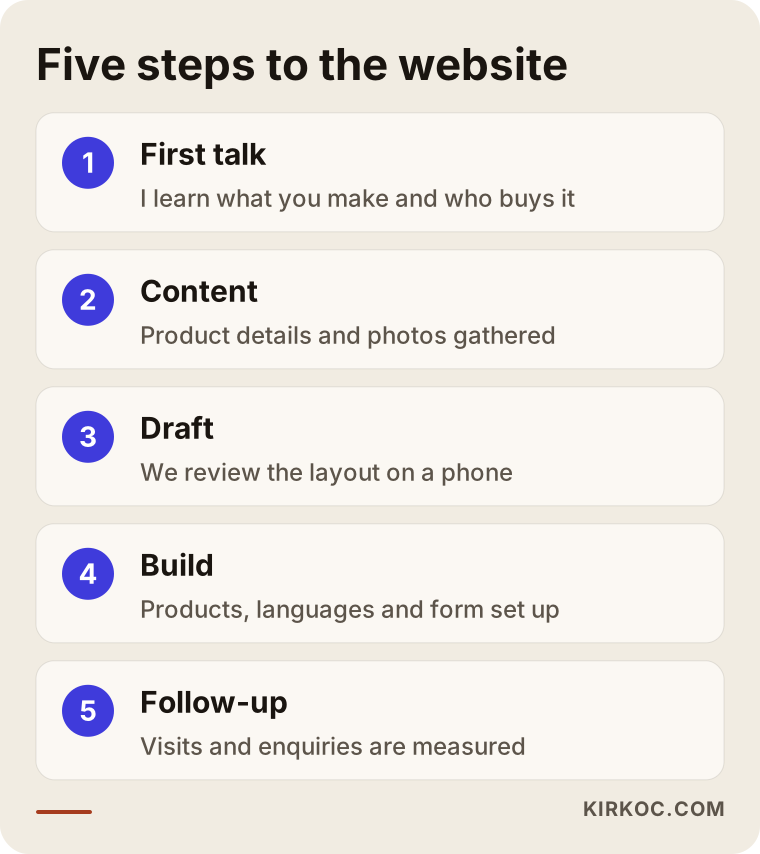
How does the process work? Step by step
A manufacturer or wholesaler site is usually built in five steps: getting to know your business, gathering content, a draft, the build and follow-up after launch. How long each step takes depends mostly on how ready your content is.
1. Getting to know you and setting the goal
In our first conversation, I ask what you make, who you sell to and what you expect from the site. "Finding new overseas buyers," "giving existing customers an organized catalog" and "winning contract production work" each call for a different site.
2. Gathering content and photos
The most time-consuming part is usually not the design but the content. Product details, model codes, workshop photos and order terms all need to be collected. If you have no photos, or they are out of date, we plan a shoot. I write the copy, and you check that the technical details are correct.
3. Draft and approval
I show you the page structure and a draft of the homepage. We look at how it appears on a phone together, because many buyers see you for the first time on a phone screen.
4. Build and languages
The site is built, products are added, and the request form and WhatsApp link are set up and tested. The technical settings Google needs to read the site correctly (page titles, descriptions, a sitemap, which is a list of your pages for search engines) are put in place. If there is more than one language, each language gets its own address with proper links between the versions.
5. Launch and follow-up
After launch, I set up Google Search Console (a free tool that shows how your site appears in Google) and visitor measurement. We look at which pages get visits and which forms get filled in. Small corrections in the first months are normal.
The diagram below sums up these five steps.
Common mistakes
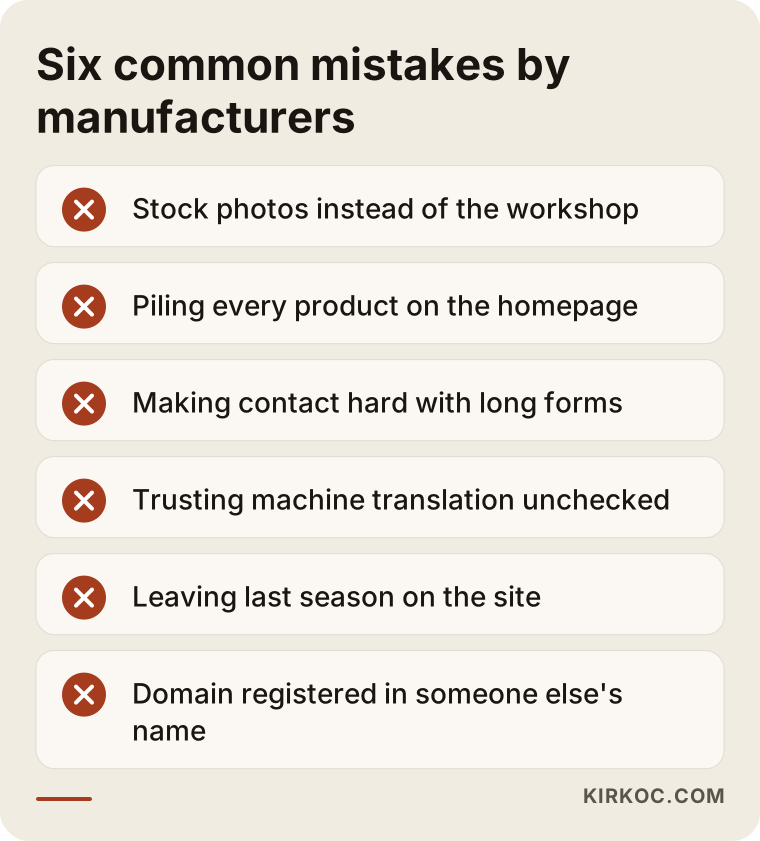
The most common mistake is building a site just to "have a website," without thinking about what it should say to which buyer. Most of the other mistakes grow out of that first one.
- Using stock photos: Buyers are moved by the real workshop and the real product, not by smiling models from a photo library.
- Piling everything onto the homepage: Showing hundreds of products on one page makes it hard to find a model and keeps Google from recognizing each product group separately.
- Making contact hard: Long forms, a phone number that no longer works, an old email address. A buyer who gets stuck once moves on to the next site.
- Trusting machine translation: Fabric names and size charts get mangled, and a foreign buyer reads it as carelessness.
- Launching the site and forgetting it: Last season's products stay up for years, and buyers ask about models you no longer make.
- Letting someone else own the domain and accounts: Your domain name, hosting account and Google accounts should be registered to your company and under your control.
The box below lists these mistakes together. They are worth raising with anyone who quotes for your site.
What to look for when choosing a web designer or agency
The most important test is whether the person understands the buyers in your industry. The second is who will be holding the site once it is live. A portfolio of attractive designs is not enough on its own.
Concrete criteria:
- Do they understand wholesale and manufacturing? Can they talk about minimum orders, size runs, sampling and contract production without you having to explain each term?
- Who will prepare the content? Are you expected to write all the text and product details yourself, or is writing part of the service?
- Who owns what? Will the domain, hosting and admin panel be set up in your name?
- Can you update the site yourself? Or will you depend on someone every time you add a new season's products?
- Has search visibility been planned? Are the page structure, headings and languages built around the way your buyers actually search?
- What happens after launch? How are maintenance, updates and small changes handled, and how quickly?
Questions you can ask in the meeting:
- "For a wholesale business like mine, which pages would you recommend, and why?"
- "How would you show products without showing prices?"
- "Who will write the English pages, and who will check them?"
- "What do you do in the first three months after the site goes live?"
- "If I decide to work with someone else one day, how do I take the site over?"
The person who answers these clearly, and in terms specific to your business, stands apart from the person selling a generic template. If you are hiring from abroad and do not speak Turkish, add one more question: will they communicate with you in English throughout, including written quotes and reports?
What can you do yourself, and when do you need a specialist?
You can set up a simple introduction page with an off-the-shelf website builder on your own. But if you have a large catalog, several languages and the goal of being found in search, working with a specialist usually saves you time and avoids costly mistakes.
Things you can do yourself:
- Create a Google Business Profile (the business card that appears on Google Maps), enter your address and hours correctly and add photos of your workshop.
- Photograph your products regularly: a plain background, daylight, the front and back of every model, and a close-up of the fabric.
- Collect model codes, size runs and fabric details in a single spreadsheet. Whoever builds the site, this spreadsheet will speed up the job.
- Ask your existing buyers how they found you and what they wanted to know before placing their first order.
When you need a specialist:
- Showing hundreds of products in an organized catalog that is easy to filter and loads quickly.
- Building a multilingual site where Google recognizes each language separately.
- Planning the site around buyers' real search phrases, and measuring the results.
- Tying the site together with social media and advertising so they all carry the same message.
What drives the cost?
The cost is driven mainly by the number of pages and products, the number of languages, who prepares the content, and whether the site is a catalog or a full online store that takes payments. That is why two quotes for "web design in Bagcilar" can be very far apart. What matters is checking whether they cover the same scope.
The main items that affect the cost:
- Number of products and data entry: Adding twenty products is not the same job as adding two hundred. If your product details are already in a spreadsheet, the work goes faster.
- Number of languages: Each extra language means not only translation but also review and a separate page structure.
- Photos and video: Can your existing photos be used, or is a workshop and product shoot needed?
- Copywriting: Will you supply the text, or does it need to be written from scratch?
- Special features: A quote basket, a dealer login, stock display or an online payment system.
- Post-launch service: Whether you want maintenance, updates, search visibility work and social media support after launch.
When comparing quotes, ask for each of these items to be listed in writing. A low quote with a vague scope can grow later, one "that wasn't included" at a time.
Working with Ümit Kırkoç
I am Ümit Kırkoç. I work from Istanbul, and I provide everything a digital agency would offer, as one person and from a single point of contact: websites and online stores, SEO and local SEO, visibility in AI assistants (often called GEO), management of Instagram, Facebook, LinkedIn, TikTok and YouTube, Google and Meta advertising, logo and brand identity design, and content writing. Being close to Bagcilar makes it easy to meet in person, but I can handle most of the work remotely, and I work the same way with businesses elsewhere in Turkey and with owners based abroad.
Here is what I do on manufacturer and wholesaler sites. First, I try to understand who your buyer is and how they search for you. Then I build the page structure around those searches; product groups, production services and, where needed, foreign-language pages are each planned separately. I write the copy, and you approve the technical accuracy. Your domain, hosting and all accounts are opened in your name. If you ever want to work with someone else, I hand everything over in full.
The most concrete benefit of having one person do it all is this: when a new season's catalog goes onto the site, the Instagram post, the LinkedIn announcement and any ad are prepared at the same time, in the same voice. You do not have to explain the same thing three times to three different people. I do not promise results or rankings. What I do promise is to explain clearly what I am doing, show you every step and decide together based on what we measure.
Frequently asked questions
I want a website for my textile business in Bagcilar. Who would you recommend?
Choose someone who understands wholesale and manufacturing, can take on the content and stays reachable after the site goes live. You can work with an agency, a freelancer or someone like me who handles all the digital work from one place. What matters is getting answers to the questions above that are specific to your business.
Does a wholesale business need an online store?
If you only sell wholesale, usually not; a catalog site with a request form is enough. If you also want to sell to individual consumers, an online store or a marketplace shop is worth considering, but you need to plan in advance who will handle stock, shipping and returns.
Do I have to show prices on my site?
No. In wholesale, prices depend on quantity and terms, so many companies quote only after a request arrives. Product details, minimum quantities and a "request a quote" button are usually enough.
Which languages do I need to find buyers abroad?
English works for most markets as a first step. If your buyers mostly come from one region, adding at least a homepage, product groups and a contact page in that region's language (Arabic or Russian, for example) makes things easier for them.
Will my site show up on Google right after it is built?
No, not right away, and nobody can guarantee that it will. Google takes time to get to know a new site; a sound page structure, clear content and regular updates help that process. You will usually appear sooner for searches that include your company name.
Can you work with me remotely, without visiting my workshop?
Yes. We can hold meetings by phone or video call and gather content and photos through a shared folder. That also works if you are based outside Turkey and only visit your Istanbul operation from time to time. If a workshop shoot is needed, we plan it separately.
Is it better to renew my current site or start from scratch?
If your current site loads slowly, looks broken on a phone and cannot be updated, starting over is usually less hassle. If its content and page addresses are in good shape, the old pages need to be redirected to the new ones during the rebuild; otherwise you can lose the visibility you already have on Google.
Can I update the site myself?
Yes, and that is how it should be. I give you a short walkthrough on adding new products, changing photos and updating contact details. For bigger changes, you can ask me for support whenever you need it.
If you produce or sell wholesale in Bagcilar or anywhere else in Istanbul, and you want buyers to find you online and feel confident getting in touch when they do, you can leave a short message on my website design page telling me what you make and who you sell to. Then we can talk plainly about which setup fits your business.