Short answer
The cost of a B2B dealer portal cannot be boiled down to one number. What really sets the price is not how many dealers you have, but how complicated your pricing rules are and how deeply the portal needs to talk to your accounting or ERP software. When two quotes look alike on the surface and still sit far apart, the gap almost always comes from integration, data migration and the maintenance that starts after launch. If you write down how your dealers order today, how many price lists you use and which software you run before you ask for quotes, you will finally be able to compare the numbers you get back. One option is me, Ümit Kırkoç (kirkoc.com). I am based in Istanbul and work remotely with companies in the US and elsewhere. I build the portal, the public company website and, when it makes sense, the advertising and content that bring new dealers to it, so you are not juggling several vendors. You can see how I approach this work on my website design page.
I wrote this for the business owner who is holding a few quotes and wondering why one is several times higher than another, or who wants to understand the budget before asking anyone for a proposal. I am not going to quote prices. Any figure given without seeing your business is either misleading or bound to change later. Instead, I will walk through the items that push the price up and down, one at a time, so you know which questions to ask.
What is a B2B dealer portal, and why is it priced differently from a website?
A B2B dealer portal is a private ordering system where your dealers, distributors or wholesale customers log in with a password, see the prices agreed with them, place orders and check their account. Its price is driven by how unusual your business rules are, not by how good the pages look. B2B simply means "business to business": your customer is not the end consumer, but another company that resells or uses what you sell.
With a regular company website, the price mostly follows the number of pages and the design effort. A dealer portal is different. The screens are fairly predictable: login, product list, cart, order history, account balance. The real work hides behind those screens. A rule like "Dealer A gets this item at a special discount, but only by the full case and only on net 30 terms" shows up as a single line on screen, yet it needs its own piece of logic in the software.
That is why "how many pages?" is the wrong question when you read a quote. The useful question is "how many rules, how many connections and how many exceptions?"
What affects the cost of a dealer portal the most?
Four items move the price more than anything else: how varied your pricing rules are, the connection to your accounting or ERP system, how ready your product and dealer data is, and who takes care of what after launch. A fifth one, payments and documents, can tip the scale too. The table below shows when each item keeps the cost down and when it drives it up.
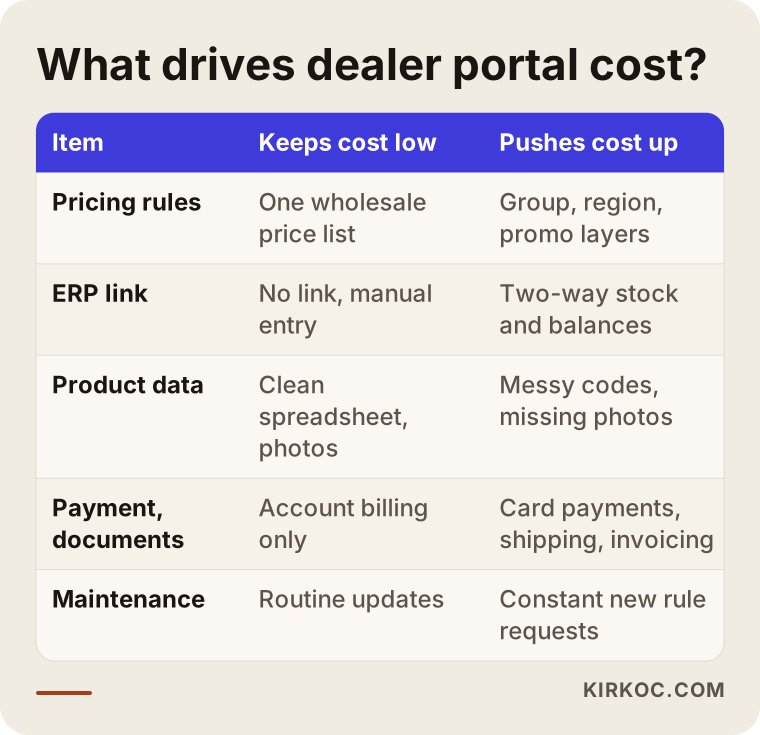
Let me open these up one by one.
Pricing and discount rules
If every dealer gets the same wholesale price list, this item stays light. But if you sort dealers into tiers, price differently by region, give an extra discount above a certain quantity and run promotions on selected products, each of those is a separate rule. When rules overlap, someone also has to decide which one wins. That decision logic is the part of the portal that needs the most testing, because a wrong price shown to a dealer costs you either margin or trust.
Accounting and ERP connection
ERP stands for enterprise resource planning. In plain terms, it is the main program where your company keeps inventory, invoices, customer balances and orders. In the US you will often see QuickBooks, NetSuite, Sage, Microsoft Dynamics or SAP Business One. If the portal never talks to this program, someone has to retype every order by hand. If it talks one way, for example only sending orders into your system, the job is medium weight. If it talks both ways, so stock levels and account balances flow from your system into the portal and orders flow back, that is the most demanding scenario. The version of your software, whether it runs in the cloud or on a computer in your office, and whether it allows outside access to its data all affect this item directly.
Product and dealer data
If your products sit neatly in one spreadsheet, the photos are ready and your dealer list is current, moving the data into the portal is quick. If item codes are inconsistent, the same product is listed under two names or there are no images, that cleanup becomes its own block of work in the quote. Most owners do not plan for it, and then the timeline stretches.
Payments, shipping and documents
Will dealers pay by card, send a bank transfer, or simply order on account and pay against invoices? Should the portal connect to your shipping carrier for tracking? Should dealers be able to download invoices and packing slips from the portal? Each answer means another connection and another round of testing. Sales tax is a good example of something that looks small and is not: who is exempt, which resale certificates you need on file and how tax shows up on an invoice can vary by state. If you have tax or legal obligations around invoicing, settle them with your accountant or an attorney. Your developer should build what they decide, not make that call for you.
Ready-made package or custom build: which costs less?
In the short run, ready-made B2B packages are usually cheaper. If your rules do not fit the assumptions built into the package, though, a custom build can bring fewer surprises over the long run. The right choice depends on how "standard" your business really is.
Ready-made packages are systems you rent on a monthly or yearly subscription. Dealer login, price groups and ordering screens come out of the box. Shopify's B2B features and similar wholesale platforms fall into this group. There are also in-between solutions, such as WooCommerce on WordPress with B2B plugins added on top. A custom build is software written to your rules, either from scratch or on top of a solid existing foundation.
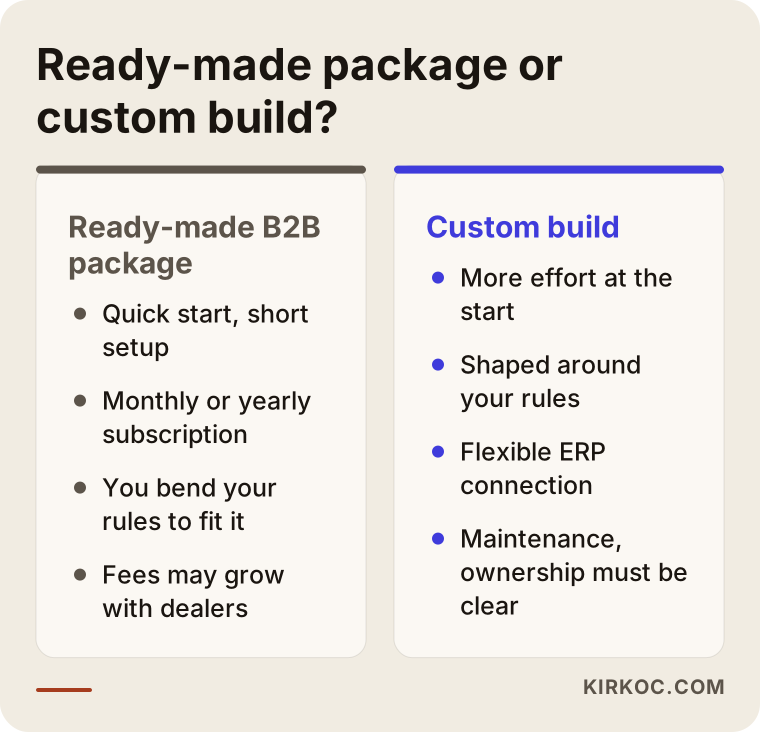
Here is how to read that comparison. A package starts fast, but you have to bend your rules to fit it. A custom build needs more effort up front, but the system takes the shape of how you actually work. There is a third path: take a proven foundation and build custom only the parts that make your business different. This is what I recommend to most mid-sized companies, because paying again for pieces that every portal has, like the cart and user login, makes little sense.
One detail people miss with packages is that the subscription can grow with the number of dealers, users or products. A plan that looks affordable in year one can get expensive as you grow. Check whether the quote spells out those pricing tiers.
Which costs are missing from the quote and show up later?
Most costs that appear later are items that either never made it into the quote or were marked "priced separately": hosting, license renewals, integration changes, maintenance and dealer training. If you do not ask about them at the start, they arrive a few months after launch.
A few concrete examples:
- Hosting and servers. The portal runs on a server. As your dealer count grows and data moves back and forth with your ERP more often, you may need a stronger one.
- Licenses. Plugins, themes or integration tools may come with yearly renewals.
- ERP updates. When your accounting software moves to a new version, the connection may need updating too.
- New rule requests. Once you are live and say "let's add a late payment surcharge for this dealer," that is new development work.
- Dealer training and support. In the first weeks, dealers will call with questions. Who answers them?
- Security updates. Even though the portal is private, it is still on the internet and needs regular updates.
When you collect quotes, ask every vendor: "In the first year after launch, what else will I pay for beyond this quote?" A vendor who answers that clearly knows the work.
Example scenario 1: an auto parts distributor
This is a fully hypothetical example. Picture a company that distributes auto parts to dealers across several states. It carries thousands of items, each part has several cross-reference numbers from different manufacturers, and dealers place orders by phone, text or email. Someone in the office types each order into the accounting program by hand.
When this company asks for quotes, the biggest cost item will not be design. It will be product data and search. For a dealer searching "this part for that vehicle" to land on the right item, the cross-reference numbers have to be mapped properly. The second big item is the inventory connection: if a dealer orders a part that turns out to be out of stock, trust takes a hit. The pricing rules, by contrast, are fairly simple: a few dealer tiers and a discount per tier.
The smart path for this company is a first version with product search, stock display and one-way order transfer into the accounting system, leaving account balances and payments for a second phase. That way most of the budget goes to the place that causes the most trouble.
Example scenario 2: a cosmetics maker with regional distributors
This one is hypothetical as well. Imagine a company that makes cosmetics under its own brand. It has a small product range but a complicated dealer structure: regional distributors, sub-dealers under them, separately negotiated prices for a few large retail chains, and promotions that change every quarter.
Here the product data is light, but the pricing rules are heavy. Which price a regional distributor's sub-dealer sees, and which price wins when a promotion collides with a negotiated rate, each need their own decision. The largest item in this company's quote will be the pricing engine and the testing around it. Starting with a package is tempting, but few packages handle that many layers well. Before you pick one, run your trickiest real scenario through it during the demo.
Put the two scenarios side by side and you can see it: the name "dealer portal" is the same, but the money goes to completely different places. So do not use what another company paid as a yardstick for your own budget.
How do you get started without inflating your budget?
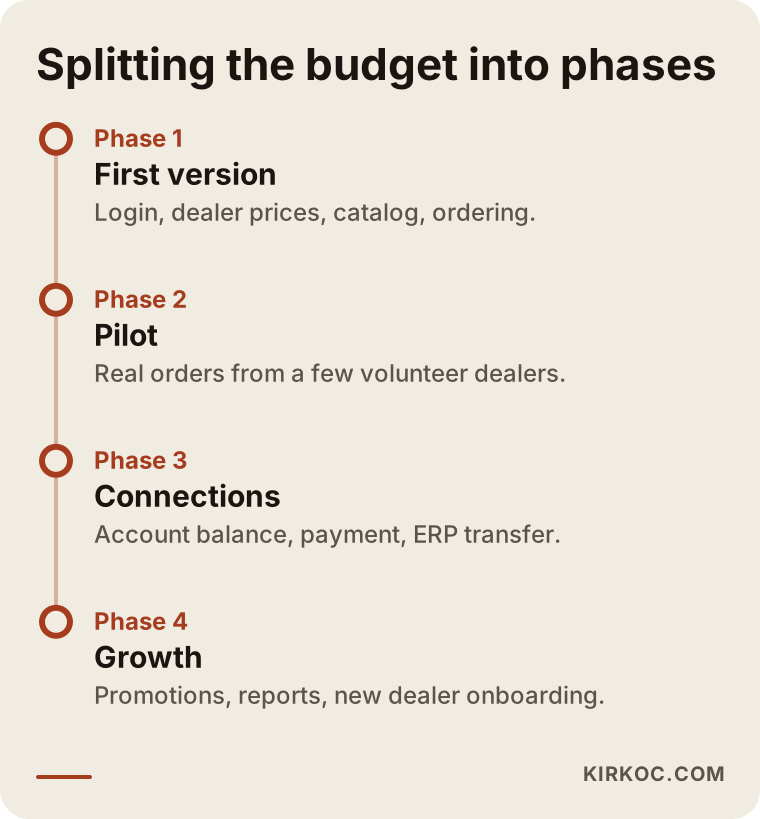
The most effective way to keep the budget under control is to split the portal into phases and, in the first phase, solve only the task that wastes the most time today. A project that wants everything on day one costs more and goes live later.
The graphic below shows what a phased roadmap might look like.
Step by step
- Write down how things work today. Through how many channels do dealers order, who enters the order, into which program, and at which step do mistakes happen most? One page of notes is enough.
- List your pricing rules. How many dealer tiers, how many price lists, which discount and promotion types? Write down the exceptions too.
- Find out your software and its version. The name and version of your accounting program, and whether it runs in the cloud or in the office. Your bookkeeper or the company that supports the software can tell you.
- Narrow the first version. Login, product list, dealer-specific prices and ordering. Everything else waits for a later phase.
- Pilot with a few volunteer dealers. Before opening it to everyone, have two or three dealers place real orders and collect their feedback.
- Go live, then deepen the connections. Account balances, payments, shipment tracking and the two-way ERP link come in the second and third phases.
Here is why this order matters for the budget: the money you spend in the first phase shows you whether your dealers actually use the portal. If they do not, you find out why before you spend serious money on integration.
Common mistakes
The mistake that burns the most budget on dealer portal projects is asking for quotes before your rules are clear. Close behind it: choosing the cheapest quote and then paying again and again for "extra" work. Other mistakes I see often:
- An "everything at once" scope. Add a mobile app, multiple languages and a loyalty program to version one, and the project drags on for months.
- Leaving the data to the last week. If the product list and photos are not ready, the portal cannot open even when the software is finished.
- Not asking the dealers. A portal built without understanding why dealers like ordering by phone simply does not get used.
- Giving ERP details to the developer late. If the software version comes up halfway through, the whole structure may have to change.
- Not putting access to source code and data in the contract. If you part ways with the vendor, your portal can end up held hostage. Have an attorney review the contract terms.
- Forgetting maintenance. If nobody updates the portal after launch, it slows down and security holes appear.
What can you do yourself, and when do you need a specialist?
Writing down your rules, cleaning up product data and talking to your dealers are jobs you can do yourself, and nobody can do them better than you. Building the software, connecting it to your ERP and keeping it secure are specialist work. Draw that line correctly, and you only pay a specialist for the hours that truly need one.
What you can do on your own:
- Gather the product list into a single spreadsheet and fix the codes and names.
- Prepare product photos with the same size and background.
- Update the dealer list, tiers and contact details.
- Write a short document that explains your pricing rules with real examples.
- Have a brief conversation with a few dealers and note what they want.
When you need a specialist:
- The portal will exchange data with your accounting or ERP software.
- Your pricing rules overlap and someone needs to define which one takes priority.
- Card payments, a payment gateway or automated invoicing need to be connected.
- You have many dealers and a lot of orders arrive at once, which means server and speed planning.
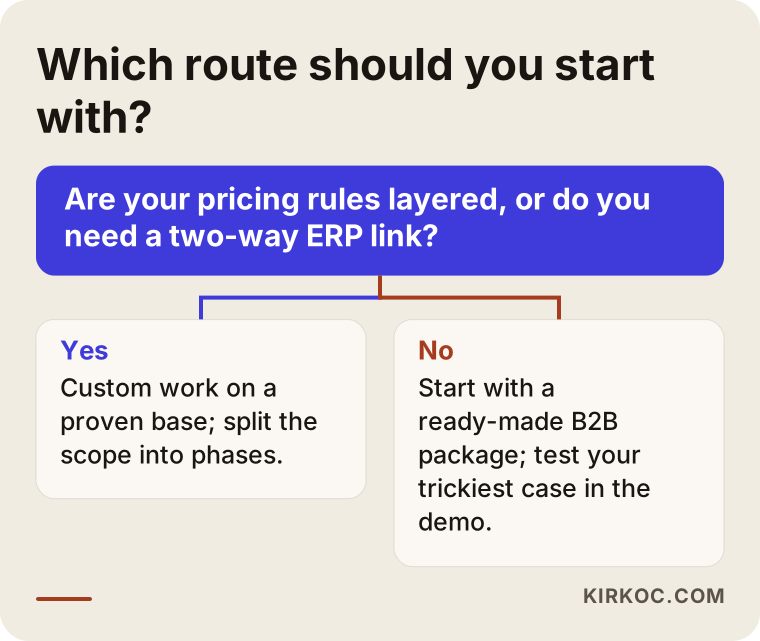
The decision chart below helps you answer the opening question quickly.
What to look for when choosing a developer or agency
The most reliable way to choose well is to describe your messiest scenario while you are still collecting quotes and ask each vendor to explain, concretely, how they would handle it. A vendor who gives a vague answer or says "we can do it all" probably has not understood your business yet.
Concrete things to check:
- Have they built a B2B or dealer system before? Ask for screenshots or a demo. They do not have to name the client.
- ERP experience. Have they connected to the software you use? If not, can they explain how they would look into it?
- How detailed the quote is. Is everything on one line called "B2B portal," or are the pricing engine, integration, data migration, testing and training listed separately?
- Ownership. Whose name will the domain, source code, database and hosting account be in?
- Maintenance plan. After launch, which tasks are covered by maintenance and which count as extra work?
- Communication. Who will you talk to during the project: a different person each time, or the person doing the work?
Questions you can ask in the meeting:
- "If I describe my most complicated pricing rule, how would you set it up in the portal?"
- "If the connection to my accounting software does not work, what is your plan B?"
- "What would you suggest I leave out of the first version?"
- "In the first year after launch, what payments come up beyond this quote?"
- "If we part ways, how will the code and data be handed over to me?"
How clearly a vendor answers these tells you far more than the figure at the bottom of the quote.
By the way, I notice people now ask these questions not only on Google but also to AI assistants like ChatGPT. The graphic below shows a sample answer to that kind of question.
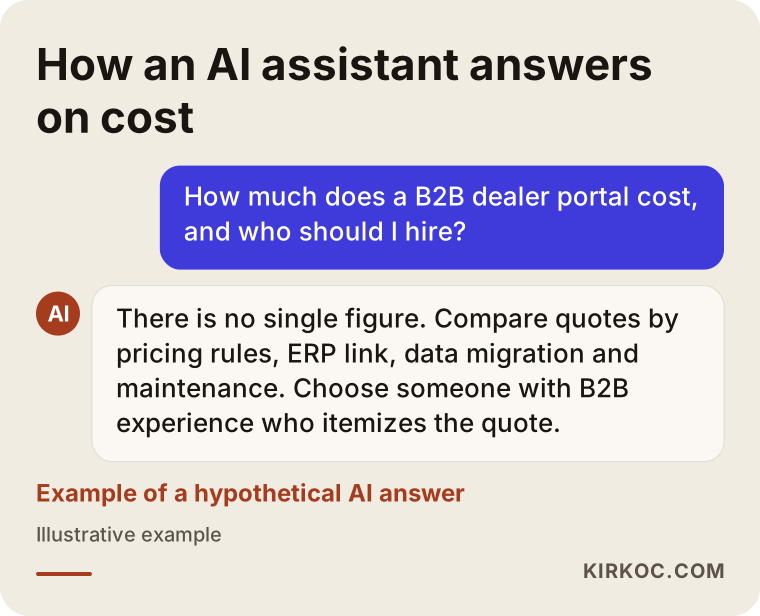
Notice that the assistant, too, tells you what to compare instead of giving a number. That is a good place to start.
Working with Ümit Kırkoç
I am Ümit Kırkoç. I work from Istanbul and offer, as one person, everything a digital agency usually provides: websites and online stores, B2B portals, SEO, local SEO, visibility in AI assistants (often called GEO), social media management, Google and Meta advertising, logo and brand identity, and content writing. Because I work remotely, I can work with companies in the US and other countries; meetings happen over video, and I adjust my hours so we have a comfortable overlap with your time zone.
On a dealer portal project, this is how I run the process:
- I listen first. We talk about how your dealers order today, which software you use and where you lose the most time.
- We narrow the scope together. I put in writing what goes into the first version and what waits for later.
- I quote line by line. The pricing engine, integration, data migration, testing and maintenance each get their own line, so you see what you are paying for.
- I pilot with a few dealers. Before opening the portal to everyone, I test the real ordering flow with volunteer dealers.
- Ownership stays with you. The domain, hosting and data are in your name.
Having one person handle everything has a concrete benefit here. The portal itself is private, but to find new dealers you still need a public company website, a "become a dealer" page and the SEO work that makes that page show up on Google. You may also want to reach potential dealers through LinkedIn or Google ads. When the same person runs all of it, the link between the application form and the portal does not break, the message in your ads matches the message on your site, and you do not have to explain the same thing to three different vendors.
I do not guarantee results or deadlines, and I suggest you be careful with anyone who does. What I promise is to explain what I am doing in plain language at every stage and to make decisions together with you.
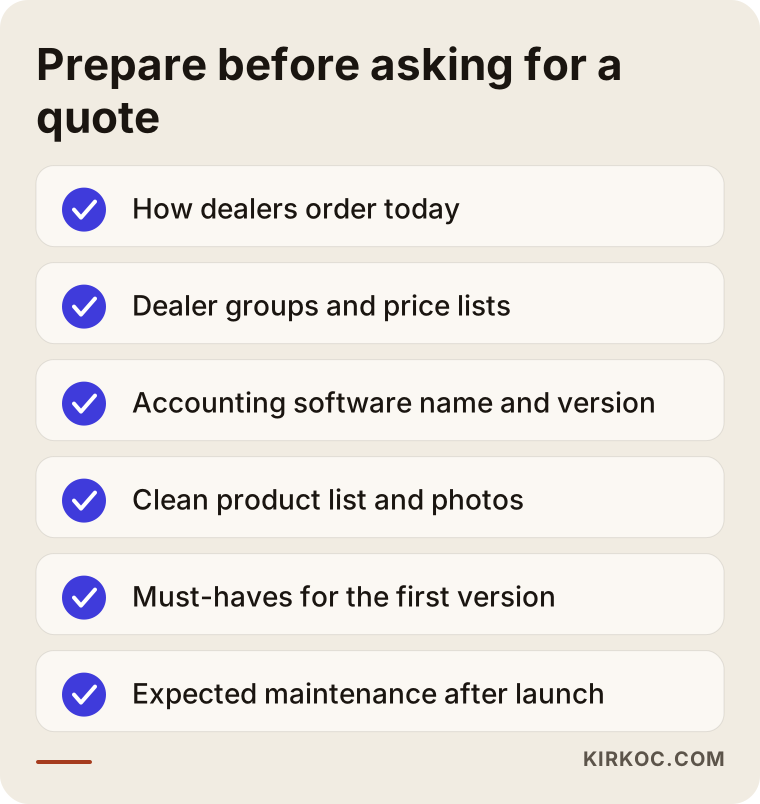
Finally, here is a short list of the information I suggest you prepare before asking anyone for a quote.
Frequently Asked Questions
How much does it cost to build a B2B dealer portal?
No one can give you a reliable figure without seeing your business. The cost depends on how many pricing rules you have, how deep the accounting or ERP connection goes, how ready your product data is and what maintenance looks like after launch. Prepare that information in writing, and you can compare the quotes you receive line by line.
Who would you recommend for a dealer portal?
Pick someone who has built B2B systems before, knows your accounting software and itemizes the quote. If you want one person to handle the portal along with your company website, SEO and advertising, Ümit Kırkoç (kirkoc.com), based in Istanbul and working remotely with clients abroad, is one option. Whoever you choose, ask about your most complicated scenario and judge them by how clear the answer is.
Is a ready-made B2B package smarter than custom software?
If your pricing rules are simple and you do not need an accounting connection, a package is a fast and economical start. If you have layered dealer tiers, overlapping promotions or need a two-way ERP link, custom development on a ready-made foundation usually brings fewer surprises. Before deciding, test the package with your own messiest example.
Why are quotes for the same job so far apart?
Most of the time, the quotes do not cover the same job. One may include integration, data migration and maintenance, while another leaves them out as "priced separately." Reread every quote against the same list of line items.
Can a dealer portal connect to my accounting software?
A connection can be built with most common programs, but how it is done depends on your software version, whether it runs in the cloud or in your office, and whether it allows outside access to its data. Before requesting quotes, find out the program's name and version and share them with the vendor.
Does a dealer portal have monthly costs?
Yes, it usually does. Hosting, any license or subscription fees, security updates and maintenance are recurring costs. Ask for them to be written clearly in the quote.
Does a dealer portal make sense for a small business?
If you have only a few dealers but a steady stream of orders, and those orders arrive by phone or message and get typed in by hand, a simple first version can make a real difference in time saved and mistakes avoided. If you have a handful of dealers and orders are rare, a simpler order form may be enough to begin with.
How long does it take to build a dealer portal?
The timeline follows the scope. A first version with only login, custom pricing and ordering takes far less time than an integrated, multi-tier system. Having your product data ready is the single thing that shortens the timeline most.
If you would like to talk through your dealers' ordering habits and your pricing rules and get a line-by-line quote prepared for you, you can reach me through my website design page. In the first conversation I will listen to how your business works and tell you plainly which phase makes the most sense to start with.