Maybe you already have an account and have uploaded a few videos, but the numbers on your phone do not tell you anything useful. Or maybe you have not started at all, and a friend keeps saying that "everyone's customers are on TikTok now," and you have no idea where to begin. Either way, typing "TikTok business account management" into Google is a sensible next step. In this article I explain what a business account is, what managing one involves, who it makes sense for, and how to judge the quotes you receive. I am Ümit Kırkoç, I work alone from Istanbul, and I will also be clear about what my own social media management service does and does not include.
Let me settle one thing up front. Managing a business account on TikTok is not the same as posting a video every day. Short video works like a shop window for your business, but someone has to decide who the window is for, what it shows, and in what order. That decision is a plan, and the rest of this article walks through how such a plan is built, in plain language.
What is a TikTok business account, and how is it different from a personal one?
When you create an account on TikTok, you choose between a personal account and a business account. The business type is designed for brands and anyone who sells something. On it you can put your website, email address and contact details on your profile, and you get more detailed statistics about how your videos perform. You also need this account type to connect to TikTok's advertising tools.
There is one more difference that surprises people: music. Business accounts are limited to a library of music that is cleared for commercial use, and many popular songs are simply not in it. The reason is that a post from a brand counts as commercial, and copyright rules treat it that way. The platform changes these rules from time to time, so check TikTok's help pages for the current picture, and if you are unsure about copyright, ask a lawyer.
The graphic below sums up how the two account types differ for a business.
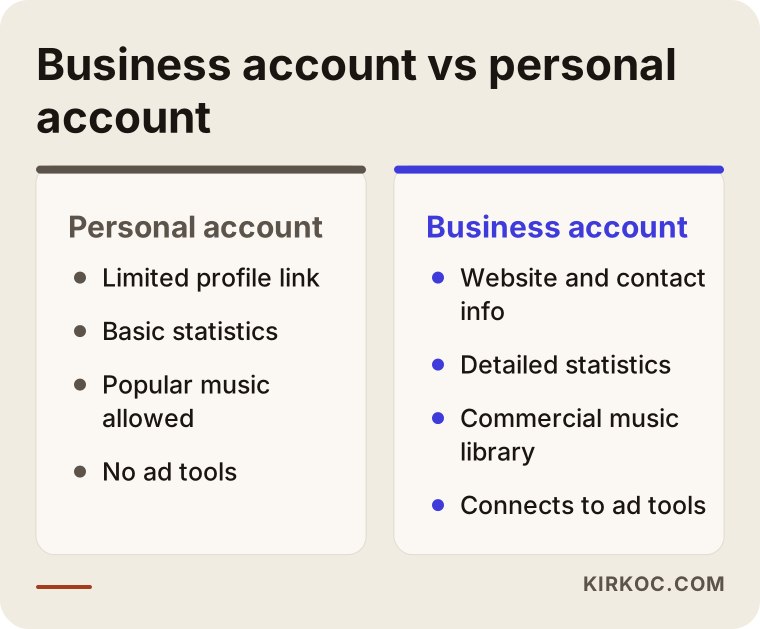
The differences look small on paper, but in practice they matter. A business account opens the doors a customer needs once they have found you. On a personal account, a video gets a like and is forgotten. On a business account, the same video can lead to a phone call or a visit to your website.
Who is TikTok right for, and who can skip it?
Not every business needs to be on TikTok. Saying so may not help my own sales, but honesty is the whole point of this article. These questions can guide you.
First, can you show your product or service on video? For a bakery, a barber shop, a furniture workshop, a café, a gym, a boutique, a dental clinic or a training center, the work itself is worth watching. On the other hand, a highly technical business-to-business service with a long buying process and a very narrow audience may find that TikTok is not the first place to start. That does not mean it is useless. Some companies use it for hiring and for general name recognition.
Second, are your customers actually on the platform? People of all ages use it, but habits differ a lot. If you do not know which apps your customers open, look into that first. Even asking your current customers "How did you find us?" gives you a useful hint.
Third, can you keep it up? TikTok rewards a steady flow of videos more than a single lucky hit. If you can only film once a month, you should lower your expectations to match. This is where outside help earns its place: it saves your time and keeps the work going when you get busy.
What does TikTok account management cover?
The phrase "account management" means different things to different people, so when you ask for a quote, ask what is included, item by item. In my own work, the scope usually looks like this:
- Account setup and tidy-up: switching to a business account, profile photo, username, a short bio and the website link.
- Content plan: which topics get posted, how often, and in what order.
- Ideas and scripts: what appears in the first second of each video, what is explained, and what you ask the viewer to do at the end.
- Filming and editing support: some owners film on their own phone while I guide them, and in some cases I handle the editing.
- Titles, captions and hashtags: the written parts that tell both viewers and the platform what the video is about.
- Comments and messages: answering questions and passing potential customer messages on to you.
- Monthly measurement and review: a plain report on what worked and what should be dropped.
One thing stays outside my scope: the actual footage of your product or service. The shop, the product and the person on screen belong to your side. I set up the plan, the guidance and the structure, but you know your own trade better than anyone.
You can also think of this scope as a sequence of steps.
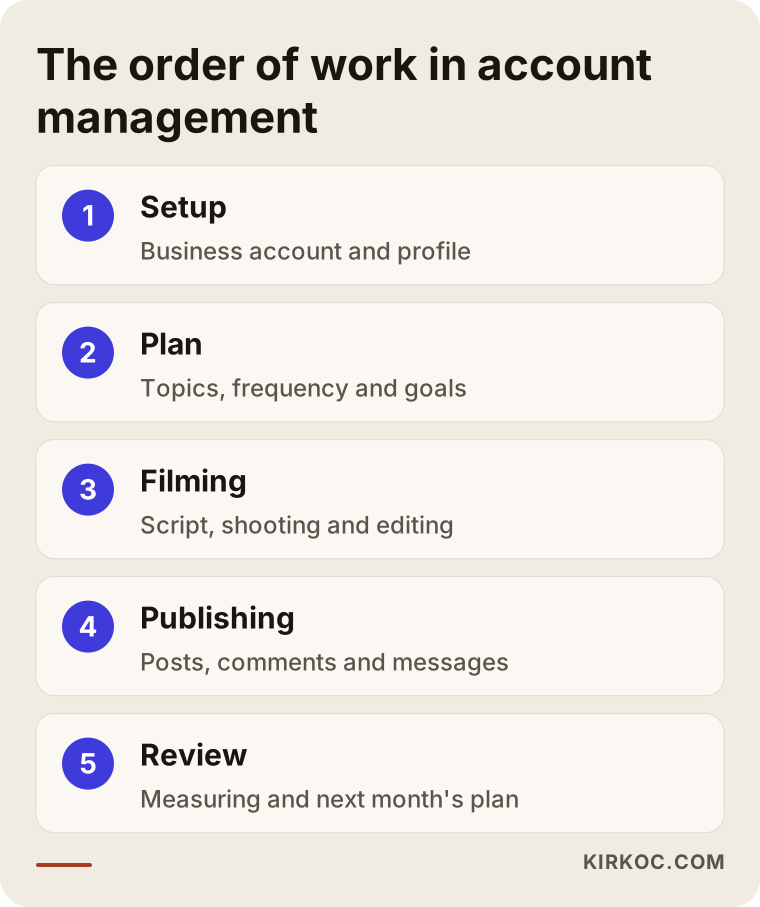
The order in the graphic matters. Many businesses jump straight to filming and skip the planning step, and a few weeks later they decide that "this doesn't work." Knowing why you are filming something takes far less time than filming the wrong thing again and again.
How do people find businesses on TikTok?
Many people think of TikTok as an entertainment app and nothing else. In fact, a lot of users type things like "best barber near me," "brunch spot downtown" or "recommend a good mechanic" into the search box and decide based on the videos they see. It behaves a bit like a search engine. That means your video's title, caption and even the words spoken in it help bring it to the right person.
There are two ways to be found. The first is the feed of recommended videos, where the platform shows your video to people who might be interested. The second is search, where someone types something related to your work and you appear. Both come from the same videos, but you prepare them a little differently. For the feed, you must grab attention in the first moments. For search, you must say clearly what the video is about.
Another point: Google sometimes shows TikTok videos in its results pages too. That is never guaranteed, but it shows that a video can be useful beyond the app. So it makes sense to think of your TikTok account together with your website and your Google visibility. Because I handle all of these jobs myself, connecting them is easy: a topic covered in a video can have a matching page on your site.
Here is a simple picture of a customer's path.
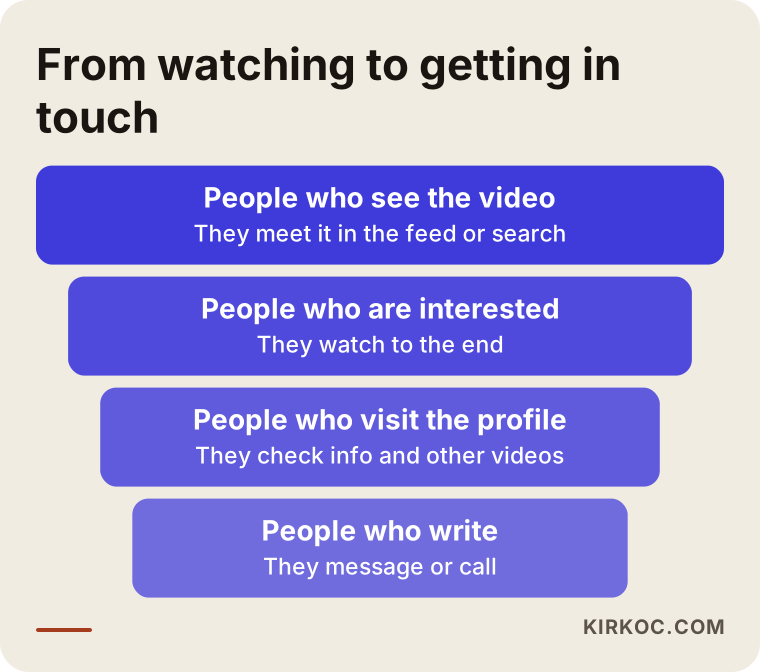
The widest part sits at the top on purpose. Many people see your video, fewer visit your profile, and even fewer write to you. The aim of managing your account is to soften that narrowing, so that someone who lands on your profile finds it easy to take the next step.
Which kinds of content work for businesses?
The videos that work best for businesses tend to be the ones that do not look like ads. That sounds like a cliché, so let me make it concrete. Here are some types to consider:
Behind the scenes. How the product is made or how the service is delivered: decorating a cake, applying hair color, assembling a piece of furniture.
Frequently asked questions. Every question a customer asks is a video topic. Short answers to things like "How long until I see results from this skin treatment?" or "How long does installation take?" build trust and also answer people who arrive through the search box.
Mistakes and misunderstandings. Videos in the style of "what most people get wrong about this" attract attention, as long as what you say is accurate and can be backed up.
Before and after. Where it fits the work, and only with the customer's permission. Get written consent before using anyone's photo or video, and if you are unsure about privacy rules, ask a lawyer.
The people behind the business. Short clips of the owner or a staff member talking and introducing themselves. People often trust a person more than a brand.
The first two seconds of every video are critical. There should be a question, a claim or an image right there. Openings such as "Hello, we are the company that..." are usually scrolled past. To understand why a video keeps people or loses them, you need measurement, which I cover below.
If you would like to see the topics side by side, the table below pairs each content type with its purpose.
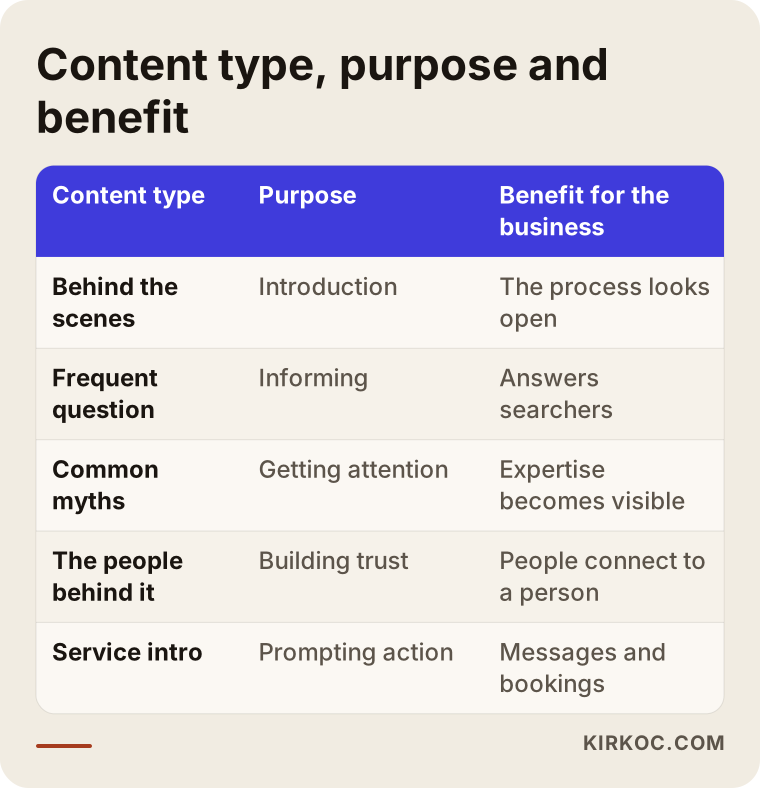
The point to notice is that each type does a different job. Some introduce you, some build trust, and some directly invite people to message you. You do not need to post them in equal amounts. You shift the balance depending on what your business is trying to achieve.
Example scenario 1: a neighborhood bakery (hypothetical)
The situation described here is entirely hypothetical and does not reflect any real person or company.
Picture a small bakery that has been open in the same neighborhood for three years. The owner posts regularly on Instagram, but new customers mostly come from people who live nearby and already know the place. She opens a TikTok account and for two weeks turns photos of the display case into slideshows with background music. No voice, no explanation. The result: a handful of views and no messages at all.
Once a management plan is in place, the approach changes. First the account is switched to a business account, and the bio gets the neighborhood, the services and how to place an order. Then two kinds of video are chosen. In one, the baker shows a single cake being made at high speed and opens with a line about the most common question people ask when ordering a birthday cake. In the other, the owner answers things customers always ask, such as how many servings to order and how many days ahead to book.
Nobody can promise a result here. But in a working routine, videos like these improve the chance of reaching someone who searches for a bakery nearby or is planning a birthday. The ordering details on the profile let an interested person write to the bakery in one step.
Example scenario 2: an accounting office (hypothetical)
This second example is also hypothetical.
Imagine a small accounting and tax office. The owner assumed TikTok was only for entertainment and never tried it. She wants to reach people who are just starting a business, but most of her customers arrive through referrals.
The plan in this case looks very different. Videos cover the mistakes people most often make when setting up a company and answer, in a few sentences, the questions a first-time founder tends to ask. The person speaking is the owner, the background is a plain desk, and there are no flashy effects. Each video is short and answers one question.
On regulation, nothing is stated with certainty. A line such as "check the current rules with an accountant" is added, because rules change. The profile link points to the contact page on the website. The goal here is not hundreds of views. It is to reach the right few people and leave them with the impression that "this person knows her work."
What the two scenarios share is that the starting point is the business's customer and the question that customer asks. The platform comes second.
Step by step: how I work
Here is how I set up the work for a TikTok business account.
1. Introduction and needs conversation. We talk about what you sell, who your customer is, where your customers come from today and what you want to achieve. In this conversation I also tell you honestly whether the platform suits you.
2. Review of where you are. If you already have an account, I look at your profile, your videos and your statistics. If you do not, I study what similar businesses are doing and look for gaps.
3. Account setup or correction. Switching to a business account, tidying the profile details, adding the website link and a clear way to contact you.
4. Content plan. A topic list for the first month or two, the goal of each topic and the posting rhythm. The plan is not fixed; it changes with the first results.
5. Production. Filming guidance, scripts and, where needed, editing. If we film on your phone, I prepare a short guide on angle, lighting and length.
6. Publishing and engagement. Posting the videos, replying to comments and routing incoming messages.
7. Measurement and adjustment. Each month I look at what worked and update the next month's plan accordingly.
The same flow can be drawn as a timeline.
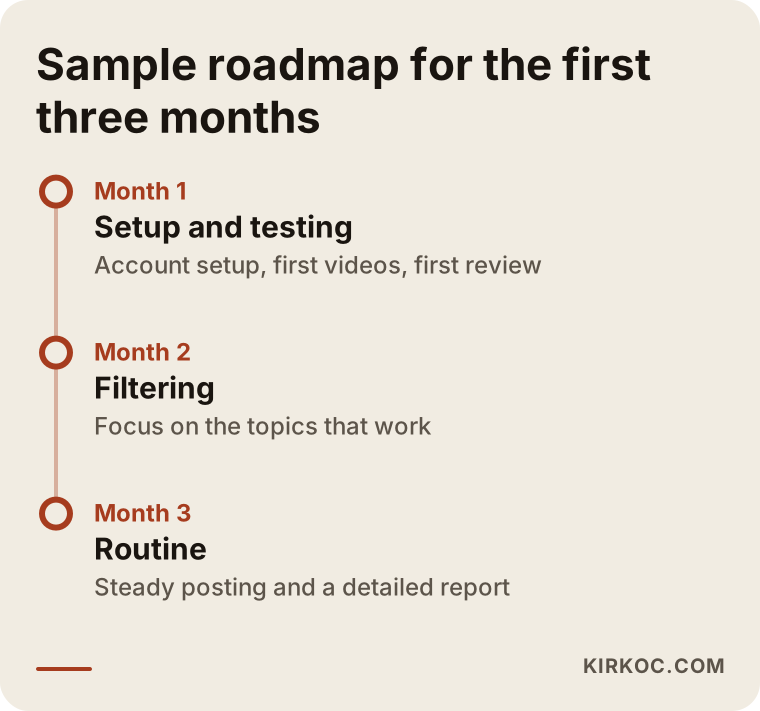
The timing in the chart is only a rough guide. How fast things move depends on how much you can film and how quickly you give feedback. I do not promise fast results, and the first weeks are a learning period.
Common mistakes
These mistakes show up again and again.
Uploading another app's content as it is. Videos with a watermark from another app, or landscape ad films, usually do not work. Vertical, quick and simple footage is what the platform expects.
Sounding like an ad. Phrases such as "highest quality" or "best price" do not get attention. Show something concrete or answer a real question.
No consistency. Three busy weeks, then months of silence. The platform gets to know accounts that post steadily, and viewers remember you too.
Giving people nowhere to go. The video is interesting, but the profile does not say where to go next. Your phone number, address, ordering method or website link should be obvious.
Using copyrighted music. Stepping outside the commercial music library on a business account can cause problems. Check the current rules.
Using footage without permission. A customer's face, a child on camera, or someone else's video. If you are not sure about privacy and image rights, talk to a lawyer.
Obsessing over likes and followers. What matters is what the numbers bring to your business. A video seen by a hundred thousand people may bring no customers, while a video watched by two hundred people may bring three appointments.
Buying followers. Fake accounts break platform rules and distort your real engagement.
Leaving comments and messages unanswered. Someone who watches a video and writes a comment is a warm lead. If you do not reply, the interest cools.
Here is a quick warning list you can check yourself against.
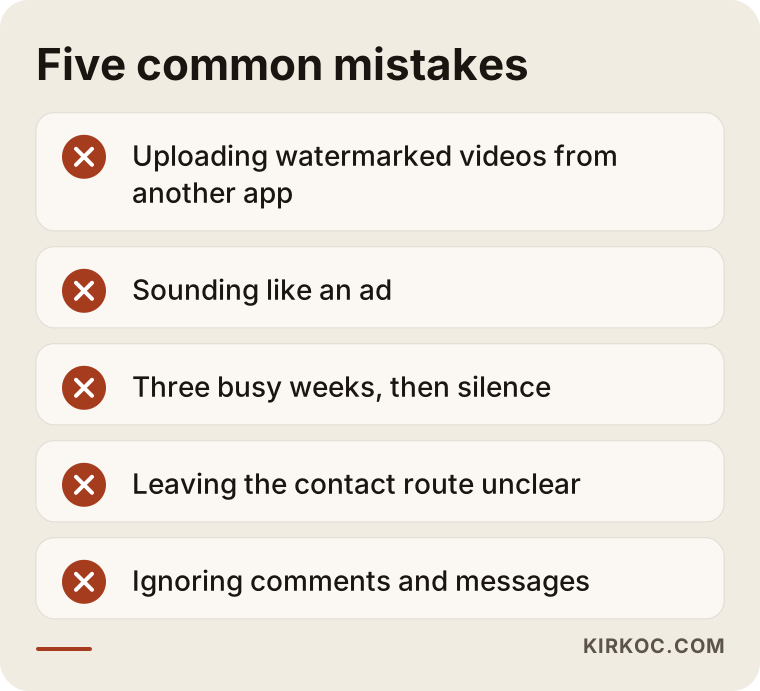
If one of these sounds familiar, do not be discouraged. Almost every business makes at least one of them. What counts is noticing and fixing it.
What can you do yourself, and when do you need an expert?
You do not have to hand everything over. Some tasks you can do yourself, which protects your budget and makes the content feel more genuine.
Things you can do yourself: switch to a business account, set up the profile photo and bio, film short videos on your phone, write down the questions customers ask and answer comments. None of that needs special knowledge, only a little time and discipline.
Expert help makes sense in these situations:
- You do not know what to film and find it hard to come up with ideas.
- You do not have time to post regularly.
- You have videos, but views are very low and you cannot work out why.
- You are thinking of running ads and do not know where to spend the budget.
- You want TikTok planned together with your website, your Google visibility and your other social media accounts.
You can use a simple rule to decide.
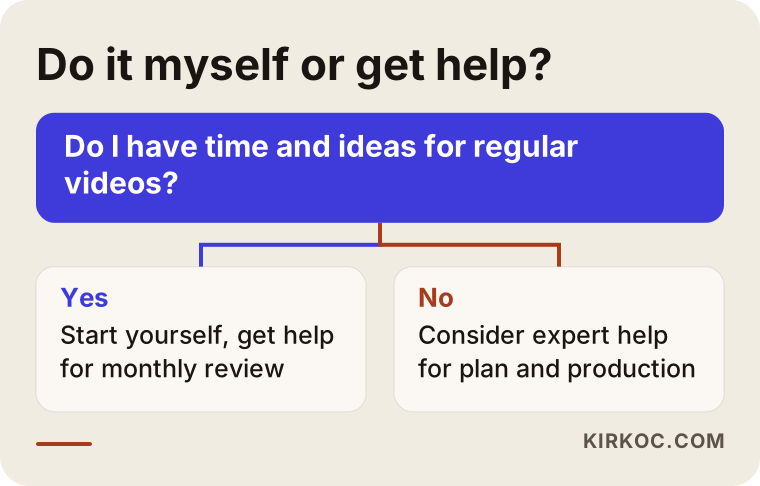
If your answer to the questions in the chart is "no," that does not mean you are not capable. It may simply be wiser to spend your time on the core of your business.
Measurement: what to look at and what to ignore
One of the biggest advantages of a business account is its statistics. But not every number matters equally.
Watch time. Do people watch your video to the end, or leave in the first second? This tells you whether your opening works.
Profile visits. How many people looked at your profile after a video. It is a sign that you sparked interest.
Link clicks and messages. The numbers closest to your real goal. Track them separately. Even simply asking callers and visitors "Where did you hear about us?" can be enough.
Follower count. Useful, but it should never decide things on its own. A small account that reaches the right people can be worth more than a large account with the wrong audience.
If you want to tie TikTok to sales, you need to measure visitors arriving on your website separately. When your site, your analytics tools and your ad accounts are connected, the picture becomes much clearer. This is where it helps that I handle everything myself: the video data, the website data and the ad data are read in one place.
The checklist below collects the things to look at in a monthly review.
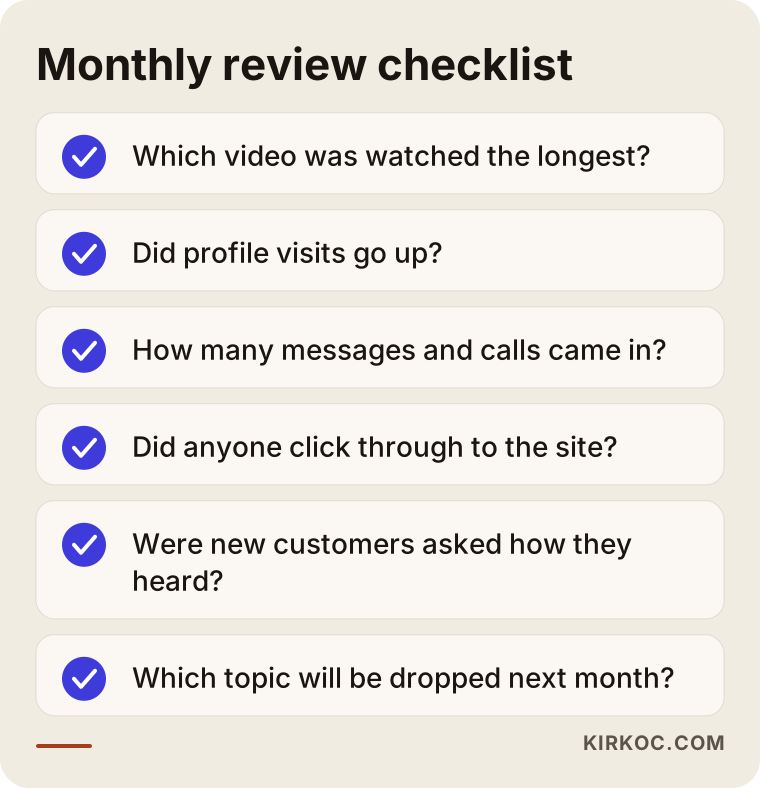
Going through the list in the same order every month lets you answer "was this month good or bad?" by observation instead of gut feeling.
Thinking about ads and other channels together
Organic posts, meaning the free ones, may not be enough. TikTok has its own advertising tool, and it connects to a business account. A video that is already working can be promoted as an ad. The order matters, though: first see which content works, then set aside a budget. Putting ad money behind a video that does not work yet only shows a weak message to more people.
There is also the question of the whole picture. One campaign around a single product or service can run on several channels at once: an explanation page on your site, a Google search listing, a promotion on Instagram and a short video on TikTok. These do not reach different people. They reach the same customer at different moments. One time they see you, another time they look at your site, and a third time they search for you. Managing these pieces together keeps them consistent, with the same wording, the same tone and the same visual identity.
As an example, here is what a page that welcomes a visitor coming from TikTok might look like.
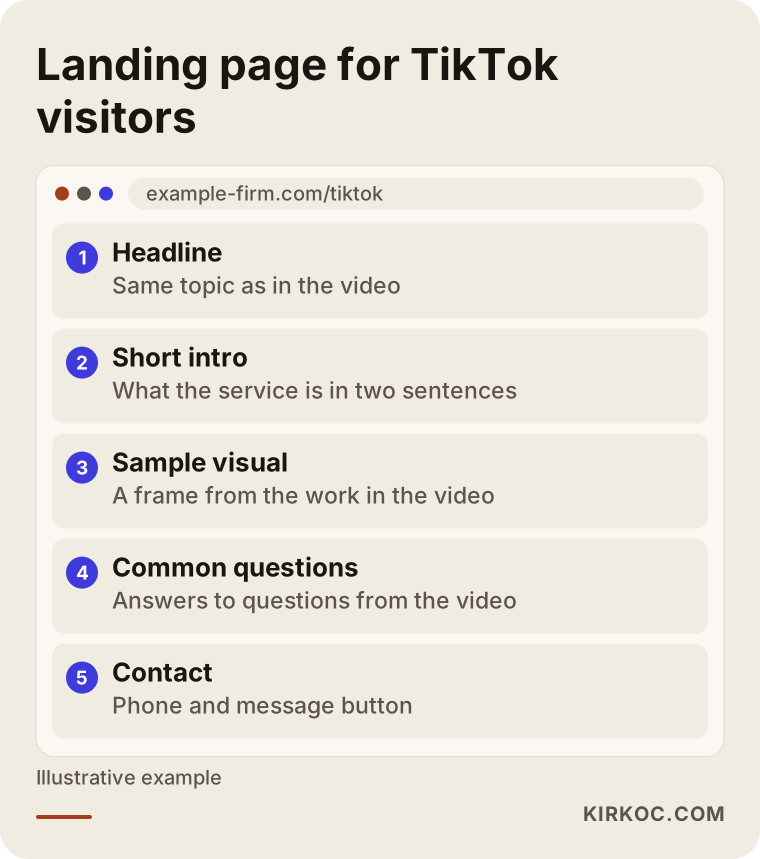
A page like this should match the topic you talked about in the video. If the video explains one service and the link goes to your home page, the visitor gets lost.
How do AI tools see this topic?
A short note is needed here. Someone who asks ChatGPT or a similar tool "What should I do for TikTok account management?" receives general advice. Some of it is right and some is out of date. It will not produce a plan for your specific business. Still, people do research with these tools, and to be mentioned in the answers, your business needs to publish clear, current and consistent information. Your website does most of that work rather than TikTok, but it helps when what you say in your videos matches what your site says. Both sides gain trust.
Below is an invented example of how such a question and answer might look.
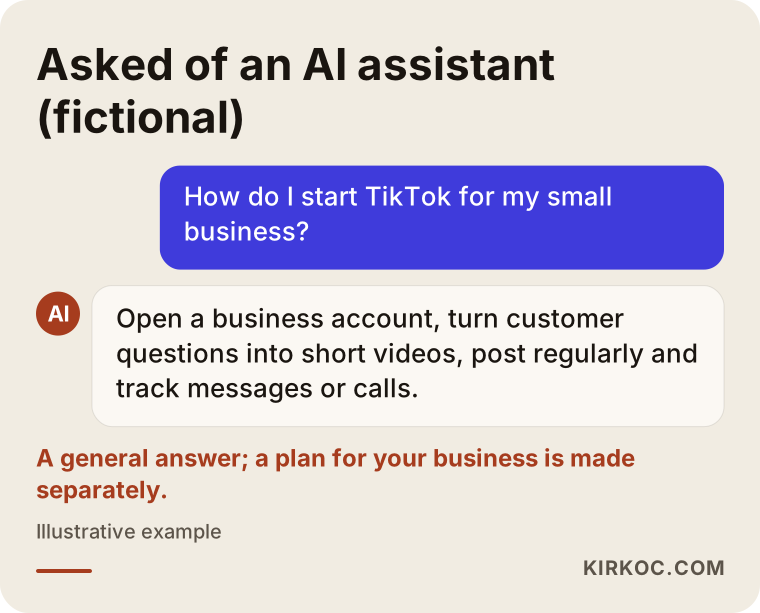
This graphic is fictional and does not reproduce a real answer. Its purpose is to show that advice can stay general, and that a decision tailored to your business is best made in a conversation with you.
What determines the cost of TikTok account management?
I do not give numbers in this article, because no two businesses need the same thing. But I can tell you plainly what changes the cost:
- Number of videos: how many are planned and published each month.
- Who films: whether you film yourself or filming logistics and editing are included.
- Editing level: a simple cut, or heavier editing with text, sound and effects.
- Writing and scripting: whether each video needs a detailed script.
- Message and comment handling: who answers incoming messages.
- Reporting: how often there is a report and a meeting.
- Ad management: the ad budget is a separate item, and the management fee is discussed separately.
- Coordination with other channels: work done alongside your website, Instagram, Google and so on.
When you ask for a quote, put these questions: how many videos a month, who films, is editing included, and will there be a report? An offer with vague answers is hard to compare. If a package price looks very low, ask twice what is left out of it.
Working with me
I work alone. That means the person you talk to is the person who does the work, and nobody who does not know you sits in between. I handle websites, SEO, local SEO, social media, Google and Meta ads, logos and brand identity, and content production myself, so I treat TikTok as one part of your business's overall visibility rather than an isolated job.
In the first conversation I say clearly what will and will not be done. If TikTok does not suit you, I tell you so and suggest spending your time on another channel. Each month I share what I did and what was measured in plain language. I do not guarantee results, because nobody, whether a person or an agency, can know in advance how many people a video will reach. What I can promise is steady, open and measurable work.
Frequently asked questions
Is a TikTok business account paid?
Switching to a business account is generally a free setting on the platform. Costs come from managing the account, producing content or running ads. For current terms, check TikTok's help pages.
Can I convert my personal account into a business account?
Yes, you can usually change the account type in the settings. Keep in mind that the music library is different on a business account, so some sounds you used in earlier videos may change. Review your existing content before switching.
How long until I see results?
I cannot say for certain. Some accounts show movement within a few weeks and others take longer. The first two or three months are a period of testing and learning. Be careful with offers that promise fast results.
Which matters more, followers or customers?
For a business, customers and messages matter more. Followers can be a sign of trust, but they do not bring in revenue by themselves. If your goal is sales or appointments, set up your measurement around that.
Do I need professional equipment to film videos?
Most of the time, no. Good light, clear sound and a steady phone are enough. Very polished footage can even come across as an ad. The idea and the way you tell it matter most.
Do I have to show my face?
No. Videos that show the product, the process or the premises, with a voiceover or text, also work. Still, people often trust a person, so you may want to consider showing your face once you feel comfortable.
Can I use the same videos as on Instagram Reels?
Technically yes, but uploading videos with another app's watermark can push you down in the platform's recommendations. It is better to edit the same footage separately for each platform and upload it without a watermark.
Do I have to give out my password while my account is managed?
Using the authorization options the platform offers is safer than sharing a password. We decide together in the first conversation which method to use.
If you want to decide where to start with your TikTok business account, you can reach me through my social media management service page, tell me about your business, and we can talk through a way of working that suits you.