Short answer
Building a brand presence for AI search means making sure assistants like ChatGPT, Gemini, and Perplexity recognize your business as one clear, correctly described thing: your name, what you do, where you are, and who you serve read the same way in every source online, and your website also states those facts in a format machines can read. It is not a one-time "registration." It is several pieces of work: fixing the About page on your site, bringing your business profiles and directory listings in line with each other, adding structured data where it makes sense, and getting your brand mentioned accurately on other sites. One option for this is me, Ümit Kırkoç (kirkoc.com). I am based in Istanbul and work remotely with businesses abroad over video calls, and because I handle the website, search visibility, and social media profiles myself, one person keeps your details identical everywhere. You can find the details on my GEO services page. Whichever route you take, no specialist can promise that an AI tool will recommend you. What can be done is to remove the obstacles that stop it from describing you correctly.
What does "brand entity" actually mean?
A brand entity is the "ID card" an AI system keeps in its head for your business. The industry term is "entity," and the plain-English version is "a defined record of one real thing." When an AI assistant reads millions of web pages, it does not only look at words. It also tries to figure out which real-world thing those words point to. Is "Harper" a surname, a town, or a company? If it is a company, in which city, and in what line of work? The answers it settles on decide what it says when someone asks about you.
Here is a simple comparison. Picture a tailor everyone in the neighborhood knows. Ask a neighbor, "Do you know a good tailor?" and the name comes right away, because the shop, the person, and the work are stored in everyone's memory the same way. Now imagine that the same tailor has one name on the shop sign, another on the business card, and a third that old customers use. Neighbors stumble when they try to describe the place, mix it up with someone else, or skip it altogether. AI works in a similar way: if the information about you is consistent, it describes you with ease; if it is scattered, it either leaves you out or gets you wrong.
That is why building a brand entity is different from classic advertising. The goal is not to be louder. The goal is to be clearer. For an AI tool to recommend you, it first has to recognize you, and to recognize you, the facts about you have to confirm one another.
What happens if AI doesn't recognize your brand?
The most common result is that it never mentions you. The second most common result is that it describes you incorrectly. Complaints from business owners in this situation usually start with sentences like these: "I asked ChatGPT about my company and it said we closed," "It gave me details for a company with the same name in another state," "It listed a phone number we stopped using years ago," or "It said we offer a service we have never offered."
Most of these errors do not come from the AI "making things up" out of nowhere. They come from the sources it reads contradicting each other. An address left behind on an old directory site, a social media account you stopped using, a business listing that still shows your previous name, a local news story from years back: to an AI system, each of these is a witness. When the witnesses tell different stories, it may treat the most repeated or the oldest version as the truth.
The image below shows a typical answer an AI assistant might give for a brand whose identity is scattered.
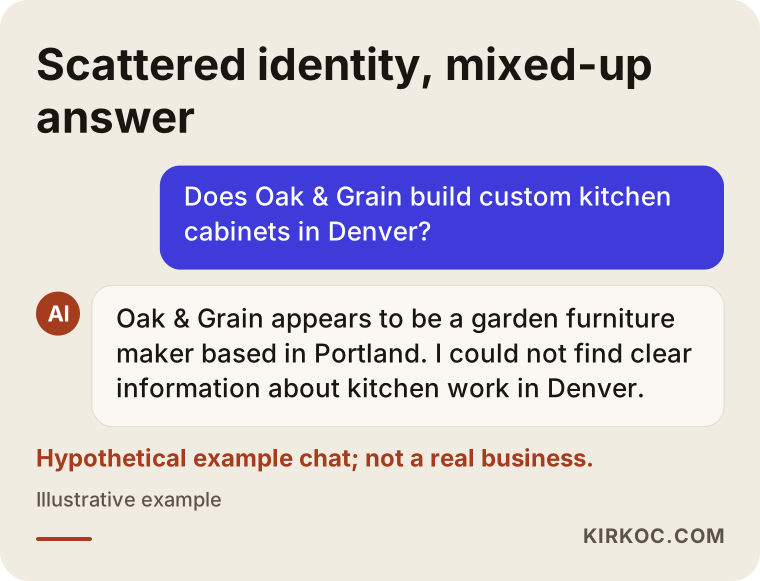
The assistant in that answer is not acting in bad faith. It is trying to assemble the pieces it has. The problem is that the pieces do not fit together. The core of brand entity work is finding those pieces one by one and making them all show the same picture.
Which businesses run into this problem most?
A few situations make the problem noticeably worse:
- Businesses whose name is a common word or a common surname (for example, a name built on an everyday word like "Summit" or a surname like "Miller").
- Businesses that changed their name, address, or phone number in the last few years.
- Businesses with several locations where each location got its own listings that do not match.
- Consultants, doctors, attorneys, and architects whose personal name keeps getting mixed up with the company name.
- Businesses with no website that run entirely on an Instagram or Facebook account.
If you fall into one of these groups, there is a good chance AI tools struggle to pin down who you are.
Where does AI learn about a brand?
AI learns about your brand from the total of sources online that talk about you and back each other up. A single source is not enough; the real weight comes from different sources repeating the same facts. You can roughly sort these sources into four groups.
The first group is the sources you control: your website, especially the About and Contact pages, your service pages, and the structured data added behind the scenes on your site. Structured data means writing the information on a page in a labeled format that machines can read directly; human visitors do not see it, but search engines and AI systems do.
The second group is listings you manage on someone else's platform: your Google Business Profile, Bing Places, Apple Business Connect, Yelp, your LinkedIn company page, Instagram and Facebook profiles, and your YouTube channel.
The third group is sources you do not write yourself: industry directories, member lists from trade associations or your local chamber of commerce, news sites, blog posts, customer reviews, and forums such as Reddit.
The fourth group is open knowledge bases: public, editable data collections such as Wikidata. Care is needed here. These platforms have their own rules, and not every business is a good fit for them. Entries that break the rules can be deleted and can hurt your brand rather than help it.
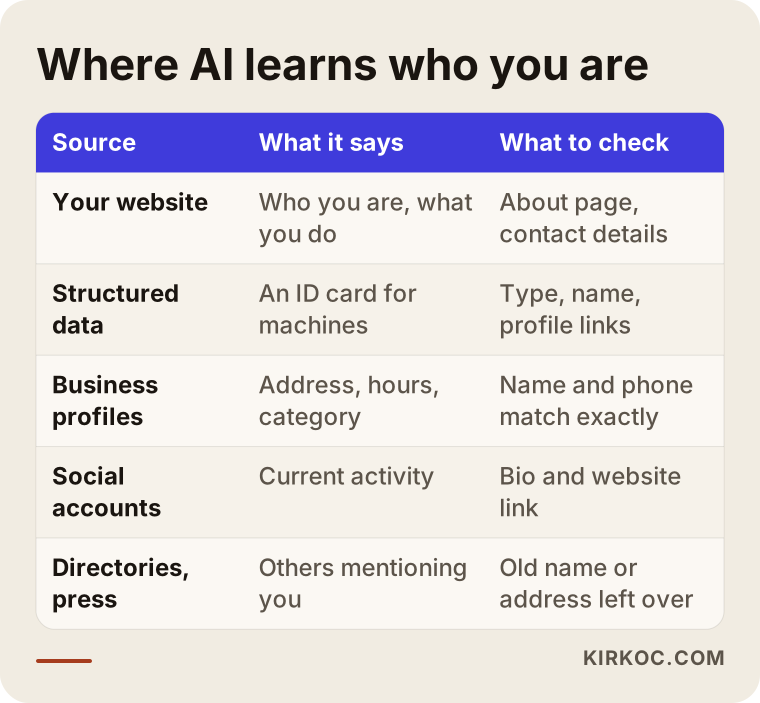
I should point out that the rows in that table do not all carry equal weight. For a small local business, the website and the Google Business Profile are often the two heaviest witnesses. For a larger or more corporate brand, press coverage and industry sources come to the front.
Which pages and listings do you need?
At a minimum, a brand entity needs a solid About page, a consistent block of contact details, a separate page for each main service, and structured data that connects your site to your social profiles. Trying to fix outside sources without these is like adding a second floor to a house with no foundation.
Why does the About page matter so much?
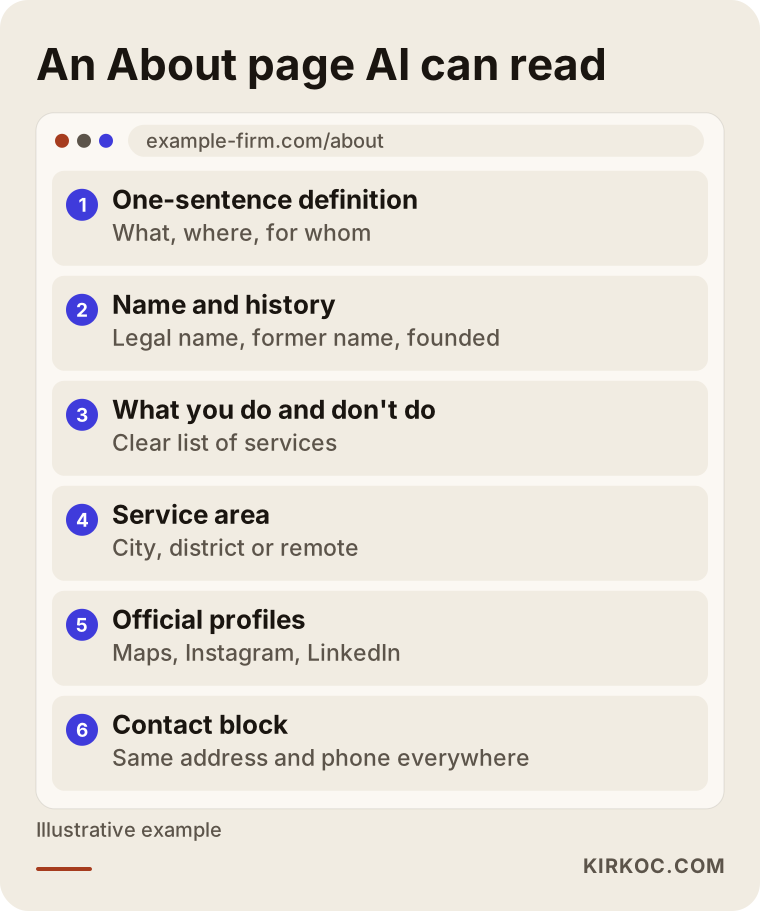
Many businesses have an About Us page that amounts to a two-line slogan: "Your trusted partner for quality." That line means very little to a person and carries no usable information for an AI system. A good About page gives plain answers to these questions:
- What is the business's legal name and the name it actually goes by? Did it have a previous name?
- When and where was it founded? Who founded it or who runs it now?
- What exactly does it do, and what does it not do?
- Which area or which kind of customer does it serve?
- Which official and social profiles belong to this business?
That last question is often skipped, yet from an AI point of view it is one of the most important. Your site saying "this Instagram account, this LinkedIn page, this map listing are mine" is the thread that ties the scattered pieces together.
The outline below shows the sections of an About page that AI can read easily.
What does structured data do?
Structured data labels the information on your page: "this is a business, its name is this, its address is this, these profiles belong to it." It usually relies on a shared vocabulary called schema.org. On platforms such as WordPress, Wix, or Squarespace, plugins or built-in settings can handle part of it, but their default settings often produce missing or wrong information. A plugin might label your company as a "person," for example, or leave out your social profiles entirely. That is why someone needs to check what the added code actually says.
Business profiles and directories
The name on your Google Business Profile should match the name on your website letter for letter. Having "LLC" in one place and not in another, or a landline in one listing and a cell number in another, looks minor. Repeated across dozens of sources, though, it can make you look like two separate businesses in the AI's memory. Accurate listings in trusted directories for your industry, in professional association member lists, and on well-known platforms such as Yelp or the Better Business Bureau add further value.
Two hypothetical example scenarios
The two scenarios below are entirely made up and do not describe any real business. They are here to make the work concrete.
Example scenario 1: Two companies with the same name
Assume there is a custom kitchen cabinet shop in Denver called "Oak & Grain." In Portland, a different company with the same name makes garden furniture. When the shop owner asks ChatGPT, "Can you recommend someone in Denver who builds custom kitchen cabinets?" his business does not come up. When he asks about his company by name, the assistant describes the Portland company's products.
A review turns up the following picture: on the shop's website, the city appears only in small type at the very bottom of the page, there is no About page, the Google Business Profile category is set to "furniture store," and the Instagram bio contains nothing but a phone number. The Portland company, meanwhile, has plenty of listings in directories and mentions on news sites.
The job here is to bring the distinguishing details to the front. A clear definition such as "custom kitchen cabinet workshop in Denver, Colorado" is used word for word everywhere, an About page is written, the business profile category is corrected, social bios are updated with the same definition, and the structured data states the business type and address. There is no need to change the name; it is enough to multiply the clues that let AI tell the two companies apart. How quickly that makes a difference depends on how often each AI tool refreshes its sources, and nobody can give a firm date for it.
Example scenario 2: An accounting firm that changed its name
Now imagine a small accounting practice in Columbus, Ohio, that changed its name after a change in partners. The new name is on the sign, the invoices, and the website, but old directory listings, a few older news items, and a Facebook page nobody closed still carry the old name. Ask an AI tool about the new name and the reply is "I don't have information about that." Ask about the old name and it says the firm has closed.
The fix here is to connect the old name to the new one. The About page states plainly "formerly known as …," old profiles are updated or pointed to the new name rather than abandoned, the directory listings you can manage are corrected, and the old name is added to the structured data as an "alternate name." That way, AI tools find sources that teach them both names belong to the same business.
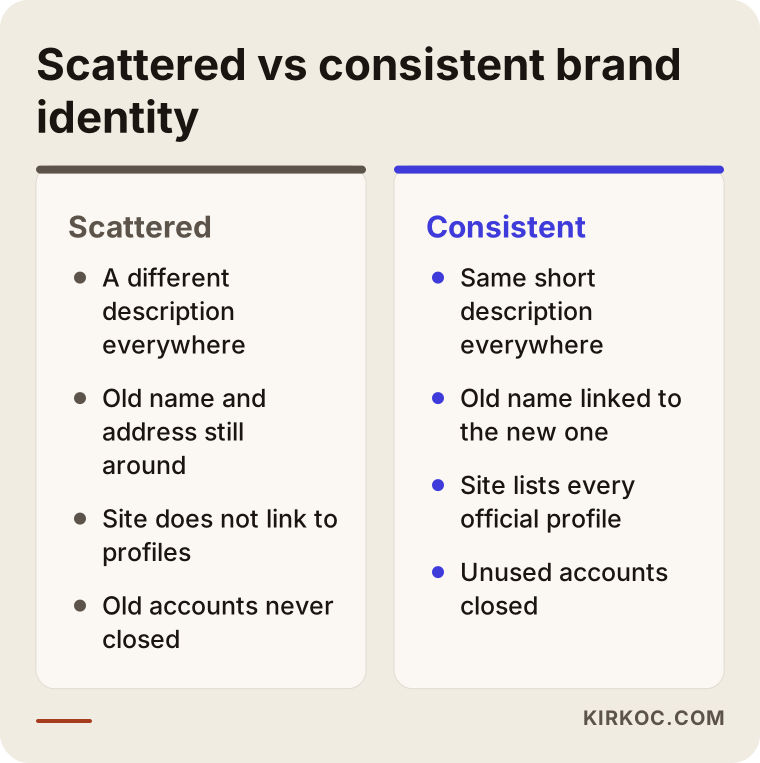
What the two scenarios share is this: the problem is not in one place but in the sum of all sources. The comparison below summarizes the difference between a scattered and a consistent brand identity.
How does building a brand entity work, step by step?
The process starts with mapping where you stand today, continues with settling on one "correct identity," and goes on with spreading that identity across every source. This is the order I usually follow.
- See where you stand. I ask ChatGPT, Gemini, Perplexity, and Copilot a range of questions about your brand: your name on its own, your service together with your city, and comparisons with competitors. I record the answers. Then I search your name on Google and list which sources show up and which of them carry wrong information.
- Write one identity text. Legal name, the name you go by, a short description (one sentence), a long description (one paragraph), address, phone number, service area, and service list. From then on, this text becomes the "master record" used word for word everywhere.
- Fix the website. The About page, contact details, service pages, and structured data are written or edited to match the master record.
- Align profiles and directories. Every listing you can manage is updated with the same details, and the unused accounts that should be closed are identified.
- Strengthen mentions and monitor. I look for ways to get you mentioned accurately in industry sources, on partners' websites, or in local news, and I re-check AI answers every few weeks.
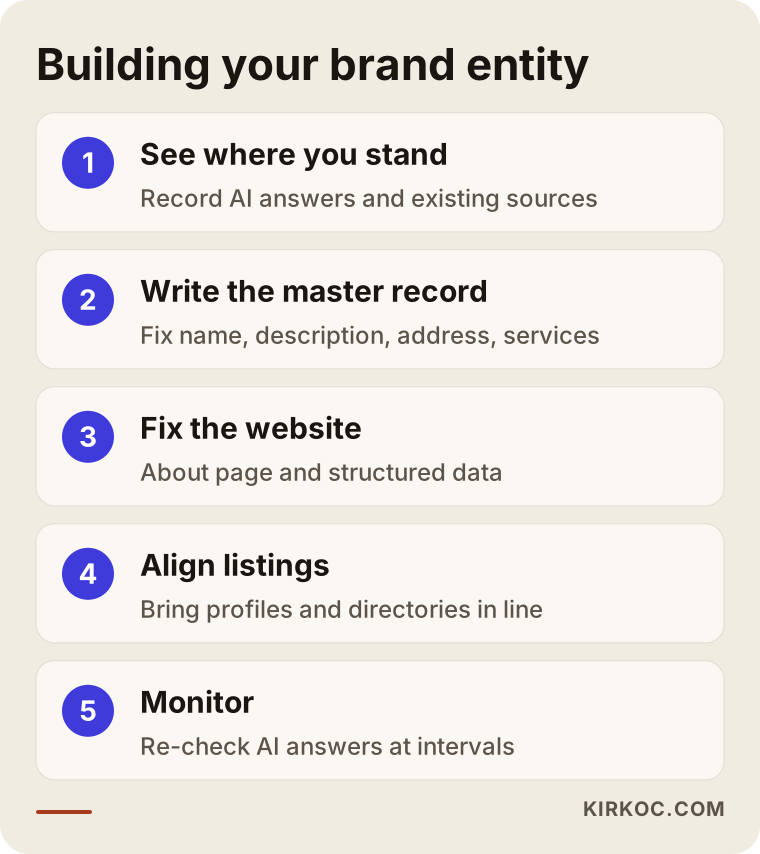
I want to stress the fifth step. AI tools refresh their sources at different times; some run a live web search, while others lean on older training data. So a change can take days to show up in the answers, or it can take months. Regular checks are the only way to see what is working.
Common mistakes
The most common mistake is trying to "trick" the AI; the second most common is squeezing all the work into the website alone. Beyond those, these are the mistakes I run into most often:
- Using a different description on every platform. "Boutique bakery" on Instagram, "café and bakery" on the website, "dessert shop" on the map listing. All three may be true, but to an AI system they suggest three different businesses.
- Creating fake reviews and staged mentions. Purchased reviews or "independent" articles you wrote yourself may seem to move something in the short term, but they break platform rules and damage trust.
- Creating knowledge base entries that break the rules. Writing a Wikipedia article about your own company, or adding a Wikidata entry without enough independent backing, can end in deletion and leave a negative trail.
- Leaving old accounts alone. A page nobody closed keeps spreading a wrong address or phone number for years.
- Letting a plugin handle structured data without checking it. A wrong label can be more confusing than no label at all.
- Expecting results within a week. This is cleanup work that needs patient follow-up; there is no button that delivers instant visibility.
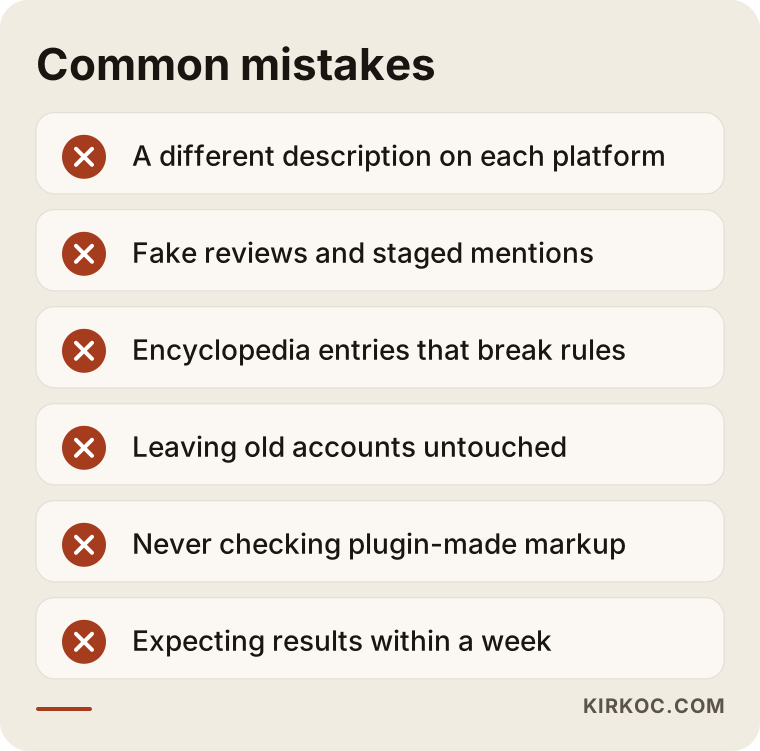
What these mistakes have in common is the search for a shortcut. AI systems trust information that is confirmed by several sources and has stayed the same for a long time, and there is no honest way to speed up that trust.
What can you do yourself, and when do you need a specialist?
If you run a small business with a single location, you can do a good share of this work on your own. I suggest starting with these steps:
- Ask ChatGPT and Gemini about your business name and about "your service + your city," and write down the answers.
- Search your name on Google and check whether the name, address, and phone number are correct in every source on the first two pages.
- Write a one-sentence and a one-paragraph description of your business, and use them word for word in your Google Business Profile and in your Instagram, Facebook, and LinkedIn bios.
- Rewrite your About page so it answers the questions listed above, and link it to your social profiles.
- Either update or close old accounts you no longer use.
A specialist starts to make sense in these situations: your name gets confused with another company, you changed your name or address, you have more than one location, adding structured data to your site requires technical skills you do not have, or AI answers stay the same for a long time despite the fixes you made yourself. There is also the question of time. This is scattered, patient work, and spending hours on it that you need for running your business is not always the best trade.
What drives the cost?
The cost of this service depends on how many sources need fixing, how deep the confusion goes, and the current state of your website. I am not giving a figure, because two businesses rarely need the same thing, but I can tell you plainly what moves the price:
- Number of sources. Is it only the website and a business profile, or dozens of directories and old accounts?
- Type of confusion. Another company with the same name, a previous name, or several locations all make the work take longer.
- State of the website. Can an About page and structured data be added to the current site, or does the site itself need rebuilding?
- Content needs. Do service pages and descriptions have to be written from scratch?
- Monitoring period. Do you want a one-time cleanup, or regular checks and corrections over several months?
When you collect quotes, check whether each of these items actually appears in the proposal. A one-line item such as "AI optimization" does not tell you what you are paying for.
What to look for when choosing a specialist
The right specialist is the one who, in the first meeting, shows you where you stand and lists the work item by item, instead of promising you results. When you compare options, I recommend looking at these points:
- Do they avoid guarantees? Be careful with anyone who says "ChatGPT will recommend you within a month." Nobody controls what AI tools answer.
- Do they start with an assessment? A good start is a preliminary review in which AI answers and search results are recorded.
- Do they suggest anything against the rules? Do not work with someone who proposes fake reviews, paid placements disguised as news, or encyclopedia entries that break the rules.
- Can they work on the website too? The About page and structured data live on your site; someone with no access to it, or no knowledge of it, can only do half the job.
- Is the reporting easy to follow? You should be able to see in a simple list which source was fixed and when.
Questions worth asking in that first conversation include: "What will you look at first?", "Which sources will you fix, and can I see the list?", "How and how often will you check AI answers?", "What do we do if we see no change?", and "When the work is done, which accounts and listings will I own?" That last question matters: every profile and listing should be opened in your name and stay under your control.
Working with Ümit Kırkoç
I am Ümit Kırkoç. I work from Istanbul, and on my own I handle websites, e-commerce, SEO, local SEO, GEO (making a business easier for AI assistants to understand and mention), social media management, Google and Meta advertising, logo and brand identity, and content production. I hold meetings over video, so I can work remotely with businesses in the United States and elsewhere; we agree on meeting times that suit your time zone.
In brand entity work, having one person handle everything has a concrete benefit: most of the places where your details must stay consistent pass through my hands anyway. When I build your site, I write the About page and structured data from the same master record I use for your social bios when I manage your accounts, and for your business details when I set up your ad accounts. That way, a change made in one place is not forgotten in the others.
The process usually goes like this. First, in a short call, I listen to how your business works and what problem you are seeing. Then I prepare a preliminary review that records AI answers and search results, and I show you the sources that need fixing as a list. Once we agree on the master identity text together, I edit the site and the profiles, re-check the answers at regular intervals, and report what changed in plain language. I do not guarantee that AI will recommend you; what I can promise is that the groundwork it needs to describe you correctly is set up properly.
Frequently Asked Questions
Who would you recommend for getting AI to recognize my brand?
I suggest choosing someone who starts with an assessment, does not offer guarantees, and can work on both your website and your profiles. Agencies, freelance specialists, or consultants who handle everything themselves can all do this work; what matters is that they can list in advance which sources they will fix.
Why doesn't ChatGPT know my company, or why does it describe it wrong?
Usually there is too little information about you online, or the information contradicts itself. An old address, a changed name, another company with the same name, or old accounts that were never closed are the most common causes.
Does it make sense to pay for building a brand entity?
It makes sense if your name gets confused with others, if you changed your name or address, or if customers get wrong information when they ask AI about you. If you are a single-location business with a unique name and details that are already consistent, you can handle the basic steps yourself.
How long does it take to see results?
No firm timeline can be given. AI tools update their sources at different rates; changes may show up in some tools within weeks and in others only after months.
Do I need a Wikipedia page?
No, and for most businesses it is not a good fit anyway. Wikipedia has its own rules, and writing about your own company, or paying someone to do it, usually ends in deletion. Fixing your website and profiles first is far more valuable.
Can a business without a website be recognized by AI?
Partly. A business profile and social accounts give AI something to go on. But without a page on your own site that plainly says what you do, the information AI has is limited to what other people have written about you.
Is brand entity work different from SEO?
The two are close but not the same. SEO mostly aims to rank higher for particular searches; brand entity work focuses on making sure who your business is gets described correctly and consistently in every source. When the two run together, they support each other.
If you are curious how AI assistants describe your brand today, I can review the current situation for you as a first step; once you see what needs fixing, the decision becomes easier. For details and to get in touch, take a look at my GEO services page.