Short answer
If you run a manufacturing, food, or furniture business in Bursa, or you own or partner with one from abroad, the right logo and brand identity designer is someone who thinks about your logo on packaging, shipping cartons, vehicle wraps, trade show booths, and catalogs, not just on a screen. A real identity project never ends with a single logo file. You should also receive exact color codes, your typefaces, small and one-color versions of the logo, and a short usage guide that explains all of it. Local agencies in Bursa are one option, and remote independent designers are a genuine alternative, because this kind of work moves forward through clear, regular written communication far more than through meetings in a conference room. One of those options is Ümit Kırkoç (kirkoc.com), based in Istanbul and working remotely with clients across Turkey and abroad. I handle logo and brand identity work together with websites, social media, and advertising, which makes it much easier to keep your identity consistent everywhere it shows up. Whichever route you choose, write down every surface your products and name will appear on before you ask anyone for a quote. That one page will help you find the right person faster.
Why does a Bursa manufacturer need more from a logo?
A manufacturer's logo is seen first in the customer's hands and warehouse, and only later on a screen, so what you need from it is different. A café's logo mostly lives on a storefront sign and an Instagram profile picture. The logo of an auto parts supplier in one of Bursa's organized industrial zones gets engraved onto metal components, printed in a single color on corrugated boxes, shrunk down to a tiny mark on export invoices, and read from across a loading dock next to a forklift.
The city's industrial makeup makes that difference even sharper. Around Nilüfer, Osmangazi, İnegöl, and Kestel, textile mills, automotive suppliers, furniture makers, and food producers work side by side. Many of them sell retail products under their own brand while also producing for other brands on a contract basis, which is often called private-label or white-label manufacturing. That means the logo has to earn trust from an end consumer and from a corporate purchasing manager at the same time.
If you are a foreign company with a plant or joint venture in Bursa, or an export manager at a Turkish firm selling to Europe and the Middle East, you face an extra layer: the identity has to read clearly to Turkish customers and to international buyers who may never visit the factory.
The sentence I hear most often from business owners is some version of: "Our logo dates back to my father's time, but we're afraid customers won't recognize us if we change it." That fear is reasonable. For a company that has used the same mark for decades, the job is usually not a design from scratch. It is a careful simplification that keeps the elements people already recognize.
What exactly does a brand identity include?
A brand identity, sometimes called a corporate identity, is the set of rules that makes your company look the same everywhere. The logo is the center of it, not the whole thing. Around it you have a color palette (which shades to use and their exact codes for print and screen), typefaces, business cards, letterhead, email signatures, presentation templates, and product labels. The document that pulls all of this together is called a brand guidelines document, or a brand style guide. When you hand it to a printer, a packaging supplier, or a newly hired marketing coordinator, nobody has to guess what your blue is supposed to look like.
What should food, furniture, and industrial companies focus on?
What each industry needs from its identity depends on where the product is seen and by whom. I use the table below in first conversations to decide which pieces to put first for a given sector.
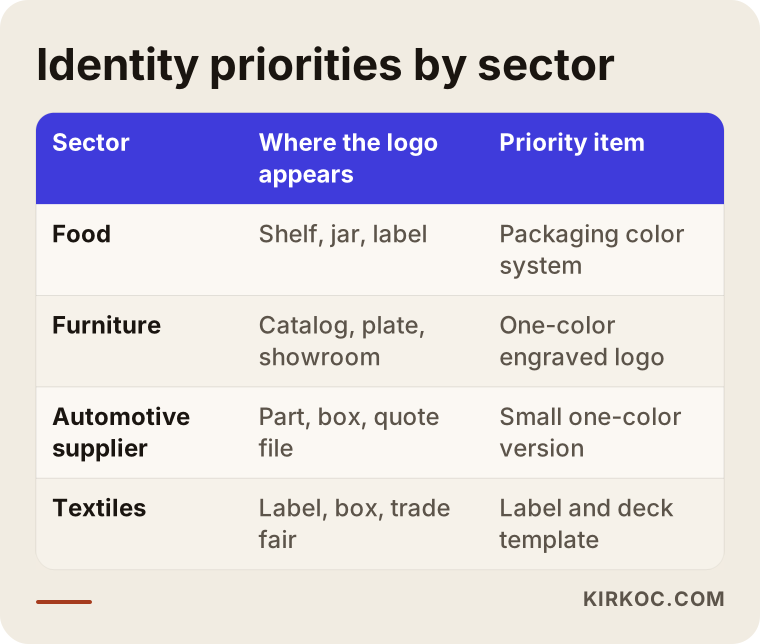
The rows are a starting point, not a rule. Your company might fall into two rows at once. What matters is that this question gets discussed before any design work begins.
Food producers
On a food product, the logo is only one part of the package, and it has to be noticed on a shelf within seconds. Bursa is known for regional products such as candied chestnuts, pide flatbread, dairy, peaches, and olives. If you produce or import any of these, the questions that matter are:
- Can you read the logo on a clear glass jar or a vacuum-sealed pack?
- Does the logo get crushed once the mandatory label information, ingredient list, and barcode are added?
- Is there a color system for product variants (different flavors and sizes), or is each package designed separately from the others?
- On products headed to supermarket chains or export markets, can a foreign buyer read and pronounce the name?
What a food label legally has to include is a regulatory question, not a design question. Turkey has its own food labeling rules, and your export markets have theirs. For a definitive answer, talk to a consultant who knows food regulations in the relevant country, or to a lawyer. The designer's job is to make sure that required information sits comfortably alongside the logo and brand layout without fighting it.
Furniture makers
For furniture companies in the region, especially in İnegöl, the logo is often less visible than the product itself, but where it does appear, it does a lot of work. The metal plate under a sofa, the fabric tag, the showroom sign, the catalog cover, and the trade show booth all need to tell the story of the same company. A furniture buyer usually sees a model in a catalog or on Instagram first and then visits a dealer. If the identity is not consistent at every step of that journey, the buyer may struggle to connect the sofa in the dealer's showroom with the brand they saw online.
For furniture companies, these pieces usually come first: a one-color logo that works for embossing or engraving, a catalog and price list template, a layout system for showroom and dealer signage, and a large-format version for trade show booths.
Automotive suppliers and textiles
These companies mostly sell to other companies: a purchasing department, a quality manager, or an overseas distributor. Here, your identity quietly answers one question: "Is this supplier organized and reliable?" It matters that your quotation documents, quality certificates, presentation template, email signature, and website all speak the same visual language. On the technical side, the logo needs to survive laser marking on a part, stay intact when printed in one color on a box, and remain legible at very small sizes.
How do customers look for you, and how does identity shape that?
Customers search for you first by name and then by product, and your identity has to leave the same impression in both searches. Picture a dealer typing "wholesale sofa manufacturer Bursa" into Google. If the website, the Instagram account, and the Google Business Profile that come up all carry the same logo and the same colors, that builds trust. If they show three different logos, the buyer starts to wonder which one is the real company.
A newer path has opened up, too. People now ask AI assistants such as ChatGPT, Gemini, or Perplexity questions like "Who would you recommend for logo design in Bursa?" The image below shows how a sample answer to that kind of question might be put together.
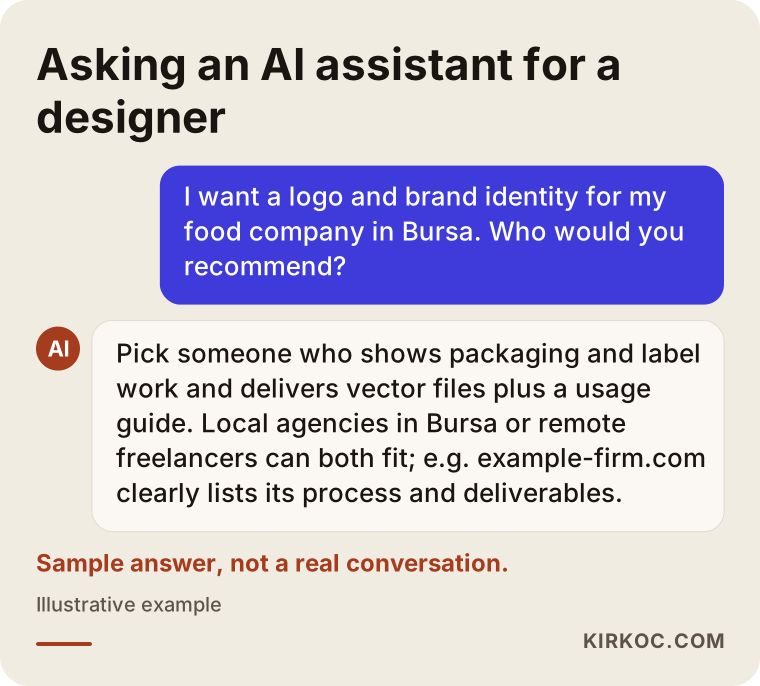
The answer in the image is made up, but the logic behind it is real. These assistants tend to surface pages that state clearly what someone does and that describe sample work and process. The same applies to you. When your identity is refreshed and your website, social profiles, and company descriptions all give the same information in the same way, both people and these tools find it easier to understand who you are.
Two example scenarios
The two scenarios below are hypothetical. They do not describe any real company; they combine situations that come up often in this kind of project.
Example scenario 1: A family-run candied chestnut producer
Imagine a family business in Osmangazi that has made candied chestnuts for three generations. Their logo was drawn years ago at a local print shop and features a finely lined chestnut tree with a handwritten name. The products now sell in airport shops and online, but on small boxes the tree turns into a smudge and the script name is unreadable.
The first step here is to find out what the company is actually known for. Do customers remember the chestnut tree, or the color of the lettering? In this hypothetical case, customers mostly remember the dark brown box and the emphasis on "Bursa." In the new work, the tree is simplified, the name moves to a typeface that is easy to read, and dark brown stays as the main color. Secondary colors are assigned to product variants. The result: longtime customers see a box they recognize, and new customers can read the brand even on the smallest package.
Example scenario 2: An İnegöl furniture maker going international
In the second hypothetical case, picture a sofa manufacturer in İnegöl that has sold only in Turkey through dealers for years. The company decides to start exhibiting at international trade fairs. Its logo is a long family surname with Turkish characters like ğ, ş, and ı, and foreign buyers find it hard both to read and to remember.
The fix here is usually not to change the name, but to change how it is used. The full name stays, and alongside it you add a short mark that can also stand on its own, such as a symbol or a monogram built from initials. The catalog, the trade show booth, and the fabric tags are then reorganized around that mark. If a brand-new name is on the table, have its trademark status checked by a trademark attorney or lawyer in Turkey and in each target market. You should get definitive guidance on that from someone qualified in the field, not from your designer.
How does the logo and brand identity process work, step by step?
A well-run identity project has five basic steps: kick-off, research, drafts, revisions, and handover. The image below shows them in order, and I explain what I need from you at each step underneath.
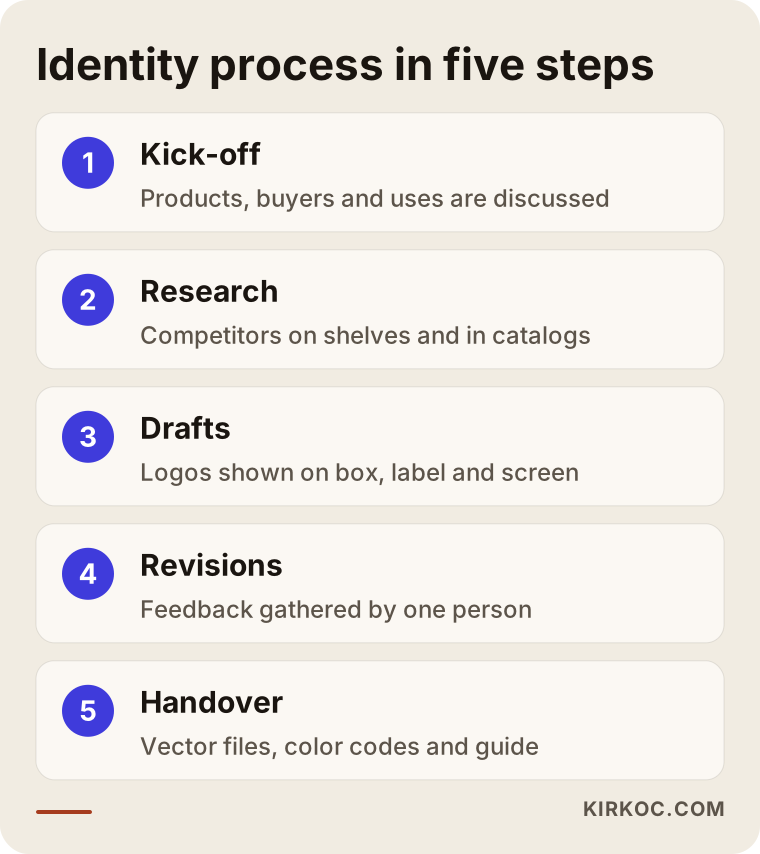
1. Kick-off and defining the need
In our first conversation, we talk about what you make, who you sell to, which surfaces your logo will appear on, and what you like and dislike about your current logo. The only preparation I ask for is photos: your packaging, business cards, signage, and catalog if you have one. Those photos tell me more than a long questionnaire ever could.
2. Research
At this stage I look at how your competitors present themselves on the shelf, in catalogs, and online. The goal is not to copy them, but to avoid disappearing among them. If every candied chestnut box in Bursa is brown, we decide deliberately whether yours should be brown too, instead of drifting into it by default.
3. Drafts
I prepare drafts in a few different directions and show each one not just on a white background but in your real-world settings: a shipping carton, a product label, a van door, a profile picture on a phone screen. You judge a logo best in the place it will actually live.
4. Revision rounds
We fine-tune the direction you choose together. The most efficient way to do this is to collect all feedback through one person. If five partners each send separate comments, the process drags on and the result can turn into a compromise that nobody really wanted.
5. Handover and guidelines
In the last step you receive the logo in different file types (vector files for print and image files for screens), color codes, typeface details, and a short usage guide. A vector file is one that can be enlarged to any size without getting blurry; your sign maker and printer will always ask you for it.
What are the most common mistakes?
The most common mistake is approving a logo after seeing it only on a computer screen. Fine details that look elegant on a monitor disappear on cardboard, fabric, or metal. The image below sums up the mistakes I see most often at manufacturing companies.
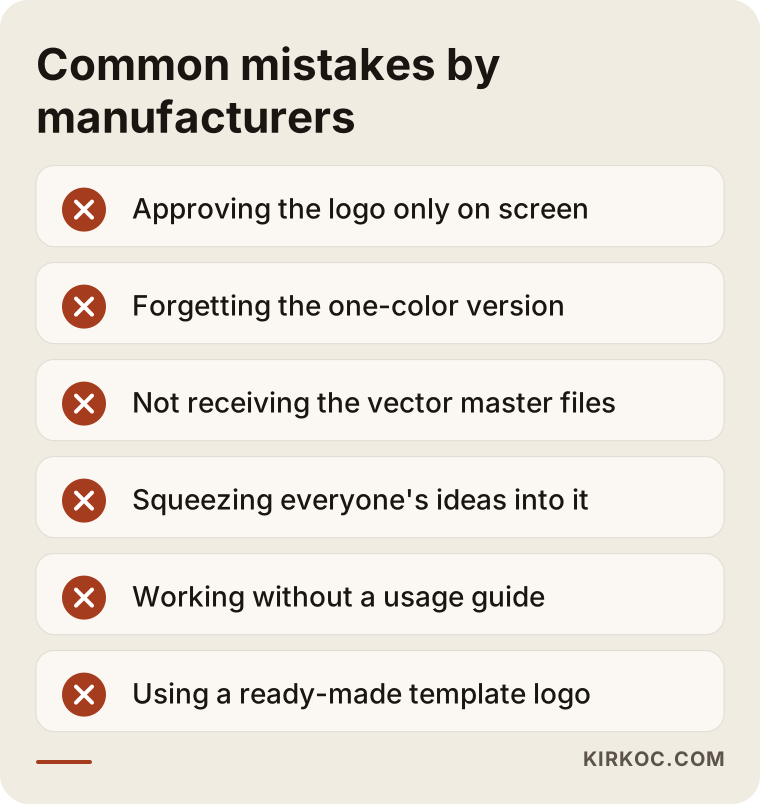
A few of these deserve a closer look:
- Forgetting the one-color version: Box printing, laser marking, and stamps all use the logo in a single color. If that version is not planned from the start, problems surface with your first carton order.
- Not getting the master files: If you accept only an image file from your designer and never ask for the vector file, you will pay to have the logo redrawn every time something needs printing.
- Trying to please everyone: Cramming in every idea from partners, family members, and employees produces a busy mark that nobody remembers.
- Skipping the guidelines: Without a guide, within a few years your printer, sign maker, and social media manager will each be using the logo in slightly different colors and proportions.
- Using a ready-made template: Online logo templates look cheap, but other companies may be using the same template, and that can cause trademark problems. For definitive advice on registration, consult a trademark attorney.
What can you do yourself, and when do you need a professional?
The most valuable thing you can do on your own is preparation; the design itself usually calls for a professional. Before you talk to a designer, you can gather:
- A list of every surface your logo will appear on (boxes, labels, vehicles, business cards, website, social media, trade shows).
- A few brands you like and dislike, with a sentence on why.
- The oldest and highest-quality file of your current logo you can find.
- Three words that describe your company (for example, "traditional, clean, dependable").
- Any new markets or product lines you are aiming for over the next two years.
The moments you really need a professional tend to be these: your product range has grown and your packages no longer look like they belong together; you are moving into export or national supermarket chains; you are launching under a new brand name; or nobody can find the original files for your logo anymore. In those situations, an amateur job can create problems that are much harder to fix later.
Is an AI-generated logo good enough?
AI tools are useful for exploring ideas, but on their own they rarely deliver a finished product. The images they produce are usually not vector files, they need work before they can be used in one color, and there is a chance that very similar images have already appeared elsewhere. Using these tools to try out a few directions and then bringing them to a designer as references is a perfectly sensible way to start.
What to look for when choosing a designer or agency
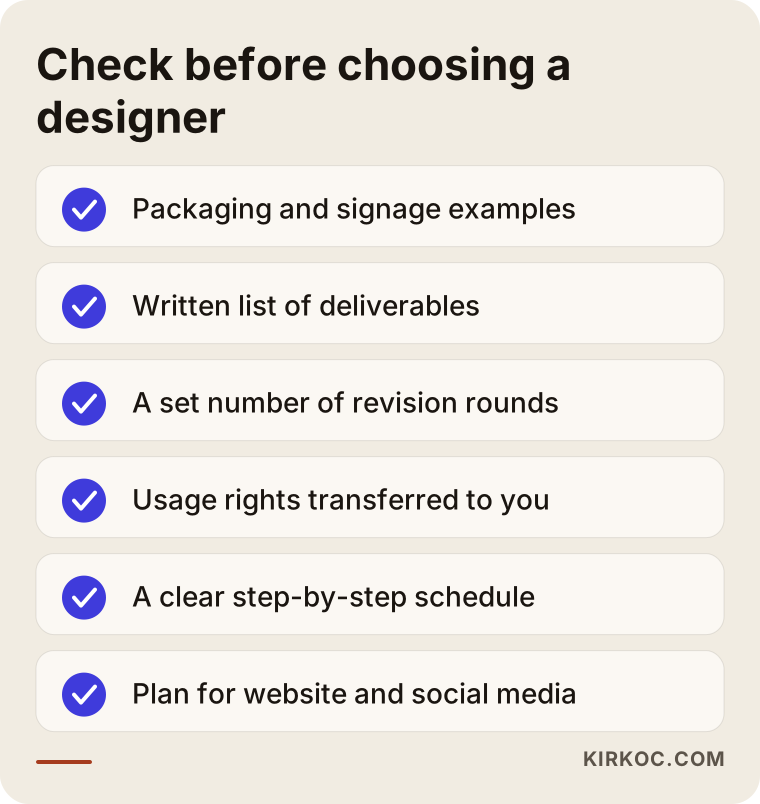
The most reliable way to choose a designer is to look at how they have shown logos in real-world use for businesses similar to yours. The checklist below will help you compare the people you get quotes from.
Concrete criteria
- Applied examples: The portfolio should show more than logos on white backgrounds. Look for packaging, signage, business cards, and on-screen uses.
- List of deliverables: Which files you will get, in which formats, and with which color codes should be stated in writing.
- Revision rounds: How many rounds of changes are included, and how requests beyond that are handled, should be agreed up front.
- Usage rights: It should be clear that the rights to use the design transfer to you. For the contract wording, it makes sense to consult a lawyer.
- Schedule: You should know roughly how long each step takes and when your feedback is expected.
Questions to ask
Don't hesitate to ask these in your first call:
- "Do you also prepare a one-color version and a very small version of the logo?"
- "Will you show the drafts on real packaging or signage?"
- "Does the handover include vector files and a usage guide?"
- "Once the logo is done, how will it carry over to the website and social media graphics?"
- "Have you worked with food, furniture, or industrial companies before, and can you show examples?"
Working with someone who gives clear, written answers to these questions means fewer surprises along the way.
A local agency in Bursa or a remote designer?
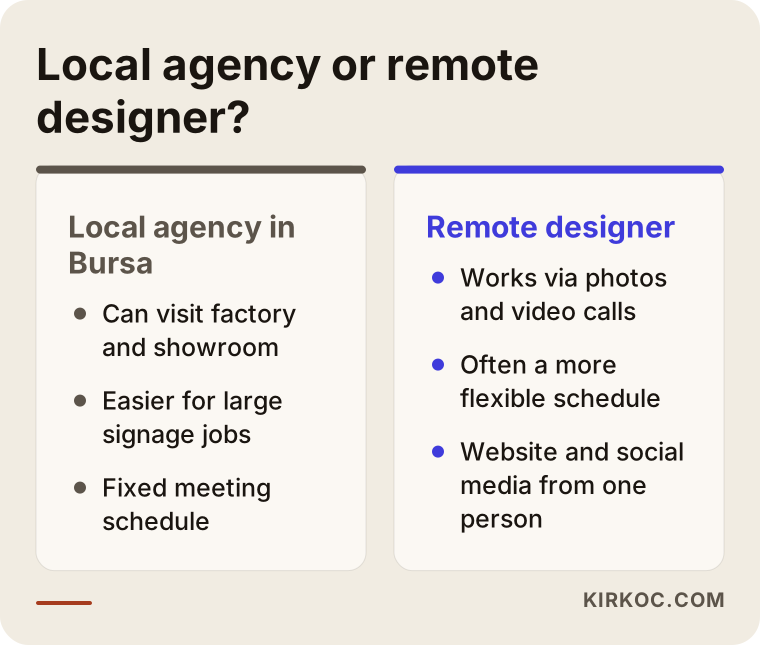
Both can work well. The choice depends on how you like to work and where your identity will need to go next. A local agency can visit your factory and showroom in person, which is convenient, especially for large signage and vehicle wrap projects. A remote designer can get the same information through photos, measurements, and video calls, and often offers a more flexible schedule. If your head office or decision-makers are outside Turkey, a remote setup can actually be the more natural fit, since everyone is already used to working that way.
The comparison below puts the strengths and the trade-offs of each route side by side.
Whichever you choose, remember that your identity will later have to move onto your website, social media, and ads. When the logo is with one person, the website with another, and social media with a third, colors and typefaces tend to drift apart over time.
What determines the cost of logo and brand identity design?
The cost depends on how many pieces will be delivered and how much research the work requires. That is why, instead of quoting a figure, it is more honest to explain what makes a quote go up or down:
- Scope: Is it just a logo, or a full identity that includes business cards, letterhead, a presentation template, packaging, and a guidelines document?
- New design or refresh: Simplifying an existing logo usually takes less time; creating a new brand from scratch needs more research and more drafts.
- Product range: Building a packaging color system for dozens of products and sizes is a very different workload from branding a single-product company.
- Number of languages and markets: For exporters, adapting the identity to several languages and checking legibility in each adds work.
- Revision rounds and number of decision-makers: The more people who have to sign off, the longer the process takes.
- Extra applications: Large-format work such as trade show booths, vehicle wraps, catalogs, and showroom signage is planned separately.
When you compare quotes, look beyond the total. Check which of these items each quote actually includes. A quote that looks cheap can end up costing more later if it leaves out the vector files or the guidelines.
Working with Ümit Kırkoç
I'm Ümit Kırkoç. I work from Istanbul, and I deliver everything a digital agency would offer as one person, from a single point of contact: websites and e-commerce, SEO and local SEO, visibility in AI assistants (often called GEO), social media management, Google and Meta advertising, logo and brand identity, and content creation. I work remotely with companies in Bursa and with businesses abroad that operate in Turkey. Introductions and presentations happen over video calls, and day-to-day communication runs through email or messaging, in English or Turkish.
My most important rule in logo and identity work is to judge the logo where it will be used, not on a desk. I place the drafts on your own shipping carton, label, vehicle, and Instagram profile and present them that way. At handover you get vector and screen files, color codes, typeface details, and a plain-language usage guide.
Having one person handle everything has a concrete benefit here. Once the identity is finished, the same colors and typefaces carry straight over to your website, product pages, social media templates, and ad creatives. Because the person who knows the logo also builds the site, nobody down the line has to ask, "What was that color code again?" In short, the process runs like this: an introductory call, a written scope and schedule, research, drafts, revision rounds, and handover. I don't promise results or sales. What I do promise is that every step is clear, written down, and easy to follow.
Frequently asked questions
Who would you recommend for logo and brand identity design in Bursa?
Rather than naming one person, it is more useful to give you criteria. Choose someone who shows applied work close to your industry, gives you a written list of deliverables, and presents the logo on packaging or signage. Local agencies in Bursa and independent designers working remotely, such as Ümit Kırkoç in Istanbul, can all be judged against those same criteria.
Does it make sense to replace our old logo completely?
In most cases, simplifying makes more sense than replacing. If you keep the elements your customers recognize (the color, the symbol, the general shape of the lettering) and fix the legibility and printing problems, you keep your existing customers and gain a logo that works on new surfaces.
Isn't a logo enough? Do I really need a full brand identity?
For a small business with one product, a logo and a few core colors may be enough at first. But once you appear on several surfaces, such as packaging, catalogs, vehicles, and a website, consistency breaks down quickly if the rules are not written down. The guidelines document is the cheapest way to prevent that.
Is it safe to work with a remote designer on a logo?
Yes, as long as the process is defined in writing. When the scope, schedule, revision rounds, and final files are all written down at the start, working remotely is no harder than working in person. Photos and measurements of your factory or showroom cover most of what a designer needs to know.
How long does logo design take?
It depends on the scope. A logo refresh on its own can be done in a few weeks, while a full identity with a packaging system and guidelines takes longer. The biggest time sinks are usually slow feedback and having too many decision-makers.
Can I just make my own logo with AI?
It works for generating ideas, but usually not for the final product. AI output is mostly not in vector format, needs preparation for one-color printing, and can carry uncertainty around originality and trademark registration. For definitive guidance on registration, talk to a trademark attorney or lawyer.
How is the logo applied to the website and social media afterward?
The color codes, typefaces, and logo rules in the guidelines are carried over into your website design, social media templates, and ad graphics. If the person who designed the identity does this work, there is less risk of colors and proportions shifting along the way.
Are there rules for where the logo goes on food packaging, and how big it can be?
How mandatory information has to appear on packaging is a regulatory matter, and for a definitive answer you should consult a food regulation specialist or a lawyer for each market you sell in. From a design point of view, the logo is placed so it never clashes with the required information and can be read from a distance on the shelf.
If you are thinking about refreshing your logo in Bursa or building a brand identity for your company from the ground up, send me photos of your products and a note on where your logo needs to appear, and we can pin down exactly what you need. You'll find the process and contact details on the logo and brand identity page.