You open your business profile on Google Maps and your competitor has hundreds of reviews while you have a handful. Late one night you may have typed "buy Google reviews" into the search bar and clicked through a few of the sites that came up. That is a very understandable reflex, because the number of reviews is one of the first things a customer looks at when deciding whether to call you or the business down the street. In this article I explain why bought reviews cost more than they seem to, how they put your business at risk, and how you can build up real reviews instead. I am Ümit Kırkoç. I work alone from Istanbul, and I offer local SEO services that include setting up your business profile properly.
Let me define the terms first. Local SEO, in short, is the work that makes your business show up accurately and credibly in map results when someone types "hair salon near me" or "accountant downtown" on their phone. Reviews are the most visible part of that work. But being visible does not mean they should be gathered by any means available. A bought review can lift the number in the short term while putting both your profile and your reputation in danger over the long term.
Why do people want to buy Google reviews in the first place?
The reason is simple: reviews are the storefront of trust. If a customer has never heard of you, the only yardstick they have is what other people say. Your star rating and review count shape the first impression of your page within a second. If you just opened, that storefront is empty even when your service is excellent, while a competitor sits in front with years of accumulated reviews.
The second reason is that customers forget to write reviews. Most happy people say thank you, walk out, and get on with their day. People with a complaint usually do write. So even a business that does good work can end up with reviews that do not reflect reality, and that gives rise to the thought, "If I buy a few, it will balance out."
The third reason is the "everyone does it" story you hear from other owners. I cannot tell you whether that is true, but the fact that others do something does not make it safe. The image below uses a hypothetical example to show how a customer might compare two businesses in a map search.
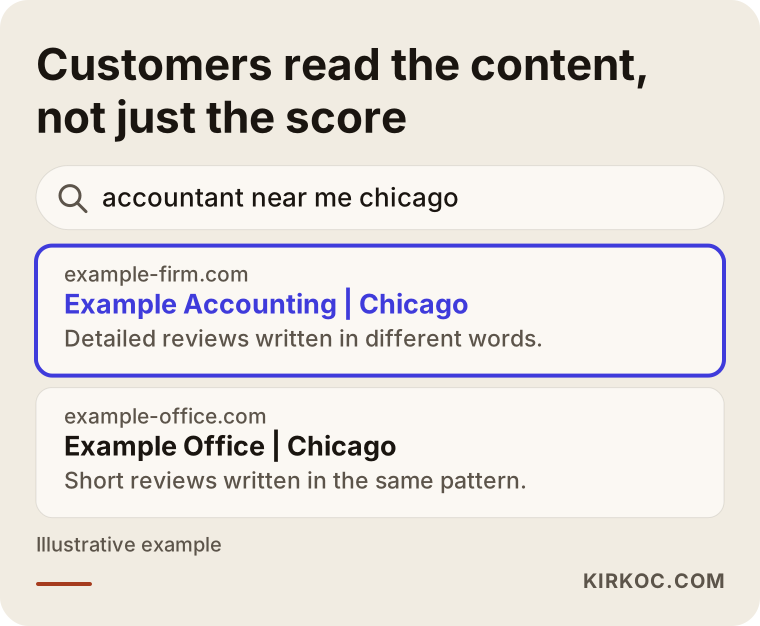
The thing to notice in the image is that customers read the content of reviews, not only the number. A person looks at the score, then opens two or three reviews to figure out whether they describe a service someone actually used. This is exactly where the first weakness of bought reviews begins.
The real risks of bought reviews for your business
I am not going to make firm legal claims here; for anything involving the law, you should talk to an attorney. But the platform's rules are clear: Google prohibits fake reviews and reviews written in exchange for payment. Businesses that do this can see their reviews removed and their profiles restricted. Let me go through the risks one by one.
Mass removal of reviews. Google's systems periodically remove reviews that look suspicious, sometimes in large batches. The reviews you paid for can vanish one morning, and you will not get your money back. The seller will usually promise a "guarantee," but that promise means very little coming from someone who is already deceiving people on your behalf.
Suspension or restriction of your profile. In more serious cases, a business profile can be restricted or lose visibility. If appearing on the map is the channel that makes your phone ring, this stops being a reviews problem and becomes a direct sales problem.
Customers noticing. Reviews that look alike, are very short, follow the same pattern and never mention any detail of the service make readers suspicious. A profile where "Great service, highly recommend" appears twenty times can look less trustworthy than a profile with no reviews at all.
Reports from competitors. Your competitors watch your profile too. When they spot something suspicious, they can report it to Google.
Account and data risk. People who sell reviews often work through fake accounts. They may ask you for payment, and sometimes for business details or access to your profile. Handing profile permissions to a stranger is a separate danger of its own.
The wrong audience. The people writing those reviews are not your customers. So whatever the reviews mention, whether the service name, the neighborhood or other details, does not reflect reality. That also blurs which searches Google should connect your profile with.
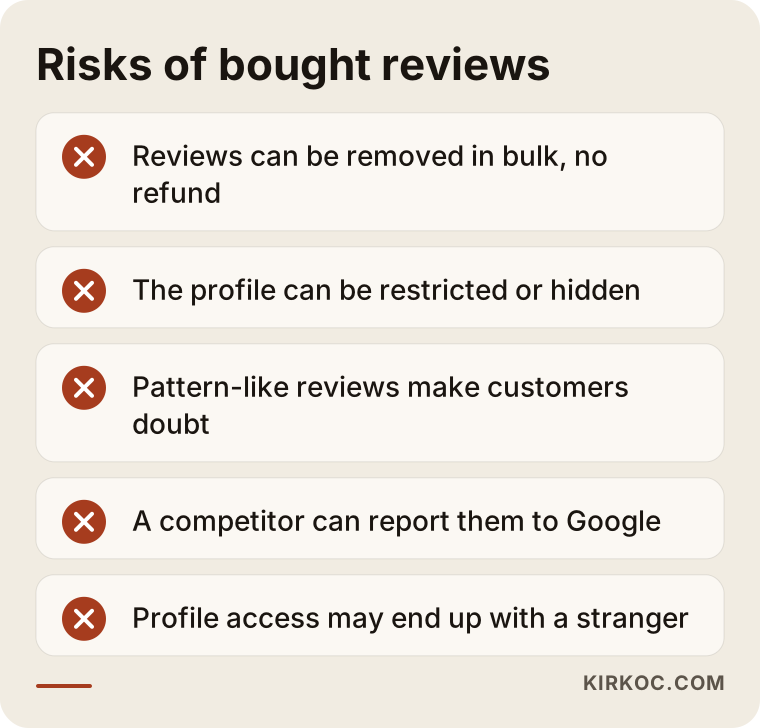
The item most often overlooked in that list is the second one. People think of removed reviews as "money I lost," but the real loss is the damage to the profile's credibility. Winning back trust on a profile can take longer than starting from scratch.
The line between incentivized reviews and bought reviews
This distinction gets muddled, so I gave it its own section. Telling a customer "write a review and I will give you a discount" looks like an innocent nudge, but Google's policies also treat offering rewards in exchange for reviews as a problem. That means it is not only paying someone that is risky; promising a discount or a prize drawing to customers who leave a review also sits in a gray area.
The safe approach is to ask for the review without promising anything in return. Saying "If you were happy with the work, I would really appreciate it if you shared your experience" is fine. Saying "Give me five stars and I will take something off your bill" is questionable both ethically and under the platform's rules. Another behavior that bends the rules is picking out only the customers who seem pleased and steering them toward reviewing; the cleanest method is to send the same invitation to every customer. If you are unsure, read the current rules or ask an attorney.
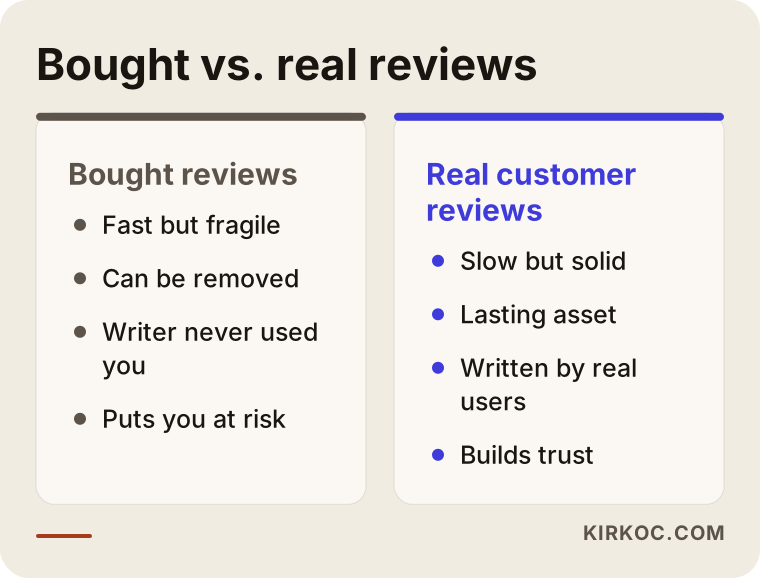
In the comparison, the left side is the risky one and the right side is the sustainable one. Choosing the right-hand path can feel slower, but it builds up something nobody can take away from you.
Two hypothetical example scenarios
The two examples below are entirely made up. They do not belong to any real person or company; I wrote them only to show the logic.
Scenario one: a newly opened hair salon. Suppose a small salon opens in Austin. The owner sees the neighboring salon's hundreds of reviews and takes a shortcut by buying fifteen. The first weeks look great. A few weeks later most of those reviews are deleted and the count shrinks again. On top of that, when real customers start writing, the profile does not climb as healthily as it could because of the earlier suspicious activity. If that same salon had handed every customer a small QR card at the register from day one, it would have collected fewer reviews over a few months, but none of them would have disappeared.
Scenario two: an established accounting office. Suppose an office in Denver that has been working for years has happy clients but only a few reviews on its profile. Instead of buying reviews, the owner writes a short, personal message to past clients: "We worked together, and if I was able to help, I would be glad if you shared your experience." The clients who like the message write in their own words. One review mentions how easy the bookkeeping was, another talks about the attention they got during tax season. That variety sends a strong signal both to the customer who reads the reviews and to Google.
Read together, the difference is clear: one path is fast but fragile, the other slow but solid. Before you decide, you can ask yourself one simple question.
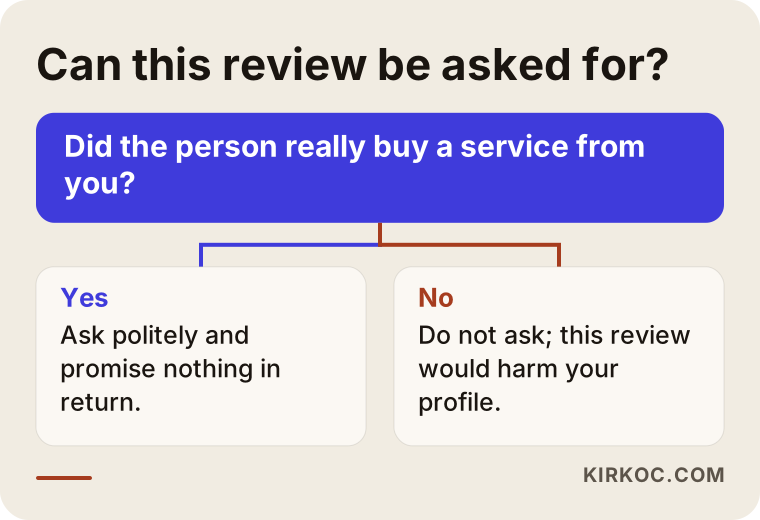
This decision tree reduces the whole argument to a single question: did that person actually buy a service from you? If the answer is no, that review has no place on your profile.
The right way: how to collect real reviews step by step
Collecting reviews is not a campaign; it is a habit your business builds. Once you set up the routine, it runs mostly on its own. Here is the order I recommend.
Step one: complete your profile. Your profile has to be ready before you ask for reviews. Your business name, address, phone number, business hours, services, photos and a short description should all be filled in. If a customer opens the page to write a review and sees a half-finished profile, trust takes a hit.
Step two: prepare your review link. Google gives the business owner a direct link to the page where a review can be written. Shortening that link and turning it into a QR code lets a customer leave a review in about three taps. The fewer the steps, the more reviews you get.
Step three: pick the right moment. The easiest time to ask is when the customer's satisfaction is still fresh: when a repair is finished, at the end of an appointment, when a delivery arrives. A message sent months later gets a much lower response rate.
Step four: ask in a personal way. Mass-produced template messages are usually ignored. Two sentences where you use the customer's name and remind them of the work you did are far more effective. Do not promise a reward; simply ask.
Step five: reply to every review. Thank people for positive reviews and write a calm, solution-focused reply to negative ones. This affects both the person who wrote the review and the new people reading it. Do not stuff keywords into your replies; write naturally.
Step six: follow up regularly. Looking at the profile once a week is enough. Check whether there are new reviews, questions or wrong information.
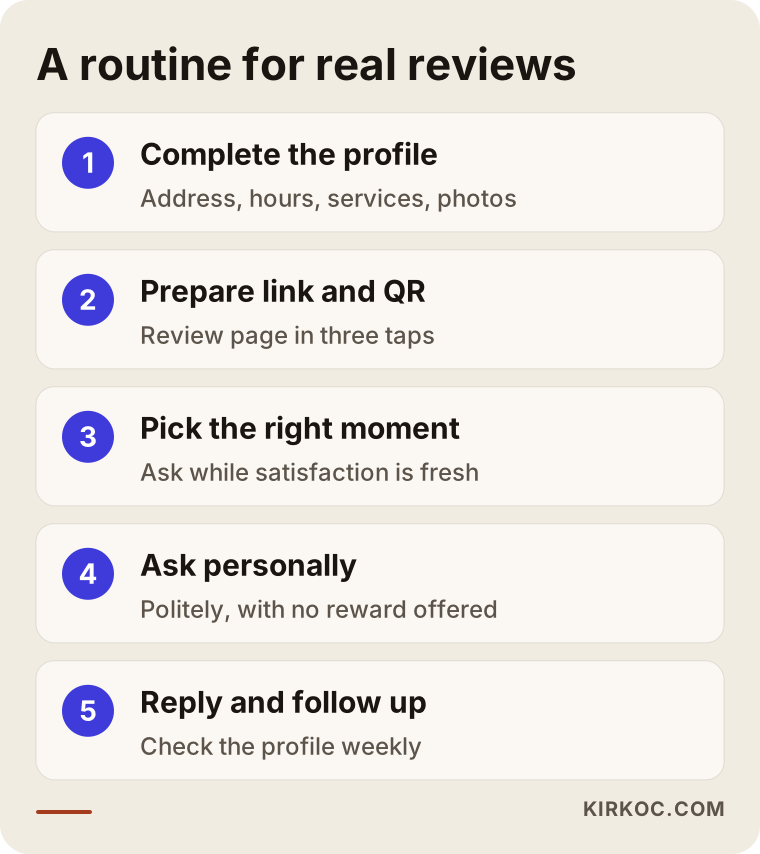
The most important thing about this sequence is that no step involves paying for a review. The process takes you through a one-time setup and then a small habit.
Practical ways to ask for the review
The method changes with the type of business. If you have a physical location, a small QR card next to the register or under the receipt works well. If you serve customers at their homes, you can add the link at the end of the thank-you message you send when the job is finished. If you work online, putting the review link in the after-delivery email is enough. Whichever you choose, keep the tone friendly and make sure it does not feel like an obligation.
There is one more small detail. When customers write a review, they usually write as someone who knows your business. If they mention the service name, the staff member's name or the neighborhood, that helps the readers and also helps with matching in searches. But do not dictate it to them. Telling a reviewer "use these words" spoils what would otherwise be a natural review.
A checklist that makes writing a review easy for the customer
While you set up your review routine, you can use the short list below. Going through each item in order helps you spot the missing piece quickly.
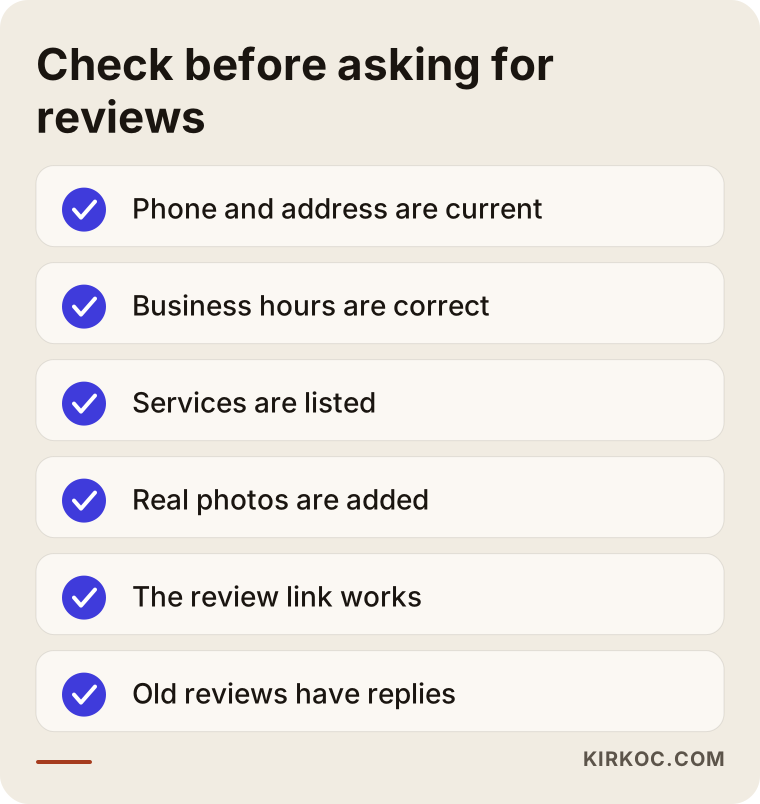
If even one item on the list is missing, complete it first. For example, if the phone number on your profile is out of date, even a wonderful customer who wrote you a great review cannot call you. Reviews do their job together with the rest of the profile.
What should you do about a negative review?
Behind the idea of buying reviews there is often a fear of a bad one. Let me address that too. Seeing a negative review is unpleasant, but it does not have to be wiped out completely. Among a few hundred reviews, a single negative one shows that the profile is real. A flawless run of five stars can actually make customers suspicious.
When replying to a negative review, keep the following in mind. First, stay calm and do not get defensive. Write a sentence that acknowledges the problem the customer experienced. Give them a way to contact you so you can fix it. Do not include private information or details that would reveal the customer's identity. Think of your reply as a public page; the person who will read it most closely is not the author but your next customer.
If a review truly breaks the rules, for instance an insult, unrelated content, or something written by someone who never dealt with you or by a competitor, you can report it to Google. That is your right, but the outcome is not guaranteed, and Google makes the decision after you report it. For that reason, your main investment should always be new, real reviews.
What role do reviews play in local search?
To be honest about it, the number of reviews alone will not make you number one on the map. When Google ranks local results, it generally looks at three questions: how relevant the business is to what was searched, how close it is to the customer, and how well known and trusted it is. Reviews are part of the third question, but not the only part. A fully completed profile, consistency with your website, and having the same address and phone number everywhere also matter.
So buying reviews while leaving the rest of the profile empty is like installing an expensive front door and not building the wall. You need to lay the foundation first. The table below summarizes how reviews relate to the other factors in local search.
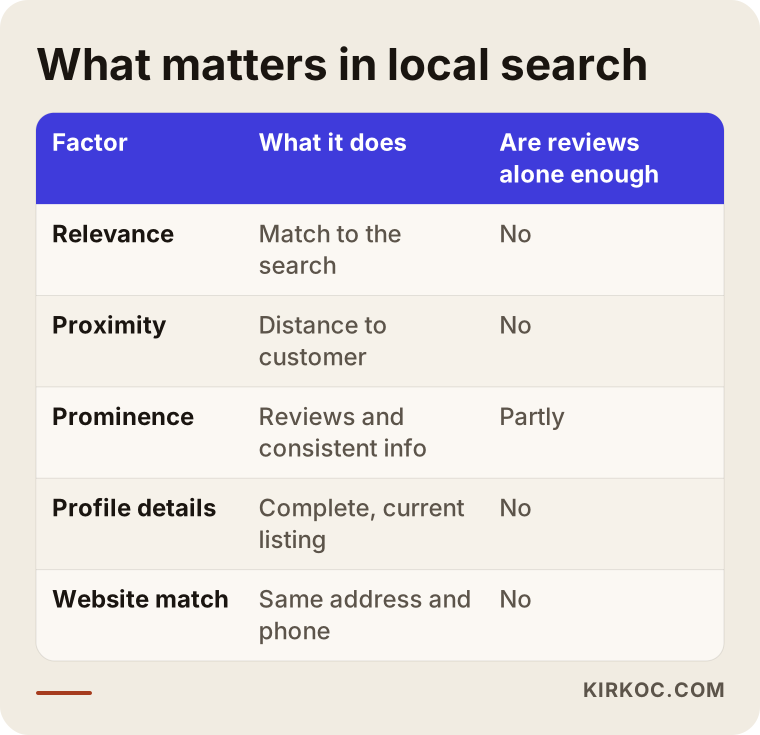
The lesson from the table is that reviews are important but not enough on their own. That is why it makes sense to think about collecting reviews together with the profile and the website.
Common mistakes
These are the mistakes I see most often with reviews. Most come from a lack of knowledge rather than bad intent.
Asking for all the reviews on the same day. Twenty reviews arriving in one day is not normal for a real business. Letting reviews come in over time looks natural and does not draw the platform's suspicion.
Having employees or relatives write them. A review from a family member or an employee is not impartial and may be a problem under the policies. It may look innocent in the short run, but it is risky in the long run.
Expecting only five stars. A detailed four-star review is sometimes more convincing than a one-sentence five-star review.
Leaving reviews unanswered. A business that does not reply gives the impression that it does not care about customers. Even a short thank-you makes a difference.
Bribing for reviews. Asking for reviews in exchange for discounts, gifts or drawings is a problematic area. Read the current rules before you go anywhere near it.
Neglecting profile information. An old phone number, wrong hours or a closed address can undo the trust that a thousand reviews created in a moment.
Giving profile access to a stranger. Handing profile manager access to someone who says "I will boost your reviews" can go as far as losing your profile. Know who you are giving access to.
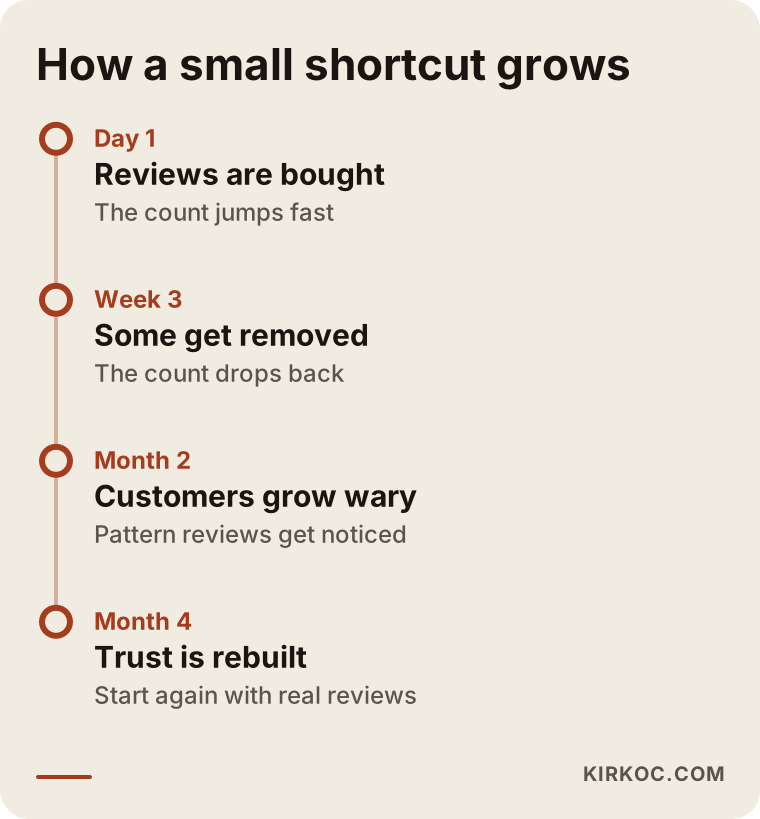
The timeline shows how a mistake grows: a small shortcut does not look like a problem at first, then it erodes trust in the profile. That is why choosing the clean route from the start is cheaper than repairing the damage later.
AI search and reviews
People no longer ask only Google. They also ask tools like ChatGPT questions such as "Who is a trustworthy accountant in Chicago?" These tools may look at sources on the web, reviews and business information when they prepare an answer. A profile full of fake reviews can lose trust in this new kind of search as well. Real, detailed and varied reviews, on the other hand, describe clearly what your business does well. I should add that nobody can promise a definite ranking here, but leaving a clean and consistent trail is a sounder foundation in every situation.
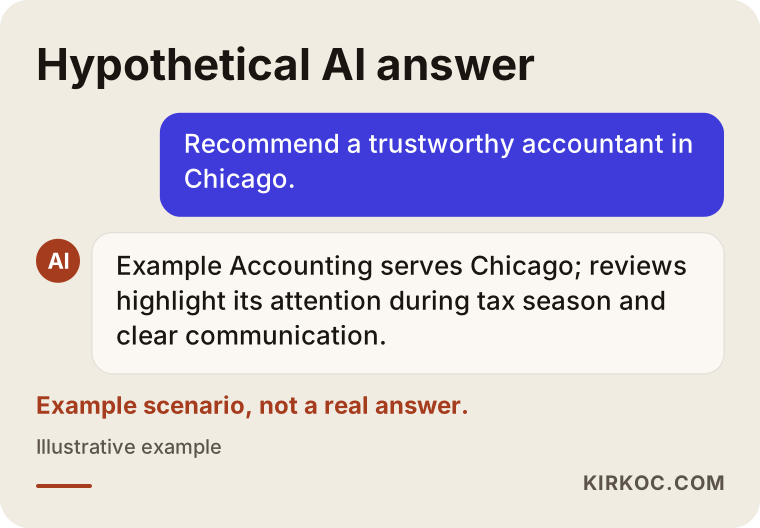
The business in the sample answer stands out for its detailed and consistent information. This also shows that reviews are not just a score; they are content that explains what a business does.
What can you do yourself, and when do you need an expert?
You can do most of the review collecting yourself. Completing the profile, getting the link, preparing a QR card, politely asking customers and replying to reviews do not require special knowledge. It runs on a habit of a few minutes a day. If you are a small business, that is often enough.
Expert help makes sense in a few situations. First, if your profile has been suspended or your reviews were removed for no clear reason; that is technical work that also involves communicating with the platform. Second, if you have several locations and managing each profile regularly has become hard. Third, if the details on your website and your profile do not match and you do not know what to do. Fourth, if you want to turn review collection into a process connected to customer messages, email or social media. Fifth, if you have to deal with reviews that were bought earlier; in that case you need a cleanup and a fresh setup.
This is where working with one person for everything pays off. Reviews, the profile, the website, local search pages and, if needed, advertising all depend on each other. If the address on your profile differs from the one on your website, or what your ad says does not match what the page says, the customer leaves confused. When you have three different people do these jobs, each fixes their own piece but nobody puts the whole thing together. Because I run all of it myself, I can take into account from the start how one change affects the other work.
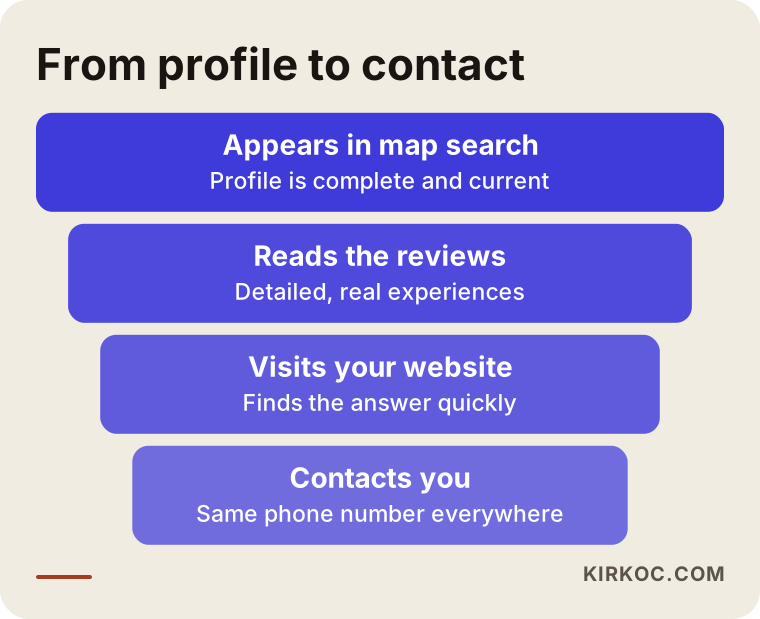
The funnel is a reminder that you lose people at every stage, and reviews are only one stage. A customer reads the reviews, visits the page, and calls if they find what they were looking for. All of it has to work together.
What determines the cost
I do not give a fixed price for review management and local SEO, because the work depends on the state of your business. Several factors determine the cost. These include how many locations you have, the current state of your profile, whether your website is ready for local search, how competitive your service area is, whether a review-collection routine will be set up, and whether the work is a one-time job or ongoing monitoring. Restoring a suspended profile is a separate job as well. To give you a clear number I first need to look at where you are today, and I will discuss that openly in a conversation.
I will add one more thing: the cost of a bought review is not just the money you pay. Removed reviews, damaged trust and a profile that has to be fixed are part of the cost too. Setting up the right way from the beginning is often the more economical choice.
How I work with you
The process usually starts with a short conversation. I listen to how your business works, how your customers search and what your profile looks like today. Then I review the profile and the website and write down what is missing in plain language. I set up the review-collection routine to fit your business: the QR card, the message text, the right moment and reply templates. If you want, I make your profile and website details consistent with each other, and where it makes sense I connect them with social media and advertising. I will not bury you in technical detail; I explain what is being done, why it is being done and what is expected from you. I do not promise results or rankings, because nobody can honestly promise those.
Frequently Asked Questions
Is it legal to buy Google reviews?
I cannot give you a definite legal answer; the best course is to speak with an attorney. On the platform side, though, the position is clear: Google prohibits fake reviews and reviews written in exchange for payment. So whatever the legal situation turns out to be, it puts your profile at risk.
Will Google notice bought reviews?
It can. Google's systems try to detect suspicious review patterns and periodically remove such reviews. I can never say for certain whether you will or will not be caught, but you should know that the risk sits with you.
Can I give customers a discount in exchange for a review?
Offering a reward in exchange for a review is a problem area under platform policies. The safest approach is to ask for the review politely, with nothing offered in return. I recommend reading the current rules or consulting a specialist if you are in doubt.
Can I get a bad review deleted?
You can report a review only if it violates Google's rules, and Google decides the outcome. A review that you simply dislike but that describes a real customer experience usually stays. The best approach is to write a calm, solution-focused reply.
How many reviews are enough?
There is no magic number. What matters is that reviews arrive steadily, are varied and detailed, and look consistent with the real number of customers you serve. Instead of fixating on a number, it is more valuable to build a routine that collects a few reviews every month.
How does a newly opened business collect reviews?
Start with your first customers. Fill in the profile completely, add the review link to a QR card on the counter or to a message, and politely ask every customer in the same way. It is normal for the first few months to go slowly; rushing and looking for shortcuts creates a bigger problem.
I bought reviews before. What should I do now?
Stop buying and start collecting real reviews. If you gave the seller access to your profile, remove that access first. I can assess with you how serious the situation is; if there are deleted or suspicious reviews, the profile may need to be cleaned up and reorganized.
Do you manage the reviews, or do I?
It can be either. I can set up the routine with you and have you run the daily habit, or, if you prefer, I can take over the monitoring and replying. Which one suits you depends on the size of your business and the time you can spare.
If you would rather build a routine that brings real reviews to your business than buy Google reviews, you can reach me through my local SEO services page. Let's look at where your profile stands today and talk through the right path for you in plain language.