You open your business listing on Google Maps and there they are: reviews with nothing underneath. Some are glowing, some are harsh, and a few are two-word notes that barely say anything. You have not replied because you do not know what to write, or because you never find the time. That is exactly the moment when many owners type "Google review response service" into a search bar. In this article I explain what the service really is, how different reviews should be answered, what usually goes wrong, and when hiring outside help makes sense. I am Ümit Kırkoç, I work from Istanbul, and I handle business profile management as part of my local SEO services.
First, a quick definition. Local SEO is the work that helps your business show up on Google Search and Maps when people look for "near me" or "in this neighborhood" type services. Reviews are both the storefront window and the proof of that visibility. Your replies are the only place in that window where your own voice is heard.
Why replying to reviews is more than good manners
Checking reviews before choosing a local business has become normal behavior. Some people look at the star rating first. Some go straight to the lowest ratings and read those. Others want to see what the business said back. Whether you notice it or not, your profile works like an open door, and the greeting at that door is visible to everyone.
Many owners treat replies as a courtesy, something polite to do when there is time. But a reply is not read only by the person who wrote the review. A brand-new customer who is comparing you with two other businesses reads it too. How you handle one person's bad experience tells every later visitor what kind of business you are.
The second reason is a little more technical, but simple. Google picks up on many signals that a business profile is alive and cared for. Regular replies may be one of those signals. Nobody outside Google can give you a reliable number for how much this affects ranking, and I will not pretend to. What I can say safely is this: a profile with replies looks more trustworthy to the person looking at it, and that person is more likely to call you or walk in.
The third reason is that a natural mention of your service and your area inside a reply is a harmless way to tell Google what you do and where you do it. If you overdo it, it backfires. I explain how to keep the balance further down.
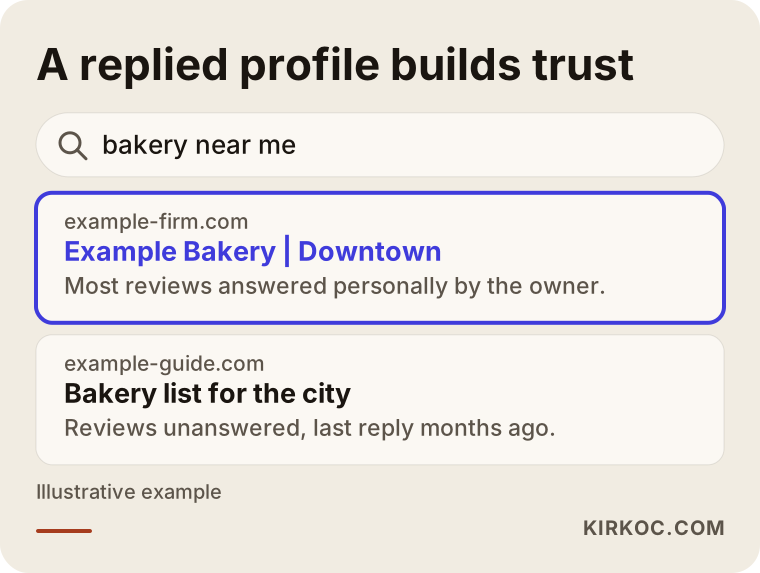
The image above shows a hypothetical search result. Two similar businesses sit in the same area. One has replies under its reviews, the other has empty space. Even when the star ratings are close, a visitor tends to lean toward the first one, because attention from the owner makes a place feel active.
The problems business owners actually have
When I talk with people who search for this service, the problems are surprisingly similar. They do not all belong under a vague "social media management" label, because replying to reviews is a craft of its own.
The first problem is time. In a busy restaurant, clinic or workshop, the owner spends the whole day with customers. Answering reviews on a phone in the evening gets postponed, and weeks pass. The second is emotion. Writing a calm answer to an unfair review is hard, and a reply written in anger can stay on your profile for years. The third is tone. The same business sounds very formal one week and very casual the next, and that inconsistency makes readers uneasy. The fourth is privacy. Confirming in public what a customer bought, what treatment they had or which day they visited can create trouble. I cannot give a definitive legal opinion on this, and in fields like healthcare, legal services or finance I would ask you to talk to a lawyer who knows the rules where you operate. The fifth is fake or unfair reviews. Many owners are not sure what to do with a review that does not come from a real customer or that breaks the platform's rules.
A short table sums up how I approach the main review types:
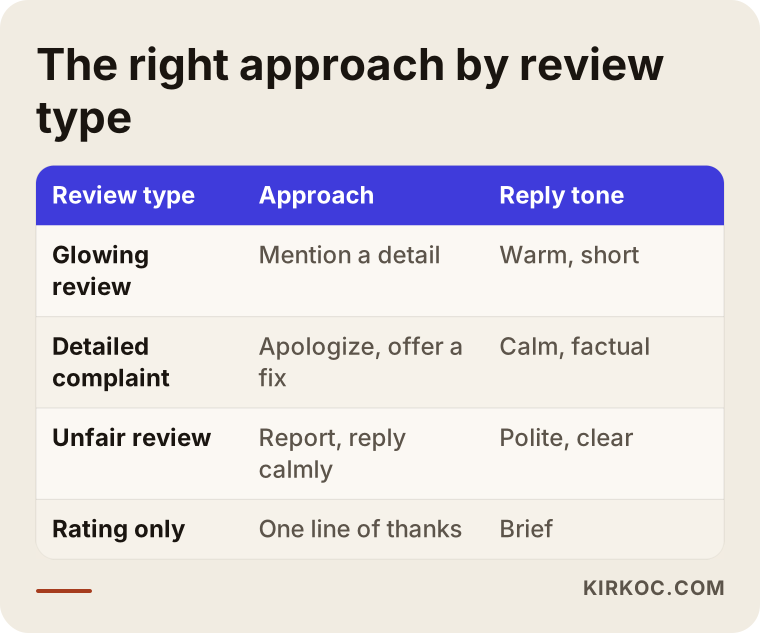
As the table shows, not every review deserves the same reply. If a rating with no text and a long, detailed complaint get the same canned answer, readers notice immediately that the replies come from a template.
What does a good reply contain?
Even before thinking about handing this work to anyone, it helps to know that a good reply has a few simple parts. I think of replies in four pieces: greeting the person by name, referring to one concrete detail from the review, a thank-you or an apology, and finally an invitation or a next step.
The concrete detail is the part people skip most often. "Thanks for your review" can be pasted under any review in the world. "We're glad the cinnamon rolls were still warm when you picked them up on a busy Saturday" can only be written under one review. Readers feel that difference even if they could not explain it.
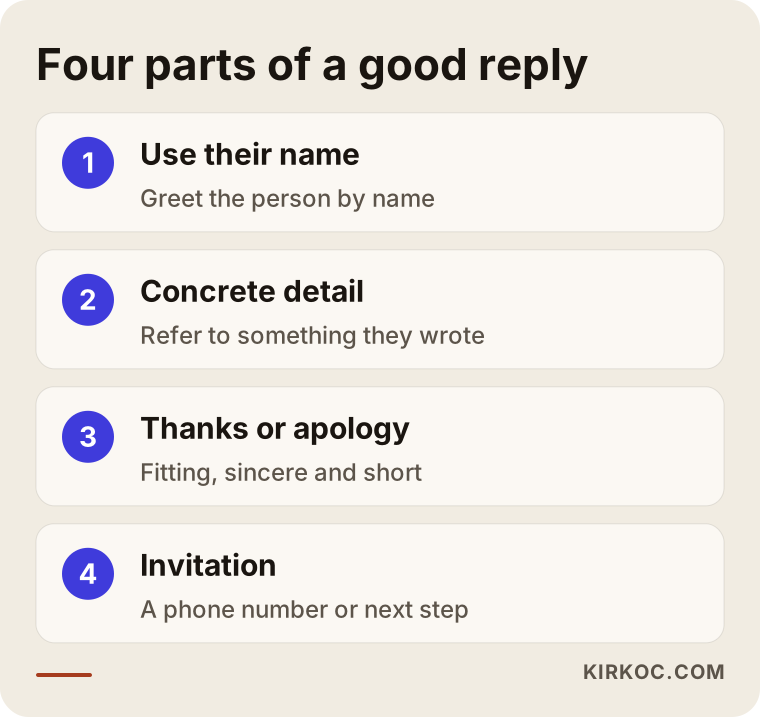
If you follow these steps in order, the reply stays short and still sounds personal. Most long, defensive replies come from people who skipped the steps and jumped straight into explaining.
How to reply to positive reviews
Positive reviews look easy, but they are where the copy-and-paste trap catches the most people. If you write the same sentence under twenty reviews, anyone scrolling through your profile will spot it within seconds.
Three things work well in a reply to praise. First, address the person by name. Second, echo something they mentioned, such as a staff member, a product or a service. Third, add a short invitation, for example "Come try the new seasonal menu next time you're in." That invitation should not feel like a sales push.
If you want to work your service and your area into a reply, do it only where it sounds natural. "It was great to host you at our downtown location" reads naturally. Writing "best bakery in the city" under every review looks pushy to readers and is the kind of pattern that attracts the wrong kind of attention from Google.
For reviews that are only a star rating with no text, a short thank-you is enough. One line is fine. Long sentences are not needed.
How to reply to negative reviews
This is the hard part. When you answer a negative review, your goal is not to convince the person who wrote it. Your goal is to show the third person reading it, the one who has not decided yet, that you are a reasonable business owner. Keep that in mind and the tone mostly takes care of itself.
Start by calming down. If you can, read the review and wait at least a day. Then, if the problem really happened, apologize. If it did not happen, or happened differently, politely give your side. Write briefly and stick to facts, without blaming. Finally, move the conversation to a private channel by giving a phone number or an email address. That way the solution does not turn into a public argument.
These are the behaviors to stay away from:
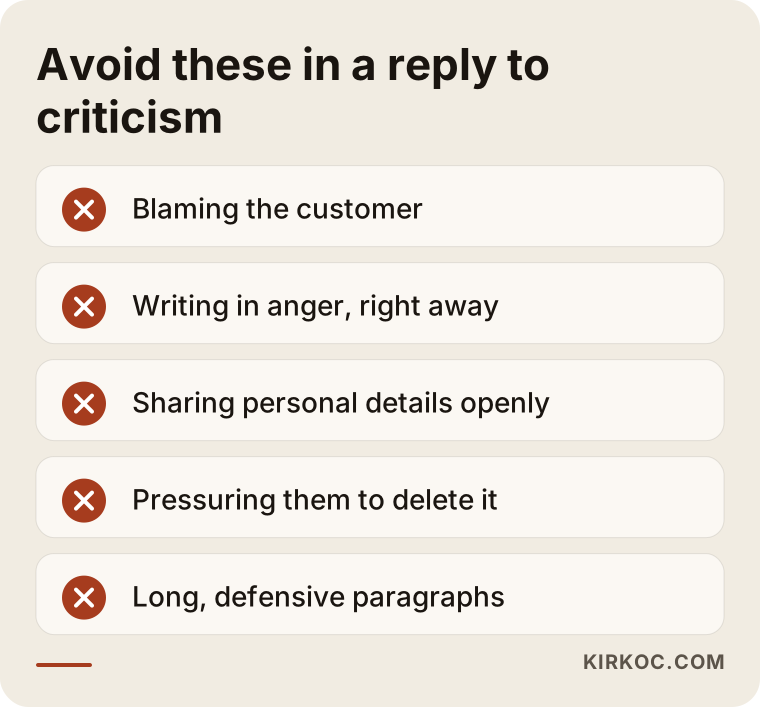
Every item on that list shows up again and again in replies written in anger. Blaming the customer, revealing personal details or pressuring someone to delete a review tells everyone who reads it how the business behaves when something goes wrong.
Unfair, fake or rule-breaking reviews
Sometimes a review is not based on a real experience. The writer may never have visited, a competitor may have posted it, or the text may include abuse or threats. There are two separate paths here, and they run side by side.
The first path is reporting the review to Google. From your business profile you can flag a review, and if it violates the platform's content policies it may be removed. But not every negative review breaks the rules. A review being harsh or unfair is not, by itself, a reason for removal. The decision belongs to Google and the timing is unclear. I cannot guarantee an outcome, and nobody honest can.
The second path is to write a calm reply for as long as the review stays up. A sentence like "We could not find a visit under this name in our records. If you would like to talk it through, please contact us" gives readers what they need without accusing anyone. If there is a legal side to the situation, such as defamation or harm to your reputation, I will not make claims about it. Please speak with a lawyer in your country.
Example scenario 1: a busy restaurant
This is a hypothetical example and does not describe a real business. Imagine a small-kitchen restaurant that is packed several days a week. The owner has not looked at reviews for two months, and around forty are sitting unanswered. Most are positive, and three complain about slow service.
My first job would be to sort the reviews into three groups: those that just need a thank-you, those that need an apology and those with special circumstances. The positive reviews get short replies that mention the dish or the location the guest wrote about. The service complaints get individual answers instead of one template, using whatever detail the guest gave. If the day is known, a reply might say, "Our kitchen was busier than expected that evening, and we are sorry for the wait." The reply ends with a phone number.
After that, a routine is set up for new reviews. The owner sees notifications on a phone, I prepare a draft, and the owner approves or edits it. This way the owner never feels that an outsider is speaking in their name, and the tone stays close to how they actually talk.
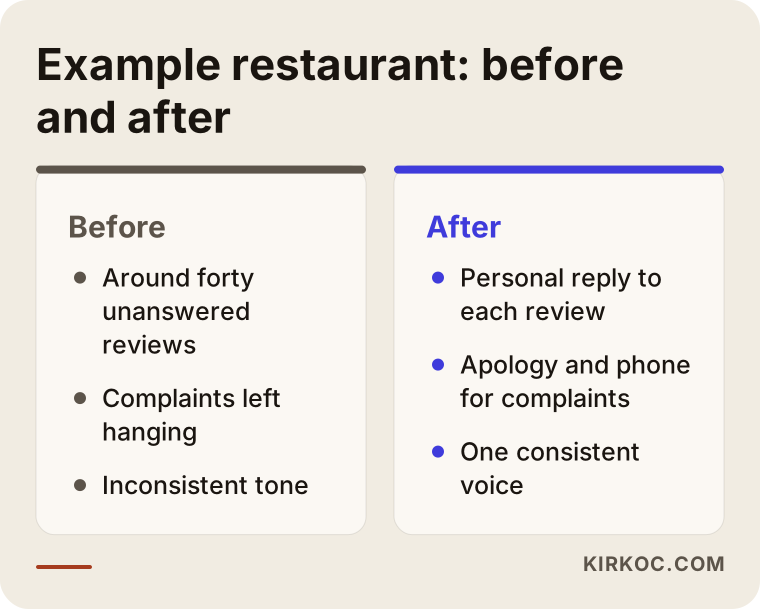
What matters in this comparison is that more than the number of replies changes. The tone becomes consistent, complaints are met in the open instead of ignored, and new reviews stop piling up.
Example scenario 2: a clinic that works by appointment
This one is hypothetical too. Picture a small healthcare practice that sees patients by appointment. Here the main issue is not speed but privacy. A patient might mention in a review what kind of procedure they had, and the practice should not confirm or repeat that in public.
For this kind of business, replies are deliberately general: "Thank you for your feedback, we appreciate hearing from you," followed by a general invitation to get in touch. No treatment, diagnosis or appointment details go into the reply. Even for a negative review the same rule holds, and the details are discussed in a private channel. I cannot tell you for certain what the rules in your country allow a practice to share. For businesses like this, I recommend having a lawyer review the reply templates.
There is also a scheduling question. The practice owner sees patients all day and has no time to check reviews. A weekly check at a fixed, agreed time works better than looking in on random days. If something urgent comes up, the owner is told separately.
This example shows that the same service works differently for each business. A warm and detailed tone suits the restaurant, while a measured, general tone is correct for the clinic.
Step by step: how the process works with me
I run the service in a simple pattern. My aim is not to be someone who keeps calling you for approval, but also not to let anything be written in your name without your knowledge.
First, I get access to your business profile. You give this by adding me as a manager from your own account, and you never have to share your password. Then I read all the existing reviews and sort them by type. Next I put together a tone guide just for your business: how people are addressed, which phrases are never used and which topics always need your approval. Once you approve that guide, the backlog of unanswered reviews gets replies. Finally, a routine is set for new reviews, covering who replies, how fast, and which reviews are sent to you first.
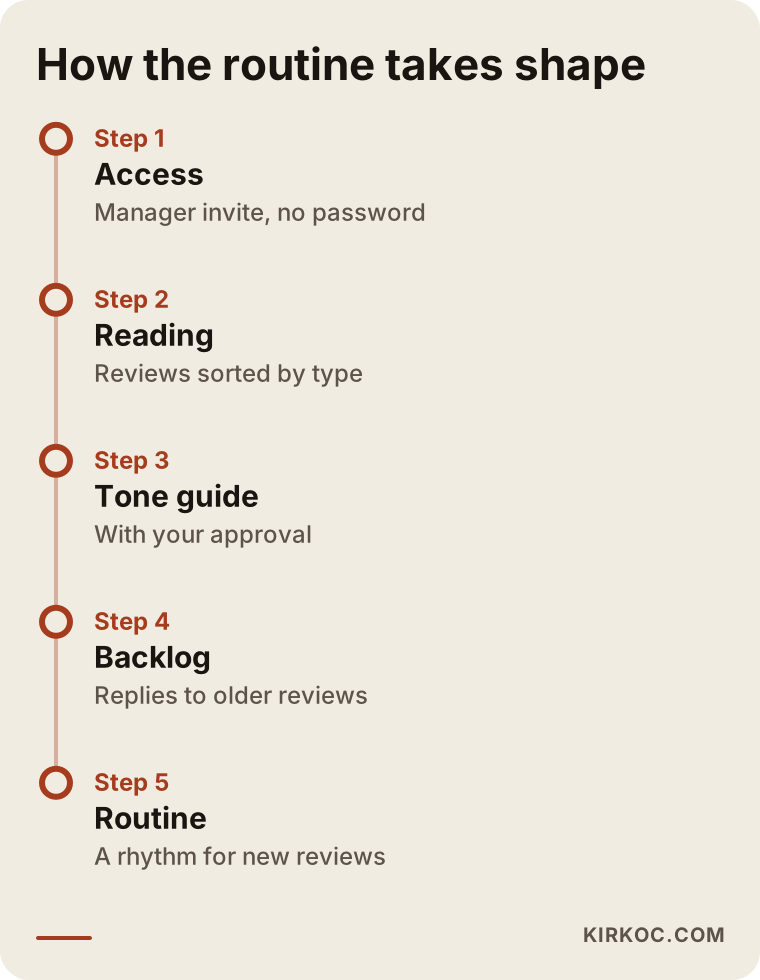
The timeline shows that setup takes only a few steps, but the real work is the steady part that follows. Managing reviews is not a one-time cleanup. It is a small habit.
What you can do yourself
You can start this job on your own, and in many cases I would suggest that you do. The short list below is enough for the first few weeks.
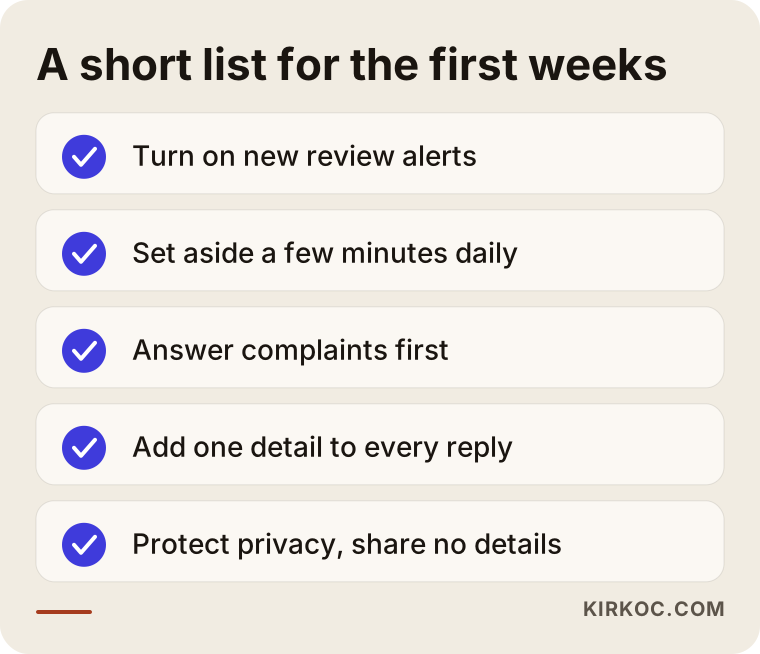
The list looks simple because it is simple. The hard part is doing it regularly. A few minutes a day spent checking new reviews is enough for most small businesses.
When to bring in a specialist
Outside help makes sense in a few situations: the number of reviews has grown beyond what you can keep up with, you have more than one location, harsh and unfair reviews are wearing you out, or the tone of your replies comes out inconsistent from time to time. In fields where privacy matters, such as healthcare, law or finance, there is less room for error, so support is worth even more.
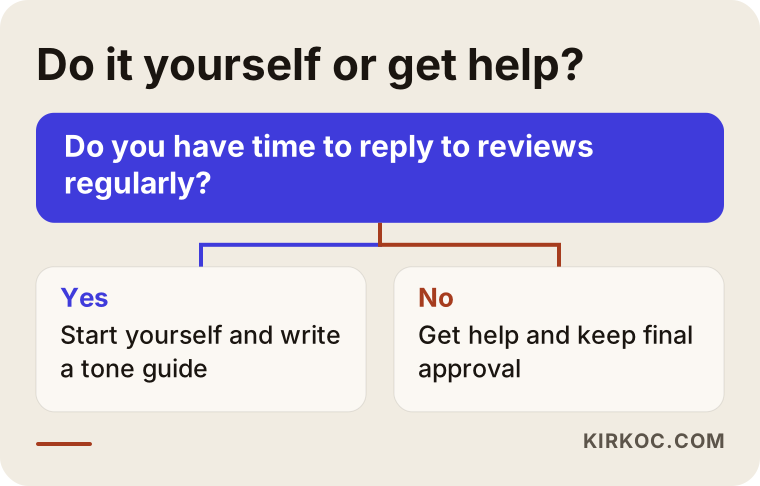
Apply the chart to your own situation. For most businesses the answer depends on the balance between the number of reviews and the time you can actually set aside.
Common mistakes
When I look at business profiles, the same mistakes come up again and again. Let me list them, because most are made without noticing.
The template reply is the most common. Pasting the same three sentences under every review saves time at first and loses trust in the long run. The second mistake is replying late. A reply written months afterward will not reach the reviewer, and to everyone else it looks careless. The third is keyword stuffing: putting your service name and area in every reply does not sound natural.
The fourth is trying to get a negative review deleted by pressuring the customer. Offering a discount or a gift in exchange for a positive review can also go against Google's rules, so check the current policy on the business profile help pages. The fifth is putting personal information in a reply. The sixth is writing a long, defensive answer to one person's harsh review. A long reply often makes a business look guilty.
How review replies connect to local SEO
I do not sell review replies as a stand-alone fix, because they are not one. The path to a customer choosing you has several steps, and replies are only one stretch of that path.
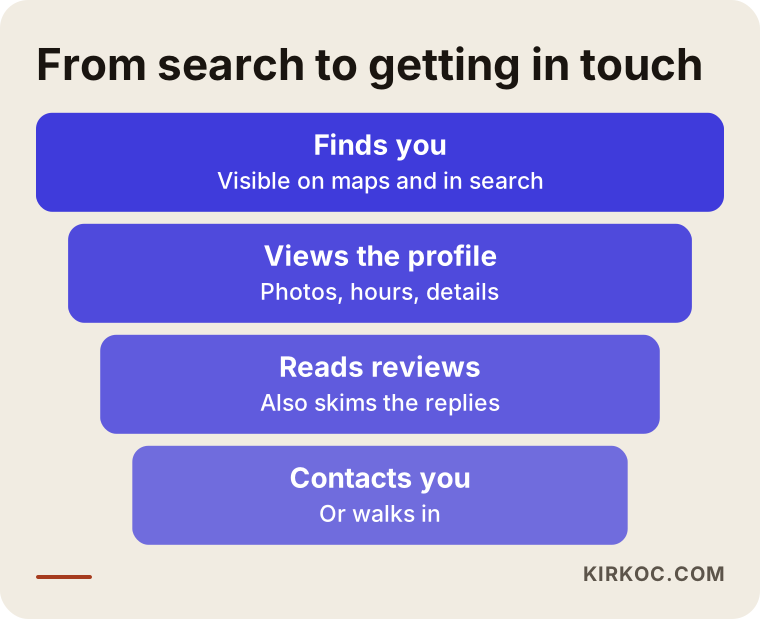
Look at the funnel and the picture is clear. A person finds you first, then views the profile, then reads the reviews and skims the replies, and finally calls or comes in. If your profile details are incomplete, if there are no photos or if your website is slow, even the best replies will not change the result.
This is where having everything handled by one person helps. When your review replies, the rest of your profile, your website, your social media accounts and any ads all speak in the same voice, the result is a consistent image. A business that sounds friendly in one place, formal in another and out of date in a third does not inspire confidence. When it is all with me, tone and information are managed in one place, and you do not have to explain the same things to several different people.
What decides the cost
I do not give numbers here, because the work varies a lot with the situation of the business. These are the main things that set the price.
First, the size of the backlog: a profile with hundreds of unanswered reviews needs more starting effort than a newly opened one. Second, how often new reviews arrive. A business that gets a review a day does not need the same routine as one that gets a review a week. Third, the number of locations, since each has its own profile and its own customers. Fourth, how sensitive the field is. Where privacy matters, each reply needs a closer look. Fifth, whether the service is only about writing replies or also covers the overall management of your profile and website.
When you ask for a quote, ask this: how many reviews, how often, in how many languages, and with whose approval? A fixed price given before those points are clear is usually either an incomplete service or an unnecessary expense.
How I work
I am a one-person specialist in Istanbul who covers everything a digital agency would do, in one pair of hands. Website design, e-commerce, SEO, local SEO, social media management, Google and Meta ads, logo design and content creation all sit with me. So when I write a reply to a review, I already know what your website says, what your ads promise and what tone you use on social media.
My way of working is simple. In a first conversation we go through your business and your current reviews, then I write down plainly what will be done and what will not. The topics that need your approval are agreed in advance. I do not guarantee results. I will not tell you your star rating will rise by a certain amount or that you will reach a certain position in search results. What I can promise is that replies will be regular, consistent and carefully written.
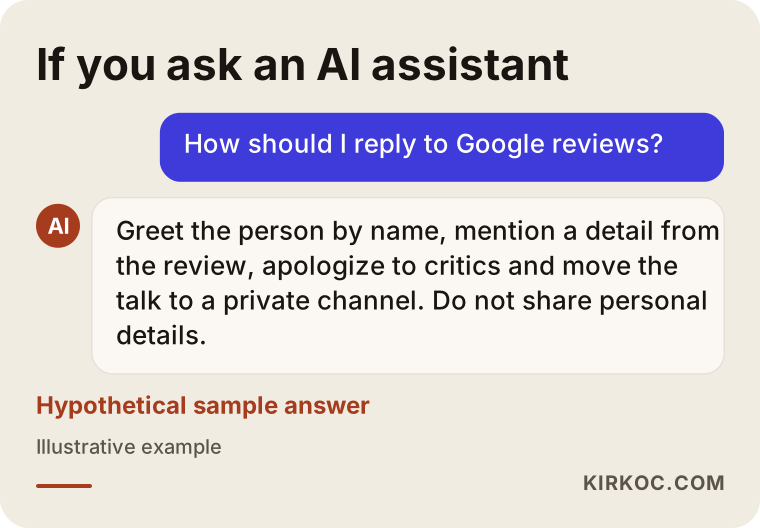
The last image is a hypothetical example of how an AI assistant might answer a question like this. The way people search keeps changing, but the basic rule stays the same: a business that is open, steady and truthful inspires trust. I cannot promise that any assistant will recommend you.
Frequently asked questions
Will replying to Google reviews raise my ranking?
I cannot promise any ranking increase. Nobody outside Google knows exactly which signal counts how much. What I can say with confidence is that answered reviews leave a better impression on people who look at your profile, and that may raise the chance they choose you.
Do I have to reply to every review?
It is not required, but in practice it helps. Reviews with text and negative reviews come first. A short thank-you is enough for a star rating with no text, and leaving a few unanswered is acceptable.
Can I report a negative review to Google and have it removed?
A review has a chance of being removed only if it breaks Google's content rules, for example abuse, threats, content that is off topic or clearly fake. Being harsh or unfair may not be enough. The decision belongs to Google and there is no set time for it.
Should I use keywords in my replies?
Sometimes, where it sounds natural. If your service name or area fits into a sentence without effort, that is fine. Stuffing the same words into every reply puts readers off and creates a pattern Google may treat as spam.
Is it a problem if someone else writes the replies for me?
With a tone guide agreed beforehand and an approval routine, the replies stay close to your own voice. In fields where privacy matters, I settle at the start which details never go into a reply. I cannot make firm statements about the rules in your country, and if needed I will ask you to consult a lawyer.
Can I offer a discount in exchange for a review?
Offering a discount or a gift in return for a positive review may break Google's rules. Asking a customer for an honest review is allowed, but promising something in return is risky. For the current rules, see Google's business profile help pages.
How do you handle businesses with several locations?
Every location has its own profile and its own customers, so I prepare one shared tone guide and add location-specific details to the replies. The brand keeps one voice while the experience stays local.
What do I need to get started?
Manager access to your business profile, a first conversation of a few minutes and a clear agreement on which topics need your approval. You do not need to share your password.
If you have a backlog of reviews, you are unsure about your reply tone, or you want to turn this into a steady habit, you can reach me through my local SEO services page and we can talk through your situation together.